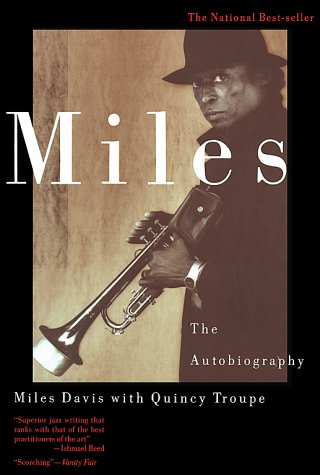
The Autobiography
MILES DAVIS with Quincy Troupe
MILES
 A TOUCHSTONE BOOK Published by Simon &
Schuster New York, London, Toronto, Sidney, Tokyo, Singapore
A TOUCHSTONE BOOK Published by Simon &
Schuster New York, London, Toronto, Sidney, Tokyo, Singapore
Touchstone
Rockefeller
Center
1230
Avenue of the Americas
New
York, New York 10020
Copyright © 1989 by Miles Davis
All
rights reserved
Including
the right of reproduction
in
whole or in port In any form.
First
Touchstone Edition September 1990
TOUCHSTONE
and colophon ore registered trademorks of Simon & Schuster Inc.
Designed
by Korolina Harris
Picture
section researched, edited and arranged bu Vincent Virgo
Manufactured
In the United States of America
Library of Congress Cataloging In Publication Data
Davis, Miles.
Miles, the
autobiography/Miles Davis with Quincy Troupe.-1st Touchstone ed. p. cm.
"A Touchstone
booh."
Includes index.
Discography: p
1. Dovis, Miles.
2. Jazz musicians-United States-Biography. 1. Troupe, Quincy. II. Title.
M1419.D39A3 1990 788.9'2165'092-dc20
[B] 90-37501
ISBN 0-671-63504-2 CIP ISBN 0-671
-72588-3 Pbh. MN
Prologue. 2
Chapter 1. 6
Chapter 2. 25
Chapter 3. 44
Chapter 4. 68
Chapter 5. 91
Chapter 6. 123
Chapter 7. 137
Chapter 8. 152
Chapter 9. 166
Chapter 10. 192
Chapter 11. 214
Chapter 12. 241
Chapter 13. 266
Chapter 14. 286
Chapter 15. 306
Chapter 16. 328
Chapter 17. 337
Chapter 18. 353
Chapter 19. 373
Chapter 20. 388
AFTERWORD.. 408
Discogrophy. 413
Index. 419
About the Authors. 455
Listen. The greatest
feeling I ever had in my life-with my clothes on-was when I first heard Diz and
Bird together in St. Louis, Missouri, back in 1944.1 was eighteen years old and
had just gradu-ated from Lincoln High School. It was just across the
Mississippi River in East St. Louis, Illinois.
When I heard Diz
and Bird in B's band, I said, "What? What is this!?" Man, that shit
was so terrible it was scary. I mean, Dizzy Gillespie, Charlie
"Yardbird" Parker, Buddy Anderson, Gene Ammons. Lucky Thompson, and
Art Blakey all together in one band and not to mention B: Billy Eckstine
himself. It was a motherfucker. Man, that shit was all up in my body. Music all
up in my body, and that's what I wanted to hear. The way that band was playing
music-that was all I wanted to hear.
It was something. And me up there playing with them.
I had already
heard about Diz and Bird, was already into their music-especially Dizzy's, with
me being a trumpet player and all. But I was also into Bird. See, I had one
record of Dizzy's called "Woody 'n You" and a record of Jay McShann's
with Bird on it called "Hootie Blues." That's where I first heard Diz
and Bird, and I couldn't believe what they were playing. They were so terrible.
Besides them I had one record of Coleman Hawkins, one record of Lester Young,
and one of Duke Ellington with Jimmy Blanton on bass that was a motherfucker,
too. That was it. Those were all the records
8
I had. Dizzy was my idol then. I used to try to play every solo Diz
played on that one album I had by him. But I liked dark Terry, Buck Clayton,
Harold Baker, Harry James, Bobby Hackett, and Roy Eldridge a lot, too. Roy was
my idol on trumpet later. But in 1944 it was Diz.
Billy Eckstine's band had come to St. Louis to play at a place
called the Plantation Club, which was owned by some white gangsters. St. Louis
was a big gangster town back then. When they told B that he had to go around to
the back door like all the other black folks, he just ignored the motherfuckers
and brought the whole band through the front door. Anyway, B didn't take no
shit off nobody. He would cuss and knock a motherfucker out at the drop of a
hat. That's right. Forget about the playboy look and air he had about himself.
B was tough. So was Benny Carter. They both would drop anybody they thought was
disrespecting them in a minute. But as tough as Benny was-and he was-B was
tougher. So these gangsters right there on the spot fired B and brought in
George Hudson, who had dark Terry in his band. Then B took his band across town
to Jordan Chambers' Riviera Club, an all-black club in St. Louis, located on
Delmar and Taylor-in a black part of St. Louis. Jordan Chambers, who was the
most powerful black politician back in them days in St. Louis, just told B to
bring the band on over.
So when word got around that they were going to play the Riviera
rather than the Plantation, I just picked up my trumpet and went on over to see
if I could catch something, maybe sit in with the band. So me and a friend of
mine named Bobby Danzig, who was also a trum-pet player, got to the Riviera and
went on in to try and catch the rehearsals. See, I already had a reputation
around St. Louis for being able to play by that time, so the guards knew me and
let me and Bobby on in. The first thing I see when I got inside was this man
running up to me, asking if I was a trumpet player. I said, "Yeah, I'm a
trumpet player." Then, he asked if I got a union card. I said, "Yeah,
I got a union card, too." So the guy said, "Come on, we need a
trumpet player. Our trumpet got sick." This guy takes me up on the
bandstand and puts the music in front of me. I could read music, but I had
trouble reading what he put in front of me because I was listening to what everybody
else was playing.
That guy who ran up to me was Dizzy. I didn't recognize him at
first. But soon as he started playing, I knew who he was. And like I said, I
couldn't even read the music-don't even talk about playing
-for listening to Bird and Diz.
9
But shit, I wasn't alone in listening to them like that, because the
whole band would just like have an orgasm every time Diz or Bird played-especially
Bird. I mean Bird was unbelievable. Sarah Vaughan was there also, and she's a
motherfucker too. Then and now. Sarah sounding like Bird and Diz and them two
playing every-thing! I mean they would look at Sarah like she was just another
horn. You know what I mean? She'd be singing "You Are My First Love"
and Bird would be soloing. Man, I wish everybody could have heard that shit!
Back then Bird
would play solos for eight bars. But the things he used to do in them eight
bars was something else. He would just leave everybody else in the dust with
his playing. Talk about me forgetting to play, I remember sometimes the other
musicians would forget to come in on time because they was listening to Bird so
much. They'd be standing up there on the stage with their mouths wide open.
Goddamn, Bird was playing some shit back then.
When Dizzy would
play the same thing would happen. And also when Buddy Anderson would play. He
had that thing, that style that was close to the style that I liked. So I heard
all that shit back in 1944 all at once. Goddamn, them motherfuckers was
terrible. Talk about cooking! And you know how they
were playing for them black folks at the Riviera. Because black people in St.
Louis love their music, but they want their music right. So you know what they were doing at the Riviera. You
know they were getting all the way
down.
B's band changed
my life. I decided right then and there that I had to leave St. Louis and live
in New York City where all these bad musicians were.
As much as I
loved Bird back then, if it hadn't been for Dizzy I wouldn't be where I am
today. I tell him that all the time and he just laughs. Because when I first
came to New York he took me every-where with him. Diz was funny back in those
days. He's still funny now. But back then he was something else. Like, he'd be
sticking his tongue out at women on the streets and shit-at white women. I
mean, I'm from St. Louis and he's doing that to a white person, a white woman.
I said to myself, "Diz must be crazy." But he wasn't, you know? Not
really. Different, but not crazy.
The first time
in my life I went on an elevator was with Diz. He took me up on this elevator
on Broadway somewhere in midtown Manhattan. He used to love to ride elevators
and make fun at every-one, act crazy, scare white people to death. Man, he was
something. I'd go over to his house, and Lorraine, his wife, wouldn't let
nobody
10
stay there too long but me. She would offer me
dinner all the time. Sometimes I'd eat and sometimes I wouldn't. I've always
been funny about what and where I eat. Anyway, Lorraine used to put up these
signs that said, "Don't Sit Here!" And then she'd be saying to Diz,
"What you doing with all them motherfuckers in my house? Get them out of
here and I mean right now!" So I would get up to leave, too, and she'd
say, "Not you, Miles, you can stay, but all the rest of them motherfuckers
got to go." I don't know what it was she liked about me, but she did.
It seems
people loved Dizzy so much they used to just want to be with him, you know? But
no matter who was around, Dizzy always took me every place he went. He would
say, "Come on, go with me, Miles." And we'd go down to his booking
office, or someplace else, or like I said, maybe ride in elevators, just for
the hell of it. He'd do all kinds of funny shit.
Like his
favorite thing was to go by where they first started broad-casting the
"Today" show, when Dave Garroway was the host. It was in a studio on
the street level, so people could watch the show from the sidewalk, looking
through this big plate glass window. Dizzy would go up to the window while the
show was on the air-they shot it live, you know-and stick out his tongue and
make faces at the chimpanzee on the show. Man, he would fuck with that
chimpanzee, J. Fred Muggs, so much, he would drive him crazy. The chimpanzee
would be screaming, jumping up and down and showing his teeth, and everybody on
the show would be wondering what the fuck got into him. Every time that
chimpanzee laid eyes on Dizzy, he'd go crazy. But Dizzy was also very, very
beautiful and I loved him and still do today.
Anyway,
I've come close to matching the feeling of that night in 1944 in music, when I
first heard Diz and Bird, but I've never quite got there. I've gotten close,
but not all the way there. I'm always looking for it, listening and feeling for
it, though, trying to always feel it in and through the music I play every day.
I still remember when I was just a kid, still wet behind the ears, hanging out
with all these great musicians, my idols even until this day. Sucking in
everything. Man, it was something.
The very first thing I remember in
my early childhood is a flame, a blue flame jumping off a gas stove somebody
lit. It might have been me playing around with the stove. I don't remember who
it was. Anyway, I remember being shocked by the whoosh of the blue flame
jumping off the burner, the suddenness of it. That's as far back as I can
remember; any further back than this is just fog, you know, just mystery. But
that stove flame is as clear as music is in my mind. I was three years old.
I saw that
flame and felt that hotness of it close to my face. I felt fear, real fear, for
the first time in my life. But I remember it also like some kind of adventure,
some kind of weird joy, too. I guess that experience took me someplace in my
head I hadn't been before. To some frontier, the edge, maybe, of everything possible.
I don't know;
I never tried to analyze it before. The fear I had was almost like an
invitation, a challenge to go forward into something I knew nothing about.
That's where I think my personal philosophy of life and my commitment to
everything I believe in started, with that moment. I don't know, but I think it
might be true. Who knows? What the fuck did I know about anything back then? In
my mind I have always believed and thought since then that my motion had to be
forward, away from the heat of that flame.
Looking back, I don't remember much of my first years-I never liked to
look back much anyway. But one thing I do know is that the
12
year after I was born a bad tornado hit St.
Louis and tore it all up. Seems like I remember something about that-something
in the bot-tom of my memory. Maybe that's why I have such a bad temper
sometimes; that tornado left some of its violent creativity in me. Maybe it
left some of its strong winds. You know, you need strong wind to play trumpet.
I do believe in mystery and the supernatural and a tornado sure enough is
mysterious and supernatural.
I was born
May 26, 1926, in Alton, Illinois, a little river town up on the Mississippi
River about twenty-five miles north of East St. Louis. I was named after my
father; he was named after his father. That made me Miles Dewey Davis III, but
everybody in my family called me Junior. I always hated that nickname.
My father
was from Arkansas. He grew up there on a farm that his father, Miles Dewey
Davis I, owned. My grandfather was a book-keeper, so good at what he did he did
it for white people and made a whole lot of money. He bought five hundred acres
of land in Arkan-sas around the turn of the century. When he bought all that
land, the white people in the area who had used him to straighten out their
financial matters, their money books, turned against him. Ran him off his land.
In their minds, a black man wasn't supposed to have all that land and all that
money. He wasn't supposed to be smart, smarter than them. It hasn't changed too
much; things are like that even today.
For most
of my life my grandfather lived under threats from white men. He even used his
son, my Uncle Frank, as a bodyguard to protect him from them. The Davises were
always ahead of the game, my father and grandfather told me. And I believed
them. They told me that people in our family were special people-artists,
business-men, professionals, and musicians-who played for the plantation owners
back in the old days before slavery was over. These Davises played classical
music, according to my grandfather. That's the rea-son my father couldn't play
or listen to music after slavery was over, because my grandfather said,
"They only let black people play in gin houses and honky-tonks." What
he meant was that they-the white people-didn't want to listen to no black folks
playing classical music anymore; they only wanted to hear them sing spirituals
or the blues. Now, I don't know how true this is, but that's what my father
told me.
My father
also told me my grandfather told him that whenever he got some money, no matter
where or who he got it from, to count it
13
and see if it was all there. He said you can't trust no one when it
comes to money, not even people in your family. One time my grand-father gave
my father what he said was $1,000 and sent him to the bank with it. The bank
was thirty miles away from where they lived. It was about 100 degrees in the
shade-summertime in Arkansas. And he had to walk and ride a horse. When my
father got down there to the bank, he counted the money and there was only
$950. He counted it again and got the same amount: $950. So he went on back
home, so scared he was just about ready to shit in his pants. When he got back
he went to my grandfather and said that he lost $50. So Grandpa just stood
there and looked at him and said, "Did you count the money before you
left? Do you know if it was all there?" My father said, no, he didn't
count the money before he left. "That's right," my grandfather told
him, "because I didn't give you nothing but $950. You didn't lose
anything. But didn't I tell you to count the money, anybody's money, even mine?
Here's $50. Count it. And then go ahead on back and put that money in the bank
like I told you." Now what you got to keep in mind about all of this is
that not only was the bank thirty miles away but it was hotter than a
motherfucker. It was cold of my grandfather to do that. But some-times you've
got to be cold like that. It was a lesson my father never forgot and he passed
it on to his kids. So today I count all
my money.
My father, like
my mother, Cleota Henry Davis, was born in 1900 in Arkansas. He went to
elementary school there. My father and his brothers and sisters didn't go to
high school, just skipped right over it and went straight to college. He
graduated from Arkansas Baptist College, from Lincoln University in
Pennsylvania, and from North-western University's College of Dentistry, so my
father received three degrees and I remember looking at them motherfuckers up
on his office wall after I got older and saying, "Goddamn, I hope he won't
ask me to do that." I also
remember seeing a picture some-where of his graduating class from Northwestern
and counting only three black faces there. He was twenty-four when he graduated
from Northwestern.
His brother,
Ferdinand, went to Harvard and some college in Ber-lin. He was a year or two
older than my father, and like my father, he skipped over high school. He went
straight into college after pass-ing the entrance exam with high scores. He was
a brilliant guy also;
used
to talk to me all the time about Caesar and Hannibal, and black history. He
traveled all over the world. He was more intellectual than
14
my father, and a ladies' man and player, editor of a magazine called
Color. He was so smart he made me feel almost dumb; he was the only
person I knew growing up who made me feel this way. Uncle Ferdinand was
something else. I loved being around him, hearing him talk and tell stories
about his travels, his women. And he was stylish as a motherfucker, too. I hung
around him so much that my mother would get mad.
My father got
out of Northwestern and married my mother. She played the violin and the piano.
Her mother had been an organ teacher in Arkansas. She never talked much about
her father, so I don't know much about her side of the family, never did, never
asked either. I don't know why that is. From what I have heard of them, though,
and the ones I did meet, they seemed to be middle class and a little uppity in
their attitudes.
My mother was a
beautiful woman. She had a whole lot of style, with an East Indian, Carmen
McRae look, and dark, nut-brown, smooth skin. High cheekbones and Indian-like
hair. Big beautiful eyes. Me and my brother Vernon looked like her. She had
mink coats, diamonds; she was a very glamorous woman who was into all kinds of
hats and things, and all my mother's friends seemed just as glamorous to me as
she was. She always dressed to kill. I got my looks from my mother and also my
love of clothes and sense of style. I guess you could say I got whatever
artistic talent I have from her
also.
But I didn't get along with her too well. Maybe it was because we
both had strong, independent personalities. We seemed to argue all the time. I
loved my mother; she was something else. She didn't even know how to cook. But,
like I said, I loved her even if we weren't close. She had her mind about the
way I should be doing things and I had mine. I was this way even when I was
young. I guess you could say I was more like my mother than my father. Although
I've got some of him in me, too.
My father settled first in Alton, Illinois, where me and my sister
Dorothy were born, then moved the family to East St. Louis, on 14th and
Broadway, where my father had his dental practice up over Daut's Drugstore. At first
we lived upstairs behind his office, in the
back.
Another thing I
think about with East St. Louis is that it was there, back in 1917, that those
crazy, sick white people killed all those black people in a race riot. See, St.
Louis and East St. Louis were-
15
and still are-big packing-house towns, towns where they slaughter
cows and pigs for grocery stores and supermarkets, restaurants and everything
else. They ship the cows and pigs up from Texas or from wherever else it is
that they come from and then they kill them and pack them up in St. Louis and
East St. Louis. That's what the East St. Louis race riot in 1917 was supposed
to be about: black workers replacing white workers in the packing houses. So,
the white work-ers got mad and went on a rampage killing all them black people.
That same year black men were fighting in World War I to help the United States
save the world for democracy. They sent us to war to fight and die for them
over there; killed us like nothing over here. And it's still like that today.
Now, ain't that a bitch. Anyway, maybe some of remembering that is in my
personality and comes out in the way I look at most white people. Not all,
because there are some great white people. But the way they killed all them
black people back then-just shot them down like they were out shooting pigs or
stray dogs. Shot them in their houses, shot babies and women. Burned down
houses with people in them and hung some black men from lampposts. Anyway,
black people there who survived used to talk about it. When I was coming up in
East St. Louis, black people I knew never forgot what sick white people had
done to them back in 1917.
My brother Vernon was born the year the stock market crashed and all
the rich white men started jumping out of them Wall Street windows. It was
1929. We had been living in East St. Louis for about two years. My older
sister, Dorothy, was five. There was just three of us, Dorothy, Vernon, and me
in the middle. We have always been close all our lives, my sister and my
brother, even when we are arguing.
The neighborhood was very nice, with row houses, something like the
ones they have in Philadelphia or Baltimore. It was a pretty little city. It's
not like that anymore. But I remember it was that way back then. The
neighborhood was also integrated, with Jews and Germans and Armenians and
Greeks living all around us. Catercomer across the street from the house was
Golden Rule's Grocery Store, owned by Jews. On one side was a filling station,
with ambulances coming in all the time, sirens blasting, to fill up with gas.
Next door was my father's best friend. Dr. John Eubanks, who was a physician.
Dr. Eubanks was so light he almost looked white. His wife. Alma, or Josephine,
I forget which, was almost white, too. She was a fine lady,
16
yellow, like Lena Home, with curly black, shiny hair. My mother
would send me over to their house to get something and his wife would be
sitting there with her legs crossed, looking finer than a motherfucker. She had
great legs and she didn't mind showing them either. As a matter of fact she
looked good everywhere! Anyway, Uncle Johnny-that's what we called her husband,
Dr. Eubanks- gave me my first trumpet.
Next to the drugstore under us, and before you got to Uncle John-ny's
house, was a tavern owned by John Hoskins, a black man who everybody called
Uncle Johnny Hoskins. He played saxophone in the back of his tavern. All the
old-timers in the neighborhood went there to drink, talk, and listen to music.
When I got older, I played there once or twice. Then there was a restaurant
owned by a black man named Thigpen down the block. He sold good soul food; the
place was real nice. His daughter Leticia and my sister, Dorothy, were good
friends. Next to the restaurant was a German lady who owned a dry goods store.
This was all on Broadway going toward the Missis-sippi River. And there was the
Deluxe Theatre, a neighborhood movie theater on 15th going toward Bond Street,
away from the river. All along 15th paralleling the river toward Bond were all
kinds of stores and places like that owned by blacks, or Jews, or Germans, or
Greeks, or Armenians, who had most of the cleaning places.
Over on 16th and Broadway this Greek family owned a fish market and
made the best jack salmon sandwiches in East St. Louis. I was friends with the
son of the guy who owned it. His name was Leo. Everytime I'd see him, as we got
bigger, we'd wrestle. We were about six. But he died when the house he lived in
burned down. I remember them bringing him out on a stretcher with his skin all
peeling off. He was burnt like a hot dog when you fry it. It was grotesque,
horrible-looking shit, man. Later, when somebody asked me about that and
whether Leo said anything to me when they brought him out, I remember saying,
"He didn't say, 'Hello, Miles, how you doing, let's wrestle,' or nothing
like that." Anyway, that was shocking to me because we were both around
the same age, though I think he was a little older. He was a nice little cat. I
used to have a
lot of fun with him.
The first school I went to was John Robinson. It was located on 15th
and Bond. Dorothy, my sister, went one year at a Catholic school, then
transferred over to John Robinson, too. I met my first best friend in the first
grade there. His name was Millard Curtis, and
17
for years after we met we went almost everywhere together. We were
the same age. I had other good friends in East St. Louis later, as I got more
into music-musician friends-because Millard didn't play music. But I knew him
the longest and we did so many things together that we were almost like
brothers.
I'm pretty sure
Millard came to my sixth birthday party. I remem-ber this birthday party
because my boys, guys I was hanging out with at the time, said to me, let's go
hang out on the runway-the wooden scaffolding that runs across sign boards,
them billboards that have them ads all pasted over them. We would go and climb
up on them, sit on the scaffolds with our feet dangling down in the air and eat
crackers and potted ham. Anyway, my boys told me we might as well go do this
because later I was having a birthday party, so wasn't none of them going to
school that day. See, it was supposed to be a sur-prise birthday party, but all
of them knew it and told me all about what was happening. Anyway, I think I was
six; I could have been seven. I remember this cute little girl named Velma
Brooks being at the party. Her and a whole lot of other pretty little girls
with short dresses, like miniskirts, on. I don't remember any little white
girls and boys being there; there might have been some-maybe Leo be-fore he
died and his sister, I don't know-but I don't remember any being there.
The real reason I remember that party was because I
got my first kiss from a little girl there. I kissed all the little girls, but
I remember kissing Velma Brooks the longest. Man, was she cute. But then my
sister, Dorothy, tried to ruin everything by running and telling my mother that
I was in there kissing all over Velma Brooks. My sister did this to me all my
life; she was always telling on me or my brother Vernon about something. After
my mother told my father to go in there and stop me from kissing on Velma, he
said, "If he was kissing on a boy like Junior Quinn, now that would be
something to tell. But kissing on Velma Brooks ain't nothing to tell; that's
what the boy supposed to be doing. So as long as it ain't Junior Quinn he's
kissing on, then everything's cool."
My sister left
in a huff with her mouth stuck out, saying over her shoulder, "Well, he's
in there kissing on her and somebody ought to stop him before he give her a
baby." Later, my mother told me that I had been a bad boy kissing all over
Velma and that I shouldn't do that and if she had it to do all over again that
she wouldn't have had no son like me who was so bad. Then she slapped the shit
out of me.
18
I never forgot that day. At that
age, I used to remember feeling that nobody liked me, because they always
seemed to be whipping on me for something, but they never beat on my brother
Vernon. I mean, his feet hardly ever touched the floor. He was like a little
black doll for my sister and my mother and everybody else. They spoiled the
shit out of him. Every time Dorothy had her friends over, they would bathe him,
comb his hair, and dress him up just like he was a little baby girl doll.
Before I
was into music I was really into sports-baseball, football, basketball,
swimming, and boxing. I was a small, skinny kid, with the skinniest legs
anybody ever had-my legs stayed skinny until today. But I loved sports so much
I couldn't be intimidated or scared by people bigger than me. I ain't never
been the scaredy type, never was. And if I liked someone 1 liked them, no
matter what. But if I didn't like you, I didn't like you. I don't know why that
is but that's the way I am. That's the way I've always been. For me, it's
always been a vibe thing, a spiritual thing, whether I like someone or not.
Like people say that I'm arrogant, but I've always been the way I am;
I haven't changed that much.
Anyway, Millard and I would always be looking
to find a game of football or baseball to play. We'd play a game called Indian
ball, too, which was a kind of baseball game played with three or four guys to
a team. If we weren't playing this, we were
playing regular baseball on some vacant lot or baseball diamond. I played
shortstop and could play my ass off. I could really field the ball and I was a
pretty good hitter, though I didn't hit too many home runs because of my small
size. But man, I loved baseball, and swimming and football and boxing.
I remember we used to play tackle football on
the little plots of grass in between the sidewalk and the curb. This was on
14th Street in front of Tilford Brooks's house, who later got a Ph.D. in music
and lives in St. Louis today. Then we'd go over and play in front of Mil-lard's
house. Man, we'd be getting tackled and falling on our heads and busting them
wide open and bleeding like butchered hogs. Scar-ring up our legs and giving
our mothers fits. But it was fun, man, it
was a lot of fun.
I liked to swim, I loved to box. Even today those are the favorite
sports I like to do. I would swim every chance I got then, and I swim every
chance I get now. But boxing was and is my heart. I just love it. I can't
explain why. Man, I would listen to all of Joe Louis's fights
19
like everybody else. We'd be all crowded
around the radio waiting to hear the announcer describe Joe knocking some
motherfucker out. And when he did, the whole goddamn black community of East
St. Louis would go crazy, celebrate in the streets, drinking and danc-ing and
making a lot of noise. But it was joyful noise. And they did the same thing-but
not as loud-when Henry Armstrong won, be-cause he was from across the river,
from St. Louis, so that made him a black local, a hometown hero. But Joe Louis
was the man.
Even though I loved boxing, I didn't get into
fights when I was young. We would body punch, you know, hit each other in the
chest, but nothing more serious than that. We were just like every other normal
bunch of kids, growing up and having fun.
But there were gangs all around East St.
Louis, bad gangs like the Termites. And they had some real bad ones over in St.
Louis. East St. Louis was a rough place to grow up in, because you had a lot of
cats, black and white, who didn't take no shit off nobody. I wasn't into
fighting until I got to be a teenager. I wasn't into no gangs when I was
growing up because I was into music so much. I even stopped playing sports
because of music. Now, don't get me wrong, I used to fight with motherfuckers
and shit, especially when they called me Buckwheat, because I was little,
skinny and dark. I didn't like that name, so if anybody called me that they had
to fight. I didn't like the name Buckwheat because I didn't like what the name
meant, what it represented, that stupid Our Gang
bullshit image white people had about black people. I knew/wasn't like that,
that I came from people who were somebodies and that whenever anybody called me
by that name they were trying to make fun of me. I knew even way back then that
you've got to fight to protect who you are. So, I'd fight a lot. But I never
was in no gangs. And I don't think I'm arrogant, I think I'm confident of
myself. Know what I want, always have
known what I wanted for as long as I can remember. I can't be intimidated. But
back then, when I was growing up, everybody seemed to like me, even though I
didn't talk too much; I still don't like to talk too much now.
It was
even tough in the schools as well as out in the streets. They had an all-white
school up the street from where I lived, Irving School, I think it was called,
that was clean as a whistle. But couldn't no black kids go there; we had to go
past it to get to our school. We had good teachers, like the Turner sisters at
John Robinson where I went. They were the great-granddaughters of Nat Turner
and they
20
were
race-conscious just like he was. They taught us to have pride in ourselves. The
teachers were good, but the black schools were all fucked up, with running
toilets and things like that. They stunk like a motherfucker, man, like open
cesspools in Africa where poor peo-ple live. I mean that shit made me not want
to eat while I was going to elementary school, made me sick to my stomach then-and
now whenever I think about it. They treated us black kids like we was just a bunch
of cattle. Some people I went to school with say it wasn't this bad, but that's
the way I remember it.
That's why I used to love to go to my grandfather's place in Arkan-sas.
Down there out in the fields, man, you could walk with your shoes off and you
wouldn't step into no pile of shit and get it all running and sticky and funky
all over your feet, like in elementary school.
My mother was always-it seems now-putting me, my brother, and my
sister on trains when we were real young to go visit my grandfather. She pinned
name tags on us, gave us boxes of chicken, and put us on the train. And man,
that chicken was gone soon as the train left the station. Then we'd starve all
the way to wherever we were going. We always ate up the chicken too fast. Never
did stop doing that. Never did learn to eat that chicken slowly. It was so good
we couldn't wait. We'd be crying all the way to my grandfather's house, hungry
and mad. Soon as we got to his place, I always wanted to stay. My grandfather
gave me my first horse.
He had a fish farm down in Arkansas. We would catch fish all day
long, buckets of them, tubs of them. Man, we ate fried fish all day long, and
talk about good? Shit, that fish was a motherfucker. So, we'd run around all
day. Ride horses. Go to bed early. Get up early. And do the same thing all over
again. Man, it was fun being on my grandfather's farm. My grandfather was about
six feet tall, brown-skinned with big eyes; looked something like my father,
only taller. My grandmother's name was Ivy, and we called her Miss Ivy.
I remember getting into all kinds of things there you couldn't get
into back in a town like East St. Louis. One time me and my Uncle Ed, my
father's youngest brother, who was a year younger than me, went out one morning
busting up nearly all of Grandpa's watermel-ons. We went from one watermelon
patch to another and busted up every watermelon we could find. We took the
heart, the center, out of them, ate some, but mostly left all the rest behind.
I think I was ten and he was nine. Later, back in the house, we laid up
laughing
21
like two motherfuckers. When Grandpa found out, he told me,
"You can't ride your horse for a week." That
cured me forever of busting up watermelons. Like my father, my grandfather was
something else, didn't take no shit off no one.
When I was about
nine or ten I got me a paper route and started delivering papers on weekends to
make some extra money. Not that I needed it, because my father by now was
making a whole lot of money. I just wanted to make my own money and not have to
ask my parents for anything. I've always been like that, always been inde-pendent,
always wanted to make it on my own. I didn't make much, maybe sixty-five cents
a week, but it was mine. I could buy me some candy. I kept a pocketful of candy
and a pocketful of marbles. I would trade candy for marbles and marbles for
candy, soda, and chewing gum. Somehow I learned back then that you've got to
make deals- and I don't really remember who I learned it from, but it could
have been from my father. In the middle of the Depression, I remember a lot of
people were hungry and poor. But not my family, because my father was taking
care of the money side.
I used to deliver papers to the best barbecue man in East St. Louis,
old man Piggease. His place was located around 15th and Broadway, where they
had all the rest of those businesses. Mr. Piggease had the best barbecue in
town because he'd get the fresh meat from them packing houses in St. Louis and
East St. Louis. His barbecue sauce was just outta sight. Man, that shit was so
good I can taste it now. Nobody made barbecue sauce like Mr. Piggease, nobody,
then or now. Nobody knew how he made his sauce, nobody knew what he put in it.
He never told nobody. Then, he made this dip for the bread and that was a motherfucker,
too! Plus fish sandwiches that were outta sight. His jack salmon sandwiches
eventually got as good as my friend Leo's father's.
Mr. Piggease didn't have nothing but a shack that he sold his bar-becue
out of. Only about ten people could get in there at any one time. He had his
barbecue grill laid with bricks, made it himself. He also built the chimney and
you could smell that charcoal smoke all over 15th Street. So everybody got
themselves a sandwich or one of those bad small ends of barbecue before the day
was out. The stuff was ready about six o'clock; he had it all cooked and done.
I'd be there at six on the dot, giving him his paper, the Chicago Defender or the Pittsburgh Courier, both black newspapers. I'd give him both of those papers and
he'd give me two pig snouts; pig snouts cost
22
fifteen
cents apiece. But because Mr. Piggease liked me, thought I was smart, he'd let
me slide for the dime and sometimes throw in an extra pig snout, or pig ear
sandwich-that's where he got his nick-name "Mr. Pig Ears"-or rib tip,
whatever he felt like giving me that day. Sometimes he'd throw in a piece of
sweet potato pie or candied yams and a drink of milk. So, he put that shit on
paper plates, which would absorb all that fucking great flavor, in between slices
of that funky, tasty bread he got from the bakery. Then, he'd wrap it all up in
newspapers, yesterday's newspapers. Man, that was good. Ten cents for a jack
salmon, fifteen cents for a snout. So I'd get my shit' and sit down and talk to
him for a while, with him behind the counter, dealing with everybody. I learned
a lot from Mr. Piggease, but mainly he taught me-along with my father-to avoid
unneces-sary bullshit.
But I learned the most from my father. He was something else. He was
a good-looking guy, about my height but a little bit on the plump side. As he
got older, he began to lose his hair-which fucked with his head a little bit,
in my opinion. He was a well-bred man, liked nice things, clothes and cars,
just like my mother.
My father was pro-black, very pro-black. Back in those days some-one
like him was called a "race man." He was definitely not an
"Uncle Tom." Some of his African classmates at Lincoln University,
like Nkrumah of Ghana, became presidents of their countries, or high up in
their country's governments. And so my father had these connections over in
Africa. He liked Marcus Garvey more than the politics of the NAACP. He felt
that Garvey was good for the black race, because he got all those black people
together back in the 1920s. My father thought that was important and hated the
way people like William Pickens of the NAACP thought and talked about Garvey.
Pickens was a relative, an uncle, I think, of my mother's, and sometimes when
he was passing through St. Louis he would call her up and come over. At the
time I think he was high up in the NAACP, a secretary or something. Anyway, I
remember him calling up to come by one time and when my mother told my father,
he said, "Fuck William Pickens, because the son of a bitch never did like
Marcus Garvey and Marcus Garvey didn't do anything other than get all those
black people together to do something for themselves, and that's the most black
people have ever been together in this country. And this cocksucker is opposed
to him. So fuck the motherfucker, fuck him and all his stupid ideas."
23
My mother was different; she was all for the uplifting of the black
race, but she saw it like somebody in the NAACP would see it. She thought that
my father was too radical, especially later when he started getting into
politics. If I got my sense of style and clothes from my mother, I think I got
most of my attitude, my sense of who I was, my confidence and race pride from
my father. Not that my mother wasn't a very proud person, she was. But most of
it I picked up from my father, the way I looked at certain things.
My father didn't
take no shit off nobody. I remember one time when this white man came by his
office for something. He was the one who sold my father gold and stuff. Anyway,
my father's office was real crowded when this white man comes in. Now, my
father had a sign behind the reception desk that read, "Do Not
Disturb," which he used when he was working on somebody's mouth. The sign
was up, but the white man, after waiting about a half an hour, says to me-I was
about fourteen or fifteen, working the receptionist's desk that day-"I
can't wait any longer, I'm going on in." I say to him, "The sign says
'Do Not Disturb,' can't you see what the sign says?" The man just ignores
me and goes on in to my father's office where he does the teeth. Now, the
office is full of black people who know
my father don't tolerate that kind of shit. So, they just kind of smile and lay
back, to see what was going to happen. No sooner did the gold man get into my
father's office when I hear my father say to him, "What the fuck are you
doing in here? Can't you read, mother-fucker? You dumb white motherfucker! Get
the fuck on out of here!" The white man came on out of there quick,
looking at me like I was crazy or something. So I told the motherfucker as he
was going out the door, "I told you not to go in there, stupid." That
was the first time I ever cussed a white man who was older than me.
Another time my
father went looking for a white man who had chased me and called me a nigger.
He went looking for him with a loaded shotgun. He didn't find him, but I hate
to think of what would have happened if he had. My father was something. He was
a strong motherfucker, but he was weird in the way he looked at things, too.
Like he wouldn't cross certain bridges going from East St. Louis to St. Louis
because he said he knew who built them, said they were thieves and that they
probably didn't build the bridges very strong because they were likely cheating
on the money and the building materials. He actually believed that them bridges
would fall into the Mississippi one day. And to the day he died he believed
this was so
24
and
was always puzzled by the fact that they never did fall. He wasn't perfect. But
he was a proud man and was probably way ahead of his time for a black man.
Shit, he even liked to play golf way back then. I used to caddy for him over on
the golf course in Forest Park in St. Louis.
He was one of
the pillars of the black community in East St. Louis, because he was a doctor and
got into politics. Him and Dr. Eubanks, his best friend, and a few other
prominent black men. My father carried a lot of weight and influence in East
St. Louis while I was growing up. So some of his importance was carried over to
his kids and that's probably why a lot of people-black people-in East St. Louis
treated my brother and sister and me as if we were kind of special. Now, they
didn't kiss our asses or nothing like that. But they did treat us most times
like we were different. They expected us to make something important of
ourselves. I guess this kind of special treatment helped us have a positive
attitude about ourselves. This kind of thing is important for black people,
especially young black people-who mostly hear all kinds of negative things about
them-selves.
My father was a strict man when it came to discipline.
He made us all aware that we had to keep our shit together. I think I got my
bad temper from him. But he never, ever whipped me. The maddest he ever got
with me was once when I was about nine or ten and he had bought me a bike, I
think my first bike. So me being mischievous, I used to ride the bike off the
stairs. We were still living on 15th and Broadway, and hadn't yet moved to the
house at 17th and Kansas. Anyway, I rode my bike down these real high stairs
and had a curtain rod in my mouth. I was going so fast that I couldn't stop and
ran into the front door of the garage behind our house. The curtain rod jammed
back into my mouth and busted it wide open. Well, when he found out what had
happened he got so mad I thought he was going to kill me.
Another time that he got very mad with me was when I
set fire to the shed, or the garage, and almost burned the house down. He
didn't say nothing, but if looks could kill I would have been dead. Then later
when I got older and thought I knew how to drive, I backed the car all the way
across the street and ran it into a tele-phone pole. Some of my friends had
been teaching me how to drive, but my father wouldn't let me practice, because
I didn't have a li-cense. And me being like I was-headstrong-I wanted to see if
I
25
could drive. When he found out about my crashing the car, he didn't
do nothing but shake his head.
The funniest
thing I can remember happening when I did some-thing wrong was when he took me
over to St. Louis and bought me all of these clothes. I think I was about
eleven or twelve and I was just getting into clothes. Anyway, it's Easter time
and my father wants me and my sister and brother to look good in church. So he
takes me over to St. Louis and buys me a pleated, gray double-breasted suit;
some Thom McAn boots; a yellow, striped shirt; a hip beanie cap; and a leather
change purse that he put thirty pennies in. Now I know I'm clean, right?
When we get back
home my father goes upstairs to get something from his office. I got these
thirty pennies burning a hole in the new change purse he just bought me. Now,
you know I've just got to spend this money-hip and clean as I am, right? So I
go into Daut's Drug-store and tell Mr. Dominic, the owner, to give me
twenty-five cents' worth of them juicy chocolate soldiers-my favorite candy at
that time. You could get three chocolate candy soldiers for a penny, so he
sells me seventy-five of them. Now I got my big bag of candy, and I'm standing out
in front of my father's office, sharp as a tack, and I'm eating the candy
soldiers faster than nobody's business. I ate so many of them I got sick and
just started spitting them out. My sister, Dor-othy, sees me and thinks I'm
spitting up blood, and runs and tells my father. So he comes downstairs and
says, "Dewey, what are you doing? This is my place of business. People
come to see me here and they'll think that I done killed somebody, think all
this chocolate is dried-up blood, so get upstairs."
Another time
around Easter, the next year, I think it was, my father bought me an outfit to
go to church, a blue suit with short pants and socks. Along the way while me
and my sister was going there, I saw some of my boys playing in the old factory
house. They asked me to join them and I told my sister that I'd catch up with
her. I went on in that factory house and all of a sudden it's so dark in there
I can't see. I trip, fall, and I'm crawling around. I fall into this puddle of
dirty water with my good new clothes on. And it's Easter. You know how I felt.
So, I didn't go to church. I just went back home and my father didn't do
anything. But he did tell me that if I so much as "ever stumble again like
that, and you're not supposed to stumble, I'm going to kick your motherfucking
ass." So that stopped me from doing really silly shit like that again. He
said, "That could have been
26
acid
or anything you fell in. You could have been dead, going in a strange dark
place like that. So don't you ever do it again." And I didn't.
Because it
wasn't so much the clothes he was concerned about. It didn't bother him that I
ruined them. It was me he was worried about. I never forgot that, that he was
only concerned about me. So we always got along well. He was always behind me
100 percent, whatever I wanted to do, and I believe that his confidence in me
made me have confidence in myself.
But my mother would whip the shit out of me at the drop of a hat.
She was into whipping so much that one time, when she couldn't do it because
she was sick or something, she told my father to do it. He took me into a room,
closed the door, and told me to scream like he was beating me. "Make some
noise, like you're getting beat," I re-member him saying. And then me
screaming at the top of my lungs and him sitting there looking at me all
steely-eyed. That was some funny shit, man. But now that I think about it, I
would have almost preferred his whipping me to the way he used to look right
through me like I was nothing. When he did that he made me feel like I was nothing. That feeling was worse
than a whipping could ever have been.
My mother and
father never did get along well. They saw most things through different eyes.
They had been at each other's throats since I was a little kid. The only thing I
ever saw that really connected them up was later when I got my bad heroin
habit. When that hap-pened, they seemed to forget their differences and pulled
together to try to save me. Other than that time, they always seemed to me to
be fighting like cats and dogs.
I remember my mother picking up things and throwing them at my
father and saying all kinds of off-the-wall, nasty things to him. Some-times he
would get so mad that he'd also pick up something and throw it at her, whatever
he could get his hands on-a radio, the dinner bell, anything. And she'd be
screaming, "You're trying to kill me, Dewey!" I remember one time
after an argument my father had gone outside to cool himself out. When he came
back my mother wouldn't open the door and let him back in-he had forgotten his
key. He was standing out there screaming for her to open the door, and she
wouldn't. It was one of those glass doors that you could see through. He got so
mad with her he punched her right in the mouth through the glass. He knocked a
couple of teeth right out of her
27
mouth. They were best apart, but they gave each other grief until
they finally got divorced.
I think part of their problem was that they had
different tempera-ments. But it wasn't only that. They developed a typical
doctor-wife relationship in that he was seldom ever at home. It didn't bother
us kids too much because we were always doing something. But I think it
bothered her a lot. And then when he got into politics he was there even less.
Plus, they always seemed to be arguing about money, even though my father was
considered wealthy. At least, he was for a black man.
I remember when
he ran for State Representative of Illinois. He was running because he wanted
to put a fire department out where he had his farm in Millstadt. Some white
people wanted to give him money not to run, but he ran anyway and lost. My
mother got on him for not taking the money. She said that they could have used
that money to go on a vacation or something. Plus, she was mad at him later for
losing most of his fortune gambling; my father lost over a million dollars
gambling like he did. And she never did like all that radical political shit my
father was into. But after they broke up she told me later that if she had it
to do all over again, she would have treated my father differently. But by
then, it was way too late.
None of our
parents' problems seemed to affect the fun that me, my sister, and my brother
were having, although looking back I guess it really did. It had to affect us
somehow, although I don't really know how. I just thought it was a drag to
watch them fighting all the time. Like I said, my mother and I didn't get along
too well and so I guess I blamed her for all the problems. I know my father's
sister, Corrine, blamed her; she never did like my mother.
My Aunt Corrine
had a lot of money and shit, but everybody thought she was weirder than a
motherfucker. I did too. But they were close, my father and his sister. And
even though she was against my father marrying my mother, people said that when
they got married my aunt said, "Lord, help that poor woman. Because she
don't know the trouble she's getting into."
Aunt Corrine was
a doctor of metaphysics or something like that. She had her office right next
to my father's. There was a sign out in front saying "Dr. Corrine, Reader,
Healer," with an open palm facing the viewer. She told people's fortunes.
She'd be in her office lighting all them candles and shit and smoking them
cigarettes. Man, she'd be up in her office behind all those clouds of smoke,
talking weird
28
shit.
People were scared of her; some thought she was a witch, or some kind of voodoo
queen. She liked me. But she must have thought that I
was weird, because as soon as I walked in her office she started
lighting those candles and smoking cigarettes. Ain't that a bitch; she thought I was weird.
All of us kids-my brother and my sister and me-liked artistic things
when we were young, especially Vernon and me, but Dorothy, too. When I was
growing up-before I really got into music-me and Dorothy and Vernon used to
have our own talent shows. We were still living on 15th and Broadway when we
started. I think I was about nine or ten. Anyway, I was just beginning to play
trumpet, just getting into it. As I said, Uncle Johnny had given it to me. So,
I would play trumpet-as much as I could play back then-and Dorothy would play
piano. Vernon would dance. We had a lot of fun. Dorothy could play a few church
songs. But other than that, she couldn't play. Mostly we would do little skits-funny
shit, you know-talent shows with me being the judge. Man, I was hard on them.
Vernon could always sing, draw, and dance. So, he'd be singing and Dorothy
would be dancing. By this time my mother was sending her to dancing school.
Anyway, that's the kind of shit we was doing. But as I got older, I got more
serious, especially about my playing music.
The first time I really paid attention to music was when I used to
listen to a radio show called "Harlem Rhythms." I was about seven or
eight. The show used to come on at fifteen minutes to nine every day, so I was
late to school a lot because I was listening to that program. But I had to hear
that show, man, had to. Most of the time they played black bands, but sometimes
when they had a white band on I would cut it off, unless the musician was Harry
James or Bobby Hackett. But that program was really great. It had all them
great black bands on there and I remember being fascinated by hearing the
records of Louis Armstrong, Jimmie Lunceford, Lionel Hampton, Count Basie,
Bessie Smith, Duke Ellington, and a whole bunch of other bad motherfuckers on
that program. Then when I was nine or ten I started taking some private music
lessons.
But before the lessons, I also remember how the music used to sound
down there in Arkansas, when I was visiting my grandfather, especially at the
Saturday night church. Man, that shit was a moth-erfucker. I guess I was about
six or seven. We'd be walking on these dark country roads at night and all of a
sudden this music would seem to come out of nowhere, out of them spooky-looking
trees that
29
everybody
said ghosts lived in. Anyway, we'd be on the side of the road-whoever I was
with, one of my uncles or my cousin James- and I remember somebody would be
playing a guitar the way B. B. King plays. And I remember a man and a woman
singing and talking about getting down! Shit, that music was
something, especially that woman singing. But I think that kind of stuff stayed
with me, you know what I mean? That kind
of sound in music, that blues, church, back-road funk kind of thing, that
southern, midwestern, rural sound and rhythm. I think it started getting into
my blood on them spook-filled Arkansas back-roads after dark when the owls came
out hoot-ing. So when I started taking music lessons I might have already had
some idea of what I wanted my music to sound like.
Music is a funny
thing when you really come to think about it. Because it's hard to pinpoint
where it all began for me. But I think some of it had to have started on that
Arkansas road and some on that "Harlem Rhythms" radio show. When I
got into music I went all the way into music; I didn't have no time after that
for nothing else.
By the time I was
twelve, music had become the most important thing in my life. I probably didn't
realize how important it would become, but looking back, I can see just how
important it was. I still played baseball and football, still hung out with my
friends like Millard Curtis and Darnell Moore. But I was seriously taking
trumpet lessons and was really into my horn. I re-member going to Boy Scout
camp near Waterloo, Illinois, when I was about twelve or thirteen. It was Camp
Vanderventer, and Mr. Mays, the Head Scoutmaster, knew that I played trumpet.
He gave me the job of playing taps and reveille. I remember how proud I was for
him to ask me, picking me out from everyone. So I guess by then I was starting
to play all right.
But
I really started to stretch on out as a player after I left Attucks Junior High
and went to Lincoln High School. My first great teacher, Elwood Buchanan, was
at Lincoln. Lincoln was both a junior and senior high school; I went there for
junior high and stayed all the way to graduation. When I started playing in the
band I was younger than everybody else. After my father, Mr. Buchanan was the
biggest influence on my life up until then. He was definitely the person who
took me all the way into music at that time. I knew I wanted to become a
musician. That was all I wanted to be.
Mr.
Buchanan was one of my father's patients and drinking bud-dies. My father told
him how interested I was in music and in playing
31
trumpet, specifically. So he said he would give me trumpet lessons
and that was that. I was going to Attucks when I first started taking lessons
from Mr. Buchanan. Later, after I started going to Lincoln High School, he
still sort of looked after me to keep me on the right track.
On my thirteenth birthday, my father bought me a new
trumpet. My mother wanted me to have a violin, but my father overruled her.
This caused a big argument between them, but she soon got over it. But Mr.
Buchanan was the reason I got a new trumpet, because he knew how bad I wanted
to play.
It was about that time that I first started having
serious disagree-ments with my mother. Up until then, it had been over small
things. But it just kind of went downhill. I don't really know what her prob-lem
was. But I think it had something to do with her not talking real straight to
me. She was still trying to treat me like I was a little baby, the way she was
treating my brother, Vernon. I think this had some-thing to do with him
becoming a homosexual. The women-my mother, my sister, and my grandmother-always
treated Vernon like a girl. So, I wasn't having none of that shit from them. It
was a matter of talking straight to me or not talking to me at all. My father
told my mother to leave me alone when we started having problems. And she did
most of the time, but we really got into some bad argu-ments. Despite all that,
my mother did buy me two records by Duke Ellington and Art Tatum, though. I
used to listen to them all the time and that helped me later in understanding
jazz.
Because Mr.
Buchanan had already given me trumpet lessons at Attucks before I came to
Lincoln, I was advanced on the instrument. I was already playing pretty good.
Then in high school I also started studying with a great German trumpet teacher
named Gustav who lived over in St. Louis and played first trumpet with the St.
Louis Symphony Orchestra. He was a bad motherfucker. He also made great trumpet
mouthpieces, and I use one of his design even today.
At Lincoln High,
the band under Mr. Buchanan's direction was a motherfucker. We had a hell of a
cornet and trumpet section. It was me, Ralaigh McDaniels, Red Bonner, Duck
McWaters, and Frank Gully-who played first trumpet and was a bad motherfucker.
He was about three years older than I was. Because I was the smallest and
youngest person in the band, some of the kids would pick on me. But I was
mischievous, too, playing little pranks on people and shit -throwing spitballs
and hitting people upside the head when they
32
weren't
looking. You know, little kid, teenage shit, wasn't none of it serious.
Everybody always seemed to like my tone, which I kind of got from
the way Mr. Buchanan played at the time. This was on cornet. As a matter of
fact, Red and Frank and everybody else who was playing cornet or trumpet in the
band used to pass around Mr. Buchanan's instrument; I think I was the only one
in the cornet section who had his own instrument. But even though they were all
older than me and I had a lot to learn, they all encouraged me, liked the way I
sounded, the way I approached playing. They always used to tell me I had a lot
of imagination on the instrument.
Mr. Buchanan kept us playing strictly marches and shit like that.
Overtures, real good background music, John Philip Sousa marches. He didn't let
us play no jazz shit while he was around, but when he would leave the band room
for a while we would try to get into some jazz. One of the hippest things Mr.
Buchanan taught me was not to play with vibrato in my tone. At first, I used to
like to play with vibrato because of the way most of the other trumpet players
played the instrument. One day while I was playing in that style, with all this
vibrato, Mr. Buchanan stopped the band and told me, "Look here, Miles.
Don't come around here with that Harry James stuff, playing with all that
vibrato. Stop shaking all those notes and trem-bling them, because you gonna be
shaking enough when you get old. Play straight, develop your own style, because
you can do it. You got enough talent to be your own trumpet man."
Man, I never forgot that. But at the time, he hurt and embarrassed
me. I just loved the way Harry James played. But after that I started to forget
James and found out that Mr. Buchanan was right. At least, he was right for me.
By the time I was in high school I started getting really serious
about my clothes. I started caring about the way I looked, trying to look hip
and everything, because about this time girls started paying attention to me-although
at age fourteen I wasn't really into them yet. So I started dressing real hip,
taking a lot of time about selecting the clothes I bought and wore to school.
Me and a couple of my friends-who were also into clothes-started comparing
notes on what was hip and what wasn't. I liked the dress style of Fred Astaire
and Gary Grant back then, so I created a kind of hip, quasi-black English look:
Brooks Brothers suits, butcher boy shoes, high top pants, shirts with high tab
collars that were so stiff with starch that I could hardly move my neck.
33
One of the most important things that happened for me in high school-besides
studying under Mr. Buchanan-was when one time the band went to play in
Carbondale, Illinois, and I met dark Terry, the trumpet player. He became my
idol on the instrument. He was older than me and was a drinking buddy of Mr.
Buchanan. Anyway, we went down there to Carbondale to play and I saw this dude
and walked right up to him and asked him if he was a trumpet player. He turned
and asked me how I knew he was a trumpet player. I told him I could tell by his
embouchure. I had on my school band uniform and dark had on this hip coat and
this bad, beautiful scarf around his neck. He was wearing hip butcher boy shoes
and a bad hat cocked ace-deuce. I told him I could also tell he was a trumpet
player by the hip shit he was wearing.
He kind of smiled at me and said something that I have forgotten.
Then, when I asked him some things about playing trumpet, he sort of shined on
me by telling me that he didn't want to "talk about no trumpet with all
them pretty girls bouncing around out there." dark was really into the
girls at that time, and I wasn't. So what he said to me really hurt me. The
next time we met it was a different story altogether. But I never forgot that
first time me and dark met, how hip he was. I decided then I was going to be
that hip, even hipper, when I got my shit together.
I started hanging out with my friend Bobby Danzig. Bobby was about
the same age as me and was a hell of a trumpet player. We used to go around
listening to music and sitting in wherever we could. We went everywhere
together, we were both into clothes, even thought a lot alike. But he was more
outspoken than me. He would tell a motherfucker off in a minute. Man, we'd go
to a club and listen to a band and if the horn player was standing wrong, or
the drummer had his drums set up wrong, Bobby would say, "Let's get out of
here, man, because this motherfucker can't play. Look at how the drummer done
set up his drums, man; they're wrong. And look at how that trumpet player's
standing. His pos-ture's all fucked up. Now you know
that motherfucker can't play standing up there on the bandstand like that! So
let's get out of here!"
Man, Bobby Danzig was something else. He was a great trumpet player
and he was even a greater pickpocket. He'd get on one of them trolleys that was
running in St. Louis and by the time it had reached the end of the line, Bobby
would have himself $300, or more on a great day. I met Bobby when I was sixteen
and I think he was
34
the
same age. We joined the union together and we'd go everywhere together. Bobby
was my first musical best friend, my running part-ner. Like I said, it was him
who went with me to the Riviera when I went to audition for the Billy Eckstine
band, and he could play trum-pet like a motherfucker. I later became good
friends with dark Terry, but dark was about six years older than I was and so
we were into different head sets. But Bobby was right there in the things we
liked to do together. Except I was never into picking pockets like he was. He
was the best at it I have ever seen.
Another great trumpet player was Levi Maddison. My teacher Gustav
used to rave about him. Levi was his star pupil, and man, he was a
motherfucker. Back in those days, around 1940, St. Louis was a great city for
trumpet players and Levi was one of the baddest, if not the baddest. But Levi was a crazy motherfucker
who went around laughing to himself all the time. And once he started laughing
at something he couldn't stop. A lot of people said he was laughing all the
time because he was despondent. I don't know what Levi was despondent over, but
I know he could sure play the trumpet. I used to love to watch him. His trumpet
was an extension of him. But all of the trumpet players from St. Louis at that
time played like that- Harold "Shorty" Baker, dark Terry, and myself.
We all played like that, had what I used to call "that St. Louis
thing."
Levi would always be smiling with that crazy look in
his eyes. That distant thing. He was out and he was always being confined in
the nuthouse for a few days. He didn't never hurt nobody, he wasn't violent or
anything like that. But I guess people back in those days didn't want to take
no chances. Later, after I left St. Louis to live in New York, every time I
would come back home for a visit I would go and see Levi. Finding him was
sometimes difficult. When I found him, though, I would always ask him to put
the trumpet to his mouth just because I loved the way he held it. And he would,
with a big smile on his face.
Then once when I came back I couldn't find him. They
said he started laughing one day and couldn't stop. So they took him to the
sanatorium and he never came out again. Or, at least, nobody ever saw him
again. But the thing Levi used to do on trumpet was just too bad, man, he was a
hell of a musician. When he picked up the horn you would hear all this tone and
brilliance, you know? Nobody else had it and I have yet to hear a tone like
that. It's almost like mine, but it was rounder-sort of in between Freddie
Webster's and mine.
35
And Levi had that air about him when he picked up his horn that you
were going to hear something you'd never heard before in your life. Only a few
people had that attitude. Dizzy had it and I think I have it. But Levi was the
man. He was a motherfucker. If he hadn't gone crazy and went to the nuthouse,
people would have been talking about him today.
Gustav would tell me I was the worst trumpet player in the world.
But later, when Dizzy had a hole in his lip that wouldn't heal and so he went
to see Gustav about changing mouthpieces, he said Gus told him that I was his
best pupil. All I know is that Gus never told me that to my face.
Maybe Gus thought that by telling me I was his worst student that I
would play harder. Maybe he thought that was the way to get the best out of me.
I don't know. But it didn't bother me. As long as he taught me that half an
hour for the $2.50 I paid him, he could say anything he wanted. Gus was a
technician. He could run chromatic scales about twelve times in one breath. He
was something. But by the time I was going to him for lessons I already had
some confidence in my playing. I knew I wanted to be a musician and so everything
I did was leaning toward that.
While I was in high school I started hanging out with a piano player
named Emmanual St. Claire "Duke" Brooks. (His nephew, Richard Brooks,
an all-American football player, is now the principal of Miles Davis Elementary
School.) He got his nickname "Duke" because he knew and could play
all of Duke Ellington's music. He used to play with the bassist Jimmy Blanton
at a place across the street from where I lived then called the Red Inn. Duke
Brooks was two or three years older than me, but he had a big influence on me
because he was into the new music that was happening at the time.
Duke Brooks was
a hell of a piano player. Man, the motherfucker played like Art Tatum. He used
to teach me chords and shit. He lived in East St. Louis and had a room by
himself in his parents' house, off the porch. I'd go over to his house and
listen to him at lunchtime when I was going to Lincoln High School. He lived
about two or three blocks from school. He smoked a lot of reefer and I think he
was the first person I knew who did that. I never did it with him, though. I
never did like reefer too much. But then, at that time, I wasn't doing nothing,
not even drinking.
Duke
eventually got killed when he was hoboing a ride on a train somewhere in Pennsylvania.
He was in one of those cars filled with
38
around
Lincoln stopped and asked me what I was doing. They started looking at me
differently after that. Also, me and Duke were beginning to catch jam sessions
in Brooklyn, Illinois-just up the road from East St. Louis. One of my father's
best friends was the mayor of Brooklyn, so he let me play even though I was too
young to be going into clubs. A lot of really fine musicians played those
river-boats on the Mississippi from New Orleans to St. Louis. They were always
sitting in up in those all-night Brooklyn nightspots. Man, them places was
always jumping, especially on weekends.
East St. Louis and St. Louis were country towns full of country
people. Both towns are real square, especially the white people from around
there-realty country, and racist to
the bone. Black people from around East St. Louis and St. Louis were country,
too, but kind of hip in their countryness. It was a hip place. A lot of people
from that area had a whole lot of style back in those days-still probably do.
Black people from that area of the country are kind of different from black
people in other places. And I think when I was growing up it was because of the
people-especially black musicians-mov-ing back and forth from New Orleans. St.
Louis is close to Chicago and Kansas City, as well. So people would bring the
different kinds of styles of those places back to East St. Louis.
There was a hipness in the black people then. After St. Louis closed
down at night, everybody over there came to Brooklyn to listen to the music and
party all night long. People in East St. Louis and St. Louis worked their asses
off in them packing and slaughter-houses. So you know they was mad when they
took off work. They didn't want to hear no dumb shit off nobody, and would kill
a moth-erfucker quick who brought them some stupid shit. That's why they were
serious about their partying and listening to music. That's why I loved playing
up in Brooklyn. People were really into listening to what you were playing. If
you weren't playing anything, the people in Brooklyn would let you know it
quick. I've always liked honesty and can't stand people being any other way.
About this time I was starting to make a little money, not much. My
teachers at Lincoln knew that I was serious about being a musi-cian. Some of
them heard me up in Brooklyn on weekends or at other jam sessions. But I made
it a point to do real good in my studies, because if I didn't, I knew my mother
and father weren't going to let me play. So I studied harder.
When I was sixteen, I met Irene Birth, who was going to Lincoln
39
with me. She had real pretty feet. I was always a sucker for pretty
little feet. She was about five feet six inches tall and weighed about 103
pounds. A slender woman, but a real nice figure-reminded me of a dancer's body.
She was half yellow-looking in color. You know, kind of light-skinned, but
half-assed light skin. Outside of her being pretty and hip, with a good body,
her feet is what really attracted me. She was a little older than I was-I think
she was born May 12, 1923-and a couple of grades ahead of me. But she liked me
and I liked her and she was the first real girlfriend that I had.
She lived up on Goose Hill, which
is a part of East St. Louis that is over by the packing houses and the pens
where they used to keep the cows and pigs after they unloaded them from the
trains. The neighborhood was poor and black. There was always a real bad smell
in the air, of burnt meat and hair. The smell of manure and cow shit mingled with
this smell of death. What a weird, funky smell. Anyway, it was a long distance
from where I lived, but I used to walk over there to see her. Sometimes alone
and sometimes with my friend Millard Curtis, who was by then a star football
and basketball player; I think he was captain of the football team.
I was really into Irene. I got my first orgasm with her. I remember
the first time I bust my nuts I thought I had to pee and jumped up and ran to
the bathroom. I had had a wet dream before, when I thought I had rolled over on
an egg and burst it. But, man, I had never experienced nothing like that first
nut.
Irene and I used to take the trolley car across the bridge over the
Mississippi River to St. Louis on weekends. We'd go all the way out to Sarah
and Finney-which was the richest black neighborhood in St. Louis back then-to
the Comet Theatre, the best black movie house in town. The whole trip cost
about forty cents for both of us. I used to carry my horn every place we went,
because I figured I might get a chance to play. Always wanted to be ready if
the opportunity presented itself, and sometimes it did.
Irene used to dance in one of those groups they had around East St.
Louis. She could really dance. I never was a good dancer. But I could dance
with Irene for some reason; she seemed to be able to pull the shit out of me
and not make me stumble all over the place and look like a fool. She actually
made me look like I knew what I was doing. But Irene was one of the only girls-besides
my sister, Dorothy-I could dance with. I didn't like to dance because I was too
shy back then.
40
Irene grew up with her mother, who was a good woman, strong and fine
like Irene. Her father, Fred Birth, was a numbers writer. He was a gambler, a
real tall dude. She had a younger half-brother named Freddie Birth who I used
to give trumpet lessons to. He was a pretty good player, but I was hard on him,
like Mr. Buchanan was hard on me. After I left Lincoln, Freddie played first
trumpet in the school band. He is a school principal back in East St. Louis
today. Freddie Jr. grew up to be a very nice and hip dude.
Irene also had a little brother named William, about five or six
years old, I think, who I liked very much. William was a real cute little boy,
with curly hair, but thin and always coughing. He had gotten real sick with
pneumonia, or something like that. So anyway, this doctor came over to see
William. Because Irene knew that I had thought of being a doctor-following in
my father's footsteps, but on the medical, not dental side (something few
people knew about me) -she called me to watch what he did. The doctor came and
took one look at William and flat out said, without any emotion, that there was
nothing he could do. He said that William was going to be dead before morning.
Man, that shit made me so fucking mad. You know, for a long time I couldn't
understand how he could say something like that and be so cold about it. It
just turned my stomach, man. William did die early the next day in his mother's
arms at home without the doctor ever taking him to the hospital, and that shit
hurt me so bad.
After this happened, I went to my father and asked him how a doctor
could come to see William and tell his family that he was going to be dead
before morning and not do nothing about it. He's a doctor, ain't he? Is it that
they don't have no money, or what? So my father, knowing that I was asking
these questions because of my interest in medicine, said, "If you go to
some doctors with a broken arm, they will just cut it off instead of setting it
because it might be real hard for them to set it. It might take too much
effort. So it's easier for them to cut it off. He's one of them kind of
doctors. Miles. There are plenty of them in the world. Those kinds of people,
Miles, are only in medicine for the prestige and money that it brings them.
They don't love it like I do, or like some of my friends do. You don't go see
him if you're really sick. The only people that go to see him are poor black
people. Those doctors and he don't care nothing about them. That's why he was
so cold to William and his family. He don't care nothing about them, do you
understand?"
41
I nodded that I understood. But, man, that shit shocked me, dis-turbed
the fuck out of me. Then, I found out later that this doctor had this real big
house, that he was rich and had his own airplane. He had all this shit that he
made off people-poor black people that he didn't give a fuck about. That shit
made me sick. So I thought about William's death and what my father told me
about how some doctors were. I just couldn't understand how someone could look
at somebody whose heart is still beating and just say that that person's going
to die tomorrow morning and not try to do something about it
-at
least try to ease the pain. It just seemed to me, at that time, that if
someone's heart is still beating then that person's still got a chance to live.
I decided that I wanted to be a doctor so that I could try and save the lives
of people like William.
But you know how
it is. You say you want to be this, you want to be that. And then, finally,
something else just comes along and moves it out of your head, especially when
you're young. Music just moved medicine out of my head. That is, if it ever
really was there in the first place. I had in my head that if I didn't make it
as a musician by the time I was twenty-four, I was going to do something else.
That something else, in my mind, was medicine.
Anyway, going back to Irene. I think William's dying like he did
drought Irene and me closer. We got real tight after that. She used to go
everywhere with me. My father never liked Irene, though. My mother did. I
really don't know why he didn't like her, but he didn't. Maybe he thought she
wasn't good enough for me. Maybe he thought that she was too old and would
misuse me. I don't know what it was, but it didn't change the way I felt about
her. I was really into her.
Irene was the person who, when I was seventeen, dared me to call up
Eddie Randle and ask him for a job in his band. Eddie Handle's Blue Devils band
was hot, man; them motherfuckers could play their asses off. I was over to her
house when she dared me, so I told her to give me the phone, and I called him
up. When he answered the phone, I said, "Mr. Randle, I hear you need a
trumpet player; my name is Miles Davis."
He said, "Yeah, I need a trumpet player.
Come on over and let me hear you."
So I went over
to the Elks Club in downtown St. Louis where the Rhumboogie Club was located.
It was on the second floor, up a long, narrow flight of stairs, in a building
sitting off by itself. It was in the black community, so the place would be
packed with black people
42
who really were into music. This was where
Eddie Randle played. His band was also billed as the Rhumboogie Orchestra. I
auditioned with another trumpet player and got the job.
The Blue
Devils played hot dance music so good and there were so many good musicians in
that band that everybody used to come hear us play, no matter what kind of
music they themselves played. Duke Ellington came through and heard Jimmy
Blanton, the great bass player, sitting in with us one night and hired him on
the spot.
There was
an alto saxophone player in the Blue Devils named Clyde Higgins, who was one of
the baddest motherfuckers I ever heard. His wife, Mabel, played piano with the
Blue Devils. She was a great musician and a great woman. She was fatter than a
mother-fucker, though, and Clyde was skinnier than a motherfucker. But she was
something else, a beautiful person. I spent a lot of time learning from her.
She showed me a lot of shit on piano, which helped me to develop even faster as
a musician.
Another
dude who played a great alto was Eugene Porter. He was almost as bad. He was
younger than Clyde and wasn't in the band, but he sat in a lot. Eddie Randle
played a mean trumpet himself. But Clyde Higgins was so bad that when him and
Eugene Porter went down to audition for a gig with Jimmie Lunceford's band,
Clyde blew them all away. See, Clyde was a tiny, real black man, and he looked
like a monkey. Back during those days a lot of bands that played for white
people liked to hire light-skinned musicians, and so Clyde was too dark for
them. Eugene said when Clyde went for the audition and told Lunceford he was a
saxophone player, everybody laughed at him and started calling him "the
little monkey." They gave him the toughest music they had in their book to
play. Clyde, being the great musician that he was, ran right through it like it
wasn't nothing. At least, that's what Eugene said. When Clyde got through
playing, all them cats in Lunceford's band had their mouths hanging open. So
Lunceford said to them, "Well, how y'all like that?" Nobody said
nothing. Clyde didn't get the job, though. Eugene did, because he was
better-looking and light-skinned, and a real good alto player. But he wasn't
even close to Clyde Higgins. And he told everybody that Clyde should have
gotten the job. But that's the way things were back then in those days.
Playing
with Eddie Randle had to be one of the most important steps in my career. It was
with Eddie Randle's band that I really started opening up with my playing,
really got into writing and ar--
43
ranging music. I became the musical director
of the band, because most of the other guys in the band were working regular
gigs in the daytime, so they didn't have the time to get the music together. I
was in charge of setting up rehearsals and rehearsing the band. They had other
acts at the Rhumboogie, like dancers and comedians, singers, shit like that. So
sometimes the band accompanied another act and I had to get the band ready for
that. We traveled some and played all over the St. Louis and East St. Louis
areas. I met many other great musicians when they came through. I learned a lot
being in Eddie Randle's band, and I made more money than I had ever made, about
$75 or $80 a week.
I stayed
with Eddie Randle's band for about a year, from 1943 to 1944, I think. I used
to call him "Bossman," because that's what he was to me-the boss-and
he ran a tight band. I learned a lot from him about how to run a band. We used
to do the musical charts and arrangements of Benny Goodman, Lionel Hampton,
Duke Ellington, and all them bad cats that were playing back then. There were a
lot of great bands around St. Louis, like the Jeter-Pillars Band and George Hudson's
band. Man, both of them bands was
motherfuck-ers, too. But Ernie Wilkins, who was the arranger for the Blue
Devils when I was in that band, and Jimmy Forrest came out of Eddie Randle's
band, so I guess I would have to say that he-Eddie Randle -was a leader of
great musicians. But George Hudson was a mean trumpet player, too. St. Louis,
like New Orleans, is a big trumpet player's town, maybe because of all those
marching bands in St. Louis. All I know is that some bad motherfuckers on
trumpet came out of there and when I was growing up trumpet players from all
over the country used to come through to play in those jam sessions. But I hear
it's a lot different today.
I remember when I ran into dark Terry
again at the Rhumboogie; it was a different story from when I had first met
him. Now, here he comes into the Rhumboogie to hear me play. I said to him when
he ran up to me telling me how bad I was, "Yeah, motherfucker, you come up
to me now saying that shit, when you wouldn't even talk to me when I first met
you over in Carbondale; I'm the little dude you shined on over there." So
man, we just laughed, and have been great friends ever since. But him telling
me I was bad and could really play at that time did a lot of good. I already
had confidence, but dark telling me this just gave me more. After dark and I
became friends, we hung out all over the St. Louis area, sitting in and going
to jam
44
sessions, and when people heard that dark and I were going to be
sitting in on a particular night, the place would fill up quick, be
jammed-packed with people, dark Terry was the one who really opened up the St.
Louis jazz scene for me, taking me with him when he would go sit in. I learned
a lot from listening to him play the trumpet. He introduced me to the fluegelhorn,
too, which I played for a while, calling the one I had "my fat girl,"
because of the way it was shaped.
But I had an
impact on dark also, because he used to borrow my fluegelhorn and keep it for a
couple of days because I preferred playing the trumpet. That's how he started
playing fluegelhorn, and he's still playing it today and is one of the best in
the world at playing it, if not the
best. All through this period I loved dark Terry-still do to this day-and I
think he felt the same way about me. Every time I got a new horn back in those
days, I would go looking for dark to fix up my horn, get the valves to working,
and he would fix it up like nobody else could. Man, dark had a way of twisting
and light-ening the spring action of the pumps of a trumpet, just by adjusting
the springs around, that would make your horn sound altogether different. It
made your horn sound like magic, man. dark was a magician with that shit. I
used to love for dark to fix my valves. And he used to always use those Heim
mouthpieces of Gustav's design with his instrument, because they were very thin
but very deep, and gave a big, round, warm sound. All the St. Louis trumpet
players used them. One time I lost mine and dark got me a new one. After that,
every time he would find an extra one he'd get it for me in St. Louis.
While I was with
Eddie Handle's band, like I said, a lot of other great musicians used to come
and listen to the band-people like Benny Carter and Roy Eldridge, and the
trumpet player Kenny Dor-ham, who came all the way from Austin, Texas, to hear
me play. He had heard about me all the way down there. Then there was Alonzo
Pettiford, who also played trumpet, and who was the bass player Oscar
Pettiford's brother. He was from Oklahoma and was one of the baddest trumpet
players around back in those days. Man, could that motherfucker play fast-his
fingers were a blur. He played that real fast, hip, slick Oklahoma style. Then
there was Charlie Young, who played both saxophone and trumpet, and played both
of them real good. And then I met
"the President," Lester Young, when he would come down from Kansas
City to play in St. Louis. He'd have
45
Shorty McConnell on trumpet in his band, and sometimes I'd come over
with my horn to where they were playing and sit in. Man, play-ing with Prez was
something. I learned a lot from the way he played the saxophone. As a matter of
fact, I tried to transpose some of his saxophone licks over to my trumpet.
Then there was
"Fats" Navarro, who came through from Florida or New Orleans. Nobody
knew who he was, but that motherfucker could play like I had never heard nobody
play before. He was young, like me, but he was already advanced in his concept
of how to play the instrument. Fats was in a band of Andy Kirk's and Howard
McGhee's, who was also a fantastic trumpet player. One night him and me got
into a jam session on trumpet that was a motherfucker, turned the whole place
out. I think this was sometime in 1944. After I heard that band, Howard became
my idol, replacing dark Terry for a while, until I heard Dizzy.
I
also met Sonny Stitt around this time. He was playing in Tiny Bradshaw's band
and so in between sets at the club he was playing at he would come over to the
Rhumboogie to catch our set. After Sonny Stitt heard the band and my playing,
he approached me about going on the road with Tiny Bradshaw's band. Man, talk
about ex-cited, I couldn't wait to get home to ask my parents if I could go. i
Plus, Sonny had told me I looked like Charlie Parker. All the cats in the band
had their hair slicked back, was wearing hip shit-tuxedos and white shirts-and
acting and talking like they was the baddest motherfuckers in the world. You
know what I mean? They im-pressed the fuck out of me. But when I got home and
asked my I parents, they said no, because I hadn't finished high school yet. I
would have been making only $60, $25 less than I was making with Eddie Randle's
Blue Devils. I think it was the idea of traveling on the road with a big time
band that impressed me the most. Plus, they seemed so hip and were wearing such
hip shit. At least, it seemed that way to me back then. I got other offers from
Illinois Jacquet, McKinney's Cotton Pickers, and A. J. Sullivan to travel on
the road playing in their bands. I also had to turn them down until I graduated
from high school. Man, I wanted to hurry up and graduate so that I could get on
with playing music and living my life. I was still quiet. Still didn't talk
much. But I was changing on the inside. And I really was into clothes-I was
clean as a motherfucker, or like they used to say back in St. Louis, cleaner
than a broke-dick dog.
Things
were going great for me musically, but things at home were
46
not going so good. My parents were getting along worse than ever and
were just about to separate. They did separate around 1944, I forget which year
it was. My sister, Dorothy, was starting college at Fisk, and by this time
people in East St. Louis felt that Vernon was on his way to being a homosexual.
Back in them days that was some other kind of shit.
My father had bought a three-hundred-acre farm in Millstadt, Illi-nois,
before he and my mother separated. But she didn't like being out there with all
the horses, cows, and prize-winning pigs my father was raising. My mother
wasn't into the country living like my father was. But he started spending a
lot of time out on his farm and this probably caused them to break up quicker
than they would have. My mother didn't cook or do housework. So we had a cook
and a maid. But that still didn't seem to make her happy. I liked it out in
Millstadt -riding horses and all. It was peaceful and beautiful. I've always
been into shit like that. In fact, it reminded me of my grandfather's place,
only it was bigger. The house was white, with colonial-style columns, and had
about twelve or thirteen rooms. It was two stories high and had a guesthouse.
It was really a beautiful place, with a lot of grounds and trees and flowers. I
used to love to go out there.
After my mother and father separated, things got real bad be-tween
my mother and me. I stayed with her after they separated, but we didn't seem to
agree on anything, and with my father not there to keep her off me, there were
a lot of screaming arguments. I was getting independent, but I think that the
real cause of the problem with my mother was my relationship with my girlfriend
Irene Birth.
My mother liked Irene, but she was pissed off when Irene got
pregnant. She had plans for me going to college and this was going to cause a
problem. My father, like I said, didn't like Irene, although he warmed up to
her later. So when I first heard about Irene being pregnant, I went and told my
father and he said, "So? So what? I'll take care of it for you."
So I said, "No, Dad, it don't go like that. I'll take care of
it myself. I helped do it and I got to be man enough to take care of it."
So he kind of paused for a minute and then he said, "Listen, Miles, the
baby might not even be yours, because I know all them other niggers she's been
fucking. So don't be walking around thinking you are the only one. There's
others, plenty of others." I knew Irene was messing around with another
dude named Wesley, I forgot his last name, who was older than me. And I knew
she was going with a drummer
47
named James-a little bitty guy-who used to play around East St.
Louis; I would see her with him from time to time. But then again, Irene was
fine and popular with the men. So my father wasn't telling me nothing I didn't
already know. But I was convinced that the baby was mine and that I was doing
the right thing by owning up to it. My father was really pissed off with Irene
for getting pregnant. I think it was one of the things that stood between them
ever really getting tight as they could have been. Anyway, I graduated from
Lincoln in January 1944, although I didn't get my degree until that June. We
had our first child, a daughter, Cheryl, that year.
Meanwhile, I was
making about $85 a week playing in Eddie Randie's band and with other people,
and I was buying myself some hip Brooks Brothers suits. I had myself a new
horn, so I wasn't doing too bad. But the problems with my mother were getting
out of hand, and I knew I had to do something about that and also do something
about taking care of my family. I never married Irene legally, but we were
still like man and wife. But I started to see some other things about how women
were with men. I was also starting to think seriously about leaving the St.
Louis area to live in New York.
Marghuerite
Wendell (later Willie Mays's first wife) used to work the door at the Rhumboogie.
Me and her got to be good friends. She was from St. Louis and was one of the
hippest women I ever met. Anyway, she used to come up to me and tell me how
handsome all the women, her friends, thought I was. But I didn't pay much atten-tion
to that kind of shit. That just seemed to make them bitches more serious about
getting me in bed with them. You know what I mean? I remember this one woman
named Ann Young, who turned out to be Billie Holiday's niece, coming up to me
one night telling me she wanted to take me to New York and buy me a new
trumpet. I said I got a new trumpet and I don't need nobody to take me to New
York because I'm going to get there anyway. Well, the bitch got madder than a
motherfucker and told Marghuerite that I was silly. Mar-ghuerite just laughed,
because she knew how I was.
Another time
when I was in Eddie Randle's band, there was this dancer named Dorothy Cherry,
who was finer than ten motherfuck-ers. Man, she was so fine guys used to send
her roses every night. Everybody wanted to fuck her. She was an exotic dancer
and we used to play behind her act at the Rhumboogie. Anyway, one night I was
passing by her dressing room and she said for me to come in. Now, this bitch
had a fine, low ass, long legs, hair down her back;
48
just a pretty, Indian-looking woman. Dark, with a great body and
beautiful face. I guess I was about seventeen at the time and she was about
twenty-three or twenty-four. Anyway, she tells me she wants me to hold a mirror
under her pussy while she shaved her pubic hairs. So I did. I held the mirror
while she did it and didn't think nothing of it. The bell rang announcing that
intermission was over and it was time for the band to play again. I told the
drummer in the band what had happened and he looked at me really funny and
said, "So, what did you do?" I told him I just held the mirror for
her. And he said, "That's all? That's all you did?"
I said, "Yeah, that's all I did; what else was I supposed to
do?" The drummer, who was about twenty-six or twenty-seven, just shook his
head and started laughing and then he said, "You mean with all these
sex-fiend motherfuckers in this band she lets you hold that goddamn mirror? Aw,
man, ain't that a bitch!" Then he
started looking for somebody to tell. For a while after that, the guys in the
band looked at me kind of funny. I just figured that it was just show business,
right, everybody helping each other out.
But after I got to thinking about it later, that fine bitch having
me hold that mirror for her and me looking at that sweet pussy-what was on her
mind? I never found out. But she would look at me in that sly way women look at
men who are sort of innocent. It's like they're wondering how it would be to
teach you all they know. But I was stupid about women then-except for Irene-and
I didn't know when I was being hit on.
Once I had graduated from high school I was finally free to do what
I wanted to do for at least a year or so. I had decided to try to go to the
Juilliard School of Music in New York City. But I couldn't get in until
September, and I still would have to pass an audition to be accepted. So I
decided to get in as much playing and traveling as I could before I went to
Juilliard.
In June 1944, I decided to leave Eddie Handle's band to play with a
group out of New Orleans called Adam Lambert's Six Brown Cats. They had a kind
of modern swing style, and Joe Williams, the great jazz singer-who was unknown
at the time-was singing with them. Their trumpet player, Tom Jefferson, had
gotten homesick for New Orleans while the band was playing in Springfield,
Illinois, and de-cided to go home. I was recommended to take his place and they
paid me good money. So I went with them to Chicago-the first time I had been to
that city.
49
After a few weeks with the band, I came back home because I didn't
like what they were playing. That's when Billy Eckstine's band came to St.
Louis and I got that chance to play with them for two weeks. This really made
up my mind for me to go to New York and attend Juilliard. My mother wanted me to
go to Fisk, where my sister, Dorothy, was. She was telling me about how good
Fisk's music department was and about the Fisk Jubilee Singers. But after I had
heard and played with Charlie Parker, Dizzy Gillespie, Buddy Anderson (the
trumpet player I replaced in the band in St. Louis; he got sick with
tuberculosis and went back to Oklahoma and never played again), Art Blakey,
Sarah Vaughan, and Mr. B himself, I knew
I had to be in New York, where the action was. But my father had to settle the
argument between my mother and me over my choice of school, and even though
Juilliard was a world-famous music school, it still didn't make no difference
to my mother. She wanted me to go to Fisk, where my sister could keep an eye on
me. But I wasn't having none of that.
East St. Louis
and St. Louis were getting so depressing to me around this time that I had to
go someplace, even if it was wrong. I especially felt like this after dark
Terry left and joined the Navy. For a while, I was so down, I thought of
joining the Navy myself so I could play with the great Navy band they had up
there in the Great Lakes. Man, they had dark, Willie Smith, Robert Russell,
Ernie Royal and the Marshall brothers, and a whole lot of other dudes who used
to play with Lionel Hampton's band, and Jimmie Lunceford's band. They didn't
have to do no drills or duty or nothing; all they had to do was play music.
They went to boot camp, but that was it. But finally, you know, I said, fuck
it, because Bird and Dizzy weren't there and that's where I wanted to be,
around them; that was where it ulti-mately was at and they were in New York, so
that's where I took my ass. But I came real close to joining the Navy in 1944
after I got out of high school. Sometimes I wonder what would have happened if
I had done that instead of moving to New York.
I left East St.
Louis for New York in early fall 1944. I had to pass my audition to get into
Juilliard, and I passed with flying colors. The two weeks I had spent with B's
band in St. Louis had been good for me, but I had been a little hurt when B
didn't take me with them to play in Chicago's Regal Theatre. B had gotten
Marion Hazel to re-place me, since Buddy Anderson wasn't coming back. That had
hurt my confidence a little. But playing around East St. Louis and St. Louis
50
again before I went up to New York helped me regain my confidence in
myself. Plus Dizzy and Bird had told me to look them up if I ever came to the
Big Apple. I knew I had learned all I could from playing around St. Louis, knew
it was time to move on. So I packed up my stuff in the early fall of 1944 and
took a train up to New York City, confident in my heart that I was going to
have some shit for them motherfuckers playing up there. I ain't never been
scared of doing new things, and I wasn't scared when I got to New York City.
But I knew I had to get my shit together if I was going to hang with the big
boys. I also knew I was going to do just that. I thought I could play the
trumpet with anybody.
I arrived in New York City in September 1944, not in 1945 like a lot
of jive writers who write about me say. It was almost the end of World War II
when I got there. A lot of young guys had gone off to fight the Germans and the
Japanese and some of them didn't come back. I was lucky; the war was ending.
There were a lot of soldiers in their uniforms all around New York. I do
remember that.
I was eighteen
years old, wet behind the ears about some things, like women and drugs. But I
was confident in my ability to play music, to play the trumpet, and I wasn't
scared about living in New York. Nonetheless, the city was an eye-opener for
me, especially all the tall buildings, the noise, the cars, and all those
motherfucking people, who seemed to be everywhere. The pace of New York was
faster than anything I had ever seen in my life; I thought St. Louis and
Chicago were fast, but they weren't anything like New York City. So that was
the first thing I had to get used to, all the people. But getting around by
subway was a gas, it was so fast.
The first place
I stayed was at the Claremont Hotel, which was on Riverside Drive right across
from Grant's Tomb. The Juilliard School got me a room there. Then I found me a
room up on 147th Street and Broadway, in a rooming house run by these people
named Bell, who were from East St. Louis and knew my parents. They were nice
people and the room was big and clean and cost me a dollar a week. My father
had paid for my tuition and had given me some pocket money beyond my rent,
enough to last me for about a month or two.
52
I spent my first week in New York looking for Bird and Dizzy. Man, I
want everywhere looking for them two cats, spent all my money and didn't find
them. I had to call back home and ask my father for some more money, which he
sent me. I still was living clean, not smoking or drinking or using dope. I was
just into my music and that was a total high for me. When school started at
Juilliard, I would take the subway to 66th Street where the school was located.
Right off the bat, I didn't like what was happening at Juilliard. The shit they
was talking about was too white for me. Plus, I was more inter-ested in what
was happening in the jazz scene; that's the real
reason I wanted to come to New York in the first place, to get into the jazz
music scene that was happening around Minton's Playhouse in Har-lem, and what
was going on down on 52nd Street, which everybody in music called "The
Street." That's what I was really in New York for, to suck up all I could
from those scenes; Juilliard was only a smokescreen, a stopover, a pretense I
used to put me close to being around Bird and Diz.
After I got to
52nd Street, I found Freddie Webster, who I had met back in St. Louis when he
passed through playing in Jimmie Lunceford's band. Then I went and heard the
Savoy Sultans at the Savoy Ballroom in Harlem; me and Freddie went to see them.
They was badder than a motherfucker. But I was trying to find Bird and Dizzy
and, although I was liking what I was seeing, still, it wasn't what I really
came to New York to see.
The second thing
I looked for was the horse stables. Since my father and grandfather had horses
and since I had been riding them most of my life, I loved them as spirits and
loved to ride them. I thought they would be in Central Park, so I used to walk
up and down the Park, from 110th Street to 59th Street, looking for the horse
stables. I never found them. Finally, one day I asked a police-man where I
could find them, and he told me they were somewhere on 81st or 82nd Street. I
went there and rode me a couple of horses. The attendants looked at me strange,
I guess because they weren't used to seeing a black person coming to ride
horses. But I just figured that that was their problem.
I went up to
Harlem to check out Minton's, on 118th Street be-tween St. Nicholas and Seventh
Avenue. Next to Minton's was the Cecil Hotel, where a lot of musicians stayed.
It was a hip scene. The first dumb motherfucker I saw on the corner of St.
Nicholas and 117th Street was a cat named "Collar." It was in the
little park they
53
called Dewey Square, where all the musicians used to sit and get
high. I never knew Collar's real name. He was from St. Louis. He used to be the
Dexedrine king there and would supply Bird with Dexedrine and nutmeg and shit
when he came through St. Louis. So, anyway, here's Collar up in Harlem, clean
as a broke-dick dog, white-on-white shirt, black silk suit, his hair all
slicked back and down to his shoulders. He said that he was in New York trying
to play saxophone at Minton's. But he couldn't play too tough when he was back
in St. Louis. He just wanted to be in the life of a musician. He was a real funny motherfucker on top of all of this.
So here he was, trying to sit in at Minton's, the black jazz capital of the
world. He never made it. Nobody never paid no attention to Collar up at
Minton's.
Minton's and the
Cecil Hotel were both first-class places with a lot of style. The people that
went there were the cream of the crop of Harlem's black society. That great,
middle-class building across the street from Dewey Square was called Graham
Court. A lot of society black people lived in those huge, fabulous apartments;
you know, doctors and lawyers and head-nigger-in-charge-type blacks. A lot of
people from around the neighborhood, from Sugar Hill, came to Minton's and the
neighborhood was first-class back in those days before the drugs really came in
and destroyed it during the 1960s.
People who came
to Minton's wore suits and ties because they were copying the way people like
Duke Ellington or Jimmie Lunceford dressed. Man, they was cleaner than a
motherfucker. But to get into Minton's didn't cost anything. It cost something
like two dollars if you sat at one of the tables, which had white linen
tablecloths on them and flowers in little glass vases. It was a nice place-much
nicer than the clubs on 52nd Street-and it held about 100 or 125 people. It was
mainly a supper club and the food was prepared by a great black woman cook
named Adelle.
The Cecil Hotel
was also a nice place, where a lot of the black musicians visiting from out of
town would stay. The rates were rea-sonable and the rooms were big and clean.
Plus, they had a few high-class hustlers and prostitutes who hung around there
and so if a cat wanted to get his balls up out of sand he could pay for a fine
woman and get himself a room.
Minton's was the ass-kicker back in those days for aspiring
jazz musicians, not The Street like they're trying to make out today. It was
Minton's where a musician really cut
his teeth and then went
54
downtown to The Street. Fifty-second Street
was easy compared to what was happening up at Minton's. You went to 52nd to
make money and be seen by the white music critics and white people. But you
came uptown to Minton's if you wanted to make a reputation among the musicians.
Minton's kicked a lot of motherfuckers' asses, did them in, and they just
disappeared-not to be heard from again. But it also taught a whole lot of
musicians, made them what they eventually became.
I ran into
Fats Navarro again up at Minton's and we used to jam up there all the time.
Milt Jackson was there. And Eddie "Lockjaw" Davis, the tenor
saxophonist, led the house band. He was a mother-fucker. See, the great
musicians like Lockjaw and Bird and Dizzy and Monk, who were the kings of
Minton, never played no ordinary shit. They did this to eliminate a whole lot
of people who couldn't play.
If you got
up on the bandstand at Minton's and couldn't play, you were not only going to
get embarrassed by people ignoring you or booing you, you might get your ass
kicked. One night this guy who couldn't play worth shit got up to try and do
his thing-bullshit- and style himself off to get some bitches, playing
anything. A regular street guy who just loved to listen to all the music was in
the audience when this dumb motherfucker got up on the stage to play, so the
man just got up quietly from his table and snatched this no-playing cat off the
stage, dragged him outside and into the alcove between the Cecil Hotel and
Minton's, and just kicked this motherfucker's ass. I mean real good. Then he told the dude not to never
take his ass up on the bandstand at Minton's again until he could play some-thing
worth listening to. That was Minton's. You had to put up or shut up, there was
no in between.
A black
man named Teddy Hill owned Minton's Playhouse. Bebop started at his club. It
was the music laboratory for bebop. After it polished up at Minton's, then it
went downtown to 52nd Street-the Three Deuces, the Onyx, and Kelly's Stable-where
white people heard it. But what has to be understood in all of this is no
matter how good the music sounded down on 52nd Street, it wasn't as hot or as
innovative as it was uptown at Minton's. The idea was that you had to calm the
innovation down for the white folks downtown be-cause they couldn't handle the real thing. Now, don't get me wrong, there were
some good white people who were brave enough to come up to Minton's. But they
were few and far between.
I hate how white people always try to take
credit for something
55
after they
discover it. Like it wasn't happening before they found out about it-which most
times is always late, and they didn't have noth-ing to do with it happening.
Then, they try to take a// the credit, try to cut everybody black out. That's
what they tried to do with Min-ton's Playhouse and Teddy Hill. After bebop
became the rage, white music critics tried to act like they discovered it-and
us-down on 52nd Street. That kind of dishonest shit makes me sick to my stom-ach.
And when you speak out on it or don't go along with this racist bullshit, then
you become a radical, a black troublemaker. Then they try to cut you out of
everything. But the musicians and the people who really loved and respected
bebop and the truth know that the real
thing happened up in Harlem, at Minton's.
Every night after I finished my
classes, I would either go down to The Street or up to Minton's. For a couple
of weeks I didn't find Bird or Dizzy nowhere. Man, I was going to the 52nd
Street clubs like the Spotlite, the Three Deuces, Kelly's Stable, and the Onyx looking
for them. I remember when I went down to the Three Deuces for the first time
and saw how little that place was; I thought it was going to be bigger. It had
such a big reputation in the jazz scene that I thought it would be all plush
and shit. The bandstand wasn't nothing but a little tiny space that could
hardly hold a piano and didn't seem like it could ever hold a whole group of
musicians. The tables for the customers were all jammed together and I remember
thinking that it wasn't nothing but a hole in the wall, and that East St. Louis
and St. Louis had hipper-looking clubs. I was disappointed in the way the place
looked, but not in the music I heard. The first person I heard there was Don
Byas, who was a hell of a tenor saxophone player. I remember listening with awe
to him playing all that shit on that little bitty stage.
Then I was finally able to get in
touch with Dizzy. I got his number and called him up. He remembered me and
invited me over to his apartment on Seventh Avenue in Harlem. It was great to
see him. But Dizzy hadn't seen Bird, either, and didn't know how or where to
get in touch with him.
I kept
looking for Bird. One night I found myself just sort of stand-ing around in the
doorway at the Three Deuces when the owner came up and asked me what I was
doing there. I guess I looked young and innocent; I couldn't even grow a
moustache back then. Anyway, I told him I was looking for Bird and he told me
he wasn't there and that I had to be eighteen to come in the club. I told him I
was
56
eighteen
and all I wanted to do was to find Bird. Then the dude start telling me what a
fucked-up motherfucker Bird was, about him being a dope addict and all that
kind of shit. He asked me where I was from and when I told him, he come telling
me that I ought to go on back home. Then he called me "son," a name I
never liked, espe-cially from some white motherfucker who I didn't know. So I
told him to go fuck himself and turned around and left. I already knew Bird had
a bad heroin habit; he wasn't telling me nothing new.
After I left the Three Deuces, I walked up the street
to the Onyx Club and caught Coleman Hawkins. Man, the Onyx was jam-packed with
people there to see Hawk, who played there regularly. So, be-cause I still
didn't know anybody I just hung around the doorway like I had done at the Three
Deuces, looking for a face I might recognize, you know, maybe somebody from B's
band. But I didn't see anyone.
When Bean-that's what we called Coleman Hawkins-took a
break, he came over to where I was, and until this day I don't know why he did
this. I guess it was a lucky break. Anyway, I knew who he was and so I spoke to
him and introduced myself and told him that I had played with B's band back in
St. Louis and that I was in New York going to Juilliard but really trying to
find Bird. I told him that I wanted to play with Bird and that he had told me
when I got to New York to look him up. Bean kind of laughed and told me that I
was too young to get mixed up with somebody like Bird. Man, he was making me
mad with all this shit. This was the second time I had heard this that night. I
didn't want to hear it no more, even if it came from somebody that I loved and
respected as much as Coleman Hawkins. I got a real bad temper, so the next
thing I know I'm saying to Coleman Hawkins
something like, "Well, you know where he is or not?"
Man, I think Hawk was shocked by a young little black
mother-fucker like me talking to him like that. He just looked at me and shook
his head and told me the best place to find Bird was up in Harlem, at Minton's
or Small's Paradise. Bean said, "Bird loves to jam in those places."
He turned to walk away, then added, "My best advice to you is just finish
your studies at Juilliard and forget Bird."
Man, those first weeks in New York were a motherfucker-look-ing
for Bird, and trying to keep up with my studies. Then somebody told me that
Bird had friends in Greenwich Village. I went down there to see if I could find
him. I went to coffeehouses on Bleecker Street. Met artists, writers, and all
these long-haired, bearded beat-
57
nik poets. I had never met no people like them in all my life. Going
to the Village was an education for me.
I began to meet people like Jimmy Cobb and Dexter Gordon as I moved
around Harlem, the Village, and 52nd Street. Dexter called me
"Sweetcakes" because I was drinking malted milks and eating cakes,
pies, and jelly beans all the time. I was even getting friendly with Coleman
Hawkins. He took a liking to me, watched out for me, and helped me all he could
to find Bird. By now Bean thought I was really serious about the music and he
respected that. But, still no Bird. And not even Diz knew where he was at. One day I saw in the paper where Bird was
scheduled to play in a jam session at a club called the Heatwave, on 145th
Street in Harlem. I remember asking Bean if he thought Bird would show up
there, and Bean just kind of smiled that slick, sly smile of his and said,
"I'll bet Bird doesn't even know
if he'll really be there or not."
That night I went up to the Heatwave, a funky little club in a funky
neighborhood. I had brought my horn just in case I did run into Bird -if he
remembered me, he might let me sit in with him. Bird wasn't there, but I met
some other musicians, like Alien Eager, a white tenor player; Joe Guy, who played
a great trumpet; and Tommy Potter, a bass player. I wasn't looking for them so
I didn't pay them hardly no attention. I just found a seat and kept my eye
fixed on the door, watching out for Bird. Man, I had been there almost all
night waiting for Bird and he hadn't shown up. So I decided to go outside and
catch a breath of fresh air. I was standing outside the club on .the corner
when I heard this voice from behind me say, "Hey, Miles! I heard you been
looking for me!"
I turned around and there was Bird, looking badder than a
motherfucker. He was dressed in these baggy clothes that looked like he had
been sleeping in them for days. His face was all puffed up and his eyes were
swollen and red. But he was cool, with that hipness he could have about him even
when he was drunk or fucked up. Plus, he had that confidence that all people
have when they know their shit is bad. But no matter how he looked, bad or near
death, he still looked good to me that night after spending all that time
trying to find him; I was just glad to see him standing there. And when he
remembered where he had met me, I was the happiest motherfucker on earth.
I
told him how hard it had been to find him and he just smiled and said that he
moved around a lot. He took me into the Heatwave,
58
where
everybody greeted him like he was the king, which he was. And since I was with
him and he had his arm around my shoulder, they treated me with a lot of
respect, too. I didn't play that first night. I just listened. And, man, I was
amazed at how Bird changed the minute he put his horn in his mouth. Shit, he
went from looking real down and out to having all this power and beauty just
bursting out of him. It was amazing the transformation that took place once he
started playing. He was twenty-four at the time, but when he wasn't playing he
looked older, especially off stage. But his whole appear-ance changed as soon
as he put that horn in his mouth. He could play like a motherfucker even when
he was almost falling-down drunk and nodding off behind heroin. Bird was
something else.
Anyway, after I
hooked up with him that night, I was around Bird all the time for the next
several years. He and Dizzy became my main influences and teachers. Bird even
moved in with me for a while, until Irene came. She came to New York in
December 1944. All of a sudden, there she was, knocking on my motherfucking
door; my mother had told her to come. So I found Bird a room in the same
rooming house, up on 147th and Broadway.
But I couldn't
handle Bird's lifestyle then-all the drinking and eating and using dope. I had
to go to school in the daytime and he'd be laying up there fucked up. But he
was teaching me a lot about music-chords and shit-that I would go and play on
the piano when I got to school.
Almost every night I was going somewhere with Diz or Bird, sitting
in, soaking up everything I could. And like I said, I had met Freddie Webster,
who was a great trumpet player about the same age as me. We would go down to
52nd Street and listen in amazement at how fast Dizzy could play tempos on the
trumpet. Man, I hadn't never heard no shit like they was playing on 52nd Street
and up at Minton's. That was so good it was scary. Dizzy started showing me
shit on the piano so I could expand my sense of harmony.
And Bird introduced me to Thelonious Monk. His use of space in his
solos and his manipulation of funny-sounding chord progressions just knocked me
out, fucked me up. I said, "Damn, what is this motherfucker doing?"
Monk's use of space had a big influence on the way I played solos after I heard
him.
Meanwhile I started really getting pissed off with what they was
talking about at Juilliard. It just wasn't happening for me there. Like I said,
going to Juilliard was a smokescreen for being around Dizzy
59
and Bird, but I did want to see what I could learn there. I played
in the school symphony orchestra. We played about two notes every ninety bars,
and that was that. I wanted and needed more. Plus, I knew that no white
symphony orchestra was going to hire a little black motherfucker like me, no
matter how good I was or how much music I knew.
I was learning more from hanging out, so I just got
bored with school after a while. Plus, they were so fucking white-oriented and
so racist. Shit, I could learn more in one session at Minton's than it would
take me two years to learn at Juilliard. At Juilliard, after it was all over,
all I was going to know was a bunch of white styles;
nothing
new. And I was just getting mad and embarrassed with their prejudice and shit.
I remember one
day being in a music history class and a white woman was the teacher. She was
up in front of the class saying that the reason black people played the blues
was because they were poor and had to pick cotton. So they were sad and that's
where the blues came from, their sadness. My hand went up in a flash and I
stood up and said, "I'm from East St. Louis and my father is rich, he's a
dentist, and I play the blues. My father didn't never pick no cotton and I
didn't wake up this morning sad and start playing the blues. There's more to it
than that." Well, the bitch turned green and didn't say nothing after
that, Man, she was teaching that shit from out of a book written by someone who
didn't know what the fuck he was talking about. That's the kind of shit that
was happening at Juilliard and after a while I got tired of it.
The way I was thinking about music was that people like Fletcher
Henderson and Duke Ellington were the real geniuses at arranging music in
America. This woman didn't even know who these people were, and I didn't have the time to teach her. She was
supposed to be teaching me! So, instead of listening to what she and the other
teachers said, I was looking up at the clock and thinking about what I would be
doing later that night, wondering when Bird and Diz would be going downtown. I
was thinking about going home to pick up some clothes to wear over to
Bickford's at 145th Street and Broadway, to pick up fifty cents worth of soup
so I could have the strength to play later on that night.
On Monday nights at Minton's, Bird and Dizzy would come in to jam,
so you'd have a thousand motherfuckers up there trying to get in so they could
listen to and play with Bird and Dizzy. But most of
60
the musicians in the know didn't even think about playing when Bird and
Dizzy came to jam. We would just sit out in the audience, to listen and learn.
The rhythm section for them might be Kenny Clarke on drums and sometimes Max
Roach, who I met up there. Curly Russell would be playing bass and Monk was on
the piano some-times. Man, people would be fighting over seats and shit. If you
moved you'd lose your seat and have to argue and fight again. It was something.
The air was just electric.
The way the shit went down up at Minton's was you brought your horn and
hoped that Bird and Dizzy would invite you to play with them up on stage. And
when this happened, you'd better not blow it. I didn't. The first time I played
there I wasn't great but I was playing my ass off in the style I played, which
was different from Dizzy's, although I was influenced by his playing at this
time. But people would watch for clues from Bird and Dizzy, and if they smiled
when you finished playing, then that meant that your playing was good. They
smiled when I finished playing that first time and from then on I was on the
inside of what was happening in New York's music scene. So after that I was
like an up-and-coming star. I could sit in with the big boys all the time.
That's what I was thinking about in
my classes at Juilliard, instead of having my mind on what they was teaching
me. That's why I eventually quit Juilliard. They weren't teaching me nothing
and didn't know nothing to teach me
because they were so prejudiced against all black music. And that's what I
wanted to learn.
Anyway, after a while I was sitting in up there at Minton's when-ever I
wanted to and people were coming to hear me play. I was getting a reputation.
One of the things that surprised me about being in New York was that when I
first got there, I thought all the musi-cians would know more about music than
they did. So I was shocked to find out that among the older guys, Dizzy, Roy
Eldridge, and long-haired Joe Guy were the only ones I could listen to and
learn some-thing from. I expected everybody was going to be a motherfucker and
was surprised when I knew a lot more about music than most of them.
Another thing I found strange after living and playing in New York for a
little while was that a lot of black musicians didn't know any-thing about
music theory. Bud Powell was one of the few musicians I knew who could play.
write, and read all kinds of music. A lot of the old guvs thought that if you
went to school it would make you play
61
like you were white. Or, if you learned something from theory, then you
would lose the feeling in your playing. I couldn't believe that all them guys
like Bird, Prez, Bean, all them cats wouldn't go to mu-seums or libraries and
borrow those musical scores so they could check out what was happening. I would
go to the library and borrow scores by all those great composers, like
Stravinsky, Alban Berg, Prokofiev. I wanted to see what was going on in all of
music. Knowl-edge is freedom and ignorance is slavery, and I just couldn't
believe someone could be that close to freedom and not take advantage of it. I
have never understood why black people didn't take advantage of all the shit
that they can. It's like a ghetto mentality telling people that they aren't
supposed to do certain things, that those things are only reserved for white
people. When I would tell other musicians about all this, they would just kind
of shine me on. You know what I mean? So I just went my own way and stopped
telling them about it.
I had a good friend named Eugene
Hays, who was from St. Louis and studied classical piano at Juilliard with me.
He was a genius. If he had been white, he would have been one of the most
highly re-garded classical pianists in the world today. But he was black and he
was ahead of his time. So they didn't give him anything. He and I took
advantage of these music libraries. We would take advantage of everything we
could.
Anyway, at the time I was hanging
out with musicians like Fats Navarro-who everybody called "Fat Girl"-and
Freddie Webster, and I had gotten kind of close with Max Roach and J. J.
Johnson, the great trombone player from Indianapolis. We was all trying to get
our master's degrees and Ph.D.'s from Minton's University of Bebop under the
tutelage of Professors Bird and Diz. Man, they was playing so much incredible
shit.
One time after the jam session was
over and I had gone home to sleep, there was this knock on my door. I got up
and went to the door with sleep in my eyes, madder than a motherfucker. I
opened the door and there was J. J. Johnson and Benny Carter standing there
with pencils and paper in their hands. I asked them, "What do you
motherfuckers want this early in the morning?"
J. J. said, " 'Confirmation.'
Miles, do 'Confirmation' for me, hum it."
The
motherfucker ain't even said hello, right? That's the first thing out of his
mouth. Bird had just written "Confirmation" and all the musicians
just loved that tune. So, here's this motherfucker at six in
62
the
morning. We had just finished jamming "Confirmation" earlier, me and
J. J., at the jam session. Now he's talking about humming the tune.
So I started
humming it through my sleep, in the key of F. That's what it's written in. Then
J. J. says to me, "But Miles, you left out a note. Where's the other note,
what's that other note in the tune?" So I remember it and tell him.
He said,
"Thanks, Miles," wrote something down, and then left. J. J. was a
funny motherfucker, man. He used to do that shit to me all the time. He figured
I knew what Bird was doing technically be-cause I was going to Juilliard. I'll
never forget that first time he did it, and we laugh about it even today. But
that's how much everybody was into Bird's and Dizzy's music. We lived and slept
it every day.
Me and Fat Girl
used to sit in a lot together up at Minton's. He was so big and fat until he
lost all that weight right before he died. If he didn't like what some
motherfucker was playing up at Minton's, Fat Girl would just block the cat from
getting the microphone. He'd just turn sideways and block whoever it was and
motion for me to play. Cats used to get mad with Fat Girl, but he didn't care,
and whoever he did it to knew they couldn't play. So they'd stay mad for only
so long.
But my real main man during those first days in New York was Freddie
Webster. I really liked what Freddie was doing on the horn then. He had a style
like the players from St. Louis, a big, singing sound, and he didn't play too
many notes or play those real fast tempos. He liked medium-tempo pieces and
ballads a lot, like I did. I loved the way he played, that he didn't waste
notes and had a big, warm, mellow sound. I used to try to play like him, but
without the vibrato and "shaking about the notes." He was about nine
years older than me, but I used to show him everything they taught me at
Juilliard about technique and composition, technical things, which Juilliard
was good for. Freddie was from Cleveland and grew up playing with Tadd Dameron.
We were as close as real brothers and a lot alike. We were about the same size
and used to wear each other's clothes.
Freddie had a lot of bitches. Women were his thing, besides music
and heroin. Man, people would be coming by telling me about Fred-die being a
violent cat who carried a .45 gun and shit like that. But everybody who knew
him well knew this wasn't true. I mean he didn't take no shit, but he didn't go
around fucking with nobody. He
63
even stayed with me for a while after Bird moved out. Freddie spoke
his mind and didn't take shit off nobody. He was a complex guy, but we got
along real well. We were so close that I paid his rent a lot. Whatever I had
was his. My old man was sending me about forty dollars a week, which was a nice
amount of money in those days. Whatever I didn't spend on my family I shared
with Freddie.
The year 1945
was a turning point in my life. So many things started happening for me and to
me. First off, from hanging around with so many musicians and being in so many
clubs, I started to drink a little during that year and I started to smoke. And
I was playing with more people. Me and Freddie, Fat Girl, J. J., and Max Roach
were jamming all over New York and Brooklyn, wherever we could. We'd play
downtown on 52nd Street until about twelve or one in the morning. Then, after
we finished playing there, we'd go uptown to Minton's, Small's Paradise, or the
Heatwave and play until they closed-around four, five, or six in the morning.
After we'd be up all night at jam sessions, me and Freddie would sit up even
longer talk-ing about music and music theory, about approaches to the trumpet.
At Juilliard I'd sleepwalk through them sorry-ass classes, bored to tears,
especially in my chorus classes. I'd be sitting there yawning and nodding.
Then, after classes, me and Freddie would sit around and talk more music. I
hardly slept. And with Irene home, well, I had to be taking care of my husband
duties with her sometimes, you know, being with her, shit like that. Then
Cheryl would be crying. It was a motherfucker.
During 1945, me
and Freddie Webster used to go down almost every night to catch Diz and Bird
wherever they were playing. We felt that if we missed hearing them play we were
missing something important. Man, the shit they were playing and doing was
going down so fast you just had to be there in person to catch it. We really
studied what they were doing from a technical point of view. We were like
scientists of sound. If a door squeaked we could call out the exact pitch.
There was a
white teacher named William Vachiano that I was studying with who helped me.
But he was into shit like "Tea for Two" so he'd ask me to play stuff
like that for him. We'd have arguments that became legendary among musicians in
New York, because he was supposed to be this great teacher of advanced stu-dents,
like I was. But me and that motherfucker went around on each other's back a lot
of times. I would say, "Hey, man, you're
64
supposed to be teaching me something, so do it and cut out the
bullshit." Well, when I would say something like that, Vachiano would get
madder than a motherfucker and turn all red in the face. But I got my point
across to him.
It was
playing with Bird that really got my shit to going. I could sit and talk, eat
and hang out with Dizzy, because he's such a nice guy. But Bird was a greedy
motherfucker. We didn't never have too much to say to each other. We liked
playing with each other and that was it. Bird didn't never tell you what to play. You learned from him by
just watching him, picking up shit that he did. He never did talk about music
much when you were alone with him. But we talked a few times about it when he
was living with me, and I picked up some things, but mostly I just learned by
listening to him play.
Dizzy liked to talk a lot about music, though, and I
picked up a lot from him in that way. Bird might have been the spirit of the
bebop movement, but Dizzy was its "head and its hands," the one who kept
it all together. I mean, he looked out for the younger players, got us jobs and
shit, talked to us, and it didn't matter that he was nine or ten years older
than I was. He never talked down to me. People used to put Dizzy down because
he acted so crazy and shit. But he wasn't really crazy, just funnier than a
motherfucker and really into the history of black people. He was playing music
from Africa and Cuba a long time before it got popular anywhere else. Dizzy's
apartment -at 2040 Seventh Avenue, in Harlem-was the gathering place for many
of the musicians in the daytime. There got to be so many of us that his wife,
Lorraine, started putting motherfuckers out. I'd be there a lot. Kenny Dorham
would be over there, Max Roach, Monk.
It was Dizzy who made me really learn how to play piano. I'd be over
there watching Monk doing his weird shit with space and pro-gressive chords.
And when Dizzy would practice, man, I would be soaking up all that good shit.
But then again, I showed Diz something that I'd learned at Juilliard, the
Egyptian minor scales. With the Egyptian scale you just change the flats and
sharps where you want the note flatted and where you want it sharp, so you have
two flats and one sharp, right? That means you will play E flat and A flat and then
the F will be sharp. You put in the note that you want, like in the C scale's
minor Egyptian scale. The shit looks funny because you have two flats and a
sharp. But it gives you the freedom to work with melodic ideas without changing
the basic tonality. So I turned Dizzy on to that: it worked both ways. But I
learned way more from him than he did from me.
65
Bird could be a lot of fun to be
around, because he was a real genius about his music, and he could be funnier
than a motherfucker, talking in that British accent that he used to use. But he
still was hard to be around because he was always trying to con or beat you out
of something to support his drug habit. He was always borrowing money from me
and using it to buy heroin or whiskey or anything he wanted at the time. Like I
said. Bird was a greedy motherfucker, like most geniuses are. He wanted
everything. And when he was desper-ate for a fix of heroin, man, Bird would do
anything to get it. He would con me and as soon as he left me, he would run around
the corner to somebody else with the same sad story about how he needed some
money to get his horn out of the pawnshop, and hit them up for some more. He
never paid nobody back, so in that way Bird was a motherfucking drag to be
around.
One time I left him in my apartment when I
went to school and when I got back home the motherfucker had pawned my suitcase
and was sitting on the floor nodding after shooting up. Another time, he pawned
his suit to get some heroin and borrowed one of mine to wear down to the Three
Deuces. But I was smaller than he was so Bird was up there on the bandstand
with suit sleeves ending about four inches above his wrist and suit pants
ending about four inches above his ankles. That was the only suit I had at the
time, so I had to stay in my apartment until he got his suit out of the
pawnshop and brought mine back. But man, the motherfucker walked around for a
day looking like that, just for some heroin. But they said Bird played that
night like he had on a tuxedo. That's why everybody loved Bird and would put up
with his bullshit. He was the greatest alto saxo-phone player who ever lived.
Anyway, that's the way Bird was; he was a great and a genius musician, man, but
he was also one of the slimiest and greediest motherfuckers who ever lived in
this world, at least that I ever met. He was something.
I remember
one time we was coming down to The Street to play from uptown and Bird had this
white bitch in the back of the taxi with us. He done already shot up a lot of
heroin and now the moth-erfucker's eating chicken - his favorite food-and
drinking whiskey and telling the bitch to get down and suck his dick. Now, I
wasn't used to that kind of shit back then - I was hardly even drinking, I
think I had just started smoking - and I definitely wasn't into drugs yet
because I was only nineteen years old and hadn't seen no shit like that before.
Anyway, Bird noticed that I was getting kind of uptight with the woman sucking
all over his dick and everything, and
66
him sucking on her pussy. So he asked if something was wrong with me,
and if his doing this was bothering me. When I told him that I felt
uncomfortable with them doing what they was doing in front of me, with her
licking and slapping her tongue like a dog all over his dick and him making all
that moaning noise in between taking bites of chicken, I told him, "Yeah,
it's bothering me." So you know what that motherfucker said? He told me
that if it was bothering me, then I should turn my head and not pay attention.
1 couldn't believe that shit, that he actually said that to me. The cab was
real small and we all three were in the backseat, so where was I supposed to
turn my head? What I did was to stick my head outside the taxi window, but I
could still hear them motherfuckers getting down and in between, Bird smacking
his lips all over that fried chicken. Like I said, he was something, all right.
So I
looked up to Bird for being a great musician more than I liked him as a person.
But he treated me like his son, and he and Dizzy were like father figures to
me. Bird used to always tell me that I could play with anybody. So he would
almost push me up on stage sometimes to play with somebody who I didn't think I
was ready for, someone like Coleman Hawkins or Benny Carter or Lockjaw Davis. I
might have been confident in my playing with most people, but I was still only
nineteen and felt that I was too young to play with certain other people-though
there weren't many that I felt that way about. But Bird used to build up my
confidence by saying he had gone through the same bullshit when he was younger
back in Kansas City.
I did my first recording date, in May 1945, with Herbie Fields. Man, I
was so nervous about making that date that I couldn't even hardly play. Even in
the ensemble playing-I didn't get to play no solos. I remember Leonard Gaskin
on bass on that date, and a singer named Rubberlegs Williams. But I tried to
put that record out of my mind and I forgot who else was on that date.
I also got my first important nightclub gig at that time. I played with
Lockjaw Davis's group for a month at the Spotlite on 52nd Street. I had been
sitting in with him a lot up at Minton's, so he knew how I played. Around that
time-maybe a little bit before this, 1 don't exactly remember-I started sitting
in with Coleman Hawkins's band at the Downbeat Club on 52nd Street. Billie
Holiday was the star singer with the group. The reason that I got to sit in a
lot was because Joe Guy, Bean's regular trumpet player, had just gotten
67
married to Billie Holiday. Sometimes, they'd
be so high off heroin and be fucking so good that Joe would miss his gig. So
would Billie. So, Hawk would use me when Joe didn't show up. I used to check
with Hawk down at the Downbeat every night to see if Joe had shown up. If he
didn't, then I would play the set.
I loved playing with Coleman
Hawkins and behind Billie when I got the chance. They were both great
musicians, really creative and shit. But nobody played like Bean. He had such a
big, huge sound. Lester Young-Prez-had a light sound and Ben Webster used to be
running all kinds of funny-ass chords, you know, like a piano, be-cause he also
played piano. And then there was Bird who also had his own thing, his sound.
But Hawk started liking me so much that Joe got his act together and stopped
missing sets. Then the gig with Lockjaw came around.
After the gig with Lockjaw was
over, people started using me a lot on The Street. What was happening was that
white people, white critics, were now beginning to understand that bebop was
some im-portant shit. They began talking and writing a lot about Bird and
Dizzy, but only when they played on The Street. I mean, they wrote and talked
about Minton's, but only after they had made The Street the place for white
people to come to and spend a lot of money to hear this new music. Around 1945
a lot of the black musicians were playing down on 52nd Street, for the money
and the media exposure. It was around this time that the clubs on 52nd-like the
Three Deuces, the Onyx, the Downbeat Club, Kelly's Stable, and others- started
being more important for musicians than the clubs uptown in Harlem.
A lot of white people, though,
didn't like what was going on on 52nd Street. They didn't understand what was
happening with the music. They thought that they were being invaded by niggers
from Harlem, so there was a lot of racial tension around bebop. Black men were
going with fine, rich white bitches. They were all over these niggers out in
public and the niggers were clean as a motherfucker and talking all kind of hip
shit. So you know a lot of white people, especially white men, didn't like this
new shit.
There were a couple of white music
critics, like Leonard Feather and Barry Ulanov, who were co-editors of
Metronome music maga-zine and who understood what was going on with bebop, who
liked it and wrote good things. But the rest of them white motherfucking
critics hated what we were doing. They
didn't understand the music.
68
They didn't understand, and hated, the musicians. Still, the people were
packing into the clubs to hear the music, and Dizzv's and Bird's group at the
Three Deuces was the hottest thing in New York.
Bird himself was almost a god. People followed him around every-where.
He had an entourage. All kinds of women were around Bird, and big-time dope
dealers, and people giving him all kinds of gifts. Bird thought this was the
way it was supposed to be. So he just took and took. He began missing sets and
whole gigs. This was fucking with Dizzv's head, because though he might have
acted a little crazy, he was always organized and took care of business. Dizzv
didn't believe in missing gigs. So he would sit down with Bird, beg him to pull
his act together, threaten to quit if he didn't. Bird didn't, so finally Dizzy
quit, and that was the end of the first great group in bebop.
Dizzv's quitting the group shocked everybody in the music world, and
upset a lot of musicians who loved to hear them play together. Now, everybody
realized that it was over and we weren't going to hear all that great shit they
did together no more, unless we heard it on record or they got back together.
That is what a lot of people hoped would happen, including me, who took Dizzv's
place.
When Dizzy left their band at the Three Deuces, I thought Bird was going
to take a band uptown, hut he didn't, at least not right away. A lot of club
owners on 52nd began asking Bird who his trum-pet player was going to be since
Dizzv quit. I remember being with Bird one time in a club when the owner asked
that, and Bird turned to me and said, "Here's my trumpet player right
here, Miles Davis." I used to kid Bird by saying, "If I hadn't joined
your band, vou wouldn't even have a
job, man." He would just smile, because Bird enjoyed a good joke and
one-upmanship. Sometimes it didn't work -me being in the band-because the
owners liked Bird and Dizzv together. But the owner of the Three Deuces hired
us in October of 1945. The group had Bird. Al Haig on piano. Curly Bussell on
bass. Max Boach and Stan Levey on drums, and me. It was the same rhythm section
that Bird and Dizzy had right before Dizzy quit. I remember the gig at the
Three Deuces being for about two weeks. Baby Laurence, the tap dancer, w as the
floor show. He took four and eights with the band and was a motherfucker. Baby
w as the greatest tap dancer that I have ever seen, or heard, because his tap
dancing sounded just like a jazz drummer. He was something else.
I was so nervous on that first real
gig with Bird that I used to ask if
69
I could quit every night. I had sat in with him, but this was my first
real paying gig with him. I would ask, "What do you need me for?"
because that motherfucker was playing so much shit. When Bird played a melody I
would just play under him and let him lead the fucking note, let him sing the
melody and take the lead on every-thing. Because what would it look like, me
trying to lead the leader of all the music? Me playing lead for Bird-are you
kidding? Man, I was scared to death 1 was going to fuck up. Sometimes I would
act like I was quitting, because I thought he might fire me. So I was going to
quit before he did, but he would always encourage me to stay by saying that he
needed me and that he loved the way I played. I hung in there and learned. I
knew everything Dizzy was playing. I think that's why Bird hired me-also because
he wanted a different kind of trumpet sound. Some things Dizzy played I could
play, and other things he played, I couldn't. So, I just didn't play those
licks that I knew 1 couldn't play, because 1 realized early on that I had to
have my own voice-whatever that voice was-on the instrument.
That first two weeks with Bird was a motherfucker, but it helped me grow
up real fast. I was nineteen years old and playing with the baddest alto
saxophone player in the history of music. This made me feel real good inside. I
might have been scared as a motherfucker, but I was getting more confident too,
even though I didn't know it at the time.
But Bird didn't teach me much as far as music goes. I loved playing with
him, but vou couldn't copy the shit he did because it was so original.
Everything I learned about jazz back then I learned from Dizzy and Monk, maybe
a little from Bean, but not from Bird. See, Bird was a soloist. He had his own
thing. He was, like, isolated. And there was nothing vou could learn from him
unless you copied him. Only saxophone players could copy him, but even they
didn't. All they could do was try to get Bird's approach, his concept. But you
couldn't plav that shit he played on saxophone with the same feeling on
trumpet. You could learn the notes but it won't sound the same. Even great
saxophonists couldn't copy him. Sonny Stitt tried, and Lou Donaldson a little
later, and Jackie McLean a little later than both of them. But Sonny had more
of Lester Young's style. And Bud Freeman used to play a lot like Sonny Stitt
played. I guess Jackie and Lou came the closest to Bird. but only in their
sound, not in what they played. Nobody
could play like Bird, then or now.
As for my concept of music, back then my main
influences besides
70
Dizzy
and Freddie Webster were dark Terry with his approach to the horn, and
Thelonious Monk with his harmonic sense-the way he played chords was something
else. But I guess Dizzy was my main influence. One day after I first came to
New York, I asked Dizzy about a chord and he said, "Why don't you sit down
and play it on piano?" So I did. You know, I was asking him for the
chords, but I already knew them in my head, I just wasn't playing them. Because
when I first went with Bird's band I knew everything Dizzy was playing on
trumpet with Bird. I had studied that shit up and down, backwards and forward.
I couldn't play it high, but I knew what he was playing. I just couldn't play
it high like Dizzy could because my chops weren't that developed and I didn't
hear the music up in that high register. I always heard the music better and
clearer coming from me in the middle registers.
I asked Dizzy one day, "Man, why can't I play
like you?" He said, "You do play like me, but you play it down an
octave lower. You play the chords." Dizzy is self-taught, but he knows
everything about music. So when he told me that I heard everything down lower,
in the middle register, it just made sense to me, because I didn't hear
anything up, you know? Now I can, but not then. And one time a little after
this conversation with Dizzy, he came up to me after I had played a solo and
said, "Miles, you're stronger now; your chops are better than they were
when I first heard you." What he meant was that I was playing higher and
stronger than I was before.
In order for me to play a note it has to sound good to
me. I've always been that way. And a note has to be in the same register that
the chord was in when I played it back, at least then it did. Back in bebop,
everybody used to play real fast. But I didn't ever like playing a bunch of
scales and shit. I always tried to play the most important notes in the chord,
to break it up. I used to hear all them musicians playing all them scales and
notes and never nothing you could re-member.
See, music is about style. Like if I were to play with
Frank Sinatra, I would play the way he sings, or do something complementary to
the way he sings. But I wouldn't go and play with Frank Sinatra at breakneck
speed. I learned a lot about phrasing back then listening to the way Frank, Nat
"King" Cole, and even Orson Welles phrased. I mean all those people
are motherfuckers in the way they shape a musical line or sentence or phrase
with their voice. Eddie Randle used to tell me to play a phrase and then
breathe, or play the way
71
you breathed. So, the way you play behind a singer is like the way
Harry "Sweets" Edison did with Frank. When Frank stopped sing-ing,
then Harry played. A little before and a little afterwards, but not ever over
him; you never play over a singer. You
play between. And if you play the blues you just have to play a feeling; you
have to feel it.
I learned all that back in St. Louis, so I always wanted to play
something different than the way most trumpet players played. Still, I wanted
to play high and fast like Dizzy just to prove to myself that I could do it. A
lot of cats used to be putting me down back in the bebop days because their
ears could only pick up what Dizzy was doing. That's what they thought playing
the trumpet was all about. And when somebody like me came along, trying
something different, he ran the risk of being put down.
But Bird wanted something different after Dizzy quit the band. He
wanted a different trumpet approach, another concept and sound. He wanted just
the opposite of what Dizzy had done, somebody to complement his sound, to set
it off. That's why he chose me. He and Dizzy were a lot alike in their playing,
fast as a motherfucker, up and down the scales so fast sometimes you almost
couldn't tell one from the other. But when Bird started playing with me there
was all this space for him to do his shit in without worrying about Dizzy being
all up in there with him. Dizzy didn't give him no space. They were brilliant
together, maybe the best ever at what they did together. But I gave Bird space
and after Dizzy, that's what he wanted. A little while after we opened up at
the Three Deuces, some people still wanted to hear Diz instead of me. I could
understand that.
After a while, the group moved down the street to play the Spotlite
Club. Bird replaced Al Haig on piano with Sir Charles Thompson and hired
Leonard Gaskin on bass instead of Curly Russell. We didn't play there long
because the police shut down the Spotlite and some of the other clubs on 52nd
for some bullshit about drugs and phony liquor licenses. But the real reason I
think they shut it down for a couple of weeks was because they didn't like all
them niggers coming downtown. They didn't like all them black men being with
all them rich, fine white women.
That part of 52nd Street was nothing but a row of three- or
four-storied brownstones in the first place. W''asn't nothing fancy about the
motherfucking place. Earlier, rich white people used to live on the block,
between Fifth and Sixth avenues. Somebody told me that
72
ended around Prohibition when the rich people
moved out and the buildings were turned into small businesses and clubs that
were on the ground floor. The clubs got real popular during the 1940s when the
small bands took over from the large bands. Those clubs were too small to hold
big bands. The bandstand couldn't hardly hold a five-piece combo, let alone one
with ten or twelve people. So this kind of club created a new kind of musician,
who was comfortable in a small-band setting. That's the kind of musical atmosphere
I came into when I started playing on The Street.
But the small clubs like the Three Deuces, the Famous Door, the
Spotlite, the Yacht Club, Kelly's Stable, and the Onyx also attracted hustlers
and fast-living pimps with plenty of whores, hipsters, and drug dealers. I
mean, these kinds of people-both black and white -were a dime a dozen on The
Street. Them motherfuckers were everywhere doing whatever they wanted to do.
Everyone knew that they had paid off the police, and this was all right as long
as most of the hustlers were white. But when the music came downtown from
uptown, the black hustlers around that scene came downtown with it, at least a
whole lot of them did. And this didn't set too well with the white cops. The
drug and liquor license thing was only a cover, as far as a lot of black
musicians were concerned, for the real reason, which was racism. But they
wouldn't admit that back then.
But anyway, after they closed down the Spotlite Club, Bird moved the
group up to Minton's in Harlem. I started to play a whole lot better up there.
I don't know why, maybe it was all those black people who I had played in front
of who were in my corner. I can't put my finger on it. All I know is that I had
more confidence in myself and in my playing, and although Bird got standing
ovations all the time and wild cheers and shit like that, the people seemed to
love my playing, too. I even got a few standing ovations. And Bird was smiling
when I played and so were the rest of the musicians in the band. I was still struggling
with tunes like "Cherokee" or "A Night in Tunisia," which
Diz had just burned through because these tunes were made to order for the way
he played. But I was good enough to get through them most of the time without
most of the audience knowing that. But when Freddie Webster or Diz would show
up out in the audience, they knew I was having trouble with these tunes, but
they never came down hard on me about it, although they did let me know that
they knew.
A lot of people-white people included-followed the band up-town. I think
that's one of the reasons 52nd Street didn't stay closed,
73
because them white owners began to complain
about how they was losing all the money to them niggers up in Harlem. Anyway,
The Street reopened a short time after Bird went uptown and began drawing all
those white people up there. If it's one thing white people are united on it is
that they all hate to see black people making the money they think belongs to them. They were beginning to
think that they owned these black musicians because they was making money for
them. So, the word must have gone out that these new rules was hurting these
white club owners' pocketbooks, that they were about to lose the business back
to Harlem. But when the clubs reopened, it seemed like the shit had changed; in
the space of time that we were gone some magic, some energy, had been lost. I
might be wrong, but it seemed to me that when they closed The Street, that that
was the beginning of the end for everything down there. It was just a matter of
time.
So that's the kind of world I was juggling when I first got to New York,
both uptown and downtown. I mean I was juggling it with Juilliard, which was a
whole other world from the one bebop played in. And Bird was the king of this
whole scene, because he did so much of everything that world was about-like
shooting heroin, fucking around with whores, borrowing money to support his
heroin habit, all that shit. Bird did more weird shit than anybody I ever met.
When I decided to quit Juilliard in the fall of 1945, Freddie Web-ster
was the first person I told. Freddie was a strong, nice dude. He told me that I
ought to call up my father and tell him first before I quit. Now, I was just
going to quit and tell my father later. But when Freddie said that to me I got
to thinking about the whole thing. Then I told Freddie, "I can't call up
my old man and say, 'Listen, Dad, I'm working with some cats named Bird and
Dizzy, so I'm gonna quit school.' I can't do no shit like that. I got to go
back home and tell him in person." Freddie agreed, and that's the way I
did it.
I caught a train and went back to East St. Louis, walked in his office,
which had out the "Do Not Disturb" sign. Of course, he was shocked to
see me, but my father was cool about things like that. He Just said,
"Miles, what the fuck you doing back here?"
I said, "Listen, Dad. There is something happening in New York. The
music is changing, the styles, and I want to be in it, with Bird and Diz. So I
came back to tell you that I'm quitting Juilliard because what they're teaching
me is white and I'm not interested in that."
"Okay," he said, "as long as you know what you're doing,
every-thing is okay. Just whatever you do, do it good."
74
Then he told me something I will never forget: "Miles, you hear
that bird outside the window? He's a mockingbird. He don't have a sound of his
own. He copies everybody's sound, and you don't want to do that. You want to be
your own man, have your own sound. That's what it's really about. So, don't be
nobody else but yourself. You know
what you got to do and I trust your
judgment. And don't worry, I'll keep sending you money until you get on your
feet."
That was
all he said and then he went back to working on his patient. It was something
else, man. But I was forever grateful to my father for understanding so well.
My mother didn't like it, but she had learned by now not to say anything about
something I had al-ready decided to do. As a matter of fact, it seemed like we
were getting closer. I mean, one time in a trip home I had found out that my
mother could play a mean blues on the piano. Up until then I hadn't even known
that she was that kind of musician. So, when I came in on this Christmas trip
home from Juilliard and she was playing the blues, I told her I liked what she
was playing and that I didn't even know she could play the piano like that. She
kind of smiled at me and said, "Well, Miles, there's a lot of things that
you don't know about me." We both just laughed and realized for the first
time that it was true.
My mother
was a beautiful woman, physically, and as she got older, spiritually. She had a
beautiful attitude. Her face was an atti-tude. I picked this up from her and
the older she got the more beautiful the attitude became and the closer we got
to each other. But as much as I'm into music, my parents hardly ever went to
nightclubs, not even to see me play.
Before I
quit Juilliard, I did take Dizzy's advice to take some piano lessons. I also
took some lessons in symphonic trumpet playing that helped me out with my
playing. Trumpet players from the New York Philharmonic Orchestra gave the
lessons, so I learned some things from them.
When I say
that Juilliard didn't help me, what I mean is it didn't help me as far as
helping me understand what I really wanted to play. I figured there wasn't
nothing left for me to do at that school. I have hardly ever felt regret over
anything I've done. I have some-times, not often. But I didn't feel anything
when I left Juilliard in the fall of 1945. Anyway, I was playing with the
greatest jazz musicians in the world, so what did I have to feel bad about?
Nothing. And I didn't. Never looked back.
About this time, in the fall of
1945, Teddy Reig, who was a producer for Savoy Records, approached Bird about
doing a recording date for his Savoy label. Bird agreed to do the record and
asked me to be on trumpet; Dizzy was on some tracks playing piano. Thelonious
Monk and Bud Powell couldn't or wouldn't make it; Bud never did get along too
tough with Bird anyhow. So it was Sadik Hakim on piano on some tracks Dizzy
didn't play piano on, Curly
Russell on bass, Max Roach on drums, and Bird on alto sax. The name of the
record was Charlie Parker's Reboppers. It
was a great record, at least a lot of people thought it was, and it definitely
made my name in the bebop movement.
But
getting that record finished was something else, man. I remem-ber Bird wanting
me to play "Ko-Ko," a tune that was based on the changes of
"Cherokee." Now Bird knew I
was having trouble playing "Cherokee" back then. So when he said that
that was the tune he wanted me to play, I just said no, I wasn't going to do
it. That's why Dizzy's playing trumpet on "Ko-Ko," "Warmin' up a
Riff," and "Meandering" on Charlie
Parker's
Reboppers, because I wasn't going to get out there and embarrass
myself. I didn't really think I was ready to play tunes at the tempo of
"Cherokee" and I didn't make no bones about it.
One thing
was funny about that recording session. When Dizzy played all them beautiful
solos, I was fast asleep on the goddamn
76
floor and missed all that bad shit he played.
Later, after I heard it on record, man, all I could do was shake my head and
laugh. That shit Dizzy played on that day was too bad.
But the gig itself was weird, because all
these hustlers and dope dealers looking for Bird were coming by. The whole
recording ses-sion was done in one day, I think. It was in late November, on a
day off from playing, so it probably was on a Monday. Anyway, all these people
kept coming by and Bird would disappear into the bathroom with a dope dealer
and come out an hour or two later. In the mean-time, everybody was sitting
around, waiting on Bird to finish his nap. Then, he would come back all fucked
up and shit. But after Bird got high, he just played his ass off.
When the record was released, I remember some
of the reviewers put me down, especially the one in Down Beat. I forget his name, but I remember him saying something about
how I had copied all the wrong shit from Dizzy, and that in the end it was
going to be bad for me. I don't pay any attention to critics, but back then
what that cat said kind of hurt me, because I was so young and all, and playing
on this record and doing good was very important to me. But Bird and Dizzy told
me not to pay that shit critics said no mind, and I didn't; I respected what they-Bird and Dizzy-had to say about how good I
played. The dude who wrote that shit in Down Beat
probably never played any instrument in his entire life. Maybe that's where my
bad feelings for music critics first started, back then when they put me down
so cold, when I was so young and had so much to learn. They were cold-blooded
on me then, didn't show no mercy. I guess I thought that was wrong to be so
hard on someone so young and inexperienced without giving no kind of
encouragement.
But as good as my relationship with Bird was
getting in music, our private relationship was getting worse. Like I said, Bird
lived with me for a minute, but it wasn't as long as a lot of writers say it
was. I mean, I got him a room in the same apartment building where me and my
family lived. But he would be down to our apartment all the time, borrowing
money and shit, eating Irene's cooking, passing out drunk on the couch or the
floor. Plus, when he would come by, he was constantly bringing all kinds of
women and hustlers, dope dealers and all kinds of dope-fiend musicians.
One of the things I never understood about
Bird was why he did all the destructive shit he used to do. Man, Bird knew
better. He was an intellectual. He used to read novels, poetry, history, stuff
like that.
77
And he could hold a conversation with almost
anybody on all kinds of things. So the motherfucker wasn't dumb or ignorant or
illiterate or anything like that. He was real sensitive. But he had this destruc-tive
streak in him that was something else. He was a genius and most geniuses are
greedy. But he used to talk a lot about political shit and he loved to put a
motherfucker on, play dumb to what was happening and then zap the sucker. He
used to especially like to do this to white people. And then he would laugh at
them when they found out they had been had. He was something-a very complex
person.
But the worst thing that Bird did back then was to take advantage of my
love and respect for him as a great musician. He would tell dope dealers that I
was going to be paying the money he owed them. So them dudes would be coming by
looking like they wanted to kill me sometimes. That shit was dangerous. Finally
I just told him and all the rest of them motherfuckers not to come by my house
no more. That shit got so bad that Irene went back to East St. Louis, but she
came back to New York as soon as Bird stopped coming around so much. Bird met
Doris Sydnor about this time and he moved into her apartment, somewhere on
Manhattan Avenue. But when Bird moved out of my place and before Irene came
back from East St. Louis, Freddie Webster moved in and we would talk all night.
He was a whole lot better to get along with than Bird was.
In between gigs with Bird, I played some with Coleman Hawkins and Sir
Charles Thompson up at Minton's in the fall of 1945. Like I said, I loved
playing with Bean, man, because he could play so good and he was just a
beautiful person. He always treated me good, almost like his son. Man, Bean
could play the hell out of a ballad, especially one like "Body and
Soul." He was from Saint Joseph, Missouri, a little town near Kansas City,
which is where Bird came from. We-Bird, me, and Bean-were all from the Midwest.
I think that had a lot to do with us hitting it off musically, and sometimes- at
least with Bird-socially; we kind of thought and saw things alike. Bean was a
sweet guy, one of the most beautiful people I've ever met and he taught me a
lot about music.
Plus he used to give me clothes. I'd ask him how much he wanted for a
coat or a shirt, and he'd give me one for fifty cents or something like that.
He bought the clothes from this hip store on Broadway near 52nd Street, then
gave them to me for almost nothing. Like Bean would give me one of them hip
overcoats he had for about ten dollars. One time down in Philly, I met these
guys through Bean
78
named Nelson Boyd and Charlie Rice (who I
think was a drummer, I don't remember). Anyway, Charlie used to make his own
suits and he would make some for Bean. Man, them suits was motherfuckers. I
said to him, "Goddamn, Charlie, why don't you make me one of them
suits?" He said for me just to get the material and he would, free of
charge. So I did. And he made me a bad double-breasted suit that I used to wear
to death. I think a lot of them pictures that they took of me around 1945 to
1947 I was wearing Charlie Rice's suits. After that, I have always got my suits
made when I had the money.
I also got to know Thelonious Monk better when
I was working with Bean; he was in the band, too. Denzil Best was playing
drums. I really liked Monk's tune, "'Round Midnight," and I wanted to
learn how to play it. So I used to ask him every night after I got through
playing it, "Monk, how did I play it tonight?" And he'd say, looking
all serious, "You didn't play it right." The next night, the same
thing and the next and the next and the next. This went on for a while.
"That ain't the way to play it," he
would say, sometimes with an evil, exasperated look on his face. Then, one
night, I asked him and he said, "Yeah, that's the way you play it."
Man, that made me happier than a motherfucker,
happier than a pig in shit. I'd gotten the sound down. It was one of the
hardest. " 'Round Midnight" was very difficult because it had a complex
mel-ody and you had to hang it together. You had to play it so you could hear
the chords and changes and also hear the tops; it was just one of those tunes
that you had to hear. It wasn't like a regular eight-bar melody or motif and it
stopped, like in a minor key. It's a hard tune to learn and remember. I can
still play it, but I don't like to do it too much now, except maybe when I'm
practicing, alone. And what made it so hard for me to play was that I had to
get all those harmo-nies. I had to hear the song, play it, and improvise so
that Monk could hear the melody.
I learned
about improvising from Bean, Monk, Don Byas, Lucky Thompson, and Bird. But Bird
was such a great and inventive improviser that he would turn songs inside out.
If you didn't know music, you didn't know where the fuck Bird was at when he
was improvis-ing. See, Bean, Don Byas, Lucky Thompson all had the same style:
They would run their solos and then they would improvise. You could
still hear the melody when they improvised. But when Bird played, it was
totally another ball game, totally something else, something different every
time. Among the masters he was the master.
79
Let's put it another way: There are
painters and then there are painters among great painters. In this century, in
my opinion, you had Picasso, Dali. Bird for me was like Dali, my favorite
painter. I liked Dali because of his imagination when he painted death. See, I
was into that kind of imagery and I liked the surrealism in his paint-ings. The
way Dali used surrealism always had a wrinkle in it-at least for me-it was so
different; you know, like a man's head in a breast. And Dali's paintings had a
slick finish about them. But Pi-casso, besides his cubist work, had that
African influence in his paintings, and I already knew
what that was all about. So Dali was just more interesting for me, taught me a
new way of looking at things. Bird was like that with music.
Bird had about five or six styles,
all different. He had one like Lester Young; one like Ben Webster; one Sonny
Rollins used to call "pecking," when a horn player uses real short
phrases (today, Prince uses that style); and at least two others I can't
describe right now. Monk was like that as a composer and as a piano player; not
all the way like Bird, but similar.
I think a lot about Monk these days
because all the music that he wrote can be put into these new rhythms that are
being played today by a lot of young musicians-Prince, my new music, a lot of
stuff. He was a great musician, an innovator, especially in his composition and
writing.
Monk was also a funny cat, man,
because he used to play the beats with his legs and feet moving. I used to love
to watch him play piano, because if you watched his feet, you could know
whether or not he was up into the music. If his feet moved all the time, then
he was in it; if they didn't, then he wasn't. It was like watching and
listening to sanctified church music: the beats, you know, the rhythms. A lot
of his music reminds me of the West Indian music being played today, that is
his accents and rhythms and the way he approached melody. You know, a lot of
guys used to say that Monk didn't play piano as well as Bud Powell, because
they all thought Bud was better techni-cally because of his speed. That was
some wrong shit to say, the wrong way to approach them, because they had
different styles. Monk played some real hip shit and so did Bud Powell. But
they were different. Bud played more like Art Tatum, and all the bebop piano
players were crazy about Art. Monk was more into Duke Ellington, that stride
piano thing Duke was into. But you could hear Monk's style up in Bud's playing.
They were both bad motherfuckers. They just had two different styles. Like Bird
and Bean are different;
80
like
Picasso and Dali. But Monk's shit was very hip, especially his approach to
composition. It was very innovative.
Now this might sound strange, but Monk and I were very close,
musically speaking. He used to show me all his songs, then he would explain
them to me if I didn't understand something. I used to see them all and laugh
about them because they were so funny, so quirky. Monk had a great sense of
humor, musically speaking. He was a real innovative musician whose music was
ahead of his time. You could adapt some of his music to what's going on now in
fusion and in some of the more popular veins; maybe not all of them, but the
ones that got the pop in the motherfucking head, you could. You know, that
black rhythmic thing that James Brown could do so good. Monk had that thing and
it's all up in his compositions.
Monk was a serious musician. When I first met him, he used to stay
fucked up a lot, high off Dexedrines. At least, that's what I heard. But when I
was learning music from him-and I learned a lot from him-he wasn't getting high
so much. He was a big, strong motherfucker, about six feet two, and over two
hundred pounds. He didn't take no shit off nobody. When I heard stories later
saying that me and him was almost about to fight after I had him lay out while
I was playing on "Bags' Groove," I was shocked, because Monk and I
were, first, very close, and second, he was too big and strong for me to even
be thinking about fighting. Shit, man, he could have just squashed me if he
wanted to. All I did was tell him to lay out when I was playing. My asking him
to lay out had something to do with music, not friendship. He used to tell cats
to lay out himself.
But as great a musician as he was, I just didn't like what he played
behind me, that is, the way he used to play chords in the rhythm. See, you had
to play like Coltrane to play with Monk-all that space and disjointed shit he
used to play. But that shit was bad, now. It was some top of the shit music.
But it was just different.
Monk was a quiet dude. Sometimes he and Bean used to get into these
deep conversations. Bean liked to tease Monk about a lot of shit. And Monk
would take it, because he loved Bean and because- as big and strong and
menacing as he could look-he was a real soft, calm and gentle person, a
beautiful person, almost serene. But if it had been reversed and it was Monk
teasing the shit out of Bean, then Bean wouldn't have liked that.
I thought nothing of it before but now that I'm looking back, hardly
any of the critics understood Monk's music. Man, Monk taught me
81
more
about music composition than anyone else on 52nd Street. He showed me
everything; play this chord like that, do this, use that, do that. He wouldn't
tell me quite like that; he'd just sit down at the piano and show me. But you
had to be quick with Monk and be able to read between the lines, because he
never did talk too much. He'd be doing what he'd be doing in that funny sort of
way that he had. If you weren't serious about what you
were doing and what he was showing you-not telling you-then, you'd be
saying, "What? What was that? What's he doing?" It was over for your
ass if you found yourself in that place. The shit done passed you by. And that
was that. It wasn't no coming back. By that time Monk was somewhere 'else.
Because Monk was a man who couldn't and wouldn't stand for no bullshit. And so
he saw in me somebody who was serious and he gave me all he could, which was a
lot. And although I really didn't hang out with Monk in a social type of way-he
never did do that kind of thing no way-he also was a musical elder and teacher
for me, and I really felt very close to him and him to me. I really don't think
he would have done for someone else all that he did for me. I might be wrong,
but I don't think so. But despite Monk being a beautiful cat, he could also be strange
to people that didn't know him, like I became later for people who didn't know
me.
Sir Charles Thompson was also a strange cat, but a strange that was
different from Monk's, whose strangeness came mainly from him being quiet. Sir
Charles would use me on trumpet with Connie Kay on drums and himself on piano.
Up until that time, I had never heard that combination of instruments played
together before, but that didn't bother Sir Charles-who had
"knighted" himself. He was strange in that way, and he wasn't quiet.
A lot of cats used to come up and sit in with us at Minton's during
the short time I played in Sir Charles's band. People like Bird, Milt Jackson,
Dizzy, and a white trumpet player named Red Rodney, who was a bad motherfucker.
Freddie Webster used to sit in a lot and I remember when Ray Brown first came
to Minton's and blew every-body away with his playing. Sir Charles had a lot of
good musicians sitting in with his band. He came out of the swing era, out of
that kind of music-Buck Clayton, Illinois Jacquet, and Roy Eldridge- those
kinds of musicians. He played a Count Basie-type piano. But he could copy some
of Bud Powell's licks, too, when he wanted. He liked playing with the hoppers.
I know Gil Evans used to like him. I did, too, for a while, but I was moving in
another musical direction,
82
more into the kind of music Bird and Dizzy were playing, at least at
that time.
After I started playing with Bird's band, me and Max Roach got real
tight. He, J. J. Johnson, and I used to run the streets all night until we
crashed in the early morning hours, either at Max's pad in Brooklyn or in
Bird's place. Other cats like Milt Jackson, Bud Powell, Fats Navarro, Tadd
Dameron, and Monk, sometimes Dizzy, all thought somewhat alike. We had a lot of
give and take among us. And if anybody needed anything, like musical
encouragement, or money, we shared what we had. If Max thought I missed
something when we started out in Bird's band, he'd pull my coattails to what it
was I missed. And I would do the same for him.
But it was the jam sessions, all over Harlem and Brooklyn, where we had
a lot of fun just sitting in with other musicians our own age. I had mostly
been around guys who had been older than me and who had something to teach me.
Now, in New York, I had found a group of guys who were about my age and who I
could both learn from and share my shit with. Before, I hadn't run with too
many young guys. I was too advanced musically for them and they didn't have
anything they could teach me; most of the time it was the other way around. But
I'm the kind of person who always likes to learn different, new, innovative
things. So with Max and all the other cats I mentioned before, I could sit up
all night and play and talk music. That's what I have always been into.
New York was different back in those days, because you could run the
streets looking for all kinds of jam sessions to play in. Plus all the great
musicians would be there just like everybody else. Unlike today, in those days
you didn't get too big to be sitting in at the jam sessions. Also, all the
clubs were close to each other; like either on 52nd Street, or up in Harlem-at
Lorraine's, or Minton's, or Small's Paradise, all around Seventh Avenue. The
clubs were not so spread out like they are today. Our main interest was to be a
part of the music scene. I don't think it's the same today.
I have always liked to take chances, musically speaking, and I guess
with my own life as I got older. But back in 1945 all my risk taking was in
music. Max Roach was like that back then too. He and I were supposed to be the
next bad motherfuckers. Everybody was talking about Max being the next Kenny
Clarke, who was considered bebop's top drummer during that time; everybody
called Kenny Clarke "Klook." And I was supposed to be the next Dizzy
Gillespie. Now, whether that was true or not, I didn't know. That's what the
83
musicians and a lot of the people who came to listen to bebop were
saying.
The critics were still putting me down, and I think some of it had to do
with my attitude, because I ain't never been no grinner, or someone who went
out of his way to kiss somebody's ass, especially a critic. Because who most
critics like a lot of times depends on whether the person is nice to them. Plus
most of them were white and were used to black musicians being nice to them so
that the critics would write good things about them. So a lot of the guys
kissed their asses, grinned up on stage and entertained, rather than just
played their instruments-which is what they were there for.
As much as I love Dizzy and loved Louis "Satchmo" Armstrong, I
always hated the way they used to laugh and grin for the audiences. I know why they did it-to make money and because they
were entertainers as well as trumpet players. They had families to feed. Plus
they both liked acting the clown; it's just the way Dizzy and Satch were. I
don't have nothing against them doing it if they want to. But I didn't like it and didn't have to like it. I
come from a differ-ent social and class background than both of them, and I'm
from the Midwest, while both of them are from the South. So we look at white
people a little differently. Also I was younger than them and didn't have to go
through the shit they had to go through to get accepted in the music industry.
They had already opened up a whole lot of doors for people like me to go
through, and I felt that I could be about just playing my horn-the only thing I
wanted to do. I didn't look at myself as an entertainer like they both did. I
wasn't going to do it just so that some non-playing, racist, white motherfucker
could write some nice things about me. Naw, I wasn't going to sell out my prin-ciples
for them. I wanted to be accepted as a good musician and that didn't call for
no grinning, but just being able to play the horn good. And that's what I did
then and now. Critics can take that or leave it.
So a lot of critics didn't like me back then-still don't today- because
they saw me as an arrogant little nigger. Maybe I was, I don't know, but I do
know that I wasn't going to have to write about what I played and if they
couldn't or wouldn't do that, then fuck them. Anyway, Max and Monk felt like
that, and J. J. and Bud Powell, too. So that's what brought us close together,
this attitude about ourselves and our music.
We were getting reputations about this time. People were following us
around wherever we played-you know, Harlem, downtown On The Street, and
sometimes over to Brooklyn. And a lot of women
84
were coming around to see Max and me. But I was with Irene, and I
believed at the time that a man should only have one woman. I believed that
shit for a long time until I changed, when I got my heroin habit and had to use
women to help support me. But back then I believed one man-one woman. But I did
have a thing for a few women back then, like Annie Ross and Billie Holiday.
When The Street stayed closed throughout the last part of 1945, Dizzy
and Bird decided to leave New York and go to Los Angeles. Dizzy's agent. Billy
Shaw, had convinced a nightclub owner there that bebop would be sensational out
on the coast. I think the club owner's name was Billy Berg. Dizzy liked the
idea of spreading bebop to California, but he didn't like the idea of having to
put up with Bird's shit again. He balked at first, but when they said Bird had
to be a part of the deal. Dizzy finally gave in. So the group was Dizzy, Bird,
Milt Jackson on vibes and Al Haig on piano, Stan Levey on drums and Ray Brown
on bass. They all went to California by train, I think in December of 1945.
Since it was slow in New York, I decided to go back to East St.
Louis for a rest. I closed down my apartment up on 147th and Broad-way. Irene
and Cheryl were with me, and we really needed a bigger place. I decided to take
care of that when I got back to New York. In the meantime, we all arrived back
in East St. Louis in time for Christmas.
I was still there in January when Benny Carter came to play at the
Riviera over in St. Louis with his big band, so I went over to catch the band,
and since I knew Benny, I went backstage. He was glad to see me and asked me to
join his band. Benny's band was based in Los Angeles. Since Bird and Dizzy were
out there, I called Ross Russell, who was living in New York and handling all
of Bird's book-ings, and told him I was going out to L.A. and wanted to look up
Bird and Dizzy. He gave me Bird's number, and I called Bird up and told him I
was coming to L.A.
What you've got to understand is that I was thinking only about just
seeing Bird and listening to what they were playing. I had no other reason for
calling Bird than that. But he started talking about me joining the band out
there, about me, him, and Dizzy playing together. He said that he was lining up
a record deal with Dial Rec-ords and that Ross Russell was setting it up, and
wanted me to play on the date. I was flattered listening to him, praising me
like that. Who wouldn't be happy if the baddest motherfucker on the scene
85
was telling you how bad you are and that he wanted you to play with
him? But when you talked to Bird there was always a chance of him trying to put
something over on you for reasons other than music. And I wasn't thinking no
thoughts about taking Dizzy's place. I loved him. I knew that Bird and Dizzy
had had problems in the past, but I hoped they were getting along like they
used to.
What I didn't know was that Bird and Ross Russell had already talked
about using me. Bird wanted a different kind of trumpet player from Dizzy. He
wanted someone with a more relaxed style who played in the middle register,
like me. I found out after I got to Los Angeles.
When we arrived, Benny Carter had a job at the Orpheum The-atre.
After we played that job the band broke up temporarily until the next job.
Benny formed a small group from the larger band that had me and Al Grey, the
trombonist, and some other people who I've forgotten. I think he had a guy
named Bumps Meyers in the group. We started doing small clubs around L.A. and
did a radio broadcast. But I didn't like the music Benny's group was playing,
though I didn't tell him that right then. Benny was a nice guy and I liked how
he played, but I couldn't use the music them other guys were playing. Plus,
when I first got to L.A. I was living with Benny. I felt it would have been
wrong to just up and walk out on him. So I didn't know what to do for a little
while. I didn't like playing in Benny's band because they were playing a lot of
old-fashioned num-bers and arrangements. Benny is a hell of a musician, you
know. But he wasn't confident in his playing and sometimes he'd ask if he sounded
like Bird. I'd say, "No, you sound like Benny Carter." Man, when I
would tell him this, he would laugh his ass off.
I was playing with Bird at an after-hours club called the Finale
when I was still with Benny Carter's band. The Finale was upstairs, on the
second floor, I think. It wasn't a large place, but it was a nice place and I
thought it was funky because the music was funky and the musicians were getting
down. They used to broadcast live from there over the radio. Bird had persuaded
a guy named Foster John-son, a retired vaudevillian hoofer who ran the club, to
let him bring in the band. The Finale Club was located in a section of Los
Angles called Little Tokyo. There was a black neighborhood right next to this
Japanese neighborhood. I think the Finale Club was located on South San Pedro.
Anyway, in Bird's band at the Finale, we had my-self on trumpet, Bird on alto,
Addison Farmer-the twin brother of
86
trumpet player Art Farmer-on bass, Joe Albany on piano, and Chuck
Thompson on drums. A lot of other good musicians used to sit in at the Finale.
Howard McGhee would come around a lot. He ran the club after Foster Johnson
managed it. Sonny Criss, an alto player, used to sit in, and Art Farmer, Red
Callender, the bassist, and Red's protege, that crazy, beautiful motherfucker,
Charlie Mingus.
Charlie Mingus loved Rird, man, almost like I
have never seen nobody love. Maybe Max Roach loved Bird that much. But Mingus,
shit, he used to come to see and hear Bird almost every night. He couldn't get
enough of Bird. He also liked me a lot. But Mingus could play the bass and
everybody knew when they heard him that he would become as bad as he became. We
also knew he would have to come to New York, which he did.
I got tired of the music Benny's band was
playing. It wasn't music. I told my friend Lucky Thompson how sick I was of
playing in the band. He told me to quit and come stay with him. Lucky was a
hell of a saxophone player that I had met at Minton's. He was from Los Angeles
and had come back home. I had let Lucky stay with me a couple of times when he
was in New York. He had a house in Los Angeles and I went and stayed with him.
By now it was early 1946 and my girl, Irene,
was back in East St. Louis, pregnant with our second child, Gregory. Now I had
to think about making money to support my family. Before I quit, Benny asked me
if I needed some money. He had heard that I was unhappy. I just told him,
"Naw, man, I just want to quit." He was hurt, and I felt bad because
he had brought me out to California and was count-ing on me. That was the first
time I had quit a band abruptly like that. I was making about $143 a week. But
I was in pain playing with Benny's band. No amount of money was going to make
me happy playing those bullshit Neil Hefti arrangements Benny's band was
playing.
After leaving Benny's band I didn't have no
money in my pocket. So I moved in with Lucky for a while, then I started living
with Howard McGhee. We got to be big buddies and he wanted to learn what I knew
about the trumpet and music theory. Howard lived with this white girl, Dorothy.
She was beautiful-looked just like a movie star. I think they were married: I
don't know. Anyway, she kept Howard in a new car and with a pocketful of money
and brand-new clothes. Howard was something else, man. Anyway, Dorothy had a
friend, a blonde, beautiful woman who looked just like Kim Novak, only finer.
Her name was Carol. She was one of George Raft's girls.
87
She'd be over to Howard's house and Howard
wanted me to go with her. At this time I had probably made love to only two or
three women. I had started smoking a little bit by this time, but I still
didn't even know how to curse. So, here was Carol coming by to see me and I
ain't paying no attention to her. She was sitting around watch-ing me practice
trumpet, which was all I was doing.
When Howard would get home after Carol had
left, I would tell him, "Howard, you know Carol came by." "And
what?" Howard would say.
"And what?" I'd say, "What do
you mean, 'And what?' " "And what did you do, Miles?" "Nothing,"
I said, "I didn't do nothing."
"Listen, Miles," Howard would say, "that girl is rich. I
mean if she comes by, that means she likes you, so do something. You think she
coming by here and by Lucky's house blowing the horn of her Cadillac for her health,
man? So the next time she come by, do something. You hear what I'm telling you,
Miles?"
She came by a little after that and blew the horn of that new Cadillac
she had. I let her in and she asked me if I needed something. Cadillac sitting
outside with the top down, she finer than a mother-fucker. I hadn't messed with
no white girls at that time, so I was probably a little scared of her. Maybe I
had kissed one in New York. But I hadn't been to bed with one yet. So I told
her I didn't need anything. So she left. When Howard got home I told him Carol
had come by and asked me if I needed anything. "And what?" Howard
said.
"I told her I didn't need anything. I don't want any money or
nothing."
"Are
you crazy, motherfucker," Howard said, madder than a motherfucker.
"When she comes by again and you tell me that shit and you don't have no
money, man, I'm cutting your motherfucking nose off. Here we can't play
nowhere. The black union don't want us to play because we're too modern. The
white union don't like us because we're black. And here's a white woman, a
whore who wants to give you money, and you ain't got none, and you say no? If
you do that shit again I'm going to stab you, you jive motherfucker, you hear
what I'm saying, you understand? You'd better, because I ain't
bullshitting."
I knew Howard was nice and
everything, but he didn't like no stupid bullshit. The next time Carol came by
and asked me if I needed money, I said, "Yeah." When she offered it
to me, I took it.
88
When I told Howard that, he said,
"Good." After that I used to think about what Howard told me, I mean
that shit embarrassed me, her giving me money. I hadn't been around no shit
like that. But it was the first time I didn't have money, really. After that
Carol used to give me sweaters and shit because it got cold in Los Angeles at
night. But I never forgot that conversation with Howard. I remember it almost
word for word. And that's unusual for me.
After I quit Benny's band, then I finally hooked up with Bird and played
with him for a while. Howard McGhee was also taking care of Bird while he was
out in Los Angeles. Bird lived with Howard for a while after he got through
playing his engagement with Dizzy at Billy Berg's club. The music Diz and Bird
had done at Berg's club had gone over big in Los Angeles, but Dizzy wanted to
go back to New York. He bought tickets for all of the band-including Bird-to
fly back to New York. Everybody went, was glad to go. Except at the last
minute, Bird decided to cash in his ticket in order to buy heroin.
Early in the spring of 1946, I think it might have been March, Ross
Russell set up a recording session with Dial Records for Bird. Ross made sure
that Bird was sober, and hired me and Lucky Thompson on tenor, a guy named Arv
Garrison on guitar, Vic McMillan on bass, Roy Porter on drums, and Dodo
Marmarosa on piano.
At this time, Bird was drinking cheap wine and shooting heroin. People
on the West Coast weren't into bebop like people in New York were and they
thought some of the shit we were playing and doing was weird. Especially with
Bird. He didn't have no money, was looking bad and raggedy, and everybody who knew who he was, knew
he was a bad motherfucker who didn't care. But the rest of the people who were
being told that Bird was a star could only see this broke, drunken dude playing
this weird shit up on stage. A lot of them didn't buy all that shit about Bird
being this genius, they just ignored him, and I think this hurt his confidence
in himself and what he was doing. When Bird left New York he was a king, but
out in Los Angeles he was just another broke, weird, drunken nigger playing
some strange music. Los Angeles is a city built on celebrating stars and Bird
didn't look like no star.
But at this recording session that Ross set up for Dial, Bird pulled
himself together and played his ass off. I remember we rehearsed at the Finale
Club the night before we recorded. We argued half the night about what we were
going to play and who was going to play what. There had been no rehearsal for
the recording date, and the
89
musicians were pissed because they were going
to be playing tunes they were unfamiliar with. Bird was never organized about
telling people what he wanted them to do. He just got who he thought could play
the shit he wanted and left it at that. Nothing was written down, maybe a
sketch of a melody. All he wanted to do was play, get paid, and go out and buy
himself some heroin.
Bird would play the melody he wanted. The
other musicians had to remember what he had played. He was real spontaneous, went
on his instinct. He didn't conform to Western ways of musical group interplay
by organizing everything. Bird was a great improviser and that's where he
thought great music came from and what great mu-sicians were about. His concept
was "fuck what's written down." Play what you know and play that well
and everything will come together-just the opposite of the Western concept of
notated music.
I loved the way Bird did that. I learned a lot
from him that way. It would later help me with my own music concepts. When that
shit works, man, it's a motherfucker. But if you get a group of guys who don't
understand what's happening, or they can't handle all that freedom you're
laying on them, and they play what they
want, then it's no good. Bird would get guys in who couldn't handle the
concept. He did it in the recording studio and when they were playing a live
performance. That's what a lot of that argument was about at the Finale the
night before we recorded.
The recording session took place in Hollywood
at a studio called Radio Recorders. Bird was a motherfucker on that date. We re-corded
"A Night in Tunisia," "Yardbird Suite," and
"Ornithology." Dial released "Ornithology" and "A
Night in Tunisia" on a 78 rpm record in April of that year. I remember
Bird recording a tune on that date called "Moose the Mooch" that was
named after the cat who used to get Bird's heroin. I think he got something
like half of Bird's royalties from that record date for supplying Bird with
heroin. (It was probably written into Bird's contract in some kind of way.)
I think everyone played well on this date but
me. This was my second recording date with Bird but I don't know why I didn't
play as well as I could have. Maybe I was nervous. It's not that I played
terrible. It's just that I could have played better. Ross Russell-a jive
motherfucker who I never did get along with because he was nothing but a leech,
who didn't never do nothing but suck off Bird like he was a vampire-said
something about my playing was flawed. Fuck
90
that jive white boy. He wasn't no musician, so
what did he know what Bird liked! I told Ross Russell he could kiss my ass.
I remember playing with a mute on that date so
I would sound less like Dizzy. But even with the mute I still sounded like him.
I was mad with myself, because I wanted to sound like myself. I still felt that
I was close to getting to the place where I would have my own voice on trumpet.
I was anxious to be myself even then, and I was only nineteen. I was impatient
with myself and most everything else. But I kept it to myself and kept my eyes
and ears wide open so that I could keep on learning.
After the recording session, I think it was
around that time, maybe in early April, the police closed the Finale, which was
then run by Howard and Dorothy McGhee. Howard was constantly being fucked over
by the white police because he was married to a white woman. When Bird started
living in their garage and drinking, with all them pimps, dope dealers, and
hustlers around, the police began to notice and turned up the heat. They really
started messing with them even more. They were a tough couple though, so it
didn't make them change what they were doing. The police had closed the Finale
be-cause they said dope was being dealt from there-and it was. But they didn't
never bust nobody. So they closed it down because of suspicion.
There weren't many places for jazz musicians-especially
black jazz musicians-to play in the first place. So there was hardly any money
to make. After a while I started getting some money from my father, so I wasn't
doing too bad. But I wasn't doing real good, either. About this time heroin got
hard to get in Los Angeles. This didn't bother me because I wasn't using it,
but Bird was all the way into it. He was a real bad junkie by then, so he started
going through severe withdrawal. He just disappeared. Nobody knew he was living
with Howard, and Howard didn't tell nobody that he was there going cold turkey.
But when Bird gave up heroin, he only switched to drinking more heavily. I
remember him telling me once that he was trying to kick heroin and that he
hadn't had any for a week. But he had two gallons of wine on the table, empty
quart whiskey bottles in the trash can, bennies spilled all over the table, and
a crowded tray overflow-ing with cigarette butts.
Bird drank a lot before, but nowhere near as
much as he did after he kicked heroin. Then he started drinking a fifth of
anything he could get his hands on. He liked whiskey, so if he had that it
would be gone in no time. Wine he drank even more of. That's what How-
91
ard later told me Bird survived on when he was
going cold turkey, port wine. Then he started taking pills, Benzedrine, really
messing his body up.
The Finale
was opened up again in May of 1946. Bird used Howard on trumpet instead of me
and for some reason the month stayed in my mind. I think Bird had Howard, Red
Callender, Dodo Marmarosa, and Roy Porter in that group. Bird was breaking down
physi-cally right in front of everyone, but he was playing good, too.
I started
hanging out with some of the younger musicians of Los Angeles, like Mingus, Art
Farmer, and, of course, Lucky Thompson -my main man during the time I stayed
out on the West Coast. I think I played another gig with Bird in April, but I'm
not sure. Seems like I played at a place called the Carver Club, on UCLA's
campus. I think Mingus, Lucky Thompson, Britt Woodman, and maybe Arv Garrison
were on that job. Work was getting hard to find in Los Angeles and by May or
June I was tired of living out there. The scene was too slow. I wasn't learning
nothing.
I had
first met Art Farmer at the black union office, which was located in downtown
Los Angeles, in the black community. I think it was Local 767. I was talking to
a trumpet player named Sammy Yates, who played in Tiny Bradshaw's band. Some
other guys were standing around asking me about what was happening with the new
music, bebop, and what was New York like. Questions like that. I was telling
them what I could. I remember this real quiet cat stand-ing off to the side who
couldn't have been more than seventeen or eighteen, watching everything I was
saying, soaking it all up. I re-membered him when I would see him at some of
the jam sessions. That was Art Farmer. And then I played with his twin brother
and found out that he played trumpet and fluegelhorn too. So we'd have these
short conversations about music. I liked him, because he was a real nice cat
and he could really play, for someone as young as he was.
I think I
ran into him the most over at the Finale. I knew him better after he moved to
New York later on. But I met Art Farmer the first time I went to Los Angeles. A
lot of the young musicians in Los Angeles who were serious about playing would
come up and ask me questions about what was happening in New York. They knew I
had played with a lot of the bad cats and so they wanted to pick my brains.
By the
summer of 1946 I was working with Lucky Thompson's band at a place called the
Elks Ballroom, farther south on Central
92
Avenue, where we got the black crowd from
Watts. They were some country motherfuckers but they used to like the music we
played because they could dance to it. Mingus played bass in that band. Lucky
used to rent the place three nights a week and advertise by saying something
like, "Lucky Thompson's All Stars, featuring the brilliant young trumpet
player Miles Davis, last heard here with Benny Carter." Man, that shit was
funny. Lucky Thompson was something else. That gig lasted for about three or
four weeks and then Lucky left with Boyd Raeburn's band.
Around this time I was on an album with
Mingus, Baron Mingus and His Symphonic Airs. Mingus was a crazy,
brilliant person and I never knew what he meant by that title. He tried to
explain it to me once, but I don't think even he knew what he meant by it. But
Mingus didn't do nothing halfway. If he was going to make a fool out of
himself, he was going to do it better than anybody else ever did it. A lot of
people didn't like Mingus calling himself Baron, but it didn't bother me.
Mingus might have been crazy, but he was also ahead of his time. He was one of
the greatest bass players who ever lived.
Charlie Mingus was a motherfucking man who
didn't take no shit off nobody. And I admired that in him. A lot of people
couldn't take him, but they were scared to tell him to his face. I used to. It
didn't scare me that he was so big. He was a gentle, nice cat who wouldn't hurt
nobody unless they fucked with him. Then, watch out! We used to argue and
scream at each other all the time. But Mingus never threatened to hit me. In
1946, after Lucky Thompson left town, Min-gus became my best friend in Los
Angeles. We would rehearse to-gether all the time, talk about music all the
time.
Bird was worrying me because he was drinking
like a fish and getting fat. He was in such bad physical shape that for the
first time since I had known him, his playing was really bad. He was now
drinking about a quart of whiskey a day, up from a fifth. See, junkies have
routines. First thing they do is satisfy the habit. Then they can operate, play
music, sing, whatever. But Bird was out of his routine in California. When
you're in a new place and you can't consistently find what you need, you find
something else-for Bird it was drink-ing. Bird was a junkie. His body was used
to heroin. But his body wasn't used to all the drinking he was doing. He just
went crazy. It happened to him in Los Angeles, and later on in Chicago and
Detroit.
It really started to show when Ross Russell
organized another Dial Records session in July of 1946, but Bird couldn't
hardly play. How-
93
ard McGhee, who played trumpet on that date,
organized the band. Bird was pitiful; he couldn't play anything. Being in Los
Angeles, and being neglected, and not having any drugs, and drinking all them
quarts of whiskey and downing bennies finally had wasted him. He seemed drained
and I really thought it was over. I mean I thought he was going to die. Later
that night after the set, he went back to the hotel room and got so drunk he
fell asleep smoking and he set fire to the bed. When he put the fire out and
then wandered into the street naked, the police arrested him. They thought he
was crazy and took him to Camarillo State Hospital. He stayed there for seven
months. It probably saved his life, though they did some fucked-up shit to him.
When they
took Bird away it really shocked everybody on the scene, especially in New
York. But what horrified everybody was that they gave Bird shock treatment
while he was in Camarillo. One time they gave him so much that he almost bit
off his tongue. I couldn't understand why they gave him shock treatments. They
said it helped him. But for an artist like Bird the shock treatments just
helped to fuck him up more. They did the same thing to Bud Powell when he got
sick, and it didn't help him. Bird got in such bad shape, the doctors told him
that if he got even a bad cold-or pneumonia, again-he would die.
After Bird
went off the scene, I would rehearse with Charlie Min-gus a lot. He wrote tunes
that Lucky and him and me would rehearse. Mingus didn't give a fuck what kind
of musical ensemble it was; he just wanted to hear his shit played all the
time. I used to argue with him about using all those abrupt changes in the
chords in his tunes.
"Mingus,
you so fucking lazy, man, that you won't modulate. You just, barn! hit the
chord, which is nice sometimes, you know, but not all the fucking time."
He would
just smile and say, "Miles, just play the shit like I wrote it." And
I would. It was some strange-sounding shit back then. But Mingus was like Duke
Ellington, ahead of his time.
Mingus was
playing really different shit. All of a sudden he started doing this
strange-sounding music, almost overnight. Now, nothing in music and sounds is
"wrong." You can hit anything, any kind of chord. Like John Cage
playing the shit he's playing, making all them strange sounds and noises. Music
is wide open for anything. I used to tease him, "Mingus, why you playing
like that?" Like, he'd be playing "My Funny Valentine" in a
major key and it's supposed to be
94
played in D minor. But he would just smile that sweet smile of his
and keep doing what he was doing. Mingus was something else, man, a pure
genius. I loved him.
Anyway, during
the summer of 1946-late August I think-Billy Eckstine's band came to Los
Angeles. Fats Navarro had been their regular trumpet player, but he had quit
the band to stay in New York. So B got in touch with me because Dizzy had told
him I was out in L.A., and he asked me if I wanted to play in his band.
"Hey, Dick"- B called me Dick-"well, you ready now, motherfucker?"
"Yeah,"
I said.
"Dick, I'm
gonna give you $200 a week, whether we play or not. But don't tell nobody
else," he said. "If you do I'll kick your ass."
"Okay,"
I said, with a big smile on my face.
See, B had asked
me to join his band before I left New York. He had wanted me real bad. That's
the reason he paid me so much now. But back then I was enjoying myself playing
in the little groups, and Freddie Webster had told me, "Miles, you know
playing with B is nothing but death for you. If you go with him you're going to
die as a creative musician. Because you can't do what_you want to. You can't
play what you want to. They're going
to South Carolina and you ain't like that. You can't grin. You ain't no Uncle
Tom and you're going to do something and them white folks down there are going
to shoot you. So don't do it. Tell him you don't want to go with him."
And I did,
because Freddie was my main man and he was very wise. When I tried to say that
B didn't take shit off nobody, so why wouldn't they shoot him in the South,
too, Freddie said, "Miles, B is a star and a big money-maker. You ain't.
So don't put yourself in the same league with him, yet." That's the reason
B said to me, "Well, Dick. You ready now, motherfucker?" when he asked
me to join his band in Los Angeles. He was pulling my leg for not having joined
the band back in New York. But he respected me for having turned him down.
B
had Sonny Stitt, Gene Ammons, and Cecil Payne in the saxo-phone section; Linton
Garner-Erroll Garner's brother-on piano; Tommy Potter on bass and Art Blakey on
drums. Hobart Dotson, Leonard Hawkins, King Kolax, and me were the trumpet
section.
By this time B
had become one of the most famous singers in the United States, ranking up
there with Frank Sinatra, Nat "King" Cole, Bing Crosby, and others.
He was a sex object among black women, a star. He was that for white women,
too, but they didn't love him or buy his records the way black women did. He
was a rough mother-
95
fucker who didn't take no shit off no one, woman or man. He'd just
knock the shit out of the first person to get out of line.
But B thought of
himself more as an artist than as a star. He could have made a lot of money for
himself if he had dropped the band and gone out on the road as just a singer.
That band, like all the others before it, was very tight, very disciplined.
They played the shit out of anything B wanted. The band would get down
especially after B had done his numbers. He would just stand there with this
big grin on his face, loving what everybody was doing. B's band was never
recorded correctly. The record label was more interested in B as a singer, so
they put the emphasis on him and on popular music. He had to do the pop stuff
to keep the band going.
B had, I think,
a nineteen-piece orchestra, and around that time all them big bands were
breaking up because of money. One day when the band had been off for a week, B
brought me all this money. I said, "B, I can't take this money, man,
because the rest of the guys ain't getting paid."
B just smiled
and put the money back in his pocket and never did that to me again. It wasn't
that I couldn't have used the money. I could have used it on my family; Irene
was in East St. Louis with the two kids, Cheryl and Gregory. But I just
couldn't take it knowing the rest of the guys weren't getting paid.
When we weren't
working dances and shit all over Los Angeles, we broke down into small groups
and played little clubs, like the Finale. We stayed out in Los Angeles about
two or three months before working our way back to New York in late fall 1946,
with stops in Chicago.
I had played all
over California with B's band, so my reputation there was growing. When I got
ready to leave Los Angeles with B's band, Mingus got real mad at me. He thought
I was abandoning Bird, who was still up in Camarillo. He asked me how I could
go back to New York without Bird. He was madder than a motherfucker. I couldn't
say nothing, so I didn't. Then, he said that Bird was like my "papa."
I told him that there wasn't anything I could do for Bird. I remember saying,
"Listen, Mingus, Bird's in a mental hospital and no one knows when he'll
get out. Do you, man? Bird's all fucked up, can't you see that?"
Mingus went on:
"Like I said. Miles, Bird is your musical papa. You're an asshole. Miles
Davis. That man made you."
Then I said,
"Fuck you, Mingus. Ain't no motherfucker made me, nigger, but my real daddy. Bird might have helped me, and he
did.
96
But the motherfucker didn't make me, man. So fuck that
shit. I'm tired of this jive-ass Los Angeles. I've got to go back to New York
where the shit is really happening. And don't worry about Bird, Mingus. Because
Bird will understand even if you don't."
Talking to
Mingus like that really hurt me, because I loved him, and I could see that my
leaving hurt him real bad. He gave up trying to convince me to stay. But I
think that argument really hurt our friendship. We played together after that,
but we weren't as close as we had been. We were still friends, though, no
matter what some of the people said who wrote about us in their books. Those
writers never talked to me. How would they know how I
felt about Charlie Mingus? Later on in our lives, Mingus and me just went our
separate ways, like a whole lot of other people do. But he was my friend, man,
and he knew it. We might have had disagreements, but we always did, even before
that Bird argument.
I started
snorting cocaine while I was in B's band. Hobart Dotson, the trumpet player who
sat right next to me, turned me on. He gave me a pure rock one day. We were in
Detroit on our way back to New York. The person who first turned me on to
heroin-which I also did while I was in B's band-was Gene Ammons, in the reed
section. I remember when I snorted cocaine for the first time. I didn't know
what it was, man. All I know is that all of a sudden everything seemed to
brighten up and I felt this sudden burst of energy. The first time I used
heroin, I just nodded out and didn't know what was happening. Man, that was a
weird feeling. But I felt so relaxed. Then the idea was going around that to
use heroin might make you play as great as Bird. A lot of musicians did it for
that. I guess I might have been just waiting for his genius to hit me. Getting
into all that shit, though, was a very bad mistake.
Sarah Vaughan had
left the band by this time and a singer named Ann Baker had taken her place.
She was a good singer. She was also the first woman to tell me "a hard
dick has no conscience." She used to just open up my hotel door and come
right in and fuck me. She was something.
We used to
travel around by bus and if B caught somebody asleep on the bus with his mouth
open, he would drop salt in his mouth and wake him up. Man, everybody would be
dying laughing at the poor sucker, coughing and shit, eyes all bugged out. Yeah,
man, B was funnier than a motherfucker.
B was so clean
and fine back in them days that women were all over his ass. He was so handsome
that I used to think he looked like
97
a girl sometimes. A lot of people thought that because B was so
handsome that he was soft. But B was one of the toughest mother-fuckers I ever
met. One time we were in Cleveland or Pittsburgh and everybody was waiting on B
outside his hotel in the bus, ready to go. We were about an hour late in
leaving. Now here comes B out of the hotel with this fine woman. He said to me,
"Hey, Dick, this is my woman."
She said
something like, "I got a name, Billy, tell him my name."
B turned around
and said, "Bitch, shut up!" He slapped the shit out of her right
there.
She says to B,
"Listen, you motherfucker, if you wasn't so pretty I'd break your
motherfucking neck, you jive bastard."
B was just
standing there laughing and shit, saying "Aw, shut up, bitch. Wait 'til I
get some rest. I'm gonna knock your fucking ass out!" The woman was madder
than a motherfucker.
Later on in New
York, after the band broke up, me and B used to meet and hang out on The
Street. By this time I was snorting coke, so B would be buying all the coke a
motherfucker could snort. They used to sell it to you in these little packages.
B would be counting the packages, saying "How many packages you got,
Dick?"
When I was
younger I used to have B's problem of looking almost too pretty in the face. I
was so young-looking in 1946, people used to say I had eyes like a girl. If I
went into a liquor store to buy myself or someone else some whiskey, they would
always ask how old I was. I'd tell them that I had two kids and they'd still
ask for I.D. I was small and had this young girl's face. But B was debonair and
a ladies' man. I also learned a lot from him about dealing with people you
didn't want around. You just tell them to get the fuck out of your face. That's
it. Anything else is a waste of time.
On the way back
to New York we went through Chicago, Cleve-land, Pittsburgh, and some other
places, I forget now. When we got to Chicago, I went home to see my family and
my new son for the first time. This was around Christmas, so I spent the
holidays with my family. After that, the band stayed together through the first
two months of 1947 before we broke up. I had gotten some good news:
Esquire magazine
had voted me its New Star award for trumpet, I think because of my playing with
Bird and B's band. Dodo Marmarosa won it for piano and Lucky Thompson for tenor
saxophone, and we all three had played with Bird. So it was a rough year but it
was a good year, too.
back in New York, The Street was open again. To have experienced
52nd Street between 1945 and 1949 was like reading a textbook to the future of
music. You had Coleman Hawkins and Hank Jones at one club. You had Art Tatum,
Tiny Grimes, Red Alien, Dizzy, Bird, Bud Powell, Monk, all down there on that
one street sometimes on the same night. You could go where you wanted and hear
all this great shit. It was unbelievable. I was doing some writing for Sarah
Vaughan and Budd Johnson. I mean everybody was there. Nowadays you can't hear
people like that all at once. You don't have the opportunity.
But 52nd Street
was something else when it was happening. It would be crowded with people, and
the clubs were no bigger than apartment living rooms. They were so small and
jam-packed. The clubs were right next to each other and across the street from
one another. The Three Deuces was across from the Onyx and then across from
there was a Dixieland club. Man, going in there was like going to Tupelo,
Mississippi. It was full of white racists. The Onyx, Jimmy Ryan's club, could
be real racist, too. But on the other side of the street, next to the Three
Deuces, was the Downbeat Club and next to that was dark Monroe's Uptown House.
So you had all these clubs right next to each other featuring people like
Erroll Garner, Sidney Bechet, Oran "Hot Lips" Page, Earl Bostic every
night. Then there would be other jazz going on at other clubs. That scene was
99
powerful. I'm telling you, I don't think we will ever see any shit
like that ever again.
Lester Young
used to be there, too. I had met Prez when he came through St. Louis and played
the Riviera before I moved to New York. He called me Midget. Lester had a sound
and an approach like Louis Armstrong, only he had it on tenor sax. Billie
Holiday had that same sound and style; so did Budd Johnson and that white dude,
Bud Freeman. They all had that running style of playing and singing. That's the
style I like, when it's running. It floods the tone. It has a softness in the
approach and concept, and places emphasis on one note. I learned to play like
that from dark Terry. I used to play like he plays before I was influenced by
Dizzy and Freddie, before I got my own style. But I learned about that running
style from Lester Young.
Anyway, after
laying around for a while, I did a record with Illinois Jacquet in March 1947.
We had a hell of a trumpet section, with me, Joe Newman, Fats Navarro, and two
others-I think Illinois's brother Russell Jacquet and Marion Hazel. Dickie
Wells and Bill Doggett played trombone and Leonard Feather, the critic, played
piano. I liked playing with Fats again.
Dizzy was
packing them in with his big band, playing bebop. He had Walter Gil Fuller, who
used to write for B's band, as his musical director. Gil was a motherfucker and
so there was a lot of excitement with what Dizzy's band was doing. Then, in
April, Dizzy's manager, Billy Shaw, booked his big band into the McKinley
Theatre up in the Bronx. What made this gig so special in my memory is that Gil
Fuller hired the best trumpet section that I think has ever been in any one
band. He had me, Freddie Webster, Kenny Dorham, Fats Navarro, and Dizzy
himself. Max Roach was on drums. Just as we were about to do the gig. Bird came
back to New York and joined the band. He had got out of Camarillo in February
and hung around Los Angeles long enough to record two albums for Dial and pick
up his drug habit again. But those were terrible records that Ross Russell made
Bird record. Now, why did Ross do Bird like that? Man, that's the reason I
didn't like Ross Russell. He was a slimy motherfucker who used the fuck out of
Bird. Anyway, when Bird came back to New York he wasn't as bad off as he had
been in Los Angeles, because he wasn't doing too much drinking and he wasn't
shooting up as much then as he would later. But he was still using shit.
But, man, the
trumpet section-the whole band on the first night
100
-was a motherfucker, you hear me? That music was all over the place,
up in everyone's body, all up in the air. And it was so good to play with
everybody like that. I loved it and was so excited about playing with everybody
I didn't know what to do. It was one of the most exciting, spiritual times I
have ever had, next to that first time I played with B's band in St. Louis. I
remember the crowd on the first night listening and dancing their asses off.
There was an excite-ment in the air, a kind of expectation of the music that
was going to be played. It's hard to describe. It was electric, magical. I felt
so good being in that band. I felt that I had arrived, that I was in a band of
musical gods, and that I was one of them. I felt honored and humble. We were
all there to do it for the music. And that's a beautiful feeling.
Dizzy wanted to
keep the band clean and felt that Bird would be a negative influence. On the
night we opened at the McKinley, Bird was up on stage nodding out and playing
nothing but his own solos. He wouldn't play behind nobody else. Even the people
in the audi-ence were making fun of Bird while he was nodding up there on
stage. So Dizzy, who was fed up with Bird anyway, fired him after that first
gig. Then Bird talked to Gil Fuller and promised him that he would stay clean,
and he wanted Gil to tell this to Diz. Gil went to Dizzy to try to talk him
into letting Bird stay. And I went to Diz and told him that it would be good to
keep Bird around to write some tunes for a little money; I think it was a
hundred dollars a week. But Dizzy refused, saying he didn't have no money to
pay him and that we would just have to get along without him.
I think we
played the McKinley Theatre for a couple of weeks. Meanwhile, Bird was forming
a new band and asked me to come with him, and I did. The two records Bird had
recorded for Dial out in Los Angeles had been released. I was on one and Howard
McGhee was on the other, I think. They had been released in late 1946 and were
now big jazz hits. So, with 52nd Street open again and Bird back in town, the club
owners wanted Bird. Everybody was after him. They wanted small bands again and
they felt that Bird would pack them in. They offered him $800 a week for four
weeks at the Three Deuces. He hired me, Max Roach, Tommy Potter, and Duke
Jordan on piano. He paid me and Max $135 a week and Tommy and Duke $125. Bird
made the most he had ever made in his life, $280 a week. It didn't matter to me
that I was making $65 a week less than what I had made in B's band; all I
wanted to do was play with Bird and Max and make some good music.
101
I felt good about it, and Bird was clear-eyed, not like the crazed
look he had in California. He was slimmer and seemed happy with Doris. She had
gone out to California to get him when he got out of Camarillo, and accompanied
him east on the train. Man, Doris loved her Charlie Parker. She would do
anything for him. Bird seemed happy and ready to go. We opened in April 1947,
opposite Lennie Tristano's trio.
I was really
happy to be playing with Bird again, because playing with him brought out the
best in me at the time. He could play so many different styles and never repeat
the same musical idea. His creativity and musical ideas were endless. He used
to turn the rhythm section around every night. Say we would be playing a blues.
Bird would start on the eleventh bar. As the rhythm section stayed where they
were, then Bird would play in such a way that it made the rhythm section sound
like it was on 1 and 3 instead of 2 and 4. Nobody could keep up with Bird back
in those days except maybe Dizzy. Every time he would do this, Max would scream
at Duke not to try to follow Bird. He wanted Duke to stay where he was, because
he wouldn't have been able to keep up with Bird and he would have fucked up the
rhythm. Duke did this a lot when he didn't listen. See, when Bird went off like
that on one of his incredible solos all the rhythm section had to do was to
stay where they were and play some straight shit. Eventually Bird would come
back to where the rhythm was, right on time. It was like he had planned it in
his mind. The only thing about this is that he couldn't explain it to nobody.
You just had to ride the music out. Because anything might happen musically
when you were playing with Bird. So I learned to play what I knew and extend it
upwards-a little above what I knew. You had to be ready for anything.
A week or so
before opening night, Bird called for rehearsals at a studio called Nola. A lot
of musicians rehearsed there during those days. When he called the rehearsals,
nobody believed him. He never had done this in the past. On the first day of
rehearsal, everybody showed up but Bird. We waited around for a couple of hours
and I ended up rehearsing the band.
Now, opening
night, the Three Deuces is packed. We ain't seen Bird in a week, but we'd been
rehearsing our asses off. So here this nigger comes in smiling and shit, asking
is everybody ready to play, in that fake British accent of his. When it's time
for the band to hit, he asks, "What are we playing?" I tell him. He
nods, counts off the beat and plays every motherfucking tune in the exact key
we had
102
rehearsed it in. He played like a motherfucker. Didn't miss one
beat, one note, didn't play out of key all night. It was something. We were
fucking amazed. And every time he'd look at us looking at him all shocked and
shit, he'd just smile that "Did you ever doubt this?" kind of smile.
After we got
through with that first set. Bird came up and said- again in that fake British
accent-"You boys played pretty good to-night, except in a couple of places
where you fell off the rhythm and missed a couple of notes." We just
looked at the motherfucker and laughed. That's the kind of amazing shit that
Bird did on the band-stand. You came to expect it. And if he didn't do
something incredi-ble, that's when you were
surprised.
Bird often used
to play in short, hard bursts of breath. Hard as a mad man. Later on Coltrane
would play like that. Anyway, so then, sometimes Max Roach would find himself
in between the beat. And I wouldn't know what the fuck Bird was doing because I
wouldn't have never heard it before. Poor Duke Jordan and Tommy Potter, they'd
just be there lost as motherfuckers-like everybody else, only more lost. When
Bird played like that, it was like hearing music for the first time. I'd never
heard anybody play like that. Later, Sonny Rollins and I would try to do things
like that, and me and Trane, playing those short, hard bursts of musical
phrases. But when Bird played like that, he was outrageous. I hate to use a
word like "out-rageous," but that's what he was. He was notorious in
the way he played combinations of notes and musical phrases. The average mu-sician
would try to develop something more logically, but not Bird. Everything he
played-when he was on and really
playing-was ter-rifying, and I was there every night! And so we couldn't just
keep saying, "What? Did you hear that!' all night long.
Because then we couldn't play nothing. So we got to the point where, when he
played something that was just so outrageous, we blinked our eyes. They would
just get wider than they were, and they already were real wide. But after a while it was just another day at the
office playing with this bad motherfucker. It was unreal.
I was the one
who rehearsed the band and kept it tight. Running that band made me understand
what you had to do to have a great band. People said it was the best bebop band
around. So I was proud of being the band's musical director. I wasn't
twenty-one years old yet in 1947, and I was learning real quick about what
music was all about.
103
Bird never talked about music, except one time I heard
him argu-ing with a classical musician friend of mine. He told the cat that you
can do anything with chords. I disagreed, told him that you couldn't play D
natural in the fifth bar of a B flat blues. He said you could. One night later
on at Birdland, I heard Lester Young do it, but he bent the note. Bird was
there when it happened and he just looked over at me with that "I told you
so" look that he would lay on you when he had proved you wrong. But that's
all he ever said about it. He knew you could do it because he had done it
before. But he didn't get up and show nobody how to do it or nothing. He just
let you pick it up for yourself, and if you didn't, then you just didn't.
I learned a lot from Bird in this way, picking up from the way he
played or didn't play a musical phrase or idea. But like I said, I never did
talk to Bird much, never talked to him over fifteen minutes at a time, unless
we were arguing about money. I'd tell him right up front, "Bird, don't
fuck with me about money." But he always did.
I never liked the way Duke Jordan played piano and neither did Max,
but Bird kept him in the band anyway. Me and Max wanted Bud Powell on piano.
Bird couldn't get him though, because Bud and Bird didn't get along. Bird used
to go by Monk's house and try to talk to Bud, but Bud would just sit there and
not say anything to him. Bud would come to a gig wearing a black hat, white
shirt, black suit, black tie, black umbrella, cleaner than a motherfucker and
wouldn't speak to nobody but me or Monk, if he was there. Bird would beg him to
join the group and Bud would just look at him and drink. He wouldn't even smile
at Bird. He'd just sit out in the audience drunk as a motherfucker, high off heroin.
Bud got too high and stayed that way, like Bird. But he was a genius piano
player-the best there was of all the bebop piano players.
Max used to always want to fight Duke Jordan for fucking up the
tempo in the group. Max would get so mad that he wanted to physi-cally beat
Duke up. Duke wouldn't listen. He'd just be playing and Bird would do something
and Duke would lose time. This would fuck Max up if I wasn't counting the time
for him. Then Max would scream at Duke, "Clear the fuck out of the way, motherfucker,
you fucking up the time again."
We did replace Duke Jordan with Bud Powell on a record for Savoy
around May of 1947. I think the record was called the Charlie Parker All Stars. It had everyone in Bird's regular
group on it except Duke. I wrote a tune for the album called "Donna
Lee," which was
102
rehearsed it in. He played like a motherfucker. Didn't miss one
beat, one note, didn't play out of key all night. It was something. We were
fucking amazed. And every time he'd look at us looking at him all shocked and
shit, he'd just smile that "Did you ever doubt this?" kind of smile.
After we got
through with that first set. Bird came up and said- again in that fake British
accent-"You boys played pretty good to-night, except in a couple of places
where you fell off the rhythm and missed a couple of notes." We just
looked at the motherfucker and laughed. That's the kind of amazing shit that
Bird did on the band-stand. You came to expect it. And if he didn't do
something incredi-ble, that's when you were
surprised.
Bird often used
to play in short, hard bursts of breath. Hard as a mad man. Later on Coltrane
would play like that. Anyway, so then, sometimes Max Roach would find himself
in between the beat. And I wouldn't know what the fuck Bird was doing because I
wouldn't have never heard it before. Poor Duke Jordan and Tommy Potter, they'd
just be there lost as motherfuckers-like everybody else, only more lost. When
Bird played like that, it was like hearing music for the first time. I'd never
heard anybody play like that. Later, Sonny Rollins and I would try to do things
like that, and me and Trane, playing those short, hard bursts of musical
phrases. But when Bird played like that, he was outrageous. I hate to use a
word like "out-rageous," but that's what he was. He was notorious in
the way he played combinations of notes and musical phrases. The average mu-sician
would try to develop something more logically, but not Bird. Everything he
played-when he was on and really
playing-was ter-rifying, and I was there every night! And so we couldn't just
keep saying, "What? Did you hear that!' all night long.
Because then we couldn't play nothing. So we got to the point where, when he
played something that was just so outrageous, we blinked our eyes. They would just
get wider than they were, and they already were real
wide. But after a while it was just another day at the office
playing with this bad motherfucker. It was unreal.
I was the one
who rehearsed the band and kept it tight. Running that band made me understand
what you had to do to have a great band. People said it was the best bebop band
around. So I was proud of being the band's musical director. I wasn't
twenty-one years old yet in 1947, and I was learning real quick about what
music was all about.
103
Bird never talked about music, except one time I heard
him argu-ing with a classical musician friend of mine. He told the cat that you
can do anything with chords. I disagreed, told him that you couldn't play D
natural in the fifth bar of a B flat blues. He said you could. One night later
on at Birdland, I heard Lester Young do it, but he bent the note. Bird was
there when it happened and he just looked over at me with that "I told you
so" look that he would lay on you when he had proved you wrong. But that's
all he ever said about it. He knew you could do it because he had done it
before. But he didn't get up and show nobody how to do it or nothing. He just
let you pick it up for yourself, and if you didn't, then you just didn't.
I learned a lot from Bird in this way, picking up from the way he
played or didn't play a musical phrase or idea. But like I said, I never did
talk to Bird much, never talked to him over fifteen minutes at a time, unless
we were arguing about money. I'd tell him right up front, "Bird, don't
fuck with me about money." But he always did.
I never liked the way Duke Jordan played piano and neither did Max,
but Bird kept him in the band anyway. Me and Max wanted Bud Powell on piano.
Bird couldn't get him though, because Bud and Bird didn't get along. Bird used
to go by Monk's house and try to talk to Bud, but Bud would just sit there and
not say anything to him. Bud would come to a gig wearing a black hat, white
shirt, black suit, black tie, black umbrella, cleaner than a motherfucker and
wouldn't speak to nobody but me or Monk, if he was there. Bird would beg him to
join the group and Bud would just look at him and drink. He wouldn't even smile
at Bird. He'd just sit out in the audience drunk as a motherfucker, high off
heroin. Bud got too high and stayed that way, like Bird. But he was a genius
piano player-the best there was of all the bebop piano players.
Max used to always want to fight Duke Jordan for fucking up the
tempo in the group. Max would get so mad that he wanted to physi-cally beat
Duke up. Duke wouldn't listen. He'd just be playing and Bird would do something
and Duke would lose time. This would fuck Max up if I wasn't counting the time
for him. Then Max would scream at Duke, "Clear the fuck out of the way,
motherfucker, you fucking up the time again."
We did replace Duke Jordan with Bud Powell on a record for Savoy
around May of 1947. I think the record was called the Charlie Parker All Stars. It had everyone in Bird's regular
group on it except Duke. I wrote a tune for the album called "Donna
Lee," which was
104
the
first tune of mine that was ever recorded. But when the record came out it
listed Bird as the composer. It wasn't Bird's fault, though. The record company
just made a mistake and I didn't lose no money or nothing.
Bird was still under contract to Dial Records when he made this
record for Savoy, but that kind of shit didn't ever stop Bird from doing what
he wanted to do. Whoever had the money right then was who he went with. Bird
recorded four albums that I played on in 1947, I think three on Dial and one on
Savoy. He was real active musically that year. Some people think that 1947 was
Bird's greatest year. I don't know about that and I don't like to make
statements like that. All I know is he played great music then. And he played
great music after that, too.
It was through "Donna Lee" that I met Gil Evans. He had
heard the tune and went to see Bird about doing something with it. Bird told
him that it wasn't his tune but that it was mine. Gil wanted the lead sheet for
the tune in order to write an arrangement of it for the Claude Thornhill
orchestra. I met Gil Evans for the first time when he approached me about
arranging "Donna Lee." I told him he could do it if he got me a copy
of Claude Thornhill's arrangement of "Rob-bin's Nest." He got it for
me and after talking for a while and testing each other out, we found out that
I liked the way Gil wrote music and he liked the way I played. We heard sound
in the same way. I didn't really like what Thornhill did with Gil's arrangement
of "Donna Lee," though. It was too slow and mannered for my taste.
But I could hear the possibilities in Gil's arranging and writing on other
things, so what they did on "Donna Lee" bothered me less, but it did
bother me.
Anyway, I think that Savoy record with Bird was my best recording up
until that time. I was getting more confident in my playing and was developing
a style of my own. I was getting away from Dizzy's and Freddie Webster's
influences. But it was at the Three Deuces, playing every night there with Bird
and Max, that really helped me find my own voice. Musicians were constantly
sitting in with the band and so we were always adjusting to different styles.
Bird liked this shit a lot and I liked it too, sometimes. But I was more interested
in developing the band's sound than I was in sitting in with a bunch of
different motherfuckers every night. But Bird had come from that tradition in
Kansas City and kept it going up at Minton's and the Heatwave in Harlem, so it
was something he always liked to do and
105
felt comfortable with. But when somebody who couldn't play the tunes
sat in, then that was a drag.
Playing with
Bird and being seen and heard every night on 52nd Street helped lead to my
first record date as a leader. The record was called Miles Davis All Stars. I cut the record for the Savoy label. Charlie Parker played
tenor sax, John Lewis piano, Nelson Boyd bass, and Max Roach drums. We went in
the studio in August of 1947. I wrote and arranged four tunes for the album:
"Milestones," "Little Willie Leaps," "Half
Nelson," and "Sippin' at Bell's," a tune about a bar in Harlem.
I also recorded on an album with Coleman Hawkins. So I was busy in 1947.
Irene had come
back to New York with our two kids and we found a place out in Queens that was
a lot bigger than the place we used to have. I was snorting coke, drinking, and
smoking some by now. I didn't smoke pot because I never liked it. But I still
wasn't using heroin. As a matter of fact. Bird once told me that if he ever
caught me shooting heroin he would kill my ass. What was starting to get me
into trouble though was all the women hanging around the band and me. But I
still wasn't really into them yet. I was still so much into the music that I
was even ignoring Irene.
There was a concert
that a lot of cats played in at Lincoln Square, which was a ballroom that was
located where Lincoln Center is now. Man, that was a great concert of All
Stars. Art Blakey, Kenny Clarke, Max Roach, Ben Webster, Dexter Gordon, Sonny
Stitt, Charlie Par-ker, Red Rodney, Fats Navarro, Freddie Webster, and myself.
I think it cost something like $1.50 to get in and hear all those great musi-cians.
Some people danced and some just listened.
I remember that
concert because it was one of the last times Fred-die Webster played in New
York. When Freddie died, in 1947, it made me sick. Everybody else, too,
especially Diz and Bird. Webs- that's what we called him-died in Chicago of an
overdose of heroin that was meant for Sonny Stitt. Sonny had been beating
everybody out of their money to support his habit. So he did it in Chicago when
he and Freddie were playing there. Whoever he beat arranged to give him some
bad shit, probably battery acid or strychnine. I don't know what it was.
Anyway, Sonny gave it to Freddie, who shot it and died. I was sick over that
for a long time. We were almost brothers, me and Freddie. I think about him,
even today.
We went on the
road to Detroit in November of 1947. We were supposed to play a club called the
El Sino there, but they canceled
1 06
on us after Bird showed up at the club and
walked out. When Bird left New York he always had trouble buying heroin. Then
he would drink a lot, which is what he did this night, and he couldn't play.
After he got into the argument with the manager and walked out, he went back to
the hotel and got so mad he threw his saxophone out of the window and smashed
it up on the street. Billy Shaw bought him another one, though, a brand-new
Selmer.
After coming back to New York and recording another record (which had J.
J. Johnson on it), the group came back to Detroit to fulfill the broken
contract we had with the El Sino club. This time everything was all right and
Bird played his ass off. Betty Carter sat in with the group on this trip. She
left right after this, though, to go with Lionel Hampton's band. I think it was
in Detroit that Teddy Reig approached Bird to do another album for him on
Savoy. Billy Shaw, who had a lot of influence over Bird and was, I think, a
co-manager, told Bird that he had to stop recording for small labels like Dial
and stick with a big label, like Savoy. See, everybody knew that the American
Federation of Musicians was calling for a ban against recording because of a
contract dispute. So Bird-who was always needing cash-signed with Reig and
Savoy and went immediately into the studio. 1 think it was the Sun-day before
Christmas.
After finishing this album-I think it was called Charlie Parker Quintet-and the one we made in
Detroit, Bird went out to Califor-nia to join Norman Granz's Jazz at the
Philharmonic for a concert tour of the Southwest. I went to Chicago to see my
sister and her husband, Vincent Wilburn, for Christmas. Then I went back to
New-York and joined up with Bird again. He had gone off to Mexico and married
Doris, missing a concert to do it and fucking up Norman Granz. Bird got star
billing on the tour. He was the main
attraction, so when he missed that concert people got mad and took it out on
Norman. But Bird didn't care about that kind of shit. He could always talk his
way back into a person's good graces.
Bird was full of confidence after the Philharmonic tour. He had just
been named best alto saxophonist of the year by Metronome
magazine. He seemed happier than I had ever seen him. We played the
Three Deuces again and the lines got longer each night. But it seemed to me
that every time Bird was just about to get himself together, he always fucked
up. It was as if he were afraid of living a normal life; people might think he
was square or something. It was
107
tragic, because he was such a genius and a
nice person, when he wanted to be. But the constant heroin use really started
to fuck with him. Drug dealers went everywhere we went. This shit started to
get out of hand in 1948.
I remember
this time in '48 when we were out in Chicago to play the Argyle Show Bar. The
band was there to start the show but Bird hadn't shown up yet. When he did, he
was so fucked up on heroin and alcohol he couldn't play. He was half asleep up
on stage. Me and Max played four bars apiece trying to wake him up. The tune
would be in F, and Bird would start playing a different tune. So Duke Jor-dan,
who couldn't play anyway, would start to follow Bird's fucked-up lead. It was
so bad, they fired us. Bird left the club and peed in a telephone booth,
thinking it was a toilet. The white guy who owned the club told us that we had
to pick up our money from the black union office. Now, they got this tough
black union local in Chicago, right? And we ain't got no money. But I ain't
worried about that because my sister lives in Chicago and I could stay there.
They would give me some money. But I was worried about the rest of the band.
Anyway, Bird said for us to meet him at the black musicians' local the next day
to pick up our money.
Bird walks
into Union President Gray's office and tells him that he wants his money. Now,
keep in mind none of these guys like the way Bird plays anyway. They see him as
an overrated junkie, all fucked up and everything, right? So when Bird says
this to President Gray, Gray just reaches into his drawer and pulls out a gun.
He tells us to get the fuck out of his office or he's going to shoot us. So we
get the fuck out of there real quick.
On the way out, Max Roach says to me, "Don't worry. Bird will get the
money." Max believed Bird could do anything. Bird wanted to go back and
fight the guy, but Duke Jordan stopped him. That black motherfucker Gray would
have shot Bird, because he was a mean guy and didn't give a fuck about who Bird
was.
But Bird
got his revenge on the club owner of the Argyle when we came back there later
in the year. While everybody was playing, Bird laid down his saxophone after
finishing his solo, walked off the stage, and out into the Argyle lobby. He
walked into a telephone booth in the lobby and peed all over the booth, man. I
mean a whole lot of pee. It ran all out of the booth and out on the
motherfucking carpet. Then, he came out of the booth smiling, zipped up his
pants, and walked back up on the bandstand. All these white people were
108
watching. Then he started playing again and
played his ass off. He wasn't high or nothing that night; he was just telling
the owner in so many words-without even saying them-not to fuck with him. And
you know what? The owner didn't say shit, acted like he didn't see what Bird
did. He paid him. But we never did get that money from Bird.
Around this time 52nd Street started to decline. People kept com-ing to
the clubs to hear the music but the police were everywhere. There were a lot of
hustlers on the street, so the police put pressure on the owners to clean up
their club acts. The police started to arrest some of the musicians and a lot
of the hustlers. People were coming to hear Bird's group, but other groups
weren't doing so good. Some of the clubs on The Street had stopped featuring
jazz and had turned into strip joints. Also, in the past, a lot of the crowd
had been good-time-loving-servicemen, but now that the war was over, people
were stiffer and not as lenient.
The music scene was hurt by the decline of The Street and the continuing
recording ban. The music wasn't being documented. If you didn't hear bebop in
the clubs then you forgot it. We were play-ing regularly at a few places, the
Onyx and the Three Deuces. But Bird was fucking with everybody's money and that
was messing with our heads. I used to look at Bird as if he were a god, but I
wasn't looking at him that way no more. I was twenty-two years old, had a
family, had just won the 1947 Esquire
New Star Award for trumpet, and had tied Dizzy for first place in the critics' Down Beat poll. It wasn't that I had gotten a
big head, but I was beginning to know who I was musically. Bird's not
paying us was not right. He showed us no respect at all and I wasn't going to
take it.
I remember one time the band went from Chicago to Indianapolis to play a
gig. Max and I were roommates and went everywhere together. On the way we
stopped in some little diner somewhere in Indiana, an integrated place, to get
something to eat. We're sitting there eating, minding our own business, when
four white guys walk in and sit down across from us. They were drinking beer
and getting drunk, laughing and talking louder than anybody else, like drunken
hillbillies can do. Being from East St. Louis, I knew what kind of white people
they were, but Max, being from Brooklyn, didn't. I
knew they were ignorant motherfuckers. And them drinking beer just made it
worse, right? Anyway, so one of them leans over and says, "What do you
boys do?"
109
Now, Max, who is intelligent but who don't know what he's in for, turns
to the guy and says with a smile, "We're musicians." See, Max don't
understand, this is redneck-cracker shit. Being from Brooklyn, he ain't never
been around it. So then the white guy says, "Why don't you play something
for us if y'all so good?" When he said that, I knew
what was coming next, so I just picked up the whole table-cloth with everything
on it and threw it all over the motherfuckers before they could say or do
anything. Max was throwing shit and screaming. Those white boys was so shocked
they just sat there with their mouths open, not saying nothing. When we left I
told Max, "Next time just ignore them; this ain't Brooklyn."
By the
time I got to Indianapolis to play that night, I'm madder than a motherfucker.
And here comes Bird, after we get through playing, telling us that he ain't got
no money and that we'd have to wait until the next time we played to get paid
because the owner didn't pay him. Everybody else goes for it, but me and Max go
up to Bird's room. His wife, Doris, is there, and when we walk in I see Bird
putting a lot of money under his pillow. So then he blurts out, "I ain't
got no money. I need this for something else. I'll pay you when I get back to
New York."
Max says, "Okay, Bird,
anything you say."
I said,
"Come on Max, he's taking our money, again. He's bull-shitting."
Max just
shrugged his shoulders and didn't say anything. He was always on Bird's side no
matter what Bird did, you know. So I said, "I want my fucking money,
Bird."
Bird, who
used to call me Junior, says, "You will not get one penny, Junior,
nothing, no money at all."
Max says,
"Yeah, I can dig that Bird, I can wait, yeah I can dig it. I can dig that.
Miles, because Bird has been teaching us."
I picked
up a beer bottle and broke it and with it poised in my hand said to Bird,
"Motherfucker, give me my money or I'm gonna kill you." And I had him
by his collar.
He reached
under the pillow real fast then and handed me the money and said with a
shit-eating grin on his motherfucking face, "See, you got mad, didn't you.
Did you see that, Max? Miles got mad at me after all I've done for him."
Max comes
down on his side, saving, "Miles, Bird was just testing you to see where
you were at. Yeah, he didn't mean nothing."
That's when I seriously started to
think about quitting the group.
110
Bird high all the time, not paying us, and me
working like a dog to keep the band and music together. He was fucking up.
Plus, I thought too much of myself to be treated like that. And Doris, his
wife, looked just like Olive Oyl to me. I can't stand nobody talking to me if
they ain't together. Especially if they hand out shit like white people do when
they think they're the boss. That's the way Doris was. She was nice and all and
in Bird's corner, but she liked acting like the boss, especially over black
people. When we would be going somewhere to play, Bird would send Doris down to
the train station with the tickets. Here'd be this bitch looking just like
Olive Oyl, standing in the middle of Penn Station lording it over a group of great
musicians like she was our mother or something. I didn't like no ugly women
acting like they owned me. But Doris loved it, being surrounded by all these
fine black men. She was in heaven. And Bird was someplace high, or trying to
get high. He was just insensitive.
Since 52nd Street was going down fast, the
jazz scene was moving to 47th and Broadway. One place was the Boyal Roost,
owned by a guy named Ralph Watkins. It was originally a chicken joint. But in 1948
Monte Kay talked Ralph into letting Symphony Sid produce a concert on an
off-night there. Monte Kay was a young white guy who was hanging around the
jazz scene. Back then he used to pass himself off as a light-skinned black guy.
But when he got some money, he went back to being white. He's made millions
producing black musi-cians. Anyway, Sid picked Tuesday night and did a concert
with me and Bird, Tadd Dameron, Fats Navarro, and Dexter Gordon. They had a
non-drinking section in the club where young people could come and sit and
listen to the music for ninety cents. Birdland did that too, later on.
This was the time when I got to know Dexter
Gordon. Dexter had come east in 1948 (or somewhere around that time), and he
and I and Stan Levey started hanging out. I had first met him in Los Ange-les.
Dexter was real hip and could play his ass off, so we used to go around and go
to jams. Stan and I had lived together for a while in 1945, so we were good
friends. Stan and Dexter were using heroin together but I was still clean. We
would go down to 52nd Street to hang out. Dexter used to be super hip and
dapper, with those big-shouldered suits everybody was wearing in those days. I
was wearing my three-piece Brooks Brothers suits that I thought were super hip,
too. You know, that St. Louis style shit. Niggers from St. Louis had the
reputation for being sharp as a tack when it came to clothes. So couldn't
nobody tell me nothing.
111
But Dexter didn't think my dress
style was all that hip. So he used to always tell me, "Jim"
("Jim" was an expression a lot of musicians used back then),
"you can't hang with us looking and dressing like that. Why don't you wear
some other shit, Jim? You gotta get some vines. You gotta go to F &
M's," which was a clothing store on Broad-way in midtown.
"Why, Dexter, these some bad suits I'm
wearing. I paid a lot of money for this shit."
"Miles, that ain't it, 'cause the shit
ain't hip. See, it ain't got noth-ing to do with money; it's got something to
do with hipness, Jim, and that shit you got on ain't nowhere near hip. You
gotta get some of them big-shouldered suits and Mr. B shirts if you want to be
hip, Miles."
So I'd say, all hurt and shit,
"But Dex, man, these are nice clothes."
"I know you think they hip, Miles, but
they ain't. I can't be seen with nobody wearing no square shit like you be
wearing. And you playing in Bird's band? The hippest band in the world? Man,
you oughta know better."
I was hurt. I always respected Dexter because
I thought he was super hip-one of the hippest and cleanest young cats on the
whole music scene back then. Then one day he said, "Man, why don't you
grow a moustache? Or a beard?"
"How, Dexter? I ain't even got no hair
growing nowhere much except on my head and a little bit under by arms and
around my dick! My family got a lot of Indian blood, and niggers and Indians
don't grow beards and be hairy on their faces. My chest is smooth as a tomato,
Dexter."
"Well, Jim, you gotta do something. You
can't be hanging with us looking like you looking, 'cause you'll embarrass me.
Why don't you get you some hip vines since you can't grow no hair?"
So I saved up forty-seven dollars and went
down to F & M's and bought me a gray, big-shouldered suit that looked like
it was too big for me. That's the suit I had on in all them pictures while I
was in Bird's band in 1948 and even in my own publicity shot when I had that
process in my hair. After I got that suit from F & M's, Dexter came up to
me grinning that big grin of his and towering over me, patting me on my back,
saying, "Yeah, Jim, now you looking like something, now you hip. You can
hang with us." He was something else.
More and more now I was really leading Bird's
band because he was never around except to play and pick up his money. I was
show-
1 12
ing Duke chords every day, hoping he would
pick up shit, but he never did listen. We never got along. Bird wouldn't fire
him, and I couldn't because it wasn't my band. I'd ask Bird to fire him all the
lime. Me and Max wanted Bud Powell in the band instead of Duke Jordan. But Bird
stuck with Duke.
But there was a problem with Bud. What
happened was that one night a few years earlier be had gone up to the Savoy
Ballroom in Harlem dressed in his all-black outfit that he used to like to
wear. He had his boys from the Bronx with him, who, he used to brag,
"would kick anybody's ass." So he goes up to the Savoy without any
money in his pocket, and the bouncer, who knew him, told him he couldn't go in
without any money. But tie's saving this to Bud Powell, the greatest young
piano player in the world, and Bud knew this. So Bud just walked right past the
motherfucker. The bouncer did what he was being paid to do. He broke Bud's head
all the way open, cracked him upside his head with a pistol.
After that, Bud started shooting heroin like
il was going out of style, and he was the last person who should have been
shooting heroin, because it made him crazy. And he never could drink but now he
started drinking like it was going out of style. too. Then Bud started acting
crazy, throwing fits and going for weeks not speaking to anyone, including his
mother and his oldest friends. Finally his mother sent him over to the Bellevue
psychiatric ward in New York City; this was in 1946. They started giving him
shock treatments. They really thought he was crazy, too.
So that was that. After them shock treatments,
Bud wasn't never the same, as a musician and as a person. Before Bud went to
Belle-vue, everything he played had a wrinkle in it: there was always some-thing
different about the way the music came off. Man, after they bashed his head in
and gave him shock treatments, they would have done better cutting off his
hands, instead of cutting off his creativity. Sometimes I used to wonder if
them white doctors gave him shock treatments on purpose, to cut him off from
himself, like they did to Bird. But Bird and Bud were different. Where Bird was
ornery, Bud was passive. Bird survived his shock treatments; Bud didn't.
Before all this happened. Bud Powell was a bad
motherfucker. He was the missing link that kept our band from really being
maybe the greatest bebop group of all time. With Max pushing Bird and Bird
pushing Bud, and me floating over all that bad music-man, it's too painful to
think about. Al Haig. the piano player Bird had in the
113
group in 1948, played good enough. He was all
right. And John Lewis, who also played with us, played nice enough, too. But
Duke Jordan was just there taking up space. And Tommy Potter used to choke the
bass like he was strangling somebody he hated. We'd always be saying to him,
"Tommy, let that woman loose!" Although Tommy's time wasn't bad. But
if Bud had been there, well, what can you say; it didn't happen, but it could
have happened.
For some
reason, Bud's mother trusted and liked me. But then, people used to like me a
lot, I mean all kinds of people. Sometimes I think it might have had something
to do with the fact that I used to be a paper boy back in East St. Louis.
Having a paper route, you had to learn to talk to all kinds of people. So Bud's
mother liked me because whenever I saw her, I talked to her. After Bud went
crazy like he did, she would let him go places with me. She knew I hardly drank
or used drugs like a lot of the other people always hanging around Bud.
I would
come by and sneak him a bottle of beer-he couldn't take more than that without
going off in his head. He would sip on that, sit there, and say nothing. He
would sit there in front of the piano in their apartment up on St. Nicholas in
Harlem. I would ask him to play "Cherokee," and he would,
brilliantly. He was like a thorough-bred horse on the piano, even after he was
ill. And he would try to play after he was sick because he never thought he
couldn't. But no matter how great he might play "Cherokee" or
anything else after he got sick he could never play the way he could before.
But not to know how to play, man, Bud didn't know what that was, at least not
inside his own head. Bird was the same way. In fact, Bird and Bud are the only
two musicians that I've known like that.
Sometimes,
when I was living in Harlem, Bud would come over to my apartment up on 147th
Street and not say anything. He did this every day for two weeks one time.
Didn't say a word to nobody, me or Irene or our two kids. He would just sit
there and stare off into space with this sweet smile on his face.
Years
later, in 1959, we went on tour, me and Lester Young-it was the same year that
Lester died-and Bud. Bud wouldn't say nothing to nobody; he'd just sit there
and smile. He used to look at this musician named Charlie Carpenter. One day
Bud was sitting there as usual, not saying nothing to nobody, just smiling at
Charlie. So Charlie said, "Bud, what are you always smiling about?"
Bud, without changing expression, said, "You." Lester Young just fell
out
114
laughing, because Charlie was a sad motherfucker and that's what Bud
was smiling about all the time.
Before that, when Bud got out of the crazy house where they had put
him, he came downtown one night to listen to Bird's band, wear-ing his usual
black suit, black umbrella, white shirt, black tie, black shoes, black socks,
and his black hat. We came outside on break and there he was standing there,
real clean and sober. Now, you see, the reason Bird didn't want Bud in the band
was not because he didn't like the way he played. He told Max and me that he
didn't want Bud in the band because he "got too high." Now can you
imagine Bird' saying that somebody got "too high"? As high as he got?
So this time Max and me said, "Bud, stay right here, we'll be
right back. Don't go nowhere." He just grinned at us and didn't say any-thing.
We ran into the club, did our set, and told Bird, "Bud's outside and he's
clean."
Bird said, "Oh, yeah? I don't believe it."
We said, "Come on, Bird, we'll show you." So me and Max
took Bird outside and there was Bud standing by the car where we had left him,
like a zombie. He looked at Bird and his eyes rolled up in his head. Then he
just started sliding right down the side of the motherfucking car, to the
ground. "Bud, where you been?" I said. He just mumbled something
about how he had been around the corner to the White Rose tavern. He had gotten
drunk that quick.
Later, after he got so far gone, he wouldn't even hardly talk to
nobody. It was a shame. He was one of the greatest piano players in this
century.
Things in the band were bad by now. Bird was hocking his horn all
the time. He didn't have one most of the time, so he was borrowing other
people's saxophones. It got so bad that the Three Deuces had a guy, I think he
was a janitor or something, who would go to the pawnshop every day just to get
Bird's horn out of hock and then return it to the pawnshop after Bird got
through playing.
By this time, Max and I were confident we could make it by our-selves
and we were fed up with Bird's childish', stupid bullshit. All we wanted to do
was play great music, and Bird was acting like a fool, some kind of
motherfucking clown. He was treating us like we were nothing, like we were one
foot high, and we knew different.
One time at the Three Deuces Bird came in late and went in the
dressing room, where he opened up sardines and crackers. The owner was trying
to get him to hurry up to the bandstand and Bird
115
was just casually eating, grinning like a motherfucking fool, you
know what I mean? The owner was begging him to play and Bird was offering him
crackers. Man, that was a funny scene. I laughed until I almost died. Finally
he came on out of the dressing room and played. But by that time he had made
fools out of the owners, who never forgot it. After that, Bird moved the group
to the Royal Roost and we never played the Three Deuces again.
From, I think,
September of 1948 until December of that year, we played the Royal Roost. It
was good at the Roost because Symphony Sid was broadcasting from there and so
we were heard by a wider audience. I also started playing with other groups
besides Bird's and with my own band. The music I played during this time was
what I played with Bird and other groups, but also what I was playing of my own
music, which was a lot different from the other stuff. I was finding my own
voice and that's what I was mainly interested in.
It was right
around this time that Bird's group got to record the first time in 1948, I
think it was in September. I got Bird to replace Duke Jordan with John Lewis on
that record. Duke got real mad with me, but I didn't care what he thought
because I was only inter-ested in the music. Curly Russell was on this record,
too.
Later, Al Haig
came into the group as Duke's permanent replace-ment. This was around December
of 1948.1 wasn't crazy about Bird bringing in Al. I didn't have nothing against
him personally but thought that John Lewis and Tadd Dameron were better piano
play-ers. I think Bird's decision had something to do with showing every-body
that he, not me, was in control. Everybody knew who I wanted in the group, so
for Bird it might have been about saving face. I don't know really. Bird and I
never talked too much, probably fifteen min-utes at the most through all the
time I knew him. And in 1948 we were talking less than we had before. After Al
Haig was brought in, Bird replaced Tommy Potter with Curly Russell. Then he
switched back up and replaced Curly with Tommy.
Right after this
I brought a group, a nonet, into the Roost. I had Max Roach, John Lewis, Lee
Konitz, Gerry Mulligan, Al McKibbon on bass and Kenny Hagood on vocals. I also
had Michael Zwerin on trombone, Junior Collins on French horn, and Bill Barber
on tuba. I had started working with Gil Evans some time before this and he had
done the arrangements.
Gil had stopped
arranging for Claude Thornhill's band in the sum-mer of 1948. He had hoped that
he could write and arrange for Bird.
116
But Bird never had time to listen to what Gil did, because for Bird,
Gil only provided him with a convenient place to eat, drink, shit, and be close
to 52nd Street, since Gil had an apartment over on 55th Street. When Bird did
finally listen to Gil's music, he liked it. But by that time Gil didn't want to
work with Bird.
Gil and I had
already started doing things together and everything was going real well for
us. I was looking for a vehicle where I could solo more in the style that I was
hearing. My music was a little slower and not so intense as Bird's. My
conversations with Gil about exper-imenting with more subtle voicing and shit
were exciting to me. Gerry Mulligan, Gil, and I started talking about forming
this group. We thought nine pieces would be the right amount of musicians to be
in the band. Gil and Gerry had decided what the instruments in the band would
be before I really came into the discussions. But the theory, the musical
interpretation and what the band would play, was my idea.
I hired the
rehearsal halls, called the rehearsals, and got things done. I was doing this
shit with Gil and Gerry on the side from the summer of 1948 until we recorded in
January and April of 1949 and then again in March 1950. I got us some jobs and
made the contact at Capitol Records to do the recording. But working with Gil
really got me into writing compositions. I would play them for Gil on the piano
at his apartment.
I remember when
we started to get the nonet together that I wanted Sonny Stitt on alto
saxophone. Sonny sounded a lot like Bird, so I thought of him right away. But
Gerry Mulligan wanted Lee Konitz because he had a light sound rather than a
hard bebop sound. He felt that this kind of sound was what was going to make
the album and the band different. Gerry felt that with me, Al McKibbon, Max
Roach, and John Lewis all in the group and all coming from bebop, it might just
be the same old thing all over again, so I took his advice and hired Lee
Konitz.
Max was hanging
out with Gil and Gerry and me over at Gil's and so was John Lewis, so they knew
what we wanted to do. Al Mc-Kibbon too. We also wanted J. J. Johnson, but he
was traveling with Illinois Jacquet's band, so I thought about Ted Kelly, who
was playing trombone with Dizzy's band. But he was busy and couldn't make it.
So we settled on a white guy, Michael Zwerin, who was younger than me. I had
met him up at Minton's one night when he was sitting in and asked him if he
could rehearse the next day with us at Nola's Studio. He made it and was in the
band.
117
See, this whole idea started out just as an experiment, a collabo-rative
experiment. Then a lot of black musicians came down on my case about their not
having work, and here I was hiring white guys in my band. So I just told them
that if a guy could play as good as Lee Konitz played-that's who they were mad
about most, because there were a lot of black alto players around-I would hire
him every time, and I wouldn't give a damn if he was green with red breath. I'm
hiring a motherfucker to play, not for what color he is. When I told them that,
a lot of them got off my case. But a few of them stayed mad with me.
Anyway, Monte
Kay booked us into the Royal Roost for two weeks. When we opened up at the
Roost, I had the club put up a sign outside that said, "Miles Davis's
Nonet; Arrangements by Gerry Mulligan, Gil Evans, and John Lewis." I had
to fight like hell with Ralph Wat-kins, the owner of the Roost, to get him to
do this. He didn't want to do the shit in the first place, because he felt it
was too much for him to be paying nine motherfuckers when he could have paid
five. But Monte Kay talked him into it. I didn't like Watkins too much, but I
respected him for taking the chance that he did. We played the Royal Roost for
two weeks in late August and September of 1948, taking second billing to Count
Basie's orchestra.
A lot of people
thought the shit we were playing was strange. I remember Barry Ulanov of Metronome
magazine being a little con-fused about the music we played. Count Basie used
to listen every night that we were there opposite him, and he liked it. He told
me that it was "slow and strange, but good, real good." A lot of the
other musicians who used to come hear the band liked it also, including Bird.
But Pete Rugolo of Capitol Records really liked what he heard and he asked me
if he could record us for Capitol when the recording ban was over.
Later in
September I took another group into the Roost, with Lee Konitz, Al McKibbon,
John Lewis, Kenny Hagood, and Max Roach. Symphony Sid broadcast this gig and
recorded it, so there was a record of what we played. That group was happening,
man. We got down on that one time we played together, you know. Max was playing
his ass off.
But around this
time, Gil went into a musical writing slump. It Would take him a week to write
eight bars. He finally got it together, though, and wrote a tune called
"Moon Dreams" and some things for "Boplicity" for Birth of the Cool. The Birth of
the Cool album came from some of the sessions we did trying to sound
like Claude
118
Thornhill's
band. We wanted that sound, but the difference was that we wanted it as small
as possible. I said it had to be the voicing of a quartet, with soprano, alto,
baritone, and bass voices. We had to have tenor, half-alto, and half-bass. I
was the soprano voice, Lee Konitz was the alto. We had another voice in a
French horn and a baritone voice, which was a bass tuba. We had alto and
soprano up top-me and Lee Konitz. We also used the French horn for the alto
voicing and the baritone sax for baritone voicing and bass tuba for bass
voicing. I looked at the group like it was a choir, a choir that was a quartet.
A lot of people put the baritone sax on the bottom, but it's not a bottom
instrument, like a tuba is. The tuba is a bass instrument. I wanted the
instruments to sound like human voices, and they did.
Gerry Mulligan would double with Lee sometimes and then double with
me, and with Bill Barber, who was always on the bottom playing bass tuba.
Sometimes he would come up in the register and some-times we'd have him bring
the sound up. And it worked.
We had one day
in the studio with the nonet-I think it was in January 1949. Kai Winding had
replaced Michael Zwerin, who had to go back to college, and Al Haig replaced
John Lewis on piano, and Joe Shulman took Al McKibbon's place. At this first
session I think we recorded "Jeru," "Move,"
"Godchild," and "Budo." We didn't use any of Gil's
arrangements at that session because Pete Rugolo wanted to record the faster
and medium-tempo tunes first. That first session went off almost without a
hitch. Everybody played well, and Max was pushing everybody. I liked the way
everybody played that day. Capitol Records liked the music so much that they
released "Move" and "Budo" as 78s about a month after we
recorded them, and they brought out "Jeru" and "Godchild"
in April. Later we did two more recording sessions, one in March or April 1949,
and an-other one in 1950. By then we had made more changes in the band:
J.
J. Johnson replaced Kai Winding on trombone; Sandy Siegelstein replaced Junior
Collins on French horn and then he was replaced by Gunther Schuller; Al Haig
was replaced by John Lewis on piano; Joe Shulman was replaced by Nelson Boyd on
bass, who was then re-placed by Al McKibbon; Max Roach was replaced by Kenny
Clarke on drums, who was then replaced again by Max; and on the last date,
Kenny Hagood sang the vocals. The only ones who were constants throughout the
three recordings were myself, Gerry Mulligan, Lee Konitz, and Bill Barber.
119
Me and Gil wrote "Boplicity" but credited it
to my mother, Cleo Henry, because I wanted it in a different music publishing
house than the one I was signed with. So I just put her name on it.
Birth of the Cool became a collector's item, I think, out of a reac-tion to Bird and
Dizzy's music. Bird and Diz played this hip, real fast thing, and if you
weren't a fast listener, you couldn't catch the humor or the feeling in their
music. Their musical sound wasn't sweet, and it didn't have harmonic lines that
you could easily hum out on the street with your girlfriend trying to get over
with a kiss. Bebop didn't have the humanity of Duke Ellington. It didn't even
have that recog-nizable thing. Bird and Diz were great, fantastic, challenging-but
they weren't sweet. But Birth of the Cool was
different because you could hear everything and hum it also.
Birth of the Cool came from black musical roots. It came from Duke Ellington. We were
trying to sound like Claude Thornhill, but he had gotten his shit from Duke
Ellington and Fletcher Henderson. Gil Evans himself was a big fan of Duke's and
Billy Strayhorn's, and Gil was the arranger for Birth
of the Cool.
Duke and Billy used to use that doubling thing up in the chords like we did on Birth. You always hear Duke doing that and he would always get guys
with a sound that you could recognize. If they playe'd alone in Duke's band,
you could always tell who they were by their sound. If they played in a section
thing, then you could still tell who they were in the section by the voicing.
They put their own personality on certain chords.
So that's what
we did in Birth. And that's why I think it got over
like it did. White people back then liked music they could under-stand, that
they could hear without straining.
Bebop didn't come out of them and so it was hard for many of them to hear what
was going on in the music. It was an all-black thing. But Birth was not only hummable but it had white
people playing the music and serving in prominent roles. The white critics
liked that. They liked the fact that they
seemed to have something to do with what was going on. It was Just like
somebody shaking your hand just a little extra. We shook people's ears a little
softer than Bird or Diz did, took the music more mainstream. That's all it was.
By late 1948 I
was at the end of my rope with Bird, but I was just hanging in there hoping he
would change and get better because I loved playing with him so much when he did play. But as he got more famous, he would
work more as a solo act, leaving the band behind. I know he made more money for
himself this way, but we were
120
supposed
to be a group and had sacrificed so much for him. He hardly introduced us at
jobs, and when he finished his solos, he just left the bandstand without even
looking at us. He wouldn't count off the tempo of a tune, so we didn't know
what he was going to play.
All Bird had to do was show up on stage and play. But he was always
putting shit in the game. I remember one time at the Three Deuces Bird looked
at me with this annoyed, exasperated look he could give you when he wasn't
pleased about something-it could be you, it could be the fact that the dope man
hadn't come, it could be that his woman hadn't sucked his dick properly, it
could be the owner, someone in the audience, it could be anything, but you
never, never knew. Because Bird always wore a mask over his feelings, one of
the best masks that I have ever seen. Anyway, he looked at me and bent over to
tell me that I'm playing too loud. Me, as soft as I was playing then? I thought to myself that
Bird must be crazy, telling me I was playing too loud. I never did say
anything about it, because what the fuck was I supposed to say. It was, after
all, his band.
Bird always said he hated the idea of being thought of as just an
entertainer, but like I said, he was becoming a spectacle. I didn't like whites
walking into the club where we were playing just to see Bird act a fool,
thinking that he might do something stupid, anything for a laugh. When I first
met Bird he might have been a little foolish, but he wasn't acting stupid like
he was now. I remember him announcing a tune once by saying it was called,
"Suck You Mama's Pussy." But people weren't sure if he said that, if
they heard him right. It was embarrassing. I didn't come to New York to work
with no clown.
But when he started cutting off the band just for the hell of it,
after I had spent all that time rehearsing everybody in his absence-just to
hear white people laugh because they thought it was funny-that was too much for
me to take. It made me mad, made me lose respect for him. I loved Charlie Parker as a musician-maybe not as
a per-son-but I loved him as a creative, innovative musician and artist. But
here he was turning into a motherfucking comedian right before my eyes.
Other things were beginning to happen for me. Even the master
himself. Duke Ellington, liked what I was doing, what I was playing in 1948,
because he sent a guy to get me once. I didn't even know Duke; I had only seen
him on stage and had listened to all of his records. But I really loved him,
for his music, his attitude, and his style. So I was flattered when he sent
this guy to bring me up to
121
his office to talk to me. The guy's name, I think, was Joe, and he
tells me that Duke likes me, likes the way I dress, likes the way I handle
myself. Well, this was pretty heady shit for a twenty-two-year-old person,
coming from one of his idols. Man, that shit almost took my head off my shoulders,
sent my ego climbing up to the sky. Joe gave me the address to his office,
which was in the old Brill Building on Broadway and 49th Street.
I go down to see Duke, cleaner than a motherfucker, go upstairs to
his office, knock on the door, and there's Duke, dressed in shorts, with some
woman in there sitting on his lap. I was shocked. Now here was the person that
I thought was the coolest, hippest, cleanest person in the music business,
sitting in his office dressed in shorts with a woman on his lap, a big grin on
his face. Man, that shit fucked me all the way up. But he tells me that I'm in
his plans for the fall, musically speaking, and he wants me in his band. Man,
that knocked me right out. I was awfully glad, really flattered. I mean it
knocked me out that one of my idols would ask me to be in his band, which was
the best big band in the business. That he would even think of me, that he had
even heard about me and liked the way I played just knocked me out.
But I had to
tell him that I couldn't make it, because I was finishing up Birth of the Cool. That's what I told him and it was true,
but the real reason I didn't-couldn't-go with Duke was because I didn't want to
put myself in a musical box, playing the same music, night after night after
night. My head was somewhere else. I wanted to go in another direction from the
one he was going, although I loved and totally respected Duke. But I couldn't
tell him that. So I just told him that I had to finish Birth of the Cool, and he understood that. I also told him
that he was one of my idols and that I was flattered that he thought of me. I
hoped he wouldn't hold it against me that it didn't work out. He said for me
not to worry, that I had to go the way that was best for me.
When I came out
of Duke's office, Joe asked me what had hap-pened, and I told him that after I
had worked with Billy Eckstine's big band I couldn't do that kind of thing
anymore. I told him that I admired Duke so much that I didn't want to work with
him. I never was alone with Duke again after that, never did speak to him
again, and sometimes I used to find myself wondering what would have happened
if I had joined his band. One thing is for certain, I'll never know.
122
During this time I was going over to Gil Evans's a lot, listening to
what he was saying about the music. Gil and I had hit it off right away. I
could relate to his musical ideas and he could relate to mine. With Gil, the
question of race never entered; it was always about music. He didn't care what
color you were. He was one of the first white people I had met that was like
this. He was Canadian and maybe that had something to do with how he thought.
Out of Birth of the Cool me
and Gil got to be real great friends. Gil was just the kind of guy you love
being around, because he would see things nobody else saw. He loved paintings
and he would show me things that I wouldn't have ever seen. Or, he would listen
to an orchestration and say, "Miles, listen to the cello right here. How
else do you think that he could have played that passage?" He'd make you
think about shit all the time. He used to just go inside of music and pull
things out another person wouldn't normally have heard. Later he would call me
up at three a.m. and tell me,
"If you're ever depressed. Miles, just listen to 'Springsville'"
(which was a great tune we put on the Miles
Ahead album). And then he'd hang up
the phone. Gil was a thinker and I loved that about him right away.
When I first met him, he used to come to listen to Bird when I was
in the band. He'd come in with a whole bag of "horseradishes"- that's
what we used to call radishes-that he'd be eating with salt. Here was this
tall, thin, white guy from Canada who was hipper than hip. I mean, I didn't
know any white people like him. I was
used to black folks back in East St. Louis walking into places with a bag full
of barbecued pig snout sandwiches and taking them out and eating them right
there, right in a movie or club or anywhere. But bringing
"horseradishes" to nightclubs and eating them out of a bag with salt,
and a white boy? Here was Gil on fast 52nd Street with all these super hip
black musicians wearing peg legs and zoot suits, and here he was dressed in a
cap. Man, he was something else.
Gil's basement apartment over on 55th Street was where a lot of
musicians hung out. Gil's place was so dark you didn't know whether it was
night or day. Max, Diz, Bird, Gerry Mulligan, George Russell, Blossom Dearie,
John Lewis, Lee Konitz, and Johnny Carisi used to be at Gil's all the time. Gil
had this big bed that took up a lot of space and this weird motherfucking cat
who was always getting into every-thing. We would always be sitting around
talking about music, or arguing about something. I remember Gerry Mulligan
being very angry at that time, about a lot of shit. But so was I, and we would
get
123
into arguments sometimes. Nothing serious, just testing each other's
shit. But Gil was like a mother hen to all of us. He cooled everything out
because he was so cool. He was a beautiful person who just loved to be around
musicians. And we loved being around him because he taught us so much, about
caring for people and about music, espe-cially arranging music. I think Bird
even stayed there for a while. Gil could put up with Bird when nobody else
could.
Anyway, I was
moving in another direction, away from Bird. So when the shit hit the fan in
December of 1948, I was already cool in my head about what I wanted to do and
what I was going to do. The band's spirit was very low about the time I decided
to quit. Bird and I were hardly speaking to each other and there was a lot of
tension happening within the group. The final motherfucking straw hap-pened
right before Christmas. Bird and I had an argument in the Three Deuces about my
money. Here he was sitting up in the club, eating a ton of fried chicken,
drinking and higher than a mother-fucker off some heroin, and I ain't been paid
in several weeks. And here Bird is, grinning like some full-ass Cheshire cat,
looking like Buddha. I ask him for my money and he just kept on eating chicken
like I wasn't there. Like I'm some kind of flunky. So I grabbed the
motherfucker by his collar and said something like, "Pay me, now,
motherfucker, or I'm gonna kill you and I ain't bullshitting, nigger." He
goes and gets me some money real quick, not all of it, but about half of it.
About a week
later, right before Christmas, we were playing at the Royal Roost. Bird and I
had an argument about the rest of the money he owed me before we went on stage
to play. So now Bird is up on stage acting a fool, shooting a cap gun at Al
Haig, letting air out of a balloon into the microphone. People were laughing
and he was, too, because he thinks it's funny. I just walked off the bandstand.
Max quit too, that night, but he went back until Joe Harris came and took his
place. I went back, too, for a while, but finally, not too long after that,
Kenny Dorham, my old friend, took my place in Bird's band.
When I quit the
band, a lot of people have written that I just walked off the bandstand and
never came back. That didn't happen. I didn't just quit while he was working. I
wouldn't do it like that; it just isn't professional to do things like that and
I have always be-lieved in being professional. But I had hinted to Bird that I
was sick and tired of what was going on, had told him that I wanted to leave
and finally I did leave.
124
Soon after, when Norman Granz came and offered me and Max fifty
dollars a night to go with Jazz at the Philharmonic with Bird, I said no. When
he asked Max, Max wanted to hit Norman in the mouth. But I told him, "Max,
all you gotta say is no, you don't have to threaten to beat up the
motherfucker." So he did. Max was mad because Norman didn't like or take
the kind of music we normally played seriously, and the money wasn't right. But
Norman wanted Bird on the programs, and he wanted him to feel comfortable with
the people around him. They had to have a drummer, a piano, and a bass, and
Bird wanted me on trumpet. Norman already had Erroll Garner on piano, but Bird
could play with anybody, so it didn't mat-ter who the piano player was, just as
long as he could hit the keys. But Erroll could play so that was something
positive. But I couldn't do what Norman or Bird wanted me to do, so I just said
no. It was painful to say no to Bird, but I did. I think saying it then helped
me as an individual later on, helped me to know that I knew myself.
After I quit playing with Bird, I just went across the street and
got a job at the Onyx Club. I got Sonny Rollins on tenor saxophone, Roy Haynes
on drums, Percy Heath on bass, and Walter Bishop on piano. I tried not to look
back.
After this, me and Bird played together two or three times and made
some records with each other. I didn't hold anything against Bird; I'm not that
kind of person. I just didn't want to be up in Bird's shit myself. I think
around 1950 Red Rodney took Kenny Dorham's place in Bird's band, and Bird used
to tell him how sorry he was about the way he treated us. Kenny told me the
same thing and even Bird said it to us a couple of times. But that still didn't
stop him from doing the same shit to every band he had after us.
But in January 1949, Metronome
picked a group of All Stars to make a record as soon as the recording ban was
lifted, which was on the first working day of 1949. So they had me on trumpet,
along with Dizzy and Fats Navarro, J. J. Johnson and Kai Winding on trombone,
Buddy De Franco on clarinet, Bird on alto, Lennie Tristano on piano, Shelly
Manne on drums, and some other people. Pete Rugolo was the conductor. RCA did the
record, the Metronome All Stars.
Bird was funny at that session. He kept having to do extra takes
because he said he didn't understand the arrangements. But he did understand
the shit. He was just doing this so he could make some more money. The new
recording contract had a three-hour limit set by the union, all over that was
overtime. So Bird with his extra takes
125
and shit stretched the session about three hours over the limit, and
everybody made more money. They later named a tune "Overtime" because
of what Bird did.
It was a
bullshit record except for what me and Fats and Dizzy played. They were
limiting everybody because there were so many soloists and these were 78 rpm
recordings. But the shit that the trumpet section played I think was a
motherfucker. Me and Fats decided to follow Dizzy's lead and play the shit he
was playing in-stead of playing our own styles. It was so close to what Dizzy
played, he didn't even hardly know
when he left off and when we started. Man, them trumpet licks was flying all
over the place. It was some-thing else. After that, a lot of musicians knew
that I could play Dizzy's shit, too, as well as play my own style. They-the
Dizzy diehards- gave me a lot of respect after they heard this record.
After I played
the Onyx, I started playing the Royal Roost with Tadd Dameron's band. Tadd was
a great arranger and composer, and he was a very fine piano player also. It was
a steady job, and after leaving Bird I needed this to support my family. Fats
Navarro had been Tadd's regular trumpet player, but he was a total junkie by
now, losing a lot of weight. He was sick all the time and missed a lot of jobs.
Tadd wrote a lot of shit for Fat Girl's trumpet, but in January of 1949, Fat
Girl was too sick to play, so I took over for him. He still came in and played
sometimes, but he wasn't the player he used to be.
Right after Tadd and I played the Royal Roost, I joined Oscar
Pettiford's band, and we went into the Three Deuces with Kai Wind-ing on
trombone. The owners of the Three Deuces, Sammy Kaye and Irving Alexander,
opened up a new club on Broadway called the Clique in January of 1949. They
were hoping to pick up the jazz crowd that had moved from 52nd Street to
Broadway, but they had to close down six months after they opened. Then new owners
leased the spot, and that's where they opened up Birdland in the summer of
1949.
Anyway, Oscar Pettiford's band had some great musicians in it: Lucky
Thompson, Fats Navarro, Bud Powell, and myself. But that band wasn't into
playing as a group. Everybody was playing these long solos and shit, trying to
outdo the next guy. It was all fucked up and it was a shame, because it could
have been something else.
Early in 1949, Tadd and I took a group to Paris, France, and played
opposite Bird, just like we had done at the Royal Roost. This was my
126
first trip out of the country and it changed the way I looked at
things forever. I loved being in Paris and loved the way I was treated. I had
bought me some new suits that I had made, so I know I was together, man.
The band was me, Tadd, Kenny Clarke, James Moody, and a French bass
player named Pierre Michelot. Our band was the hit of the Paris Jazz Festival,
along with Sidney Bechet. That's where I met Jean-Paul Sartre and Pablo Picasso
and Juliette Greco. I have never felt like that in my life since. The only
other times that I felt that good was when I first heard Bird and Diz in B's
band and that time in Dizzy's big band up in the Bronx. But that was about just
music. This was different. This was about living. Juliette Greco and I fell in
love. I cared a lot for Irene, but I had never felt like this before in my
life.
I met Juliette at one of my rehearsals. She would come in and sit
and listen to the music. I didn't know she was a famous singer or nothing like
that. She was just so fine sitting there-long black hair, beautiful face,
small, stylish, so different from any other woman that I had ever met. She
looked different and had a different way of carrying herself. So I asked this
guy who she was.
He said, "What do you want with her?"
I said, "What do you mean, what do I want with her? I want to
see her."
Then he says, "Well, you know she's one of those
existentialists."
So I told him, right then and there, "Man, fuck all that kind
of shit. I don't care what she is. That girl is beautiful and I want to meet
her."
I got tired of waiting for someone to introduce me to her, so one
time when she came to the rehearsal I just took my index finger and beckoned
for her to come over to me, and she did. When I finally got to talk to her she
told me that she didn't like men but that she liked me. After that we were
together all the time.
I had never felt that way in my life. It was the freedom of being in
France and being treated like a human being, like someone impor-tant. Even the
band and the music we played sounded better over there. Even the smells were
different. I got used to the smell of cologne in Paris and the smell of Paris
to me was a kind of coffee smell. I found out later you could smell that same
kind of smell on the French Riviera, in the morning. I have never smelled
smells like that since. It's kind of like coconut and lime in rum all mixed to-
127
gether.
Almost tropical. Anyway, everything seemed to change for me while I was in
Paris. I even found myself announcing the songs in French.
Juliette and I used to walk down by the Seine River together,
holding hands and kissing, looking into each other's eyes, and kissing some
more, and squeezing each other's hands. It was like magic, almost like I had
been hypnotized, was in some kind of trance. I had never done this before. I
was always so into the music I never had time for any kind of romance. Music
had been my total life until I met Juliette Greco and she taught me what it was
to love someone other than music.
Juliette was probably the first woman that I loved as an equal human
being. She was a beautiful person. We had to communicate with each other
through expressions and body language. She didn't speak English, and I didn't
speak French. We talked through our eyes, fingers, stuff like that. When you
communicate like that, you know the person is not bullshitting. You have to go
on feelings. It was April in Paris. Yeah, and I was in love.
Kenny Clarke decided right then and there he was staying, told me I
was a fool to go back to the United States. I was sad, too, because every night
I would go out to the clubs with Sartre and Juliette and we would just sit in
the outside cafes and drink wine and eat and talk. Juliette asked me to stay.
Even Sartre said, "Why don't you and Juliette get married?" But I
didn't. I stayed a week or two, fell in love with Juliette and with Paris and
then left.
When I got ready to leave, there were a lot of sad faces at the
airport, including mine. Kenny was there waving goodbye. Man, I was so
depressed coming back to this country on the airplane that I couldn't say
nothing all the way back. I didn't know that shit was going to hit me like
that. I was so depressed when I got back that before I knew it, I had a heroin
habit that took me four years to kick and I found myself for the first time out
of control and sinking faster than a motherfucker toward death.
When
I got back to this country in the summer of 1949 it was just like Kenny Clarke
had told me-nothing had changed. I don't know why
I thought it would be any different than it was; I think I thought it would be
different because of the way things had happened for me in Paris. I was still
up into the illusion of what had happened to me there. But I knew deep down
things hadn't changed in the United States. It had only been a couple of weeks.
But I was living in an illusion of possibility, maybe a miracle had happened.
Paris was where I understood that all white people weren't the same,
that some weren't prejudiced and others were. I had kind of known this after I
met Gil Evans and some other people, but I really came to know it in Paris. It
was an important thing for me to know and it made me conscious of what was
happening around me politi-cally. I started noticing things that I hadn't
noticed before, political stuff-what was really happening to black people. I
knew about that stuff before on account of growing up around my father. But I
was so much into music that I didn't really pay any attention to it. Only when
it hit me right in my face did I do something about it.
Around this time Adam Clayton Poweil from Harlem and William Dawson
from Chicago were the two most powerful black politicians -I used to see Adam
in Harlem because he really liked music. Ralph Bunche had just won the Nobel
prize. Joe Louis had been heavy-
129
weight champion of the world for a long time by then, and he was
every black person's hero-and a lot of white people's, too. Sugar Ray Robinson
wasn't far behind him in popularity. Both of them used to hang out up in
Harlem. Ray had a club up on Seventh Avenue. Jackie Robinson and Larry Doby
were playing baseball in the major leagues. Things were beginning to happen for
black people in this country.
I had never been too political, but I knew how white people treated
black people and it was hard for me to come back to the bullshit white people
put a black person through in this country. To realize you don't have any power
to make things different is a bitch.
In Paris-shit, whatever we played over there, right or wrong, was
cheered, was accepted. That ain't good either, but that's the way it was and we
came back over here and couldn't even find no work. International stars and
couldn't get jobs. White musicians who were copying my Birth of the Cool thing were getting the jobs.
Man, that shit hurt me to the quick. We got a few gigs here and there and I
think we rehearsed an eighteen-piece band that summer, but that was it. I was
only twenty-three years old in 1949 and I guess I ex-pected more. I lost my
sense of discipline, lost my sense of control over my life, and started to
drift. It wasn't like I didn't know what was happening to me. I did, but I
didn't care anymore. I had such confidence in myself that even when I was
losing control I really felt I had everything under control. But your mind can
play tricks on you. I guess when I started to hang like I did, it surprised a
lot of people who thought I had it all together. It also surprised me how fast
I eventually lost control.
I remember
starting to fuck around a lot uptown in Harlem after I got back from Paris.
There was a lot of dope around the music scene and a lot of musicians were deep
into drugs, especially heroin. Peo-ple-musicians-were considered hip in some
circles if they shot smack. Some of the younger guys like Dexter Gordon, Tadd
Dameron, Art Blakey, J. J. Johnson, Sonny Rollins, Jackie McLean, and myself-all
of us-started to get heavily into heroin around the same time. Despite the fact that Freddie Webster had died
from some bad stuff. Besides Bird, Sonny Stitt, Bud Poweil, Fats Navarro, Gene
Ammons were all using heroin, not to mention Joe Guy and Billie Holi-day, too.
They were shooting up all the time. There were a lot of white musicians-Stan
Getz, Gerry Mulligan, Red Rodney, and Chet Baker-who were also heavy into
shooting drugs. But the press back
130
then
used to try and make out like it was only black musicians who were doing it.
I wasn't never into that trip that if you shot heroin you might be
able to play like Bird. I knew a lot of musicians who were into that, and Gene
Ammons was one of them. That ain't what got me into heroin. What got me strung
out was the depression I felt when I got back to America. That and missing
Juliette.
And then there was cocaine, which was a real big Latin thing. Guys
like Chano Pozo were heavy into cocaine. Chano was a percussionist in Dizzy's
band. He was a black Cuban and the baddest conga player on the scene then. But
he was a bully. He used to take drugs from people and wouldn't pay them. People
were scared of him because he was a hell of a street fighter and would kick a
motherfucker's ass in a minute. He was a big man and mean and used to carry
this big knife. He would terrorize people uptown. He got killed in 1948 after
he slapped some Latin coke dealer upside his head up in Harlem in the Rio Cafe,
on Lenox Avenue around 112th or 113th. The guy asked Chano for some money that
he owed him and Chano just slapped the guy's face. The dealer got his gun and
shot Chano to death. Man, him dying like that shook everybody up. This happened
before I went to Paris, but it was a big part of what the whole drug scene was
about.
Searching for dope uptown kept me away from my family even more. I
had moved them into an apartment in Jamaica, Queens, then to St. Albans. So I was
driving back and forth in my 1948 Dodge convertible-Sonny Rollins used to call
it the "Blue Demon."
Irene and I didn't have any kind of family life anyway. We didn't
have a whole lot of money to do things with, with the two kids and ourselves to
feed and all. We didn't never go anywhere. Sometimes I used to stare into space
for two hours just thinking about music. Irene would imagine that I was
thinking about another woman. She'd find hair on my suit coat or my overcoat
and she would swear that I had been out fucking with somebody. One reason Irene
accused me of having other women was that I bought clothes off Coleman
Hawk-ins, who was a notorious ladies' man with all kinds of hair on his
clothes. But I wasn't into women at that time. So we would just get into these
arguments over nothing. It used to piss me off. I really liked Irene and
everything. She was a very nice person, a good woman, but for someone else. She
was a real classy lady and fine. It was me who wanted something different. It
was me, not her, who
131
started fucking up royally. After I met Juliette Greco, I kind of
knew what I wanted in a woman. If it wasn't going to be Juliette, then it was
going to be someone with her way of looking at life and her style, both in and
out of bed. She was independent, her own thinker, and I liked that.
I basically left
Irene sitting at home with the kids because I didn't want to be there. One of
the reasons why I stopped coming home was that I felt so bad that I couldn't
hardly face my family. Irene had had such confidence and faith in me. Gregory
and Cheryl, the kids, were still young and didn't know exactly what was going
on. But Irene knew. It was all there in her eyes.
I left her in
the care of Betty Carter, the singer. If it hadn't been for Betty Carter I
don't know what Irene would have done. Because of the way I treated Irene back
in those days, I think Betty Carter, even today, don't like me much. I can't
blame her, because I was a no-count motherfucker in those days as far as
providing for my fam-ily went. I didn't mean to leave Irene stranded the way I
did, but I was sick with a heroin habit and my dreams of the woman I wanted,
and that's all I could think about.
When you're doing heroin all the time, you really lose your desire
to have sex with a woman, at least I did. But people like Bird seemed to want
to have sex whether they were off heroin or shooting every day. It didn't seem
to make a difference to them. I enjoyed having sex with Irene-like I enjoyed
having Juliette. But after I got my habit, I didn't even think about having
sex, and I didn't enjoy it when I did. The only thing I could think about was
how I was going to cop me some more heroin.
I wasn't shooting it in my veins yet, but I was snorting as much as
I could get my hands on. One day I was standing on this corner in Queens with
my nose running and shit. I felt like I had a fever or a cold. This hustler
friend of mine who called himself "Matinee" came up and asked what I
had been doing. I told him I had been snorting heroin and coke and that I had
been doing it every day and on this particular day I hadn't gone into Manhattan
where I used to cop the shit. Matinee looked at me like I was a fool and told
me that I had a habit.
"What do you mean, a habit?" I said.
Matinee told me, "Your nose is running, you got chills, you
weak. You got a motherfucking habit, nigger." Then he bought me some
heroin in Queens. I had never bought heroin in Queens. I snorted
132
the stuff Matinee copped for me and I felt just fine. My chills went
away, my nose stopped running, and I didn't feel weak no more. I continued my
snorting but when I saw Matinee again he said. "Miles, don't waste that
little money on getting some to snort, because you still gonna be sick. Go on
and shoot it, then you'll feel much better." That was the beginning of a
four-year horror show.
After a while, I was driven to getting dope, because I knew if I
didn't get it I was going to be sick. And when you got sick it was like having
the flu. Your nose would run, your joints would ache real bad, and if you
didn't shoot some heroin into your veins, pretty soon you would start to vomit.
That shit was terrible. So I avoided being in that situation at all costs.
When I first started shooting heroin, I shot up by myself. Then I
started hanging out. Me, a tap dancer named Leroy, and a guy we called Laffy
was copping up on 110th, lllth, and 116th streets up in Harlem. We were hanging
in bars like the Rio, the Diamond, Ster-ling's, LaVant's pool hall, places like
that. We were snorting coke along with heroin, all day long. When I wasn't with
Leroy, I was with either Sonny Rollins or Walter Bishop-and a little later on,
with Jackie McLean or maybe Philly Joe Jones, who was around then, too.
We'd buy $3 caps of heroin and shoot it up. We'd do four or five
caps a day, according to how much money we had. We'd go over to Fat Girl's
apartment in the Cambridge Hotel, on 110th Street be-tween Seventh and Lenox;
or sometimes to Walter Bishop's house to shoot up. We'd have to go to Bishop's
house to get our "works"- our needles and whatever we was using to
tie our arms up with so we could "pop" or "hit," make the
veins we were going to be shoot-ing the dope into stand up so we could see
them. Sometimes we'd get so high that we'd leave our works at Bishop's house. Then
we'd go hang around Minton's and watch the tap dancers dueling each other.
I loved to look at and listen to tap dancers. They are so close to
music in the way they make their taps sound. They are almost like drummers and
you can learn a lot from just listening to the rhythms they get from their
taps. In the daytime, outside Minton's next to the Cecil Hotel, tap dancers
used to come up there and challenge each other on the sidewalk. I especially
remember duels between the dancers Baby Laurence and a real tall, skinny dude
named Ground Hog. Baby and Ground Hog were junkies, and so they used to dance a
lot in front of Minton's for their drugs, because the dealers liked to
133
watch them. They gave them shit for free if they got down. There'd
be a crowd all around and they would be dancing like motherfuckers. Baby
Laurence was so bad, man, it's hard to describe how great he was. But Ground
Hog didn't take no backseat to Baby, now. He was real hip and cleaner than a
broke-dick dog, you know, his clothes and everything. Buddy Briggs was another
great tap dancer, and so was a guy named L. D., and Fred and Sledge, and the
Step Brothers. Most of these guys were dope addicts, though I don't know about
the Step Brothers. Anyway, if you weren't in the "in" crowd you
didn't know nothing about the dancing in front of Minton's. Those tap danc-ers
used to talk about Fred Astaire and all of them other white dancers like they
were nothing, and they weren't nothing compared to how these guys could dance.
But they were black and couldn't ever hope to get no break dancing for real
money and fame.
By this time I
was getting really famous and a whole lot of musi-cians were starting to kiss
my ass like I was somebody important. I was into whether I should stand like
this or that, should I hold my trumpet this way or that way when I played.
Should I do this or that, speak to the audience, tap my right foot or left
foot. Should I tap my foot inside of my shoe so nobody would see me doing it? I
was into that kind of shit when I got to be twenty-four. Plus, while in Paris,
I had found out that I wasn't as bad a player as a lot of them old-time
motherfuckers had said I was. My ego was bigger than it had been before I left.
I changed from a real shy person into someone confident.
By 1950 I had
moved back to Manhattan and was staying in the Hotel America down on 48th
Street. A lot of musicians were living there, like dark Terry, who had finally
come up to New York. dark was playing in Count Basic's band then, I think, and
so he'd be out on the road a lot. Baby Laurence used to hang out there at the
hotel, too. A lot of junkies were living there also.
I was really
heavy into heroin and also began to hang out with Sonny Rollins and his Sugar
Hill Harlem crowd. This group included, besides Sonny, the pianist Gil Coggins,
Jackie McLean, Walter Bishop, Art Blakey (who was actually from Pittsburgh, but
who hung out a lot up in Harlem), Art Taylor, and Max Roach, who was from
Brooklyn. I also think I met John Coltrane for the first time during this
period while he was playing in one of Dizzy's bands. I think I first heard him
play at a club up in Harlem.
Anyway, Sonny
had a big reputation among a lot of the younger
134
musicians in Harlem. People loved Sonny Rollins up in Harlem and
everywhere else. He was a legend, almost a god
to a lot of the younger musicians. Some thought he was playing the saxophone on
the level of Bird. I know one thing-he was close. He was an aggres-sive,
innovative player who always had fresh musical ideas. I loved him back then as
a player and he could also write his ass off. (But 1 think later Coltrane's
playing affected him and made him change his style. If he had kept doing what
he was doing w hen I first heard him, I think he would have been an even
greater player than what he is now, today-and he's still a very great player.)
Sonny had just got back from
playing a gig out in Chicago. He knew Bird, and Bird really liked Sonny, or
"Newk" as we called him, be-cause he looked like the Brooklyn
Dodgers' pitcher, Don Newcombe. One day, me and Sonnv was in a cab coming from
buying some dope. when the white cahdriver turned around and looked at Sonny
and said, "Damn, you're Don Newcomhe!" Man, the guy was totally ex-cited.
I was amazed, because I hadn't thought about it before. We just put that
cabdriver on something terrible. Sonnv started talking about what kind of
pitches he was going to throw Stan Musial, the great hitter for the St. Louis
Cardinals, that evening. So Sonny was feeling mischievous on this day and tells
the cabdriver that he would leave tickets in his name at the gate. After that,
the cabdriver treated us like gods.
I had a job at the Audubon Ballroom
and so I asked Sonny to join the band, and he did. Coltrane was in that band,
as was Art Blakey on drums. All of them-Sonny, Art, and Coltrane-were using a
lot of heroin at the time, so being around them a lot like I was just got me
into it deeper.
By this time, Fats Navarro was a
real bad junkie, pitiful. Fat Girl's wife, Lena, was worried about him all the
time. She was white. They had a little girl named Linda. He was a jolly kind of
person, short and fat before the drugs got to him. But by now, he was skin and
bones, walking around with this terrible cough wracking through his body all
the time. He would literally shake all over every time he coughed. It was sad
to see him like that. He was such a beautiful cat. man. and a great trumpet
player. I really loved him. I would hang with him sometimes and shoot up with
him. too. Me and Fat Girl and Ben Harris, another trumpet player. Fat Girl
hated him. I knew it. but I thought Benny w as all right. After we'd get off,
we'd sit around and talk about music, about the old days up at Minton's when
Fat
135
Girl would be blowing away everybody that came
through the door. I would tell him shit-technical shit-about the trumpet,
because, see, Fat Girl was a natural musician, a natural genius player and so I
would be showing him stuff to play. Like, he couldn't play ballads for shit.
I'd tell him to play softer, or to invert some of the chords he played. He used
to call me "Millie." He always used to talk about changing, getting
off heroin, hut he didn't. He never did make it.
Fat Girl
made his last record with me in May of 1950. He died a few months after making
that gig. He was just twenty-seven. It was sad to listen to him that last time,
trying to hit notes he used to hit like they was nothing. I think that record
was called the Birdland All Stars, because that's where
the gig was. J. J. Johnson, Tadd Dameron, Curly Russell, Art Blakey, Fat Girl,
a saxophone player named Brew Moore, and myself were on that gig. Later I made
a record with Sarah Vaughan, playing trumpet in Jimmy Jones's band. Some time
in here, I think I played in another All Star band with Fat Girl, and that might
have been the last time we played together. I'm not sure, but I think that was
a Birdland All Star band, too, with Dizzy, Red Rodney, Fat Girl, and Kenny
Dorham on trumpet; J. J., Kai Winding, and Bennie Green on trombone; Gerry
Mulligan, Lee Konitz on sax; Art Blakey on drums; Al McKibbon on bass; and
Billy Taylor on piano.
I remember everybody playing all
these great fucking solos and then fucking up everything when we all tried to
play together. If I remember correctly, nobody knew the arrangements, which
were out of Dizzy's big band musical book. I seem to remember the owners of
Birdland wanting to call the band Dizzy Gillespie's Dream Band, but Diz
wouldn't go for that because he didn't want to step on nobody else's toes. Then
they wanted to call the band Symphony Sid's Dream Band. Now ain't that some
white people's racist shit? But even Sid was too hip and cool to go for that.
So they ended up calling it the Birdland Dream Band. I think they recorded the
band.
After this, I think I played the
Black Orchid Club, which used to be called the Onyx Club. I had Bud Powell.
Sonny Stitt, and Wardell Gray in that band, and I think Art Blakey on drums,
but I'm not positive who the drummer was. This was around June 1950. I know Fat
Girl died in July.
Later that summer 52nd Street
closed down. then Dizzy broke up his big band. and the music scene just seemed
to be falling apart. I started to believe that all this shit was happening for
a specific rea-
136
son, although I didn't know what the reason
was. See, I'm a very intuitive person. I've always been able to predict things.
But I fucked up when it came to predicting what was going to happen to me with
the drugs. I'm a number six in numerology, a perfect six, and six is the number
of the Devil. I think I have a lot of the devil in me. After I found this out I
also came to the realization that it was hard for me to like most people-even
women-beyond six years. I don't know what it is, call it superstition if you
like. But in my own head, I believe that all this shit is true.
In 1950 I
was coming up on living in New York for six years, so in my head maybe I
thought that all of this fucked-up shit was supposed to happen to me and I
couldn't seem to do nothing about it. I wanted to stop shooting drugs almost
from the first time I realized I had a bad habit. I didn't want to end up like
Freddie Webster or Fat Girl. But I couldn't seem to stop.
Shooting
heroin changed my whole personality from being a nice, quiet, honest, caring
person into someone who was the complete opposite. It was the drive to get the
heroin that made me that way. I'd do anything not to be sick, which meant
getting and shooting heroin all the time, all day and all night.
I started
to get money from whores to feed and support my habit. I started to pimp them,
even before I realized that this was what I was doing. I was what I used to
call a "professional junkie." That's all I lived for. I even chose my
jobs according to whether it would be easy for me to cop drugs. I turned into
one of the best hustlers because I had to get heroin every day, no matter what
I had to do.
I even
beat dark Terry out of some money once in order to buy some drugs. I was down
around the Hotel America, where dark lived, too, sitting on the curb thinking
about how and where I was going to get some money to get off when dark walked
up. My nose was runny and my eyes were
all red. He bought me some breakfast and afterward he took me to his room at
the hotel and told me to get some sleep. He was going out on the road with
Count Basie and about to leave. He told me when I felt well enough to leave to
just lock the door behind me, but I could stay as long as I wanted to. That's
how tight we were. He knew what I was doing but he just figured I would never
do nothing fucked up to him, right? Wrong.
As soon as
dark left to catch his bus, I opened up his drawers and closets and took
everything I could get my hands on to carry. Took a horn and a lot of clothes
straight to the pawnshop and what I couldn't
137
pawn, I sold for whatever little money I could
get for the stuff. I even sold Philly Joe Jones a shirt that dark later saw him
in. Later I found out that dark didn't catch the bus. He had waited but the bus
had taken longer than he thought. He came back to his hotel room to check on
how I was doing and found his door wide open. dark called home to St. Louis and
told his wife, Pauline, who was still living there, to call my father and tell
him what bad shape I was in. When she called him, my father got on her case.
"The
only thing that's wrong with Miles now is those damn musi-cians like your
husband that he's hanging around with," he said to her. My father believed
in me and it was hard for him to accept that I was in real deep trouble, and so
he blamed dark. My father felt that dark had been the reason that I had gone
into music in the first place.
Since dark
knew my father, he knew where he was coming from, and on top of everything,
dark forgave me for what I had done to him. He knew that if I hadn't been sick
that I would never have done it to him. But for a little while after that, I
avoided being anyplace I thought dark was going to be. When we did finally run
into each other, I apologized and we went on like nothing had ever happened.
Now, that's a good friend. A long time after that every time he caught me in a
bar drinking with my change on the counter, he'd take it for payment on what I
had stolen. Man, that was some funny shit.
Irene and
I were behind in our rent payments at the Hotel Amer-ica. I had pawned a lot of
my shit, including my own horn, and was renting a trumpet from Art Farmer for
ten dollars a night. One time when he had to play, I wanted to rent it and he
said I couldn't, so I got real upset. And when he did lend the horn, he would
come around where I was playing so that he could pick it up. He didn't trust me
to keep it overnight. I was also behind in my car payments. The people who sold
me the Blue Demon were constantly on my case about repossessing it, so I always
had to be figuring out secret places where I could park it. Everything was
falling apart.
In 1950 me
and Irene and the kids drove back to East St. Louis in the Blue Demon. We told
ourselves it would be a break from New York and maybe we could pull it
together. In the back of my mind I knew that it was over between us. I don't
know how Irene felt at the time, but I do know that she was sick and tired of
my silly shit.
As soon as
we got into East St. Louis and I parked the Blue Demon in front of my father's
house, the finance company took the car off
138
the street. Everybody kind of wondered what that was all about, but
nobody said anything. There were rumors back home that I was hooked on drugs,
but it wasn't all the way into the open yet. Anyway, people in East St. Louis
weren't around a lot of drug addicts, so they didn't know how drug addicts
looked or acted. To them I was just Miles, the weird musician son of Dr. Davis
who was living up in New York with all of those other weird musicians. At least
that's what I thought they thought.
A friend of mine had told me that Irene was pregnant with another
guy's child. This time I knew it couldn't have been mine, because I wasn't having sex with her. This friend told
me he had seen her coming out of a hotel in New York with this guy. We never
did get legally married, so we didn't have to get no divorce. At the end, we
didn't have no argument or nothing like that; it was just over.
See, Irene had followed me to New York and she used to follow me
around town, like to my Uncle Ferdinand's (my father's brother) in Greenwich
Village. Uncle Ferd was a drunk. I used to hang with him and a couple of his
black journalist friends. These guys were drinking together a lot and I didn't
particularly like her seeing all these guys falling down drunk, especially my
uncle. One time my mother asked me what I had been doing. When I told her that
I had been hanging out with Uncle Ferd, she said, "Oh, y'all two together,
huh; the blind leading the blind." Well, my mother was trying to tell me
that he and I had the same kind of personality-addictive. But at the time she
told me, my "jones" was music. Later, it was heroin, and then I knew
what she was trying to tell me.
Anyway, Irene stayed in East St. Louis, and that's where Miles IV was
born, in 1950. I came back to New York for a while and then I got a job back in
Billy Eckstine's band, they were going out to Los Angeles to play and so I went
with them. I needed some steady money and I didn't have anything better to do.
I didn't like the music B was playing, but Art Blakey was in the band and some
other mu-sicians that I respected, so I thought that I would do it until I got
myself together.
Los Angeles was the last stop on the tour, and it had been one of
those long bus-ride things where we went from city to city. We didn't know
where to cop on the road, and because I wasn't getting good dope on a regular
basis, I began to think I had broken my habit. Dexter Gordon, Blakey, and I
think Bird was with us, were on our way to the Burbank airport. Art wanted to
stop somewhere and buy some
139
1 drugs from a guy he knew. We did and the police busted us at the
airport. They had followed us from the dealer's house. They put us in their car
and said, "All right, we know who you all are and what you're doing."
They were all white guys and straight as arrows. They asked us for our names. I
gave them mine, Bird gave them his, Dex-ter gave them his, but when it came to
Blakey, he tells them his name is Abdullah Ibn Buhaina, his Moslem name. So the
policeman taking everything down says, "Cut that shit out and give me your
fucking American name, your right name!" So Blakey tells him that he al-ready
gave him his right name. The cop got mad, took us and booked us and put us in
jail. I really think he would have let us go if Blakey had given the guy his
right name. So now we're in jail and I had to call my father to help get me
out. He called a friend living in L.A., a dentist he went to school with named
Dr. Cooper, who got in touch with a lawyer, Leo Branton. The lawyer came down
and got me out.
I had all these old needle tracks on my arm, which the police
noticed, but I wasn't using nothing at the time. I told Leo Branton this and he
told me something which shocked the fuck out of me. He said that Art told the
police that I was using so that they
might go light on him. I didn't believe it, but one of the cops said it was
true. I never said nothing to Art about it and this is the first time that I
ever said anything about it publicly.
This was the first time that I had been busted for anything, the
first time that I had gone to jail, and I didn't like that shit at all. They
dehumanize you, and you feel so goddamn helpless behind all them steel bars
with your life in the hands of someone who don't give a fuck about you. Some of
them white guards are totally racist and would just as soon kick you as
anything else, or kill you just like they was killing a fly or a roach. So my
time in jail was an eye-opener, a real revelation.
After I got out of jail I stayed with Dexter for a while in Los Ange-les.
We worked some but mostly we didn't. Dexter was shooting a lot of heroin and
liked being at home where he could get really good stuff. So I started shooting
all over again.
I had met Art Farmer when I first went out there, and when I
returned in 1950 I got to know him better. After staying with Dexter for a
while, I got a place at the Watkins Hotel, which was located on West Adams
around Western Avenue. I'd get together with Art and we'd talk about music. I
think I was the first one to tell him about Clifford Brown, who I had heard
somewhere. I thought he was good
140
and that Art would like hearing him. Clifford wasn't famous yet, but
a lot of musicians from around Philly were already talking about him. Art was
and is a real nice dude, real quiet, but a hell of a trumpet player.
Toward the end of the year Down Beat
magazine wrote this story about how heroin and drugs were ruining the music
scene and they talked about how Art Blakey and myself had been busted in Los
Angeles. Well, after that, everything was out in the open and I could hardly
buy a music job. The club owners just froze me out.
I soon got tired of L.A., so I came on back east. I stopped at home
for a hot minute, then went on to New York. But wasn't nothing happening for me
there either but shooting dope with Sonny Rollins and all them guys from Sugar
Hill. Wasn't no gigs happening for me.
Waiting for the trial in L.A. was hard, because hardly anybody
believed that I was innocent. Around Christmas, I finally got a job playing
with Billie Holiday at the Hi-Note in Chicago. This lasted about two to three
weeks and I had a great time.
It was a great experience. While I was doing that gig, I got to know
her and Anita O'Day, the white jazz singer, real well. I found Billie to be a
very sweet, beautiful, extremely creative person. She had such a sensuous mouth
and always wore a white gardenia in her hair. I thought she was not only
beautiful but sexy. But she was sick because of all the drugs she did, and I
understood that because I was sick, too. Still, she was a warm person, nice to
be around. Years later when she was real sick, I used to visit her at her house
out on Long Island and do whatever I could. I would take my son Gregory, who
she loved, with me and we'd sit and talk for hours, drinking gin after gin.
This young white guy named Bob Weinstock had started a new jazz
label called Prestige, and he was looking for me to make a record for him. He
hadn't been able to find me and was out in St. Louis on business. Since he knew
I was from around there, he called up all the Davises in the East St. Louis and
St. Louis telephone books until he reached my father, who told him I was
working up in Chi-cago. It was right after Christmas in 1950 when he ran me
down at the Hi-Note, where I was playing with Billie. We signed a one-year
contract beginning in January when I would be back in New York. It wasn't much
money-I think something like $750-but it gave me a chance to lead a group of my
own choosing, lay down some music that I wanted to record, and put a little
money in my pocket. I spent
141
the rest of the time in Chicago thinking about who I was going to
record with.
I was acquitted
in January 1951, and a real heavy load was lifted off my mind. But the damage
had been done. My acquittal didn't make the headlines of Down Beat like my getting busted did; as far as all
the club owners were concerned, I was just another junkie.
I thought that
the nonet recordings would be good for my career, and they were, to a certain
extent. Capitol Records, who had re-corded the nonet sessions, didn't make the
money they thought they were going to make and so they weren't interested in
recording any more of the material. And because I didn't have an exclusive
record-ing deal with Capitol I was free to go with Prestige and I did. I still
hadn't gotten the recognition I thought I deserved. Toward the end of 1950 I
was voted into Metronome magazine's
All Star Band by its readers. But everybody was white in that band except for
me and Max. Bird didn't even make it-they picked Lee Konitz over him, Kai
Winding over J. J. Johnson, and Stan Getz over all them great black tenor
players. I felt funny being picked over Dizzy. Plus a lot of white musicians
like Stan Getz, Chet Baker, and Dave Brubeck- who had been influenced by my
records-were recording all over the place. Now they were calling the kind of
music they were playing "cool jazz." I guess it was supposed to be
some kind of alternative to bebop, or black music, or "hot jazz,"
which in white people's minds, meant black. But it was the same old story,
black shit was being ripped off all over again.
Bird broke up
with Doris Sydnor-"Olive Oyl"-in 1950 and started living with Chan
Richardson. Chan was an improvement over Doris; at least she was good to look
at and understood the music and musicians. Doris didn't. Bird wasn't looking so
good-but neither was I. He had gained a lot of weight and was looking a whole
lot older than he was. The hard living was starting to get to him. But Bird had
moved downtown to East llth Street and things looked good for him. He had a new
record contract with a big label, Verve, and he asked me to record with him in
January of 1951.1 agreed and was looking forward to it. I was looking forward
to the new year, to moving ahead with my life and my music, and the contract
with Prestige also helped my spirits. Nineteen fifty had been the worst year of
my life. I figured there wasn't nowhere for me to go but up. I was already on
the bottom.
I came back to New York in high spirits. I didn't have my own place
so I stayed with Stan Levey, the drummer, until I could get back on my feet.
Then, in the middle of January 1951, around the seventeenth, I played on three
recording sessions: one with Bird for Verve Records early in the day, then on
my own date for Prestige, and then on a date for Sonny Rollins. On Bird's date,
I think we had Bird, myself, Walter Bishop on piano, a guy named Teddy Kotick
on bass, and Max Roach on drums. Bird was in good form that day and played
great. So did everyone else. The music had a Latin base and was interesting. It
was one of the most organized sessions I'd ever seen Bird put together.
Everything went smoothly, although, as usual, there wasn't a lot of rehearsing.
I remember thinking that things seemed like they were going well for Bird. He
seemed happy, and that was a good sign.
After I finished
Bird's session, I went over to record my first date as a leader for Prestige. I
hired Sonny Rollins, Bennie Green, John Lewis, Percy Heath, and Roy Haynes for
the date. Bob Weinstock, the producer, didn't like the idea of my using Sonny
because he didn't think he was ready, but I talked him into it and even
convinced him that he should give Sonny his own record date, and he did on that
same day.
I didn't play
well on this date because I was tired from playing the sessions with Bird. I
remember that day being a cold and mushy day, a day when snow can't seem to
decide if it wants to be snow; a
143
fucked-up, raw day. I had started to shoot heroin again and so my
body and chops weren't in the best shape. But I think everyone else played well-especially
Sonny on a couple of tracks. Bob Weinstock knew I was a junkie, but he was
willing to take a chance that I would eventually come around.
At Sonny's
session John Lewis had to leave so I ended up playing piano. Everybody else on
that date was the same as on my session. After it was all over, everybody
teased me about playing the piano better than I had played the trumpet on my
own date. I think Sonny recorded one tune that time and I think I did four and
that was it. I remember feeling good when everything was over. I was back in
New York and playing again and had a contract to do two more records. And I
remember thinking, as Sonny and I were on our way uptown through the slush to
buy some heroin, "If only I could kick this habit, then things might be
all right." But I was a long way from kicking the habit and deep down, I
knew it.
To make ends
meet and support my habit I started transcribing music from records for lead
sheets, the first eight bars of a melody, for twenty-five or thirty dollars. It
was easy work and I could do a job in a couple of hours. I'd get the money and
go uptown and get off. But soon even this wasn't enough to keep my habit
satisfied. My health was poor and there weren't that many gigs coming where I
could play regularly; my embouchure was in bad shape. A trumpet is a very
demanding instrument to play. You have to keep in pretty good physical shape to
play it well. Also, where I used to be a fash-ion-plate dresser, now I was
wearing anything that would cover my body. I was beginning to think I was real
cool before all this heroin shit came down on me, wearing my marcel processed
hair down to my shoulders. Shit, couldn't nobody tell me I wasn't slick. But
when my heroin habit started to get the best of me, all that fell apart- including
my attitude-and I couldn't even support my hair being fried, done up, because I
didn't have no extra money to do it. After a while I started looking bad about
the head, hair all frazzled and shit, sticking out from my head like needles. I
looked like a porcupine who somebody had made mad. That five dollars it used to
cost me to get my hair done I just put in my arm to feed the monster. I was
shooting heroin in my veins so that the monster inside wouldn't get hungry and
make me sick. In 1951,1 wasn't ready to admit to myself that I was sick, so I
kept on sliding down that long, dark, ice-slicked road into deeper addiction.
A few days after
I recorded for Prestige, I went back in the studio
144
to record with the 1951 Metronome All
Stars for Capitol Records. The session was nothing to write home
about. It was professional-sounding and that was it; didn't no earth-breaking
shit happen. I remember that they were pushing Lennie Tristano and that we re-corded
some tunes by George Shearing. Altogether, it was only a few minutes of music
that was tightly structured and arranged. Nothing could come out of an
atmosphere like that. It was just publicity bullshit, trying to push white
musicians with me and Max-the only blacks among eleven musicians-being used as
tokens. It didn't really matter, except that white musicians were making most
of the money. Everybody knew where the action was really at, and that was with
black musicians. I picked up my money and went uptown to cop.
About a month or
so later I took my band into Birdland. I had Sonny Rollins, Kenny Drew, Art
Blakey, Percy Heath, and Jackie McLean. Bud Powell had told me that I ought to
use Jackie because he knew Jackie and was high on him. I had seen Jackie around
because he came from Sugar Hill up in Harlem. He knew Sonny Rollins well
because they came from the same neighborhood, around Edgecombe Avenue. Jackie
wasn't even twenty when he made that Birdland gig. But he could already play
his ass off. That first night, he was so scared and high that after playing
about seven or eight bars of his solo, he suddenly ran off the stage and out
the back door. Now, the rhythm section is still playing, and the crowd's out
there with their mouths open, wondering what the fuck was going on. I left the
bandstand to go back and see what happened to Jackie, although in the back of
my head I'm thinking that he might have become sick from heroin, because I
already knew that Jackie was using. Oscar Goodstein, the owner of Birdland,
follows me outside. There's Jackie puking his brains out into a garbage can,
vomit all over his mouth. I asked him if he was all right and he nodded his
head that he was. I told him to wipe off his horn and come on back and play. We
could hear the rhythm section still walking. Oscar's standing there with this
disgusted look all over his face and says to Jackie as he's passing him,
"Here kid, wipe your face," and he threw him this towel and turned
and walked back into the club ahead of us. Jackie went back in there and played
his ass off. I mean he was something that night.
After the gig
that night, I went out to Long Island where I was now staying with Stan Levey
and thought about Jackie. The next day I called and asked him to come out and
go over some tunes with me,
145
so he did. After that, I asked him to join a band I was putting
together -Art Blakey, Sonny Rollins, Percy Heath, and Walter Bishop-and then we
became roommates off and on for about two or three years.
Me and Jackie
started hanging out a lot together, shooting dope and going to the movies on
42nd Street. Mostly, now after I moved out of Stan Levey's, I was staying in
and out of hotels with bitches who were giving me what I needed to support my
habit. I was staying at the University Hotel down on 20th Street and in and out
of the Hotel America on 48th Street. Jackie and I used to ride the subway
higher than a motherfucker, laughing at the corny shoes and clothes people was
wearing. We'd just look at somebody and if we thought they looked funny, we'd
just crack up. Jackie was a funny guy, man, and he used to like to play pranks
on people. I would stay with him and his girlfriend sometimes, down on 21st
Street, when I was too high to leave. We'd go up to Stillman's Gym and watch
the boxers train, but mostly we were running partners, buying and shooting up
dope. I was twenty-four going on twenty-five when Jackie and I hooked up and
had already done a lot of things. He was only nineteen and hadn't been nowhere.
I already had a reputation, so Jackie looked up to me, treated me with great
respect, like an elder.
I was hanging with Sonny Rollins too. I remember we used to hang
'out at a place uptown called Bell's ("Sippin' at Bell's" is a tune I
'wrote about that bar). It was a classy bar, on Broadway in the 140s, ,and
everyone that came there was clean. Or we would hang out at Sonny's apartment
over on Edgecombe. We would get high and look at that beautiful view he had of
that park across from where he lived. You could see Yankee Stadium from there.
If we didn't hang out over Sonny's house, or Walter Bishop's, we'd
go to Jackie's parents' (I liked Jackie's mother and father) or we'd sit out in
the little square down on St. Nicholas and 149th or 150th Street-especially in
the summertime. It would be me, Jackie, Sonny, Kenny Drew, Walter Bishop, and
Art Taylor.
I loved it in
Harlem-hanging out in the clubs, in the park on 155th and St. Nicholas, going
swimming in the Colonial Pool on Bradhurst around 145th Street with Max. We
were all getting high and there Were so many places to do it, even at Art
Taylor's house. His mother, a very nice lady that I liked a lot, worked all day
and so we could just have the run of the house.
After
we got down, we might go by Bud Powell's and sit and listen to him play. There
he'd be, not saying a word, but with that big sweet
146
smile all over his face. We might go to Sugar Ray Robinson's night-club.
That place was jumping too, not to mention Small's Paradise, Lucky's, and all
the rest of them hip clubs. So I was spending a lot of time in Harlem, chasing
down that heroin. Heroin was my girlfriend.
After I did the Birdland gig, I think I recorded with Lee Konitz, as
a sideman, for Prestige. Max Roach was on that date and George Russell and some
other guys I have forgotten. We did some of George's compositions and
arrangements; he was always a very in-teresting composer. The playing as I
remember it was good, but not startling. For me it was just another job to get
some money. The club owners blacklisted me; the only person who would hire me
more than once was Oscar Goodstein, at Birdland.
I played Birdland in June with J. J. Johnson, Sonny Rollins, Kenny
Drew, Tommy Potter, and Art Blakey. I think they recorded a Sat-urday session
on their regular Saturday-night broadcast. Everyone played well on this date,
though I know my chops were still in bad shape. Then, in September, me and
Eddie "Lockjaw" Davis took a band into Birdland that had Charlie
Mingus, Art Blakey, Billy Taylor, and a tenor saxophonist named George
"Big Nick" Nicholas. The music was good. I played better than I had
been playing.
I always loved the way Lockjaw played, ever since I first heard him
up at Minton's. He had such an energetic style. If you were going to play again
with Lockjaw, then you'd better not be bullshitting be-cause he would embarrass
you, just like Big Nick would. Nick never got a big reputation, but everybody
back on the scene then knew he could play his ass off; I never knew why Nick
didn't get any wider recognition. With all this energy around me, I probably
played harder on these sets than I had in a long time. See, Lockjaw was one of
the elders of the music scene. Same thing with Big Nick, who used to play with
Dizzy and lead a great house band in Harlem at Small's Paradise Club. He used
to play regularly with Monk and Bird there. So I couldn't be fucking around
with these guys, because they would just blow your ass up out of the club if
you was half-stepping. As high as I was, I still knew that when I played with
guys like that I had a reputation to protect. So on this gig I practiced and
came out playing as hard as I could.
It was good to play with Mingus again. He had been hanging around
New York doing nothing ever since he quit Red Norvo's trio because he wasn't
getting no billing. He was getting a few jobs here and there, and I thought
that playing Birdland might help him get his
147
.thing together. He was a great bass player. But he was hard to get
along with, especially about music, because he had his own definite ideas about
what was good and what was bad, and he didn't mind 'telling anybody what he had
on his mind. In that way, we were a lot alike. Our musical ideas were different
sometimes. But I was glad to play with him again because he was always an
inventive, hard driv-ing, imaginative musician.
My second date with Prestige in 1951 was coming up in October, and I
wanted to make a better record than I did the first time around. Plus Prestige
was going to record me using a new technology they were calling
"microgroove." Bob Weinstock told me that it would allow me to grow
outside the three-minute time limit we were al-lowed on 78 rpm records. We
could stretch out our solos like we played them live in clubs. I was going to
be one of the first jazz artists to make 331/3 rpm recordings, which
until then had been used exclu-sively for live performances, and I was excited
about the freedom this new technology would give me. I had gotten tired of that
three-minute lockstep that the 78s had put musicians in. There wasn't any room
for really free improvisation; you had to get in your solo real quick and then
get out. Bob told me that Ira Gitler was going to be the producer on the album.
I got Sonny Rollins, Art Blakey, Tommy Potter, Walter Bishop, and Jackie McLean
for the date; it was Jackie's recording debut.
This was the set where I recorded my best work in a long time. I had
been practicing and I rehearsed the band, so everybody was familiar with the
material and arrangements. Sonny played his ass off on this album and so did
Jackie McLean. That album was called the Miles
Davis All Stars;
sometimes it was just called Dig. We did "My Old
Flame," "It's Only a Paper Moon," "Out of the Blue,"
and "Conception" on this album. Mingus had come with me to the studio
with his bass; he played a few things in the background on "Concep-tion."
He didn't get listed on the album because of his exclusive contract with Verve.
Charlie Parker came by and sat in the engi-neer's booth. Since this was Jackie
McLean's first recording, he was already nervous about that, but when he saw
Bird it just flipped him out. Bird was his idol, so he kept going over to Bird
and asking him what he was doing there, and Bird kept telling him that he was
just hanging out and listening. Man, Jackie must have asked Bird that a
thousand times. But Bird understood and so he was cool. Jackie wanted Bird to
leave so that he could relax. But Bird kept telling him
148
how
good he sounded and encouraging him like that. After a while Jackie relaxed and
played his ass off.
I liked what I
played on Dig, because my sound was really becom-ing my
own thing. I wasn't sounding like nobody else, and I was getting my tone back-especially
on "My Old Flame," which calls for a very melodic approach. I also
remembered liking what I did on "It's Only a Paper Moon" and "Blueing."
The new long-playing for-mat was made to order for the way I played. But then
when we left the recording studio, the same old bullshit was out there waiting
for me.
I was in a deep
fog, high all the time and pimping women for money to support my habit through
the rest of 1951 and the early part of 1952. At one time, I had a whole stable
of bitches out on the street for me. I was still living in and out of hotels.
But it wasn't like people thought it was; these women wanted someone to be with
and they liked being with me. I took them to dinner and shit like that. We'd
get down on the sex thing, too, but that wasn't much, because heroin takes away
your sex drive. I just treated the prostitutes like they were like anybody
else. I respected them and they would give me money to get off in return. The
women thought I was handsome and for the first time in my life, I began to
think I was, too. We were more like a family than anything. But even the money
they were giving me wasn't enough. I still found myself coming up short.
By 1952 I knew I
had to try to do something to get off drugs. I had always loved boxing, so I
thought that maybe I could get into that. If I trained every day, then maybe I
could do something about seriously kicking my habit. I had already met Bobby
McQuillen, who was a trainer at Gleason's Gym in midtown Manhattan. When I'd go
there, he and I would sit around and talk about boxing. He'd been a top
welterweight fighter until he killed a guy in the ring and then he quit and
started coaching and training fighters. One day-I think this was early in 1952-I
asked him if he would train me. He said he would think about it. I went to a
fight in Madison Square Garden and after-wards I went back to Bobby's fighter's
dressing room to see if Bobby was going to train me or not. Bobby looked at me
with this real disgusted look and told me that he wasn't going to be training
nobody that had a drug habit. So I told him that I didn't have a drug habit- and
me standing there higher than a motherfucker, almost nodding I was so high. He
told me that I couldn't fool him and that I should go back to St. Louis and try
to kick my habit. Then he told me to get out of the dressing room and go and
get myself together.
149
Nobody had ever talked to me like that before, and especially not
about my using drugs. Man, Bobby made me feel like I was about one foot tall. I
was always around musicians who either used drugs or ones who didn't but who
didn't say nothing about those who did. So to hear that shit like that was something
else, man.
After Bobby told me that, in a moment of clarity, I called my father
and told him to come and get me. Then I hung up the phone and went back to
shooting drugs.
One night I was playing the Downbeat Club. I had Jackie McLean on
alto sax. Jimmy Heath on tenor sax, his brother Percy Heath on bass, Gil
Coggins on piano, and Art Blakey on drums. I looked out at the audience and
there was my father-standing there, in a raincoat -looking at me. I knew I was
looking bad, because I owed people money, and I was playing with borrowed
trumpets. I think I had borrowed Art Farmer's that night. The club owner had a
lot of pawn tickets that I had given him as collateral when I borrowed money. I
was in bad shape and knew it. So did my father. He was looking at me with this
disgusted look that made me feel like I was a piece of shit. I walked over to
Jackie and said, "That's my father down there, man. So finish out the set
while I go have a little talk with him." Jackie said, "Okay,"
looking at me funny as hell. I must have been looking a little weird.
I left the stage and my father followed me to the coat room. The
owner came in, too. My father looked me straight in the eye and told me how
terrible I looked and that I was going back to East St. Louis with him that
night. The owner told my father that I had to finish out the week, but my
father said I wasn't finishing out anything, that he would have to get someone
else to take my place. Me and the owner agreed on J. J. Johnson, who I called
right then and who agreed to substitute for me on trombone.
Then the owner brought up the matter of the pawn tickets, and my
father wrote him out a check and turned to me and told me to get my things. I
said, "Okay," but that I had to go back out and tell the band what
was happening. He said he would wait for me.
After the set was over, I pulled Jackie McLean to one side and told
him J. J. was taking my place and was going to finish out the week. "I'll
call you when I'm coming back, but my old man came to get me and I can't do
nothing but go with him." Jackie wished me good luck and me and my father
caught a train to East St. Louis. I felt like a little boy again going with his
daddy. I had never felt like that before and probably haven't felt like that
since.
150
On the way home I told him that I was going to give up dope and that
all I needed was a little rest and that it would be good to be at home where
there wasn't much dope around. My father was living in Millstadt, Illinois,
where he had his farm and he had bought a place over in St. Louis. I stayed on
the farm for a little while, riding horses and shit, just trying to relax. But
that shit got boring quick, plus I started to get sick because my Jones started
to come down on me. So I hooked up with some people who knew where to buy her-oin.
Before I knew it, I was shooting up again and borrowing money from my father to
support my habit, twenty, thirty dollars at a time.
About this time, I hooked up with Jimmy Forrest, who was a hell of a
tenor saxophonist from St. Louis. He was also a junkie and knew where the best
shit was. Me and Jimmy started playing a lot at a club out on Delmar, in St.
Louis, called the Barrelhouse. Mostly white people came out to this club and
that was where I met this young, fine, rich white girl whose parents owned a
shoe company. She liked me a lot and she had a lot of money.
One day I felt myself getting sick, so I went to my father's office
to ask him for some more money. He told me he wasn't going to give it to me,
that my sister, Dorothy, had told him that I wasn't doing nothing with it but
shooting it all up. At first my father didn't want to believe that I was still
shooting drugs, because I had told him that I had stopped, but after Dorothy
told him that I was lying, he told me he wasn't giving me no more money.
When my father told me that, I just lost it, man, and started curs-ing
him out, calling him all kinds of names and shit. That was the first time in my
life that I had done something like that. And although something deep inside me
was telling me not to do it, that need to get heroin was stronger than the fear
of cursing my father out. He just let me curse him out without doing or saying
nothing. The people in his office were all sitting there shocked with their
mouths hanging open. I was cursing so hard and so loud that I didn't even
notice that he had made a phone call. Before I knew it, these two big black
motherfuckers had done come in and grabbed me and took me off to a jail in
Belleville, Illinois, where I stayed for a week, madder and sicker than a
motherfucker, throwing up all the time. I felt like I was dying. But I didn't
die and I think this was the first time that I thought to myself that I could
kick this habit cold turkey; all I had to do was make up my mind to do it.
Because my father was a sheriff in East St. Louis, he had arranged
151
for my arrest not to be official so it didn't show up on my arrest
record. I learned a lot about stealing and picking pockets from all them
criminals that they had in there. I even had a fight with this guy yvho kept
fucking with me. So I just knocked him right out and then 11 got some respect
after that. But then, man, when they found out 'that I was Miles Davis, because
a lot of them had listened to my music, they respected me a lot. After that, they didn't bother me with no
kind of stupid bullshit. Then, I got out. The first thing I did when I got out
was run and get high. But my father had decided he was going to do something
else about my problem; he was going to take me down to the federal prison for
drug addiction and have me check myself in for rehabilitation. When I had
cursed him out, he thought that I had lost my mind and that I really needed
help. And at that moment, I agreed with him.
We drove down to
Lexington, Kentucky, in my father's new Cadillac with his second wife,
Josephine (Hanes was her maiden name). I had told my father that I would go
into the rehabilitation program because I was doing real bad and also because I
didn't want to dis-appoint him; I thought that I had already disappointed him
enough. I figured that this might be a way to kick the habit, which I was
getting tired of, and to please my father, too. But I was really getting sick
of heroin by this time. I hadn't used it but one time since I had gotten out of
jail, so maybe I felt that now was the time to try and .beat it.
When
we got to Lexington, I saw that I had to volunteer myself in Order to get in,
since I hadn't been busted for no criminal offense. But I couldn't do it, couldn't and wouldn't sign myself
into no prison, rehabilitation or not; shit, I wasn't going to volunteer myself into no Joint. I was never in
love with being in jail and because I hadn't shot dope for almost two weeks
now, maybe I thought that I had already kicked my habit. (Some musicians who were
in Lexington then later told me that they heard through the prison grapevine
that I was there to sign myself in and so some of them had come down to greet
me before they found out that I hadn't checked myself in.) I told myself now
that I was doing this mainly to satisfy my father, not myself. I convinced him
that I was all right, so he gave me some money. He didn't even hold it against
me that I had cursed him out like that-at least he never said anything else
about it to me-because he knew I was sick. But I knew he was concerned when I
didn't check myself into Lexington that time-though he didn't say nothing
152
-because I could see the worry in his face when we said goodbye. He
wished me luck, and he and his wife drove on over to Louisville to see her
father. I came on back to New York.
On the way back to New York, I called Jackie McLean and told him
that I was coming. I had already talked to Oscar Goodstein at Birdland, and he
gave me a date to play, so I needed to put together a group. I wanted Jackie
and Sonny Rollins in the band, but Jackie told me that Sonny was in jail,
busted for drugs or something. Any-way, I told Jackie that I had Connie Kay on
drums, but that I needed a piano player and a bass player to open with me at
Birdland. Jackie brought Gil Coggins and Connie Henry into the band for that
gig. Jackie said I could stay with him, and as soon as I got back to New York,
I went back to shooting drugs again; not all at once, but kind of gradually,
and before I knew it I was back into the shit again. I had fooled myself into
thinking I had kicked my habit by doing just a little bit at first. Then I got
mad at myself for not checking into Lexington. Still, I was happy to be in New
York, because in the back of my head I knew that I had to either kick my habit
or die, and since I wasn't ready to die, I figured that sooner or later I would
kick my habit, though I didn't know when. Going cold turkey in jail back home
had given me the confidence that I could do it when I set my mind to it. But
setting my mind to doing it was a bigger thing than I could have ever imagined.
Back in New York, Symphony Sid was putting together a concert tour
and asked me if I would join it. I said yes, because I definitely needed the
money. Also I was opening at Birdland in May with the group Jackie McLean
helped me put together: me, Jackie, Connie Kay on drums, Connie Henry on bass,
Gil Coggins on piano, and a cat named Don Elliott on mellophone.
We didn't have no time to rehearse, since I had just got back, and I
think the playing showed that. But I remember Bird was in the audience one
night and he kept applauding everything that Jackie played, even if it was
wrong, which wasn't often because Jackie was playing his ass off during this
engagement. One time, Bird ran over and kissed Jackie on the neck or on the
cheek after we had finished a set. But all through this, Bird didn't say
nothing to me, so I guess I might have gotten upset, but I don't think I did.
It just struck me as kind of strange because I hadn't seen Bird act like that
before. I was wondering if he was fucked up or something, because when he was
doing all this applauding for Jackie, he was one of the only ones
153
doing it. Jackie was playing good, but he wasn't playing that
motherfucking good. I kept wondering why Bird was doing it and whether he was
trying to psych me out or trying to make me look bad by cheering for Jackie and
ignoring me. But Bird applauding Jackie like that made a whole lot of critics
start paying more attention to what Jackie was playing. That particular night
really put Jackie on the musical map.
Although Jackie could play his ass off, he still had a problem with
his discipline and learning to play certain tunes. A little while after the
Birdland gig, we had a real big argument in the recording studio over the way
he wasn't playing "Yesterdays," or "Wouldn't You." Jackie
had a lot of natural ability, but he was lazy as a motherfucker back then. I
would tell him to play a certain tune, and he would tell me he "didn't
know it."
"What do you mean you don't know it? Learn it," I would
say.
So he would tell me some shit about the tunes being from another
time period, and that he was a "young guy" and he didn't see why he
had to learn "all that old shit."
"Man," I said, "music has no periods; music is music.
I like this tune, this is my band,
you're in my band, I'm playing this tune, so you learn it and learn a// the
tunes, whether you like them or not. Learn them."
One particular
day in 1952 I was doing my first recording for Alfred Lion's Blue Note label
(my deal with Prestige wasn't exclu-sive). Gil Coggins played piano that
session; J. J. Johnson, trombone;
Oscar
Pettiford, bass; Kenny Clarke-who had come over from Paris -was on drums; and
Jackie was on alto. I really thought people played good on that album; I
thought I played well also. I think we recorded "Woody 'n' You,"
Jackie's "Donna" (which was called "Dig" on the other album
and was credited as my tune), "Dear Old Stockholm," "Chance It,"
"Yesterdays," and "How Deep Is the Ocean." Jackie pulled
his same shit on me while we were recording "Yesterdays." I just blew
the fuck up and cursed Jackie out so cold I thought he was going to cry. He
never played it right so I just told him to lay out on that tune; that's the
reason he wasn't on that tune on that album. I think this was the only album I
made in 1952.
One time we were down in Philadelphia playing a club, me and Jackie,
Art Blakey, Percy Heath, and, I think. Hank Jones on piano. Anyway, in walks
Duke Ellington, Paul Quinechette, Johnny Hodges, and some other members of
Duke's band. I said to myself, "Man, we
154
gotta hit it now." So I called out "Yesterdays." I
start the melody with Jackie, and then I played a solo and motioned for him to
play a solo. Now, usually on "Yesterdays" I didn't let Jackie play,
but he had promised me again that he was going to learn it. I wanted to see if
he had kept his word.
He started
playing around with the melody and fucked it up again, right? After the set was
over and I'm introducing everybody in the band over the microphone-I used to do
that shit back in the real old days-when I get to Jackie I said, "Ladies
and gentlemen, Jackie McLean, and I don't know how he got his union card, since
he never does know how to play 'Yesterdays.' " Well, the audience didn't
know whether I was joking or not, whether to applaud for Jackie or to boo the
motherfucker. After the set, Jackie runs up to me in the alley behind the club
where Art and I were getting high and says, "Miles, that wasn't right,
man, embarrassing me like that in front of Duke, man, who is my fucking musical
daddy, you motherfucker!" He was crying!
So I said to
him, "Fuck you, Jackie, you ain't nothing but a big, fucking baby! Always
talking about some shit that you're a young cat and so you can't learn that old
music. Fuck that and you too! I told you, music is music. So you'd better learn
your music or you ain't gonna be in my fucking band for much longer, you hear
me? Learn the music that's required of you in order to play. You talking about
Duke being out in the audience and that I embarrassed you when I introduced you
like that. Well, motherfucker, you embarrassed yourself
when you didn't play 'Yesterdays' right. Man, you don't think Duke Ellington
knows how that tune goes? Are you crazy? I didn't embarrass you, you
embarrassed your motherfucking self! Now, fuck all that crying and let's go
back to the hotel."
Jackie just got
quiet, then I told him a true story about how, when I was in B's band that
first time, I had to run errands for B while he'd be sitting with some
beautiful woman. Told Jackie how B would call out, "Where's Miles!"
and make me go get his suits, or make sure his shoes were shined or send me out
to get him some cigarettes;
how
B used to make me sit on a Coke box when I first joined the trumpet section.
And all because he was the bandleader and I was the youngest guy in the band, a
kid, and how this was making me pay some dues because he was the leader and
could do this kind of shit to me. I told Jackie, "So don't be telling me
nothing about what I say to you or about
you, man, because you ain't even started paying no
155
dues yet. You're just a spoiled brat and you're gonna learn how to
play this music or you're gonna get the fuck out of my band."
He was stunned, but he didn't say nothing. I think if Jackie had said something right then I would have
kicked his motherfucking ass, because I was telling him some shit that was
going to help not hurt him.
Later, when Jackie was out of the band, every time that I would go
to see him play he would play a couple of them older tunes, espe-cially
"Yesterdays." After the set he would come up to me and ask me how he
did on them. By then he had become a master and could play the fuck out of
anything! So I'd tell him, "You did all right for a young man," and
he'd laugh his ass off. After a while, when they asked him where he studied
music, he'd tell them, "I studied at the University of Miles Davis."
I thought that said it.
Sometime that year, I used John Coltrane as a replacement for
Jackie. I wanted to use two tenors and an alto, but I couldn't pay three horns.
So I used Sonny Rollins and Coltrane on tenors at a gig I had at the Audubon
Ballroom (where Malcolm X was later killed). I remember Jackie getting nervous
when I told him I was using Trane instead of him: he thought I was firing him.
But I just couldn't pay three horns and after I explained to him it was only
for one night, he was cool. But Sonny was awesome that night, scared the shit
out of Trane, just like Trane would do to him a few years later.
After those incidents, though, me and Jackie's relationship wasn't
what it had been. Me talking to him like I had when I cursed him out put a
strain on our friendship, so we kind of drifted apart and he left the band,
although we played together some after these incidents.
Jackie introduced me to a lot of good players, like Gil Coggins. He
was a hell of a piano player. But he decided to go into real estate because he
didn't really like the musician's lifestyle and the money wasn't coming in
regular enough back in those days. Gil was a real nice, middle-class dude and
he was thinking about security. But I liked the way he played and if he had
stayed at it I think he would have been one of the best piano players around.
When Jackie first introduced me to him I didn't dig him. Then he played behind
me on "Yesterdays" and just knocked me out. I think I met Gil when I
had just come back from home that time my father took me to Lexington. Later,
Jackie introduced me to the bassist Paul Chambers and the drummer Tony
Williams. I think I also met the drummer Art Taylor through either Jackie or
Sonny Rollins, but I think it was Jackie. I
156
met a lot of the uptown Harlem Sugar Hill connection through both
Jackie and Sonny. And all them Sugar Hill musicians could really play back in
those days. They were super hip.
Except for a few
gigs here and there, I spent the rest of my time running down drugs. Nineteen
fifty-two was another terrible year, and the years seemed like they was getting
worse after that high point of 1949. I also began for the first time to doubt
myself, my own ability and discipline; for the first time I began to wonder if
I could really make it in music, if I had the inner strength to keep it all
together.
A lot of white
critics kept talking about all these white jazz musi-cians, imitators of us,
like they was some great motherfuckers and everything. Talking about Stan Getz,
Dave Brubeck, Kai Winding, Lee Konitz, Lennie Tristano, and Gerry Mulligan like
they was gods or something. And some of them white guys were junkies like we
were, but wasn't nobody writing about that like they was writing about us. They
didn't start paying attention to white guys being junkies until Stan Getz got
busted trying to break into a drugstore to cop some drugs. That shit made the
headlines until people forgot and went back to just talking about black
musicians being junkies.
Now, I'm not
saying here that these guys weren't good musicians, because they were; Gerry,
Lee, Stan, Dave, Kai, Lennie, all of them were good musicians. But they didn't
start nothing, and they knew it, and they weren't the best at what was being
done. What bothered me more than anything was that all the critics were
starting to talk about Chet Baker in Gerry Mulligan's band like he was the second
coming of Jesus Christ. And him sounding just like me-worse than me even while
I was a terrible junkie. Sometimes I found myself wondering if he could really
play better than me and Dizzy and Clifford Brown, who was just really coming on
to the scene. Now, I knew that among all the younger players, Clifford was head
and shoulders above the rest, at least in my opinion he was. But Chet Baker?
Man, I just couldn't see it. The critics were beginning to treat me like I was
one of the old guys, you know, like I was just a memory -and a bad memory at
that-and I was only twenty-six years old in 1952. And sometimes I was even
thinking of myself as a has-been.
We had signed on to do Symphony Sid's tour in the early summer-I
think-of 1952 and the tour would be taking us to several cities. Sid's tour
band had me on trumpet, Jimmy Heath-Percy's brother-on tenor, J. J. Johnson on
trom-bone, Milt Jackson on vibes, Percy Heath on bass, and Kenny Clarke on
drums. Zoot Sims couldn't make it, and so they replaced him with Jimmy Heath. I
first met Jimmy when I was in Bird's band and we went to Philly back in 1948 to
play the Downbeat Club. Jimmy used to loan Bird his horn, because Bird's was in
the pawnshop, then wait until the gig was over and pick it up since he couldn't
trust Bird not to pawn it. Bird would catch the train back to New York, because
Philly was always hard on junkies; the police would bust a junkie in a minute.
Jimmy had small
feet and he used to wear some dynamite shoes. And he could dress his ass off,
too. So I would see him when I went down to Philly, where he was from. His
mother loved jazz musicians. Besides Percy and Jimmy, there was Albert, or
"Tootie" as all the guys in music called him, who was a drummer. The
Heath brothers were a family of musicians and their mother could really cook,
so a lot of musicians used to hang out at their house. Jimmy had a big band
that Coltrane came out of. They was some bad motherfuckers, hip and everything.
Plus Jimmy was really into heroin, so I know me and him probably
158
started shooting up together before he joined Symphony Sid's tour. 1 know
he used to shoot up with Bird. I think maybe I recommended Jimmy for the band
because I needed somebody else in the band that got down on heroin like me. By
this time, everybody else who was in this band had quit. And with Zoot-who also
got off-quit-ting, I was by myself.
We all felt that we should have been called something else besides The
Symphony Sid All Stars, but there wasn't nothing we could do about it if we wanted
our money. Because of his radio broadcast from Birdland, Sid was more of a
celebrity than we were, a voice in the night coming into people's homes
introducing all the great music that was changing people's lives. So he was
famous and everyone thought he had discovered all of us, that he was the reason that this music existed. Now
I will admit that white people might
have come out to see the show because a white man like him was involved in it.
But black people came to see us play and the majority of shows were for
black people. He was paving us maybe $250, $300 a week, which was a good sum
back in those days. But he was making two or three times that much just for his
name and for saving a few words. So it really pissed everyone off.
We played Atlantic City. 1 remember on that gig we didn't have a piano
player because somehow Milt's vibes were taking up that spot, so it was an
interesting musical setup. When somebody did
want a piano, either I or one of the other guys played piano behind whoever
wanted it, so it was a learning experience for everyone. If nobody wanted piano
then whoever was playing could just
stroll, which meant playing whatever you wanted with only drum and bass behind
you and that empty spot where the piano ordinarily would be. It was like
walking down the street on a bright, sunny day without nobody or anything being
in your way. That's what I meant by
strolling: also, using your own imagination. Playing without the piano freed up
the music. I found out on this tour that sometimes a piano got in the way. that
you didn't need it when you wanted to get a looser, freer sound.
Next we played the Apollo Theatre on 125th Street in Harlem. which was a
motherfucker of a gig. Man, the place w as packed with niggers who loved-I mean
loved-what we did. what everybody
played. I remember that night playing almost above myself for the first time in
a long time because the crowd was so great. Man. we were up there in our
processes and I had my suits out of the pawn-shop, so you couldn't tell me we
weren't doing it, with all those people out there cheering. I had my
"do"-process-done at Rogers
159
up on Broadway. I was clean and I was playing
my ass off at the Apollo Theatre with a group of great musicians. I was high
and was going to get paid some decent money, so what else could a nigger want?
Then we went out on the road for real, to places like Cleveland, the
Graystone Ballroom in Detroit, and so on, and that's when things started to go
bad, because it was hard for me and Jimmy to make connections for the heroin we
needed. These weren't like concerts, but more like dances, with Sid introducing
the whole show. That's all he did besides collect the money and pay us.
Out in the
Midwest we couldn't get no dope, or we had a hard time finding it. Sometimes we
were late getting to gigs and the rest of the band would have to start without
us. This would happen at intermis-sion too. Me and Jimmy would find someone in
the audience who was holding and so we'd run off back to the hotel room to get
down and be late getting back. After a while, the other guys in the band
started to get mad and started telling us to get our act together. Jimmy's
brother, Percy, was especially giving him a hard time. But they would come down
on me collectively. They were sick and tired of covering for me and Jimmy. The
guys who were especially on my back were Kenny, Milt, and Percy.
Also, a
lot of bullshit built up between Sid and all the musicians. In Buffalo, Sid
didn't show up and so we split his $200 among our-selves. He took us to the
union when we wouldn't give him the money and he lost. Then one time we found
out when we were playing Chicago that Sid had sold the package for $2,000 and
told us he had gotten $700. Milt Jackson overheard the conversation between Sid
and the club owner. Now Sid's the booking agent for the show, so he gets the
agent's fee, which was five or ten percent back then, plus he's the announcer-and,
he thought, star-of the show, so he gets that money, too. Here he's taking all
of that and all of the $1,300, the
difference between $700 and $2,000. All of that is going in his pocket.
Meanwhile, we were making about $500 a show to split between six guys
and he's making $200 a show just to do the announcing and walk around and act
important and shit. So when we confront him with it, he denies it and gets mad
and tells us we are ungrateful. Now ain't that just like a white man? By the
time we had gotten back to New York, everybody was really fed up with Sid's
conniving bullshit. Didn't nobody hate him; we just didn't want to be around
him. When the tour was ending in New York. Sid owed J. J. fifty dollars,
160
and J. J. asked him for it. Sid fluffed him
off. Sid was an arrogant motherfucker. So J. J.just up and knocked Sid's false
teeth out of his mouth; They went skipping and sliding across the floor. I
didn't see it happen, but Milt told me what had gone down when we came walking
in high and late. Then Sid called in these gangsters who came down to the club
to kick J. J.'s ass, maybe kill him. We were standing there when they all
walked in like they were right out of a gangster movie. Big hats, cigars, black
suits and shit and looking like they could kill a brick. They asked me if I was
with J. J. and I said that if anything was going to happen to J then I was in it, too. All the guys joined in behind
J. Sid, who was wrong in the first place, cooled everything out and gave J the
money, but it was kind of scary before that.
By this time I was hanging out with a white
girl named Susan Garvin, who was blond, had big, nice breasts, and looked like
Kim Novak. I later wrote "Lazy Susan" for her. She was good to me
because she kept me with some money and she was a good woman. She loved me. I
liked her a lot, too, but because of my habit we didn't have a lot of sex,
although when we did I enjoyed being with her. I had other girls, too, that
gave me money, a whole stable of them. But Susan was who I was with most of the
time. I was also seeing this same rich white girl who I'd met in St. Louis; she
had come up to New York to check me out. Let's call her "Alice,"
because she's still alive and I don't want to cause her trouble; plus she's
married. They were both fine and were both giving me money. But I used to like
Susan a lot and she would come around to the clubs with me.
Besides this, wasn't too much happening for me
in 1952.1 was still trying to get my life together. But there is one story that
came out around that time that Cecil Taylor says happened but I can't remem-ber
no shit like that ever happening. The story is about Joe Gordon, a real fine
trumpet player who was from Boston, where Cecil Taylor's from. Now, Cecil says
that Joe came to Birdland one night to sit in with me and that after he sat in,
that I just walked off the band-stand-because he played so good-until Bird ran
up to me and told me, "Man, you're Miles Davis; you can't let nobody do
that to you." Supposedly I then went back up on the bandstand and just
stood around. Somebody wrote that this guy fucked me up only because I was
looking at him from my own "distorted perspective in 1952." I really
can't remember nothing like that ever happening to me. Mavbe it did, but I
don't think so. (I heard Joe Gordon later died in a fire, I don't know if
that's true or not 'cause I never saw him
161
around. Anyway, he never did nothing much but
one time with The-lonious Monk on one of his albums. So he can't verify this
story as far as I know, and the other guy, Cecil Taylor, has always hated me
since I said he couldn't play, so he might say anything to get back at me.)
Nineteen
fifty-three began all right with me making a record for Prestige with Sonny
Rollins (who had gotten out of jail), Bird (who appeared on the album as
"Charlie Chan"), Walter Bishop, Percy Heath, and Philly Joe Jones on
drums (who I was hanging with a lot at the time). Bird had an exclusive
contract with Mercury (I think he had left Verve by then), so he had to use a
pseudonym on record. Bird had given up shooting heroin because since Red Rodney
had been busted and sent back to prison at Lexington, Bird thought the police
were watching him. In place of his normal big dosages of heroin, now he was
drinking an enormous amount of alcohol. I re-member him drinking a quart of
vodka at the rehearsal, so by the time the engineer was running the tape for
the session, Bird was fucked up out of his mind.
It was
like having two leaders at the session. Bird treated me like I was his son, or
a member of his band. But this was my date and so I had to get him straight. It
was difficult, because he was always on my back about one thing or another. I
got so angry with him that I told him off, told him that I had never done that
to him on one of his recording sessions. Told him that I had always been
professional on his shit. And do you know what that motherfucker said to me? He
told me some shit like, "All right, Lily Pons ... to produce beauty, we
must suffer pain-from the oyster comes the pearl." He said that to me in
that fucked-up, fake British accent. Then, the motherfucker fell asleep. I got
so mad all over again that I started fucking up. Ira Gitler, who was producing
the record for Bob Weinstock, came out of the booth and told me / wasn't
playing shit. At this point, I was so fed up that I started packing up my horn
to leave when Bird said to me, "Miles, what are you doing?" So I told
him what Ira had said, and Bird said, "Ah, come on Miles, let's play some
music." And so we played some real good stuff after that.
I think we
made that record in January 1953. I do know that a little while after that, I
cut another record for Prestige with Al Cohn and Zoot Sims on tenors, a cat
named Sonny Truitt on trombone, John Lewis on piano, Leonard Gaskin on bass,
and Kenny Clarke on drums. Bob Weinstock had gotten real upset over what
happened on that last album with Bird, so he put together a group of more
"re-
162
spectable" musicians, at least in the studio; guys who wouldn't
be getting high and acting the fool. But me and Zoot were the junkies in that
band and we got off before we recorded that day. The date was all right in the end,
because everybody played pretty well. Nobody hardly solos on the album-I think
I had one and John Lewis had one; the album was full of ensemble playing. I was
playing better now than I had for a while.
A little while
after this album I made another one for Blue Note with J. J., Jimmy Heath on
tenor, Gil Coggins on piano, Percy Heath on bass, and Art Blakey on drums. I
remember that date because besides the music that we played, me and Jimmy Heath
were trying to figure out how we could buy some heroin from Elmo Hope, the
piano player, who was living over on 46th Street and doing a little dealing. We
were recording in the neighborhood and wanted to buy some heroin to get high
before recording. Jimmy and I were getting sick because we had to feed our hungry
monsters. We told Alfred Lion, the producer and owner of Blue Note, that Jimmy
had to get some reeds for his horn. Then I told Alfred that I had to go with
Jimmy to help him carry the box of reeds back. Now, man, you know a box of
reeds ain't no bigger than a bar of soap, and you know you don't need two guys
to carry something that small. I don't know whether Alfred believed us or just
went along with us. So we were higher than a motherfucker when we made that
record. Art Blakey was high, too, but after that shit that went down in Los
Angeles with Art and me getting busted and him telling on me, I never got high
with Art again.
We cut one of
Jimmy Heath's tunes called "CTA," the initials of this fine
half-Chinese and half-black woman he was going with named Connie Theresa Ann. I
remember one time me and Jimmy and Philly Joe played a job in Philly at
Reynolds Hall-I had Susan, who was white and fine, Jimmy had Connie, and Philly
Joe had this fine Puerto Rican girl. They was all fine and everybody at the gig
was knocked out by these girls. We used to call them the "United Nations
Girls."
I did one more
recording in 1953, and I did another when they made a recording of a job I had
at Birdland substituting for Dizzy in his band. I did two nights at Birdland
and made the record in be-tween those nights, so my chops were pretty good
around this time because I was playing regularly. The record date was with a
quartet -me, Max Roach, John Lewis, and Percy Heath; we cut the record for
Prestige. I had a chance to stretch out my own playing for this
163
date because I was the main soloist. Plus Charlie Mingus played
piano on one tune, "Smooch," I think it was. Everyone played well on
this album.
But it was the dates at Birdland that made me
mad, not because of the musicians in the band, who were really fine, but
because of this singer named Joe Carroll, who always played the fool. I love
Dizzy, but I hated that clowning shit he used to do for all them white folks.
But that was his business because it was his
band. But when I had to watch Joe Carroll them two nights, man, that shit just
made me sick to my stomach. But I
needed the money and I would do anything for Dizzy. I decided right then and
there that I wasn't never going to be part of no bullshit like that. When people
came to hear me, they were going to be coming to hear my music, only.
My habit started
getting real bad. By this time, policemen routinely would make me roll up my
shirtsleeves, looking for fresh needle marks. That's why guys who were junkies
started shooting the dope into the veins of their legs. When them police would
pull you off the stage and check you out, man, that shit was embarrassing. They
were especially bad on musicians in L.A. and Philly because as soon as you said
you were a musician, all the white policemen would think you were a junkie.
I was getting by
with the help of women; every time I really needed something during this period
I had to go to women to get it. If it hadn't been for the women who supported
me, I don't know how I would have made it without stealing every day like a lot
of junkies were doing. But even with their support, I did some things that I
was sorry for later, like what I did to dark Terry, or like the time I beat
Dexter Gordon out of some money so that I could buy some heroin. I did things
like that all the time. I pawned everything I could and sometimes pawned other
people's shit and lost it-horns, clothes, jewelry-because I couldn't come up
with the money to get them out of hock. I didn't have to steal and run the risk
of going to jail, al-though after that Down
Beat story on Art Blakey and myself,
and then after Cab Calloway told that shit about us junkies to Allan Marshall
that was published in Ebony magazine
where he mentioned nay name along with a bunch of others, we might as well have
been in jail. Because we couldn't buy a job nowhere.
It was bad
enough playing the kind of music that we played, but with a habit, it was
worse. People started looking at me another way, like I was dirty or something.
They looked at me with pity and horror and they hadn't looked at me that way
before. They put my picture
164
and Bird's in that article. I never forgave Allan Marshall after
that, or Cab Galloway, either, for saying the shit that he said in that arti-cle.
Those things cost us all pain and suffering. A lot of people he talked about
never recovered from what he said, because he was very popular back then and
everybody listened to what he said.
I have always
thought that narcotics should be legalized so that it wouldn't be that much of
a street problem. I mean, why should someone like Billie Holiday have to die
from trying to kick a habit, from trying to start all over again? I think the
drugs should have been made available to her, maybe through a doctor, so she
wouldn't' have had to hustle for it. The same thing goes for Bird.
I was standing
outside of Birdland one night in the late spring or summer of 1953. It was
right after, or during, the time I was taking Dizzy's place there. Now, people
have said that this incident hap-pened in California, in 1953; they got the
year right but they got the wrong place. It happened in New York. I was
standing outside of Birdland higher than a motherfucker, nodding and shit and
wearing some dirty old clothes when Max Roach walked up and looked at me and
told me that I was "looking good." Then, he put a couple of new $100
bills in my pocket, right? Now he's standing there cleaner than a motherfucker,
looking like a million dollars, because he was taking care of himself.
Now Max and me
were just like brothers, right? Man, that shit embarrassed me so bad that
instead of taking the money and going and shooting up like I normally would, I
called my father and told him that I was coming home to try to get it together
again. My father was behind me all the way, so he told me to come on home and I
did, catching the next bus for St. Louis.
When I went back
to East St. Louis, I started seeing my girlfriend Alice again. But like it
always happens, pretty soon I started getting bored out of my brain and started
shooting dope again. Not a lot, but enough to make me worried. In late August
or early September 1953, Max Roach called from New York or Chicago and told me
that he was driving to Los Angeles with Charlie Mingus to take Shelly Manne's
place in Howard Rumsey's Lighthouse All Stars. He was passing through East St.
Louis and he'd like to stop and see me. So I told him to come on through, that
they could spend the night out at my father's place in Millstadt. They were
shocked at how big my father's place was, that he had a maid and a cook and all
that kind of shit, that he had cows and horses and prize-winning pigs. I had
165
Max and Mingus decked out in silk pajamas. Anyway, it was good
seeing them. Max was clean as usual and driving a brand-new Olds-mobile because
he was making money by then. Plus he had a girl who had plenty of money and
gave a lot of it to him.
We stayed up all
night talking about music. Man, we had a ball. And by them being there like
that, I saw how much I had missed the guys on the music scene in New York. By
then I wasn't like any of my old friends in East St. Louis, although I really
loved them like brothers. I couldn't hang around that town any longer; I didn't
fit because my mind was like a New Yorker's. When Max and Mingus were getting
ready to leave the next day, I decided to go with them. My father gave me some
money and I left for California.
That drive to
California was something else. Me and Mingus ar-gued all the way out there, and
Max was like the mediator. We got into this discussion about white people, and
Mingus just fucking flipped out. Back in those days, Mingus was death on white
people, couldn't stand nothing white, especially a white man. In his sex thing,
he might like a white girl, or an Oriental girl, but him liking a white girl
didn't have nothing to do with how much he disliked the Ameri-can white male,
or what people call WASPs. Then we got into this discussion, Max and Mingus and
me, about animals. This was after Mingus had talked about white people like they
was nothing but beasts. Then, Mingus wants to talk about real live animals, so
he says, "If you were to see an animal and you're driving your new car and
the animal is in the street, would you swerve to keep from hitting him and
crash your car, or would you try to stop or would you just hit it? What would
you do?"
Max says,
"Well, I'd hit the motherfucker, because what should I do, stop and get
all fucked up if a car is behind me, get my new car all smashed up?"
Mingus told him,
"See there, you got the same ideas that white people have; that's just how
a white man thinks. He would hit the poor animal, too, wouldn't care if he
killed him or not. Me? I would smash up my car before I would kill a little
defenseless animal." So this is how the conversation went all the way to
California.
Somewhere out in
the middle of nowhere, in Oklahoma I think, we had eaten up all the chicken
that my father's cook had made for us, so we stopped to get something to eat.
We told Mingus to go and get the food because he was real light-skinned and
they might think he was a foreigner. We knew we couldn't eat in the place so we
just
166
told him to get some sandwiches to bring out. Mingus gets out of the
car and goes into the restaurant. Then I tell Max that maybe we shouldn't have
let him go in by himself on account of how crazy he was.
All of a sudden,
here comes Mingus out of the restaurant madder than a motherfucker. "Them
white motherfuckers won't let us eat in there; I'm gonna blow up their fucking
place!"
I said,
"Man, will you sit down. Mingus, just sit down and shut your fucking mouth
for once. If you say another word I'm gonna break a bottle over your head,
because we're going to end up going to jail over your loud mouth."
He quieted down
for a while, because out in that neck of the country, they would as soon shoot
a black man as look at him, back in those days. And they would get away with it
because they were the law. So shit went like that all the way to California,
where Min-gus was from.
I didn't know
Mingus as well as I thought I did. I had been on the road with Max, so we knew
how each other was. But I had never traveled anywhere with Mingus and so I
didn't really know how he was off the bandstand, although we had had that
disagreement over Bird that time in California. I was quiet and didn't like to
talk that much and so was Max. But Mingus? Man, that motherfucker would talk
all the time. Now he would be talking about some heavy shit a lot of the time,
but sometimes that shit was lighter than a mosquito's peter. After a while all
that talking just got on my nerves and that's when I threatened to hit him with
a bottle because I just couldn't take it no more. But Mingus was a big
motherfucker, so I don't think he was scared of me or nothing like that. But he
did shut up-for a while-and then he started talking all over again.
By the time we
got to California everybody was whipped, so we dropped Mingus off and me and
Max went to his hotel room. Max was playing at the Lighthouse in Hermosa Beach,
which is about a block from the ocean. Now, one day Max let Mingus use his car
and Mingus knocked a wheel off the car. Guess how he wrecked it. He ran into a
fire hydrant trying not to hit a cat. Man, I liked to died laughing because
that was the same shit we had been talking about out on the road. But Max was
madder than a motherfucker, man, and so they got into it again.
Some good things
happened while I was in California. I sat in with some of the musicians at the
Lighthouse on a few occasions and they made a record out of that. By this time,
Chet Baker was considered
167
the hottest young trumpet on the jazz scene, and he was from Cali-fornia.
He played in a session at the Lighthouse on the same day I sat in. That was the
first time that we met, and he seemed embar-rassed that he had just won the
Down Beat poll for Best Trumpet of 1953.
I think he knew he didn't deserve it over Dizzy and a lot of other trumpet
players. I didn't hold it against him personally, al-though I was mad at the
people who picked him. Chet was a nice enough guy, cool and a good player. But
both him and me knew that he had copied a lot of shit from me. So that first
time I met him he told me afterwards that he was nervous playing with me there
in the audience.
The other good
thing that happened to me on this trip was that I met Frances Taylor. She was
later to become my wife-the first woman I ever legally married. I was trying to
keep up my appearance better than I did when I was in New York, so I got me
some nice shit on my back and my hair all done up in a marcel process. One day
Buddy, this jewelry artist I used to hang out with, comes by and picks me up on
his way to deliver a box of jewelry-a birthday gift from this rich white guy-to
this girl who was dancing in Katherine Dun-ham's group. Buddy tells me that the
dancer is a fox by the name of Frances and that he wants me to see her.
When we get out
there on Sunset Boulevard, Frances comes down the steps and Buddy gives her the
box of jewelry. As she's taking the box from Buddy, she's looking at me and smiling.
I was dressed sharp as a tack. She was so fine she almost took my breath away,
so I take out a piece of paper and sign my name on it with my phone number and
give it to her and tell her she don't have to stare. She blushed and when we
left she was walking up the stairs, looking back at me over her shoulder. I
knew she liked me right then. Buddy kept raving about her all the way back,
about how he could tell she liked me.
At that time Max
was going with this fine black girl named Sally Blair and she was driving him
crazy. She was a fine woman, from Baltimore, looked like a brown Marilyn
Monroe. He was having a lot of trouble with her. I always had to keep a
straight face with Max, because he was very sensitive about certain things. He
didn't try to fuck up on whoever he was going with. But Sally was driving him
nuts with the kind of shit she was doing, so Max was starting to look around
for somebody else.
He had met Julie
Robinson (who is now married to Harry Belafonte) and he liked her a lot. He
told me Julie had a friend that he
168
wanted me to meet. He started telling me about how fine this girl
was. So I said okay, get us together.
My head at that time was at a place where I thought that I could get
any woman that I wanted. We go out to pick them up and there's Frances. When
Frances sees me, she says, "You came out with Buddy to my motel when he
brought me that jewelry." So I say, "That's right." Right away
Frances and I are getting tight. Max is shocked. He tells me this was the girl
he was telling me about. It was a coincidence that I met her like that that
first time. But after Max got us together I knew something was meant to happen
between us and so did she.
On that first date, Max and Julie sat up in the front of Max's car
while Frances and another dancer named Jackie Walcott and I sat in the back. We
were riding around when Julie says she feels like screaming. So Max said,
"Everything is everything, scream if you want." So Julie starts
screaming as loud as she can.
I say to Max, "Man, are you crazy? Don't you know where we are?
We're in Beverly Hills and we black and she's white. These police will beat all
our asses. So stop this crazy shit." So she did. But we had a ball that
night. Went out to B's house and partied with him and listened to all his
bullshit. He's up there talking about, "Dick, where you get them ugly-ass
bitches from? Man, they ain't nothing but mules." That's the way B would
put you on. It was fun.
Before long I had made a connection to get me some heroin and so I
started coming around to the Lighthouse at Hermosa Beach high and this started
embarrassing the hell out of Max. Everything was going real well for Max at the
time. My habit was dragging me down again, and I still wasn't admitting it.
Anyway, I'm out there with Max -I think it was on his birthday-at the
Lighthouse. We were stand-ing outside. I had been taking judo lessons while I
was home in East St. Louis and so I had this knife and I was going to show him
how I could take it from someone about to stab me. I give it to him and tell
him to act like he's going to stab me. When he does it, I take the knife from
him and throw him over my shoulder, right? So he says, "Man, Miles that's
something." I put the knife back in my pocket and forget about it.
Later, we were standing at the bar having drinks, and Max says,
"You pay for us." I say, kidding, "You got the money and it's
your birthday, so you pay." But the bartender who heard this conversa-tion
and who didn't like me says to me, as Max is going up on the stage to play,
"Come on, man, I want my money." I tell him that Max
169
is going to pay when he gets through with his set. Me and the bar-tender
started arguing back and forth until finally he tells me, "I'm gonna kick
your ass when I get off from work." He's white, right? Max came back and
says to this dude, "Why you say that? He ain't doing nothing." So Max
pays him, but by this time this dude is mad. Max starts to laugh and looks at
me as if to say, "Uh-oh, you're supposed to be bad. Let's see how you handle
this nut." Then he went back on stage to finish his last set. The guy says
some more shit about kicking my ass, so I told him, "You don't have to
wait 'til you get off from work, motherfucker, you can get off right now and we
can settle this right here." So now here comes this fool right across the
bar. I had noticed the dude was left-handed, so I just moved away from his
punch and hit him upside his head and threw him all up in the seats among the
customers. Max was up on stage with this shocked grin on his face. People were
screaming and running for cover. A bunch of the guy's friends jumped me and
then somebody called the police. The whole time Max didn't even get off the
stage. All the while, he was still up there playing.
Before the guy's friends could hurt me, the bouncer breaks up the
shit. The police come. Now, everybody in the club is white, except me and Max.
Black people couldn't even come out to the Lighthouse back then. The police
take me down to the station and I tell them that the guy had called me a "black
motherfucking nigger"-which he did-and threw the first punch. Then I
remember that I got this knife. I got scared as a motherfucker because if they
find this, I know my ass is going to jail. But they didn't search me. Then I
remember my uncle William Pickens was high up in the NAACP, so I tell the
policemen this and they just let me go. About this time, Max comes walking into
the police station and takes me home. I was madder than a motherfucker, and I
said, "You motherfucker, you just let them take me away like that."
But Max is laughing his ass off.
Things started to go bad again, and even Max got tired of my shit. I
called up my father, once again, and asked him to send me bus fare home. This
time I was determined to kick my habit and when I went home, that was the only
thing on my mind.
When I got back to East St. Louis, I went straight out to my
father's farm in Millstadt. My sister came down from Chicago and me and her and
my father took a long walk around the grounds. Finally, my father said,
"Miles, if it was a woman that was torturing you, then I could tell you to
get another woman or leave that one alone. But this drug thing, I can't do
nothing for you, son, but give you my love and
170
support. The rest of it you got to do for yourself." When he said
that, he and my sister just turned around and left me out there by myself. He
had a guest house with a little two-room apartment in it and that's where I
went. I locked the door and stayed until I kicked the habit cold turkey.
I was sick. I
wanted to scream but couldn't scream because my father would have come from his
big white house next door to see what was wrong. So I had to keep it all down
inside of me. I used to hear him outside, walking past the guest house,
stopping and listen-ing to see what was going on. When he'd do that I wouldn't
say nothing. I'd just lay up there in the dark, sweating like a mother-fucker.
I was so sick
trying to kick that habit. I got to feeling bad all over, all stiff in my neck
and legs and every joint in my body. It was a feeling like arthritis, or a real
bad case of the flu, only worse. The feeling is indescribable. All of your
joints get sore and stiff, but you can't touch them because if you do you'll
scream. So nobody can give you a massage. It's the kind of hurt I later
experienced after an operation, when I had hip replacement. It's a raw kind of
feeling that you can't stop. You feel like you could die and if somebody could
guarantee that you would die in two seconds, then you would take it. You would
take the gift of death over this torture of life. At one point I even started
to jump out the window-the apartment was on the second floor-so I could knock
myself unconscious and get some sleep. But I thought that with my luck I would
just break my motherfucking leg and be laying out there suffering.
This went on for
about seven or eight days. I couldn't eat. My girlfriend Alice came over, and
we fucked, and damn if that didn't make it worse. I hadn't had an orgasm in
about two or three years. It hurt the fuck out of my balls and everyplace else.
It went on like this for a couple more days, then I started drinking orange
juice, but I would throw it up.
Then one day it
was over, just like that. Over. Finally over. I felt better, good and pure. I
walked outside into the clean, sweet air over to my father's house and when he
saw me he had this big smile on his face and we just hugged each other and
cried. He knew that I had finally beat it. Then, I sat down and ate up
everything in sight be-cause I was hungrier than a motherfucker. I don't
believe I have ever eaten like that, before or since. Then I sat down and
started thinking about how I was going to get my life back together, which
wasn't going to be an easy task.
As soon as
I kicked my habit I went to Detroit. I didn't trust myself being in New York
where everything was available. I figured that even if I did backslide a
little, then the heroin that I would get in Detroit wasn't going to be as pure
as what I would get in New York. I figured that this could help me and I needed
all the help that I could get.
When I got to
Detroit I began playing in some local clubs with Elvin Jones on drums and Tommy
Flanagan on piano. I did use some heroin up there, but it wasn't so strong and
there wasn't a lot of it around. I still hadn't gotten dope all the way out of
my head, but I was close, and I knew it.
I stayed in
Detroit for about six months. I was pimping a little then. I had me two or
three girlfriends. I was even enjoying sex once again. One of the girls was a
designer who tried to help me all she could. I don't want to name her; she's a
very prominent person now. She took me to a sanatorium to talk with this
shrink. He asked me did I ever masturbate and I told him, no. He couldn't
believe that. He told me that I should do that every day instead of shooting
dope. I thought that maybe he should put his own goddamn self in the nuthouse
if that's all the motherfucker had to tell me. Mas-turbating to break a habit?
Shit, I thought that motherfucker was crazy.
It was so hard
to break that habit. But I finally did. But goddamn it took a long time,
because I just couldn't seem to stop altogether. I
172
would dip and dabble and tell myself I was clean and then I would
start all over again.
I had this real raunchy friend named Freddie Frue, at least that's
what we called him. Anyway, I was staying in a hotel, and I would never eat or
anything. He was my dope contact in Detroit. Freddie would come upstairs and
bring my care package for the day. It was hard to kick my habit because of guys
like him and because I was weak. I had to make up my mind in my own head all
over again to kick the habit. I even thought marrying somebody might help; I
was thinking about asking Irene. So I took a trip to St. Louis and asked my
father if he could marry us. But then I thought again. Rather than do that
shit, though, I just up and left and went back to Detroit.
I had met a nice young girl while I was staying in Detroit. She was
real sweet and beautiful. But I was fucking her over like I was fucking over
all the women I knew at that time. If they didn't have no money I didn't want
to see them, because I still hadn't gotten that monkey off my back yet. He was
loosening his grip but he hadn't completely let go yet. I was still thinking
like a junkie.
I knew this guy named Clarence who was in the numbers business in
Detroit. He used to say, "Man, why do you do that girl like that? She's a
real nice person and she cares about you. So why you treat her so bad?" I
looked at him and said, "What the fuck are you talking about?"
So here's this big gangster motherfucker, got his boys all around
everywhere. He's got guns and shit in his pocket and I'm getting an attitude
with him, right? But see, it wasn't me talking that simple shit, it was the
drugs. He looked at me real strange, like he was trying to figure out if he
ought to shoot me or something. But he respected me because he loved the music
and he loved the way I played. He said, "I said,
why you treating that girl like that? You heard what I said?"
All I'm thinking about is another fix, so I tell him, "Fuck
you. What I do ain't none of your business."
He looked at me like he's about one second away from killing my ass.
But then this pity came into his cold eyes. He studied me for a second, looking
at me like I was some scroungy dog that had crawled in out of the streets.
"Man, you're fucking pathetic, a pitiful, misera-ble motherfucker who
don't even deserve to live. You're a fucking junkie, you sorry motherfucker.
And if I thought it would do any good, I'd kick your fucking ass all over
Detroit. But I'm telling you
173
this shit: you fuck over that lady again and I'll do more than that
to your sorry, junkie ass!" Then turned and left.
Man, that shit
fucked me up, because he was right about every-thing he had said. When you're
getting high you just don't care be-cause you're just trying to keep from
hurting, from being sick. But after that, after Clarence shamed me so bad, I
started really trying to clean up my act.
The dope was so
bad in Detroit-it was like Philly Joe used to say about some dope, "You
could have bought a Hershey bar and saved your money"-because it was cut
so much. And so that gradually makes your tolerance for it go away; shooting it
wasn't doing nothing for me except putting more holes in my arms. I was only
doing it for that fucking feeling you get sticking a needle in your arm. And
then all of a sudden I didn't want to put no more holes in my arms, so I
stopped.
There were some
good musicians in Detroit and I was starting to play with some of them. That
helped me and a lot of them were clean. A lot of musicians in Detroit looked up
to me because of all the things I had done. And so one of the things that made
me stay clean was that they did look up to me and since they were clean it made
me want to stay that way. There was this great trumpet player named Clair
Rockamore, I think that was his name. Man, that moth-erfucker was bad. He was
one of the best I ever heard. And then me and Elvin Jones was getting it on.
People were packing in to see us when we played this little club called the
Blue Bird.
One of the
things that I want to clear up about when I was staying in Detroit is this
story about me and Clifford Brown and Max Roach at Baker's Keyboard Lounge. I
had been playing the Blue Bird for several months as a soloist-a guest soloist-in
Billy Mitchell's house band. The band also had Tommy Flanagan on piano and
Elvin Jones on drums. Betty Carter used to come and sit in with Yusef Lateef,
Barry Harris, Thad Jones, Curtis Fuller, and Donald Byrd. It was a real hip
city for music. Now, when Max came to town with Clifford and their new group-Richie
Powell (Bud's little brother) on piano, Harold Land on tenor, and George Morrow
on bass-Max asked me to sit in with them at Baker's.
But they got the
story all wrong when they say that I just came stumbling in out of the rain
with my horn in a brown paper bag and walked up on stage and started playing
"My Funny Valentine." They say Brownie-that's what we called Clifford-let
me play because
174
he felt sorry for me, that he stopped the band from playing whatever
it was that they were playing, and then I stumbled off the bandstand and back
out into the rain. I guess that would make a nice scene in a movie, but it
didn't happen. Now, in the first place, I wouldn't ever just walk up on Max and
Brownie's gig like that without asking them if I could sit in. Second, I
wouldn't have been carrying my trumpet around in no fucking brown paper bag in
the rain because my instru-ment is too important to me. Also, I wouldn't have
let Max see me if I was so down on my luck that I had to walk around with my
shit in a paper bag. I got too much pride for that.
What really did happen at Baker's is that Max asked me to play
because he used to like to hear me play like Freddie Webster. I could play like
Freddie and I could buzzzzz the trumpet like Freddie down in the lower
register; it's a kind of tonguing, buzzing sound. That was the only time I
played with that band. But I don't know where that other story came from. That's
just legend. I might have been a junkie but I wasn't as strung out as all that;
I was on the road to kicking my habit.
Anyway, I really kicked my habit because of the example of Sugar Ray
Robinson; I figured if he could be as disciplined as he was, then I could do
it, too. I always loved boxing, but I really loved and re-spected Sugar Ray,
because he was a great fighter with a lot of class and cleaner than a
motherfucker. He was handsome and a ladies' man; he had a lot going for him. In
fact, Sugar Ray was one of the few idols that I have ever had. Sugar Ray looked
like a socialite when you would see him in the papers getting out of limousines
with fine women on his arms, sharp as a tack. But when he was training for a
fight, he didn't have no women around that anybody knew of, and when he got
into the ring with someone to fight, he never smiled like he did in those
pictures everybody saw of him. When he was in the ring, he was serious, all
business.
I decided that that was the way I was going to be, serious about
taking care of my business and disciplined. I decided that it was time for me
to go back to New York to start all over again. Sugar Ray was the hero-image
that I carried in my mind. It was him that made me think that I was strong
enough to deal with New York City again. And it was his example that pulled me
through some real tough days.
I came back to New York in February 1954, after spending about five
months in Detroit. I really felt good for the first time in a long time. My
chops were together because I had been playing every night
175
and I had finally kicked heroin. I felt strong, both musically and
physically. I felt ready for anything. I got me a hotel room. I remem-ber
calling up Alfred Lion at Blue Note Records and Bob Weinstock at Prestige and
telling them that I was ready to record again. I told them I had kicked my
habit and that I wanted to do a couple of albums using just a quartet-piano,
bass, drums, and trumpet-and they were happy about that.
The scene in New
York had changed since I'd been gone. The MJQ -Modern Jazz Quartet-was big on
the music scene then; the kind of "cool" chamber jazz thing they were
doing was getting over big. People were still talking about Chet Baker and
Lennie Tristano and George Shearing, all that stuff that came out of Birth of the Cool. Dizzy was still
playing great as ever, but Bird was all fucked up-fat, tired, playing badly
when he bothered to show up for anything. The managers of Birdland even barred
him from there after he got into a shouting match with one of the owners-and
Birdland had been named for him.
All I could
think of when I came back to New York was playing music and making records and
making up for all the time I had lost. The first two albums I made that year-Miles Davis, Vol. 2
for Blue Note and Miles Davis Quartet
for Prestige-were very important to me. The Prestige contract had not gone into
effect yet, that's why I could make the Blue Note date with Alfred Lion, which
I needed to do because my money was still short. I felt I had come on strong on
those records. I got Art Blakey on drums, Percy Heath from the MJQ on bass, and
a young piano player named Horace Silver, who had been playing with Lester
Young and Stan Getz. I think Art Blakey turned me on to Horace, because he knew
him real well. Horace was staying at the same hotel I was staying in-the
Arlington Hotel on 25th near Fifth-so we got to know each other well. Horace
had an upright piano in his room where I would play and compose songs. He was a
little younger than me, three or four years younger I think. I used to tell him
a few things and show him some shit on the piano. I liked the way Horace played
piano, because he had this funky shit that I liked a lot at that time. He put
fire up under my playing and with Art on drums you couldn't be fucking around;
you had to get on up and play. But I had Horace playing like Monk on that first
album with "Well, You Needn't" and a ballad accompaniment on "It
Never Entered My Mind." We also did "Lazy Susan."
I had signed a
three-year deal with Bob Weinstock and Prestige
176
Records. I had always appreciated what Bob Weinstock did for me
before, back in the early days, because he took a chance on me when nobody else
in the recording industry thought I was shit-except for Alfred Lion, who was
also cool with me. The money Bob gave me for them first Prestige records wasn't
much-I think something like $7SO a record, plus he wanted all my music
publishing rights, which I didn't give him. But that little money was something
I used to help support my habit back in 1951 and the records that I made helped
me later in becoming a good bandleader, helped me understand how records-good records-are made. We got along all right,
but he always wanted to tell me what to do, how to make my records, and so I used to tell him,
"I'm the musician and you're the producer, so you just work on the
technical side and leave the creative shit to me." When he didn't quite
get that, I would just say, "Fuck you, Bob, get the fuck out of here and
leave us alone." If I hadn't done that, we wouldn't have had Sonny
Rollins, Art Blakey (and later, Trane and Monk) playing the shit they were
playing because Bob wanted them to play and record differently than they did
for those sessions for Prestige.
Most white record producers just wanted to always make the shit
sound whiter, and so in order to keep it black, you had to fight them every
step of the way. Bob wanted to do some tired shit, some pseudo-white shit. But
he changed after a while-I can say that much for him. He never did pay no real
decent money-even later, when we was making all them fucking masterpieces-and
he wanted me to give up everything for the little money he was paying me.
That's the way they treated jazz musicians-especially black jazz musicians -back
in those days. And it ain't much better for most today.
Somehow I lost my horn and had to rent Art Farmer's on several
occasions. I used it on "Blue Haze" on the Mites Davis Quartet album for Prestige. We were recording
down on 31st Street. I remember this because I wanted to turn out all the
lights when we were doing "Blue Haze" so that everyone could get into
a certain mood that I wanted. So when I asked them to turn out the lights in
the studio, somebody said, "If we turn out the lights we won't be able to
see Art or Miles." That shit was funny. They said that because Art Blakey
and I are so dark. I remember Art Farmer was also there at the session and
there when I had that next session in April. I think that's when Bob Weinstock
started to use Rudy Van Gelder as his engi-neer. Rudy lived over in Hackensack,
New Jersey, so we recorded
177
right there in his house, in his living room. That's where most of
Prestige's records were done until later, when Rudy had another big studio
built. It was a tight little room. Anyway, I was borrowing Art Farmer's horn
right through that time until one time when I came to get it for a gig I was
playing, and he had a gig too. So we got into an argument over his horn. I was
paying him ten dollars to use it and so I thought I had exclusive rights, even
over him. After that, I used Jules Colomby's horn
until I got my own. Jules worked at Prestige wrapping records and stuff; he was
an amateur player and the brother of Bobby Colomby, who was later with the
group Blood, Sweat and Tears.
On that April session for Prestige, Kenny Clarke replaced Art Blakey
on drums because I wanted that brush stroke thing. When it came to playing soft
brush strokes on the drums, nobody could do it better than Klook. I was using a
mute on that date and I wanted a soft thing behind me, but a swing soft thing.
Later that month I did Walkin' for Prestige and man,
that album turned my whole life and career around. I got J. J. Johnson and
Lucky Thompson for that session because I wanted that big sound that both of
them could give me. You know. Lucky for that Ben Webster thing, but a bebop
thing, too. J. J. had that big sound and tone, and then we had Percy Heath on
bass, Art on drums, and Horace on piano. We worked out all the concepts for the
music in my room and Horace's room at the Arlington Hotel. A lot of that shit
came right out of Horace's old upright piano. We knew when we finished that
session that we had something good-even Bob Weinstock and Rudy were excited
about what went down-but we didn't really feel the impact of that album until
it was released later on that year. That record was a motherfucker, man, with
Horace laying down that funky piano of his and Art playing them bad rhythms
behind us on the drums. It was something else. I wanted to take the music back
to the fire and improvisations of bebop, that kind of thing that Diz and Bird
had started. But also I wanted to take the music forward into a more funky kind
of blues, the kind of thing that Horace would take us to. And with me and J. J.
and Lucky on top of that shit, it had to go someplace else, and it did.
Right around then, Capitol Records released those other "Birth
of the Cool" sessions that we had recorded in 1949 and 19SO. Capitol put
about eight out of the twelve recordings on a single long-playing album and
named the album Birth of the Cool. That was the first
178
time anybody had called the music that. They left off
"Budo," "Move," and "Boplicity," and that made me
mad. But because of the record's release, and the title of the record. Birth of the Cool, which was very catchy at the time, a lot
of people-especially critics, white critics-started to notice me again. I
started thinking about putting together a permanent band that would tour. I
wanted Horace Silver on piano, Sonny Rollins on tenor, Percy Heath on bass, and
Kenny Clarke on drums. But because of Sonny's drug addiction and his always
being in and out of jail, it was hard for me to put it together. But that's
where my head was going at the time.
In the summer of
1954, I went into the studio again for Prestige, this time with Sonny, Horace,
Percy, and Klook on drums. I had decided that for the sound that I wanted at
the time, Klook gave me that dimension over Art Blakey; he was more subtle than
Art. I don't mean to say that he was a better drummer than Art, but that his
style of playing was what I wanted at that time.
Now, around this
time, there was also a piano style that I really liked. I had been turned on by
the playing and musical concepts of Ahmad Jamal, who my sister, Dorothy, had
turned me on to in 1953. She called me from a pay telephone booth in the
Persian Lounge in Chicago, and she said, "Junior" (my family didn't
call me Miles until much later, after my father had died), "there's this
piano player I'm listening to right now; his name is Ahmad Jamal and I think
that you will like him." I had gone to hear him once while I was out that
way and he knocked me out with his concept of space, his lightness of touch,
his understatement, and the way he phrased notes and chords and passages. Plus I
liked the tunes he played, like "Surrey with a Fringe on Top,"
"Just Squeeze Me," "My Funny Valentine," "I Don't
Wanna Be Kissed," "Billy Boy," "A Gal in Calico,"
"Will You Still Be Mine," "But Not for Me," which were
standards, and I liked some of his originals, like "Ahmad's Blues"
and "New Rhumba." I loved his lyricism on piano, the way he played
and the spacing he used in the ensemble voicing of his groups. I have always
thought Ahmad Jamal was a great piano player who never got the recognition he
deserved.
In the summer of
1954 his influence wasn't as big on me as it would become later. But it was big
enough for me to include "But Not for Me" in that album I did for
Prestige. The other tunes we did for that date all came from Sonny Rollins.
Sonny Rollins was something else. Brilliant. He was interested in Africa, so he
turned Nigeria back-wards and called that tune "Airegin" for that
date. His other tune
179
was "Doxy." As a matter of fact, he brought the tunes in
and rewrote them right in the studio. He would be tearing off a piece of paper
and writing down a bar or a note or a chord, or a chord change. We'd go into a
studio and I'd ask Sonny, "Where's the tune?" And he'd say, "I
didn't write it yet," or, "I haven't finished it yet." So I
would play what he had and then he might go away in the corner somewhere and
write shit down on scraps of paper and come back a little while after that and
say, "Okay, Miles, it's finished." One tune he wrote like that was
"Oleo." He got the title from oleomargarine, which was a big thing
then, a cheap butter substitute. I used a mute and we left out the bass line;
Horace would come in on piano when we stopped playing. That's what made that
tune unique.
What we were
doing is something we used to call pecking. You divided the riffs, like a
chichi riff, broke them up and darted in and out of the rhythm. You could do
this real well when you had a great drummer. We had Kenny Clarke and couldn't
nobody play that kind of shit better than Klook.
Although I had
stopped using heroin, I would still use a little co-caine from time to time
because I didn't find it habit-forming; I could take it or leave it and I
didn't get sick when I didn't have it. It was especially good when you were
creating and going to be in the studio for a long time. And so we had some of
that liquid coke at this session. It was a good session and my confidence was
growing every day. But I was disappointed that I couldn't support a working
band yet, and the band that was in the studio could have turned into a great
band. Kenny was committed to the MJQ, and Percy and Art and Horace were talking
about forming a group a year later. So, to support myself, Philly Joe Jones and
I would go from city to city playing with local musicians. Philly would go
ahead of me and get some guys together and then I would show and we'd play a
gig. But most of the time this shit was getting on my nerves because the
musicians didn't know the arrangements and sometimes didn't even know the
tunes. Things still weren't where I thought they could be.
But we were
playing a lot of jam sessions during this time down at Birdland. On these
occasions there would be a lot of coke floating around that all the musicians
were using. That's when I found as a trumpet player taking a lot of coke that I
needed a lot of liquids to keep my mouth from getting dry. My mouth might get
numb, but I sure didn't run out of creative ideas; they'd be jumping out of my
head.
When I was a
drug addict, the club owners had treated me like I
180
was dirt and so had the critics. Now, in 1954, when I felt myself
getting stronger and was clean of heroin, I felt that I didn't have to take
their stupid bullshit any longer. This feeling was deep down in my mind and
wasn't something that I knew I was
feeling or thinking about. I had a lot of anger in me about things that had
happened to me in the last four years; I didn't trust hardly anyone, so I think
that had something to do with my attitude. When we would go places to play, I
was just cold to the motherfuckers; pay me and I'll play. I wasn't about to
kiss anybody's ass and do that grinning shit for no-body. I even stopped
announcing tunes around this time, because I felt that it wasn't the name of
the tune that was important, but the music we played. If they knew what the tune
was, why did I have to announce it? I stopped talking to the audience because
they weren't coming to hear me speak but to hear the music I was playing.
A lot of people thought I was aloof, and I was. But most of all, I
didn't know who to trust. I was leery and so that's the part of my attitude
that many people saw; this wariness of hanging out with people I didn't know.
And because of my former drug habit, I was also trying to protect myself by not
coming into close contact with a lot of people. But the people that knew me
well knew that I wasn't the way they were describing me in the newspapers.
I had convinced Bobby McQuillen that I was clean enough for him to
take me on as a boxing student. I was going to the gym every chance I could,
and Bobby was teaching me about boxing. He trained me hard. We got to be
friends, but he was mostly my trainer because I wanted to learn how to box like
him.
Bobby and I would go to the fights together and train at Gleason's
Gym in midtown or at Silverman's Gym, which was up in Harlem on 116th Street
and Eighth Avenue (which is now called Frederick Douglass Boulevard above 110th
Street) on the fourth or fifth floor in this corner building. Sugar Ray used to
train there, and when he came in to train, everybody would stop what they were
doing and check him out.
Bobby knew all about the swivel, which is what I call it, the
swiveling of your hips and legs when you punched a guy. When you did this when
you punched, you got more power into your punches. Bobby was like Joe Louis's trainer,
Blackburn, who taught Joe how to swivel when he punched. That's why Joe could
knock people out with only one punch. So I think Bobby must have learned it
from Joe, because they knew each other and were both from Detroit. Johnny
181
Bratton used to do it, too. Sugar Ray also knew about the swivel. It
was just one of those moves great boxers used when they were fighting.
It's a move that you have to practice over and over again until you
get it, until it becomes like a reflex action, instinctive. It's like prac-ticing
a musical instrument; you have to keep practicing, over and over and over
again. A lot of people tell me I have the mind of a boxer, that I think like a
boxer, and I probably do. I guess that I am an aggressive person about things
that are important to me, like when it comes to playing music or doing what I want to do. I'll fight, physically, at the
drop of a hat if I think someone has wronged me. I have always been like that.
Boxing is a science, and I love to watch boxing matches between two
guys who know what they're doing. Like when you see a fighter put his jab on
the outside of his opponent. If the guy slips the jab, moves to the right or
left, you got to know which way he's going to move and throw your punch at the
moment he's moving his head, so that it comes right into the line of the punch
you've thrown. Now that's science and precision, rather than just some kind of
fucking mayhem like people say it is.
So Bobby was teaching me Johnny Bratton's style, because that was
the style I wanted to know. Boxing's got style like music's got style. Joe
Louis had a style, Ezzard Charles had a style, Henry Arm-strong had a style,
Johnny Bratton had a style, and Sugar Ray Rob-inson had his style-as did
Muhammad Ali, Sugar Ray Leonard, Marvelous Marvin Hagler, Michael Spinks, and
Mike Tyson later. Archie Moore's peek-a-boo style was something else.
But you've got to have style in whatever you do-writing, music,
painting, fashion, boxing, anything. Some styles are slick and crea-tive and
imaginative and innovative and others aren't. Sugar Ray Robinson's style was
all of that, and he was the most precise fighter that I ever saw. Bobby
McQuillen told me that Sugar Ray Robinson would put an opponent in four or five
traps during every round in the first two or three rounds, just to see how his
opponent would react. Ray would be reaching, and he would stay just out of
reach so he could measure you to knock you out, and you didn't even know what
was happening until, BANG!, you found yourself counting stars. Then, on
somebody else, he might hit him hard in his side-BANG! -after he made him miss
a couple of jabs. He might do that in the first round. Then he'd tee-off on the
sucker upside his head after
182
hitting him eight or nine more times hard in the side. Maybe he'd
hit him four or five times hard upside his head. Then he'd switch back to
hitting him hard in the ribs, then back to the head. So by the fourth or fifth
round, the sucker don't know what Ray's going to do to him next. Plus his head
and ribs are hurting real bad by this time.
You don't just
learn any kind of shit like that naturally. That's something somebody teaches
you, like when you teach somebody how to play a musical instrument correctly. After you've learned how to play your instrument the right way, you can turn around and play it the
way you want to, anyway you hear the music and sound and'
want to play it. But you've got to first learn how to be cool and
let whatever happens-both in music and boxing-happen. Dizzy and Bird taught it
to me in music; so did Monk and so did Ahmad Jamal and Bud Powell.
When I used to
watch Sugar Ray train up on 116th Street, there was this old black guy in there
who they used to call "Soldier." I never did know what his real name
was. Soldier was the only other guy Ray listened to besides his trainer. When
Ray came out in the ring, Soldier would slide up to Ray and whisper something
in his ear and Ray would just nod. Nobody ever knew what Soldier told Ray, but
Ray would go back in the ring and whup up on some sorry motherfucker's ass like
he had done something to Ray's wife. I really used to watch Ray, idolized him.
When I told him one day that sum-mer that he was the prime reason that I broke
my heroin habit, he just smiled and laughed.
I remember
hanging out at Sugar Ray's bar up on Seventh Avenue (today called Adam Clayton
Powell Jr. Boulevard) around 122nd or 123rd Street. Ray would be there. That's
where a lot of hip people and beautiful women hung out, fighters and big-time
hustlers. So they all would be standing there, fat-mouthing and high-signing
and styling. And so maybe one of the other fighters might challenge Ray in some
kind of way and then Ray would look at the motherfucker and say, "You
don't believe I'm the champ today? Right now? Here, as I'm standing and talking
to you? You want me to give you some proof, right here, right now, where we
standing, while I'm talking to you?" He'd be standing there, shoulders
squared, feet apart, holding one hand in the other in front of him, rocking
back and forth on his heels, cleaner than a motherfucker, grinning, his hair
all processed back, smiling that crooked, cocky smile he used to smile when he
was daring somebody to say anything out of the way. Great fighters
183
are testy, just like great artists; they test everybody. Sugar Ray
was king of the hill, and he knew it.
He used to come up and tell everyone that I was a great musician who
wanted to be a fighter, and then laugh that high-pitched laugh of his. He liked
being around musicians because he liked to play drums. He'd come up to me when
Johnny Bratton was fighting- because Ray knew
I was crazy about Johnny Bratton-and ask, "What's your boy gonna do?"
So I'd say, "Do about what?"
"You know, Miles, how's he gonna do in this fight he has coming
up? I think that guy's too strong for him, got a little bit too much weight for
a welterweight like Johnny." Johnny was fighting a middleweight, some guy
from Canada Ray had gone ten rounds with. So Ray would shuffle his feet and
square up his shoulders, grip his hands in front of him down by his groin and
look at me cold, right in the eyes, and smile. Then he'd say, "What do you
think, Miles, you standing here telling me he can win?"
Now, he knows I ain't going
to say nothing against Johnny, so when I'd say, "Yeah, I think he's gonna
win!" Sugar would keep smiling that cold smile. Then he would say,
"Well, Miles, we'll see, you know, we'll see."
So when Johnny Bratton knocked out the Canadian guy in the first
round I said, "Well, Ray, I guess Johnny knew what he was doing,
huh?"
"Yeah, I guess he did. That
time. But wait until he gets in there with me; he won't be that lucky."
And when Ray did beat Johnny Bratton he came looking for me, then he just stood
there like he always stood, rocking back and forth on his heels, crooked smile
on his face, and said, "So Miles, what do you think of your boy now?"
And then he laughed so hard in that high-pitched laugh of his, I thought he was
going to die.
The reason I'm talking so much about Sugar Ray is because in 1954 he
was the most important thing in my life besides music. I found myself even
acting like him, you know, everything. Even taking on his arrogant attitude.
Ray was cold and he was the best and he was everything I wanted to
be in 1954.1 had been disciplined when I first came to New York. All I had to
do was go back to the way I had been before I got trapped in all that bullshit dope scene. So
that's when I stopped listening to just anybody. I got myself a Soldier just
like Sugar Ray had; and my
184
man for talking to was Gil Evans. And I decided if somebody wasn't
saying something important to me, then I would say, "Fuck them." That
got me back on the right track.
Of all the people I knew, Gil Evans was one of the only ones who
could pick up on what I was thinking musically. Like when he would come to hear
me play, he would ease up next to me and say, "Miles, you know you got a
nice, open sound and tone on your trumpet. Why don't you use it more." And
then he'd be gone, just like that, and I'd be left thinking about what he had
said. I would decide right then and there that he was right. Or, he would come
up and whisper--always confidentially, so no one else could hear-"Miles,
now don't let them play that music by themselves. You play something over them,
put your sound in it, too." Or, when I was playing with some white guys,
"Put your sound over theirs," meaning their white sound and feeling.
He said this meaning put my shit on top so that the black thing would be on
top. Now, I knew that, but what Gil was doing was just reinforcing and
reminding me not to forget.
I started going to the gym regularly in 1954 to keep myself to-gether,
my body and my mind. I already knew
that I had it there somewhere deep down inside of me, because I had had it
before I came to New York-and when I first lived there-and lost it after Paris
in 1949. I also realized that a person is lucky if he's got one Soldier or Gil
Evans in his life, someone close enough to you to pull your coattail when
something's going wrong. Because who knows what I would have done or become if
I hadn't had someone like Gil to remind me? Deep down inside I have always been
like I was when I kicked my habit. That person with a habit was never the real
me. So when I kicked, I just came back to myself and kept on trying to grow,
which was what I was all about when I came to New York in the first place-growing.
That summer Juliette Greco came over to New York to talk to the
producers who were filming Ernest Hemingway's book The
Sun Also Rises.
They wanted Juliette to be in the film. By now she was the biggest female star
in France-or close to it-so she had a suite at the Waldorf-Astoria down on Park
Avenue. She got in touch with me. We hadn't seen each other since 1949, so a
lot of things had happened. We had written a couple of letters, sent messages
to each other through mutual friends, but that was about it. I was curious to
see how she would affect me, and I'm sure she felt the same way. I didn't know
if she knew about all the shit I had been in and I was
185
curious to find out if news of my heroin problems had gotten over to
Europe.
She invited me down to see her and I went. But I remember being a
little wary because of what had happened to me before when I left Paris and she
was all up in my head, all up in my heart and blood. She was the first woman I
think that I really loved, and being sepa-rated like that almost broke my heart
and sent me falling down the pit and into heroin. I knew I wanted to see her-had
to see her- deep down in my heart. But just in case, I took a friend with me,
the drummer Art Taylor. That way, I could control the situation as best I
could.
We drove on down to the Waldorf in the little used MG sports car I
had and gunned the engine as we pulled into the garage. Man, this fucked up all
them white people; two weird-looking niggers driving up in an MG at the
Waldorf. We walked up to the front desk, and the whole lobby is looking, right?
Shocked out of their fucking minds to see two niggers in the front lobby of the
Waldorf who weren't hired help. I walked up to the desk and asked for Juliette
Greco. The man behind the counter says, "Juliette who?" Now, this
motherfuck-er's looking like this couldn't be real, like this nigger must be
crazy. I say her name again and tell him to call upstairs. So he does, and
while he's dialing he's giving me an "I can't believe this" look.
When she tells him to send us upstairs, I thought the motherfucker was going to
die on the spot.
So we walk back across the lobby, which is silent as a mausoleum
now, catch the elevator, and go on up to Juliette's room. She opened the door,
threw her arms around me, and gave me this big kiss. I introduced her to Art,
who's standing behind me looking shocked, and I see the joy go out of her face.
I mean, like you know she didn't want
to see that nigger right then and there. She was real disap-pointed. So we go
in and she's looking like a motherfucker, finer than what I remember. My heart
is beating fast and I'm trying to get my emotions under control, so I reacted
to Juliette by being cold to her. Went into my black pimp role. Mainly because
I was scared and had also picked up a pimp's attitude while I was a junkie.
I say to her, "Juliette, give me some money, I need some money
right now!" She goes in her bag and pulls out some money and gives it to
me. But she's wearing this shocked look on her face like she don't believe
what's happening. I take the money and walk around looking at her all cold-but
inside I'm wanting to grab her and make
186
love
to her, but I'm scared of what that would do to me, scared that I might not be
able to handle my emotions.
After about
fifteen minutes I tell her I got something to do. She asks me if I will see her
later, if I maybe could go to Spain with her while she's making the movie. So I
tell her that I'll think about it and call her later. I don't think she had
ever been treated like that be-fore; so many men wanted and desired her she
probably had gotten her way on anything she wanted. As I'm going out the door,
she asks me, "Miles, are you really coming back?"
"Aw, bitch,
shut up; I told you I would call you later!" But inside I'm hoping that
she will find some way to make me stay. But I dogged her so bad on that first
time I saw her again, she was too shocked to do anything but let me go. Later,
I called and told her I was too busy to go with her to Spain, but that I would
check her out later when I came to France. She was so shocked she didn't know
what to do, but she agreed to see me later, if and when I came to France. She
gave me her address and phone number and hung up and that was that.
We did
eventually get together and were lovers for many years. I told her what my
problem was when I met her at the Waldorf, and she understood and forgave me,
though she said she had really been confused and disappointed in the way I
treated her. In one of Juliette's later films-I think it was a film by Jean
Cocteau-she puts a picture of me on the table by her bed and you can see it in
the film.
So that was one
of the ways I had changed since I had my habit; I had gone inside myself to
protect me from what I thought was a hostile world. And sometimes, like in the
case of Juliette Greco, I didn't know who was my enemy or my friend and many
times I didn't stop to find out. I was just cold to mostly everyone. That was the
way I protected myself, by not letting hardly anyone inside of my feelings and
emotions. And for a long time it worked for me.
On Christmas Eve, 1954, I went into the studio with Milt Jackson,
Thelonious Monk, Percy Heath, and Kenny Clarke and we cut this record for
Prestige called Miles Davis and the Modern Jazz
Giants. We
went out to Rudy Van Gelder's Hackensack studio to record. Now, there's a lot
of misunderstanding that has gotten around about this recording date, about the
tension and the anger that was sup-posed to have been between Thelonious Monk
and me. Mostly it is bullshit and rumors that people just kept repeating until
it has be-come fact. What did happen on that day was that we all played some
great music. But I want to clear up once and for all what happened between me
and Monk.
187
I just told him to lay out, not play behind me, except on
"Bemsha Swing," a tune written by Monk. The reason I told Monk to lay
out was because Monk never did know how to play behind a horn player. (The only
horn players he ever had that sounded good playing with him were John Coltrane,
Sonny Rollins, and Charlie Rouse.) But Monk couldn't play too tough with most
horn players, in my opinion, and especially trumpet players. Trumpets don't
have that many notes, so you really have to push that rhythm section and that
wasn't Monk's thing. A trumpet player needs the rhythm section to be hot even
if he is playing a ballad. You got to have that kicking thing, and most of the
time that wasn't Monk's bag. So I just told him to lay out when I was playing,
because I wasn't comfortable with the way he voiced his changes, and I was the
only horn on that date. I wanted to hear the rhythm section stroll without a
piano sound. I wanted to hear space in the music. I was just starting to use
the concept of space breathing through the music-composition and arrangements -that
I had picked up from Ahmad Jamal, and we even cut a tune he used to play that I
loved-"The Man I Love."
On this album Monk's playing sounds good and natural, the way I
wanted to hear him. I just told him what I wanted to hear, which was the way he
was going to play it anyway. So I just told him first, told him to come into
the music a little after I played. And that's what he did. There wasn't any
argument. So I don't know how that story got started about me and Monk arguing
so bad we almost came to blows.
I mean. Monk was always saying crazy stuff and walking around like
he was out of it. But that's just the way that he acted, and everyone who knew
him understood. He might start talking to him-self in front of a bunch of
people, might say anything that came to his mind. He was a great put-on artist,
too, and that's the way he kept people off him, by acting crazy like he did. He
might have said something to someone when they brought up that session just to
fuck with their minds. I do know this: Monk was like a little baby. He had a
lot of love in him and I know Monk
loved me, and I loved him, too. He wouldn't ever fight me even if I stomped
down hard on his feet for a week, because he just wasn't that kind of person.
Monk was a gentle person, gentle and beautiful, but he was strong as an ox. And
if I had ever said something about punching Monk out in front of his face-and I
never did-then somebody should have just come and got me and taken me to the madhouse, because Monk could have
just picked my little ass up and thrown me through a wall.
We made some great music that day, and that record went on to
188
become
a classic, just like "Walkin' " did, and "Blue 'n' Boogie."
But it was on the Modern Jazz Giants
album that I started to understand how to create space by leaving the piano out
and just letting every-body stroll. I would extend and use that concept more
later; in 1954, going into 1955, it wasn't as clear in my mind as it would be
later.
Nineteen fifty-four was a great year for me-although I
didn't re-alize how great it was at the time. I had kicked my habit and was
playing better than I ever played, and a couple of the albums that were
released that year, like Birth of the Cool
and Walkin', made everybody-the musicians-sit up and
notice me again, more than ever before. The critics' heads were still someplace
else, but a few people were starting to buy my albums. I could tell this
because sometime around here. Bob Weinstock gave me about $3,000 to do my next
records and that was more than he ever had given me in the past. I had the
feeling that I was getting there, on my own terms. I hadn't compromised my
integrity to get to this place of recognition. And if I hadn't done it up to
now, then I wasn't going to do it in the future.
So I went into 1955 feeling real good. Then Bird died
in March and that just fucked everyone up. Everyone knew that he was in bad
shape, couldn't play no more, was fat and drunk and doped up all the time, so
everybody felt that he couldn't go on like that much longer. But it was still a
shock when he died like he did in Baroness Pannonica de Koenigswarter's
apartment on Fifth Avenue. I had met her first in 1949 when I played in Paris
and she was there. She loved black music, man, and especially Bird.
What made it even worse was that Irene had me put in
jail for non-support, so I was in jail on Rikers Island when I heard about
Bird's death from Harold Lovett, who later would become my lawyer and my best
friend. Harold, who was always around the music scene and was Max Roach's
lawyer at the time, came out to Rikers Island to try to get me out. I think Max
had sent him, or he came just because he heard I was there. Anyway, he told me
Bird had died and I remember it was really a downer. First of all, I was in
jail with all these crazy motherfuckers-just when everything seemed to be going
so good for me-and I guess that was depressing me. And, like I said, I knew
Bird was bad off, knew that his health was bad-the last time I saw Bird, man,
he was in terrible shape-but I guess it just came as a shock to me when he
really died. I was out in that jail for three days and then Bird just ups and
dies.
189
So Harold got me out with money he had gotten from Bob Wein-stock
and from some gig he had gotten me down in Philly; he made them give me an
advance. I found out later that Harold drove all the way down to Philly and
back to pick up that money. He did this even though he hadn't even really met
me. When I saw him walk into my cell at Rikers Island, I looked at him like I'd
been knowing him for years and said, "Yeah, I knew it would be you who was
coming. I knew it would be you." That fucked him up because I wasn't sur-prised,
but like I said, I've always been able to predict shit like that.
We got into his 1950 maroon Chevrolet and went straight up to
Harlem, to Sugar Ray's club, the Sportsman's Bar. So then after we had hung out
there, Harold took me down to my girlfriend Susan's place in the Village, on
Jones Street. So I see that I'm going to like this guy, see the way he handled
Sugar Ray when we went up to his club, see that he's sharp. So we started
hanging out and then he started doing my business.
After Bird died like that a lot of people started trying to kick
their heroin habits, and that was good. But it just made me sad that Bird had
died like he did, because, man, he was a genius and he had so much he could
have given. But that's the way life is. Bird was a greedy motherfucker and
never did know when to stop, and that's what killed him-his greed.
Bird was supposed to have a little funeral and a quiet burial, at
least that's what Chan planned, but I wasn't going to any kind of funeral. I
don't like going to funerals; I like to remember a person when they were alive.
But I heard that Doris-"Olive Oyl"-arrived and fucked things up,
turned everything into a circus and canceled Chan right out of the picture.
Man, that was some ridiculous and sad shit, because Bird hadn't even seen Olive
Oyl for years. So here she comes, claiming the body and shit and having a real
big funeral at Abyssinian Baptist Church up in Harlem. That was all right,
because that was Adam Clayton Powell's church. But then Doris didn't want
nobody to play jazz or blues (just like at Louis Armstrong's funeral later;
nobody could play that). Besides all that stupid music that Diz told me they
played over Bird's body, he was laying there in a pin-striped suit and a cravat
that Doris had bought him. Man, they turned Bird's funeral into some bullshit.
Maybe that's why when they were taking the casket out, the pallbearers almost
dropped the body after somebody slipped. Man, that was Bird protesting some
silly bullshit.
190
Then they shipped his body to be buried in Kansas City, a place Bird
hated. He had made Chan promise him she wouldn't ever bury him there. They said
Bird's burial was a motherfucker, that they buried him in a bronze coffin and
that his body was under a piece of glass that somebody told me was giving off
light. One guy told me that it seemed "like a halo was surrounding Bird's
head." Man, that shit fucked up a lot of guys who swore Bird was a god;
that shit was just the icing on the cake that he was.
Bird was dead and I had to go on with my life. In June of 1955 I
took a quartet into the studio for my next record for Bob Weinstock. Because I
wanted to find a piano player who played like Ahmad Jamal, I decided to use Red
Garland, who Philly Joe had introduced me to back in 1953 at that session when
Bird had called himself "Charlie Chan." He was into boxing and he had
that light touch that I wanted on piano. He was from Texas and had been playing
around New York and Philly for a few years. That's where he met Philly Joe, out
on the circuit, and I liked him because he was hip. Red knew I liked Ahmad
Jamal, that that was the type of piano player I was looking for, and so I asked
him to give me Ahmad's sound, because Red played his best when he played like
that. Philly Joe was on drums at that session and Oscar Pettiford played bass.
It was a nice little album, the Miles Davis
Quartet,
and it really showed Jamal's influence on me at the time. Both "A Gal in
Calico" and "Will You Still Be Mine" were tunes that Jamal
always played, and with Red playing with that Jamal feeling and touch, we got
close on that album to what I wanted to hear. That kind of melodic
understatement that Jamal had, that lightness, we put into this album. When
people say Jamal influenced me a lot, they're right; but what you've got to re-member
is that I was into liking this kind of feeling and was playing it myself a long
time before I ever heard of Ahmad Jamal. What he did for me was just to refocus
my own playing on where I had been all along. He just brought me back to
myself.
As much as I liked the music I was now doing, I think my name in the
clubs was still shit, and a lot of critics probably still thought I was a
junkie. I wasn't real popular at this time, but that began to change after I
played at the Newport Jazz Festival in 1955. This was the first festival that
this couple, Elaine and Louis Lorillard, got together. They picked George Wein
to produce it. I think George was from Boston. For the first festival George
picked Count Basie, Louis Arm-strong, Woody Herman, and Dave Brubeck. And then
he had an All-
191
Star band that had Zoot Sims, Gerry Mulligan, Monk, Percy Heath,
Connie Kay; he later added me. They played a couple of tunes with-out me and
then I joined them on "Now's the Time," which was a tribute to Bird's
memory. And then we played " 'Round Midnight," Monk's tune. I played
it with a mute and everybody went crazy. It was something. I got a long
standing ovation. When I got off the bandstand, everybody was looking at me
like I was a king or some-thing-people were running up to me offering me record
deals. All the musicians there were treating me like I was a god, and all for a
solo that I had had trouble learning a long time ago. It was something else,
man, looking out at all those people and then seeing them suddenly standing up
and applauding for what I had done.
They had all these parties that night in this big fucking mansion.
We all go there, and all these rich white people are everywhere. I was sitting
over in a corner, minding my own business, when the woman who had organized the
festival, Elaine Lorillard, came over with all these grinning, silly-looking
white people and said something like, "Oh, this is the boy who played so
beautifully. What's your name?"
Now she's standing there smiling like she's done me a fucking favor,
right? So I look at her and say, "Fuck you, and I ain't no fucking boy! My
name is Miles Davis, and you'd better remember that if you ever want to talk to
me." And then I walked away leaving them all shocked as a motherfucker. I
wasn't trying to be nasty or nothing like that, but she was calling me
"boy," and I just can't take that kind of bullshit.
So I left, me and Harold Lovett, who had come up there with me. We
got a ride back to New York with Monk and this was the only time that I got
into an argument with him. In the car he said that I hadn't played "
'Round Midnight" right that night. I said that was okay, but that I didn't
like what he had played behind me either, but I hadn't told him that, so why was he telling me all this shit? So then I told
him that the people liked it and that's why they stood up and applauded like
they did. Then I told him that he must be jealous.
Now when I told him this, I was kidding, because I was smiling. But
I guess he thought I was laughing at him, making fun of him, putting him on. He
told the driver to stop the car, and he got out. Because I knew how stubborn
Monk was-once he made up his ; mind about something, that was it, couldn't
nothing budge him-I told the driver something like, "Aw, fuck that
motherfucker. He's
192
crazy.
Let's go." So we did. We left Monk standing there where you catch the
ferry, and drove back to New York. The next time I saw Monk, it was like that
shit had never happened. Monk was like that sometimes, you know, weirder than a
motherfucker. And we never said anything else about that incident ever again.
After my appearance at Newport, things began to happen for me.
George Avakian, the jazz producer for Columbia Records, wanted to sign me to an
exclusive contract. I told him I wanted to go with Columbia because of all the
shit that he offered me, but I didn't tell him that I had a long-term deal with
Prestige Records. When be found that out, he started trying to negotiate a deal
with Bob Weinstock, but Bob was asking for a whole lot of money and a lot of
other shit. Man, I have to admit, this shit was starting to fascinate me. These
motherfuckers were talking about money, real
money, so stuff was starting to look good. It was a good position, people
talking good about you all over the place instead of bad-mouthing you. They
asked me to get a group together for Cafe Bohemia, a hot new jazz club down in
Greenwich Village. It felt good, all this positive attention; it felt real good.
I cut a record
with Charlie Mingus for his Debut label. By now, people were saying that Mingus
was one of the finest bassists living and he was also a great composer. But
something went wrong at this session and nothing ever really clicked, so the
playing didn't have any fire. I don't know what it was-maybe the arrangements-but
something definitely went wrong; Mingus had Elvin Jones on drums and you know
that motherfucker can put fire up under anybody.
At this time I
was rehearsing my own band that I was going to open up with at the Cafe Bohemia
so I might have been distracted on Mingus's date. It was going to be Sonny
Rollins on tenor, Red Garland on piano, Philly Joe Jones on drums, myself on
trumpet, and a young bass player that Jackie McLean had told me about who was
working with the George Wallington Quintet, Paul Chambers. Paul had been in New
York for only a couple of months and had already worked with J. J. Johnson and
Kai Winding in the new group that they had formed. Everybody was raving about
Paul, who was from Detroit. When I heard him I knew he was a bad motherfucker.
We opened at the Bohemia, I think in July of 1953, and the place was
always packed. After my engagement at the Bohemia, Oscar Pettiford brought a
quartet in there that had Julian "Cannonball" Adderley on alto sax. I
used to go down to the Bohemia just to hang
193
out with my girlfriend Susan. But Cannonball just fucked me up the
way he played the blues and nobody had ever heard of him. Every-body knew right
away that this big motherfucker was one of the best players around. Even white
critics were raving about his playing. All the record labels were running after
him. Man, he was hot that quick.
Anyway, I used to sit up and talk with him, because he was a real
nice guy on top of being an unbelievable alto player. When he started getting
all that attention and all those record labels started running after him, I
tried to tell him who was who and who to fuck with and who not to fuck with. I
recommended Alfred Lion as a person he could trust and who would also leave him
alone in the studio. But he didn't listen to me. I also told him about John
Levy, who became his manager. But he signed with Mercury-Emarcy, who always
told him what to play and record. In the end, that shit fucked Cannonball up
and he hardly played the things he wanted to play or was capable of playing.
They just didn't know what to do with his talent.
He was a music teacher back in Florida where he came from, so he
didn't think nobody could really tell him nothing about music. I was a couple
of years older than Cannonball, and had been on the New York music scene much
longer. I knew a lot of shit about music from just being around a lot of bad
motherfuckers, things you couldn't pick up in no college classroom-that was the
reason I had quit Juilliard. But Cannonball thought he knew everything back
then, so when I would talk to him about some of the silly chords he was playing-I
told him he ought to change the way he approached them -he just kind of fluffed
me off. By this time he had really listened to Sonny Rollins, so he knew that
the shit I was telling him was right on the money. After I said in an interview
published a short while after this that he didn't know chords but that he could
play, he came up and apologized for not listening to me when I first told him.
I could almost hear him playing in my band the first time I heard
him. You know, he had that blues thing and I love me some blues. I was also
worried about Sonny Rollins in my band. Not because of his playing, or anything
like that, but because he was talking-again- about leaving New York for good.
So I was on the lockout for a replacement for Sonny if he left. But then
Cannonball went back to his teaching job in Florida and fucked everyone up, and
didn't come back until the next year.
In August, after the Bohemia gig, I went back into the studio to
194
make another record for Prestige. This time I used Jackie McLean on
alto, Milt Jackson on vibes, Percy Heath on bass, Art Taylor on drums, and Ray
Bryant on piano because I wanted a bebop sound. I remember Jackie got so high
he got terrified he couldn't play. I don't know what that shit was all about,
but after this date, I never used Jackie again.
We were
recording two ofJackie's compositions for this date: "Dr. Jackie" and
"Minor March." Then on "Bitty Ditty," a tune by Thad Jones,
Art was having a little problem with the time. But I knew he would get it. Art
is a sensitive kind of guy and you try not to come down too hard on him because
he might take it to heart. All of a sudden, Jackie comes up to me, all high and
shit, and says, "Miles, what's happening here? You don't treat me like you
do Art when I fuck up. You let me know right away what I did. How come you
don't come down on Art like you come down on me?"
So I look at
Jackie-who was a good friend, although we had gone our separate ways because he
was still deep into drugs and I wasn't -and say, "What's the matter with
you, man, you got to pee or something?" Jackie got so mad, he packed up
his horn and left the studio. That's why he's only on two tunes on that album.
During the time
while we were cutting that album, a horrible thing happened-a young,
fourteen-year-old black boy from Chicago named Emmett Till was lynched in
Mississippi by a gang of white men for talking to a white woman. They threw his
body in the river. When they found him and pulled him out he was all bloated.
They took pictures of him and put them in the papers. Man, that shit was
horrible and shocked everyone in New York. It made me sick to my stomach. But
it just let black people know once again just how most white people in this country
thought of them. I won't forget them pictures of that young boy as long as I
live.
I had signed for
some club dates that were to start in September and when the time came Sonny
Rollins disappeared like he said he would. People told me he was out in Chicago,
but I couldn't track him down. (Later, I found out that he had signed himself
into Lexington to kick his heroin habit for good.) I was desperate for a tenor
player, so I tried John Gilmore, who was playing with Sun Ra's Arkestra. He had
moved to Philadelphia and Philly Joe knew him, had played with him a few times,
and recommended him. He came to a few rehearsals but he didn't work out,
although he's a hell of a player. He just didn't fit in with what I wanted to
do; his sound wasn't what I heard for the band.
195
And then Philly Joe brought up John Coltrane. I already knew Trane
from the Audubon gig we had done together several years back. But that night
Sonny had just blown him away. So when Philly told me who he was bringing, I
wasn't excited. But after a few re-hearsals-and I could hear how Trane had
gotten a whole lot better than he was on that night Sonny set his ears and ass
on fire-he said he had to go back home, so he left. I think the reason we
didn't get along at first was because Trane liked to ask all these
motherfucking questions back then about what he should or shouldn't play. Man,
fuck that shit; to me he was a professional musician and I have always wanted
whoever played with me to find their own place in the music. So my silence and
evil looks probably turned him off.
The group almost
didn't happen when Trane went back to Philly to play with Jimmy Smith. We
practically had to beg him to come join the band for this gig we had in
Baltimore, in late September 1955. What happened was that I had gone out and
hired the Shaw Artists Corporation to do my booking for me, since all of a
sudden I was in demand. The Shaws, Milt and Billy, booked dates for me. But I
told them from the beginning-they were white-what I
wanted them to do; I wasn't going to be doing what they
wanted me to do. Because back then white men always told black guys what to do,
so I wasn't having none of that and told them that right up front.
They assigned a
guy named Jack Whittemore to work with me. We became good friends after a
while, but I had Harold Lovett watching him like a hawk, because regardless of
the fact that I grew to like Jack, I didn't want him trying to take advantage
of me. It was Jack who set up my band's first tour when Coltrane was in the
band, set up a tour that went to Baltimore, Detroit, Chicago, St. Louis, and
back to New York to do the Cafe Bohemia.
After all this
shit was set up and Sonny Rollins hadn't come back, and Trane had gone back to
Philly to play with Jimmy Smith, the organist, we found ourselves without a
tenor. So Philly Joe called Trane and asked him to come with us. Trane was the
only one who knew all the tunes, and I couldn't risk having nobody who didn't
know the tunes. But after we started playing together for a while, I knew that
this guy was a bad motherfucker who was just the voice I needed on tenor to set off my voice.
We didn't know
until later that Trane had made up his mind that if we called him he would come
back with us, because he liked the music we were playing better than he did the
music of Jimmy Smith; he felt there was room to stretch out in my band. But we
didn't know
196
this. So he took Philly Joe through a little thing, Trane and his
girl-friend at the time, Naima Grubbs, before he decided to meet us in
Baltimore. Then, when we got there and he arrived, he and Naima got married
with all of us standing up there as best men, the whole band, man. As a group,
on and off stage, we hit it off together.
Now we had Trane
on sax, Philly Joe on drums, Red Garland on piano, Paul Chambers on bass, and
myself on trumpet. And faster than I could have imagined, the music that we
were playing together was just unbelievable. It was so bad that it used to send
chills through me at night, and it did the same thing to the audiences, top. Man, the shit we were playing in a short time was
scary, so scary that I used to pinch myself to see if I was really there. The
critic Whitney Balliett said not long after Trane and I were playing to-gether
that Coltrane had a "dry, unplaned tone that sets Davis off, like a rough
mounting for a fine stone." But before long, Trane was much more than
that. After a while he was a diamond himself, and I knew it, and everybody else
who heard him knew it, too.
T he group I had with Coltrane made me and him a legend. I That
group really put me on the map in the musical world, with all those great
albums we made for Prestige and, later, Columbia Records-George Avakian finally
got his way. Not only did this group make me famous, but it started me on the road
to making a lot of money, too-more money, it's been said, than any other jazz
musician has ever made. I don't know about that, but that's what they say. It
also brought me great critical acclaim, because most of the critics really
loved this band. For the most part, they loved my play-ing and Trane's, too-and
they made everybody in that band-Philly Joe, Red, Paul-all of us, stars.
Wherever we
played the clubs were packed, overflowing back into the streets, with long
lines of people standing out in the rain and snow and cold and heat. It was
something else, man. And a whole lot of famous people were coming every night
to hear us play. People like Frank Sinatra, Dorothy Kilgallen, Tony Bennett
(who got up on the stage and sang with my band one night), Ava Gardner, Dorothy
Dandridge, Lena Home, Elizabeth Taylor, Marion Brando, James Dean, Richard
Burton, Sugar Ray Robinson, just to mention a few.
When this group
was getting all this critical acclaim, it seemed that there was a new mood
coming into the country; a new feeling was growing among people, black and
white. Martin Luther King was leading that bus boycott down in Montgomery,
Alabama, and all
198
the black people were supporting him. Marian Anderson became the
first black person to sing at the Metropolitan Opera. Arthur Mitchell became
the first black to dance with a major white dance company, the New York City
Ballet. Marlon Brando and James Dean were the new movie stars and they had this
rebellious young image of the "angry young man" going for them. Rebel Without a Cause was a big movie then.
Black and white people were starting to get together and in the music world
Uncle Tom images were on their way out. All of a sudden, everybody seemed to
want anger, coolness, hipness, and real clean, mean sophistication. Now the
"rebel" was in and with me being one at that time, I guess that
helped make me a media star. Not to mention that I was young and good looking
and dressed well, too.
Being rebellious
and black, a nonconformist, being cool and hip and angry and sophisticated and
ultra clean, whatever else you want to call it-I was all those things and more.
But I was playing the fuck out of my horn and had a great group, so I didn't
get recognition based only on a rebel image. I was playing my horn and leading
the baddest band in the business, a band that was creative, imaginative,
supremely tight, and artistic. And that, to me, was why we got the recognition.
On our first
tour after Coltrane joined the group in late September 1955, we were having a
lot of fun together, hanging out, eating to-gether, walking around Detroit.
Paul Chambers was from Detroit and I had lived there and so for us it was like
a homecoming. My man Clarence, the numbers man, brought all his boys down every
night to see the shows. Detroit was a gas. And then we went to Chicago to play
the Sutherland Lounge on the South Side. That was a gas, too, because I knew a
lot of people there including my sister, Dorothy, who was living there and
teaching school. She brought a lot of people down to hear us.
The only downer
for me, really, during this entire first trip was that Paul Chambers was
staying with Bird's ex-wife, Doris Sydnor, in her hotel room at the Sutherland
Hotel. I told Paul not to bring that bitch around me; he could do what he wanted
to, but just don't involve me with her, because I couldn't even stand to look
at her. So he kept her to himself while we were there. I think he was a little
disappointed that I didn't like Doris, though. He probably figured she was a
catch, a feather in his cap, being Bird's former old lady. But man, she was
ugly and I could never understand what Bird saw in her-or what a handsome, big
guy like Paul saw in her. But I guess
199
she had something that you couldn't see on the surface. I guess she
was a motherfucker in bed.
From Chicago, we went down to play Peacock Alley in
St. Louis. Now you know / was going to have a good time there, and we all did.
It seemed like everybody in East St. Louis came over to St. Louis to see me
play that week in the middle of October. All my boys that I had gone to school
with showed up so it was a gas.
I was happy for my family to see me doing all right,
off drugs and clean, leading a band and making some money. I could see that my
father and mother were proud of me, especially after I told them about all the
recording deals that I had going with Columbia and all. Columbia for them was
the big time, and it was the big time for me, too. Anyway, everything just went
beautifully in St. Louis while I was there-and throughout the whole tour.
I think a lot of people had expected Sonny Rollins to
be in the band. Nobody in St. Louis had ever heard of Trane, so a lot of them
were disappointed until he played. Then he just fucked everybody up, though
some people still didn't like him yet.
By the time Sonny Rollins came back from Lexington to
New York, Trane was a fixture in the band and had taken over the place re-served
for Sonny. And Trane's playing was so bad by then that it even made Sonny go
out and change his style-which was a
great style-and go back to woodshedding. He even went out on the Brooklyn
Bridge a few times-at least that's what someone told me -to find a private
place where he could practice.
By the time we got back to New York and opened at the
Cafe Bohemia, a club down in the Village on Barrow Street, the band was playing
great, and Trane was blowing his ass off. George Avakian from Columbia Records
used to come down almost every night to hear the band. He loved the band,
thought that it was a great group, but he especially loved the way Coltrane was
playing now. I remem-ber he told me one night that Trane "seemed to grow
taller in height and larger in size with each note that he played," that
he "seemed to be pushing each chord to its outer limits, out into
space."
But as great as Trane was sounding, Philly Joe was the
fire that was making a lot of shit happen. See, he knew
everything I was going to do, everything I was going to play; he anticipated
me, felt what I was thinking. Sometimes I used to tell him not to do that lick
of his with me, but after me. And so that thing that he used to do
after I played something-that rim shot-became known as the "Philly
lick," and it made him famous, took him right up to the top of the
200
drumming world. After he started doing it with
me, guys in other bands would be telling their drummers, "Man, give me the
Philly lick after I do my thing." But I left a lot of space in the music
for Philly to fill up. Philly Joe was the kind of drummer that I knew my music
had to have. (Even after he left I would listen for a little of Philly Joe in
all the drummers I had later.)
Philly Joe
and Red Garland were the same age, about three years older than 1 was. Coltrane
and 1 were born in the same year, with me being a little older. Paul Chambers
was the baby in the group, being only twenty, but he was playing like he had
been around for-ever. And so was Red; he was giving me that Ahmad Jamal light
touch, and a little bit of Erroll Garner, along with his own shit up in all of
that. So everything was happening.
The most
stunning thing that year was that Columbia gave me a $4,000 advance for my
first record with them, plus $300,000 every year. But Prestige didn't want to
lose me to Columbia, not after they had put up with me when didn't nobody want
me, so I had about a year to go on my contract with Prestige. Columbia wanted
to start recording us right then, so somehow, and I don't know what the deal
was, George Avakian convinced Bob Weinstock to let him begin recording me in
six months with the agreement that Columbia wouldn't release any music until
after I was finished with my con-tractual obligations to Prestige. In the
meantime, I owed Prestige four albums that I was to give them during the next
year (in the end, the music I recorded for Prestige came out to be five and a
half albums). We started recording for Columbia at the end of October 1953,
while we were still playing down at the Cafe Bohemia, but we didn't release
these tunes until later, after the May 1956 agreement. George thought that
Prestige was going to release me from my con-tract with them, but Bob wasn't
even thinking about that.
I wanted
to leave Prestige because they weren't paying me no money-not what I thought I
was worth. They had signed me for peanuts when I was a junkie and had hardly
ever given me any extra. When the word got around that I was leaving Bob, a lot
of guys thought that I was cold-blooded to leave him like that after he had
done all those records with me when nobody else would. But I had to look ahead
and start thinking about my future, and the way I saw it I couldn't turn down
the kind of money Columbia was offering. 1 mean I would have been a fool to do
it. Plus. it was all coming from the white man, so why should I have second
thoughts about getting
201
what I could at the time? I appreciated what
Bob Weinstock and Prestige had done for me up until this time. But with all the
money and opportunities Columbia was offering me, it was just time to move on.
In
November, I went into the studio to fulfill my obligations to Prestige. During
that session, we recorded "There Is No Greater Love," "Just
Squeeze Me," "How Am I to Know?," "Stablemates,"
"The Theme," and "S'posin," all standards; the collection
was called Miles. For a long time
everybody thought that this was the very first recording that this band made,
since we had kept that first Columbia recording session secret. This record for
Prestige was nice, but noth-ing like what we were going to do for them in our
next sessions.
By the
beginning of 1956, I was really enjoying playing with this group and enjoying
listening to them play as individuals. But the club owners still wanted to pay
that same little money they had been paying jazz musicians in the past. So I
told Jack Whittemore we wanted more money because of all the people filling up
the clubs. The owners balked at first and then they came on in. I also told
Jack I didn't want to play no more of those "forty-twenty" sets the
club owners wanted everybody to play. They wanted you to begin your set twenty
minutes after the hour and play until the end of the hour and then come back
twenty minutes later and play another set. Sometimes you could end up playing
four or five sets like that during a night and be tired as a motherfucker.
That's one of the reasons drugs were used-especially cocaine-because playing
sets like that was tiring. One time in Philadelphia I just told the club owner
that I was only going to play three sets and that was it. The owner said he
wasn't going to go for it, so I told him he didn't have no deal. He changed his
mind after he saw all those lines outside his club.
Then there
was a concert we played during this period when I was getting something like
$1,000 a concert. The promoter was a guy named Robert Reisner (who I had once
asked for $25 as a stand-by, because he asked me to play at this thing called
the "Open Session" he used to run, and I sat around all day without
playing). He later wrote a bullshit book about Bird. Anyway, Reisner wanted to
add another show after the first one sold out so fast. So he offered Jack
Whittemore $500 for the second show. I told Jack I wasn't doing it because the
house w as going to be full, so why should I have to go up there and blow my
horn for half of w hat I made for the first concert? I told Jack to tell the guy
to rope off half of Town Hall, where we
202
were playing, if he wasn't going to give me
the rest of the money. When the promoters heard this, they came on through with
the rest of the bread.
But that was the kind of shit that promoters
and club owners did to jazz musicians back in those days, especially if you
were black. But now that we could make money whenever and wherever we played,
they gave in to our demands. That's why I had a reputation for being very
difficult to handle. I stood up for my rights and wouldn't let them fuck me
over. I had Harold Lovett handling a lot of this for me and he was so cold,
man. He had all those club owners scared of him. Harold straightened out a lot
of shit for me, and that's how I learned the importance of having a good lawyer
you can trust and call on at any time. And from then on out, I've always had
one.
One time I knocked out this promoter named Don
Friedman-this was later in 1959-because he ran up to me wanting to fine me $100
for being late even though we weren't scheduled to go on yet. I called Harold
after I had knocked Don out. Harold was a real jive-talking, loud motherfucker-so
he could straighten things out, and he did. Another time before that I canceled
a gig in Toronto because the club owner, who didn't like Philly Joe Jones's
playing, wanted me to fire him. Trane and Paul Chambers were already on their
way there. So when they got there, they had no place to play. Man, they were
mad at me. But I explained my reasons to them and they understood.
It was right after this incident in Toronto,
in February or March 1956, that I had my first throat operation and had to
disband the group while I was recovering. I had to have a non-cancerous growth
on my larynx removed. It had been bothering me for a while. After I got out of
the hospital, I ran into this guv in the record business who was trying to
convince me to do this deal. During the course of the conversation I raised my
voice to make a point and fucked up my voice. I wasn't even supposed to talk
for at least ten days, and here I was not only talking, but talking loud. After
that incident my voice had this whisper that has been with me ever since. I
used to be self-conscious about it, but eventually I just relaxed and went with
it.
I was
supposed to record again in May for Prestige, but in the meantime I relaxed for
the first time in a long time. I had bought myself a white Mercedes-Benz and
moved to 881 Tenth Avenue up by 57th Street. It was a nice pad, especially for
a bachelor. It had one huge room and a kitchen. John Lewis was living in the
building then;
Diahann Carroll and Monte Kay lived right across the hall from me. I was
making a little money by then, but not as much as I thought I
203
should be making. Dave Brubeck was making much
more at the time. But I was dressing real good again: Brooks Brothers suits and
cus-tom-made Italian suits. I remember one night I was so clean that I was
looking in the mirror admiring myself. Harold Lovett was there. I had a gig
that night and he was going with me. So I say to him, "Man, I'm cleaner
than a motherfucker in this blue suit." He nodded his head and I felt so
good that I walked to the door and forgot my trumpet. I was on my way out, my
head in the air, when Harold hollered out from behind me, "Hey, Miles, you
think they want to see you clean at the Bohemia without your trumpet?"
Man, I had to laugh.
I was
going out with Susan and about a hundred other women, at least it seemed like
that many at the time. But I still couldn't get Frances Taylor-the dancer I had
met in 1953 in Los Angeles-out of my mind. I would see her from time to time,
but she was always traveling somewhere to dance. I knew that I liked her a lot,
but she was just never around for long. I was just biding my time until she
settled down in New York, which she said she wanted to do.
I made a
record in the spring of 1956 with Sonny Bollins, Tommy Flanagan (it was Tommy's
birthday), Paul Chambers, and Art Taylor. This was the half session that I owed
Prestige. Then in May I reor-ganized my regular band with Trane, Bed, Philly
Joe, and Paul, and we went back to record for Prestige again over at Budy Van
Gelder's place in Hackensack, New Jersey. I remember this session well be-cause
it was long, and the playing was great. We did no second takes. We just recorded
like we were playing a nightclub set. That's the recording session where you
can hear Trane saying on the record, "Could I have a beer opener?"
and asking Bob Weinstock, "How was that, Bob?" and "Why?"
after Bob pulled my leg telling us we had to do a tune over again. The next
month we sneaked back into the recording studio for Columbia and cut three or
four more sides for them that came out later on 'Round About Midnight, my first
Columbia album.
After I
reorganized the band, we went back into the Cafe Bohemia from early spring to
late autumn 1956 and played to packed houses every night. With the money I was
making now I was able to send support to Irene for our three kids, so that kept
her off my back. And playing at the Cafe Bohemia down in the Village got me
into another kind of social situation with people. Instead of being around a
lot of pimps and hustlers, now I found myself around a lot of artists- poets,
painters, actors, designers, filmmakers, dancers. I found my-
204
self hearing about people like Allen Ginsberg, LeRoi Jones (now Amiri Baraka), William Burroughs (who would write Naked Lunch, a novel about a junkie), and Jack Kerouac.
In June 1956, Clifford Brown got killed in a car accident, along
with Richie Powell, the pianist who was Bud Powell's younger brother. Man, that
was some sad shit, Brownie and Richie
dying like that, and they were so fucking young. Brownie wasn't even twenty-six
yet. Everyone had been raving about this young trumpet player who was playing
in and around Philly, who could play his ass off. I think the first time I
heard him was when he was in Lionel Hampton's band, and I knew then he was
going to be outstanding. He had his own way of playing and if he had lived he
would have been something else. I have read in places about me and Brownie not
being able to get along because of competition between us. That shit's not
true. We were both trumpet players and we were trying to play the best we
could. Brownie was a beautiful, sweet, hip guy who you couldn't help but like to
be around. He was a clean-living guy who didn't hang out much. He and I got
along real good when we saw each other; he respected me a lot and I respected
him. We weren't running buddies or nothing like that, but we didn't dislike
each other. Brownie's death really fucked up Max Roach because him and Brownie
had a great group together and with Richie and Brownie dead, Max broke up the
group. It really tore up Max's head and I don't think he has played the same
since. Him and Brownie were meant for each other because of the way they both
played: real fast, so they could feed off each other. I have always felt that
great trumpet players need great drummers in order to get their shit off. I
know it has always been that way for me. Max used to tell me all the time how
he loved playing with Brownie. His death really got to Max and he didn't pull
out of it for a long time.
We were about to finish up our summer-long stand at the Cafe
Bohemia. At the end of September, we went back into the studio for Columbia and
recorded " 'Round Midnight" and "Sweet Sue" (which was
arranged by Teo Macero, who would later become my producer at Columbia). Teo
had gotten "Sweet Sue" from Leonard Bernstein, who had been trying to
record a jazz album, What Is Jazz?, and so Teo picked this
cut from a rendition that Bix Beiderbecke had done. I also recorded "All
of You" at this session. So we had two great ballads-"All of
You" and "'Round Midnight"-in the can from that session for the
album 'Round About
Midnight. "Sweet Sue" went into the album Basic Miles.
205
Then I cut a couple of tunes as a sideman with a group that called
themselves The Brass Ensemble of the Jazz and Classical Music So-ciety. I was
the principal soloist on this album, and Columbia was the label that we
recorded the songs for. Then, a few days after that ses-sion, I took Trane,
Red, Philly Joe, and Paul back into the studio to do my last sessions for
Prestige. As usual, we went out to Rudy Van Gelder's recording studio in
Hackensack. This was the time when we re-corded-all in one long session-"My
Funny Valentine," "If I Were a Bell," and all those other tunes
that appeared on those Prestige albums called Steamin', Cookin', Workin',
and Relaxin'. All of those albums came out at the end
of October 1956. That was some great music we made at both those sessions and
I'm real proud of it today. But this ended my contract with Prestige. I was
ready to move on.
After I had been
around the music scene for a while, I saw what happened to other great
musicians, like Bird. One of the basic things I understood was that success in
this industry always depends upon how many records you sell, how much money you
make for the people who control the industry. You could be a great musician, an
innovative and important artist, but nobody cared if you didn't make the white
people who were in control some money. The real money was in getting to the
mainstream of America, and Columbia Records served the mainstream of this
country. Prestige didn't; it was making great records, but outside the mainstream.
As a musician
and as an artist, I have always wanted to reach as many people as I could
through my music. And I have never been ashamed of that. Because I never
thought that the music called "jazz" was ever meant to reach just a
small group of people, or become a museum thing locked under glass like all
other dead things that were once considered artistic. I always thought it
should reach as many people as it could, like so-called popular music, and why
not? I never was one of those people who thought less was better; the fewer who
hear you, the better you are, because what you're doing is just too complex for
a lot of people to understand. A lot of jazz musicians say in public that they
feel this way, that they would have to compromise their art to reach a whole
lot of people. But in secret they want to reach as many people as they can,
too. Now, I'm not going to call their names. It's not important. But I always
thought that music had no boundaries, no limits to where it could grow and go,
no restric-tions on its creativity. Good music is good no matter what kind of
music it is. And I always hated categories. Always. Never thought it had any
place in music.
206
So I never, ever felt bad because a lot of people were beginning to
like what I was doing. I never felt that because the music I was playing was
becoming popular that meant that my music was less complex than some that
wasn't as popular as mine. Popularity didn't make my music any less worthy, or
great. In 1955, Columbia repre-sented for me a doorway my music could go
through to reach more listeners, and I went through that door when it opened up
and never looked back. All I ever wanted to do was blow my horn and create
music and art, communicate what I felt through music.
And yes, going
with Columbia did mean more money, but what's wrong with getting paid for what
you do and getting paid well? I never saw nothing in poverty and hard times and
the blues. I never wanted that for myself. I saw what it really was when I was
strung out on heroin, and I didn't want to see it again. As long as I could get
what I needed from the white world on my own terms, without selling myself out
to all of those people who would love to exploit me, then I was going to go for
what I know is real. When you're creating your own shit, man, even the sky
ain't the limit.
Around this
time, I met a white woman who I will call Nancy. She was Texan and a high-class
call girl who lived in Manhattan in a great penthouse overlooking Central Park
in the West Eighties. I met her through a black emcee named Carl Lee who worked
at the Cafe Bohemia. She fell in love with me. She was fine as a motherfucker,
outspoken about anything and didn't take no shit off anyone, and that included
me (although most of the time she gave me what I wanted). She was a pretty
little thing, dark hair, real sensuous. Nancy was a great woman, and she was
one of the people who really kept me off drugs.
Nancy never
worked the streets; her customers always came from the highest levels of
society, from very important men-white men, mostly-whose names I won't mention.
Let's just say they were some of the most important, powerful, and richest men
in this country. They really liked her, though, and after I got to know her, I
could understand why. She was a warm, caring, and very intelligent per-son, and
very, very fine, very sexy, the kind of woman men lust for. She was a
motherfucker in bed, so passionate and good that it would almost make you want
to cry. She really loved me and I never had to give her a dime to be with her.
She was a good friend, understood exactly what I was going through and what I
wanted to do. She supported me 150
percent.
She pulled me
out of a lot of tight jams during the time we were
207
together. If I was out on the road doing pick-up gigs and I was
stuck somewhere, I'd call Nancy and tell her, and she'd say, "Well, get
the fuck out of there! How much money do you need?" And whatever I needed,
she'd send it right away.
After we cut those last sides for Prestige in October 1956, I took
the group back into the Cafe Bohemia and that's where a lot of shit came out
between Coltrane and me. Things had been building up for a while. Man, it was a
drag to see how bad Trane was treating himself; by now he was really strung out
on heroin and also drinking a lot. He was coming in late and nodding on the
stage. One night I got so mad with him that I slapped him upside his head and
punched him in the stomach in the dressing room. Thelonious Monk was there that
night; he had come back to the dressing room to say hello and saw what I did to
Trane. When he saw that Trane didn't do nothing but just sit there like a big
baby, Monk got hot under the collar. He told Trane, "Man, as much as you
play on saxophone, you don't have to take nothing like that; you can come and
play with me anytime. And you, Miles, you shouldn't be hitting on him like
that."
I was so mad I didn't care what the fuck Monk was talking about,
because in the first place, it wasn't none of his business. I fired Trane that
night, and he went back to Philadelphia to try and kick his habit. I felt bad
about letting him go, but I couldn't see what else I could have done under the
circumstances.
I replaced Coltrane with Sonny Rollins and finished out the week at
the Bohemia. Right after we closed, I broke up the band and caught a plane and
went straight to Paris where I had been invited to headline, along with Lester
Young, an all-star group of musicians that included the Modern Jazz Quartet
(Percy Heath, John Lewis, Connie Kay, and Milt Jackson) and a lot of French and
German musicians. We played Amsterdam, Zurich, Switzerland, Freiburg, Germany
(a city in the Black Forest), and Paris.
In Paris I hooked up again with Juliette Greco, who was a real big
cabaret and movie star by now. At first she was a little apprehensive about
seeing me-because of the way I had acted when I saw her the last time in New
York-but when I explained why I did that, she forgave me and we got along real
well, just like the first time. And of Course, I also got together with Jean-Paul
Sartre and we had a great time just sitting around talking in their homes or at
an outside cafe. We'd use a combination of broken French, broken English, and
sign language.
After we had played our concert in Paris, a lot of the musicians
208
went over to the Club St. Germain there, a hip music spot on the
Left Bank. I took Juliette with me and we went to see Don Byas, the great
American black saxophone player who was playing there that night. I think all
the members of the MJQ were with us and Kenny Clarke was there, too. Anyway,
Bud Powell and his wife, Buttercup, came on the scene to join us. We were all
glad to see Bud. He had moved to Paris permanently by this time. Me and Bud
were really happy to see each other and we just hugged and carried on like
long-lost brothers who had finally found one another. After a few drinks and a
lot of conversation, someone said that Bud was going to play. I remember
feeling real happy about that because I hadn't heard Bud play in a long, long
time. So he went up to the piano and started to play "Nice Work If You Can
Get It."
But after a real
fast and great beginning, something happened and his playing just fell apart.
It was terrible. I was shocked, like every-one else there that night. Nobody
said nothing, just kind of looked at each other like we couldn't believe what
we were hearing. After he finished, there was silence in the club for a while.
Then Bud stood up, wiped the sweat off his face with a white handkerchief and
sort of bowed. When he did that, we all clapped because we didn't know what
else to do. Man, it was just pitiful to hear him play like that. As Bud left
the stage, Buttercup went up to greet him and she hugged him and they talked
for a moment. He looked real sad, like he knew what had happened. See, by this
time in his life, he was very sick with schizophrenia and he was only a shell
of his former self. She brought him back over to where we were all sitting.
Man, everyone was just embarrassed as hell to see him like that, too
embarrassed even to say a word, so we just had these weak smiles on our faces,
trying to hide what we really felt inside. There was complete silence.
Complete. You could have heard a feather hit the floor.
Then I just
jumped up and went and hugged Bud and told him, "Bud, now you know you
shouldn't be playing when you've been drinking like you have; now you know
that, don't you?" I looked at him straight in the eyes and I said this
loud enough for everyone to hear. So, he just kind of nodded and smiled that
secret, faraway smile that crazy people smile and sat down. Buttercup just
stood, almost crying, grateful for what I had done. Then all of a sudden,
everybody started talking and everything went back to the way it was before Bud
played. But, you know, I couldn't have just said nothing. Man, he was my friend
and one of the greatest piano players
209
who ever lived, until he got beat up and sent to Bellevue. Now he
was over there in Paris, in a foreign country, among people who might not have
understood what had happened to Bud-and maybe didn't care-and thought he might
have been just a drunken bum. That was a sad sight, man, seeing and hearing Bud
like that. I'll never forget it as long as I live.
I came back to New York in December 1956 and got the band back
together and we went on a two-month road trip. We went to Phila-delphia,
Chicago, St. Louis, Los Angeles, and San Francisco, where we played the
Blackhawk for two weeks.
But by the fall of '56, Trane (who was back in the band) and Philly
Joe had really started to get on my nerves with their junkie shit- showing up
late, sometimes not at all. Here was Trane up on the bandstand sometimes
nodding out, high off heroin. By this time Trane and his wife, Naima, had moved
from Philly to New York, so he was getting some strong shit that he hadn't been
getting in Philly. After he moved to New York his habit got worse, and real
quick, too. I didn't have no moral thing about Trane and all of them shooting
heroin, because I had gone through that, and I knew that it was a sickness that
was hard to get rid of. So I didn't give them no grief about doing it. What I
did start to get on them about was coming late and nodding up on the bandstand;
I told them I couldn't tolerate that.
Here we were getting $1,250 a week when Coltrane came back into the
band-and these guys are nodding out on stage. I couldn't afford that kind of
shit! People would see them nodding and think I
was a junkie again; you know, guilt by association. And I was clean
as a whistle, except for sometimes when I would snort a little coke. I was
going to the gym, keeping myself in good condition, not drinking much, taking
care of business. I was talking to them, trying to get them to understand what
they were doing to the group and to them-selves. I told Trane that record
producers had been coming around listening to him, thinking about giving him a
contract, but when they saw him up there nodding and shit, they held off. He
seemed to understand what I was talking about, but he kept right on shooting
heroin and drinking like a fish.
If it had been some other player I would have fired him again after
the first couple of times. But I loved Trane, I really did, although we never
did hang out too much like Philly Joe and I did. Trane was a beautiful person,
a real sweet kind of guy, spiritual, all of that. So
210
you really couldn't help loving him and caring about him, too. I fig-ured
he was making more money than he had ever made in his life, and so when I
talked to him I thought he would stop, but he didn't. And that hurt me. Later I
found out that Philly Joe was a bad influ-ence on Trane while they were in the
band together. At first, when Trane was using that shit I didn't look at how he
was acting because the music was so strong, and he and Philly would always be
promis-ing me they was going to stop. But things got worse. Sometimes, Philly
Joe would be so sick up on the bandstand he would whisper to me, "Miles,
play a ballad, I'm getting ready to throw up so I gotta go to the
bathroom." He'd leave the stage and go throw up and come back like nothing
had happened. He'd pull some stupid shit.
I remember one
time when Philly Joe and I were going out on the road and doing pick-up dates
back in 1954 or early '55. It would be me and him, and we'd find a local group.
They'd pay us $1,000 and we'd do the gig. I was clean by this time. We were out
in Cleveland, I think, and we were trying to get back to New York. Now Joe done
shot up two or three hours before, so the shit is starting to wear off. When I
get to the airport to buy the plane tickets, he's already get-ting fidgety. I'm
standing up there counting out the money to this cute little white chick who is
selling the tickets when I run across a counterfeit bill-we called them
"purple bills" back then-which if I don't give her we won't have enough
money to buy the tickets. I'm trying not to let on that this motherfucker
promoter done paid us with a counterfeit bill. I look at Philly Joe and he sees
the bill and knows what I'm thinking. So he starts telling the girl how fine
and pretty she is and that we were musicians and would like to write a song
about her because she was so nice, so could she please give us her name. That
woman started smiling from ear to ear and I didn't miss a beat when I handed
her that money. She didn't even count it because she was trying to write her
name so fast.
We get the
tickets, and when we go to catch the plane, Philly's figuring how long it will
take us to get back to New York so he can get some dope and shoot it so he
won't get sick. But on the way to New York the plane was routed to Washington,
D.C., because New York was snowed in. By this time, Philly's throwing up in the
plane's bathroom. Once we get to Washington, same thing; New York is snowed in.
So I get a refund and we're going to try to catch a train to New York. But
Philly knows someone in D.C., so now he's begging me to stop by this guy's
house. Now, I'm getting madder than a
211
motherfucker. But he's got his drum cases with him and he's too sick
now to pick them up. So I try to carry my shit and his shit out to a cab and I
fuck up my wrist. In the meantime, he's been to the bath-room to throw up
again. We catch a cab, go over to this guy's house in the snow, and have to
wait for him because he was out. Philly is throwing up in this dealer's
bathroom; his wife, who knew Philly, had let us in. Finally the guy comes back
and Philly gets off. I had to pay for the stuff. I always kept an extra stash
for emergencies, but I never let Philly know about it, because he would try to
beg me out of it.
Finally, we caught the train back to New York. By this time I was
not only mad, but my wrist felt like it was broken. When we're getting ready to
leave each other, I tell Philly, "Man, don't you ever do that shit to me
again, you hear what I'm saying?" I got my fingers all up in his face, and
my eyes are bulging out, standing out there in front of Penn Station, in all
that snow.
So Philly said to me with this wounded look all over his face,
"Miles, why you talking to me like that? Man, I'm your brother. I love
you. You know how it is when somebody gets sick! Plus, on top of that, you
shouldn't be angry at me, you should be angry at all this snow, man, 'cause
that's what caused all this bullshit in the first place. So, man, get angry
with God, instead of me, because I'm your brother, who loves you."
When I heard that I almost died laughing, that shit was so funny- so
quick and hip. But I still went home madder than a motherfucker and swore that
I was going to try to keep out of that kind of bullshit from then on.
This kind of thing happened later on, when we were on tour with the
band. I used to go to the hotel to pick up Philly Joe an hour early, just to
sit in the lobby and watch him check out of hotels. He would always try to talk
the front desk clerk down on his bill and that used to be some funny shit to
watch. He might tell the clerk that the mattress was burnt and that it was like
that when he got there. So the clerk would say something like, "That might
be so, but what about the woman you had up there?"
Then Joe would say, "She didn't stay and anyway, she didn't
come to see me."
"But she called you," the clerk might say.
"She called me to get in touch with Mr. Chambers, who has al-ready
left your establishment."
212
They would go
back and forth like that: "The shower didn't work for three days," or
"Two out of four lights didn't work"-anything. But he would always
end up saving twenty to forty dollars for a week's stay and he'd use that money
to go buy dope.
One time, I
think in San Francisco, that shit didn't work. I'm across the street at a
coffee place and I see Philly Joe throwing his bags and shit out of the side
window into the alley. Then he goes back down-stairs and I see him talking to
the desk clerk. I stand outside the door and hear the desk clerk telling him
that he's going to have to pay because he did this same shit to him before, and
that he's going to go up and lock Joe's stuff in his room until he pays. So Joe
says, "fine," that he's going to get the money from a friend of his
across town. He walks out of the hotel looking all indignant while the clerk
goes up to lock the room. When Joe gets outside, he runs around to the side of
the hotel, picks up his bags, and walks away laughing like a motherfucker.
Philly Joe was a
bitch. If he'd been a lawyer and white, he would have been president of the
United States, because in order to get there you gotta talk fast and carry a
lot of bullshit with you; Philly had it all and a lot to spare.
But the shit
with Coltrane wasn't funny like it was with Philly Joe. You could laugh at
Joe's shit, but with Trane it was getting to be pathetic. He'd be playing in
clothes that looked like he had slept in them for days, all wrinkled up and
dirty and shit. Then, he'd be standing up there when he wasn't nodding-picking
his nose and sometimes eating it. And he wasn't into women like me and Philly
were. He was just into playing, was all the way into music, and if a woman was
standing right in front of him naked, he wouldn't have even seen her. That's
how much concentration he had when he played. Now Philly Joe was a ladies' man.
He was flashy and hip, and when we were up on stage, he got almost as much
attention as I did. He was a character. But Trane was just the opposite; all he
lived for was to play music. That was it.
But there was more depressing me on this trip than Philly Joe and
Trane getting high. I was making $1,250 a week and that just wasn't enough to
support myself and the band. I was taking $400 a week for myself out of that
and dividing the rest with the group. On this trip, they were running up tabs
at the bar, overdrawing the money they had coming (by the time I finally took
Philly out of the band I think he must have owed around $30,000).
213
Here I am playing and don't have nothing to show for it. Going into debt and yet
the clubs are crowded, lines wrapped around the block! So I just said to
myself, fuck it, if they don't pay me what I want, I'm not making it anymore. I
called up Jack Whittemore and told him that I couldn't be playing anymore for
$1,250 a week. He said, "Okay, but you got to do it this time because you
signed the con-tract." He was right about that, but I wasn't going to be
doing it no more. After this I told him I had to get $2,500 a week and he said
he'd see what he could do. We got it. And $2,500 a week was high for a black
band. A lot of the club owners got mad at me for that but they gave me what I
wanted.
When it came to running bar tabs, Paul Chambers was
the worst. I'd give him his money and then I would bring up his bar tab, and he
wouldn't want to pay. One time I had to hit him in the mouth, he made me so
mad. Paul was a real nice guy, but he was just immature.
One time in Rochester, New York, the club we were
playing wasn't making a lot of money. I knew the woman who ran it, and she had
been nice to me before so I told her she didn't have to pay me. I gave her the
money back because I wasn't hurting for bread, but I told her she had to pay
everyone else, and she did. I used to do shit like that sometimes if the house
wasn't making no money and if the person had been good to me. Anyway, on this
trip to Rochester, Paul is drinking zombies. I ask him, "Why do you drink
shit like that? Why you drink so much, Paul?"
And he says, "Aw, man, I can drink all I want. I
can drink ten of these and it wouldn't bother me."
"Drink 'em and I'll pay for them," I told
him. And he said, "Okay."
So he drinks about five or six of them and says,
"See, it didn't bother me." After this we went to a spaghetti place
to eat, Paul and me and Philly Joe. We all order spaghetti and Paul puts hot
sauce all over his. I say, "Man, why you do that?"
He says, "Because I love hot sauce, that's
why."
So I'm talking
to Philly Joe and all of a sudden I hear this crashing sound and look around
and Paul's whole head had fallen face first into the spaghetti, hot sauce and
everything. Those zombies had hit him in the brain. The motherfucker was out
cold. He had shot up dope and drank all them zombies and he couldn't take it.
(That's how he died in 1969; drugs and too much drinking and doing every-thing
to excess, and he wasn't but in his early thirties.)
Another
time we were playing in Quebec, Canada, and they had
214
us
on a variety show. Paul was drunk and goes up to these real old white women-I
mean, real old-and says, "What
are you girls doing tonight after the show?" They got mad and went to the
owner. So I go to the owner and say, "My man was obviously in the wrong,
and playing this kind of place, a variety show, ain't what I really want to do.
Why don't we call it quits right now; you pay us what you owe us and we'll
leave." He agreed. But Joe's getting sick up there any-way because there
ain't no heroin around. His shit ran out and no-body else got none. We got
plane tickets but we couldn't leave because Quebec was snowed in, and I didn't
have enough money to buy everybody train tickets. So I called my girlfriend
Nancy and she sent the money that I needed right away.
By the time we got back to New York, in March 1957, the shit had
really hit the fan, and so I finally fired Trane again and also fired Philly
Joe. Trane went to play with Monk at the Five Spot and Philly just played
around, because by now he was a "star." I replaced Trane with Sonny
Rollins again and brought in Art Taylor on drums. It was hard for me to fire Trane
again, but it was even harder to let Philly Joe go, because we were best
friends and had been through a lot together. But the way I saw it, I didn't
have a choice.
During the final two weeks at the Cafe Bohemia, before I fired Trane
and Philly Joe, something happened that I still remember clearly. Kenny Dorham,
the trumpet player, came in one night and asked me if he could sit in with the
band. Kenny was a hell of a trumpet player-great style, all his own. I liked
his tone and voice. And he was really creative, imaginative, an artist on that
horn. He never got all the credit he deserved. Now, I don't let just anybody
sit in with my band. You've got to know how to play, and Kenny could play his
ass off. Plus, I had known him a long time. Anyway, the place was packed that
night like it always was back in those days. After I got through playing, I
introduced Kenny, who came up and played just like a motherfucker. Just kicked
whatever I had played right out of everyone's head. So I was mad as hell,
because nobody likes for someone to come on their gig and show them up. Jackie
McLean was out in the audience and so I went up to him and asked him,
"Jackie, what did I sound like?"
I know Jackie loves me, and he loves the way I play, so he ain't
going to pull my leg. He looked me straight in the eye and said, "Miles,
tonight Kenny is playing so beautiful you sound like an imi-tation of
yourself."
215
Man, was I pissed when I heard that. I just went home
without saying anything to nobody; it was the last set. I thought about that
shit, because I've got a lot of pride. And when I had looked at Kenny as he was
leaving, he had this shit-eating grin on his face and was walking like he was
ten feet tall. He knew what had gone
down- even if people in the audience didn't. He knew
and I knew what had happened.
The next night he came back, just like I figured he
would, to try to do it all over again, because he knew that I was playing to
the biggest and hippest audience in the city. He asked me if he could sit in
again. This time I let him play first and then I went up and just kicked his
motherfucking ass. See, the night before I had been trying to play shit like
Kenny plays, because I wanted to make him feel comfort-able. And he knew that's
what I was doing. But I came back on his ass the next night and he didn't even
know what hit him. (Later, in the 1960s, in San Francisco, the same thing
happened again, and that one ended in a draw, too, I think.) That's the way it
was back in those days, people always trying to cut you to pieces in a jam
session. Sometimes you win and sometimes you lose, but after you went through
it with a great player like Kenny, you had to get something out of that. You
had to have picked up something or you weren't ready to learn about music, even
if sometimes it might be an embar-rassing situation.
In May 1957 I went back into the studio with Gil Evans
and we recorded Miles Ahead. It was a great
experience working again with Gil. Gil and I had seen each other occasionally
after we made Birth of the Cool. After that, we talked
about getting together on an album again and we came up with the concept for
the music on Miles Ahead. As usual, I loved
working with Gil because he was so metic-ulous and creative, and I trusted his
musical arrangements com-pletely. We had always been a great musical team and I
really realized it this time when we did Miles
Ahead:
Gil and I were some-thing special together musically. We used a big band this
time; Paul Chambers and the rest were mostly studio musicians on this date.
Later, after Miles Ahead came out,
Dizzy came by one day to see me and asked me for another copy of the record
because he said he had played his so much he had worn it out in three weeks! He
told me "it was the greatest." Man, that was one of the greatest
compliments I've ever had, for someone like Dizzy to say that about something
I've done.
216
While I was
recording Miles Ahead, I was working at the
Cafe Bohemia with Sonny Rollins on tenor, Art Taylor on drums, Paul Chambers on
bass, and Red Garland on piano. Then we played to-gether all summer, all over
the East Coast and the Midwest. But when I was back in New York, I used to go
down to the Five Spot and listen to Trane and Monk's band. By this time Trane
had kicked his habit cold turkey like I had, staying at his mother's house down
in Philly. And man, he was playing great, sounding good with Monk (and Monk was
also sounding great). Monk had a real solid group, with Wilber Ware on bass and
Shadow Wilson on drums. Trane was the perfect saxophonist for Monk's music
because of the space that Monk always used. Trane could fill up all that space
with all them chords and sounds he was playing then. I was proud of him for
having finally kicked his habit and he was showing up regularly for the gig.
And as much as I always loved Sonny's playing in my band- and Art Taylor's, too-it
still wasn't the same for me as when I played with Trane and Philly Joe. I
found myself missing them.
In September my
band changed again: Sonny quit to form his own group, and after an argument we
had at Cafe Bohemia, Art Taylor left, too. Art knew I loved the way Philly
played. But Art's a real sensitive guy, and I was trying to figure out how to
tell him to play certain shit that would kick the music up a notch or two,
without hurting his feelings. I was hinting around, talking about sock cymbals
and shit, trying to let him know what I wanted, and I could see that it was
getting on his nerves. But I liked Art so I was being less direct than I
usually was when I wanted to tell somebody something. This time I was beating
around the bush.
Anyway, this went on for a couple of days, and then by the third or
fourth night I was losing my patience. The place was packed with movie stars-I
think Marion Brando and Ava Gardner were there that night (but they were always
there). Plus all of Art's uptown boys had come down to hear him. The set
started, and after I finished my solo I stood right next to Art's sock cymbal,
with my trumpet tucked under my arm, listening, like I always did, giving him
some sugges-tions. He wasn't paying me any attention. He's nervous, and his
boys are out in the house. But I don't care about that shit because I want him
to play right and not too loud on the sock cymbal like he's been doing. So I
say something else to him about the sock and he gives me this "Fuck you.
Miles, get off my back" look! So I say to him under my breath, "Aw,
motherfucker, don't you know how Philly makes that goddamn break!"
217
Art got so mad,
he stopped playing right in the middle of the number, got up from the drums,
walked off the stage, went into the back, and later, after the set was over,
went back and packed up his drums and left. Everybody was speechless, including
me. But the next night I had Jimmy Cobb take his place, and Art and I have
never talked about what happened there ever since. We have never even mentioned
it and I have seen him a lot since then.
Later on that
week or the next, I fired Red Garland and brought in Tommy Flanagan on piano. I
asked Philly to come back, and he did, and then I replaced Sonny with Bobby
Jaspar, a saxophonist from Belgium who was married to my old friend Blossom
Dearie. I had asked Trane to rejoin the band, but he had some commitments with
Monk and couldn't leave at the time. I had also been talking to Cannonball Adderley,
who was back in New York, about joining the group (he had been leading a group
all summer, with his cornet-playing brother, Nat), but he couldn't do it right
then, although he thought he could do it in October. So I had to go with Bobby
Jaspar until I could get Cannonball. Bobby was a very good musician, but he
just wasn't the right guy. When Cannonball said he was ready, I hired him in
October and let Bobby go.
I had this idea
in my head of expanding the group from a quintet to a sextet, with Trane and
Cannonball on saxophones. Man, I could just hear that music in my head and I
knew that if I got it together, it would be a motherfucker. It wasn't ready to
happen yet, but I had a feeling that it would happen real soon. In the
meantime, I toured around with the group I had, with Cannonball on alto, in a
tour called Jazz for Moderns. I think it lasted for about a month, and we
closed with a lot of other groups at Carnegie Hall.
Then
I went to Paris again to play as a guest soloist for a few weeks. And it was
during this trip that I met the French filmmaker Louis Malle through Juliette
Greco. He told me he had always loved my music and that he wanted me to write
the musical score for his new film, L'Ascenseur pour I'Echafaud
(Elevator to the Gallows, or
Frantic, as it was called in America; Lift to the
Scaffold in Britain). I agreed to do it and it was a great learning
experience, because I had never written a music score for a film before. I
would look at the rushes of the film and get musical ideas to write down. Since
it was about a murder and was supposed to be a suspense movie, I used this old,
very gloomy, dark building where I had the musicians play. I thought it would
give the music atmosphere, and it did. Everyone loved what I did with the music
on that film. Later the music score
218
was
released on the Columbia album that had "Green Dolphin Street" on it,
called Jazz Track.
While I was in
Paris writing the music for Malle's film, I was playing at the Club St.
Germain, with Kenny Clarke on drums, Pierre Michelot on bass, Barney Wilen on
saxophone, and Rene Urtreger on piano. I remember this gig because a lot of
French critics got mad when I wouldn't talk from the bandstand and introduce
tunes like everyone else did, because I thought the music spoke for itself.
They thought I was arrogant and snubbing them. They were used to all those
black musicians who came over there grinning and scratching up on stage. There
was only one critic who understood what I was doing and didn't come down hard
on me and that was Andre Hodeir, who I thought was one of the best music
critics I had come across. Anyway, none of that shit bothered me, and I just
kept on doing what I was doing. It didn't seem to disturb the people who came
to listen because the club was jam-packed every night.
I saw a lot of
Juliette and I think it was on this trip that we decided we were always going
to be just lovers and great friends. Her career was in France, and she loved
being there, while my shit was happen-ing in the States. And while I didn't
love being in America all the time, I never thought about moving over to Paris.
I really loved Paris, but I loved it to visit, because I didn't think the music
could or would happen for me over there. Plus, the musicians who moved over
there seemed to me to lose something, an energy, an edge, that living in the
States gave them. I don't know, but I think it has something to do with being
surrounded by a culture that you know, that you can feel, that you come out of.
If I lived in Paris, I couldn't just go and hear some great blues, or people
like Monk and Trane and Duke and Satchmo every night, like I could in New York.
And although there were good, classically trained musicians in Paris, they
still didn't hear the music like an American musician did. I couldn't live in
Paris for all those reasons, and Juliette understood.
When I got back to New York in December 1957, I was ready to move
forward with my music again. I asked Red to come back, and he did. When I heard
Monk's gig at the Five Spot was ending, I called Trane and told him I wanted
him back, and he said, "Okay." Man, when this happened, I knew some
real great musical shit was about to go down; I could feel it in my bones. And
it happened. It went all the way down.
Most of what had happened
up until this time in small group playing had come down from Louis Arm-strong
through Lester Young and Coleman Hawkins to Dizzy and Bird, and bebop had
basically come from that. What everybody was playing in 1958 had mostly come
out of bebop. Birth of the Cool had
gone somewhat in another direction, but it had mainly come out of what Duke
Ellington and Billy Strayhorn had already done; it just made the music
"whiter," so that white people could digest it better. And then the
other records I made, like "Walkin' " and "Blue 'n' Boogie"-which
the critics called hard bop-had only gone back to the blues and some of the
things that Bird and Dizzy had done. It was great music, well played and
everything, but the musical ideas and concepts had mostly been already done; it
just had a little more space in it.
Of all the stuff
I had done with a small group, what we did on Modern
Jazz Giants came closest to what I wanted to do now, that kind of
stretched-out sound we got there on "Bags' Groove," "The Man I
Love," "Swing Spring." Now, in bebop, the music had a lot of
notes in it. Diz and Bird played a lot of real fast notes and chord changes
because that's the way they heard everything; that's the way their voices were:
fast, up in the upper register. Their concept of music was more rather than less.
I personally
wanted to cut the notes down, because I've always felt
220
that
most musicians play way too much for too long (although I put up with it with
Trane because he played so good and I used to just love hearing him play). But
I didn't hear music like that. I heard it in the middle and tower registers,
and so did Coltrane. We had to do something suited for what we did best, for
our own voices.
I wanted the music this new group would play to be
freer, more modal, more African or Eastern, and less Western. I wanted them to
go beyond themselves. See, if you put a musician in a place where he has to do
something different from what he does all the time, then he can do that-but
he's got to think differently in order to do it. He has to use his imagination,
be more creative, more innovative; he's got to take more risks. He's got to
play above what he knows-far above it-and what that might lead to might take
him above the place where he's been playing all along, to the new place where
he finds himself right now-and to the next place he's going and even above
that! So then he'll be freer, will expect things differently, will anticipate
and know something different is coming down. I've always told the musicians in
my band to play what they know and
then play above that. Because then anything
can happen, and that's where great art and music happens.
Another thing you have to remember is that this was
December 1957, not December 1944, and things were different, sounds were different,
people didn't hear things the same as they heard it back then. It's always been
that way; every time has its own style, and what Bird and Diz did was the style
for that time-and it was great. But now it was time for something different.
If any group was going to change the concept of music
and take it someplace altogether different, a new place, forward and fresh,
then I felt this group was it. I couldn't wait for us to start playing together
so we could get used to what each musician would bring to the mix, get used to
listening to each other's voices in that mix, know each other's strengths and
weaknesses. It always takes a while for every-body to get used to one another-that's
why I've always taken a new band out on the road for a while before I take them
into the studio.
The idea I had for this working sextet was to keep
what we already had going with Trane, Red, Joe, Paul, and myself and add the
blues voice of Cannonball Adderley into this mixture and then to stretch
everything out. I felt that Cannonball's blues-rooted alto sax up against
Trane's harmonic, chordal way of playing, his more free-form approach, would
create a new kind of feeling, a new kind of sound,
221
because Coltrane's voice was already going in a new direction. And
then I wanted to give that musical mixture more space, using the concepts I had
picked up from what Ahmad Jamal did. I heard my trumpet voice kind of floating
over and cutting through all of this mixture, and I felt that if we could do it
right, the music would have all the tension up in it.
In this group, everybody had played together for over two years,
except for Cannonball. But one voice can change the entire way a band hears
itself, can change the whole rhythm, the whole timing of a band, even if
everyone else had been playing together forever. It's a whole new thing when
you add or take away a voice.
We went out on tour in late December 1957, around Christmas time,
starting at the Sutherland Lounge in Chicago. I've always tried to be in
Chicago around Christmas so I can get together with my family. My brother
Vernon comes up from East St. Louis, and my children, who live in St. Louis,
all get together at my sister Dorothy's house in Chicago, along with some guys
I grew up with who live in Chicago.
We'd all get
together and drink and eat for a week or so. You know, have a ball. When we
first opened with the sextet at the Sutherland, my old high school friend
Darnell, who used to play piano, drove his city bus all the way from Peoria,
Illinois, and parked it outside our hotel for three days! Every time we would
play Chicago he would come on up. My friend Boonie used to get me the best
barbecue in town, because being from East St. Louis, which is a barbecue town,
I've always been a freak for good barbecue and chit-lings, too. I really love
great black cooking, collard greens and can-died yams and cornbread and
black-eyed peas and southern fried chicken-all of it-and with some bad hot
sauce off to the side.
Right from the
beginning the tour was just a motherfucker. BANG! We hit and tore up the
fucking place and that's when I knew it was going to be something else. That
first night in Chicago, we started off playing the blues, and Cannonball was
just standing there with his mouth open, listening to Trane playing this way-out
shit on a blues. He asked me what we were playing and I told him, "the
blues."
He says,
"Well, I ain't never heard no blues played like that!" See, no matter
how many times he played a tune, Trane would always find ways to play it
different every night. I told Trane after the set to take Cannonball in the
kitchen and show him what he was doing. He did, but we had substituted so many
things in the twelve-bar mode
222
that
if you weren't listening when it started off, where the soloist began, then
when you did start to pay attention,
you might not know what had happened. Cannonball had told me that what Trane
was playing sounded like the blues,
but that it really wasn't, it was some-thing else altogether. That just fucked
him up because Cannonball was a blues
player.
But Cannonball caught on quick, just like snapping your fingers,
that's how fast he picked things up. He was like a sponge; he just absorbed
everything. With the blues thing, I should have told him that was just the way
Trane played-far out-because Cannonball was the only one in the group who
hadn't played with him. But once Cannonball caught on to what was happening, he
was right in there, playing his ass off. He and Trane were very different
players, but both of them were great. When Cannonball first joined the band,
everyone liked him right away because he was this big, jovial guy, always
laughing and real nice, a gentleman, and smart as they come.
After he'd been with us a while and then after Trane came back, the
sound of the band just kept getting thicker and thicker, almost like when a
woman uses too much makeup. Because of the chemistry and the way people were
playing off each other, everybody started playing above what they knew almost
from the beginning. Trane would play some weird, great shit, and Cannonball
would take it in the other direction, and I would put my sound right down the
middle or float over it, or whatever. And then I might play real fast, or
buzzzzz, like Freddie Webster. This would take Trane someplace else, and he
would come back with other different shit and so would Cannonball. And then
Paul's anchoring all this creative tension be-tween the horns, and Red's laying
down his light, hip shit, and Philly Joe pushing everything with that hip shit
he was playing and then sending us all off again with them hip-de-dip, slick
rim shots that were so bad, them "Philly licks." Man, that was too
hip and bad. Everybody was laying all kinds of slick shit on everyone. And I
was telling them things like, "Don't leave that F until the last beat.
You'll be able to play the mode five beats more than you would if you would
leave it in like four beats. You leave it on the last bar, you know, and you
accent the bar." And they would listen. It would be slicker than slick.
Trane was the loudest, fastest saxophonist I've ever heard. He could
play real fast and real loud at the same time and that's very difficult to do.
Because when most players play loud, they lock them-
223
selves. I've seen many saxophonists get messed up trying to play
like that. But Trane could do it and he was phenomenal. It was like he was
possessed when he put that horn in his mouth. He was so pas-sionate-fierce-and
yet so quiet and gentle when he wasn't playing. A sweet guy.
He scared me one time while we were in California when he wanted to
go to the dentist to get a tooth put in. Trane could play two notes all at once
and I thought his missing tooth was the cause of it. I thought it gave him his
sound. So when he told me he was going to the dentist to get the tooth put in,
I almost panicked. I told him that I had called a rehearsal for the same time
that he was going. I asked him if he could postpone his dental appointment.
"Naw," he said, "naw, man, I can't make the rehearsal; I'm going
to the den-tist." I asked him what kind of replacement he was going to get
and he says, "A permanent one." So I try to talk him into getting a
removable one that he can take out every night before he plays. He looks at me
like I'm crazy. He goes to the dentist and comes back looking like a piano, he
was grinning so much. At the gig that night -I think it was at the Blackhawk-I
play my first solo and go back by Philly Joe and wait for Trane to play, almost
in tears because I know he's fucked himself up. But when he ripped off them
runs like he always did, man, talk about a motherfucker being relieved!
Trane never wrote anything down when he was with my band. All he did
was just start off playing. We used to talk a lot about music at rehearsals and
on the way to gigs. I would show him a lot of shit, and he would always listen
and do it. I'd say, "Trane, here are some chords, but don't play them like
they are all the time, you know? Start in the middle sometimes and don't forget
that you can play them up in thirds. So that means you got eighteen, nineteen
different things to play in two bars." He would sit there, his eyes wide
open, soaking up everything. Trane was an innovator, and you have to say the
right thing to people like that. That's why I'd tell him to begin in the
middle, because that's the way his head worked anyway. He was looking to be
challenged, and if you brought the shit to him wrong he wasn't going to listen.
But Trane was the only player who could play those chords I gave him without
them sounding like chords.
After the gig he would go back to his hotel room and practice while
everybody else was hanging out. He would practice for hours after he had just
got through playing three sets. And later in 1960, after I gave him a soprano
saxophone that I got from a woman I knew in
224
Paris, an antique dealer, it had an effect on his tenor playing. Before
he got that soprano, he was still playing like Dexter Gordon, Eddie
"Lockjaw" Davis, Sonny Stitt, and Bird. After he got that horn, his
style changed. After that, he didn't sound like nobody but himself. He found
out that he could play lighter and faster on the soprano than he could on the
tenor. And this really turned him on, because he couldn't do the things on
tenor that he could on alto, because a soprano is a straight horn, and since he
liked the lower register, he found he could also think and hear better with the
soprano than he could with the tenor. When he played the soprano, after a
while, it sounded almost like a human voice, wailing.
But as
much as I liked Trane we didn't hang out much once we left the bandstand
because we had different styles. Before, it was be-cause he was deep into
heroin, and I had just come out of that. Now, he was clean and didn't hardly
ever hang out, but would go back to his hotel room to practice. He had always
been serious about music and always practiced a lot. But now it was almost like
he was on some kind of mission. He used to tell me that he had messed up
enough, had wasted too much time and not given enough attention to his own
personal life, his family, and, most of all, to his playing. So he was only
really concerned about playing his music and growing as a musician. That's all
he thought about. He couldn't be seduced by a woman's beauty because he had
already been seduced by the beauty of music, and he was loyal to his wife.
Whereas for me, after the music was through, I was out the door seeing what
pretty lady I was going to be with that night. Cannonball and I would sit and
talk and hang out sometimes when I wasn't with some woman. Philly and I were
still friends, but he was always running down that dope, him and Paul and Red.
But we were all close and everybody got along real good together.
Back in New York, Cannonball, who had signed a deal to do a record for
Blue Note, asked me to play on the date, which I did as a favor. The record was
called "Something Else" and was very nice. I wanted to get my group
into the studio, and in April, we recorded "Billy Boy,"
"Straight, No Chaser," "Milestones," "Two Bass
Hit," "Sid's Ahead," and "Dr. Jackle" (listed as
"Dr. Jekyll") for the album Milestones
on Columbia. I played piano on "Sid's Ahead" because Red got mad at
me when I was trying to tell him something and left. But I loved the way the
band sounded on this record and I knew that we had something special. Trane and
Cannon were really playing their asses off and by then were really used to each
other.
225
This was the first record where I started to really write in the
modal form and on "Milestones," the title track, I really used that
form. Modal music is seven notes off each scale, each note. It's a scale off
each note, you know, a minor note. The composer-arranger George Russell used to
say that in modal music C is where F should be. He says that the whole piano
starts at F. What I had learned about the modal form is that when you play this
way, go in this direction, you can go on forever. You don't have to worry about
changes and shit like that. You can do more with the musical line. The
challenge here, when you work in the modal way, is to see how inventive you can
become melodically. It's not like when you base stuff on chords, and you know
at the end of thirty-two bars that the chords have run out and there's nothing
to do but repeat what you've done with variations. I was moving away from that
and into more melodic ways of doing things. And in the modal way I saw all
kinds of possibilities.
After Red
Garland walked out on me, I found a new piano player named Bill Evans. I wasn't
mad at Red, but I had moved past the point where he could contribute what I
wanted in the sound of the band. I needed a piano player who was into the modal
thing, and Bill Evans was. I met Bill Evans through George Russell, whom Bill
had studied with. I knew George from the days back at Gil's house on 55th
Street. As I was getting deeper into the modal thing, I asked George if he knew
a piano player who could play the kinds of things I wanted, and he recommended
Bill.
I
had gotten into the modal thing from watching a performance by the Ballet
Africaine from Guinea. I was seeing Frances Taylor again; she was living in New
York now and dancing in a show. I had run into her on 52nd Street and was real
happy to see her. She went to all the dance performances, and I would go with
her. Anyway, we went to this performance by the Ballet Africaine and it just
fucked tne up what they was doing, the steps and all them flying leaps and
shit. And when I first heard them play the finger piano that night and sing
this song with this other guy dancing, man, that was some pow-erful stuff. It was
beautiful. And their rhythm! The rhythm of the dancers was something. I was
counting off while I was watching them. They were so acrobatic. They had one
drummer watching them dance, doing their flips and shit, and when they jumped
he would play DA DA DA DA POW! in this bad rhythm. He would hit it when they
would fall. And man, he was catching everybody that did anything. The other
drummers got them, too. So they would do
226
rhythms
like 5/4 and 6/8 and 4/4, and the rhythm would be changing and popping. That's
the thing, that secret, inner thing that they had. It's African. I knew I
couldn't do it from just watching them dance because I'm not African, but I
loved what they were doing. I didn't want to copy that, but I got a concept
from it.
When Bill Evans-we sometimes called him Moe-first got with the band,
he was so quiet, man. One day, just to see what he could do, I told him,
"Bill, you know what you have to do, don't you, to be in this band?"
He looked at me all puzzled and shit and shook his head and said,
"No, Miles, what do I have to do?"
I said, "Bill, now you know we all brothers and shit and every-body's
in this thing together and so what I came up with for you is that you got to
make it with everybody, you know what I mean? You got to fuck the band."
Now, I was kidding, but Bill was real serious, like Trane.
He thought about it for about fifteen minutes and then came back and
told me, "Miles, I thought about what you said and I just can't do it, I
just can't do that. I'd like to please everyone and make every-one happy here,
but I just can't do that."
I looked at him and smiled and said, "My man!" And then he
knew I was teasing.
Bill brought a great knowledge of classical music, people like
Rachmaninoff and Ravel. He was the one who told me to listen to the Italian
pianist Arturo Michelangeli, so I did and fell in love with his playing. Bill
had this quiet fire that I loved on piano. The way he approached it, the sound
he got was like crystal notes or sparkling water cascading down from some clear
waterfall. I had to change the way the band sounded again for Bill's style by
playing different tunes, softer ones at first. Bill played underneath the
rhythm and I liked that, the way he played scales with the band. Red's playing
had carried the rhythm but Bill underplayed it and for what I was doing now
with the modal thing, I liked what Bill was doing better. I still liked Red and
brought him back on a few occasions, but I mostly liked him when we were going
through that Ahmad thing. Bill could play a little like that Ahmad thing, too,
although when he did, he sounded a little wild.
In the spring of 1958, we moved from the Cafe Bohemia where we had
played for two years, to the Village Vanguard, a club owned and run by a guy
named Max Gordon. The crowds that were coming to
227
see us over at the Bohemia just moved on over to the Vanguard and
there were full houses there, too, as long as we stayed there. I moved over to
the Vanguard because Max gave me more money than the Bohemia. Before I opened
he had to give me $1,000 front money in cash or I wouldn't play.
But the most important thing that happened to me in the spring of 1958
was Frances Taylor coming back into my life. Man, she was a wonderful woman and
I loved just being with her. I cut everyone else loose and was just with her
during this time. We were so compatible -I'm a Gemini and she's a Libra. I
thought she was just outta sight. She was kind of tall, honey brown, beautiful,
soft smooth skin, sen-sitive, artistic. An elegant, gracious, graceful person.
I'm making her sound perfect, right? Well, she damn near was. Everybody else
loved her, too. I know Marion Brando did, and Quincy Jones, who was on the
scene back then, too. Quincy even gave her a ring, and he still don't know what
I know. Frances and I started living together in my apartment up on Tenth
Avenue, and everywhere we went we stopped traffic.
I turned in my Mercedes-Benz for a white Ferrari convertible that
cost me something like $8,000, which was considered a whole lot of money back
then. Now, here we are riding around town in this spec-tacular car. A real
black motherfucker like me with this stunningly beautiful woman! When she got
out of the bad-ass car she seemed to be all legs, because she had these long,
gorgeous, dancer's legs and she carried herself with that dancer's carriage.
Man, it was something, people stopping and looking with their mouths hanging
open and everything.
I was sharp as a tack every time I went out in public and so was
Frances. Life magazine even put me in
their international issue as a black person who was doing something good for
his people. That was all right. But I always wondered why they didn't put me in
the issue that comes out over here.
Frances was from Chicago and I was also from the Midwest, so that
might have had something to do with us hitting it off so quick, because we
never did have to explain a lot of shit. And she was black and that helped a
lot, too, although I ain't never been into a racial thing about the women I am
with; if they're cool, they're cool, no matter what color they are. I'm the
same way about white men, too.
Frances was great for me because she settled me down and took me out
of the streets and let me concentrate more on my music. I
228
was
basically a loner and she was, too. She used to always say, "We rehearsed
for this for four years, Miles, so let's make it work." I loved Frances so
much that for the first time in my life I found myself jealous. I remember I
hit her once when she came home and told me some shit about Quincy Jones being
handsome. Before I realized what had happened, I had knocked her down and she
ran out of the apartment over to Monte Kay and Diahann Carroll's place buck
naked. Then she got some clothes and went over to Gil Evans's and spent the
night there because she was afraid I was going to knock down Diahann and
Monte's door and hit her again. Gil called to tell me that she was there and
safe. I told her not to ever mention Quincy Jones's name to me again, and she
never did.
We had our verbal arguments just like all couples
have, but that was the first time I had hit her-though it wouldn't be the last.
Every time I hit her, I felt bad because a lot of it really wasn't her fault
but had to do with me being temperamental and jealous. I mean, I never thought
I was jealous until I was with Frances. Before, I didn't care what a woman did;
it didn't matter to me because I was so into my music. Now it did and it was
something that was new for me, hard for me to understand.
She was a star and on her way to being a superstar,
probably the premier black female dancer when she went with me. She was get-ting
all these offers to dance when she won Best Dancer for what she did in West
Side Story on Broadway. But I made her get out of that because I wanted her at
home with me. Later when Jerome Bobbins personally asked her to do the movie
version of West Side Story, I wouldn't let her do
that. Or Golden Boy with Sammy Davis,
Jr., who asked her himself when we were playing in Philadelphia. He was doing
the tryouts the next morning and he asked her to come down. The next day at
eight A.M., we were on the turnpike in my Ferrari on our way back to New York.
That was my answer.
I just wanted her with me all
the time. But she would argue about that shit with me, tell me that she had a career,
too, that she was an artist, too, but I just didn't want to hear no shit that
was going to keep us apart. After a while, she stopped talking about it and
started teaching a dance class for people like Diahann Carroll and Johnny
Mathis. I didn't mind her doing that because she was home with me every night.
Frances had been married before and had a little boy
named Jean-Pierre, who was staying with her parents, Maceo and Ellen, in Chi-
229
cago while she pursued her dancing career. When we started living
together, her father called one day from Chicago and wanted to speak with me.
He beat around the bush for a while before he got to the point of asking when I
was going to marry Frances. He said, "Well, Miles, it seems to me if you
settle for something long enough and live with it and taste it, you know how
the goodies are, you know whether you want to buy it or not. So what about you
and Frances, what y'all gonna do, when y'all gonna get married?"
I liked her
father; he was a very nice man. But I knew how he was and we talked man to man.
I knew he was concerned about his daughter because that's the kind of person he
was, so I said, "It's none of your fucking business, Maceo. Frances don't
mind, so what you got to do with it, man? We all grown, you know!"
He didn't say
nothing else about it for a while after that, but he would bring it up from
time to time and I would say the same thing until we got married, later.
Frances was
dancing in Porgy and Bess at City
Center when I first saw her again, so I went to see that a lot and that's where
I got the idea to do the music on the Porgy and
Bess album that Gil and I did in the summer of 1958. Being with
Frances was a big influence on me in another way outside of music; going to see
her dance all the time I really got interested in that and the theater because
we started going to see a lot of plays. I even wrote a song for her called
"Fran Dance" that we recorded on that "Green Dolphin
Street" album. After Frances finished with Porgy
and Bess she was in Mr. Wonder-ful with
Sammy Davis, Jr.
By now people
were starting to talk about "the Miles Davis Mystique." I don't know
where that shit came from, but it was around everywhere. Even the music critics
had gotten off my back by this time and many of them were calling me
"Charlie Parker's successor."
The first
important record the sextet made with Bill Evans in the band was the one we did
in May 1958, Jazz Track, when we recorded
"Green Dolphin Street," "Stella by Starlight," "Love
for Sale," and "Fran Dance." Philly Joe was gone again by the
time we recorded this and had been replaced by Jimmy Cobb, who had worked with
me once when he replaced Art Taylor for a minute at the Cafe Bo-hemia. Everyone
was tired of Philly's junkie shit by now and we just couldn't handle it any
longer. He finally quit and started his own band that sometimes had Red Garland
in it. I would miss that "Philly
230
thing,"
that "Philly lick" on the rim. But Jimmy was a good drummer who
brought his own thing to the sound of the group. And since I played with the
rhythm section, played off what they did, I knew Paul and Bill and Jimmy were
going to be reacting to and playing off that, off their thing together. I was
going to miss Philly, but I knew I was going to like Jimmy, too.
Columbia put all the "Green Dolphin Street" recordings on
the other side of the music score I had done for Louis Malle's film, Ele-vator to the Gallows, and released it over here under the
title of On Green Dolphin Street. But that was the first
recording the new group made as a band. After that, in June, I did a guest
appearance on an album of the Frenchman Michel Legrand's big orchestra date
that he did for Columbia. Coltrane, Paul Chambers, and Bill Evans also played
on that album. Then we played around New York at the Vanguard and played up at
the Newport Jazz Festival.
I came back and went into the studio with Gil to make Porgy and Bess. We started in late July and worked over
into the middle of August. I didn't use Trane and Cannon on this album because
they would have been too dominant in the saxophone section. All I wanted was
straight tones. Couldn't nobody match their sounds, so I just went with guys
who played those plain-Jane sounds for those plain-Jane songs. I also didn't
use Bill Evans because we didn't use a piano. But I did use Paul and Jimmy Cobb
and I brought in Philly Joe to do a couple of things. The rest of the musicians
were mostly studio musicians and one of them, the tuba-player Bill Barber, had
been on Birth of the Cool. That was real good to
do, because I had to get close to a human-voice sound in some places. That was
hard, but I did it. Gil's arrangements were great. He wrote an arrangement for
me to play on "I Loves You, Porgy" and he wrote a scale that I was
sup-posed to play. No chords. He had used two chords for the other voicing, and
so my passage of scales with those two chords gives you a lot of freedom and
space to hear other things.
Besides Ravel and a whole lot of others, Bill Evans had turned me on
to Aram Khachaturian, a Russian-Armenian composer. I had been listening to him
and what intrigued me about him were all those different scales he used.
Classical composers, at least some of them, have been writing like this for a
long time, but not many jazz musi-cians have. The musicians were giving me
tunes with chords all the time, and at the time I didn't want to play them. The
music was too thick.
231
Anyway, we did Porgy and Bess
and then we went down to play the Showboat in Philadelphia, and that's where a
narcotics police-man tried to bust Jimmy Cobb and Coltrane for drugs, but
everybody was clean. One time they even came fucking with me during this
engagement, looking for drugs. I just pulled down my shorts and told the
motherfuckers to look up my asshole since they couldn't find no shit no place
else. Man, them Philadelphia police were a bitch, al-ways fucking with you;
they were some of the most corrupt mother-fuckers on the planet, and racist,
too.
But things were starting to go bad in the group. After about seven
months, Bill wanted to leave because he hated all the traveling and he wanted
to do his own thing. Cannonball was talking about the same thing, and wanted to
get his old group back together again, and even Coltrane was beginning to feel
the same way. In Cannon's case, he didn't like being the road manager, paying
off the guys and all. But the reason he was doing that was because he had a
good head for that kind of thing and I really trusted him. Also I gave him more
money for doing this so he was making more than everyone else except me. When
he first joined the band, he said he would stay for a year and that year was up
in October 1958. I convinced him to stay on for a little while longer and he
agreed, but Harold Lovett and I really had to talk to him to keep him.
Some of the things that caused Bill to leave the band hurt me, like
that shit some black people put on him about being a white boy in our band.
Many blacks felt that since I had the top small group in jazz and was paying
the most money that I should have a black piano player. Now, I don't go for
that kind of shit; I have always just wanted the best players in my group and I
don't care about whether they're black, white, blue, red, or yellow. As long as
they can play what I want that's it. But I know this stuff got up under Bill's
skin and made him feel bad. Bill was a very sensitive person and it didn't take
much to set him off. Then a lot of people were saying he didn't play fast
enough and hard enough for them, that he was too delicate. So on top of all
this shit was the thing about traveling and wanting to form his own group and
play his own music, which was where Coltrane and Cannonball were moving.
We were playing the same program every night and a lot of it was
standards, or my music. I know they wanted to play their own stuff and
establish their own musical identity. I didn't blame them for feeling that way.
But we had the best group in the business and it
232
was my
band and so I wanted to keep it together for as long as I could. That was a
problem, but it happens with most bands after a while. People just outgrow each
other, like I did with Bird, and they have to move on.
Bill left
the band in November 1958 and went down to Louisiana to live with his brother.
Then he came back after a while and formed his own group. After a while he got
Scott LaFaro on bass and Paul Motian on drums and he became very popular with
that group, win-ning a number of Grammy Awards. He was a great little piano,
player, but I don't think he ever sounded as good after that as he did when he
played with me. It's a strange thing about a lot of white players-not all, just
most-that after they make it in a black group they always go and play with all
white guys no matter how good the black guys treated them. Bill did that, and
I'm not saying he could have gotten any black guys any better than Scott and
Paul, I'm just telling what I've seen happen over and over again.
I asked
Red Garland to replace Bill until I could find a replace-ment, and he stayed
three months until he left to form his own trio. While he was with me Red went
on the road with us for a while and then we came back and played Town Hall, and
even Philly Joe played that gig because I think Jimmy Cobb was sick. It was
like a reunion and everybody played their asses off. But now that we were going
on the road, I had to deal with Trane, who now really wanted to leave. He was
getting comfortable with himself, playing better and with more confidence than
he had ever played. Plus he was happy and staying home and gaining weight. I
even started kidding him about his weight, but those kinds of things didn't
even cross his mind, you know, things like how much he weighed or clothes and
shit like that. All he cared about was music and how he sounded playing. I was
concerned because he was eating a lot of sweets in place of shooting drugs, so
I offered to sell him some gym equipment so he could get his weight down.
Trane used
to call me "the teacher" and it was hard for him to bring up that he
wanted to leave; I would find it out from other people he had told. But he did
bring it up finally and we made a compromise: I turned him on to Harold Lovett
as a manager to han-dle his financial affairs. And then Harold got him a
recording con-tract with Nesuhi Ertegun at Atlantic Records, who had always
loved his playing since Trane had first come into the group. Trane had been
doing some things for Prestige as a leader, which I turned him on to, but as
usual. Bob Weinstock wasn't paying no real money.
233
Harold set up a publishing company for Trane
(he kept it until his death, in 1967, and he also kept Harold Lovett as his
manager). I had thought if Trane was going out on his own then he needed to
learn something about business and be involved with someone he could trust. To
keep Trane in the band longer, I asked Jack Whittemore, my agent, to get
bookings for Trane's group whenever we weren't playing, and he did. So by the
beginning of 1959, Trane was in a good position to get his own independent
career on the road and that's what he began to do. If he wasn't playing with me
he was always playing somewhere as a headliner, fronting his own band.
Cannonball
was doing the same thing, so in 1959 we had three bandleaders in the group, and
things started getting difficult. By now Trane had found his drummer in Elvin Jones,
my old friend from Detroit, and he was constantly raving about him; but I
already knew Elvin was bad. And Cannon was playing with his brother, Nat, so
both of them knew where they were going. I felt good for them and bad for me,
because I could see the writing on the wall, and I knew soon it was going to be
over. I'd be lying if I said that that didn't make me sad, because I really
loved playing with this band and I think it was the best small band of all
time, or at least the best I had heard up until then.
I found a
new piano player in February; his name was Wynton Kelly. There was another
piano player that I liked and his name was Joe Zawinul (he would play with me
later). But it was Wynton who came into the band. Wynton was from the West
Indies, from Ja-maica, and had played with Dizzy for a minute. I loved the way
Wynton played, because he was a combination of Red Garland and Bill Evans; he
could play almost anything. Plus, he could play behind a soloist like a
motherfucker, man. Cannonball and Trane loved him, and so did I.
Wynton
joined us just before I was going into the studio to make Kind of Blue, but I had already planned that album
around the piano playing of Bill Evans, who had agreed to play on it with us.
We went into the studio to record Kind of Blue
on the first or second day of March 1959. We had the sextet of Trane, Jimmy
Cobb, Paul, Cannon, myself, and Wynton Kelly, but he played on only one tune:
"Freddie Freeloader." That song was named after this black guy I knew
who was always seeing what he could get from you free, and he was always around
the jazz scene. Bill Evans played on the rest of the tunes.
We made Kind
of Blue at two recording sessions-one in March
234
and the other one in April. In between, Gil Evans and I took a big
orchestra and did a television show with a lot of the music on Miles Ahead.
Kind of Blue also came out of
the modal thing I started on Mile-stones. This time I added some
other kind of sound I remembered from being back in Arkansas, when we were
walking home from church and they were playing these bad gospels. So that kind
of feeling came back to me and I started remembering what that music sounded
like and felt like. That feeling is what I was trying to get close to. That
feeling had got in my creative blood, my imagination, and I had forgotten it
was there. I wrote this blues that tried to get back to that feeling I had when
I was six years old, walking with my cousin along that dark Arkansas road. So I
wrote about five bars of that and I recorded it and added a kind of running
sound into the mix, because that was the only way I could get in the sound of
the finger piano. But you write something and then guys play off it and take it
someplace else through their creativity and imagination, and you just miss where
you thought you wanted to go. I was trying to do one thing and ended up doing
something else.
I didn't write
out the music for Kind of Blue, but brought in
sketches for what everybody was supposed to play because I wanted a lot of
spontaneity in the playing, just like I thought was in the interplay between
those dancers and those drummers and that fin-ger piano player with the Ballet
Africaine. Everything was a first take, which indicates the level everyone was
playing on. It was beau-tiful. Some people went around saying that Bill was
co-composer of the music on Kind of Blue. That isn't true; it's
all mine and the concept was mine. What he did do was turn me on to some
classical composers, and they influenced me. But the first time Bill saw any of
that music was when I gave him a sketch to look at just like everyone else. We
didn't even have rehearsals for that music-we'd only had about five or six in
the last two years-because I had great musicians in that band and that's the
only way that can work.
I had Bill
playing on Kind of Blue in a minor
mode. Bill was the kind of player that when you played with him, if he started
some-thing, he would end it, but he would take it a little bit farther. You
subconsciously knew this, but it always put a little tension up in everyone's
playing, which was good. And because we were into Ravel (especially his
"Concerto for the Left Hand and Orchestra") and Rachmaninoff
("Concerto No. 4"), all of that was up in there
235
somewhere. When I tell people that I missed what I was trying to do
on Kind of Blue, that I missed getting the exact
sound of the African finger piano up in that sound, they just look at me like
I'm crazy. Everyone said that record was a masterpiece-and I loved it too- and
so they just feel I'm trying to put them on. But that's what I was trying to do
on most of that album, particularly on "All Blues" and "So
What." I just missed.
I remember when
Billie Holiday died in July 1959. I didn't know Billie all that well; we didn't
hang out or nothing like that. Billie loved my son, Gregory. She used to think
he was cute. I knew that she and her husband weren't getting along because she
said to me once, "Miles, I told him he could leave me alone. He could have
our house, everything, but just leave me alone." But that was all I re-member
her telling me that was personal. She did tell me she liked a man built like
Roy Campanella, the old Brooklyn Dodgers catcher, because she thought that kind
of man had that sexual thrust that she liked when she was making love. She loved
those short, wide, big legs, low ass; built like a buffalo. From what she told
me, Billie was really into sex when that dope and alcohol didn't kill her
sexual drive.
I remember her
being a very warm, nice woman, and she had that smooth, light-brown skinned
Indian look before drugs destroyed her face. She and Carmen McRae reminded me
of the way my mother looked, Carmen more so than Billie. Billie was a beautiful
woman before all the alcohol and drugs wore her down.
The last time I
saw her alive was when she came down to Birdland where I was playing in early
1959. She asked me to give her some money to buy some heroin and I gave her
what I had. I think it was about a hundred dollars. Her husband, John (I forget
his last name), kept her on the stuff so he could control her. He was an opium
user himself. He used to be telling me to come and lay on the sofa with him and
smoke some opium. I never did it with him, never smoked opium once in my life.
He kept all the drugs and gave them to Billie whenever he felt like it; this
was his way of keeping her in line. John was one of those slick hustling street
cats from Harlem who'd do anything for money.
"Miles,"
Billie had said, "that motherfucker John done run off with all my money.
So can you loan me some to get a fix? I need it real bad." So I gave her
what I had because she was looking real bad by this time, worn out, worn down,
and haggard around the face and
236
all. Thin. Mouth sagging at both corners. She was scratching a lot.
Before she was such a well-built woman, but now she had lost all that weight
and her face was bloated from all that drinking. Man, I felt bad for her.
Whenever I'd go
see her, I always asked Billie to sing "I Loves You, Porgy," because
when she sang "don't let him touch me with his hot hands," you could
almost feel that shit she was feeling. It was beautiful and sad the way she
sang that. Everybody loved Billie.
She and Bird
died the same way. They both had pneumonia. One time down in Philadelphia they
had kept Billie in jail overnight for drugs. Maybe it was a couple of days, I
don't remember. But I know they had her in jail. So she's in there sweating and
then being cold and stuff. When you are trying to break a habit, you get hot
and cold, and if you don't get the proper medical treatment, you go right into
pneumonia. And that's what happened with Billie and Bird. When somebody gets
backed up with that dope-using, stopping, using, stopping-and then when it gets
into your system, you die. It just kills you and that's what happened to Billie
and Bird; they just gave in to all the shit they was doing. Got tired of
everything and just checked out.
Except for that,
in 1959 I was feeling on top of the world. The new sextet with Wynton Kelly on
piano opened at Birdland to packed crowds. People like Ava Gardner and
Elizabeth Taylor were in the audience every night and coming back to the
dressing room to say hello. Coltrane went into the studio and recorded Giant
Steps around this time, about two weeks after the Kind
of Blue last session, and he did the same thing that I did with the
music I recorded on Kind of Blue: he came into the
studio with sketches of the music that none of the musicians on that date had
ever heard. That was a com-pliment to me. We also played the Apollo Theatre in
Harlem, as one of the headliners, then we went to San Francisco and spent about
three weeks at the Blackhawk, which was jammed every night with overflowing
audiences and lines that wrapped around the corners.
It was in San
Francisco that Trane gave an interview to a writer named Russ Wilson and told
him that he was seriously thinking about leaving the group, which Wilson wrote
in the papers the next day. Then, the guy went on to say who was going to be
replacing Trane: Jimmy Heath. Jimmy Heath did replace Trane when he left, but I
didn't think it was none of Trane's business to be telling the writer what I
had told Trane in private. This made me real mad, and
237
I told Trane not to do it anymore. I mean, what had I ever done to
front him off like that? I told him I had done everything for him, had treated
him like my brother and here he was doing this kind of shit to me and telling a
white boy all about my business. I told him, if you want to leave, leave, but
tell me before you start running around telling everybody else that shit and
don't be putting it out there who's going to replace you. Everyone was praising
Trane now, and I know it was hard on him not to go out on his own. But he was
moving farther and farther away from the group. When we played the Play-boy Jazz
Festival in Chicago that summer, he didn't come with us because he had other
commitments. But Cannonball played his ass off, alternating his solos with
mine. Everybody was playing great that day in early August and when I got back
to New York everybody was talking about how great we sounded even without
Trane.
In late August we opened up at Birdland again to standing-room-only
crowds. Pee Wee Marquette, the famous midget emcee, who was the mascot at
Birdland, was introducing Ava Gardner from the bandstand every night, and she
was throwing kisses and coming backstage and kissing me back there. One time
Pee Wee came back and said Ava was looking for me out front, wanted to come
back and speak to me. So I asked Pee Wee, "What for, why does she want to
speak to me?"
"I don't know, but she said she wants to take you to this
party."
So I said, "Okay, Pee Wee, send her back."
He brought her back, all smiling and shit, and left her with me. She
kidded with me and took me to this party, because she liked me a lot. The party
got boring, and so I introduced her to this big black dude named Jesse, sitting
there about to have a fit looking at Ava Gardner, who was a stunningly
beautiful woman, dark and sensuous with a beautiful full mouth that was soft as
a motherfucker. Man, she was a hot number. I said, "Ava, kiss him on the
fucking cheek so he can stop looking at you; he's almost about to have a
baby." So she kissed him on the cheek and he started talking to her. Then
she kissed me and froze him out and then we left and I dropped her off. We
didn't get down or nothing like that. She was a nice person, though, real nice,
and if I would have wanted to we could have had a thing. I just don't know why
it didn't happen, but it didn't, even though a lot of people swear that it did.
The only thing negative during this time was Trane still grumbling
about leaving the band, but everybody had gotten used to that. Then
238
something happened, some real jive bullshit that changed my whole
life and my whole attitude again, made me bitter and cynical again when I was
really starting to feel good about the things that had changed in this country.
I had just
finished doing an Armed Forces Day broadcast, you know, Voice of America and
all that bullshit. I had just walked this pretty white girl named Judy out to
get a cab. She got in the cab, and I'm standing there in front of Birdland
wringing wet because it's a hot, steaming, muggy night in August. This white
policeman comes up to me and tells me to move on. At the time I was doing a lot
of boxing and so I thought to myself, I ought to hit this motherfucker because
I knew what he was doing. But instead I said, "Move on, for what? I'm
working downstairs. That's my name up there, Miles Davis," and I pointed
to my name on the marquee all up in lights.
He said, "I
don't care where you work, I said move on! If you don't move on I'm going to
arrest you."
I just looked at
his face real straight and hard, and I didn't move. Then he said, "You're
under arrest!" He reached for his handcuffs, but he was stepping back.
Now, boxers had told me that if a guy's going to hit you, if you walk toward him you can see what's happen-ing. I saw
by the way he was handling himself that the policeman was an ex-fighter. So I
kind of leaned in closer because I wasn't going to give him no distance so he
could hit me on the head. He stumbled, and all his stuff fell on the sidewalk,
and I thought to myself. Oh, shit, they're going to think that I fucked with
him or something. I'm waiting for him to put the handcuffs on, because all his
stuff is on the ground and shit. Then I move closer so he won't be able to fuck
me up. A crowd had gathered all of a sudden from out of nowhere, and this white
detective runs in and BAM! hits me on the head. I never saw him coming. Blood was
running down the khaki suit I had on. Then I remember Dorothy Kilgallen coming
outside with this horri-ble look on her face-I had known Dorothy for years and
I used to date her good friend, Jean Bock-and saying, "Miles, what hap-pened?"
I couldn't say nothing. Illinois Jacquet was there, too.
It was almost a
race riot, so the police got scared and hurried up and got my ass out of there
and took me to the 54th Precinct where they took pictures of me bleeding and
shit. So, I'm sitting there, madder than a motherfucker, right? And they're
saying to me in the station, "So you're the wiseguy, huh?" Then
they'd bump up against me, you know, try to get me mad so they could probably
knock me
239
upside my head again. I'm just sitting there, taking it all in, watching
every move they make.
I look up on the wall and see they were advertising voyages for
officers to take to Germany, like a tour. And this is about fourteen years
after the war. And they're going there to learn police shit. It's advertised in
the brochure; they'll probably teach them how to be meaner and shit, do to
niggers over here what the Nazis did to the Jews over there. I couldn't believe
that shit in there and they're supposed to be protecting us. I ain't done
nothing but help a woman friend of mine get a cab and she happened to be white
and the white boy who was the policeman didn't like seeing a nigger doing that.
I had called my lawyer, Harold Lovett, at about three a.m. The police charged me with
resisting arrest, and assault and battery of a police officer. Me! And I ain't done nothing! It's so late that Harold can't
really do nothing. They take me downtown to police headquar-ters and so Harold
comes down to Centre Street, where they had me in the morning.
It makes the front pages of the New York newspapers, and they repeat
the charges in their headlines. There was a picture, which became famous, of me
leaving the jail with this bandage all over my head (they had taken me to the
hospital to have my head stitched up), and Frances-who had come down to see me
when they were transferring me downtown-walking in front of me like a proud
stallion.
When Frances had come down to that police station and saw me all
beat up like that, she was almost hysterical, screaming. I think the policemen
started to think that they had made a mistake, a beau-tiful woman like this
screaming over this nigger. And then Dorothy Kilgallen came down and then wrote
about it in her column the next day. The piece was very negative against the
police, and that was of some help to my cause.
Now I would have expected this kind of bullshit about resisting
arrest and all back in East St. Louis (before the city went all-black), but not
here in New York City, which is supposed to be the slickest, hippest city in
the world. But then, again, I was surrounded by white folks and I have learned
that when this happens, if you're black, there is no justice. None.
At the hearing, the district attorney said to me, "When the
police-man said, 'You're under arrest,' and you looked at him, what did that
look mean?"
240
Harold Lovett,
my lawyer, said, "What does that mean, 'What did that look mean?' "
What they were trying to say was that I was going to knock the policeman down
or something. My lawyers didn't put me on the witness stand, because they thought
that the white judge and white jury would mistake my confidence for arrogance,
and be-cause of my bad temper, which they didn't trust me to keep in check. But
that incident changed me forever, made me much more bitter and cynical than I
might have been. It took two months for three judges to rule that my arrest had
been illegal and dismiss the charges against me.
Later I sued the
police department for $500,000. Harold wasn't doing negligence suits, so he got
another lawyer, who forgot to file the claim before the statute of limitations
ran out. We lost the dam-age suit, and I was madder than a motherfucker, but
there wasn't nothing I could do about it.
The police revoked my cabaret license, and that prevented me from
playing New York clubs for a while. My band had played out the last set without
me, but the club made an announcement about what had happened. I heard that the
band had played their asses off without me, stretching out and playing
everything, every tune the way they probably would have played them in their
own groups. Cannonball and Coltrane both called off the tunes after I left, so
I know the place was popping. But after that shit made the front pages of the
New York papers for a couple of days, everything was quiet. A lot of people forgot
about it in a second. But a lot of musicians and people in the know-black and
white-didn't, and thought I was a hero for standing up to the police like I
did.
Around this time, people-white people-started saying that I was
always "angry," that I was "racist," or some silly shit
like that. Now, I've been racist toward nobody, but that don't mean I'm going
to take shit from a person just because he's white. I didn't grin or shuffle
and didn't walk around with my finger up my ass begging for no handout and thinking
I was inferior to whites. I was living in America, too, and I was going to try
to get everything that was com-ing to me.
Around the end of September, Cannonball left the band, so now we
were back to a quintet again. He never came back. Everybody else stayed.
Cannon's leaving like he did changed the sound of the band and so we went back
to what we had been playing, the style before we had gone into the modal thing.
Because in Wynton Kelly
241
on piano we had a combination of Red Garland and Bill Evans, so we
could go any way we wanted to. But without Cannon's alto voice up in the mix, I
kind of reached a dead end of ideas for what I wanted a small group to sound
like.
I just felt I
needed to take a rest. I had always been looking for new things to play, new
challenges for my musical ideas and most of the time I had reached them. Maybe
living alone had something to do with that, being out there all the time
listening to all the music and being the center of things. Now I was staying
home a lot with Frances, going to dinner parties, living the couple's life. But
there still remained something that I was compelled to do in late 1959, and
that was to begin an album with Gil Evans that we were calling Sketches of Spain.
How all this
came about was that in 1959 I was in Los Angeles and went to see a friend of
mine named Joe Montdragon, a great studio bass player, who lived in the San
Fernando Valley. Joe was a Spanish Indian from Mexico, a very handsome guy.
When I got to his house, he played this recording of Concierto de Aranjuez by this Spanish composer, Joaquin
Rodrigo, and said, "Miles, listen to this; you can do this!" So I'm
sitting there listening and looking at Joe and I'm saying to myself. Goddamn,
these melody lines are strong. I knew right there that I had to record it,
because they just stayed in my head. When I got back to New York, I called up
Gil and discussed it with him and gave him a copy of the record to see what he
thought could be done with it. He liked it, too, but said we had to get some
more pieces to fill out an album. We got a folklore record of Peruvian Indian
music, and took a vamp from that. This was "The Pan Piper" on the
album. Then we took the Spanish march "Saeta," which they do in Spain
on Fridays when they march and testify by singing. The trumpet players played
the march on "Saeta," like it was done in Spain.
The black moors
were over there in Spain, because Africans had conquered Spain a long time ago.
In the Andalusian area you have a lot of African influence in the music, architecture,
and in the whole culture, and a lot of African blood in the people. So you had
a black African thing up in the feeling of the music, in the bag pipes and
trumpets and drums.
The
"Saeta" was an Andalusian song known as the arrow of song, and it was
one of the oldest religious types of music in Andalusia. It is a song usually
sung alone, without any kind of accompaniment,
242
during the Holy Week religious ceremonies in Seville, and tells
about the Passion of Christ. It's a street procession, and the singer, a woman,
stands on a balcony grasping the iron railing overlooking the procession, which
stops beneath her balcony while she sings this song. I was supposed to be her
voice on trumpet. And when I'm through, a fanfare of trumpets gives the signal
for the procession to move on. All the way through the song these muffled drums
under-score the singer. There's a march feeling at the end of the song because
that's what's happening-they march away, leaving the woman silent on her
balcony after she gets through singing. My voice had to be both joyous and sad
in this song, and that was very hard, too.
Now,
that was the hardest thing for me to do on Sketches
of Spain: to
play the parts on the trumpet where someone was supposed to be singing,
especially when it was ad-libbed, like most of the time. The difficulty came
when I tried to do parts that were in between the words and stuff when the
singer is singing. Because you've got all those Arabic musical scales up in
there, black African scales that you can hear. And they modulate and bend and
twist and snake and move around. It's like being in Morocco. What really made
it so hard to do was that I could only do it once or twice. If you do a song
like that three or four times you lose that feeling you want to get there.
There was a
little bit of the same thing, the same kind of voice that I played on trumpet
in "Solea." "Solea" is a basic form of flamenco. It's a
song about loneliness, about longing and lament. It's close to the American
black feeling in the blues. It comes from Andalusia, so it's African-based. But
on "Saeta," I never did play until Gil had it all together.
First, he had to
reorchestrate the whole song because he had the music score and musical parts
for all the voices so tight and fucking close. He had it exactly how everything
was, musically speaking, so if somebody would just breathe, he would have that
in there, too. Gil had like micro-beats in the score. It was so tight that one
of the trumpet players-a favorite white trumpet player of mine named Bernie
Glow-turned all red while he was trying to play this Mexi-can melody. He told
me later that was the hardest passage that he ever had to play. I told Gil to
write another arrangement, but he didn't feel that anything was wrong with this
one and couldn't under-stand why Bernie was finding it so hard to play this
arrangement.
Now, Gil was the
type of guy who would spend two weeks writing
243
eight bars of music perfectly. He'd go over it and over it and over
it. Then he'd come back to it again and again and again. A lot of times I had
to be standing over him and just take the shit from him because he'd be so long
in making up his mind about putting some music in or taking some out. He was a
perfectionist.
So after Bernie
turned purple like that, I just went to Gil and told him, "Gil, you don't
have to write that music like that. It's too close for the musicians to play.
You don't have to make the trumpet play-ers sound like they're perfect, because
these trumpet players are classically trained and they don't like to miss no
notes no how." So he agreed with that. In the beginning, we had the wrong
trumpet players because we had those who were classically trained. But that was
a problem. We had to tell them not to play exactly like it was on the score.
They started looking at us-at Gil, mostly-like we were crazy. They couldn't
improvise their way out of a paper bag. So they were looking at Gil like,
"What the fuck is he talking about? This is a concerto, right?" So
they know we must be crazy talking about "play what isn't there." We
just wanted them to feel it, and read and play it, but these first ones
couldn't do that, so we had to change trumpet players, and that's why Gil had
to reorchestrate the score. Next we got some trumpet players who were both
classical and could feel. There were only a few parts; it was like a marching
band. And so after we changed trumpets and reorchestrated for them-and Bernie
still turned purple, but he and Ernie Royal and Taft Jordan and Louis Mucci
played their asses off-everything went all right. I played both trumpet and
fluegelhorn on this album.
Then we had to
have some drummers who could get the sound that I wanted; I wanted the snare
drum to sound like paper tearing, those little tight rolls. I had heard that
sound way back in St. Louis at the Veiled Prophet Parades with those marching
legit drummers they had back there. They sounded like Scottish bands. But
they're African rhythms, because that's where the bagpipes come from, too,
Africa.
That meant we
had to get a chorus of legit drummers to play in the background behind Jimmy
Cobb on drums and Elvin Jones on per-cussion. We had that kind of sound from
the drummers, the legit drummers, and we had Jimmy and Elvin to play the stuff
they nor-mally play, solo and shit. Legit drummers can't solo because they have
no musical imagination to improvise. Like most other classical players, they
play only what you put in front of them. That's what
244
classical music is; the musicians only play what's there and nothing
else. They can remember, and have the ability of robots. In classical music, if
one musician isn't like the other, isn't all the way a robot, like all the
rest, then the other robots make fun of him or her, espe-cially if they're
black. That's all that is, that's all the classical music is in terms of the
musicians who play it-robot shit. And people celebrate them like they're great.
Now, there's some great classical music by great classical composers-and
there's some great players up in there, but they have to become soloists-but
it's still robot playing and most of them know it deep down, though they
wouldn't admit it in public.
So you have to
have a balance on something like Sketches of
Spain, between
musicians who can read music and play it with no feeling or a little feeling,
and some others who could play with real feeling. I think the perfect thing is
when some musicians can both read a musical score and feel it. With me, if I
read it and play it, it's not going to have that much feeling in it. But if I
just listen to it and play it, it's going to have a lot of feeling in it. What
I found I had to do in Sketches of Spain
was to read the score a couple of times, listen to it a couple of times more, then play it. For me, it was just about know-ing
what it is, and then I could play it. It seemed to work out all right, because
everyone loved that record.
After we
finished working on Sketches of Spain, I didn't have noth-ing
inside me. I was drained of all emotion and I didn't want to hear that music
after I got through playing all that hard shit. Gil said, "Let's go listen
to the tapes." I said, 'You
go listen to the tapes, because I don't want to hear it." And I didn't
hear it until it came out on record over a year later. I wanted to go forward
to something else. When I finally did hear it, my musical head was somewhere
else, so I didn't really think nothing of it. I really only listened closely to
it once. I mean, it might have been on the record player around the house-because
Frances really loved it-but I only sat down once and really listened and went
over every tune with a fine-tooth comb. I liked the record and thought
everybody had played well on it and that Gil had arranged his ass off, but it
didn't have a large impact upon me.
Joaquin Rodrigo,
the composer of Concierto de Aranjuez, said he didn't like
the record, and he-his composition-was the reason I did Sketches of Spain in the first place. Since he
was getting a royalty for the use of the song on the record, I told his person
who had
245
played it for him, "Let's see if he likes it after he starts
getting those big royalty checks." I never heard anything about or from
him after that.
This woman told
me she went to visit this old retired bullfighter who raised bulls for the
ring. She had told him about this record that had been made by a black American
musician, and he didn't believe that a foreigner, an American-and especially a
black American- could make such a record, since it depended upon knowledge of
Spanish culture, including flamenco music. She asked him if she could play the
record for him and he said she could. He sat there and listened to it. After it
was finished, he rose from his chair and put on his bullfighting equipment and
outfit, went out and fought one of his bulls for the first time since he had
retired, and killed the bull. When she asked him why he had done it, he said
that he had been so moved by the music that he just had to fight the bull. It
was hard for me to believe this woman's story, but she swore that it was true.
After Sketches of Spain, neither Gil nor I wanted to go back into
the studio for a while. It was now early 1960, and Norman Granz had booked me and my band on a European tour. This was to
be a pretty long tour, starting in March and running through April.
Trane didn't
want to make the European trip and was ready to move out before we left. One
night I got a telephone call from this new tenor on the scene named Wayne
Shorter, telling me that Trane told him that I needed a tenor saxophonist and
that Trane was rec-ommending him. I was shocked. I started to just hang up and
then I said something like, "If I need a saxophone player I'll get
one!" And then I hung up. BLAM!
So when I saw
Trane I told him, "Don't be telling nobody to call me like that, and if
you want to quit then just quit, but why don't you do it after we get back from
Europe?" If he had quit right then he would have really hung me up because
nobody else knew the songs, and this tour was real important. He decided to go
with us, but he grumbled and complained and sat by himself all the time we were
over there. He gave me notice that he would be leaving the group when we got
home. But before he quit, I gave him that soprano saxophone I talked about
earlier and he started playing it. I could already hear the effect it would
have on his tenor playing, how it would revolutionize it. I always joked with
him that if he had stayed home and not come with us on this trip, he wouldn't
have gotten that
247
soprano
saxophone, so he was in debt to me for as long as he lived. Man, he used to
laugh until he cried about that, and then I would say, "Trane, I'm
serious." And he'd hug me real hard and just keep saying, "Miles,
you're right about that." But this was later, when he had his own group
and they was killing everybody with their shit.
Right after we got back to the States in May, Trane quit the band
and opened at the Jazz Gallery. The person I got to replace Trane when I
started playing again with my group in the summer of 1960 was my old friend
Jimmy Heath, who had just gotten out of prison for drugs.
Trane had been in the big band Jimmy used to have in Philly around
1948, and then they both went with Dizzy's band that year. So they had known
each other for a long time. From 1955 to 1959, Jimmy was in prison, so he was
off the scene altogether. When Trane said he was leaving for good he told me
Jimmy had just gotten out of the joint and probably needed a gig and that he
also knew a lot of music we were playing.
But my music had moved a ways since when Jimmy first played it back
in 1953, on my album Miles Davis All Stars, and I thought it might
be hard for him to get out of that bebop thing that he was into. But I figured
we had a while and I was willing to give Jimmy a chance. Trane was always high
on Jimmy's playing and so was I. Plus, he was a very hip dude to be with, funny
and clean and very intelligent.
We were in California, so I called him up and asked him to join the
band. He said he would love to do it, so I sent him a plane ticket to come on
out.
The first place we played was the Jazz Serville Club in Hollywood.
When Jimmy arrived I started showing him what we were doing and I could see
right away that he didn't know what the fuck it was. I mean, he knew about
modal music, but I could see that he hadn't ever played it before, that it was
new to him. He had been playing songs with a lot of chord changes that resolve,
so everything ends up in one way. But we were playing scales and into modal
stuff. For some reason I remember Cannonball was on that gig with us, and Jimmy
was fighting the songs at first, trying to adapt to the modal paying everyone
else was into. But after a while I could hear him relaxing and getting into the
music. And then we came back East and played French Lick, Indiana (that little
hick town the basketball player Larry Bird is from), the Regal Theatre in
Chicago, and a couple of other places.
When we got back East Cannonball left for good and Jimmy went
248
down to Philly to see his family before we were to go out and play
the Playboy Festival in Chicago. That's when his parole officer told him he had
to stay within a sixty-mile radius of Philadelphia as a condition of his
parole. That fucked up Jimmy's music career for years. He couldn't even come to
New York to play, and he was clean as a whistle the whole time we were out on
tour, didn't do nothing but come to the gig and play and go back to his hotel
room. Here he was making more money than he had ever made in his life, and this
parole officer, an Italian dude, blocks him. Man, life is a bitch some-times,
and especially if you're black.
When Jimmy told me that shit I called some friends in Philadel-phia
to see what they could do, but they couldn't do nothing. I hated to see Jimmy
leave the band like that because he was getting into the modal thing, and I
think he would have been fine. I know that it hurt him and it hurt me, too.
Now I thought about the other guy Trane had recommended, Wayne
Shorter. I called him up and asked him if he could join the band. But he was
playing with Art Blakey and the Jazz Messengers and couldn't come with us. So I
got Sonny Stitt, who could play both tenor and alto. He joined us about the
time I was going over to Europe for another tour, stopping in London first.
Around this time I got another shock when I found out my mother had
cancer. She had moved back to East St. Louis in 1959 with her husband, James
Robinson. Doctors had found cancer when they op-erated on her that year, so
that was worrying everybody. But when I talked to her she sounded strong, and she
looked good when I saw her.
The 1960 European tour was the first time I had come to London, I
think, and the concerts there were packed every night. We were playing these
halls of from three to eight thousand. Frances went with me and just killed
everyone who laid eyes on her. Man, every day in the British papers they were
writing about how fine she was. It was something else. They talked about her
almost as much as they talked about me. They wrote about her in a positive way,
but they jumped all over me. I didn't understand it at first. They were calling
me arrogant, saying that I didn't like the way the English talk, that I had
bodyguards to protect me, when in fact the only people who went with me besides
the members of the band were Frances and Harold Lovett. They said I didn't like
white people; all kinds of shit. And then somebody told me that if you're
famous that's the way the
249
English press does you. After that, I relaxed. After England we went
on to Sweden and Paris then back to the States to finish up our tour.
I especially
remember playing Philly because of an incident that Jimmy Heath and I had with
the police. See, Jimmy loved cars, too, and I think he had a Triumph sports
car. Anyway, I drove my Ferrari down to Philly-I used to drive it everywhere
back in those days, to all my gigs that weren't on the West Coast (later I
would even drive one of my Ferraris out there to some gigs). So I picked up
Jimmy and we were riding around talking about music and shit and I probably was
complaining to him about Sonny Stitt playing the wrong kind of shit on "So
What," because he would always fuck up on that tune and so I used to tell
Jimmy this every time I'd see him. So anyway, we were riding in my Ferrari and
I was showing him how fast the car ran on Broad Street, where the speed limit
is about twenty-five miles an hour or so. I told Jimmy this car could make all
the lights before they turned red or yellow. So I gear down and the car is
moving at fifty-five miles an hour before he could blink, right? His eyes were
bulging all out his head and we're making all the motherfucking lights. The car
is moving so fast and low it's just whistling. We're I going real fast and run
up on a light that changes and I got to hit my brakes, right? But I know what I
got, and I know the brakes are going to hold and we're going to stop on a
motherfucking dime. Jimmy's eyes are almost about to fall out of his head
because he knows we're going to run right through this red light. So I gear
down from about sixty miles an hour and stop on a dime, like I knew it would,
and Jimmy just couldn't believe it. When we stop, there are two white,
undercover narcotics policemen sitting in an unmarked car. So we stop right by
them. They look over and see us and say, "That's that fucking Miles Davis
and Jimmy Heath in that fucking car." So they tell us to pull over and
flash their badges and shit and tell us to come over to their car. We do,
because I don't want to get Jimmy in no trouble because he's on parole and
shit. So, we go over and they check us out, you know, search us and everything
and don't find nothing and let us go. Man, it was a drag.
There was a lot of shit
happening in 1960, including a new black alto saxophonist named Ornette Coleman
coming to New York City and turning the jazz world all the way around. He just
came and fucked up everybody. Before long you couldn't buy a seat in the Five
Spot, where he was playing every night with Don Cherry-who played a plastic
pocket trumpet (Ornette had a plastic alto too, I
250
believe), Charlie Haden on bass, and Billy
Higgins on drums. They were playing music in a way everyone was calling
"free jazz" or "avant-garde" or "the new thing"
or whatever. A lot of the "star" people who used to come and see
me-like Dorothy Kilgallen and Leonard Bernstein (who, they tell me, jumped up
one night and said, "This is the greatest thing that has ever happened to
jazz!")-were now going to see Ornette. They played the Five Spot for about
five or six months, and I used to go and check them out when I was in town,
even sat in with them a couple of times.
I could play with anybody, in any style-if
you're playing one way, I can play that style-because I had learned all the
trumpet styles by then. What Don Cherry was doing was just a style. But Ornette
could play only one way back then. I knew that after listening to them a few
times, so I just sat in and played what they played. It was just a certain
tempo, that particular number we played that time. I've for-gotten what the
name of the song was. Don asked me to play, so I did. Don liked me a lot and he
was a nice guy.
But Ornette's a jealous kind of dude, man.
Jealous of other musi-cians' success. I don't know what's wrong with him. For
him-a sax player-to pick up a trumpet and violin like that and just think he
can play them with no kind of training is disrespectful toward all those people
who play them well. And then to sit up and pontificate about them when he
doesn't know what he's talking about is not cool, man. But you know, music's
all just sounds anyway. The violin is okay as an instrument and I guess you can
get away with playing it as a kind of filler in places if you don't really know
how to play it. I don't mean soloing or nothing like that, just hitting a few
notes here and there. But if you don't know how to play the trumpet, it sounds
terrible. People who know how to play it can play it even when it's all stopped
up. As long as you play in rhythm, even if the horn's all fucked, as long as it
fits, you can do that. You just have to play a style. If you play a ballad, you
play a ballad. But Ornette couldn't do that on trumpet because he didn't know
anything about the instrument. But Ornette's cool; I just wish he wasn't so
jealous.
I liked Ornette and Don as people, and I
thought Ornette was playing more than Don was. But I didn't see or hear
anything in their playing that was all that revolutionary, and I said so. Trane
was there a lot more than I was, watching and listening, but he didn't say
nothing like I did. A whole lot of the younger players and critics jumped down
my throat after I put down Ornette, called me "old-
251
fashioned" and shit. But I didn't like
what they were playing, espe-cially Don Cherry on that little horn he had. It
just looked to me like he was playing a lot of notes and looking real serious,
and people went for that because people will go for anything they don't under-stand
if it's got enough hype. They want to be hip, want always to be in on the new
thing so they don't look unhip. White people are especially like that, particularly
when a black person is doing some-thing they don't understand. They don't want
to have to admit that a black person could be doing something that they don't
know about. Or that he could be maybe a little more-or a whole lot more- intelligent
than them. They can't stand to admit that kind of shit to themselves, so they
run around talking about how great it is until the next "new thing"
comes along, and then the next and then the next and then the next. That's what
I thought was happening when Or-nette hit town.
Now, what
Ornette did a few years later was hip, and I told him so. But what they were
doing back in the beginning was just being spontaneous in their playing,
playing "free form," bouncing off what each other was doing. That's
cool, but it had been done before, only they were doing it with no kind of form
or structure and that's the thing that was important about what they did, not
their playing.
I think
Cecil Taylor came on the scene around the same time that Ornette did, maybe a
little later. He was doing on piano what Or-nette and Don were doing with two
horns. I felt the same way about him that I felt about them. He was classically
trained and could play the piano technically, but I just didn't like his
approach. It was just a lot of notes being played for notes' sake; somebody
showing off how much technique he had. I remember one night somebody dragged me
and Dizzy and Sarah Vaughan up to Birdland to hear Cecil Taylor play. I left
after hearing a little bit of what he was doing. I didn't hate him or nothing,
and don't hate him today; I just didn't like what he was playing, that's all.
(Somebody told me that when Cecil was asked how he liked the way I played, he
said, "He plays all right for a millionaire." Now, that's funny; until
I heard that I didn't think he had a sense of humor.)
Sonny
Stitt left the band sometime around the beginning of 1961. I replaced him with
Hank Mobley, and we went into the studio to record Someday
My Prince Will Come in March 1961. I brought Coltrane in to play on three
or four of those tunes and Philly Joe to play on one. But the rest of the band
was the same: Wynton Kelly,
252
Paul Chambers, Jimmy Cobb, and Hank Mobley on two or three tunes. Teo
Macero, my producer, had started to splice tape together on Porgy and Bess and then on Sketches of Spain, and he did it on this album, too. We
post-recorded solos on those albums, with Trane and me doing some extra horn
work. It was an interesting process that was done frequently after that.
It was on Someday My Prince Will Come that I started
demanding that Columbia use black women on my album covers. So I was able to
put Frances on Someday My Prince Will Come. (After that Frances
was on two more album covers, then Betty Mabry was on Filles de Kilimanjaro, Cicely Tyson on Sorcerer,
and Marguerite Eskridge on Miles Davis at the
Fillmore.)
I mean, it was my album and I was Frances's prince, and "Pfrancing"
on that album was writ-ten for her. Next I got rid of all them stupid liner
notes, which I had been trying to do for a long time. See, I never thought
there was nothing nobody could say about an album of mine. I just want every-one
to listen to the music, and make up their own minds. I never did like no one
writing about what I played on an album, trying to ex-plain what I was trying
to do. The music speaks for itself.
That spring of 1961-April I think
it was-I decided to drive out to California, for a gig in San Francisco at the
Blackhawk. I had been playing at the Village Vanguard when I was in New York,
but the music was starting to bore me because I didn't like what Hank Mob-ley
was playing in the band. Gil and I were working a little bit on an album we
wanted to do for Columbia. But other than that, everything was slow.
Playing with Hank just wasn't fun
for me; he didn't stimulate my imagination. This was about the time I started
playing real short solos and then leaving the bandstand. People were
complaining be-cause they were coming to see me play, or do whatever it was
they thought I was supposed to do. By now they had made me a "star,"
and people were coming just to look at me, to see what I was going to do, what
I had on, whether I would say anything or cuss somebody out, like I was some
kind of freak in a glass cage at the motherfucking zoo. Man, that shit was
getting depressing. And by now I was in a lot of pain all the time from what I
found out was sickle-cell anemia, which was causing arthritis in my joints,
especially in my left hip joint. That was irritating me, and working out in the
gym didn't seem to help. So I decided that I would drive to California, just to
cool myself out; go through Chicago and St. Louis and then out to Califor-
253
nia before the band got there. Maybe it would
be fun. I was starting to feel like I needed a change.
Columbia recorded us at the Blackhawk, but all that equipment in the
club bothered the guys in my band and me, too. Everybody was checking on the
sound levels and shit, and that can throw off your timing. But there was a guy
out there named Ralph J. Gleason, a writer, who I liked a lot. It was always
good to see him and talk with him. He, Leonard Feather, and Nat Hentoff were
the only music critics who didn't write like fools. But you could keep the rest
of them.
When we
came back to New York after being at the Blackhawk in April 1961, we had a date
at Carnegie Hall that I was looking forward to. Not only were we going to have
a small group, but we were going to have Gil Evans conducting a big orchestra,
too, playing a lot of the music from Sketches of
Spain.
This was a
great night of music. The only thing that fucked it up for me was when Max
Roach came with some other protesters and sat up on the stage. Man, that
bothered me so I couldn't even play. The concert was a benefit for the African
Relief Foundation, but Max and his friends saw it as benefiting a group they
thought was a CIA front or something that was perpetuating colonialism in
Africa. I didn't mind that Max thought that this group was a tool for the
United States, because the group was mostly white people, you know? What I
minded was him fucking with the music like he did by coming up and sitting on
the stage just as we were about to play, holding up these goddamn signs. I had
just started playing when he did it so it just fucked me up. I didn't know why
Max did it. But Max was like my brother, and he told me later that he just
wanted me to be aware of what I was getting myself into. So I just told him he
should have told me another way than he did and he agreed with that. After
somebody got him to move off the stage, I went back and finished playing.
Me and Max
had another run-in not long after this incident. As I said before, Max had
taken Clifford Brown's death back in 1956 very hard and started drinking and
stuff. I wasn't seeing him much at that tune. He had married Abbey Lincoln, the
singer. Now he thought somehow that I was messing around with her, so he was
going to get even by trying to fuck Frances. He was coming around and beating
on our door when I wasn't there, demanding to get in. He came by one night and
tried to break the door down, which really scared
254
Frances,
and she told me. At first I couldn't believe what I was hear-ing, but then I
finally realized that she was telling the truth. I got in my car and went
looking for Max. I found him up at Sugar Ray's club in Harlem. I tried to
explain to Max that all I had ever done to Abbey Lincoln was give her a
haircut. Someone had told Max that I had "trimmed" Abbey-and he
thought that meant I had fucked her. When he started to scream at me and choke
me, I just hit him with an uppercut and knocked him out. Dropped him right
there. He was screaming, and I had tried to leave once or twice but he wouldn't
let me. Now, you know a drummer is as strong as an ox, man, and Max didn't take
no shit off no one. I knew this. Frances was there, and people were looking at
all of us like we were out of our minds.
Man, that was some real sad shit to be up in. That
wasn't the real Max Roach screaming in that club at me, just like it wasn't the
real Miles Davis who had been a junkie all them years. Drugs was talking for
Max and so when I hit him like I did, I didn't feel like I was hitting the real
Max that I knew. But that shit hurt me real bad, real bad, and I went home and
cried like a baby in Frances's arms that night, all night. That was one of the
hardest and most emotionally wrench-ing things that I have ever gone through.
But after a while, things went back to being just like they used to be. Max and
I hardly ever said anything about it after that night.
Frances and I were really getting along great in 1961.
I had sur-prised her earlier at Birdland by giving her a star sapphire ring all
wrapped up in toilet tissue. She was shocked because she didn't expect it. I
think Dinah Washington was singing that night in Bird-land. Also, I was staying
home a lot teaching Frances how to cook. I had gotten into cooking. I just
loved good food and hated going out to restaurants all the time, so I taught
myself how to cook by reading books and practicing, just like you do on an
instrument. I could cook most of the great French dishes-because I really liked
French cook-ing-and all the black American dishes. But my favorite was a chili
dish that I called Miles's South Side Chicago Chili Mack. I served it with
spaghetti, grated cheese, and oyster crackers. I taught Frances how to make
that dish and after a while she was cooking everything better than me.
Sometime during this period we moved up to 312 West
77th Street, into a converted Russian Orthodox church. I had bought the
five-story building in 1960, but we hadn't really moved into it yet because it
was being renovated.
255
It was over by the Hudson River, between Riverside Drive and West
End Avenue. It had a basement, where I put a gym so I could work out, and a
music room where I could rehearse without disturb-ing anyone else in the house.
The first floor had a big living room area and a large kitchen, too. There was
a staircase that led up to the bedrooms. And then we had apartments that we
rented out on the top two floors. We also had a little garden in back. We were
very comfortable by this time. I was making about $200,000 a year. I had
invested some of my money in stocks; I used to check the papers all the time to
see how they were doing.
We needed the house because by then Frances and I had all the kids
living with us: my daughter, Cheryl, my sons, Miles IV and Greg-ory, and
Frances's son, Jean-Pierre. My brother Vernon was coming up and staying
sometimes and so was my sister and mother. And my father came once or twice.
I hadn't seen my mother very often, but when I did, she was some-thing
else, man. She never bit her tongue. I remember once when a guy named Marc
Crawford was doing a big piece on me for Ebony magazine
and I was in Chicago playing the Sutherland Lounge. Marc was sitting at the
table with me, my mother, my sister, Dorothy, and her husband, Vincent. My
mother said to me, "Miles, you could at least smile for the audience when
they're clapping so hard for you. They're clapping because they love you, love
what you are playing because it's beautiful."
I said, "What do you want me to be, an Uncle Tom?"
She looked at me real hard for a minute and then she said, "If
I ever hear about you tomming, I'll come and kill you myself." Well,
everybody at the table just sat there, because they knew how she was. But Marc
Crawford's eyes got bigger than oranges. He didn't know whether to write that
down or not. But that's the way my mother was, totally outspoken.
In 1961 I won another Down Beat
poll for Best Trumpet and also for having the Best Combo. Trane's new group
with Elvin Jones, McCoy Tyner, and Jimmy Garrison had won Best New Combo and
Trane was named Best Tenor Saxophonist and Best New Star on Soprano Saxophone.
So everything was looking good, except for my having sickle-cell anemia. It
couldn't kill me, but it was serious enough to be a downer. Still, everything
else was looking up.
A lot of actors were coming around when I played. Marion Brando was
coming into Birdland every night to listen to the music and lay
256
his eyes on Frances. I remember him sitting at her table all night
talking to her and grinning like a schoolboy while I was up there playing. At
Birdland Ava Gardner was a regular, and Richard Burton and Elizabeth Taylor
came by, too. Paul Newman also came to Bird-land a lot, not just to listen to
the music but also to study my attitude for a film about musicians he was
making, Pan's Blues. Out in Los Angeles,
when I played there, Laurence Harvey was always coming around and parking his
white Rolls-Royce (with purple upholstery) right out in front of the club,
which I think was the It Club. It was owned by a black guy named John T.
McClain (his son, also named John T. McClain, is one of the biggest record
producers in the busi-ness today, producing people like Janet Jackson for A
& M Records), who we used to call, "John T." I was also enjoying
my new house in New York. Coltrane came by and we played a little down in the
basement. Cannonball would come by, too. I had heard Bill Evans was strung out
on heroin, and that just made me sick, man, because I had talked to Bill when
he first started to experiment with it, but I guess he didn't pay me no
attention. But that upset me a lot, because he was such a beautiful musician
and here he was getting a habit when everyone else, even Sonny Rollins and
Jackie McLean, were cleaning themselves up.
It was because of Bill's influence, I think,
that I always had classical music on around the house. It was so soothing to
think and work by. I mean people would come by and expect to hear a lot of jazz
on the box, but I wasn't into that at the time and a lot of people were shocked
to hear me listening to classical music all the time, you know, Stravinsky,
Arturo Michelangeli, Rachmaninoff, Isaac Stern. Frances liked classical music,
too, and I think she was a little sur-prised when she found out I liked it a
lot.
Frances and I had finally gotten married on
December 21, 1960. She went out and bought herself a five-band wedding ring. I
didn't believe in wearing one, so I didn't. This was the first time I had
married officially. This made Frances's parents really happy, and I found
myself being happy for them. My father and mother also thought it was good,
because they both liked Frances a lot, like every-body else did.
But as good as my home life was, the music
wasn't going too good for me during this period. Hank Mobley left the band in
1961 and I replaced him for a hot minute with a guy named Rocky Boyd, but he
didn't work out either. Like I said, by this time I was a "star" to a
lot
257
of people. In January 1961, Ebony had done a seven-page spread with a whole
lot of pictures of me and my family and friends in my new house, pictures of my
mother and father, with him out on his pig farm looking all rich and
everything. It was a big thing and really put me over with black people. But
none of this mattered to me now because the music wasn't happening and that was
fucking me up. I was starting to drink more than I had in the past and I was
taking pain medication for the sickle-cell anemia. And I was starting to use
more coke, I guess because of the depression.
In 1962, J. J. Johnson was
available, and Sonny Rollins came back and made some gigs, so I got a real good
sextet together with Wynton Kelly, Paul Chambers, Jimmy Cobb, and myself, and
we went out on the road. We played Chicago-this was the middle of May-and we
went through East St. Louis to see my father. He wasn't feeling too good.
Frances had come out with us to see her parents in Chicago, so she was with us,
too.
My father had gotten hit by a train
in his car a couple of years back -I think it was in 1960-crossing one of those
unguarded country crossings. It had fucked him up because the white ambulances
wouldn't pick up a black person where he got hit and so he had to wait for a
black ambulance to come and take him to the hospital. Nobody told me right away
because they didn't think it was too serious. Also, I was on the road and they
didn't want to worry me. When I happened to call him a week or so after this
happened, I asked him how he was doing and he said, "Oh, I got hit by a
train." Just like that he said it, like it wasn't nothing, you know?
I said, "What? What
happened?"
"Nothing. I just got hit by a
train. My wife took me to get examined, and they say I'm all right."
After that, he couldn't pick up
anything without his hands shaking. He would reach for an object and lean
forward to pick it up but couldn't do it. His wife had been telling me he was
getting worse, so I brought him to New York and had a neurosurgeon look at him,
but he couldn't tell what was wrong with my father. My father was like a
punch-drunk fighter now; he wouldn't let no one give him nothing. One time
while he was there I went to get something for him and he told me, "Can't
you tell when people don't want your help?"
He couldn't walk straight anymore,
he couldn't work. When I came through in 1962, he looked the same as when I
last saw him, shaking and shit and didn't want nobody to do nothing for him.
But
he
couldn't do nothing for himself, and he was still trying and com-plaining every
time someone did do something for him, because he was a very proud man. He was
constantly telling me he was going to beat whatever it was that was making him
this way, and that he was going to be back to work before anybody knew it.
But just as we were about to leave to go to Kansas City, he gave me
a letter. I just gave it to Frances and hugged him and left. I forgot about the
letter. Then about three days later we were playing in Kansas City and J. J.
comes up to me and says, "You better sit down."
I looked at him and ask, "What the fuck for, what you gotta
tell me?" But I can tell something's funny by the way he's looking at me,
all sad. So I sit down, feeling a little scared. "Your father just died,
man. They just called the club and told the owner; your father just died."
I just looked at him, shocked, and I said, "No shit! Aw, god-damn!
Man!" I'll never forget it. I just said, "No shit!" I don't know
what it did to me; I wasn't crying or nothing. I was just kind of numb,
probably in a state of disbelief.
Then I remembered the letter. I went right back to the hotel room
and asked Frances for it. It said, "A few days after you read this I'll be
dead, so take care of yourself, Miles. I truly loved you, and you made me
proud." Man, that just fucked me up. I cried, cried hard, man, real hard
and long. I was mad at myself for forgetting to read the letter until then. I
felt real bad, real guilty. I was frustrated-so fucking frustrated, you
wouldn't believe-for not being able to help my father when he was sick after
all those times he had helped me. And I could see how sick he was from his
handwriting because it was so shaky and uneven. I just read the letter over and
over and over again, and then I read it some more and I kept it. He was sixty years
old when he died. I thought he was going to live forever, because he was always
there for me. I knew that I had had a great father, I mean a great one, and he
had to be a bad motherfucker to tell me he was going to die like that. I didn't
think he had looked good when I saw him, and after I thought back over the last
visit-going back over every image I could remember of him-I remember him having
that certain look that people-spiritual, country people-have in their eyes when
something is very wrong. He had that look when I was saying goodbye, that sad
look of "I probably won't be seeing you any more" in his eyes. But I
didn't get it. And knowing that made me feel even sadder, even guiltier, that I
had let my father down at the one
time that he had needed me most. If I had only been paying atten-tion! I
had seen that look before, many times, like in the eyes of Bird the last time I
saw him, and others.
My
father's funeral in May 1962 was one of the biggest, if not the biggest, they had ever had for a black man
in East St. Louis. It was held in the new Lincoln High School gymnasium. It was
packed, man, people from everywhere came, all the doctors and dentists and law-yers
he knew, a lot of people from Africa that he had known from college, a lot of
white, wealthy people. I saw people I hadn't seen in years. I sat in the front
row with the rest of the family. I had already gone through the sadness, so it
wasn't painful, wasn't sad, to sit there and look at him for the last time. It
was almost like he was just steeping in the casket. My brother Vernon, who's
crazier than I could ever be, started joking about how some woman looked.
Vernon said, "Miles, look at that bitch with that big ass trying to hide
it." 1 looked and it was true, so I almost cracked up, almost died
laughing. Man, that nigger's crazy. But he relaxed everybody and I only felt
real sad again after they took my father and buried him in the cemetery. When
they put him in the ground then I really knew that I had seen him-his physical
image-for the last time on this earth. After that 1 would only see him in
pictures or Jiving in my mind.
I came back to New York and tried
to work, so I wouldn't have time to think about my father. We played the
Vanguard, places on the East Coast. I was playing clubs and going to the gym a
lot and then 1 recorded Quiet Nights
with Gil Evans in July of that year. (We did other sessions in August and
November.) 1 didn't really feel noth-ing about the music we did on this album.
1 knew I wasn't into what wo were doing like I had been in the past. We were
trying to get some bossa nova shit on to that record.
Then Columbia got the bright idea
of making an album for Christ-mas, and they thought it would be hip if I had
this silly singer named Bob Dorough on the album, with Gil arranging. We got
Wayne Shorter on tenor, a guy named Frank Reliak on trombone, and Willie Bobo
on bongos, and in August we did this album. The less said about it, the better,
but it did let me play with Wavne Shorter for the first time and I really liked
what he was into.
The last thing Gil and I did on Quiet Nights in November just wasn't happening.
It seemed like we had spent all our energy for nothing and so we just let it
go. Columbia brought it out anyway to make some money, but if it had been left
up to me and Gil, we would
260
have
just let it stay in the tape vaults. That shit made me so mad that I didn't
talk to Teo Macero for a long time after that. He just fucked up everything on
that record, looking over the musical score, getting in the way of everybody,
trying to tell people what they should play and shit. He should have just kept
his ass in the recording booth and got us some good sound instead of fucking
around with us and fuck-ing up everything. I started to get that motherfucker
fired after that record. I called up Goddard Lieberson, who was the president
of Columbia at that time. But when Goddard asked me if I wanted Teo fired, I
just couldn't do it to him like that.
Before the last
session for Quiet Nights in November,
I finally agreed to do an interview for Playboy
magazine. Marc Crawford, who had written the story on me for Ebony, introduced me to Alex Haley, who wanted to do the interview. I
didn't want to do it at first. So A'lex said, "Why?"
I told him,
"It's a magazine for whites. White people usually ask you questions just
to get inside your mind, to see what you're think-ing. And then after that,
they don't want to give you credit for think-ing what you told them, what they
asked you about." Then I told him that another reason that I didn't want
to do it was because Playboy didn't
have black or brown or Asian women in there. "All they have," I told
him, "are blond women with big tits and flat asses or no asses. So who the
fuck wants to see that all the time? Black guys like big asses, you know, and
we like to kiss on the mouth and white women don't have no mouths to kiss
on." Alex talked to me and went to the gym with me and even got in the
ring with me and took a few punches upside his head. That impressed me. So I told him, "Listen, man, if I
tell you all of this, why don't they make me part of the company for giving you
all this information they want me to give you?" He said that he couldn't
do that. So I told him if they would give him $2,500 for the interview, then
I'd do it. They agreed and that's how they got the interview.
But I didn't like what he did with the interview. Alex made up some
things, although it was good reading. In the piece he talked about how the
little colored trumpet player-me-always lost out to the white trumpet player
when they were picking the best trumpet player in Illinois. This was when I was
in high school in a competition for the All State Music Band. And Alex wrote
that I abways felt bad about that. Fuck that shit! It wasn't true. I might have
lost but I didn't feel bad because I knew
I was a bad motherfucker and so did the
261
white boy. Where's his ass
at now anyway? I didn't like that Alex dressed shit up. Alex is a good writer
but he's very dramatic. I knew later why he was doing it, that's just the way
he writes, but I didn't know it before he did that piece on me.
We finished playing Chicago in December 1962-myself, Wynton, Paul,
J. J., and Jimmy Cobb; Jimmy Heath came in for one gig taking the place of
Sonny Rollins, who left again to form his own group and to go back and woodshed
some more. I think it was around this time that he was supposed to be heard
practicing on the Brooklyn Bridge high up in the girders; at least that's what
everybody was saying. Everybody except me and Jimmy Cobb were talking about
leaving the band either to make some more money or to go out on their own to
play their own music. The rhythm section wanted to work as a trio led by
Wynton, and J. J. wanted to stay around L.A. because he could make a lot of
money doing studio gigs and be home with his family. That left just Jimmy Cobb
and me, and that wasn't enough to make a band.
At the beginning of 1963 I had to cancel bookings in Philadelphia,
Detroit, and St. Louis. Each time I canceled, the promoters sued me for
expenses and so I had to pay out over $25,000. Then I was booked to play the
Blackhawk in San Francisco and I decided not to take Paul and Wynton. I was
having trouble with them because they wanted more money and wanted to play
their own music. They said they were tired of playing just my book, and they
wanted something fresh to do, and by this time they were in great demand. But
more than that, I think, Wynton wanted to be a leader, his own man, and after
five years with me he thought he was ready for that responsi-bility. I think he
and Paul just wanted to get out from under me because everyone else had left.
I asked the Blackhawk if I could come a week later after I got
myself together, and they agreed. I went on out with a new group, with Jimmy
Cobb the only leftover from the previous band. But after a few days he left to
join Wynton and Paul. Now I had a whole new band.
I had hired George Coleman on saxophone because I figured I should
start from the ground up. Coltrane had recommended him, and he agreed to join
the band. I asked him who were some other people he liked to play with and he
recommended Frank Strozier on alto and Harold Mabern on piano. Now I needed a
bass player. I had met Ron Carter (who was from Detroit) in Rochester, New
York,
262
back in 1958 when he had come backstage after a show; he knew Paul
Chambers from Detroit. Ron was in the Eastman School of Music at the time,
studying bass. I saw him again in Toronto a few years later, and I remember him
talking to Paul a lot about what we were playing. At that time we were into the
modal thing on Kind of Blue. After he graduated,
Ron came to New York and was working around, and then I saw him with Art Farmer
and Jim Hall's quartet.
Paul had already
told me Ron was a motherfucker of a bass player. So when Paul was about to
leave and I heard Ron was playing, I went to check him out and loved what he
was doing. So I asked him if he would join the band. He was committed to Art,
but he told me that if I asked Art and Art said yes, then he would like to join
my band. I asked Art after the set was over and although Art didn't really want
to let Ron go, he agreed.
Before I left
New York, I had had tryouts for the band and that's where I got all those
Memphis musicians-Coleman, Strozier, and Mabern. (They had gone to school with
the great young trumpet player Booker Little, who soon after this died of
leukemia, and the pianist Phineas Newborn. I wonder what they were doing down
there when all them guys came through that one school?) I didn't have to try
out Ron because I had already heard him, but he did rehearse with us. And I had
heard this great little seventeen-year-old drummer who was working with Jackie
McLean named Tony Williams, who just blew my fucking mind he was so bad. I
wanted him to go to California with me as soon as I heard him, but he had
commitments to gigs with Jackie. He told me he had Jackie's blessing to join my
band after they finished those gigs. Man, just hearing that little motherfucker
made me excited all over again. Like I said ear-lier, trumpet players love to
play with great drummers and I could definitely hear right away that this was
going to be one of the baddest motherfuckers who had ever played a set of
drums. Tony was my first choice, and Frank Butler from L.A. was only a fill-in
until Tony came into the band.
We played the
Blackhawk and everything went pretty well for a new group, although I knew
right away that Mabern and Strozier weren't the players I was after. They were
very good musicians, but they just belonged in another kind of band. Next we
played a date down in L.A. at John T's It Club and there I decided I wanted to
record some music. I replaced Mabern on piano with a great piano player from
England named Victor Feldman, who could play his ass off. He also played
vibraphone and drums. On the recording date we
263
used two of his tunes: the title track "Seven Steps to
Heaven" and "Joshua." I wanted him to join the band, but he was
making a for-tune playing studio work in L.A., so he'd be losing money if he
came with me. I came back to New York looking for a piano player. I found him
in Herbie Hancock.
I had met Herbie Hancock about a year or so earlier when the trumpet
player Donald Byrd brought him by my house on West 77th Street. He had just
joined Donald's band. I asked him to play some-thing for me on my piano, and I
saw right away that he could really play. When I needed a new piano player I
thought of Herbie first and called him to come over. I was having Tony Williams
and Ron Carter over so I wanted to know how he would sound with them.
They all came over and played every day for the next couple of days,
and I would listen to them over the intercom system I had hooked up in my music
room and all over the house. Man, they sounded too good together. On around the
third or fourth day, I came downstairs and joined them and played a few things.
Ron and Tony were already in the band. I told Herbie to meet us at the
recording studio the next day. We were finishing up Seven Steps to Heaven. Herbie asked me, "So does that mean I'm in the
group?"
"You're making the record with me, ain't you?" I said.
I knew right away that this was going to be a motherfucker of a
group. For the first time in a while I found myself feeling excited inside,
because if they were playing that good
in a few days, what would they be playing like in a few months? Man, I could
just hear that shit popping all over the place. We finished Seven Steps to Heaven and then I called Jack Whittemore and
told him to get as many playing gigs as he could for the rest of the summer,
and he booked me solid.
We finished the new album in May 1963 and we went out on the road to
the Showboat in Philadelphia. I remember Jimmy Heath being in the audience.
After I got through playing my solo, I went down and asked him what he thought
of the band, because I re-spected his opinion. "Man, they're great, but I
wouldn't want to be getting up there playing with them every night. Miles, them
mother-fuckers are gonna set everybody on fire!" That's just what I
thought, only I found myself loving to play with them. Man, they were so quick
to catch on to everything. And he was right; they were great. So we Played
Newport, Chicago, St. Louis (where VGM made a record, Miles Davis Quintet: In St. Louis), and a few
other places.
After we played the States for a few weeks, we went over to An-
264
tibes in the south of France, close to Nice on the Mediterranean,
and played that festival there. Man, we just killed them over there. Tony just
blew everyone away because no one had heard of him, and the French pride
themselves on keeping up with what's happening in jazz. He just lit a big fire
under everyone in the group. He made me play so much that I forgot about all
the pain in my joints which had been bothering me a lot. I was beginning to
realize that Tony and this group could play anything they wanted to. Tony was
always the center that the group's sound revolved around. He was something
else, man.
He was the one who started me to playing "Milestones"
again in public, because he loved it so. Not long after he had come into the
band he said that he thought the album Milestones
was "the defini-tive jazz album of all time" and that it
had "the spirit in it of everyone who plays jazz." I was so stunned
that I could only say, "No shit!?" Then he told me that the first
music he "fell in love with" was my music. I just loved him like a
son. Tony played to the sound, and he played real hip, slick shit to the sounds
he heard. He changed the way he played every night and played different tempos
for every sound every night. Man, to play with Tony Williams you had to be real
alert and pay attention to everything he did, or he'd lose you in a second, and
you'd just be out of tempo and time and sound real bad.
After we played
Antibes (CBS-France recorded that performance as Miles
Davis in Europe) we came back to the States and went out in August
to play the Monterey Jazz Festival out in northern Califor-nia, just south of
San Francisco. While we were there Tony sat in with these two old musicians,
Elmer Snowden, a guitarist who was in his late sixties then, and Pops Foster, a
bassist, who was in his seventies, I think. Their drummer had never shown up.
So he played with them two guys he had never heard of, had never heard their
music, and was a motherfucker; just turned Pops and Elmer and the whole entire
festival out. That's how bad that young little mother-fucker was. Then a little
later after he got through playing with them, he went on with us and really
kicked ass. All this from a seventeen-year-old who nobody had hardly heard of
before the beginning of the year. By now, a lot of people were saying that Tony
was going to be the greatest drummer who had ever lived. And I'll tell you
this:
he
had the potential, and nobody ever played as well with me as Tony did. I mean
it was scary. But then Ron Carter and Herbie
265
Hancock and George Coleman weren't no slouches either, so I knew we
had a good thing going.
I stayed in
California for a while doing a musical score with Gil Evans. It was for a play
called Time of the Barracuda, and Laurence Harvey
was the star. They were doing the play in L.A. and so Gil and I stayed at the
Chateau Marmont in West Hollywood. Laurence would come by to listen to the
music we were doing. He had always been a big fan of mine, coming everywhere I
played in Los Angeles, so he really wanted me to do this music. I was also an
admirer of his acting, and I thought doing the score was a good idea. We
finished the musical score but then the play folded because of disagreements
between Laurence and some other people; I never did know what went on. They
paid us for what we did, and Columbia recorded it but never brought it out. I
guess it's somewhere in their tape vault. I liked what we did on that music. We
had a full orchestra, and the record was produced by Irving Townsend. I think
what probably happened was that the musicians union wanted a live band in the
pit during the play instead of some taped music. After that Gil and I didn't do
that much together musically. We remained close friends, but I was just going
in another direction with this new band.
In August of
1963, my mother's husband, James Robinson, died back in East St. Louis. I
didn't go to the funeral because that really ain't my thing. But I talked to my
mother on the phone and she didn't sound too well herself. Like I said, she had
cancer and it hadn't gotten any better. Things didn't look too good, and her
husband dying just made it worse. My father had died the year before, so she
was thinking about all that kind of shit when I spoke with her. My mother was a
real strong woman, but I found myself for the first time worrying about her.
That was hard for me to do because I'm not the worrying type, so I tried to put
it out of my mind. And then some shit happened that just fucked up everybody's
head.
I won another
Down Beat poll on trumpet and my new
band fin-ished second to Monk's in the group category. I wasn't going into the
studios first of all because I was still angry with Teo Macero for fucking up
Quiet Nights like he did, and also
because I was starting to get tired of recording in studios and just wanted to
do more live music. I have always thought musicians played better in live situa-tions
and so that studio shit had gotten boring to me. Instead I had scheduled a
benefit for the civil rights registration drives that were being sponsored by
the NAACP and also by the Congress of Racial
266
Equality (CORE) and the Student Nonviolent Coordinating Commit-tee
(SNCC). This was the height of the civil rights era, with black consciousness
on the rise. The concert was to be held at Philhar-monic Hall in February 1964,
and Columbia was going to tape the performance.
We just blew the
top off that place that night. It was a mother-fucker the way everybody played-and
I mean everybody. A lot of the tunes we played were done up-tempo and the time
never did fall, not even once. George Coleman played better that night than I
have ever heard him play. There was a lot of creative tension happening that
night that the people out front didn't know about. We had been off for a while
as a band, each doing other things. Plus it was a benefit and some of the guys
didn't like the fact that they weren't getting paid. One guy-and I won't call
his name because he has a great reputation and I don't want to cause him no
grief, plus he's a very nice guy on top of everything else-said to me,
"Look, man, give me my money and I'll contribute what I want to them; I'm
not playing no benefit. Miles, I don't make as much money as you do." The
discussion went back and forth. Everyone decided that they were going to do it,
but only this one time. When we came out to play, everybody was madder than a
motherfucker with each other and so I think that anger created a fire, a
tension that got into everybody's playing, and maybe that's one of the reasons
everybody played with such intensity.
About two weeks
after the concert, on the last day of February, my brother Vernon called in the
middle of the night and told Frances that my mother had just died in Barnes
Hospital in St. Louis. Frances told me when I got home early in the morning. I
knew that they had put my mother there, and I meant to go over and see her, but
I didn't know it was so serious. Damn, I had done it again. I hadn't read my
father's note when he gave it to me and now I hadn't gone to see my mother
before she died.
The funeral was
to take place in a few days, and Frances and I were going to fly out to East
St. Louis to attend. The plane taxied out to take off and then it came back
because the pilot had to check something out. When they got the plane back to
the gate, I just got off and went home. The pilot was saying they were
experiencing engine problems and I'm superstitious about shit like that. The
plane coming back with engine trouble told me I wasn't supposed to go.
Frances went on
out to the funeral, which was held at the St. Luke's AME Church in East St.
Louis. I just went back home and
267
cried like a motherfucker all night, cried until I was almost sick.
I know that a lot of people found it strange that I didn't come to my own
mother's funeral, and some of them probably don't understand it to this day,
probably thought I didn't care nothing about my mother. But I loved her and
learned a lot from her and miss her. I really didn't know just how much I loved
my mother until I knew she was dead. Sometimes, when I'm alone in my house, I
feel her pres-ence like a warm wind filling up the room, talking to me, coming
to see how I am. She had a great spirit, and I believe her spirit is still
watching out for me today. She also knows and understands why I didn't come to
that funeral. The image I will always carry around of my mother is when she was
strong and beautiful. That's the one I always want to have of her.
Things had
started to go bad for me and Frances around this time. She wanted us to have a
child together, and I didn't want no more children, so we used to argue a lot
about that. And that would lead to other shit and we would fight. I was in a
lot of pain from the sickle-cell anemia, so I was drinking more than I had in
the past and I was snorting a lot of cocaine. That combination can make you
real irrita-ble, because with the coke you don't get no sleep, and when you try
to take the edge off that with alcohol, well, you just end up with a bad
hangover and still real irritable. Like I said, Frances was the only woman that
I had ever been jealous of. And being jealous and using drugs and drinking, I
even thought she was fucking a homosexual friend of hers, a dancer, and I
accused her of it. She just looked at me like I was crazy, which I was at the
time. But I didn't know it; I thought I was sane and on top of the world.
I didn't want to
go nowhere, even to people we knew like Julie and Harry Belafonte, who lived
right around the corner. I didn't want to see Diahann Carroll, so when Frances
wanted to go, I'd tell her to go with Roscoe Lee Browne, the great actor, or
Harold Melvin, who was an excellent hairdresser. So they would take her places.
Because I don't dance I didn't want her to dance with nobody else. Crazy shit
like that. I remember one time we were in a nightclub in Paris and a French
comedian danced with Frances. I just left her out there on the floor and went
back to the hotel where we were staying. See, I'm a Gemini and I can be real
nice one minute and into something else the next. I don't know why I'm like
that, I just am and I accept that that's the way I am. When it would get real
bad, Frances would go down to Harry and Julie Belafonte's house until I cooled
off.
And then there
were all the women calling me at home. If Frances
268
picked up the phone while I was talking to one, I'd get mad about that
and we'd argue and have a fight. I had turned into something like the Phantom
of the Opera. I used to sneak around through this tunnel under my building, all
paranoid and shit, used to find myself down in there sometimes like a madman. I
was a mess and getting worse. Strange people were coming to the house
delivering my co-caine and Frances didn't like that.
My children must have seen what was
going on. My daughter, Cheryl, was going to Columbia University, and Gregory
was trying to box. Gregory was a very good boxer; I had taught him a lot of
shit 1 knew. He idolized me and wanted to be like me, even play the trum-pet.
But I used to tell him that he had to do his own thing. He wanted to be a
professional fighter, but I wouldn't let him because I was thinking that he
might get hurt. I loved boxing for myself, but I think I wanted something
better for Gregory, although neither of us knew what that was. Later he went to
Vietnam. I don't know why that boy did that, but he said he needed some
discipline. He felt he didn't have no purpose in his life at the time. Little
Miles was too young then to feel the tensions between me and Frances, but the
other kids knew and felt bad about how things were going. Although Frances
wasn't their real mother, she had been very good to them and they liked her a
lot. I felt that Frances and I would eventually work things out.
Then the
shit hit the fan in the group when George Coleman quit. Tony Williams never
liked the way George played, and the direction the band was moving in revolved
around Tony. George knew that Tony didn't like the way he played. Sometimes
when I would finish my solo and start to go in the back, Tony would say to me,
"Take George with you." Tony didn't like George because George played
everything almost perfectly, and Tony didn't like saxophone players like that.
He liked musicians who made mistakes, like being out of key. But George just
played the chords. He was a hell of a musician, but Tony didn't like him. Tony
wanted somebody who was reaching for different kinds of things, like Ornette
Coleman. Ornette's group was his favorite band. He also loved Coltrane. I think
Tony was the one who brought Archie
Shepp to the Vanguard one night to sit in, and he was so awful that I just
walked off the bandstand. He couldn't play, and I wasn't going to stand up
there with this no-playing moth-erfucker.
Another reason George left was that because my hip was bother-ing me a lot
I sometimes couldn't make gigs, and they would have to
269
play as a quartet. He used to complain how
free Herbie, Tony, and Ron played when I wasn't there. They didn't want to play
tradition-ally when I wasn't there, and they felt that George got in the way.
George could play free if he wanted to; he just didn't want to. He preferred
the more traditional way. One night in San Francisco he had played free, I
guess just to prove a point to everyone, and it fucked up Tony's head.
I want to clear up the story about me wanting to get Eric Dolphy in my
band when George left. Eric was a beautiful guy as far as his personality went,
but I never liked his playing. He could play; I just didn't like the way he played. A lot of people loved it; I know Trane did, and Herbie, Ron,
and Tony did, too. When George quit, Tony did bring up Eric's name, but I
didn't even consider him seriously. Sam Rivers was the man Tony was really
pushing because he knew him from Boston and Tony's like that; he was always
pushing people he knew. Afterwards, around 1964 when Eric Dolphy died, I got a
lot of criticism because I was quoted in a Leonard Feather blindfold test in
Down Beat saying that Eric played
"like somebody was standing on his foot." The magazine came out just
about the time Eric died, and everyone thought that was so cold-blooded. But I
had said that months before.
My first choice to replace George was Wayne Shorter, but Art Blakey had
made him musical director of the Jazz Messengers and he couldn't leave then. So
we hired Sam Rivers.
We traveled to Tokyo to play some concerts over there. It was my first
trip to Japan, and Frances went along and learned all about Japanese food and
culture. By this time I had a road manager named Ben Shapiro, so he took a lot
of business off my shoulders, like paying the band, getting hotels and flights,
and shit like that. That left me free to enjoy myself. We played Tokyo and
Osaka. I'll never forget my arrival in Japan. Flying to Japan is a long-ass
flight. So I brought coke and sleeping pills with me and I took both. Then I
couldn't go to sleep so I was drinking, too. When we landed there were all
these people to meet us at the airport. We're getting off the plane and they're
saying, "Welcome to Japan, Miles Davis," and I threw up all over everything.
But they didn't miss a beat. They got me some med-icine and got me straight and
treated me like a king. Man, I had a ball, and I have respected and loved the
Japanese people ever since. Beautiful people. They have always treated me
great. The concerts were a big success.
When I got back to the States I was feeling no
pain whatsoever. I
270
was in Los Angeles when I got the great news I had been waiting for:
Wayne
Shorter had left the Jazz Messengers. 1 called Jack Whittemore and told him to
call Wayne. In the meantime I told everyone in the band to call him, too,
because they loved the way he played as much as I did. So he was getting all
these calls from everyone begging him to join the band. When he finally called
I told him to come on out. To make sure he did, I sent that motherfucker a
first-class ticket so he could come out in style; that's how bad I wanted him.
And when he got there the music started happening. Our first gig together was
to be at the Hollywood Bowl. Getting Wayne made me feel real good, because with
him I just knew some great music was going to happen. And it did; it happened
real soon.
Things
were changing in this country and they seemed to be changing real fast. Music
was changing a lot in 1964, too.
A lot of people
started saying that jazz was dead, and blaming the way-out "free
thing" that people like Archie Shepp, Albert Ayler, and Cecil Taylor were
playing and the fact that it didn't have no melodic line, wasn't lyrical, and
you couldn't hum it. Now, I'm not saying these musicians weren't serious about
what they were doing. But people started to turn off to them. Coltrane was
still going strong and so was Monk; people still liked them a lot. But the
way-out free thing (even Trane went there just before he died) wasn't what a
lot of people wanted to hear.
Where just a few
years back the music we were playing was the cutting edge, was getting real
popular and finding a wide audience, all that started to stop when the critics-white
critics-started sup-porting the free thing, pushing that over what most
everybody else was doing. Jazz started to lose its broad appeal around this
time.
In place of
jazz, a lot of people were listening to rock music-the Beatles, Elvis Presley,
Little Richard, Chuck Berry, Jerry Lee Lewis, Bob Dylan; and the Motown sound
was the new rage-Stevie Won-der, Smokey Robinson, the Supremes. James Brown was
starting to get hot, too. I think some of pushing the free thing among a lot of
the white music critics was intentional, because a lot of them thought that
people like me were just getting too popular and too powerful
272
in the music industry. They had to find a way to clip my wings. They
loved the melodic, lyrical thing we were doing in Kind
of Blue,
but the popularity of it and the influence we got from doing it scared them.
When those
critics had pushed the way-out thing and people started to turn off, the
critics dropped it like a hot potato. But by then everybody was turning off to
what most of us were doing; all of a sudden jazz became passe, something dead
that you put under a glass in the museum and study. All of a sudden rock 'n'
roll (and hard rock in a few short years) was in the forefront in the media.
White rock 'n' roll stolen from black rhythm and blues and people like Little Richard
and Chuck Berry and the Motown sound. All of a sudden white pop music was being
pushed on television and every-where else. Before this, so-called white
American popular music wasn't into anything. But now that they were stealing,
they sounded half-assed new, had a little dip in it, a little bounce, a little
half-assed hipness. But it still was square, wasn't happening yet. Because of
what people now thought jazz was-non-melodic, not hummable-a lot of serious
musicians had a hard time from then on.
A lot of jazz
clubs were closing down, so a lot of jazz musicians were leaving this country
for Europe. Red Garland went back home to Dallas, Texas, complaining that there
was no place to play. Wynton Kelly had died suddenly, and Paul Chambers was
just about dead (if he hadn't already died by then).
I still don't
believe that Ornette Coleman, Cecil Taylor, John Coltrane, and all of the other
way-out guys realize how they had been used by all those white critics back
then.
I didn't
personally like a lot of the things that were happening, not even the things
that Trane was doing; I preferred what he had done in my band, maybe during the
first two or three years. Now it seemed he was just playing for himself and not
for the group. I have always felt that what the group does together is what
makes music happen.
Anyway, the
public's attitude toward the music my new group was playing was at best
indifferent, even though our concerts were packed and the records sold well. I
think that happened because I was a celebrity, so people were coming to see
this famous black rebel who might do anything. Some were still coming to hear
the music, and a lot that weren't liked what they heard, but I think the
majority were just indifferent. We were playing a searching kind of music, but
the times had changed. Everybody was dancing.
273
You got to remember that the people in a band, the quality of the
musicians, is what makes a band great. If you have talented, quality musicians
who are willing to work hard, play hard, and do it to-gether, then you can make
a great band. In the last years that Trane was with my group, he started
playing for himself, especially during the last year. When that happens the
magic is gone out of a band and people who used to love to play together start
not caring any-more. And that's when a band falls apart, and all the music gets
stale.
I knew that
Wayne Shorter, Herbie Hancock, Ron Carter, and Tony Williams were great
musicians, and that they would work as a group, as a musical unit. To have a
great band requires sacrifice and compromise from everyone; without it, nothing
happens. I thought they could do it and they did. You get the right guys to
play the right things at the right time and you got a motherfucker; you got
every-thing you need.
If I was the inspiration
and wisdom and the link for this band, Tony was the fire, the creative spark;
Wayne was the idea person, the conceptualizer of a whole lot of musical ideas
we did; and Ron and Herbie were the anchors. I was just the leader who put us
all together. Those were all young guys and although they were learning from
me, I was learning from them, too, about the new thing, the free thing. Because
to be and stay a great musician you've got to always be open to what's new,
what's happening at the moment. You have to be able to absorb it if you're
going to continue to grow and communicate your music. And creativity and genius
in any kind of artistic expression don't know nothing about age; either you got
it or you don't, and being old is not going to help you get it. I understood
that we had to do something different. I knew that I was playing with some
great young musicians that had their fingers on a different pulse.
At first Wayne
had been known as free-form player, but playing with Art Blakey for those years
and being the band's musical director had brought him back in somewhat. He
wanted to play freer than he could in Art's band, but he didn't want to be all
the way out, either. Wayne has always been someone who experimented with form
in-stead of someone who did it without form. That's why I thought he was
perfect for where I wanted to see the music I played go.
Wayne was the
only person that I knew then who wrote something like the way Bird wrote, the
only one. It was the way he notated on
274
the beat. Lucky Thompson used to hear us and say, "Goddamn,
that boy can write music!" When he came into the band it started to grow a
lot more and a whole lot faster, because Wayne is a real composer. He writes
scores, writes the parts for everybody just as he wants them to sound. It
worked exactly like that except when I changed some things. He doesn't trust
many people's interpretations of his music, so he would bring out the whole
score and everyone would just copy their parts from that, rather than go
through the melody and changes and pick our way through the music like that.
Wayne also
brought in a kind of curiosity about working with musical rules. If they didn't
work, then he broke them, but with a musical sense; he understood that freedom
in music was the ability to know the rules in order to bend them to your
satisfaction and taste. Wayne was always out there on his own plane, orbiting
around his own planet. Everybody else in the band was walking down here on
earth. He couldn't do in Art Blakey's band what he did in mine; he just seemed
to bloom as a composer when he was in my band. That's why I say he was the
intellectual musical catalyst for the band in his arrangement of his musical
compositions that we recorded.
I was learning something new every night with that group. One reason
was that Tony Williams was such a progressive drummer. He would listen to a
record and memorize the whole record, all the solos, the whole thing. He was
the only guy in my band who ever told me, "Man, why don't you practice!"
I was missing notes and shit trying to keep up with his young ass. So he
started me to practicing again because I had stopped and didn't even know it.
But man, I can tell you this: there ain't but one Tony Williams when it comes
to playing the drums. There was nobody like him before or since. He's just a
motherfucker. Tony played on top of the beat, just a fraction above, and it
gave everything a little edge because it had a
little edge. Tony played polyrhythms all the time. He was a cross between Art
Blakey and Philly Joe Jones, Roy Haynes and Max Roach. Those were his idols,
and he had a little bit of all their shit. But his shit was definitely his own.
When he first came with me he wasn't using the sock cymbal, so I made him play
that. I also told him to use his foot because he had been listening to Max and
Roy a lot, and Max doesn't use his foot. But Art Blakey uses his. (The only
players around during this time who played like this were Tony, Alphonse
Mouzon, and Jack DeJohnette.)
Ron was less musical than Tony in the sense that he played what
275
he heard. He didn't know musical forms like Tony and Herbie Hancock
did, but then he had that zip that Wayne and Herbie needed. Tony and Herbie
always had eye contact, but they couldn't have made it as a unit without Ron.
It would take Ron four or five days to really get into something, but when he
got it, man, you'd better watch out. Because that motherfucker would be laying
it down, and you'd better get up and play your ass off or you were going to be
left behind and look real bad. And
everybody's ego was too big for that. Tony would lead the tempo, and Herbie was
like a sponge. Anything you played was cool with him; he just soaked up
everything. One time I told him that his chords were too thick, and he said,
"Man, I don't know what to play some of the time."
"Then
Herbie, don't play nothing if you don't know what to play. You know, just let
it go; you don't have to be playing all the time!" He was like someone who
will drink and drink until the whole bottle is gone just because it's there.
Herbie was like that at first; he would just play and play and play because he
could and because he never did run out of ideas and he loved to play. Man, that
motherfucker used to be playing so much piano that I would walk by after I had
played and fake like 1 was going to cut both of his hands off.
When he first
came with us, I told Herbie, "You're putting too many notes in the chord.
The chord is already established and so is the sound. So you don't have to play
all the notes that are in the bottom. Ron's got the bottom." But that was
the only thing I had to tell him, except to do it slow sometimes rather than so
fast. And not to overplay; don't play nothing sometimes, even if you sit up
there all night. Don't just play because you have eighty-eight keys to play.
Piano players and guitar players, man, they do that kind of shit;
they're
always playing too much, so you've always got to bring them back in. The only
guitar player I had heard up until this time that I liked was Charlie
Christian. He played the electric guitar like a horn and influenced the way I
played trumpet. Oscar Pettiford, the bass player, played like Charlie
Christian, too, and it was Oscar who introduced that concept into the way the
modern bass is played, like a guitar. Oscar and Jimmy Blanton. Charlie
Christian influenced my approach to the trumpet and Dizzy Gillespie's and Chet
Baker's, and also influenced the phrasing of Frank Sinatra and Nat
"King" Cole.
I didn't have to
write for the band; all I did was arrange the music in a way we could play it
after they wrote it, put the finishing touches on everything. Wayne would just
write something and give it to me
276
and walk off. He wouldn't say shit. He'd just say, "Here, Mr.
Davis, I wrote some new songs." Mr. Davis! Then I'd look at the shit and
it would be a motherfucker. A lot of times on the road, there would be this
knock at my hotel door, and there would be one of these bad young motherfuckers
standing there, with a whole bunch of new tunes for me to look at. They'd hand
them to me and walk away, like they were scared. I used to think to myself,
What the fuck these motherfuckers scared of, bad as they are?
Usually, guys
who write a tune want to hear somebody play solos on it, so all these different
solos are written up in there. But a lot of the things they were writing
weren't like that, didn't have a lot of different solos, so I didn't treat them
like that. They had more to do with ensemble playing and that kind of voicing,
blending, and shit. You play the first thing in 8/8, then you could run chords
and stuff. But I would change it around. A lot of times I would let Herbie play
no chords at all, just solo in the middle register and let the bass anchor
that, and the shit sounded good as a motherfucker, because Herbie knew he could
do that. See, Herbie was the step after Bud Powell and Thelonious Monk, and I
haven't heard anybody yet who has come after him.
One of the first
things you've got to have in a great band is confi-dence in the other guys,
that they can do whatever it is that has to be done, whatever you say you're
going to play. I had faith in Tony and Herbie and Ron to play whatever we
wanted to play, whatever was decided at that moment. That comes from not
playing all the time, so the music is fresh. And they liked each other on and
off the bandstand, and that always helps a lot. It was like Ron was putting up
with Herbie and Tony until he got his chops together and then he would find out
what Herbie and Tony were doing. Like Ron would start playing major sevenths in
the bass and he and Herbie would lock that up and Tony would dig it and you
know Wayne and I dug it, too. Wayne would be sitting up there looking like an
angel, but when he picked up his horn he was a motherfucking monster. After a
while they had seeped into each other's heads, and Tony and Her-bie and Ron
locked it up.
When we went out
to the Hollywood Bowl to play it was bad from the beginning and it just got
better. There isn't any beginning to when a band really starts sounding great,
when you get used to playing with one another. It just happens by osmosis.
There will be five people in a band and it might just seep into two at first.
And then
277
the others hear that and they say, "What? What was that?"
Then they do something off what the first two did. And then it's inside
everybody.
I loved that
band, man, because if we played a song for a whole year and you heard it at the
beginning of the year, you wouldn't recognize it at the end of the year. When I
played with Tony, who is a little genius, I had to react in my playing to what
he was playing. And this goes for the whole band. So the way we all played
together changed what we were playing each and every night during that time.
The way I had
been playing before these guys came into the band was kind of getting on my
nerves. Like a favorite pair of shoes that you wear all the time, after a while
you've got to change them. What was
good about Ornette Coleman was that his musical ideas and his melodies were
independent of styles, and being independent like that would make you appear to
be creating spontaneously. I have an almost perfect sense of melodic order. But
then I discovered after really paying attention to some of the things Ornette
was playing and talking about-especially after Tony came into the band, and
listen-ing to what he had to say about what Ornette was doing-that when I
played one note from my trumpet I was really playing about four and that I was
transposing guitar solos to my trumpet voice. In my music with Tony, I started
putting the backbeat in the drums out front and on top of everything, like in
African music. In Western music, white people at this time were trying to
suppress rhythm because of where it comes from-Africa-and its racial overtones.
But rhythm is like breathing. So that's what I began to learn in this group and
it just pointed the way forward.
On a personal
level, I was probably closest to Ron, because he was the paymaster for the band
and he used to ride with me when we drove places, and sometimes he would drive.
We'd drive down to St. Louis when we would be playing in the area, and I think
he was the only one in the band that had met my mother before she died. He met
all my friends from school, some of whom had become big gang-sters.
When we were up
on the bandstand I always stood next to Ron because I wanted to hear what he
was playing. Before, I used to always stand next to the drummer, but now I
didn't worry about what Tony was playing because you could hear everything he
was playing; same thing with Herbie. But back then they didn't have
278
amplifiers
and so it was hard sometimes to hear Ron. Also I stood next to him to give him
my support, because everyone was talking about me and Wayne and Herbie and Tony
and not talking about Ron too much, and so this used to upset him.
Every night Herbie, Tony, and Ron would sit around back in their
hotel rooms, talking about what they had played until the morning came. Every
night they would come back and play something differ-ent. And every night I
would have to react.
The music we did together changed every fucking night; if you heard
it yesterday, it was different tonight. Man, it was something how the shit
changed from night to night after a while. Even we didn't know where it was all
going to. But we did know it was going somewhere else and that it was probably
going to be hip, and that was enough to keep everyone excited while it lasted.
I made six studio dates with this group in four years: E.S.P. (196S), Miles
Smiles (1966), Sorcerer
(1967), Nefertiti (1967), Miles in the Sky (1968), and Filles de Kilimanjaro (1968). We recorded much
more than what was released (some of it came out later on Direc-tions and Circle
in the Round).
And there were some live recordings that I guess Columbia will release when they
think they can make the most money-probably after I'm dead.
My playbook, the
songs we would play every night, started to wear down the band. People were
coming to hear those tunes that they had heard on my albums; that's what was
packing them in the door:
"Milestones,"
"'Round Midnight," "My Funny Valentine," "Kind of
Blue." But the band wanted to play the tunes we were recording which we
never did live, and I know that was a sore point with them. I understood where
they were coming from, though, doing all the work on "Kilimanjaro,"
"Gingerbread Boy," "Footprints," "Circle in the
Round," "Nefertiti," all those great tunes we were recording.
You bring in new tunes and write out all the parts and then pass them out and
then play them and record them. We'd try out shit and see what parts were
needed, what parts needed to be changed, and write changes. We would be writing
and making changes in stops and starts in rehearsals because we had never seen
the tune before. So it was a physical, technical problem. Is this note in G or
A? Or is it on the second or third beat? All that work. Then, when you don't
play it live where people can hear it in that kind of situation, it can be a
drag after all of that work. What was funny was this: the tunes that we used to
record live that we played every night were just
279
getting faster and faster, and after a while the speed really
limited what we could do with them because they definitely couldn't get no
faster than what they were. Instead of developing the new music live which we
were playing on records, we found ways to make the old music sound as new as
the new music we were recording.
I was paying the band good, like $100 a night back in 1964, and by
the time we broke up it was maybe $150 or $200 a night. I was making more
money, and I was paying more than anybody else in the business. And then they
were getting paid well for the record dates, and because they were playing with
me their reputations were as big as anybody's. I'm not bragging, that was just
the way things were. You play with me and then you become a leader, because
after that, everybody was saying, that's the only place to go. And that was
flattering but it was also something that I didn't ask for. But I didn't have
problems accepting that role.
The shit in the group used to get funny sometimes. The only trou-ble
I had with that band when I first got them together was that Tony was too young
to play in clubs. Whenever we played in clubs they had to have sections where
young people could come and drink soft drinks. To make him look older I made
Tony grow a moustache; one time I told him to get a cigar. Still, a lot of
clubs wouldn't book us because he was underage.
The band revolved around Tony, and Tony loved it when every-body
played a little out. That's why he liked Sam Rivers so much. He liked it when a
player reached and didn't mind if they made mistakes as long as they were
reaching and not just playing straight. So in that way Tony and I were a lot
alike.
Herbie was a freak for electronic shit and when he would go on the
road, he'd spend a lot of time buying electronic stuff. Herbie wanted to record
everything and he'd always come in with a little tape recorder. A lot of times
he was late, not real late-and it wasn't on account of any drugs or anything-and
he'd walk in on the first downbeat of the first tune. So I'd look at the
motherfucker kind of hard, and the very first thing that he would do was to get
up under the goddamn piano and fix his tape recorder up so he could record
everything. By the time he got finished, we're three-quarters of the way
through the tune and he ain't played nothing. So that's why on a lot of those
live recordings at the beginning you don't hear no piano. That was always a
joke in the band, whether or not Herbie was going to be late.
280
I remember once when Tony had bought this new tape recorder and was
showing it around to everyone. When Tony showed it to Herbie, Herbie started
telling him how to operate it. This made Tony mad because Tony wanted to tell
us all about the tape recorder himself. But Herbie had already done it, so Tony
was mad as hell now. When Tony got mad at someone he wouldn't play behind them
when they soloed. So I would tell Ron, "Watch how tonight Tony ain't gonna
play behind Herbie when he's soloing." Sure enough, when Herbie started to
play his solo, Tony just kind of fluffed off everything he played, didn't give
him no kind of support. Herbie would be looking at Tony and wondering what was
going on, Tony with his head up in the air just leaving Herbie's ass hanging.
And Tony used to get upset with W^ayne because Wayne would be drunk sometimes
up on the bandstand and missing shit, and Tony would just stop playing. But
that's the way Tony was; if he was mad with you, you couldn't expect nothing
out of him when you were playing. But as soon as it was somebody else's turn,
he'd just pick it right up where he left it before.
One night we were playing at the Village Vanguard, and the owner Max
Gordon wanted me to play behind a singer. So I told him I didn't play behind no
girl singer. But I told him to ask Herbie and if Herbie wanted to do it then it
was okay with me. So Herbie, Tony, and Ron played behind her and the people
loved her. I didn't play and neither did Wayne. I asked Max who she was, you
know, what was her name. So Max said, "Her name is Barbra Streisand and
she's going to be a real big star." So everytime I see her today somewhere
I say, "Goddamn," and just shake my head.
In 1964, Frances and I gave a party for Robert Kennedy at our house;
he was running for senator of New York and our friend Buddy Gist asked if we
would do it. All kinds of people came to that party -Bob Dylan, Lena Home,
Quincy Jones, Leonard Bernstein-and to this day I don't remember meeting
Kennedy. People say he was there, but if he was I don't remember meeting him.
Who I do remember meeting around this time was James Baldwin, the writer. Marc Crawford-who
knew him well-brought him by. I remember being in awe of him because he was so
goddamn heavy, all those great books he was writing, and so I didn't know what
to say to him. Later, I found out that he felt the same way about me. But I
really liked him right off the bat and he liked me a lot, too. We had great
respect for one another. He was a very shy person and I
281
was,
too. I thought we looked like brothers. When I say both of us have a shyness I
mean an artistic kind of shyness, where you are wary of people taking up your
time. I saw this in him, saw that he was aware of it. But here I was with James
Baldwin, in my mother-fucking house. I had read his books and loved and
respected what he had to say. As I got to know Jimmy we opened up to each other
and became real great friends. Every time I went to southern France to play
Antibes, I would always spend a day or two out at Jimmy's house in St. Paul de
Vence. We would just sit in that great big beau-tiful house of his telling all
kinds of stories, lying our asses off. Then we would go out to that wine garden
he had and do the same thing. I really miss seeing him now when I go to southern
France. He was a great man.
By now, things
had gone really badly in my marriage to Frances. Part of the reason was because
I was hardly there, going on the road for long periods of time, and that long
stay out in Los Angeles when I was recording Seven
Steps to Heaven didn't help the relationship either. The pain in my
hip seemed to get worse when it got cold, and so I was trying to be where it
was warm, but that was only part of it. It was the drugs and drinking and all
the other women I was still seeing that was causing all the problems. And she
had started drink-ing, too, and so the arguments we had had gotten really
terrible. I was starting to go now to these after-hours joints where everyone
was coked out of their minds, and she really hated all of that. I would be gone
for a couple of days and wouldn't even call home. Frances would be worried
about me and her nerves just wore down to a frazzle. Then, when I did come
home, I'd be so tired and worn out from staying up for two days that I'd fall asleep
while I was eating my food. The Belafontes invited us over for a Christmas
party at the end of 1964-one of the few times I didn't play Chicago at that
time of year-and we went and I just didn't say anything to anybody. I was high,
and irritated even to be there. That hurt her a lot, too, because Julie was one
of Frances's very best friends.
She started
doing her own stuff, going out with her friends and pursuing her own interests,
and I didn't blame her. I guess we had just been married long enough. The
picture of us on the album E.S.P;
with
me looking up at her, was taken in our garden just about a week before she left
for the last time. Around that time I was hallucinating about someone being
there in the house. So I was looking in closets, under beds, and I remember now
putting everyone out in the cold-
282
everyone
except Frances-because I was looking for this imaginary person. So here I am
crazier than a motherfucker, with a butcher knife, and I take her down in the
basement with me looking for this person who wasn't even there. She started
playing crazy like me and said, "Yes, Miles, there is somebody in this
house; let's call the po-lice." The police searched the house and looked
at me like I was crazy. Frances left the house when the police came and stayed
at a friend's house.
I talked her
into coming back home. The loud arguments started again. The kids just didn't
know what to do and so they would just stay in their rooms and cry. I think all
this is what hurt my sons, Gregory and Miles IV, because it was just hard for
them to cope; Cheryl was the only one out of the three of them who came out of
all that bullshit well, and I know even she got some scars.
After our last argument, when I threw a beer bottle across the room
and told her I wanted my dinner done when I got back, she stayed with some
friends and then went out to California and stayed with the singer Nancy Wilson
and her husband. I didn't know where she was until the newspapers and the
television stations said that she and Marion Brando were going out together. I
found out she was staying at Nancy's and called, and talked to her-I had
another woman make the call for me. I told her that I was coming out there to
get her and then I hung up. Then I realized how badly I had treated her and that
it was over. There wasn't anything else left to say, so I didn't. But I can say
this right now. Frances was the best wife that I ever had and whoever gets her
is a lucky motherfucker. I know that now, and I wish I had known that then.
My hip was operated on in April 1965, and they replaced the hip ball
with some bone from my shin, but it didn't work and so they had to do it again
that August. That time they put a plastic joint in. My sidemen now had big
reputations so they didn't have any problems working while I stayed home and
recuperated, watching the Watts riots on television.
I didn't play again until November 1965, at the Village Vanguard. I
had to use Reggie Workman on bass because Ron-who would do this kind of shit
periodically-couldn't, or wouldn't, break a commit-ment to someone else. It was
a great comeback and the people re-ceived the music real well. After that, I
went on the road in December to Philly and Chicago, where we played the Plugged
Nickel and made a record there. This was the time when Teo Macero
283
made his return, and he did the recording there. Columbia still has
some tapes they haven't released from that taping. But Ron came back for this
gig and everybody played like we hadn't been separated at all. Like I said, I
have always believed not playing with each other for a while is good for a band
if they are good musicians and like playing with each other. It just makes the
music fresher, and that's what happened at the Plugged Nickel, even though we
were playing the same book we had always played. In 1965 the music that people
were listening to was freer than ever; it seemed like everyone was playing out.
It had really taken root.
I got sick in January 1966 with a liver infection and
was laid up again until March. Then I went out west on tour with a group, and
again Ron Carter couldn't make it, so I took Richard Davis. This time I played
a lot of college dates and found them less demanding than playing in clubs. I
was really getting tired of the club scene-playing the same places, seeing the
same people, and drinking all that shit I was drinking. The liver infection
made me cut out a lot of shit, though, but not everything, at least not yet. We
played the Newport Jazz Festival and then I made Miles
Smiles in November. And on this album you can really hear us pulling
away, stretching out.
In 1966 or 1967-I'm
not sure just when-I met Cicely Tyson, out by Riverside Park. I had seen her
playing a secretary on a television show called "East Side/West
Side," starring George C. Scott. She made an impression on me because she
wore her hair in an Afro and she was always intelligent when I saw her. I
remember wondering what she was like. She had a different kind of beauty that
you didn't usually see in black women on television; she was very proud-looking
and had a kind of inner-burning fire that was interesting. When we first met,
she would say these certain words and I would say some-thing so she would have
to say it again. She'd give me that knowing look because she knew I wanted her
to say it again so I could see her mouth pout. People don't ever see that look
in movies. She hides it and doesn't do it when she's acting. It was a look that
I don't think anyone ever saw but me-at least that's what she told me. She's
from Harlem, but her parents are from the West Indies and she thinks like a
West Indian, too, being proud of her African heritage.
At first we were
just friends; it wasn't nothing real serious. I had been walking in Riverside
Park down the street from where I lived on West 77th with an artist friend from
Los Angeles named Corky McCoy. I saw Cicely. She was sitting on a park bench
and when she
284
saw me, she stood up. I think I might have met her once or twice with
either Diahann Carroll or Diana Sands by then, I've forgotten. I introduced her
to Corky-I thought she and Corky might like each other. After Frances left I
had no feelings at all for any woman, or anybody else for that matter, except
for the people in my band and a real small group of friends. But Cicely didn't
even look at Corky. She was looking at me because she knew I was not with
Frances anymore, and then she said, "You come out here every day?"
I said, "Yeah." I could
see the interest in her eyes, but I didn't want to be bothered with no woman,
Cicely included. Then I told her I didn't come out to the park every day like I
had said, but that I came on Thursdays.
"About what time?" she
said. She still ain't looked at Corky yet. I said to myself, Oh shit. But I
told her what time I came. So every time after that when I went to the park,
she would either be there or soon show up. Then she told me where she lived and
we started going out together. Because she was a very nice person and I didn't
want to lead her on, I said, "Look Cicely, ain't nothing happening. I
don't have nothing. I don't have no feelings. I know you like me and everything
and that you want our relationship to be a little more serious, but I just
can't do nothing about this emptiness I feel inside right now." But Cicely
was patient and persistent, and one thing led to another because Cicely is that
type of woman who just gets into you, gets inside your blood and your head. We
started going out and having fun at first. We went out for a long time without
having sex. Then she helped me to stop drinking hard liquor, and I only drank
beer after that for a long time. She used to just watch out for me, just took
it upon herself to do that for me. After a while she was all inside me and then
she was all inside my business, too (but she won't never tell you none of hers).
When I made Sorcerer in 1967 I put her face on the cover and everybody who
didn't already know it knew then that we were a twosome.
I had been staying in Los Angeles
off and on for a few months out of every year for the past few years. Joe
Henderson had come into the band early in 1967 because I was experimenting with
a sextet with two tenors. And it was around that time that I started not even
bothering to have breaks in between tunes but playing everything without
breaks, seguing from one tune right into the next. My music was really
stretching out from scale to scale, so I just didn't feel like breaking up the
mood with stops and breaks. I just moved right into the next tune, whatever
tempo it was, and just played it like that. My
285
performances were becoming more like musical
suites, and this al-lowed for more and longer periods of improvisation. A lot
of people really dug the new move, but others thought that it was radical as a
motherfucker and that I was definitely losing my mind.
In April I
did some gigs out in California-again without Ron Car-ter; Richard Davis was
with me again. We did our uninterrupted set in Berkeley in front of about ten
thousand people in a gymnasium, after a rainstorm caused everything to be moved
indoors. Our set just fucked up everybody. And it shocked me when even Down Beat gave us a great review.
After
Berkeley, we played Los Angeles, and that's where Buster Williams took Richard
Davis's place. Hampton Hawes, my friend from Los Angeles, turned me on to him.
When we went up to play the Both And Club in San Francisco, Hampton made Herbie
Hancock get up off the piano and he played some tunes with us. Hampton was a
crazy, beautiful motherfucker who never got the credit he deserved on piano. He
was my friend until he died in 1977. We played the West Coast until we came
back to New York to record Sorcerer in
May 1967. Ron Carter came back into the studio and we recorded Nefertiti over three days during that month.
This time I put my own picture on the cover. It was with this album that people
really began to notice what a great composer Wayne Shorter was. We did an-other
recording session that month that produced one side of an album called Water Babies; the rest of the album was filled with
other musicians because it wasn't released until 1976.
In July,
Coltrane died and fucked up everyone. Coltrane's death shocked everyone, took
everyone by surprise. I knew he hadn't looked too good and had gained a lot of
weight the last time I saw him, not too long before he died. I also knew he
hadn't been playing much in public. But I didn't know he was that sick-or even
sick at all. I think only a few people really knew that he was sick, if they
really knew. I don't know if Harold Lovett-who was our lawyer at this time-even
knew. Trane kept everything close to his vest and I wasn't really seeing too
much of him because he had been busy with his own thing, and I had with mine.
Plus, I had been sick, too, and I think the last time I saw him I talked about
what a drag it was to be sick. But he didn't say nothing about he himself not
feeling too well. Trane was real secretive like that and he only went to the
hospital I think one day before he died on July 17, 1967. He had cirrhosis of
the liver and it was hurting him so bad he couldn't take it no more. Trane's
music and what he was playing during the last two or three
286
years
of his life represented, for many blacks, the fire and passion and rage and
anger and rebellion and love that they felt, especially among the young black
intellectuals and revolutionaries of that time. He was expressing through music
what H. Rap Brown and Stokeley Carmichael and the Black Panthers and Huey
Newton were saying with their words, what the Last Poets and Amiri Baraka were
saying in poetry. He was their torchbearer in jazz, now ahead of me. He played
what they felt inside and were expressing through riots- "burn, baby,
burn"-that were taking place everywhere in this coun-try during the 1960s.
It was all about revolution for a lot of young black people-Afro hairdos,
dashikis, black power, fists raised in the air. Coltrane was their symbol,
their pride-their beautiful, black, revolutionary pride. I had been it a few
years back, now he was it, and that was cool with me.
It was this way for many intellectual and revolutionary whites and
Asians as well. Even his change to a more spiritual music in the music on A Love Supreme-which was like a prayer-reached
out and influenced those people who were into peace, hippies and peo-ple like
that. I heard he played a lot of love-ins, which was becoming the rage all over
California for a lot of whites. So he was reaching different groups of people,
too. His music was embraced by a lot of different kinds of people, and that was
beautiful and I was proud of him, even if I liked his earlier music more. He
once told me that even he liked some of the music he did earlier better than
what he was doing now. But Trane was on a search, and his course kept taking
him farther and farther out; he couldn't turn back even though I think he wanted
to.
His death created chaos in the "free thing" because he was
its leader. He was like Bird to all those musicians who considered them-selves
"out"-you know, "free," out in space: he was like a god to
them. When he died it was much like when Bird died for a lot of bebop musicians
who looked to him for directions, even though he himself had been directionless
for a lot of years. Ornette Coleman was still around, and some turned to him.
But for most Trane had been their guiding light, and after he was gone they
seemed to me like people in a boat in the ocean without compass or paddles. It
seemed a lot of what he stood for musically died with him. Even though some of
his disciples carried on his message, they carried it to smaller and smaller
audiences.
Like he did with Bird, Harold Lovett told me of Trane's death.
287
Trane's death made me real sad because not only was he a great and
beautiful musician, he was a kind and beautiful and spiritual person that I
loved. I miss him, his spirit and his creative imagination and his searching,
innovative approach to what he was doing. He was a genius, like Bird, and he
was greedy about living and his art-espe-cially about drugs and alcohol and
music-and it killed him in the end. But his music is what he left us and we can
all learn from that.
Around that time
everything was in flux again in this country- everything. Music, politics, race
relations, everything. Nobody seemed to know where things were going; everybody
seemed con-fused-even a lot of the artists and musicians who all of a sudden
seemed to have more freedom than we ever had to do our own thing. Trane's death
seemed to put a lot of confusion in a lot of people, because he had had a great
influence on a lot of people. Even Duke Ellington seemed to be going in a
spiritual direction, as Trane had done in A Love
Supreme,
when Duke wrote a score called "In the Beginning God" in 1965 and
then played it in churches all over the United States and Europe.
After Trane's
death, Dizzy Gillespie and I both took our bands into the Village Gate for the
whole month of August, and while we were there crowds lined up around the block
to see us. Sugar Ray Robin-son came by along with Archie Moore, the great old
champion from St. Louis. I remember when they came down I asked Dizzy to intro-duce
them from the stage and he told me that I
was the fight fan, so why didn't I do it. But I couldn't get into that kind of
thing, so he ended up doing it. The music that our bands played during our en-gagement
there was the talk of New York.
I think that's
where I met Hugh Masekela, the very fine South African trumpet player. He had
just come over to the States and was doing real good. He was a friend of
Dizzy's, who I think had helped sponsor him while he went to music school here.
I remember one night riding uptown with him and him being somewhat in awe that
he was in the same car with me. He told me that I had been a hero of his and
other blacks in South Africa when I stood up to that policeman outside of
Birdland that time, and I remember being sur-prised that they even knew about
that kind of thing over there in Africa. Hugh had his own approach to playing
the trumpet even then, had his own sound. I thought that was good, although I
didn't think he played black American music too well. Every time I saw him I
told him to just keep on doing his own thing rather than trying to
288
play what we were playing over here. After a while I think he
started listening to me, because his playing got better.
After I played
the Village Gate with Dizzy, I toured the United States and then Europe for
most of the rest of 1967. It was a long tour with a package that George Wein
put together called the New-port Jazz Festival in Europe. But it had too many
groups touring together, and after a while shit got all fucked up. Thelonious
Monk, Sarah Vaughan, and Archie Shepp were on the tour along with a whole bunch
of other motherfuckers. (I even played with
Archie a couple of times because Tony Williams asked me to, but I still
couldn't get into what he was playing.) And then in Spain, George Wein and I
got into this bad argument over money. I like George, and have known him for a
long time, but we've had our share of arguments over the years because I don't
like some of the bullshit that he does and I tell him. George is all right,
mostly he's cool and has been good for music and a lot of musicians, who he's
paid good money to, including me. It's just that I can't take the bullshit he
hands out sometimes.
As soon as I got
back to New York, I took the group into the studio in December 1967, along with
Gil Evans-who arranged some things -and added a young guitarist named Joe Beck.
I was already moving toward a guitar sound in my music because I was beginning
to listen to a lot of James Brown, and I liked the way he used the guitar in
his music. I always liked the blues and always loved to play it, so around this
time I was listening to Muddy Waters and B. B. King and trying to find a way to
get that kind of voicing into my music. I had learned a lot from Herbie, Tony,
Wayne, and Bon and had just about ab-sorbed all the things I had picked up from
them in the almost three years we had been together. Now I was starting to
think about other ways I could approach the music I wanted to play, because I
could feel myself starting to want to change but I didn't really know yet what
this change was all about. I knew it had something to do with the guitar voice
in my music and I was beginning to get interested in what electrical
instrumental voicing could do in my music. See, when I used to listen to Muddy
Waters in Chicago down on 33rd and Michigan every Monday when he played there
and I would be in town, I knew I had to get some of what he was doing up in my
music. You know, the sound of the $1.50 drums and the harmonicas and the two-chord
blues. I had to get back to that now because what we had been doing was just
getting really abstracted. That was cool while I
289
did it, but I just wanted to get back to that
sound from where I had come.
It was on
this recording date that Herbie first played the electric piano. I had been
listening to Joe Zawinul playing it in Cannonball Adderley's group and loved
the way it sounded; for me, it was the future. But moving into electrical
instruments would also break up my band a little later and send me into a new
kind of music.
Joe Beck
was a fine player, but he couldn't give me what I wanted at that time. I added
another young guitar player, George Benson, at the other sessions-after
recording with my regular quintet first-in a recording we did in January,
February, and March 1968. One of the tunes George played on,
"Paraphernalia," was released on Miles
in the Sky later that year. The rest of the tracks were released
later on.
I wanted
to hear the bass line a little stronger. If you can hear a bass line, then any
note in a sound that you play can be heard. So we changed the bass line on the
tunes we played; we varied them. If I wrote a bass line, we could vary it so
that it would have a sound a little bit larger than a five-piece group. By using
an electric piano and having Herbie play the bass line and the chords with what
the guitar plays and with Ron playing with him, too, in the same register, I
felt the music would have a fresh good sound. And it did. When I did these
recordings with this kind of voicing, I was moving toward what the critics
later would call "fusion." I was just about trying a fresh, new
approach.
Around
this time, Columbia wanted Gil and me to do a jazz version of the music from
the film Doctor Dolittle. See, Porgy and Bess had been my best-selling album,
and so some real dumb motherfucker over there thought that this Doctor Dolittle would be a great seller. After
listening to that shit I said, "No way, Jose."
I took the
band along with Gil to Berkeley, California, and we did a concert there and
added a big band. Columbia recorded the con-cert live and still has the tapes
in their vaults. Just before we left to do these concerts. Martin Luther King,
Jr., was killed in Memphis, in early April. The country erupted into violence again.
King had won the Nobel prize for peace and was a great leader and a beautiful
guy, but I just never could go for his non-violent, turn-the-other-cheek
philosophy. Still, for him to get killed like that, so violently-just like
Gandhi-was a goddamn shame. hp was
like America's saint, and white people had killed him anyway because they were
afraid when
290
he changed his message from just talking to blacks to talking about the
Vietnam War and labor and everything. When he died he was talking to everyone,
and the powers that he didn't like that. If he had just kept talking only to
blacks he would have been all right, but he did the same thing that Malcolm did
after he came back from Mecca and that's why he was killed, too, I'm certain of
it.
When we got back to New York, I went back into the studio in May to
complete the Miles in the Sky album
with Herbie, Wayne, Ron, and Tony. In June after we had finished Miles in the Sky, we went into the studio and began the Filles de
Kilimanjaro album. Then we went on tour all summer and finished the
album later in September.
Things weren't going too well for me and Cicely, and we broke up because
I had met a beautiful young singer and songwriter named Betty Mabry, whose
picture is on the cover of Filles de Kilimanjaro. We also had a
song on there named for her, "Mademoiselle Mabry." Man, I was really
in love again and fell real good about Betty Mabry. She was twenty-three when I
met her and was from Pittsburgh. She was really into new, avant-garde pop
music. My divorce from Frances had come through in February of 1968, and so
Betty and I were married that September while the group was playing a gig at
the Plugged Nickel. We got married in Gary, Indiana, and my brother and sister
stood for me.
Betty was a big influence on my personal life as well as my musical
life. She introduced me to the music of Jimi Hendrix-and to Jimi Hendrix
himself-and other black rock music and musicians. She knew Sly Stone and all
those guys, and she was great herself. If Betty were singing today she'd be
something like Madonna: something like Prince, only as a woman. She was the
beginning of all that when she was singing as Betty Davis. She was just ahead
of her time. She also helped me change the way I was dressing. The marriage
only lasted about a year, but that year was full of new things and surprises
and helped point the way I was to go, both in my music and, in some ways, my
lifestyle.
1968 was full of all kinds of changes, but for
me, the changes that were hap-pening in my music were very exciting and the
music that was hap-pening everywhere was incredible. These things were leading
me into the future and into In a Silent Way.
A lot of
things were changing in music around 1967 and 1968 and a lot of new shit was
happening. One of them was the music of Charles Llovd, who had become very
popular. When his band was reallv happening he had Jack DeJohnette and a young
piano player named Keith Jarrett. He was the leader, but it was those two guys
who were making the music really happen. They were playing a cross between jazz
and rock, very rhythmic music. Charles never was any kind of player, but he had
a certain sound on the saxophone that was kind of light and floating and worked
with what Keith and Jack were putting under and around it. His music was very
popular for a couple of years and so a lot of people started paying attention.
Our two groups shared a bill at the Village Gate at the end of 1967 or early
1968. Man, the place was packed. I knew Jack from when he filled in for Tony, and
when Charles's group was in town I would go over and listen. He started
accusing me of trying to steal his musicians from him. Charles didn't stay
around for too long but made a lot of money during the time he was hot. I hear
he's rich and selling real estate todav, so more power to him.
292
The music
I was really listening to in 1968 was James Brown, the great guitar player Jimi
Hendrix, and a new group who had just come out with the hit record, "Dance
to the Music," Sly and the Family Stone, led by Sly Stewart, from San
Francisco. The shit he was doing was badder than a motherfucker, had all kinds
of funky shit up in it. But it was Jimi Hendrix that I first got into when
Betty Mabry turned me on to him.
I first met Jimi when his manager called up and wanted me to introduce
him to the way I was playing and putting my music to-gether. Jimi liked what 1
had done on Kind of Blue and some
other stuff and wanted to add more jazz elements to what he was doing. He liked
the way Coltrane played with all those sheets of sound, and he played the
guitar in a similar way. Plus, he said he had heard the guitar voicing that I
used in the way 1 played the trumpet. So we started getting together. Betty
really liked this music-and later, I found out, she liked him physically, too-and
so he started to come around.
He was a real nice guv, quiet but intense, and was nothing like people
thought he was. He was just the opposite of the wild and crazy image he
presented on the stage. When we started getting together and talking about
music, I found out that he couldn't read music. Betty had a party for him
sometime in 1969 at my house on West 77th. I couldn't be there because I had to
be in the studio that night recording, so I left some music for him to read and
then we'd talk about it later. (Some people wrote some shit that I didn't come
to the party for him because I didn't like having a party for a man in my
house. That's a lot of bullshit.)
When I called back home from the studio to speak to Jimi about the music
I had left him, I found out he didn't read music. There are a lot of great
musicians who don't read music-black and white- that I have known and respected
and played with. So I didn't think less of Jimi because of that. Jimi was just
a great, natural musician- self-taught. He would pick up things from whoever he
was around. and he picked up things quick. Once he heard it he really had it
down. We would be talking, and I would be telling him technical shit like,
"Jimi, you know. when you play the diminished chord ..." I would see
this lost look come into his face and I would say, "Okay. okay, I
forgot." I would just play it for him on the piano or on the horn, and he
would get it faster than a motherfucker. He had a natural ear for hearing
music. So I'd play different shit for him, show
293
him that way. Or I'd plav him a record of mine
or Trane's and explain to him what we were doing. Then he started incorporating
things I told him into his albums. It was great. He influenced me, and I influ-enced
him, and that's the way great music is always made. Every-body showing
everybody else something and then moving on from there.
But Jimi
was also close to hillbilly, country music played by them mountain white
people. That's why he had those two English guys in his band, because a lot of
white English musicians liked that Ameri-can hillbilly music. The best he
sounded to me was when he had Buddy Miles on drums and Billy Cox on bass. Jimi
was playing that Indian kind of shit, or he'd play those funny little melodies
he dou-bled up on his guitar. I loved it when he doubled up shit like that. He
used to play 6/8 all the time when he was with them white English guys and
that's what made him sound like a hillbilly to me. Just that concept he was
doing with that. But when he started playing with Buddy and Billy in the Band
of Gypsies, I think he brought what he was doing all the way out. But the
record companies and white peo-ple liked him better when he had the white guys
in his band. Just like a lot of white people like to talk about me when I was
doing the nonet thing-the Birth of the Cool
thing, or when I did those other albums with Gil Evans or Bill Evans because
they always like to see white people up in black shit, so that they can say
they had some-thing to do with it. But Jimi Hendrix came from the blues, like
me. We understood each other right away because of that. He was a great blues
guitarist. Both him and Sly were great natural musicians;
they played what they heard.
So, that's
the way my head was as far as music was going. First, I had to be comfortable
with what I was going to be playing. Then, I had to find the right musicians.
It was a process of playing with different people and picking my way forward. I spent time listening to and
feeling what certain people could play and give, and what they couldn't, and
picking and choosing the ones who would fit, and elim-inating the ones who
wouldn't. People eliminate themselves when there's nothing happening-or they
should.
The group
disbanded sometime in late 1968. We continued to play gigs and sometimes made
some concerts together-at least Herbie, Wayne, Tony, and I did-but for all
intents and purposes the group broke up w hen Ron decided to leave for good
because he didn't want to play electric bass. Herbie had already recorded
"Watermelon
294
Man" and wanted to form a group of his own. Tony felt the same
way. So they both left the group at the end of 1968. Wayne stayed with me a
couple of years longer.
It had been a
great learning experience for everyone. Bands don't stay together for ever and
ever, and although it was hard for me when they left me, it was really time for
all of us to move on. We left each other in a positive place and that's all you
can ask for.
The changes in
my band started happening in July 1968 when I replaced Ron Carter on bass with
Miroslav Vitous, a young bass player from Czechoslovakia. (Ron still made a
couple more studio dates with me, but he quit the working band that made club
dates.) Miroslav was only a temporary replacement until I got Dave Holland. I
had seen and heard Dave in June 1968, when I played a concert over in England,
and he knocked me out. Since I knew Ron was going to be leaving soon I talked
with Dave about joining my band. He had other commitments, so when he was
through with those at the end of July, I called him in London and asked him to
join us. He came over and opened with us when we played Count Basic's club up
in Harlem. My interest was in finding an electronic bass player because of the
sound it added to my band. I was still on the lockout for someone who would
eventually play that instrument all the time in my band, because I didn't know
then if Dave would want to switch to playing that instrument. But for the time
being he could replace Ron on gigs I had lined up, and we could cross the other
bridge when we came to it.
I had also
started using both Chick Corea and Joe Zawinul on piano in some of my studio
recording dates that year. I would have three piano players on some of those
dates-Herbie, Joe, and Chick. On a couple of those dates I used two bass
players-Ron and Dave. I also started using Jack DeJohnette on drums sometimes
instead of Tony Williams, and started putting "Directions in Music by
Miles Davis" on the front of my album covers so that nobody could be
mistaken about who was the creative control behind the music. After that thing
Teo Macero did on Quiet Nights, I wanted to control
what-ever music I put on record. I was moving more and more to using electronic
instruments to make up the sound that I wanted, and I felt that saying
"Directions in Music by Miles Davis" would indicate that.
I had heard Joe
Zawinul playing electric piano on "Mercy, Mercy, Mercy" with
Cannonball Adderley, and I really liked the sound of the instrument and wanted
it in my band. Chick Corea began playing the electric Fender Rhodes piano when
he started playing with me,
295
and so did Herbie Hancock, who liked playing the Rhodes right away
after he got into it; Herbie always liked electronic gadgets anyway, so he took
to the Rhodes like a fish to water. But Chick wasn't sure about playing it when
he first came with me, but I made him
play it. He didn't like me telling him what instrument to play until he really
got into it but then he really liked it, too, and made his reputation playing
it.
See, the Fender
Rhodes has one sound and that sound is itself. It has no other sound. You
always know what it is. I'm crazy about the way Gil Evans voices his music, so
I wanted to get me a Gil Evans sound in a small band. That required an
instrument like the synthe-sizer, which can get all those different
instrumental sounds. I could hear that you could write a bass line with the
voicings that Gil did with his big band. We could get some harmony on top with
the synthesizer, and that makes the whole band sound fuller. Then you double
the bass when you double that; it works better than if you had a regular piano.
After I got this into my head and saw how that affected the music I was doing,
I didn't need a piano anymore. It didn't have nothing to do with me just wanting
to go electric, like a lot of people have said, just to be having some
electrical shit up in my band. I just wanted that kind of voicing a Fender
Rhodes could give me that a regular piano couldn't. The same thing for the
electric bass; it gave me what I wanted to hear at the time instead of the
stand-up bass. Musicians have to play the instruments that best re-flect the
times we're in, play the technology that will give you what you want to hear.
All these purists are walking around talking about how electrical instruments
will ruin music. Bad music is what will ruin music, not the instruments
musicians choose to play. I don't see nothing wrong with electrical instruments
as long as you get great musicians who will play them right.
After Herbie
left the working band in August of 1968, Chick Corea took his place. I think
Tony Williams hipped me to him because they both were from Boston, and Tony
knew him from up there. He had worked with Stan Getz, and when I called him to
work with me he was working with Sarah Vaughan. Around the first of the year of
1969, Jack DeJohnette replaced Tony on drums, so we had a new band except for
me and Wayne (although Herbie and Tony would keep making record dates with me).
In February 1969
we went into the studio: Wayne, Chick, Herbie, Dave, Tony instead of Jack on
drums (because I wanted Tony's sound), Joe Zawinul, and I added a guitarist,
another young English-
296
man, named John McLaughlin, who had come over here to join Tony
Williams's new group, Lifetime (it had Larry Young on organ). Dave Holland had
introduced Tony and me to John when we were over in England where we first
heard him. Then Dave loaned Tony a tape of John playing, and Tony let me hear
it. I heard him play with Tony up at Count Basie's and he was a motherfucker,
so I asked him to make the date. He told me he had been listening to me for a
long time and that he might be nervous going into the studio with one of his
idols. So I told him, "Just relax and play like you did up at Count
Basie's and everything will be all right." And he did.
This was the In a Silent Way recording session. I had called
Joe Zawinul and told him to bring some music to the studio because I loved his
compositions. He brought a tune called "In a Silent Way," and it
became the album's title tune. (The other two tunes on the album are mine.) I
had recorded some of Joe's other tunes like "As-cent" and
"Directions" in the November 1968 recording sessions we did together.
"Ascent" was a tone poem very similar to "In a Silent Way,"
only it wasn't as compelling. When Joe brought "In a Silent Way," I
saw what he was doing, only this time he had put it together better. (With the
tunes I wrote for the November 1968 session, like "Splash," you can
hear that I'm moving toward a more rhythmic, blues-funk sound.)
We changed what
Joe had written on "In a Silent Way," cut down all the chords and
took his melody and used that. I wanted to make the sound more like rock. In
rehearsals we had played it like Joe had written it, but it wasn't working for me
because all the chords were cluttering it up. I could hear that the melody that
Joe had written- which was hidden by all the other clutter-was really
beautiful. When we recorded I just threw out the chord sheets and told every-one
to play just the melody, just to play off that. They were surprised to be
working in this way, but I knew from when I had brought in music that nobody
had ever heard for Kind of Blue that
if you've got some great musicians-and we did, both then and now-they will deal
with the situation and play beyond what is there and above where they think
they can. That's what I did with In a Silent Way, and the music
on there came out beautiful and fresh.
Joe never did
like what I did with his composition, and I don't think he likes it even today.
But it worked and that's all that really matters. Today many people consider
Joe's tune a classic and the beginning of fusion. If I had left that tune the
way Joe had it, I don't
297
think it would have been praised the way it was after the album came
out. In a Silent Way was a
collaborative thing that Joe and I did. Some people don't like the way I work.
Some musicians feel sometimes I don't give them enough credit. But I have
always tried to credit people who did things for me. People were walking around
mad because I took credit for arranging In a
Silent Way,
but I did arrange the music by
changing it like I did.
After
we finished In a Silent Way, I took the band out on
the road; Wayne, Dave, Chick, and Jack DeJohnette were now my working band. Man,
I wish this band had been recorded live because it was really a bad
motherfucker. I think Chick Corea and a few other people recorded some of our
performances live, but Columbia missed out on the whole fucking thing.
We toured through the spring and up until August, when we went back
into the studio again and recorded Bitches Brew.
Nineteen sixty-nine was the year rock and funk were selling like
hotcakes and all this was put on display at Woodstock. There were over 400,000
people at the concert. That many people at a concert makes everybody go crazy,
and especially people who make records. The only thing on their minds is, How
can we sell records to that many people all the time? If we haven't been doing
that, then how can we do it?
That was the atmosphere all around the record companies. At the same
time, people were packing stadiums to hear and see stars in person. And jazz
music seemed to be withering on the vine, in record sales and live
performances. It was the first time in a long time that I didn't sell out
crowds everywhere I played. In Europe I always had sellouts, but in the United
States, we played to a lot of half-empty clubs in 1969. That told me something.
Compared to what my rec-ords used to sell, when you put them beside what Bob
Dylan or Sly Stone sold, it was no contest. Their sales had gone through the
roof. Clive Davis was the president of Columbia Records and he signed Blood,
Sweat and Tears in 1968 and a group called Chicago in 1969. He was trying to
take Columbia into the future and pull in all those young record buyers. After
a rough start he and I got along well, because he thinks like an artist instead
of a straight businessman. He had a good sense for what was happening; I
thought he was a great man.
He started talking to me about trying to reach this younger market
and about changing. He suggested that the way for me to reach this
298
new audience was to play my music where they went, places like the
Fillmore. The first time we had a conversation I got mad with him because I
thought he was putting down me and all
the things I had done for Columbia. I hung up on him after telling him I was
going to find another record company to record for. But they wouldn't give me a
release. After we went back and forth in these arguments for a while,
everything finally cooled down and we got all right again. For a while, I was
thinking about going over to Motown Records, because I liked what they were
doing and figured that they could understand what I was trying to do better.
What Clive really didn't like was that the agreement I had with
Columbia allowed me to get advances against royalties earned, so whenever I
needed money, I would call up and get an advance. Clive felt that I wasn't
making enough money for the company to be giving me this type of treatment.
Maybe he was right, now that I'm looking back on all of it, but right from a
strictly business position, not an artistic one. I felt that Columbia should
live up to what they had agreed to. They thought that since I sold around
60,000 albums every time I put out a record-which was enough for them before
the new thing came around-that that wasn't enough to keep on giving me money.
So this was the climate with Columbia and me just before I went into
the studio to record Bitches Brew. What they didn't
understand was that I wasn't prepared to be a memory yet, wasn't prepared to be
listed only on Columbia's so-called classical list. I had seen the way to the
future with my music, and I was going for it like I had always done. Not for
Columbia and their record sales, and not for trying to get to some young white
record buyers. I was going for it for myself, for what I wanted and needed in
my own music. I wanted to change
course, had to change course for me to continue to believe in and love what I
was playing.
When I went into the studio in August 1969, besides listening to
rock music and funk, I had been listening to Joe Zawinul and Cannonball playing
shit like "Country Joe and the Preacher." And I had met another
English guy, named Paul Buckmaster, in London. I asked him to come over
sometime and help me put an album to-gether. I liked what he was doing then. I
had been experimenting with writing a few simple chord changes for three
pianos. Simple shit, and it was funny because I used to think when I was doing
them how Stravinsky went back to simple forms. So I had been writing
299
these things down, like one beat chord and a bass line, and I found
out that the more we played it, it was always different. I would write a chord,
a rest, maybe another chord, and it turned out that the more it was played, the
more it just kept getting different. This started happening in 1968 when I had
Chick, Joe, and Herbie for those studio dates. It went on into the sessions we
had for In a Silent Way. Then I started thinking about something larger, a
skeleton of a piece. I would write a chord on two beats and they'd have two
beats out. So they would do one, two, three, da-dum, right? Then I put the
accent on the fourth beat. Maybe I had three chords on the first bar. Anyway, I
told the musicians that they could do anything they wanted, play anything they
heard but that I had to have this, what they did, as a chord. Then they knew
what they could do, so that's what they did. Played off that chord, and it made
it sound like a whole lot of stuff.
I told them that at rehearsals and then I brought in these musical
sketches that nobody had seen, just like I did on Kind
of Blue and In a Silent Way. We started early in
the day in Columbia's studio on 52nd Street and recorded all day for three days
in August. I had told Teo Macero, who was producing the record, to just let the
tapes run and get everything we played, told him to get everything and not to be coming in
interrupting, asking questions. "Just stay in the booth and worry about
getting down the sound," is what I told him. And he did, didn't fuck with
us once and got down everything, got it down real good.
So I would direct, like a conductor, once we started to play, and I
would either write down some music for somebody or I would tell him to play
different things I was hearing, as the music was growing, coming together. It
was loose and tight at the same time. It was casual but alert, everybody was
alert to different possibilities that were coming up in the music. While the music
was developing I would hear something that I thought could be extended or cut
back. So that recording was a development of the creative process, a living
composition. It was like a fugue, or motif, that we all bounced off of. After
it had developed to a certain point, I would tell a certain musi-cian to come
in and play something else, like Benny Maupin on bass clarinet. I wish I had
thought of video taping that whole session because it must have been something
and I would have liked to have been able to see just what went down, like a
football or basketball instant replay. Sometimes, instead of just letting the
tape run, I
300
would tell Teo to back it up so I could hear what we had done. If I
wanted something else in a certain spot, I would just bring the mu-sician in,
and we would just do it.
That was a great recording session, man, and we didn't have any
problems as I can remember. It was just like one of them old-time jam sessions
we used to have up at Minton's back in the old bebop days. Everybody was
excited when we all left there each day.
Some people have written that doing Bitches
Brew was Clive Dav-is's or Teo Macero's idea. That's a lie, because
they didn't have nothing to do with none of it. Again, it was white people
trying to give some credit to other white people where it wasn't deserved
because the record became a breakthrough concept, very innovative. They were
going to rewrite history after the fact like they always do.
What we did on Bitches Brew
you couldn't ever write down for an orchestra to play. That's why I didn't
write it all out, not because I didn't know what I wanted; I knew that what I
wanted would come out of a process and not some prearranged shit. This session
was about improvisation, and that's what makes jazz so fabulous. Any time the
weather changes it's going to change your whole attitude about something, and
so a musician will play differently, especially if everything is not put in
front of him. A musician's attitude is
the music he plays. Like in California, out by the beach, you have silence and
the sound of waves crashing against the shore. In New York you're dealing with
the sounds of cars honking their horns and peo-ple on the streets running their
mouths and shit like that. Hardly ever in California do you hear people talking
on the streets. Califor-nia is mellow, it's about sunshine and exercise and
beautiful women on the beaches showing off their bad-ass bodies and fine, long
legs. People there have color in their skin because they go out in the sun all
the time. People in New York go out but it's a different thing, it's an inside
thing. California is an outside thing and the music that comes out of there
reflects that open space and freeways, shit you don't hear in music that comes
out of New York, which is usually more intense and energetic.
After I finished Bitches Brew, Clive Davis put me in
touch with Bill Graham, who owned the Fillmore in San Francisco and the
Fillmore East in downtown New York. Bill wanted me to play San Francisco first,
with the Grateful Dead, and so we did. That was an eye-opening concert for me,
because there were about five thousand people there that night, mostly young,
white hippies, and they hadn't hardly heard of me if they had heard of me at
all. We opened for the Grateful
301
Dead, but another group came on before us. The place was packed with
these real spacy, high white people, and when we first started playing, people
were walking around and talking. But after a while they all got quiet and
really got into the music. I played a little of something like Sketches of Spain and then we went into the Bitches Brew shit and that really blew them
out. After that concert, every time I would play out there in San Francisco, a
lot of young white people showed up at the gigs.
Then Bill brought us back to New York to play the Fillmore East,
with Laura Nyro. But before that, we played Tanglewood for Bill with Carlos
Santana and a group that was called the Voices of East Har-lem. I remember this
gig because we got there a little late and I was driving my Lamborghini. So
when I arrived-the concert was out-doors-there was a dirt road. I drove down
that with all this dust flying everywhere. I pulled up in this cloud of dust
and Bill was there waiting for me, worried as hell. When I got out, I had on
this full-length animal-skin coat. Bill's looking at me like he wants to get
mad, right? So I say to him, "What is it, Bill? You were waiting for some-body
else to get out of that car?" And that just cracked him up.
Those gigs I did for Bill during this time were good for expanding
my audience. We were playing to all kinds of different people. The crowds that
were going to see Laura Nyro and the Grateful Dead were all mixed up with some
of the people who were coming to hear me. So it was good for everybody.
Bill and I got along all right, but we had our disagreements because
Bill is a tough motherfucking businessman, and I don't take no shit, either. So
there were clashes. I remember one time-it might have been a couple of times-at
the Fillmore East in 1970, I was opening up for this sorry-ass cat named Steve
Miller. I think Crosby, Stills, Nash and Young were on that program, and they
were a little better. Anyway, Steve Miller didn't have shit going for him, so
I'm pissed because I got to open for this non-playing motherfucker just because
he had one or two sorry-ass records out. So I would come late and he would have to go on first, and then when we
got there, we just smoked the motherfucking place and everybody due it,
including Bill!
This went on for
a couple of nights and every time I would come late, Bill would be telling me
about "it's being disrespectful to the artist" and shit like that. On
this last night, I do the same thing. When I get there I see that Bill is
madder than a motherfucker because he's not waiting for me inside like he
normally does, but
302
he's standing outside the
Fillmore. He starts to cut into me with this bullshit about "disrespecting
Steve" and everything. So I just look at him, cool as a motherfucker, and
say to him, "Hey, baby, just like the other nights and you know they worked out just fine, right?" So
he couldn't say nothing to that because we had torn the place down.
After this gig, or somewhere around this time, I started realizing
that most rock musicians didn't know anything about music. They didn't study
it, couldn't play different styles-and don't even talk about reading music. But
they were popular and sold a lot of records because they were giving the public
a certain sound, what they wanted to hear. So I figured if they could do it-reach
all those people and sell all those records without really knowing what they
were doing-then I could do it, too, only better. Because I liked playing the
bigger halls instead of the nightclubs all the time. Not only could you make more
money and play to larger audiences, but you didn't have the hassles you had
playing all those smoky night-clubs.
So it was through Bill that I met the Grateful Dead. Jerry Garcia,
their guitar player, and I hit if off great, talking about music-what they
liked and what I liked-and I think we all learned something, grew some. Jerry
Garcia loved jazz, and I found out that he loved my music and had been
listening to it for a long time. He loved other jazz musicians, too, like
Ornette Coleman and Bill Evans. Laura Nyro was a very quiet person offstage and
I think I kind of frightened her. Looking back, I think Bill Graham did some
important things for music with those concerts, opened everything up so that a
lot of different people heard a lot of different kinds of music that they
wouldn't normally have heard. I didn't run into Bill again until we did some
concerts for Amnesty International in 1986 or '87.
Around this time I met a young black comedian who was doing an
opening act for some of our concerts, Richard Pryor. Man, he was a funny
motherfucker. He didn't have a reputation yet, but I knew he was going to be a
big star. I could just feel it in my bones. I booked our band into the Village
Gate and hired Richard to open up for us. I have forgotten where I first heard
him, but I just wanted people to know how great this motherfucker was. I paid
him out of my own pocket and produced the whole thing. I think we were there
for two weekends and the band and Richard just tore the place up. Richard
opened and then we had some Indian music played by this sitar player and then
my band played. It was really successful and I even
303
made some money on the whole thing. Richard and I became good
friends after that, and we would hang out and get high and just have a great
time together. A lot of comedians are a drag once they get off the stage, but
Richard-and Redd Foxx-were just as funny offstage as on. Richard used to leave
his wife at my house when he would go out on the road, because at the time, he
didn't have a permanent place of his own. But Richard was funny, man, even back
then and off the stage,too.
I met Bill Cosby coming through the Chicago airport
around this time. After I got to know him later and we became close friends, he
told me that I had met him back in Philly when he would come around to my
shows. He told me I had been a big influence on his life, but I don't remember
meeting him back then. He was doing "I Spy" at the time and was a big
star. I liked to watch his show. So when we met in the airport, I just told him
that I liked his show. I remember him telling me, "Thanks, Miles, but I
just hope they give me one woman to have a relationship with before the show is
over. They're acting like black people don't go to bed, or have love lives like
white people do., I hope they just give me a love scene with one woman one
time, just let me have a kissing scene just once." And that was it. He was
saying this as he was moving through to catch a plane and I was doing the same
thing. I remember thinking, Yeah, he's right. But I don't think they ever did.
Things were going pretty well with my music, but they
weren't going too well in my relationship with my wife Betty. She started lying
to me and trying to get me to give her my money. She started signing shit when we
were out on the road, you know, bringing a friend into the hotel and signing my
name to their bills. She started causing me a lot of trouble. Harold Lovett, my
lawyer, was drinking too much by this time and so we weren't as close as we'd
been. He was fucking up, but I felt loyal to him because he had stood by me
when nobody else did. His shit was starting to get on my nerves by this time.
He never did like Betty and used to tell me the only reason I was with her was
because she looked like Frances. She did, espe-cially if you saw her from
across a room. He thought that was the reason I was with her, and he was
probably right. He thought she didn't have no class and was just using me and
it turned out that he was right-for once.
I remember when we went to Europe to play at
the end of the summer of 1969, after we had finished Bitches Brew. I ran into Bill
304
Cosby and his wife, Camille. We were playing
in Antibes, I think it was, and Bill was over there on vacation. He came to the
show with Camille and afterwards we all went out to a club. Bill and Camille
are up on the floor dancing, and Betty's dancing with some French guy and she's
real high. Camille has got on this beautiful white lace jumpsuit with holes in
it like a basketball net. While they're out there dancing, Betty's dancing wild
all over the place and she steps in the holes at the bottom of Camille's
jumpsuit with the heels of her shoes and tears Camille's jumpsuit like a
motherfucker. She don't even know she did it. After she finds out, she apologizes
and every-thing, and I tell Bill that I will pay for it, but Bill and Camille
won't hear that because he just says it was a mistake and they felt bad for
Betty. But I know that Betty's getting
too far out of control and that shit just embarrassed me like a motherfucker.
See, Betty was too young and wild for the things I expected from a
woman. I was used to a cool, hip, elegant woman like Frances, or Cicely, who
could handle herself in all kinds of situations. But Betty was a free spirit-talented
as a motherfucker-who was a rocker and a street woman who was used to another
kind of thing. She was raunchy and all that kind of shit, all sex, but I didn't
know that when I met her-and if I did, 1 guess, I just didn't pay much
attention. But that was the kind of shit she would do and with the other stuff
she was doing I just got tired of it.
After we left Bill and Camille, I went to London to see Sammy Davis,
Jr., who was over there opening up in Golden Boy. I also saw Paul Bobeson; I tried to see him whenever I went to
London until he came back to the States. I was hanging out with people who had
a lot of class, but Betty wasn't comfortable around those kinds of peo-ple. She
only liked rockers, and that's cool, but I have always had a lot of good
friends who weren't musicians, and Betty couldn't deal with those kinds of
people and so we were just moving away from each other.
Later on in New York I ran into this beautiful Spanish girl who wanted
to go to bed with me. I go over to her place and she tells me that Betty is
going with her boyfriend. When I ask her who he is she tells me, "Jimi
Hendrix." She was a blond, fine motherfucker. So she takes off her clothes
and she has a body that just wouldn't wait. I tell her. "If Betty wants to
fuck Jimi Hendrix. that's their thing, and I ain't got nothing to do with that, and it ain't got nothing to do with you
and me, either." She tells me that if Betty's going to be fucking her man,
then she's going to fuck me.
305
I tell her, "It don't go like
that, because I don't fuck anybody for reasons like that. If you're going to
fuck me, then you gotta want to do it because you
want to do it and not because Bettv is fucking Jimi."
She put on her clothes and we just talked.
Man, that shit I told her just fucked her up. Because she was so fine that she
was used to men just falling down over themselves to get her. But I wasn't like
that and have never been like that. Just because a woman is fine don't mean
nothing to me and never did; I've always had fine women. For me to really get
into them they also have to have a mind and think about something other than
how fine they are.
After that, my relationship with Betty just
went downhill. After I told her what I knew about her and Jimi, I asked her for
a divorce- I told her I was getting a
divorce. She said, "Naw, you ain't either, fine as I am, you know you
don't want to give up this good thing!"
"Oh yeah? Well, bitch, I'm divorcing you,
and I already got the papers made out so you'd better sign them if you know
what's good for your ass!" She did, and that was the end of that.
Betty and I broke up then in 1969, but because
things had been going so bad between us I had already started seeing two
beautiful, great women, who both made a big impact on my life, Marguerite
Eskridge and Jackie Battle. Both of them were real spiritual women, into health
food and things like that. They were both real quiet, but very strong women who
had great confidence in themselves. Plus, they were very nice people who
weren't into me because I was a star but because they genuinely cared about me.
Beautiful as Betty was physically, she didn't have any confidence in herself as
a person. She was a high-class groupie, who was very talented but who didn't be-lieve
in her own talent. Jackie and Marguerite didn't have that kind of problem, and
so I was relaxed with them.
I first saw Marguerite in the audience of one
of my concerts and had somebody tell her that I'd like to talk to her, buy her
a drink. This was at a nightclub in New York, maybe the Village Gate or the
Village Vanguard. This was early in 1969. Marguerite was one of the prettiest
women I had ever seen. So I started going out with her. But she wanted me all
to herself, wanted an exclusive relationship. I had to keep my relationship
with Jackie on the side. so she couldn't know about it. We went together on and
off for about four years. For a while she had an apartment in the building I
owned on West 77th Street. But she didn't really like the musician's life, all
the clubs and alcohol and drugs. It was just too fast for her. Slip was real
quiet and
306
a vegetarian and she was from Pittsburgh too,
like Betty. Man, Pitts-burgh's got some fine women. And she was twenty-four
years old when we met. Real beautiful woman, you know, brown-skinned, tall,
beautiful skin, eyes, and hair. Great body. We were together about four years;
she's the mother of my youngest son, Erin.
She was
with me in Brooklyn in October of 1969. We had just got through playing the
Blue Coronet Club over in Brooklyn and I had driven Marguerite back to her
house in Brooklyn (she hadn't moved into the apartment in my building yet). We
were sitting outside her house, just talking and kissing-you know, the shit
that lovers do- in my car when this car pulled up next to mine with these three
black dudes inside. At first I didn't think nothing of it, thought that they
might be some people who had just caught the show and wanted to say hello. But
the next thing I knew I heard these shots and felt this sting in my left side.
The guy must have shot about five bullets at me, but I had on a leather suit
that was kind of loose-fitting. If it hadn't been for that leather jacket and
the fact they shot through the door of a well-built Ferrari, I would have been
dead. I was so shocked I didn't have time to be scared. None of the bullets hit
Marguerite, and I was glad about that, but it scared the shit out of her.
We went
inside and called the police and they came-two white guys-and searched my car, even though I was the one who had been
shot. Then they said they found a little marijuana in my car and arrested
Marguerite and me and took us down to the station. But they let us go without
pressing charges because they didn't have no evidence.
Now, in
the first place, everyone who knows me knows
that I have never liked marijuana, never liked to smoke it. So that was a bunch
of bullshit they were trying to hang on me. They just didn't like it that a
black guy was in this expensive foreign car with a real beauti-ful woman. They
didn't know what to make of that. When they looked up my record I guess they
found out that I was a musician and had trouble in the past with drugs, so they
were going to try and pin some shit on me just for the hell of it. Maybe they
would get a promotion for busting a famous nigger. I
was the one who called them; if I had drugs on me, I would have
gotten rid of them before they arrived. I'm not that
crazy.
I offered
a $5,000 reward for information on whoever it was that shot me. A few weeks
later I was sitting in a bar uptown when some
307
guy came up and told me that the guy who had
shot me had gotten killed, shot by someone who didn't like it that he had done
that. I didn't know the guy's name who told me, and he didn't tell me the name
of the gunman who was supposed to be dead now. All I know is what the guy told
me, and I never saw him again after that. I later found out that the reason I
had been shot was because some black promoters in Brooklyn hadn't liked the
fact that white promoters were getting all the bookings. When 1 played the Blue
Coronet that night, they thought I was being an asshole by not letting the
black promoters do the booking.
Now I can
go along with black guys getting cut in on the action. But nobody had told me
shit, and here's some guy trying to kill me over something I didn't know
nothing about. Man, life is a bitch some-times. For a while after this
happened, I started carrying brass knuckles everywhere I went until I got
busted about a year later in Manhattan on Central Park South for not having a
registration sticker on my car, and the brass knuckles fell out of my bag after
the police searched me. Now I admit that I didn't have no sticker on my car,
and that the car wasn't even registered. But the cops in the patrol car
couldn't see that from across the street when they turned around and came back.
Again, the
reason that they stopped and came back was because I was sitting in my red
Ferrari, dressed in a turban, cobra-skinned pants, and a sheepskin coat, with a
real fine woman-I think it was Marguerite, again-outside the Plaza Hotel. The
two white cops who saw this probably thought that I was a drug dealer and
that's why they came back. Needless to say, if I had been a white person
sitting in that Ferrari, they would have gone about their business.
Jackie
Battle was also a very special woman. She was from Balti-more and she was about
nineteen or twenty when I met her, around the same time I met Marguerite. I met
Jackie at the United Nations, where she was the secretary of someone I knew
over there. I used to see her at a lot of concerts because she was really into
music and was an artist herself, a painter, printmaker, and designer. She was a
beautiful woman, tall, light brown-skinned-beautiful skin-with beautiful eyes
and a beautiful smile, the works, but with one of the most spiritual karmas I had ever run across. We
just started going out. She was very mature for her age, she was already her
own person, knew what she wanted out of life and didn't take no bullshit from
anyone. She is very soft-spoken, nice and calm, but underneath
308
all of that is a very strong person who knows her own worth. After I
got past her beauty, it was her head that made me love and respect her so much.
The way she thought about things and the way she looked at the world was
something special. And she really cared about me, too, even when I was so crazy
into cocaine. Once we were in Phoenix, and I got all this coke from a doctor.
Man, it was pure. So I was taking this cocaine around the clock and then I went
and played the concert. When I came back from playing, Jackie was all drugged
up on sleeping pills, about to go out. Now, Jackie don't get high, ain't even
into drugs. After I got her straight, I asked her, "Jackie, why did you
take all of my sleeping pills like that? You could have killed yourself!"
So she tells me, tears all in her eyes, "If you're gonna kill
yourself taking all that coke and shit like you been doing, then I want to be
dead before you. So that's why I took them. Because at the rate you're going
you're gonna be dead soon and I don't want to be around without you."
Man, that shit just fucked me up. I was shocked. And then I re-membered
the coke and went into the bathroom to my stash and it was gone. I came back
and asked where the coke was, and she told me that she had flushed it down the
toilet. Now that fucked me up, too. Man, she was something else.
Her family lived in New York and I got to know them real well, her
mother, Dorothea, and her brother, Todd "Mickey" Merchant, who is
also a very good artist and used to do some paintings for me. I would call up
her mother and ask her to make some gumbo for me -because she's a great cook-and
she would do it and bring it down to my house. If she had to go somewhere,
she'd leave it with someone I could pick it up from. They're a real close-knit
family and they're all special people. When I first started going out with
Jackie, her brother asked me, "Nigga, what the fuck do you want with my
sister?"
And so I said, "What the fuck do you mean, what do I want with
your sister? What does any man want with a fine, nice woman?"
Then he said, "Okay, man, but don't be fucking around and
fucking over my sister, you know, because I don't give a fuck how famous you
are; you fuck over her and you gonna have to answer to me." So when I
broke up with Betty I had two beautiful young spiritual women to be around,
Jackie and Marguerite. Looking back it was probably a shame that I knew them at
the same time, like I did, because if I could have given one of them my full
attention, who
309
knows what might have happened. But I don't like to deal in specu-lation.
I had a policy with the group that they couldn't bring
their girl-friends on tour because I felt it distracted them. But I brought my girlfriends, and this was beginning to cause
some problems with Wayne, Chick, and Jack, because they all wanted to bring
their old ladies along. I felt that it was my
band and so I had the right to set policy. I wouldn't mind their women being
there as long as it didn't stop them from playing, which it usually did.
Before we went out to California, Jack called and told
me he was taking his wife, Lydia, who was about eight months pregnant. First he
tried to get me to cancel the tour because he said that Lydia might have the
baby at any time and he should be around when this hap-pened. But I told him I
couldn't do that, so that's when he said he would have to take Lydia along. The
problem with this was that Jack changed the way he played when Lydia was
around. He started styl-ing and shit and not playing like he normally did
because he was trying to look hip. So we had this argument about Lydia, and
Jack threatened to leave the tour. I finally told him he could bring Lydia and
stick her in front of the fucking drums if he wanted, just as long as he played
them fucking drums. This argument continued right onto the plane out to
California. My girlfriend Jackie got into the argument on Jack and Lydia's
side, and I threatened to send her ass home,
too. But Jackie just hung in there and argued and shit because she wasn't
scared of nothing. I just finally let it go.
We got to Los Angeles after stops at the Monterey Jazz
Festival and in San Francisco. In Los Angeles, we played Shelly's Mamie-Hole.
By this time Anna Maria, Wayne's girlfriend, is there, too, along with Lydia
and Jackie. So then another woman comes, Jane Mandy, Chick's girlfriend. Jack
is all grins and shit, and so I know he's not going to do nothing but style. I
love the way Jack plays, but when women come around that motherfucker is just
up into being hip and playing for the crowd instead of the band. But you
couldn't tell him that.
The first two
nights we're there Lydia comes backstage both nights. She's an artist, too, and
a good one, and a real nice person. I liked her a lot. But when she came
backstage, some other kind of shit went down with Jack, and I didn't like
that-Jack's not playing nothing. The third night I saw her sitting there by the
bandstand. I Went out into the audience and sent a note to Jack through Shelly
that said, "If Lydia doesn't move, we aren't going to play."
310
Now, there are
lines wrapped around the block and Shelly's think-ing about that. But I'm
thinking about the music we ain't going to hear because of Lydia being there
and making Jack play hip instead of great. Jack is madder than a motherfucker
now, thinks I'm really fucking with his family, and so now the shit done really got thick. After a while, everybody else
in the band is laughing-even Shelly- and then Shelly comes up and actually gets
down on his knees and starts to beg me. "Please play. Miles, please
play." That's when the shit got real funny to me. I went up and played and
that night Jack played his ass off. I guess he was trying to show me that I was
wrong about him not being able to play whenever his wife came around. After
this incident, I did drop that rule about my players not being able to bring
their girlfriends on tour, as long as it didn't affect the way they played.
Later Keith Jarrett used to do that same shit when he was in my band. His wife
would come along, and he would play some shit that he thought was hip, and him
and his old lady would look at each other like it was the greatest thing in the
world. But to me it wasn't nothing but real cute shit Keith was playing, and I
had to tell him that it wasn't knocking me out. So he stopped doing it.
I was changing
my attitude about a lot of things, like the look of my wardrobe. I was working
all these clubs where there was a lot of smoke, and it would get in the fabric
of my suits. Plus, everyone was starting to dress a little looser at concerts,
at least the rock musicians were, and that might have affected me. Everybody
was into black-ness, you know, the black consciousness movement, and so a lot
of African and Indian fabrics were being worn. I started wearing Afri-can dashikis
and robes and looser clothes plus a lot of Indian tops by this guy named
Hernando, who was from Argentina and who had a place in Greenwich Village.
That's where Jimi Hendrix bought most of his clothes. So I started buying
wraparound Indian shirts from him, patch suede pants from a black designer
named Steven Bur-rows, and shoes from a place in London called Chelsea
Cobblers. (There was a guy there named Andy who in one night could make you the
hippest pair of shoes you could imagine.) I had moved away from the cool Brooks
Brothers look and into this other thing, which for me was more what was
happening with the times. I found I could move around on stage much better. I
wanted to move on stage, play in different places, because there are areas on
stage where the music and the sound are much better than other places. I was
starting to explore for those places.
It a Silent Way
began a great creative period for me from 1969. That record opened up a lot of
music in my head that just kept coming out for the next four years. In that
time I think I must have gone into the studio close to fifteen times and
finished about ten albums (some coming out sooner than others, but all recorded
during this time): In a Silent Way, Bitches Brew, Miles
Davis Sextet: At Fillmore West, Miles
Davis: At
Fillmore, Miles Davis Septet: At the Isle of Wight,
Live-Evil, Miles Davis Septet: At Philharmonic Hall, On
the Corner, Big Fun, Get Up With It. (Directions
and Circle in the Round came out
later, with recordings I made during this period.) But all the music was
different and this was causing a lot of critics a lot of problems. Critics
always like to pigeonhole everybody, put you in a certain place in their heads
so they can get to you. They don't like a lot of changing because that makes
them have to work to understand what you're doing. When I started changing so
fast like that, a lot of critics started putting me down because they didn't
understand what I was doing. But critics never did mean much to me, so I just
kept on doing what I had been doing, trying to grow as a musician.
Wayne Shorter left the band in late fall of
1969 and I broke up the band for a while until I could find replacements. I
replaced Wayne with a young white saxophonist from Brooklyn named Steve Grossman.
Wayne had told me ahead of time he was leaving. So when I
312
went into the studio in November I already had Steve Grossman in mind
and wanted to hear how he sounded with the band. I also added a Brazilian
percussionist from Brooklyn named Airto Moreira. Airto had been in this country
for a couple of years and played in Cannonball Adderley's band with Joe
Zawinul. I think it was either Cannonball or Joe who turned me on to him (I
forgot how I found out about Steve). Airto was a great percussionist, and I
have had percussionists in my band ever since. Airto turned me on to what his
kind of talent and voice could do for the sound of my band. When he first came
with me he played too loud and didn't listen to what was happening with the
music. I would tell him to stop banging and playing so loud and just to listen
more. Then for a while he wouldn't play nothing and so I had to go back and
tell him to play a little more. I think he was afraid of me, and when I told
him not to play so much it just confused him. But then he started listening
more and when he did play again he was playing in the right places.
During this time and for the next five years I
was using a lot of different musicians on my records (and in my working group,
too) because I was always looking to see which combinations played what best. I
was using so many different people that I began to lose track of all of them,
but I had a group of core musicians: Wayne Shorter (even after he left) and
Gary Bartz, Steve Grossman, Airto Moreira. Mtume Heath, Bennie Maupin. John
McLaughlin, Sonny Sharrock. Chick Corea, Hcrbie Hancock, Keith Jarrett, Larry
Young, and Joe Zawinul on pianos and electric keyboards; Harvey Brooks, Dave
Hol-land, Ron Carter, and Michael Henderson on basses: Billy Cobham and Jack
DeJohnette on drums: and three Indians-Khalil Balakrishna, Bihari Sharma, and
Badal Rov. And then others, like Sonny Fortune, Carlos Garnett, Lonnie Listen
Smith, Al Foster. Billy Hart. Harold Williams, Cedric Lawson, Reggie Lucas.
Pete Cosey, Cornell Dupree, Bernard Purdee, Dave Liebman. John Stobblefield,
Azar Lawrence, and Dominique Gaumont. I used all of these musicians in all
kinds of combinations, some more than others, some maybe only once. After a
while they became known in the musical world as "Miles's Stock Company
Plavers."
The sound of my music was changing as fast as
I was changing musicians, but I was still looking for the combination that
could give me the sound that I wanted. Jack DeJohnette gave me a certain deep
groove that I just loved to play over, but then Billy Cobham gave me a more
rock-like sound. Dave Holland played the stand-up bass and I could groove
behind that in a way that I couldn't when Harvey
313
Brooks brought in his electric bass sound. The
same thing with Chick, Herbie, Joe, Keith, and Larry, too. I was seeing it all
as a process of recording all this music, just getting it all down while it was
flowing out of my head.
In 1970 I
was asked to play on the televised Grammy Awards show. After I played, Mery
Griffin, the host, ran up and grabbed me by my wrist and started talking all
this stupid bullshit. Man, it was embarrassing. I started to knock the jive
motherfucker out right there on television, live. He ran up talking this
nonsense that most television talk hosts say because they ain't got nothing
else to say and don't know-or care-about what you're really doing. They just
talk to take up space. I don't like that kind of bullshit and so after that I
didn't go on too many of them talk shows except for Johnny Carson's, Dick
Cavett's, and Steve Alien's. Steve was the only one out of the three who knew a
little something about what I was doing. At least Steve Alien tried to play the
piano and could ask intelligent questions.
Johnny Carson and Dick Cavett
didn't show me anything about understanding what I was trying to do; they were
nice guys, but they didn't seem to know anything about music. Most of these TV
talk-show hosts were only trying to communicate with some tired, old white
people from somewhere nobody ever heard about. My music was too much for them
because their ears were used to
Lawrence Welk. Those talk shows would take a black man on television back then
only if he grinned, became a clown, like Louis Armstrong did. They could dig
that. I loved the way Louis played trumpet, man, but I hated the way he had to
grin in order to get over with some tired white folks. Man, I just hated when I
saw him doing that, because Louis was hip, had a consciousness about black
people, was a real nice man. But the only image people have of him is that
grinning image off TV.
I figured if I went on those kind
of shows, then I would have to tell the motherfuckers that they were just too
sad for words, and I know they didn't
want to hear that. So most of the time I just didn't go on. After a while even
Steve Alien's show was too white and silly for me to have to deal with. I only
went on his show because Steve is a decent human being. And I had known him for
a long time. But he wanted to pay me only union scale for plaving. After a while
I stopped going on any of those shows altogether, and Columbia got upset
because they saw the shows as a wav to sell more records.
In 1970 my son Gregory returned
from a couple of years in Viet-
314
nam. He came back a changed person. From then on he cost me a lot of
trouble, headaches, and money while he lived with me. Even-tually he moved
upstairs into one of my vacant apartments on West 77th Street. He was always
getting into trouble after Vietnam. Greg-ory and his brother. Miles IV, caused
me a lot of problems and sadness. I love both of them, but my disappointment is
so great, that's about all I can say. Their sister, Cheryl, graduated from
Colum-bia University and went back to St. Louis, made me a grandfather, and
teaches in the school system there. I feel good about her. But kids can be a
big disappointment for their parents and I guess my two eldest sons are a big
disappointment to me. And, maybe I was to them because of the shit I took
Frances through that they saw. But whatever happens or happened, they got to
pull their own lives to-gether for themselves, because, in the end, they're the
only ones who can do it. Gregory was a good boxer and won some championships in
the army, but 1 didn't want him to be a boxer and that was a mistake that 1
made. All I can do about it now is say I'm sorry, and hope that they both pull
their lives together.
By 1970 I
was making between $350,000 and $400,000 a year from everything-stocks, albums,
royalties, and gigs. I had had my house redone, all in curves and circles, at
least the two floors I live on. I brought in a friend named Lance Hay from Los
Angeles to put it all together. 1 wanted everything round, no corners and very
little fur-niture. So he started with the bathroom and did it up all in faux black marble, with a step-in pool and a
three-tiered curved ceiling covered with plaster that looked like stalactites.
Lance put a porthole in for a window. Man, it was something else, so I told him
to finish the rest of the house. He made me a cylindrical, wood-paneled kitchen
with faux marble. He used ottomans and
put in Mediterra-nean-looking arches and tiled floors and blue carpeting. I
thought it was beautiful. It reminded me of somewhere on the Mediterranean
instead of New York. When somebody asked me why I did it. I told them. "I
just got tired of living in a George Washington-kind of house." I wanted a
house with round steps rather than square steps with corners. I think the tune
I wrote called "Circle in the Bound grew out of tile same concept.
That spring I recorded the Jack
Johnson album, the soundtrack to the
movie about the boxer's life. The music w as originally meant for Buddy Miles,
the drummer, and he didn't show up to pick it up. When I wrote these tunes I
was going up to Gleason's Gym to train
315
with Bobby McQuillen, who was now calling
himself Bobert Allah (he had become a Muslim). Anyway, I had that boxer's
movement in mind, that shuffling movement boxers use. They're almost like dance
steps, or like the sound of a train. In fact. it did remind me of being on a
train doing eighty miles an hour, how you always hear the same rhythm because
of the speed of the wheels touching the tracks, the plop-plop, plop-plop,
plop-plop sound of the wheels passing over those splits in the track. That
train image was in my head when I thought about a great boxer like Joe Louis or
Jack Johnson. When you think of a big heavyweight coming at you it's like a
train.
Then the question in my mind after I got to this was, well, is the music
black enough, does it have a black rhythm, can you make the rhythm of the train
a black thing, would Jack Johnson dance to that? Because Jack Johnson liked to
party, liked to have a good time and dance. One of the tunes on there, called "Yesternow" was named by
James Finney, who was my hairdresser-and
Jimi Hendrix's, too. Anyway, the music fit perfectly with that movie. But when
the album came out, they buried it. No promotions. I think one of the reasons
was because it was music you could dance to. And it had a lot of stuff white
rock musicians were playing, so I think they didn't want a black jazz musician
doing that kind of music. Plus, the critics didn't know what to do with it. So
Columbia didn't promote it. A lot of rock artists heard the record and didn't
say nothing in public about it, but came up and told me that they loved the
record. Early in 1970 I recorded "Duran" and I thought I had a hit,
but Columbia didn't release it until way later, in 1981. "Duran" was
named for Boberto Duran, the great Panamanian boxing champion.
The beginning of the summer I had both Chick Corea and Keith Jarrett on
electric piano in my working band, and
that shit they was playing together was really kicking ass. Thev were in the
band to-gether about three or four months. Keith had his own group while he was
playing with me, but it didn't interfere because we kept our scheduling
separate so he could play in both. I don't think the two-piano idea set too w
ell with Chick, although he never did say nothing to me personally. I knew what
Keith was playing before he came with me and I also knew where he could go.
Before he came with me he hated electrical instruments, but he changed his mind
while he was with my band. Plus. he learned to stretch out more and play in
different styles. He went into the studio with the band in May and out on tlie
road after that.
316
I was trying to play the music I
grew up on now, that roadhouse, honky-tonk, funky thing that people used to
dance to on Friday and Saturday nights. But these were musicians who were used
to playing a jazz style and so it was new for them. Things take time, you know,
you just don't learn something new and do it overnight. It has to get down
inside your body, up into your blood before you can do it correctly. But they
were getting there, so I wasn't worried.
That summer I joined a birthday
celebration for Louis Armstrong's seventieth birthday. Flying Dutchman, the
record label, asked me and a bunch of other musicians if we would record a
vocal album that would be released on Pops's birthday. I agreed, and we all
sang -Ornette Coleman, Eddie Condon, Bobby Hackett, I think Dizzy, and a few
more musicians. I didn't usually do those kinds of things but this was for Pops
and he was just a beautiful guy. You can't play nothing on trumpet that doesn't
come from him, not even modern shit. I can't ever remember a time when he
sounded bad playing the trumpet. Never. Not even one time. He had great feeling
up in his playing and he always played on the beat. I just loved the way he
played and sang. I didn't get to know him well, I only met him a couple of
times, once at some big affair and the other time when I was playing somewhere
and he heard me and came up and told me afterwards that he like the way I
played. Man, I felt so good when he told me that. But I didn't like the way he
was portrayed in the media with him grinning all the time, and he said some
things about mod-ern music that didn't set too well with me; he put a lot of
modern guys down. Back then I said, "Pops was a trailblazer, too, so he
shouldn't be knocking it." Then the next year, 1971, Louis Armstrong died
and his wife had that bullshit funeral for him where she didn't have no jazz
musicians playing. Pops had said he wanted to have a New Orleans-type funeral,
but his wife didn't like that so she whit-ened it all the way up. Man, it was a
shame.
In June of 1970, I think it was, we
started work in the studio on an album that would be called Live-Evil. I saw the album as a kind of extension of Bitches Brew, although it would turn into something
different. I was learning how to play my trumpet over all of this electrical
sound and that was really an eye-opener. For instance, the Fender Rhodes
electric piano puts a cushion under a trumpet and a trumpet always needs a
cushion because it's so brassy-sounding, so piercing. Now. Dizzy has his
drummer put all these staples in his big sock cymbal: he has about twenty-four
of them in there so the cym--
317
bal vibrates when the drummer hits it, and the space between the notes
and the cymbal is filled up with this vibrating sound that Dizzy really likes.
But the Fender Rhodes does the same thing, only better, because if you hit a
chord on an electric instrument, the chord comes out clean, perfectly clear.
I heard
the same kind of musical figures for Live-Evil
that I had heard for Bitches Brew, only a little bit more
worked out because I had gone through them when we did that record. On
"What I Say," I gave Jack DeJohnette this drum rhythm, this little
figure that I wanted him to play throughout the tune. I just wanted him to lock
everything in with that figure, but I wanted it to have some fire. For me that
piece sets up that album, gives it the mood, the kind of rhythm I wanted. And,
you know, it's funny, because on this album I was hearing things up in the
upper register. On "What I Say" I played a lot of high notes on
trumpet, notes I usually don't play because I don't hear them. But I heard them
a lot after I started playing this new music.
I was
recording so much at this time that a lot of what went on in the studio I just
forgot, and sometimes the images just run into each other and I can't figure
out which was which. But I remember in Live-Evil
we turned my name around on one tune, which became "Sivad"
instead of Davis; another was "Selim" instead of Miles.
"Evil" is the reverse of "live," and some of the recordings
were live, at the Cellar Door in Washington, D.C. But that reversal was the
concept of the album: good and bad, light and dark, funky and ab-stract, birth
and death. That's what I was trying to say with those two paintings on the
front and back. One gets into love and birth and the other into evil and a
feeling of death.
Bitches Brew sold faster than any other album I had ever done, and sold more copies
than any other jazz album in history. Everyone was excited because a lot of
young rock fans were buying the album and talking about it. So that was good.
All that summer, I was touring and playing rock halls with Carlos Santana, the
Chicano guitarist who plays Latin rock. Man, that motherfucker can play his ass
off. I loved the way he played, and he's a very nice person. We got to know
each other real well over that summer and we have kept in touch. We were both
recording for Columbia. I was opening up for Carlos, and I felt comfortable
with that because I liked what he was doing. Even when we weren't playing
together, if I was in the same city where he was playing I would go and catch
his concerts. I think
318
he was recording his album Abraxas around This time, and I used to go in
the studio to hear what they were doing. He told me he learned all about how to
use silence in his music from me. We would hang out, me, him, and the music
critic Ralph Gleason.
In August 1970 I played the Isle of Wight concert in England. They were
trying to do a Woodstock-like thing over there and so they invited all these
rock and funk groups like Jimi Hendrix, Sly and the Family Stone, and a whole
bunch of white rock groups to play on this big farm off the southern coast of
England. People came from all over the world to that concert; they said they
had over 350,000 peo-ple. I had never seen that many people out in front of me
before. By that time my music was really into percussions and rhythms. The
people seemed to like what was happening, especially when we got into the real
rhythmic things. Some of the critics were talking about how aloof I was, but
that didn't bother me; I had been this same way all of my life.
I took Jackie Battle with me over to that concert. I had to talk her
into going because she wasn't going to go. Man, it took days to con-vince her.
Jimi Hendrix was there, too. He and I were supposed to get to-gether in
London after the concert to talk about an album we had finally decided to do
together. We had come close once to doing one with the producer Alan Douglas,
but the money wasn't right or we were too busy to get it together. We had
played a lot with each other at my house, just jamming. We thought that maybe
the time was right to do something together on a record. Now the roads were so
crowded coming back into London after that concert that we couldn't get to the
meeting on time, and so by the time we got into London Jimi wasn't there. I was
going to France, I think it was, to do a few-more gigs and then back to New
York. Gil Evans called and told me that he and Jimi were going to get together
and that he wanted me to come down and participate. I told him that I would. We
were waiting for Jimi to come when we found out that he had died in London,
choked to death on his own vomit. Man, that's a hell of a way to go. What I
didn't understand is why nobody told him not to mix alcohol and sleeping pills.
That shit is deadly and had already killed Dorothy Dandridge. Marilyn Monroe,
my good friend Dorothy Kilgallen, and Tommy Dorsey. Jimi's death upset me
because he was so young and had so much ahead of him. So I decided I would go
to his funeral in Seattle even though I hated going to them. That funeral
319
was such a drag that I said I would never go
to another one after that -and I haven't.
The white preacher didn't even know Jimi's name and kept on
mispronouncing it, calling him this, calling him that. Man, it was
embarrassing. Plus, the motherfucker didn't even know nothing about who Jimi
was, nothing about his accomplishments. I hated to see such a great person as Jimi
Hendrix given that kind of mistreat-ment, after all he had done for music.
Right after Jimi's funeral. Chick Corea and Dave Holland left the band,
and I brought in Michael Henderson on bass. Michael had been playing with
Stevie Wonder's band and with Aretha Franklin. He knew the kind of bass figures
I wanted, and I was real happy to have him in the group. But before he came on
permanently, Miroslav Vitous made a couple of gigs as Dave's replacement. And
then Gary Bartz replaced Steve Grossman and I found myself with a whole new
band.
I was
getting away from using a lot of solos in my group sound, moving more toward an
ensemble thing, like the funk and rock bands. I wanted to have John McLaughlin
on guitar, but he liked what he was doing in Tony Williams's Lifetime band. I
did get him to play with us at the Cellar Door in Washington, D.C., on a gig we
did there later in the year. The tapes we did on this gig were mixed into the Live-Evil album. By now I was using the wah-wah
on my trumpet all the time so I could get closer to that voice Jimi had when he
used a wah-wah on his guitar. I had always played trumpet like a guitar and the
wah-wah just made the sound closer. By this time there were a lot of fusion
groups popping up all over the place:
Wayne Shorter and Joe Zawinul's Weather Report; Chick Corea's Return to
Forever; Herbie Hancock's group, called Mwandishi; and then a little later,
John McLaughlin formed his band, the Mahavishnu Orchestra. Everyone was
chanting now, into peace and love. Even I had stopped drinking and doing drugs
for a while and was into eating health foods and taking care of myself. I was
trying to quit smoking but that was harder for me to quit than anything else.
In 1971 I was voted Jazzman of the Year by Down Beat magazine and my band was voted the top
band of the year. They also voted me top trumpet player. I don't think too much
about those kinds of things, although I know what they mean to someone's
career. Don't get me wrong: I'm happy to have won them, but it's just something
I can't really get into.
320
Airto Moreira quit early in 1971 and I got Jimmy Heath's son, Mtume, to
replace him on percussion. We didn't record for a while because you have to let
a band get used to playing together before you record anything. We went out on
the road to try to get things together.
Mtume was
a freak for history, and I knew him from his father, so we used to talk a lot.
I'd tell him old stories and he'd tell me about things that had happened in
African history, because he was really into that. Plus, he was an insomniac
like me. So I could call him up at four in the morning because I knew he was
going to be awake. I remember one time in 1975, Mtume had a knee operation and
was laid up in the hospital. I told him we had to play and that he had to get
on out of there. He said he didn't know if he could make it. So I tell him that
I'm going to take him to Jamaica and nurse him back to health. I send a limo by
to get him and we take a plane to Jamaica and swim and stuff like that for
about ten days. I knew this Jamaican healer through a friend who had turned me
on to him for my own hip problems, and he had helped me with massages and
herbs. It got Mtume back together and he was able to make the gigs. I felt
toward him like a son because I had watched him grow up.
We did the
same tours we always did during the year and played to great audiences
everywhere. We played the Hollywood Bowl with the Band, who were real hot
around this time; they used to be Bob Dylan's back-up band when he went out on
the road. At this concert our band was getting more and more into a lot of
free-form things, so I think we went right past a lot of that audience.
After Jimi
died, I realized that no matter how great a musician he was, no matter how much I
personally loved his music-the way he played the guitar-very few young blacks
had heard of him, because for them he was too far over into white rock. Black
kids were listen-ing to Siy Stone, James Brown, Aretha Franklin, and all them
other great black groups at Motown. After playing a lot of these white rock
halls I was starting to wonder why I shouldn't be trying to get to young black
kids with my music. They were into funk, music they could dance to. It took me
a while to really get into the concept all the way. but with this new band I
started to think about it.
Jack
DeJohnette left the group late in 1971, around the same time Keith Jarrett
left. I wanted the drummer to play certain funk rhythms, a role just like
everybody else in the group had. I didn't want the band playing totally free
all the time, because I was moving closer to the funk groove in my head. Now,
Jack could play drums
321
like a motherfucker in a groove; he could really do that shit, but
he also wanted to do other things, play a little freer, be a leader, do things
his own way, so he left. I tried out Leon Ndugu Chancler (who later played on
Michael Jackson's and Stevie Wonder's albums in the eighties). Chancier went to
Europe with me during the summer of 1971, but he didn't work out and when I got
back Jack DeJohnette came back for a few gigs. So did Billy Hart. But after
Gary Bartz, Keith, and Jack left my working band, I got my musicians from funk
groups and not jazz bands because that's the way I was going. Those guys were
the last pure jazz players I've had in my bands up until today.
As 1971 closed out I found my hip starting to bother me again. I bad
had a good year but things seemed to be a little out of focus. Plus I had said
in an interview that Columbia Records was a racist place to be, and it was. Now
they seemed to be interested in pushing only white music. People at the label
got mad with me, but I had renewed my contract with them for three years for
$300,000; that is, $100,000 per year plus royalties. I wanted them to push
black music like they were pushing white rock and that sad-assed hillbilly shit
they were doing. In the early sixties they had had Aretha Franklin at Columbia
before she went over to Atlantic, and they never did know what to do with her.
After she left Columbia, she became a huge star, and she could have been the
same over at Columbia. I told the truth about what was happening, and they got
mad. Fuck them! All I wanted was for them to do something about it, but they
wouldn't.
I was getting interested in seeing the black sound develop and
that's where my head was moving toward, more rhythmic stuff, more funk rather
than white rock. I had met Sly and he had given me one of his albums; I liked
it. He also gave me that album of Rudy Ray Moore's, who was a real funny
comedian back then, raunchy, you know, out there. The people at Columbia who
own Epic-the label Sly was on-wanted to see if I could get Sly to record
quicker. But Sly had his own way of writing music. He got his inspiration from
the people in his group. When he wrote something he would write the music to be
played live, rather than for a studio. After he got big he always had all these
people around his house and at his recording sessions. I went to a couple and
there were nothing but girls every-where and coke, bodyguards with guns,
looking all evil. I told him I couldn't do nothing with him-told Columbia I
couldn't make him record any quicker. We snorted some coke together and that
was it.
But when I first heard Sly, I almost wore out those first two or
322
three records, "Dance to the Music," "Stand," and
"Everybody Is a Star." I told Ralph Gleason, "Listen to this.
Man, if you know a promoter you better get him to get Sly, because he's
something else, Ralph." This was before Siy got real big. Then he wrote a
couple of other great things, and then he didn't write nothing because the coke
had fucked him up and he wasn't a trained musician.
It was with Sly Stone and James
Brown in mind that I went into the studio in June 1972 to record On the Corner. During that time
everyone was dressing kind of "out street," you know, platform shoes
that were yellow, and electric yellow at that; handkerchiefs around the neck,
headbands, rawhide vests, and so on. Black women were wearing them real tight
dresses that had their big butts sticking way out in the back. Everyone was
listening to Sly and James Brown and trying at the same time to be cool like
me. I was my own model, with a little bit of Sly and James Brown and the Last
Poets. I wanted to videotape people coming into a concert who were wearing all
those types of clothes, especially black people. I wanted to see all those
different kinds of outfits and the women trying to hide them big bad asses,
trying to tuck them in.
I had gotten into the musical
theories of Karlheinz Stockhausen, a German avant-garde composer, and an
English composer who 1 had met in London in 1969, Paul Buckmaster. I was into
both of them before I did On the Corner and, as a matter of fact, Paul
stayed with me during the time I was recording. He was also in the studio. Paul
was into Bach and so I started paying attention to Bach while Paul was around.
I had begun to realize that some of the things Ornette Coleman had said about
things being played three or four ways, independently of each other, were true
because Bach had also com-posed that way. And it could be real funky and down.
What I was playing on On the Corner had no label, although people thought it
was funk because they didn't know what else to call it. It was actually a
combination of some of the concepts of Paul Buckmaster, Sly Stone, James Brown,
and Stockhausen, some of the concepts I had absorbed from Ornette's music, as
well as my own. The music was about spacing, about free association of musical
ideas to a core kind of rhythm and vamps of the bass line. I liked the way Paul
Buckmas-ter used rhythm and space; the same thing with Stockhausen.
So that was the concept, the
attitude I tried to get into the music in On the Corner. A music where you
could tap your feet to get another bass line. I also wanted to get out of
playing them little clubs.
323
and playing that kind of music will start to
get you out of the clubs. All the electrical equipment and all that sound was
too much for small club like the ones jazz was mostly played in. On the other
hand, I had also found out it was hard to play acoustical instruments in big
halls because nobody heard what you were playing. With acoustical instruments
in those large halls, you couldn't hear the musical phrase and the
accompaniment that went with it. You couldn't hear all the notes in the piano
in a large group. People's ears were getting strained in the audience listening
to acoustical instruments because they had gotten used to listening to
instruments being amplified. The choral horns had gotten higher up in the
treble clef in everything they were playing. Plastic was coming in and plastic
has a different sound. Music has changed to reflect what's happening today.
It's more electrical because that's what people's ears tune into. The sound's
gone up, that's all.
I decided to go electric all the way (Yamaha gave me some equip-ment in
1973). Before that I had bought a real cheap sound system that was all right
for the clubs I was playing in at the time, but it wasn't good for the big
halls, because nobody could hear each other. So the sound just kept getting
higher because when it's higher you can make people feel things better. (But
today, Prince might be bringing that low sound back, because he has that double
bass. You don't hear a bass line in Prince's music because he takes keyboard
bass and doubles it with regular bass just like Marcus Miller does.)
That's the way electronics came to me. First I got a Fender bass, then a
piano, and then I had to play my trumpet against that. So then I got an
amplifier hook-up with a microphone on my trumpet. Then I got the wah-wah to
make me sound more like a guitar. Then the critics started saying that they
couldn't hear my tone anymore. I said, Fuck them. If I don't play what the
drummer wants then he won't play for me. If he can't hear me, then he can't
play. That's how the groove thing got started with me. I started playing
against all of that.
When I started playing against that new rhythm-synthesizers and guitars
and all that new stuff-first I had to get used to it. At first there was no
feeling because I was used to the old way of playing things like with Bird and
Trane. Playing the new shit was a gradual process. You just don't stop playing
the way you used to play. You don't hear the sound at first. It takes time. When
you do hear the new sound, it's like rush, but a slow rush. In the new music,
before you know it, you have played four or five minutes, which is a long
324
time. But you don't have to blast because you've got an amplifier. And
the smoother you play a trumpet, the more it sounds like a trumpet when you
amplify it. It's like mixing paint: with too many colors you get nothing but
mud. An amplified trumpet doesn't sound good when you play real fast. So I
learned to play two-bar phrases, and that's where I was going with my new
music. It was exciting because I was learning as I was doing it, just like when
I had Herbie and Wayne and Ron and Tony in my band. Only this time it was
coming from me and that made me feel real good.
I replaced Jack DeJohnette on drums with Al
Foster. I had come across him when I went to the Cellar club on 95th Street in
Manhat-tan to visit my old friend Howard Johnson, who used to sell me clothes
at Paul Stuart. Now he owned this club and restaurant, and I used to go there
to eat because they had some of the best fried chicken in the world (still do).
One night when I went in to eat, Howard had this band there led by a bass
player named Karl Mays, who used to play in one of Dizzy's bands. They had a
great little band. A guy named Larry Willis was on piano, and I forgot who the
rest of the musicians were, but Al Foster was on drums. He knocked me out
because he had such a groove and he would just lay it right in there. That was
the kind of thing I was looking for, and so I asked him to join the band, and
he did. Before that happened I asked Columbia to come up to the Cellar to
record them and they did. Teo Macero was the producer, and I guess it's in the
vault along with a lot of my stuff.
Al Foster didn't record with me on On the Corner; he first re-corded
with me on Big Fun. Al could set shit up
for everybody else to play off and then he could keep the groove going forever.
He was a lot like Buddy Miles and that's who
I wanted my drummer to play like then. I liked Billy Hart, too, but for what I
wanted in a drummer, Al Foster had all of it.
It was with On the Corner
and Big Fun that I really made an
effort to get my music over to young black people. They are the ones who buy
records and come to concerts, and I had started thinking about building a new
audience for the future. I already had gotten a lot of young white people
coming to my concerts after Bitches Brew
and so I thought it would be good if I could get all these young people
together listening to my music and digging the groove.
Gary Bartz left the band around this time, and
between 1972 and around mid-1975, I alternately used Carlos Garnett, Sonny
Fortune.
325
and Dave Liebman in my working band. I liked
the way both Dave and Sonny played. But with all these young guys in the band
they were acting toward me like I was God or their father.
I had another run-in with the police that July because of an argu-ment I
had had with one of my tenants, a white woman. She had gotten into an argument
with Jackie Battle, and I had just told her to mind her own fucking business.
Things got loud and the police came and arrested me on my own property. If the
woman had been black, nothing else would have been said. She was the one who
started all the shit by yelling at everybody. The police said that I hit her
but they couldn't find no evidence of that so they had to let me go. Later the
woman apologized to me for causing me all those problems. But if you're a black
man in this country and you get into it with a white woman, ain't no way you
can win most of the time and that's a shame. They ought to pick more
fair-minded people to be police officers, because the job's too important to
have any kind of racist white person walking around with a gun and a license to
kill.
That
incident reminded me of the time when I first moved into the house on West 77th
Street and this white guy, who I had hired to do some work on the house, asked
me when I answered the door, "Where is the owner?" Now I'm standing
there all clean and shit and he's asking if he can see the owner. He just
refused to believe a black person could own a house like that in that
particular neighbor-hood. If you're black you get it in all kinds of ways.
I got into
some controversy with the Grammy Awards people in 1971 by saying that most of
the awards went to white people copying black people's shit, sorry-assed
imitations rather than the real music. I said we ought to give out Mammy Awards
to black artists. Give the musicians their awards and then have them tear them
up right on television. Live. I hated the way they were treating black
musicians by giving all the Grammys to white guys acting like black guys. That
shit is tired and sickening, but they get mad if you say something about it.
You're just supposed to let them take your shit, grit your teeth, but don't get
mad and just bear the pain while they make all the money and all the glory.
It's strange the way many white people think. Strange and deadly.
Earlier in
the year I had a gallstone operation, and I had broken up with Marguerite
Eskridge. She didn't like the pace of my life and that I was also going out
with other women. But more than that, I think, she didn't like just sitting
around waiting for me. I remember
326
one time when we were in Italy and we were on the plane and she just
started crying. I asked why, and she said, "You want me to be like a
member of your band and I can't do it. I can't just jump when you snap your
fingers. I can't keep up with you."
Man, Marguerite was so beautiful that when we would go places in
Europe people would just follow her around. She liked to go to museums and I
remember once-it might have been in Holland- when she went into a museum that
these people were just gawking at her wherever she went. This was unsettling to
her also. She had been a model but she wasn't, really into that kind of thing.
She was a special person and I will always have a place in my heart for her.
When we were just about to break up, she told me that if I needed anything to
call her and she would come, but she couldn't regularly take all the other shit
and all the people. The last time we had sex she got pregnant with our son,
Erin. After she told me she was pregnant, I told her that I would stay with
her, but she said I didn't have to. She had Erin and just kind of took herself out
of my daily life. I would see her from time to time, but she started living her
life on her own terms. I respected that. She was a real spiritual lady who I
will always love. Later she moved to Colorado Springs taking our son, Erin,
with her. She still lives there today.
After Marguerite left, Jackie Battle and I became a team almost. I
still went out with other women sometimes, but I was mostly with her. Jackie
and I had a great relationship. She was almost in my blood, we were so close. I
had never felt this way about a woman other than Frances. But I took her
through a lot of things, because I know I was hard to put up with. She was
always trying to keep me off coke, and I would stop for a while and then I
would start again. One time when we were on a plane in San Francisco, this
stewardess walked up and handed me a matchbox full of coke that I just started
snorting right there in the seat. Man, sometimes it got so crazy after I had
been snorting coke and dropping seven or eight Tuinals (down-ers), I would
think I would hear voices and begin looking under rugs, in the radiators, under
the sofas. I would swear that people were in
the house.
I used to drive
Jackie crazy with this kind of behavior, especially when I ran out of coke.
Then I would be looking for it in the car, going through her bag because she
would always be throwing it out every time she found some. Once I had run out
of coke and we were getting on a plane to go somewhere. I thought Jackie might
have
327
hidden the coke in her purse, so I took her purse and started going
through it to see if she had it there. I came across this package of Woolite
powdered soap and I remember breaking it open and swearing it was cocaine
because it was white powder. After I tasted it I knew it was soap and I felt so
embarrassed.
In October 1972 I wrecked my car on the West Side Highway. Jackie
wasn't with me; she was at home asleep, where I should have been. I think we
had just come off the road that night from playing somewhere and everyone was a
little tired. I didn't feel like going to sleep although I had taken a sleeping
pill. Jackie was staying at my house, and I wanted to go out somewhere, but she
just wanted to sleep. So then I left; I think I was going to some after-hours
place in Harlem. Anyway, I fell asleep at the wheel and ran my Lamborghini into
a divider and broke both my ankles. When they called Jackie and told her, she
had a fit when she got to the hospital.
Jackie and my
sister, Dorothy, who had flown in from Chicago to help out, cleaned up my house
while I was in the hospital. They found these Polaroid snapshots of women doing
all kinds of things. I used to just watch these women freak out on themselves.
I didn't make them do it or anything like that; they would just do it because
they thought it would please me, and they gave me the pictures to look at. I
think these pictures upset Jackie and Dorothy a lot. But/was upset that they
had come into my house and gone through my private things like that. At that
time I liked the house dark all the time;
I guess because my mood was dark.
I think that incident had a lot to do with Jackie's getting fed up
with me. Women were calling there all the time. And Marguerite lived in the
apartment upstairs and would come down to keep the house when Jackie went out on the road with me. I was
laid up for almost three months, and when I got home, I had to walk on crutches
for a while, which further fucked up my bad hip.
When I came home from the hospital, Jackie made me vow that I would
stay off drugs, and I did for a hot minute. Then I got that craving again. I
remember one day she had put me out on the patio by the garden in back of my
house. It was a nice fall day, not too cold, not too warm. I had this hospital
bed I was sleeping in so that I could raise and lower my legs. Jackie had a bed
and was sleeping out in the garden next to me when it was nice outside. At
night of course we came inside and slept. This particular day we were resting
out in the garden, and my sister, Dorothy, was sleeping upstairs in the
328
house. All of a sudden I got a craving for cocaine. I got up on my
crutches and called a friend, who came and picked me up to go and score. I did
that, and when I got back both Jackie and my sister were hysterical because
they figured I had probably gone to buy drugs. They both got really, really
angry. But Dorothy, because she is my sister, stayed; Jackie left and went back
to her apartment, which she had never given up, and took the phone off the hook
so she wouldn't talk to me. When I finally got her on the phone and asked her
to come back, she said no. When Jackie said no, she meant no. I knew that it
was over and I was sorrier than a motherfucker. I had given her a ring that my
mother had given me. I sent Dorothy down to get my mother's ring.
Jackie used to
tell me all the right things. Without her, my life for the next two years just
went over into the dark zone. It was coke around the clock without any letup
and I was in a lot of pain. I started going out with this woman named Sherry
"Peaches" Brewer for a while. She was a beautiful woman, too. She had
come to New York from Chicago to be in the Broadway musical Hello Dolly, with Pearl Bailey and Cab Galloway. We
hung out together, and she was a very nice person, a very good actress. Then I
was going out with a model named Sheila Anderson, who was another tall,
fine-looking woman. But I was keeping more and more to myself.
By this time I
was making around a half million dollars a year, but I was also spending a lot
of money on all the things I was do-ing. I was spending a lot on cocaine.
Everything had started to blur after I had that car accident.
Columbia
released On the Corner in 1972, but
they didn't push it, so it didn't do as well as we all thought it would. The
music was meant to be heard by young black people, but they just treated it
like any other jazz album and advertised it that way, pushed it on the jazz
radio stations. Young black kids don't listen to those stations; they listen to
R & B stations and some rock stations. Columbia marketed it for them
old-time jazz people who couldn't get into what I was doing now in the first
place. It was just a waste of time playing it for them; they wanted to hear my old music that I wasn't playing any-more. So
they didn't like On the Corner, but I didn't expect that they would; it wasn't made for them.
That just became another sore spot in my relationship with Columbia, and the
problems were really adding up by this time. A year later, when Herbie Hancock
put out his Headhunters album and it
sold like hotcakes in the young black community, everybody at Columbia said.
"Oh. So that's what Miles
329
was talking about!" But that was too late for On the Corner, and watching the way Headhunters sold just pissed me off even more.
While recovering
from my car accident, I studied a lot more of Stockhausen's concepts of music.
I got further and further into the idea of performance as a process. I had
always written in a circular way and through Stockhausen I could see that I
didn't want to ever play again from eight bars to eight bars, because I never
end songs;
they
just keep going on. Some people around this time felt that I was trying to do
too much, trying to do too many new things. They felt I should just stay where
I was, stop growing, stop trying different kinds of things. But it don't go
like that for me. Just because I was forty-seven years old in 1973 didn't mean
I was supposed to sit down in some rocking chair and stop thinking about how to
keep doing inter-esting things. I had to do what I was doing if I was going to
keep thinking of myself as a creative artist.
Through
Stockhausen I understood music as a process of elimina-tion and addition. Like
"yes" only means something after you have said "no." I was
experimenting a lot, for example, telling a band to play rhythm and hold it and
not react to what was going on; let me do the reacting. In a way I was becoming
the lead singer in my band, and I felt that I had earned that right. The
critics were getting on my nerves, saying that I had lost it, that I wanted to
be young, that I didn't know what I was doing, that I wanted to be like Jimi
Hendrix, or Sly Stone, or James Brown.
But with Mtume
Heath and Pete Cosey joining us, most of the European sensibilities were gone
from the band. Now the band set-tled down into a deep African thing, a deep
African-American groove, with a lot of emphasis on drums and rhythm, and not on
individual solos. From the time that Jimi Hendrix and I had gotten tight, I had
wanted that kind of sound because the guitar can take you deep into the blues.
But since I couldn't get Jimi or B. B. King, I had to settle for the next best
player out there and most of them were white at that time. White guitar players-at
least most of them -can't play rhythm guitar like black cats can, but I
couldn't find a black guy who could play the way I wanted him to who wasn't
leading his own band. (It stayed like this until I got my present guitarist,
Poley McCreary.) I tried out Reggie Lucas (who has become a big record producer
these days, doing Madonna's records), Pete Cosey (who was close in his playing
to Jimi and Muddy Waters), and an African guy named Dominique Gaumont.
I would try
exploring one chord with this band, one chord in a
330
tune, trying to get everyone to master these small little simple
things like rhythm. We would take a chord and make it work for five min-utes
with variations, cross rhythms, things like that. Say Al Foster is playing in
4/4, Mtume might be playing in 6/8, or 7/4, and the guitarist might be comping
in another time signature, or another rhythm altogether different. That's a lot
of intricate shit we were working off this one chord. But music is real
mathematical, you know? Counting beats and time: shit like that. And then I was
playing over and under and through all of this, and the pianist and bass were
playing some-where else. Everyone had to be alert to what everyone else was
doing. At the time, Pete gave me that Jimi Hendrix and Muddy Waters sound that
I wanted, and Dominique gave me that African rhythmic thing. I think that could
have been a real good band if we had all stayed together, but we didn't. There
was too much happen-ing with my health.
I started to
think about retiring from music seriously in 1974.1 was in Sao Paulo, Brazil,
and had been drinking all this vodka and I smoked some marijuana-which I never
did, but I was having such a great time and they had told me it was so good.
Plus I took some Percodan and was doing a lot of coke. When I got back to my
hotel room, I thought I was having a heart attack. I called the front desk and
they sent up a doctor and he put me in the hospital. They had tubes up my nose
and IVs attached to me. The band was scared; everyone thought I was going to
die. I thought to myself. This is it. But I pulled through that one. Jim Rose,
my road manager, told everyone that I was probably just having heart
palpitations from all the drugs and that I would be all right the next day, and
I was. They had to cancel the show that night and reschedule it the following
night. I played and blew everybody's mind I was playing so good.
They just
couldn't believe it. One day I looked on the verge of death and then the next
day I was playing my ass off. I guess they were looking at me the way I used to
look at Bird, in total amaze-ment. But that's the kind of stuff that makes
legends. And I had a ball with all those beautiful women down in Brazil. They
were all over me and I found them great in bed. They loved to make love.
After we got
back from Brazil we started a tour of the United States playing with Herbie
Hancock's group. Herbie had a big hit album and he was really well liked among
the young black kids. We agreed to be his opening act. Deep down that pissed me
off. When we played Hofstra University on Long Island in New York, Herbie-
331
who is one of the nicest people on earth, and I love him-came back
to my dressing room just to say hello. I told him that he wasn't in the band
and that the dressing room was off limits to anybody who wasn't in the band.
When I thought about it later, I realized that I was just angry about having to
open up for one of my ex-sidemen. But Herbie understood and we cleaned it up
later.
I was touring
all over with Herbie and we were killing everybody. Most of the audiences were
young and black and that was good. That's what I wanted, and I was finally
getting there. My band was getting real hot and tight by this time. But my hip
was a mess, and playing amplified was starting to get to me, too. I was just
getting sick of everything, and on top of that, I was sick physically, too.
We played New
York and a bunch of other cities. Then I went to St. Louis to play a concert
and Irene, my children's mother, showed up at the party afterwards. She started
just putting me down in front of my family and friends and musicians. It
brought tears to my eyes. I remember the look on everybody's faces, like they
were waiting for me just to knock Irene out. But I couldn't do that because I
knew where her pain was coming from, from the fact that both our sons were
failures and she was blaming me for that. Although it was embarrassing for me
to hear it like that, I also knew that some of the things she was saying were
true. I was crying because I knew I had to accept a lot of blame. It was a very
painful experience.
Right after I
saw Irene in St. Louis, I collapsed and they rushed me to Homer G. Phillips
Hospital. I had a bad bleeding ulcer and a friend of mine, Dr. Weathers, came
over and fixed me up. It was all that drinking and the pills and drugs and
shit. I had been spitting up blood a lot but I wasn't really thinking about it
until I got to St. Louis. I had been in and out of hospitals so much that it
was almost becoming routine. I had just had nodes removed from my larynx. Now
here I was in the hospital again. We were supposed to play Chicago the next day
and so we had to cancel that.
When I finished
all the gigs with Herbie and came back to New York in the summer of 1975, I was
thinking seriously about quitting. I played Newport in 1975 and then played the
Schaefer Music Festi-val in Central Park. Then I felt so sick that I canceled a
concert I was scheduled to play in Miami. By the time I canceled, all my
musicians and their equipment were already there and so the pro-moters of the
concert kept all the sound equipment and tried to sue us. Right after this I
decided to quit. By this time the band was Al
332
Foster on drums, Pete Cosey on guitar, Reggie Lucas on guitar, Mi-chael
Henderson on bass, Sam Morrison (who had just replaced Sonny Fortune) on
saxophone, and Mtume on percussions. I was doubling up on keyboards.
I quit primarily
because of health reasons, but also because I was spiritually tired of all the
bullshit I had been going through for all those long years. I felt artistically
drained, tired. I didn't have any-thing else to say musically. I knew that I
needed a rest and so I took one, the first one I had had since I had begun
playing professionally. I thought that after I was a little better physically I
would probably start to feel better spiritually also. I was sick and tired of
going in and out of hospitals and hobbling around, on and off stage. I was
beginning to see pity in people's eyes when they looked at me, and I hadn't
seen that since I was a junkie. I didn't want that. I put down the thing I
loved most in life-my music-until I could pull it all back together again.
I thought I
might be gone for maybe six months, but the longer I stayed away the more
uncertain I was whether I was going to come back at all. And the more I stayed
away, the deeper I sank into another dark world, almost as dark as the one I
had pulled myself out of when I was a junkie. Once again it was a long, painful
road back to sanity and light. In the end it took almost six years and even
then I was doubtful whether I could truly come all the way back.
From 1975 until early 1980 I didn't pick
up my horn; for over four years, didn't pick it up once. I would walk by and
look at it, then think about trying to play. But after a while I didn't even do
that. It just went out of my mind because I was involved in doing other things;
other things which mostly weren't good for me. But I did them anyway and,
looking back, I don't have any guilt about doing them.
I
had been involved in music continuously since I was twelve or thirteen years
old. It was all I thought about, all I lived for, all I completely loved. I had
been obsessed with it for thirty-six or thirty-seven straight years, and at
forty-nine years of age, I needed a break from it, needed another perspective
on everything I was doing in order to make a clean start and pull my life back
together again. I wanted to play music, but I wanted to play it differently
than I had in the past and I also wanted to play in big halls a// the time
instead of in little jazz clubs. For the time being, I was through with playing
little jazz clubs because my music and its requirements had just outgrown them.
My health was also a factor, and it was
getting harder and harder for me to
play constantly like I was because my hip wasn't getting any better. I hated
limping around the stage like I was, being in all that pain and taking all them
drugs. It was a drag. I have a lot of pride in myself and in the way I look,
the way I present myself. So I
334
didn't like the way I was physically, and didn't like people looking
at me with all that pity in their eyes. I couldn't stand that shit, man.
I couldn't play
two weeks in a club without having to go to the hospital. Drinking so much,
snorting all the time, and fucking all night. You can't do all of that and
create music like you want to. You got to do one or the other. Artie Shaw told
me one time, "Miles, you can't play that third concert in bed." What
he meant was that if you do two concerts and you're doing all that other stuff,
then that third concert you're supposed to play when you're doing one-nighters
is going to be played in bed because you're going to be wasted. After a while,
all that fucking ain't nothing but tits and asses and pussy. After a while
there is no emotion in it because I put so much emotion into my music. The only
reason I didn't get staggering drunk was because when I played all that shit
came out of my pores. I never did get drunk when I drank a lot, but I would
throw up the next day at exactly twelve noon. Tony Williams would come by some
time in the morning and at 11:55 he would say, "Okay, Miles, you got
exactly five minutes before it's time for you to throw up." And then he'd
leave the room and I would go into the bathroom at exactly twelve o'clock and
throw up.
Then there was
the business side of the music industry, which is very tough and demanding and
racist. I didn't like the way I was being treated by Columbia and by people who
owned the jazz clubs. They treat you like a slave because they're giving you a
little money, especially if you're black. They treated all their white stars
like they were kings or queens, and I just hated that shit, especially since
they were stealing all their shit from black music and trying to act black.
Record companies were still pushing their white shit over all the black music
and they knew that they had taken it
from black people. But they didn't care. All the record companies were
interested in at that time was making a lot of money and keeping their
so-called black stars on the music plantation so that their white stars could
just rip us off. All that just made me sicker than I was physically, made me
sick spiritually, and so I just dropped out.
I had invested
my money pretty good and Columbia still paid me for a couple of years while I
was out of the music industry. We worked out a deal so that they could keep me
on the label, and that was cool enough to keep some money coming from
royalties. In the seventies, my deal with Columbia was that I got over a
million dollars to deliver albums, phis royalties. Plus I had a few rich white
ladies
335
who saw to it that I didn't want for money. Mostly during those four
or five years that I was out of music, I just took a lot of cocaine (about $5OO
a day at one point) and fucked all the women I could get into my house. I was
also addicted to pills, like Percodan and Seconal, and I was drinking a lot,
Heinekens and cognac. Mostly I snorted coke, but sometimes I would inject coke
and heroin into my leg; it's called a speedball and it was what killed John
Belushi. I didn't go out too often and when I did it was mostly to after-hours
places up in Harlem where I just kept on getting high and living from day to
day.
I'm not the best person in the world about picking up after myself
and keeping a house clean and neat because I didn't never have to do any of
that stuff. When I was young, either my mother or my sister, Dorothy, did it,
and later my father had a maid. I've always been clean about my personal
hygiene, but the other shit I never learned to do and, frankly, I didn't even
think about doing it. When I started living by myself after I broke up with
Frances, Cicely, Betty, Marguerite, and Jackie, the maids who I had during this
time just stopped coming, I guess because of how crazy I was acting. They were
probably afraid to be alone with me. I would have a maid from time to time but
I couldn't keep anyone steady because cleaning up after me got to be a very big
job. The house was a wreck, clothes everywhere, dirty dishes in the sink,
newspapers and magazines all over the floor, beer bottles and garbage and trash
everywhere. The roaches had a field day. Sometimes I would get someone to come
in or one of my girlfriends would do it, but mostly the house was filthy and
real dark and gloomy, like a dungeon. I didn't give a fuck be-cause I never
thought about it, except during those very few times that I was sober.
I became a hermit, hardly ever going outside. My only connection
with the outside world was mostly through watching television- which was on
around the clock-and the newspapers and magazines I was reading. Sometimes I
got information from a few old friends who would drop by to see me to see if
everything was all right, like Max Roach, Jack DeJohnette, Jackie Battle, Al
Foster, Gil Evans (I saw Gil and Al more than anybody else), Dizzy Gillespie,
Herbie Hancock, Ron Carter, Tony Williams, Philly Joe Jones, Richard Pryor, and
Cicely Tyson. I got a lot of information from them but sometimes I wouldn't
even let them come in.
I changed managers again through this period. I hired Mark Rothbaum,
who had worked for my former manager Neil Reshen for a
336
while, and later became Willie Nelson's manager. My road manager,
Jim Rose, was around. But the person who was around the most after a while and
who ran errands for me was a young black guy named Eric Engles, who I knew
through his mother. Eric stayed with me most of the time during those silent
years. If I didn't cook for myself or if one of my girlfriends didn't, Eric
would run up to the Cellar, my friend Howard Johnson's place, and get me some
fried chicken. It was good that I had Eric because there were times during this
period when I didn't leave my house for six months or more.
When my old friends came by to see how I was living they would be
shocked. But they didn't say nothing because I think they were afraid if they
had, I would just put them out, which I would have. After a while many of my
old musician friends stopped coming by, because a lot of time I wouldn't let
them in. They got sick and tired of that shit so they just stopped coming. When
all those rumors got out about me doing a lot of drugs during that time they
were all on the money, because I was. Sex and drugs took the place that music
had occupied in my life until then and I did both of them around the clock.
I had so many different women during this period that I lost track
of most of them and don't even remember their names. If I met them on the
street today I probably wouldn't even recognize most of them. They were there
one night and gone the next day and that was that. Most of them are just a
blur. Toward the end of my silent period, Cicely Tyson came back into my love
life, although she had always been a friend and I would see her from time to
time. Jackie Battle came by to check on me, but we were no longer lovers, just
real good friends.
I was interested in what some people would call kinky sex, you know,
getting it on in bed sometimes with more than one woman. Or sometimes I would
watch them just freaking out on themselves. I enjoyed it, I ain't going to lie
about that. It gave me a thrill-and during this period I was definitely into
thrills.
Now, I know people reading this will probably think I hated women,
or that I was crazy, or both. But I didn't hate women; I loved them, probably
too much. I loved being with them-and still do- doing what a lot of men
secretly wish they could do with a whole lot of beautiful women. For those men
it's a dream, just some kind of fantasy, but I made it real in my life. A lot
of women also want to do all these kinds of things, like be in bed with several
handsome men -or women-doing everything they ever fantasized about in their
337
secret imaginations. All I was doing was what my imagination told me
to do, fulfilling my most secret desires and nothing else. I was doing it in
private and wasn't hurting nobody else, and the women I was with loved it as
much as or more than I did.
I know what I'm talking about here is disapproved of in a country
that is as sexually conservative as the United States. I know that most people
will consider all of this a sin against God. But I don't look at it that way. I
was having a ball, and I don't regret ever having done it. And I don't have a
guilty conscience, either. I would admit that taking all the cocaine that I was
probably had something to do with it, because when you're snorting good cocaine
your sex drive needs satisfaction. After a while, all of this got routine and
boring, but only after I had had my fill of it.
A lot of people thought I had lost my mind, or was real close to
losing it. Even my family had their doubts. My relationship with my sons-which
was never what it should have been-hit rock bottom during this time, especially
with Gregory, who was now calling him-self Rahman. He would just cause me all
kinds of grief, like getting arrested, getting into accidents, and just
generally being a pain in the ass. I know he loved me and really wanted to be
like me. He used to try to play trumpet, but he played so bad it was just
terrible to listen to, and I would scream at him to stop. He and I were having
a lot of arguments, and I know the way I was using drugs wasn't good for him to
see. I know I wasn't a proper father, but that just wasn't my thing, never was.
In 1978 I went to jail for non-support. This time it was Marguerite
who had me put there because I wasn't giving her any money for Erin. It cost me
$10,000 to get out of jail and I have tried not to neglect that duty in my life
since then. For the last few years, Erin has been staying and traveling with
me, so now I have full responsi-bility for him.
When I didn't have coke my temper was real short and things would
just get on my nerves. I couldn't handle that. I didn't listen to any music or
read anything during this period. So I would snort coke, get tired of that
because I wanted go to sleep, then take a sleeping pill. Even then, I didn't
want to go to sleep, so I'd go out at four a.m.
and prowl the streets like a werewolf or Dracula. I'd go to an
after-hours joint, snort more coke, get tired of all the simple motherfuck-ers
who hang out in those joints. So I'd leave, come home with a bitch, snort some,
take a sleeping pill. All I was doing
was bouncing up and down. That was four people,
338
because being a Gemini I'm already two. Two people without the coke
and two more with the coke. I was four different people; two of them people had
consciences and two didn't. I would look into the mirror and see a whole
fucking movie, a horror movie. In the mirror I would see all those four faces.
I was hallucinating all the time. Seeing things that weren't there, hearing
shit that wasn't there. Four days without sleeping and taking all those drugs
will do that to you.
I did some weird
shit back in those days, too many weird things to describe. But I'll tell you a
couple. I remember one day when I was really paranoid from snorting and staying
up all the time. I was driving my Ferrari up West End Avenue and I passed these
police-men sitting in a patrol car. They knew me-all of them knew me in my
neighborhood-so they spoke to me. When I got about two blocks away from them, I
became paranoid and thought that there was a conspiracy to get me, bust me for
some drugs. I look down in the compartment on the door and see this white
powder. I never took coke out of the house with me. It's winter and snowing and
some snow got inside the car. But I didn't realize that; I thought it was some
coke that someone had planted in the car just so I could get busted. I
panicked, stopped the car in the middle of the street, ran into a building on
West End Avenue, looked for the doorman, but he wasn't there. I ran to the
elevator and got on and went up to the seventh floor and hid in the trash room.
I stayed up there for hours with my Ferrari parked in the middle of West End
Avenue with the keys in it. After a while I came to my senses. The car was
still sitting where I had left it.
I did that
another time just like that and a woman was on the elevator. I thought that I
was still in my Ferrari, so I told her, "Bitch, what are you doing in my
goddamn car!" And then I slapped her and ran out of the building. That's
the kind of weird sick shit that a lot of drugs will make you do. She called
the police and they arrested me and put me in the nut ward at Roosevelt
Hospital for a few days before letting me out.
Another time, I
had a white woman dealer and sometimes-when nobody was at my house-I would run
over to her place to pick up some coke. One time I didn't have no money, so I
asked her if I could give it to her later. I had always paid her and I was
buying a lot of shit from her, but she told me, "No money, no cocaine.
Miles." I tried to talk her into it, but she wasn't budging. Then the
doorman calls upstairs and tells her her boyfriend is on his way up. So I ask
339
her one more time, but she won't do it. So I just lay down on her bed,
and started to take off my clothes. I know her boyfriend knows I got a
reputation for being big with the ladies, so what's he going to think when he
sees me on her bed like that? So now she's begging me to leave, right? But I'm
just laying there with my dick in one hand and my other hand held out for the
dope, and I'm grinning, too, because I know she's going to give it to me and
she does. She cursed me like a motherfucker on my way out, and when the
elevator opened and her boyfriend passed me, he kind of looked at me funny, you
know, like, "Has this nigger been with my old lady?" I never went
back by there after that.
After a while
this shit got boring. I got tired of being fucked up all the time. When you're
high like that all the time, people start taking advantage of you. I didn't
never think about dying, like I hear some people do who snort a lot of coke.
None of my old friends were coming around, except Max and Dizzy, who would come
by just to check on me. Then I started to miss them guys, the old guys, the old
days, the music we used to play. One day I put up all these pictures all over
the house of Bird, Trane, Dizzy, Max, my old friends.
Around 1978,
George Butler, who used to be at Blue Note Records but was now at Columbia,
started calling me and dropping by. There had been changes at Columbia since I
had left. Clive Davis was no longer there. The company was now run by Walter
Yetnikoff, and Bruce Lundvall was over the so-called jazz arm of the company.
There were still some old people who had been there when I retired, like Teo
Macero and some others. When George started telling them that he would like to
see if he could convince me to record again, a lot of them told him it was
useless. They didn't believe I would ever play again. But George took it upon
himself to convince me to come back. It wasn't easy for him. In the beginning I
was so indifferent to what he was talking about that he must have thought I
would never do it. But he was so goddamn persistent and so pleasant when he
would come by, or call and talk on the telephone. Sometimes we would just sit
around watching television and not saying nothing.
He wasn't
exactly the kind of guy I had been hanging around with all these years. George
is conservative and has a Ph.D. in music. He was an academic kind of guy,
reserved, laid back. But he was black, and he seemed honest and really loved
the music I had done in the past.
Sometimes we'd
talk and then we'd get into when I was going to
340
start playing again. At first I didn't want to talk about it, but
the more he came, the more I thought about it. And then one day I started
messing around on the piano, fingering out a few chords. It felt good! So more
and more I started thinking about music again.
Around this same time. Cicely Tyson started coming to see me again.
She had been dropping by throughout all of this, but now she started coming by
more often. We had this real tight spiritual thing. She kind of knows when I'm
not doing too well, when I'm sick and shit. Every time I would get sick, she
would just show up because she could feel something was wrong with me. Even
when I got shot that time in Brooklyn she said she knew something had happened
to me. I used to always say to myself that if I ever married someone again
after Betty, it would be Cicely. She just started coming around and I stopped
seeing all those other women. She helped run all those peo-ple out of my house;
she kind of protected me and started seeing that I ate the right things, and
didn't drink as much. She helped get me off cocaine. She would feed me health
foods, a lot of vegetables, and a whole lot of juices. She turned me on to
acupuncture to help get my hip back in shape. All of a sudden I started
thinking clearer, and that's when I really started thinking about music again.
Cicely also helped me understand that I had an addictive person-ality,
and that I couldn't ever be just a social user of drugs again. I understood
this, but I still took a snort or two now and then. At least I cut it way down
with her help. I started drinking rum and Coke instead of cognac, but the
Heinekens stayed around for a little while longer. Cicely even got me off
cigarettes; she taught me that they were a drug, too. She told me she didn't
like kissing me with all that cigarette smell on my breath. She said she would
stop kissing me if I didn't stop, so I did.
One of the other important reasons that I came back to music was
because of my nephew Vincent Wilburn, my sister's son. I had given Vincent a
set of drums when he was about seven, and he fell in love with them. When he
was about nine I let him play a song with me and the band one time when we
played in Chicago. He sounded pretty good for a kid even then. After he came
out of high school, he went to the Chicago Conservatory of Music. So he was serious
about music most of his life. Dorothy would complain about him and his friends
always being down in the basement playing all the time. I just told her to
leave him alone, because I was just like that. From time to time I would call
and he would play something for me over
341
the telephone. He could always play. But I would give him advice,
tell him what to do and what not to do. Then when I didn't play for those four
years or so, Vincent came to New York to stay with me. He would always be
asking me to play something for him, show him this, show him that. I wasn't
into doing that at the time, so I would just tell him, "Naw, Vincent, I
don't feel like it." But he would stay on my case. "Uncle Miles"-he
always called me "Uncle Miles," even after he was in my band-"Why
don't you play something?" Sometimes he would get on my nerves with that
shit. But he always kept music in front of me when he was there, and I used to
look forward to his visits.
It was hell trying to get off all those drugs, but I eventually did
because I have a very strong will to do whatever I put my mind to. That's what
helped me to survive. I got it from my mother and father. I had had my rest and
a whole lot of fun-and misery and pain-but I was ready to go back to music, to
see what 1 had left. I knew it was there, at least I felt it was in me and had
never left, but I didn't really know for sure. I was confident in my ability
and my will to move on. During those years people were even saying that I'd
been forgotten. Some people just wrote me off. But I ain't never listened to
that kind of shit.
I really believe in myself, in my ability to make things happen in
music. I never think about not being able to do something, especially music. I knew I could pick up my horn again whenever I wanted
to, because my horn is as much a part of me as my eyes and hands. I knew it
would take time to get back to where I was when I was really playing. I knew I had lost my embouchure
because I hadn't played in so long. That would take time to build back up to
where it was before I retired. But otherwise, I was ready when I gave George
Butler a call in early 1980.
When I decided to come back and play
music again, I didn't have a band. But I did have Al Foster to begin with on
drums and Pete Cosey on guitar. Al and I had talked a lot about the kind of
music I wanted to play. It had been in my head, but now I had to hear it played
by a band to know if it was real. I knew I had to go someplace different from
where I had been the last time I had played, but I also knew I couldn't go back
to the real old music, either. I still didn't know who to get in the band
because while I was off I hadn't listened to music and so I didn't know who was
around, or who could play. That was all a mystery to me, but I wasn't worried
because things like that just work themselves out. One of the first things I
told George Butler that I wanted to do was to call some rehearsals and listen
to what was out there. George was going to be my producer at Columbia. I was
through with Teo Macero. I said I would only work with George and everybody
agreed with that. Plus, George convinced me that he wouldn't interfere with
what I would be doing in the studio; he trusted my musical judgment and taste.
I felt good about going into the studio again. We set a date for early spring,
1980.
I
was still under a contract from 1976 but wanted to negotiate a new one;
however, they wouldn't do this. But although we agreed upon a date for me to go
into the studio, a lot of people were skepti-cal about me showing up. Other
people had tried to get me back into the studio to record one project or
another, but after a while I
343
wouldn't
even talk to them, so they stopped. To these people, just because my name was
on a contract didn't mean that I would honor it and show. They just said they
were going to wait until I showed up at the studio and when they saw me there
with their own eyes, in the flesh, then they would believe it. It had taken
George almost a year to convince me to come back.
When I decided to come back, George Butler had Columbia send me a
Yamaha grand piano as a present; they just sent it over to the house on West
77th Street. It was a beautiful piano and I used to pick out tunes on it, but
the funny thing about getting that piano was that I wasn't using an acoustical
piano in my band anymore. I didn't even have a piano player in the band. But I
appreciated the present, and the piano was a wonderful instrument.
In April my nephew Vincent Wilburn brought in his Chicago friends to
play with me: Randy Hall, Robert Irving, and Felton Crews. He stayed until June
and after we had got it together we made The Man
with the Horn.
Vincent played drums on some of the tracks. Dave Liebman turned me on to Bill
Evans, a saxophonist who played on the date and was later a member of my
working band. Dave had been Bill's teacher, and when he told me Bill could
play, I said send him over. I have always relied on musicians I respect,
especially if they have played with me, to recommend other musicians. They know
what I want and expect.
We got Angela Bofill to sing on that date as backup to Randy Hall,
who co-wrote with Robert Irving the title song, "The Man with the
Horn" and a couple of other tunes. I wrote three songs for that album for
women I knew: "Aida," "Ursula," and "Back Seat
Betty," which was for Betty Mabry. The feeling says everything about them.
I also wrote the rest of the songs. After things got going, I relented and let
Teo Macero come back, and I think it was he who got Barry Finnerty and Sammy Figueroa;
Barry played guitar and Sammy played per-cussion. I didn't know anything about
either one of them, but I had heard Sammy playing on an album of Chaka Khan's-who
I just love -and I had liked what he did there. So Teo called him up. I remem-ber
when Sammy first got to the studio, he came up and spoke to me. I just told
him, "play, don't talk." He said he had to tune his drums up. I told
him again just to play. He said, "But Miles, my drums sound horrible when
they're not tuned properly, so I'm not gonna play them like that." So I
told him, "Motherfucker, you'd better play!" So he did and I hired
him. My chops weren't up because I
hadn't played for so long, so I
344
started using the wah-wah. One day somebody hid my wah-wah-I think it
was Sammy, because he was always trying to get me to play without it. At first,
that fucked me up, hut after I started playing without it for a while 1 was all
right.
Playing
with this group got me back in touch with music. When I was retired, 1 wasn't
hearing any melodies in my head because I wouldn't let myself think about
music. But after being in the studio with those guys, I started hearing
melodies again, and that made me feel good. Plus, I learned that although I had
not played the trumpet for almost five years, I hadn't retired from it. It was
still there, all that shit I learned over all them years of playing; the
instrument, how to approach it, was still in my blood. The only thing I had to
work on was building my technique, my embouchure, back to where it had been.
After I
had recorded with Vincent and his friends, I knew I couldn't use nobody but
Vincent, Bill Evans, and Bobby Irving in my working band. After I listened to
what we had done, I realized that we needed something else, some other kind of
music to make a whole album. Despite all that time in the studio, we used only
two songs from those sessions on the album. It wasn't that they weren't good
musicians; they were. It's just that I needed something else to satisfy what I wanted to do. So I called Al Foster to play
the drums on these songs, and Bill Evans brought in Marcus Miller. I kept Sammy
Figueroa and Barry Finnerty, as well as Bill Evans, and we started rehearsing
in my house.
The
rehearsals went real good and everybody was playing what I wanted, except for
Barry Finnerty when we were rehearsing the last track on the album. One night
we were over at my house rehearsing. Barry is playing this shit I don't like on
his guitar, so I tell him not to play it, but he keeps playing the way he
wants. After he did it several times I told him to go outside and play
everything he wanted to play for himself, and then come back in
and play what I wanted. Now, Barry is
a very good musician, but he's also a very opinionated guy and doesn't like it
when somebody tells him what to play. He comes back in after a while and we
start all over again and he played the same thing, so I told him not to play
anymore. I went into the kitchen and got a bottle of Heineken and poured the
beer on his head. He started telling me how he could be electrocuted because he
was plaving electric guitar. So I just told him, "Fuck that shit; I told
you not to play that chord, motherfucker, and I mean don't play it and if
345
you got
to play it, then play it across the street like I told you." So when I
told him that he got real scared. The next day we were going into the studio,
and I got Mike Stern to play guitar in the band. I think the sax player Bill
Evans brought him in. He was the other guitarist on The
Man with the Horn and I kept him in my working band.
I liked the way we were playing together, but I felt I needed an-other
kind of percussionist. So I got Mino Cinelu, a percussionist from Martinique,
to take Sammy's place. Mino was a prima donna-like guy, light-skinned, curly
hair, thought he was a ladies' man. But I liked the way he played, so I put up
with the rest of his silly shit. I had first met Mino in a club in New York
where I used to hang out called Mikell's. The club is run by Mike and Pat
Mikell (Mike's black and Pat is a nice, foxy Italian woman; James Baldwin's
brother, David, was the bartender there for many years). The club is on Co-lumbus
Avenue and 97th Street and always has great music, espe-cially on weekends.
Anything could happen at Mikell's in terms of music. I remember one night when
I was there and not playing, Stevie Wonder came in and sat in with Hugh
Masekela until early in the morning. Sly Stone used to do the same thing when
he was in town and Hugh was playing there. I first heard Mino at Mikell's in
May 1981 when he was playing in a group called Civily Jordon and Folk. That's
also where I first heard the guitarist Cornell Dupree, who had made a record
with me, Get Up With It, the one that is
dedicated to Duke Ellington. I heard him in Mikell's playing with a group
called Stuff, which was a very good group. Anyway, when Mino came into the
group, everything was starting to fall into place. I could see where we could
have a hell of a group.
Bill Evans, my former piano player, had died in the summer of 1980. His
death made me real sad, because he had turned into a junkie, and I think he
died from complications of that. The year before Bill died, Charlie Mingus had
died, so a lot of my friends were going. Sometimes it seemed like just a few of
us were left from the old days. But I was trying not to think about the old
days, because in order to stay young I believe a person has to forget the past.
I hadn't stopped using drugs entirely at this time, although I had cut
down a lot. My favorite things in the world to get high on were champagne,
beer, cognac, and cocaine. I really enjoyed them. But I could see where one day
I wouldn't be able to do any of them any-more, because my doctor had told me
that on top of everything else
346
that was wrong with me, I also had diabetes. Alcohol is a no-no for
diabetics. It was only a matter of time before I had to stop every-thing. And
although I knew it in my mind, I wasn't prepared emo-tionally to quit.
By the spring of 1981, I felt ready to play again out in public. I fell
that I was ready and that my band was, too. So I called my manager, Mark Rothbaum, and told him to call
Freddie Taylor, a promoter up in Boston, who then booked us into a small club
in the Cambridge area called Kix. I had also agreed to plav George Wein's
Newport Jazz Festival on the first weekend of July. so the Kix gig, which was
booked for four days at the end of June, would be a good warm-up for that. We
also had to get a road group together; I had had a good crew with me when I
retired, with guys like Jim Rose and Ghris Murphy. A good road crew is almost
as necessary as a great band when you go on the road because they take care of
all the everyday shit that musicians don't think about, like setting up
everything and making sure things run smoothly so that all the musicians have
to think about is playing. Jim Rose, who had been driving a cab while 1 was in
retirement, heard from a black female passenger that I was going to play
Newport, so he called up Mark Rothbaum, who it so happened had been looking for
him. I always thought that Jim was the best road manager I ever had. Jim came
by a couple of times when I was retired, but eventually I had lost contact with
him. When he agreed to come back, man, that was a big relief. Ghris Murphy came
back, too; he had also been driving a cab. When I saw those guys-both with long
hair-I just hugged them, I was so glad they had come back.
I had bought a brand-new, canary-yellow 308 GTSI Ferrari sports coupe,
with a targa top. Jim Rose and I drove up to Boston and Chris drove the truck
with the equipment. When Jim and I left the house, we got a little coke and
after we crossed the George Washington Bridge I drove all the way up like a bat
out of hell. I know this scared Jim a little because I was really hitting the
speed. But I found that I was finally starting to lose my interest in coke
because after we got to Boston I gave it away to someone and then turned some
down. So that's how I knew I was winning my battle with it.
The rest of the band had flown up to the gig, but I wanted everyone to
see me arriving to work in my new
Ferrari. I wanted them to know that I was really back, even if I
was only staying right across the street from the club and could have just
walked across the street every night. A little show biz don't hurt sometimes.
347
My band had Marcus Miller, Mike Stern, Bill Evans, Al Foster, and Mino
Ginelu. Everyone got along real well. The first night we played, there were
lines, but a lot of people wore just waiting to see if I was reallv going to
show up to play. After I did, the place was jam-packed: there were people
everywhere. Man, people were crying when they saw me and crying when I played.
It was something. One night, there was this little crippled black guy who had
cerebral palsy sitting down front in a wheelchair. He looked about thirty-five
years old, but I really don't know how old he was. I was playing this blues,
and he was sitting right in front of the stage. I played it to him because I
knew that he knew what the blues were.
Halfway through my solo, I looked into this guy's eyes, and he was crying. He
reached up his withered arm, which was trembling, and with his shaking hand he
touched my trumpet as though he was
blessing it-and me. Man, I almost lost it right then and there, almost broke
down myself and cried. I wanted to meet the guy, but when I went outside they
had taken him away. Now, I don't ever get sad about not meeting somebody I
don't know, and especially a man, but I wanted to tell him how much his gesture
had meant to me. What he had done when he reached up his hand like that can
only come from a heart that understands. I wanted to thank him for what he had
done because it meant a lot to me, coming back to play after all I had gone
through. It was almost like he was telling me everything was all right and that
my playing was as beautiful and strong as ever. I needed that, needed it right
at that moment to go on.
I think we got $15,000 a night for
those four days in Boston, which was some nice money for a club that seated
around 425 people. We did two shows a night and the club made money, too. Then
we played the Newport Jazz Festival at Avery Fisher Hall in New York City. A
lot of critics hated what we did there and said I didn't play long enough. On
the other hand, a lot of people dug it, so it was even Stephen. We got a lot of
money for the Newport thing; I think about $90,000 for two shows. Both shows
were sold out, and so that made everyone feel good. In September I went to
Japan and they paid me $700,000 for eight shows, plus transportation and food
and hotels. That was a great trip we made over there. Everybody played well and
the Japanese people loved what we did.
Columbia brought out The Man with the Horn in the fall of 1981, and
although the record sold well, the critics universally didn't like the music.
They said my playing sounded weak and that I was "only a shadow of my
former self." But I knew it was going to take a while
348
to get my chops together. I could feel them getting stronger each
day that I played, and I was practicing every day. But Columbia thought that I
might not stay around for too long, so they sent along a crew to record all my
live performances, which was okay with me. I knew that I wasn't going to be
retiring unless my health gave out on me. I was feeling a whole lot better than
I had been feeling, although that wasn't saying much.
Cicely Tyson had been staying at my house most of the summer, at
least while she was in town. She had a place in Malibu, California, right on
the water, and another place available to her at a resort called Gurney's out
at Montauk, Long Island, right on the ocean. Cicely had become a big star since
we were last together. She had made a lot of movies and a lot of money, and she
was probably more famous than I was. But I had had some influence on her, too;
I mean, she got her accent in the film The
Autobiography of Miss Jane Pittman in 1974 from copying my voice,
the way I talk-that's where that voice
came from. Anyway, when she was in town, she would be over to my place.
On Thanksgiving Day in 1981, Cicely and I got married at Bill
Cosby's house in Massachusetts by Andrew Young. Max Roach was there, along with
Dizzy Gillespie, Dick Gregory, and a few other people like my manager. Mark
Rothbaum. It was a nice ceremony, but if you look at the pictures of that
wedding, you can see I was real sick. I had that gray look of almost-death in
my face. Cicely saw it. I told her I felt like I could die at any minute.
During the summer I had shot some dope in my leg and it had fucked it up. I was
going to see Dr. Phillip Wilson over at New York Hospital a few times a week
for therapy when I was in New York and a Dr. Chin that Cicely had turned me
onto. I was going to Dr. Wilson for physical therapy and to the other doctor
for herbs and acupuncture. I was still smoking three or four packs of
cigarettes a day. One day Dr. Wilson just asked me if I wanted to live. I said,
"Yeah, I want to live."
So he said, "Well, Miles, if you want to live, you've got to
cut all this stuff out, including smoking." He kept telling me this, but I
just kept on doing what I was doing.
I even went to bed with a woman I knew five days after Cicely and I
were married, because I didn't feel that sex thing for Cicely any-more. I
respected her as a woman and felt like she was a good friend to me, but I also
needed that sex thing that I couldn't get from her. So I got it in other
places. In January Cicely went to Africa to make some kind of film for the
State Department. After she left I went a
349
little wild with the drinking once again. I had stopped using
cocaine by this time, but I had replaced it with a lot of beer drinking. That
was the time when my right hand was paralyzed by a stroke. I called it a
stroke, and some other people called it "Honeymoon Syndrome," which
is supposed to happen when you sleep embracing someone and that pressure on
your hand and arm cuts off the blood circula-tion to the arm and it damages the
nerves. I don't know exactly what happened, except that when I reached for a
cigarette one night while Cicely was gone, my fingers and my hand were stiff
and I couldn't bend them. I said, "What the fuck is this?!" I could
close my hand but I couldn't open it. It scared the shit out of me. Cicely said
she felt that too while she was over in Africa, and, sure enough, the phone
rang and she was asking me what was wrong. I told her that I couldn't move my
hand and my fingers. She told me that that sounded like a stroke and so she
came on back.
I should have
known something was wrong because I hadn't been feeling good and when I peed my
urine was filled with blood. When we had come back from playing Japan, I caught
a touch of pneu-monia and flew all night and day to get back to New York to do
the television show "Saturday Night Live." I remember Marcus Miller
asking me, "What hurts?" before we did that show, and I told him: "What
don't hurt!" I felt so sick that if
I had sat down, I didn't believe I could get up again. All through that show I
just walked my ass off, while I was playing and even while I wasn't playing; I
just walked the whole time. I guess everyone thought that I was crazy, but I
was only trying to keep myself together and that was the only way I could think
of doing it. I started feeling this numbness in my hand and fingers right after
I did that television show. I should have done something about it then, but I
didn't. So after that stroke, or whatever it was, and the doctor's warnings,
and Cicely telling me she wasn't going to kiss me no more with all the
cigarette smell on my breath, I just stopped everything cold turkey, just like
I had done with my heroin problem. Stopped everything just like that.
This was 1982, and my doctor told me that if I had sex anytime in
the next six months that I could have another stroke. That was tough, because a
hard-on comes spontaneously; sex is that way for me, too. And if you don't go
and do it right then, then you lose it. I couldn't do nothing, and Cicely said,
"If you don't want to do anything, I'll just wait." So she waited six
months.
I was still weak through all of this and couldn't play. I didn't
even have enough strength to pee straight. The urine would go all down
350
my
leg. Dr. Chin gave me herbs that he said would clean me all the way up in about
six months. I started taking these herbs and I had all kinds of shit coming
out; mucus, everything. Dr. Chin also said that after I took the herbs for six
months, I would want to have sex. I said, "Bullshit," but to myself.
But he was right, because right after the six months were over I had the urge again.
Somehow through all of this I lost most of my hair, and this just really fucked
me up because I have always been vain about my appearance.
For the next two
or three months after I had that stroke and couldn't use my fingers, I went to
physical therapy at New York' Hospital three or four times a week. Jim Rose
drove me. Man, this was the scariest shit that had ever happened to me, because
with my hand and fingers bunched up and stiff like they were, I thought I would
never play again. At least that thought sometimes crept into my mind. That was
more frightening than death to me; to live when my mind was working and not be
able to play what I was thinking about. After a time of doing the herbs and the
physical therapy, not drinking or smoking, eating good solid food, getting a
lot of rest, and drinking Perrier water instead of beer or liquor, my fingers
all of a sudden started getting some life back in them. I started swimming
every day again like I used to, which helped increase my breathing capacity and
stamina. I could feel my health coming back after a while, could feel myself
growing stronger.
In April 1982, I
got the band back together again to tour Europe in early May. I knew that I
looked like death waiting to eat a soda cracker. I was so thin and had lost most
of my hair; just a few strands of it were sticking up. I slicked them back and
eventually I got myself a hair weave. I was so weak a lot of the time that I
had to play while sitting down. Some days I'd feel good and others I'd feel
like getting back on the airplane and going home. But the band was playing
better and better together. I was trying to get Al Foster to play more funk
licks on drums, but he didn't seem to be listening to me. Other than that,
everything was going fine with the band and my chops were getting stronger all
the time. When I felt good I would walk all over the stage, playing into the
wireless mike attached to the bell of my trumpet. But I always played keyboard
sitting on a stool. Al-though I was looking very sick, I was, in fact, feeling
stronger than I had felt in a long, long time. I had lost a lot of weight
because of the diet I was on, fish and vegetables, food that keeps the weight
off. That's why I looked so frail.
351
My health wasn't good, but we were able to keep stories of my stroke
out of the newspapers and away from the media. No one knew of the problem until
a few months later when Leonard Feather pub-lished an interview I had given
when I said I couldn't use my hand. By the time the interview was published, we
had already completed our European tour.
As it turned
out, the biggest problem I had on this tour was with Cicely and a friend of
hers who went with us all over Europe. Man, they were a pain in the ass on that
trip with their prima donna bullshit of "Get me this," "Get me
that," like Perrier water, to the band roadies. They were buying clothes
like there wasn't going to be no tomorrow. Me and the rest of the band-five
people-and the road crew didn't have but two bags each, while Cicely and her
friend soon had over eighteen bags for the two of them. It got to be ridicu-lous.
Chris and Jim, my two main road people, along with Mark Allison and Ron Lorman
(the two other roadies), had to carry all their shit and Cicely's and her
friend's. Jim and Chris got really mad about having to do it. I was making
$25,000 dollars a night by this time and we were paying both Jim and Chris real
well for what they were doing. But there just wasn't enough money to pay them
for the way that Cicely and her friend were treating them. Jim and Chris
thought that if they complained to me about Cicely, I would have probably blown
up at them since she was my wife. And maybe I would have; I don't know.
Since Cicely had become a star actress, her personality had changed.
She demanded everything, gave a lot of people a hard time, treated a lot of
people like they were nothing. Now, I know I got a bad reputation for treating
people bad, too. But I don't just fuck with people just because I'm famous and
I think I can. That's the shit that Cicely started doing after she became a
star; she just gave everyone grief. She just treated the roadies like they were
her servants.
Cicely was starting to get on my nerves real bad, so when we got to
Rome I told Jim that I wanted a separate room from her. I stayed in another
room for the three days we were in Rome, and Cicely didn't know where I was.
After I had been there for three days and we had played the concert, I rejoined
her in our room. I had told her I needed a rest and that I would see her after
the concert.
I had had another little break from Cicely in Paris when I had Jim
Rose take me over to see my old girlfriend, Juliette Greco. We are still good
friends and I always like to see her when I'm in Paris. She
352
is still doing her thing, is still a big star all over France. We
just talked about what I did when I wasn't playing, the old days, and what she
was doing. It was good seeing her, always was.
I started to
draw a lot on this trip to Europe. It started with just a little doodling.
Cicely had bought me some sketch pads the summer before, but I didn't use them
much. But now, on this trip, when I wasn't thinking about music and playing, I
found myself thinking about drawing and painting. I think it was therapeutic at
first, some-thing to do with my spare time now that I wasn't smoking or
drinking or snorting. I had to keep myself occupied so that I wouldn't start
thinking about doing those kinds of things again.
When I came back
to music I started to hear something I had thought might happen. More and more
musicians were going over to the guitar as their main instrument because of the
influence of pop music and because most of the kids nowadays really get off on
that instrument. Plus, it allows you to sing. The new musicians were mainly
playing electric guitar or bass, or electric piano. Or, they were becoming just
pure singers or writers of popular songs. That's where the black kids who where
gifted in music were going, and there was nothing anyone could do about it.
Fewer and fewer
black musicians were playing jazz and I could see why, because jazz was
becoming the music of the museum. A lot of musicians and critics are at fault
for letting it happen. No one wants to be dead before their time, you know,
when they're twenty-one, and that's what was going to happen to someone who
went into jazz. At least that's the way it looked to me. The only way that
wasn't going to happen was if somehow they got the ear of the young people
again, and I didn't see that happening. I didn't even go to listen to most jazz
groups anymore, because they were only playing the same musical licks that we
played way back with Bird, over and over again;
that,
along with some of the things that Coltrane introduced, and maybe Ornette. It
was boring to hear that shit. These musicians had become victims of the
critics, most of whom are lazy and don't want to work too hard to understand
contemporary musical expression and language. That's too much like work for
them, so they just put it down every time. Dumb, insensitive critics have destroyed
a lot of great music and musicians who just weren't as strong as I was in
having the ability to say, "Fuck y'all."
Even though the
jazz scene seemed to be stagnant, there were some good young musicians coming
up, like Lester Bowie, and the Marsalis brothers, Wynton and Branford. Wynton
played trumpet
353
and everybody was saying that he was one of the best trumpet play-ers
to come along in a long time. I think he was playing with Art Blakey's band at
the time. Branford was the older, a saxophone player, also playing with Art
Blakey. I think it was around 1981 that I first started hearing about them from
some of the musicians I knew. I don't know what was happening to Freddie
Hubbard, who I thought was going to be a great trumpet player. A lot of good
trumpet players were off the scene now: Lee Morgan had gotten killed, and
Booker Little had died young like Clifford Brown, and then Woody Shaw had gone
off the deep end from drugs before he could get all the recognition I thought
he would get. But there were guys like Jon Faddis and a player from Mississippi
named Olu Dara, who I heard was great, but who I had never heard play. Dizzy
was still playing great and so was Hugh Masekela, Art Farmer, and a few other
guys.
Some of the new developments in music were kind of interesting, but
I found the most interesting stuff happening in white rock music. Some of the
fusion music was okay, especially some of the stuff that Weather Report,
Stanley Clarke, and a few other guys were doing. But I saw room for a new kind
of music to express itself. I felt that some of the things being done in rap
music might get to be real interesting, but that was a little ways off. Then
there was the music of Prince, who I was hearing for the first time. His shit
was the most exciting music I was hearing in 1982 around the time of my
European tour. Here was someone who was doing something different, so I decided
to keep an eye on him.
We got back to the States in the spring of 1982, and then toured the
United States and Canada during the summer. With all the play-ing I could
really hear my technique and sound and tone coming back. Things were going
better than I expected. I even took a little time off and went down to Lima,
Peru, with Cicely, who was a judge at the Miss Universe contest. All I did for
three or four days was swim and lie around the hotel pool and rest and eat good
seafood. I was even starting to look like myself again, only my motherfucking
hair wouldn't grow back and that was pissing me off.
We were mostly playing the tunes on the album We Want Miles,
which were recorded live when we went on tour that first time in 1981. They
were tunes like "Jean-Pierre" (named after Frances's son), "My
Man's Gone Now" (from Porgy and Bess), "Back Seat
Betty," and "Fast Track." We were playing a tune called
"Kix," too, which was named after the club in Boston.
We Want Miles was
released in late summer 1982, and in the fall
354
of
1982 I took the group into the studio to record Star
People (I think these two albums were the last ones I worked on with
Teo Macero). That was the session when we recorded "Come and Get It,"
which was now the opening number at our live performances. I also put a song on
that album called "Star on Cicely," which Gil Evans ar-ranged. The
title track "Star People" is a long blues and I really think I got
into the solos I play on it.
On the last tunes we did on Star People
around the end of 1982 and the beginning of 1983, we brought in John Scofield
to play some guitar tracks, and I just kept him in the band. Barry Finnerty was
gone by now. John made his first gig with us at New Haven, Connect-icut, close
to the end of the year, and stayed on when we played the Felt Forum at Madison
Square Garden on the last day of 1982. We shared that gig with Roberta Flack. I
liked the subtleties of John Scofield's playing. My sax player Bill Evans had
recommended John, just like he had Mike Stern. I felt that two guitarists with
different styles would create a tension that would be good for the music. I
also felt that if Mike listened to John, then he might learn something about
understatement. On "It Gets Better" on Star People, John is featured as the lead soloist with Mike playing in the
background. This was a blues, too. Now with John Scofield in the band I started
playing more blues because Mike had been more rock-oriented. The blues was
John's thing, along with a good jazz touch, so I felt com-fortable playing the
blues with him.
As John came into the band Marcus Miller was leaving, and this hurt
me a lot, because Marcus was the best bass player I had had in a long, long
time. Plus, he was a funny motherfucker who kept every-one in the band loose.
He was just a nice guy to be around, mature and really into the music. That
motherfucker could play four or five instruments-guitar, bass, saxophone, and
some other things. Mar-cus was really in demand as one of the best studio
musicians in the United States; everybody wanted him to play on their albums.
He was also getting into a lot of producing and writing, so playing with me was
cutting into the money he could make. (But he'd be back later.)
Marcus recommended a guy named Tom Barney, who stayed around for
about a month or two and got in on one of the recordings that went on Star People. Then I got Darryl Jones from Chicago on the recommendation of
my nephew, Vincent. Darryl was nineteen years old at the time. Darryl came to
New York in May 1983 and met
355
me in my house. I told him that we were going to play a little bit,
but if I don't like what he plays, that don't mean he can't play. I put on a
tape of one of our records and tell him to play along with it. Then I put on a
blues and ask him to play with that. After that I ask him if he can play a
B-flat blues and he plays a little and then he don't play it. So I ask him
again, "Can you play a B-flat blues?" He starts playing it slower
than he had before. I ask him if he can play it slower, and so he plays it even
slower. I go into my bedroom with Vincent and tell him that this motherfucker
can really play, so tell him he got the gig. Vincent goes out and tells Darryl,
but he wants to hear it from me. So I go out and punch him on the shoulder and
tell him he's got the gig.
It was around this time that I changed managers. I fired Mark
Rothbaum after a dispute we had and on Cicely's advice I hired some Jewish guys
from Philadelphia, the Blank brothers, Lester and Jerry and Lester's son Bob,
who was working with them. But I had enjoyed hanging out with Mark Rothbaum. In
1982 he had brought me and Cicely out to Las Vegas and introduced me to Willie
Nelson and his wife, Connie. Mark manages Willie and also Emmylou Harris, Kris
Kristofferson, and some other stars. We had a nice time in Las Vegas. I got to
know Willie Nelson real well. He was down-to-earth and cool with me. I have
always liked the way he sang. After this, Willie came to a place called Red
Rocks, in Denver, Colorado, where I was playing. He came to see me play a few
times after that.
In the spring of 1983 the band went back to Europe. Chris Murphy
quit in Torino, Italy, because he said he couldn't take Cicely any longer. Now
that the Blanks were running things, they were trying to penny-pinch their way
through the tour, nickel-and-diming everyone to death. But a tour takes cash
money to make it run smooth, and they were holding back on the money. That's
when I began to see that having them might be a big mistake. The Blanks turned
out to be a horror show because they could hardly get us dates. I think they
got us a few dates in Europe during all of 1983, including a tour of Japan in
May, but that was all. That's how incompetent they were.
Throughout this period Cicely and I were living at 315 West 70th
Street while my house on West 77th was being gutted; we lived there until we
moved out to California, to Malibu, where she had her place on the beach. I
spent a lot of money fixing up my place on 77th Street so that it could be like
Cicely wanted. But ironically I wound up having to sell the place under
pressure from the Blank brothers,
356
because I owed them money. But really, I think that Cicely was
behind having the house gutted so that she could make a fresh start there,
without having to think about all the other women who had been in there before
her. Having my house gutted like that really fucked me up for a while.
At least the music we were playing really turned me on. The guys in
the band played so well and they were great to be around. The only problems I
had with them was that they were reading the critics, who were saying the music
we were playing wasn't happen-ing. They were young musicians, trying to make
their reputations and they thought they were playing with someone that everyone
would love. They expected the critics to say everything we played was great.
But the critics didn't, and that disturbed them. I had to hip them to how
critics felt about me-at least some of them.
I told them that so-called critics had done the same thing to Bird
when he first started playing that great music he was playing, and that they
had also criticized Trane and Philly Joe when they were in my band. I hadn't
listened to them then and I wasn't about to listen to them now. After this, me
and the guys in my band got closer than ever, and they stopped paying attention
to critics.
I could communicate with the band just by giving them a certain
look. That look told them to play something different from what they had been
playing, and after a while the music really started coming together. I listened
to what everybody was playing in my band. I listen constantly and if anything
is just a little off, I hear it right away and try to correct it on the spot
while the music is happening. That's what I'm doing when I have my back turned
to the audience-I can't be concerned with talking and bullshitting with the
audience while I'm playing because the music is talking to them when
everything's right. If the audience is hip and alert, they know when the music
is right and happening. When that's the case, you just let things groove and
enjoy what's going on.
Al Foster was the person closest to me in my new band because he had
been with me the longest. He was a real spiritual person, nice to be around. It
was Al that kept me in touch with the music scene when I was out for those
years. I used to talk to him almost every day when I was retired. I really
trusted him during that time. It's hard for me to relax with people I don't
know well, hard for me to trust them even after I've known them for a while.
Maybe it comes from where I was raised. People out there in the East St. Louis
area just don't get into people right away. If they are laughing and talking
357
with you, that's just a mask so they can check you out. I think it
has something to do with a country mentality. Country people are skep-tical of
other people, and I'm like that no matter how sophisticated I've gotten. Most
of the time my best friends are the musicians in my current band, and it was
the same thing with the guys in the new band. I liked Bill Evans and Darryl
Jones in my new band (and Marcus Miller before he left). I liked John Scofield,
too, and Mike Stern, even though I had to let him go. So we were all close; all
up against the critical world.
We Want Miles won a
Grammy for 1982 (given out in 1983) and I was named Jazz Musician of the Year
in Jazz Forum. We played Japan, and some festivals in
this country and in Canada, and in the late summer and early fall of 1983, we
started laying down tracks for Decoy, some of which were
live recordings. When we went into the studio I added Branford Marsalis on
soprano saxophone and Robert Irving (who had first recorded with me on The Man with the Horn) on synthesizer, an
instrument that I wanted to bring into the band. Gil Evans did some arranging.
I wanted to add Branford to my band, but he couldn't do it because he was
committed to playing with his brother Wynton. I had heard Branford when we
played a gig to-gether in St. Louis. I think he was playing with Herbie
Hancock, Wynton, Tony Williams, and Ron Carter in a group that was calling
themselves the Reunion band. I had liked what he had done and asked him if he
could make some recordings with me.
I took the band to Europe for a few dates in the fall of 1983. This
tour was something special because the people were so happy to see me, and they
really got into the music. I remember one date in particular in Warsaw, Poland.
We didn't even have to go through customs; they just waved us on through.
Everybody was wearing "We Want Miles" buttons. The leader of the
Soviet Union, Yuri Andropov, sent his personal limousine (or one just like it)
to take me everywhere I wanted to go while I was in Warsaw. They told me that
he loved my music and thought that I was one of the greatest musi-cians of all
time. They also told me that he had wanted to come to my concert, but that he
was too sick. He sent his personal regards, wishing that I have a great concert
and saying that he was sorry that he couldn't be there. They put me up at the
very best hotel in War-saw and treated me like a king. When I got through
playing my concert, people stood and cheered, and chanted that they hoped that
I live a hundred years. Man, that was something!
When I got back to the States, Cicely
and the people at Columbia had organized a celebration for me at Radio City
Music Hall in November 1983 called "Miles Ahead: A Tribute to an American
Music Legend," co-produced by the Black Music Association. Bill Cosby was
the host and they had all kinds of musicians there that night: Herbie Hancock,
J. J. Johnson, Ron Car-ter, George Benson, Jackie McLean, Tony Williams, Philly
Joe Jones, and a whole bunch of others. They even had an all-star band con-ducted
by Quincy Jones that played a few arrangements by Slide Hampton of some of Gil
Evans's arrangements from Porgy and Bess and
Sketches of Spain. The president of Fisk
University gave me an honorary degree in music.
It was cool up
until this point and I had really enjoyed myself. Then, they wanted me to give
a speech and the only thing I could think of to say was "Thank you,"
which I did. I think this pissed some people off because they thought I was ungrateful,
which I wasn't. But I can't be giving no long speeches because that isn't me. I
said what I thought was real and I meant it from the bottom of my heart. Before
they wanted me to talk, I had played a half-hour set with my band. They wanted
me to play with some of the old guys, but I couldn't do that because I don't
believe in going back. It was a beautiful night, and I was happy that they
honored me the way that they did. But right after this, I got sick and had to
go into the hospital to have
359
another operation on my hip. Then I caught pneumonia. As a result, I
was out of action for about six months.
When I came back, we played the usual concerts, and Decoy won a Grammy for Best Album. Al Foster
left the band for a while be-cause he wouldn't play the kind of drums I wanted
him to play. He never did like the rock thing. I used to ask him over and over
again to play that funky backbeat, but he just wouldn't play it and so I
brought in my nephew, Vincent Wilburn, on drums because that was his thing. I
hated to see Al go because we were close, but the music comes before
everything. Al and Vincent played alternately with me on my next album, You're Under Arrest, in 1985. Vincent joined my working band
in 1985 (I think it was March), right after Al left for good, and stayed with
me for about two years.
In November 1984, I won the Sonning Music Award for lifetime
achievement in music. The award is given in Denmark, and I was the first jazz
musician and the first black ever to win it. The award is usually given to
classical musicians; Leonard Bernstein, Aaron Cop-land, and Isaac Stern had won
it in the past. I was happy and hon-ored that they gave me that award. They
wanted me to make a record with Denmark's best musicians, so in February 1985 I
went back over to record and they got together a big band. All of the music was
written by the Danish composer Palle Mikkelborg. It is a mixture of orchestra
and electronic music, synthesizers. I took Vincent over with me to get a
certain sound on the drums. He recorded with us on this album. John McLaughlin
is on guitar and Marilyn Mazur is on percussion. Columbia was supposed to
release the album, but they reneged on me and so 1 had to get a grant from the
National Endow-ment for the Arts to finish the album, which was to be called
Aura.
That was the beginning of the end of my relationship with Colum-bia.
That and the way that George Butler was treating me and Wynton Marsalis. I
really liked Wynton when I first met him. He's still a nice young man, only
confused. I knew he could play the hell out of classical music and had great
technical skills on the trumpet, tech-nique and all of that. But you need more
than that to play great jazz music, you need feelings and an understanding of
life that you can only get from living, from experience. I always thought he
needed that. But I was never jealous of him or anything like that. Shit, man,
he was young enough to be my son, and I wanted the best for him.
But the more famous he became the more he started saying things -nasty,
disrespectful things-about me, things I've never said about
360
musicians who influenced me and who I had great respect for. I've
disagreed with and spoken out about many musicians I didn't like, but never
against someone who had influenced me in the way I had influenced Wynton's
playing. When he started hitting on me in the press, at first it surprised me
and then it made me mad.
George Butler
was the producer for both of us, and I felt that he was more concerned about
Wynton's music than he was about mine. George likes that classical shit, and he
was pushing Wynton to rec-ord more of that. Wynton was getting a lot of play
because he was playing classical music and by this time he was winning all the awards, both in classical and in jazz
music. A lot of people thought I was getting jealous of Wynton because of this.
I wasn't jealous; I just didn't think he was playing as good as people said he
was playing.
The press was
trying to play Wynton off me. They compared me with Wynton, but never with some
white trumpet player, like Chuck Mangione. Just the way they compare Richard
Pryor, Eddie Murphy, and Bill Cosby to each other. They don't compare them to
people like Robin Williams, or somebody else who is white. When Bill Cosby
first won all those awards for his television show, you could hear a pin drop
at the awards ceremony, because all those other television networks had turned
him down. I know, because Cicely and me were there. White people want to see
blacks crawling around and Uncle Tomming. Or, they like to see blacks angry
with each other, like Wynton and me.
So all these
white people are praising Wynton for his classical playing and that's all
right. But then they turn around and rank him over Dizzy and me in jazz, and he
knows he can't hold a candle to all the shit we have done and are going to do
in the future. What makes it so bad is that Wynton is listening to all their
shit and believing them. If he keeps on, they're going to fuck him up. They
even got him putting down his own brother for playing the kind of music he
wants to play. Now you know that's some bullshit right there, good as Bran-ford
can play.
They got Wynton
playing some old dead European music. Why doesn't he play some of the American
black composers, give them some play? If the recording companies really want to
do classical stuff with black guys, why don't they do some black classical
compos-ers or even young white classical composers instead of all that old
shit? I'm not saying that music isn't good, but it's been done over and over
and over again. Wynton's playing their dead shit, the kind of
361
stuff anybody can do. All you've got to do is practice, practice,
prac-tice. I told him I wouldn't bow down to play that music, that they should
be glad someone as talented as he is is playing that tired-ass shit.
Wynton ought to
learn from the way they did me and all the rest of the guys who came before
him, how they try to set you up so they can put you down if you miss one
motherfucking note. Wynton's taking off from playing his own shit to play their
shit and he ain't got time to do that, because he's still got a lot to learn
about improvisational music. I don't see why our music can't be given the
respect of European classical music. Beethoven's been dead all these years and
they're still talking about him, teaching him, and playing his music. Why ain't
they talking about Bird, or Trane, or Monk, or Duke, or Count, or Fletcher
Henderson, or Louis Armstrong like they're talk-ing about Beethoven? Shit, their music is classical. We're all Ameri-cans
now, and sooner or later whites are going to have to deal with that and with
all the great things that black people have done here.
They've also got
to accept that we do things differently. Our music isn't the same on Friday and
Saturday night. Our food isn't the same. Most black people don't sit up there
and listen to Billy Graham and those other sorry preachers, who sound just like
Ronald Reagan. We aren't into that kind of shit and Wynton isn't either, not
really. But they had him believing that this was the thing to do, that it was
hip and everything. But it wasn't, at least it wasn't hip to me.
I had just
recorded You're Under
Arrest in the late part of 1984 and the early part of 1985. This was
the last record that I officially recorded with Columbia. But this time, Bob
Berg had replaced Bill Evans on saxophone in the band, Steve Thornton had taken
Mino Cinelu's place, and my nephew Vincent Wilburn had recorded on the drums,
in place of Al Foster. The singer Sting was on that album, too, because Darryl
Jones was recording with him and asked if he could bring him over, so I said he
could. Sting plays the French policeman's voice on the album. He is a nice guy,
although I didn't know at the time that he was trying to hire Darryl as a bass
player for his band.
The concept for
You're Under Arrest came out of the
problems that black people have with policemen everywhere. The police are
always fucking with me when I drive around out in California. They didn't like
me driving around in a $60,000 yellow Ferrari, which I was doing at the time I
made this record. Plus, they didn't like me, a
362
black person, living in a beachfront house in Malibu. That's where
the concept for You're Under Arrest
came from: being locked up for being part of a street scene, being locked up
politically. Being sub-jected to the looming horror of a nuclear holocaust-plus
being locked up in a spiritual way. It's the nuclear threat that is really a
motherfucker in our daily lives, that and the pollution that is every-where.
Polluted lakes, oceans, rivers; polluted ground, trees, fish, everything.
I mean, they're
just fucking up everything because they're so fuck-ing greedy. I'm talking
about whites who are doing this, and they're doing it all over the world.
Fucking up the ozone layer, threatening to drop bombs on everybody, trying to
always take other people's shit, and sending in armies when people don't want
to give it up. It's shameful, pitiful, and dangerous what they're doing, what
they have been doing all these years, because it's fucking with everyone.
That's why on "Then There Were None" I have the synthesizer creating
sounds like flaming, howling winds which were supposed to be a nuclear
explosion. Then you hear my lonely trumpet, which is sup-posed to be a baby's
wailing cry, or the sad cry of a person who has survived the bomb's explosion.
That's why those bells are there in that tolling, mourning kind of sound.
They're supposed to be ringing for the dead. I put that countdown in there,
"5, 4, 3, 2 . . ." and then, at the end of the record, you hear my
voice saying, "Ron, I meant for you to push the other button."
You're Under Arrest did
real good; it sold over 100,000 albums in a few weeks. But I didn't like what
was happening at Columbia. When the opportunity came to move over to Warner
Bros. Records, I told my new manager, David Franklin, to do it. David was
Cicely's manager, and she had recommended him to me. I had already de-cided
that I wanted a black person to manage my business. But David fucked up on the
negotiations by giving up too much to Warners, like the rights to all my
publishing. They gave us a lot of money to come over to Warner Bros., in the
seven figures, just to sign. But I didn't like the idea of giving up my
publishing rights to them. That's why you don't see my own songs on my new
albums; Warner Bros. would get the rights to use those tunes, not me. So until
we renegotiate that point you're going to always see someone else's tunes on my
albums.
I was doing my
usual touring all over the world between 1984 and 1986. Nothing new there, just
lots of music being played in places I had seen now many, many times, so
visiting those places wasn't new
363
to me anymore. The thrill was gone. It just becomes a routine, so
it's the music that keeps you going. If the music is cool, then everything else
gets better and easier to deal with. If it isn't, well, then that can make
things a little bit rough, because a long tour can get tiring and boring. But
I'm used to it. As a matter of fact, since I've gotten so deeply into painting,
I spend a lot of my time on the road going to museums and visiting painters'
and sculptors' studios and buying a lot of art. This is new for me and I just
love doing it, having the money to buy art from all over the world. I'm
building up a good international collection that I'm dividing between my house
in Mal-ibu and my apartment in New York.
More and more
I've been drawing and painting; I do it several hours a day now when I'm at
home. When I'm on the road, too. It's soothing for me to paint, and I just love
seeing what comes out of my imagination. It's like therapy for me, and keeps my
mind occupied with something positive when I'm not playing music. I get
obsessed with painting just like I get obsessed with music and everything else
that I care about. Like, I love good movies and so I try to watch a lot of
them.
I don't read a
lot of books, never have, never found the time for it. But I read all the
magazines I can get my hands on and newspapers. That's where I get a lot of my
information. Plus, I like to watch the CNN all-day news program on television.
But I take my reading with a grain of salt; I just never have trusted many
writers, because so many of them are so dishonest, especially journalists. Man,
they will make up anything to get a good story. I think my distrust of writers
started with my not liking most of the journalists I ran into, and especially
those who used to write all those lies about me. Most of them are white. I like
poets and some novelists. I used to love poetry, especially the black poets-The
Last Poets, LeRoi Jones, Amiri Baraka-in the 1960s, because the shit the poets
were saying and writ-ing about was true, although I know a lot of people-black
and white -didn't want to admit that it was true, then or now. But it was, and
everybody who knows anything about this country and who is aware of truth knows
that what they were writing was the truth.
I remember on
one of the trips I was taking to Japan to play-I think it was in 1985-I got
sick on the way in Anchorage, Alaska, because I had eaten all these sweets that
I wasn't supposed to eat while we were in France. I'm a fiend when it comes to
good pastry, and the French make the best as far as I'm concerned. We had just
364
finished a concert in France and were flying to Japan, and I had
brought all these goodies on the plane with me. I'm a diabetic and I know I
shouldn't be doing this, but sometimes I can't help myself;
I'm
an obsessive-type person. We stopped off in Anchorage, and I was going into a
sugar or insulin shock about the time we got there. The symptoms are low energy
and nodding and falling asleep like a junkie. Jim Rose stuck me in a hospital
there, because he's hip to my medical condition and he was watching me like a
hawk. The Japan Airlines people wouldn't let me get back on board the plane
until they had me together.
It was a scare,
and so after this I started taking insulin shots every day. I've had a lot of
problems since then with some of the immigra-tion officials in certain
countries thinking my insulin syringes are going to be used for shooting heroin
or some other drug. Once I had to throw a fit at the airport in Rome, Italy,
when the immigration people were giving me a hard time about my syringes and
the medi-cation I take for my various ailments. I started cussing everyone out.
Diabetes is a very serious disease and it can kill you, so I have to be careful
of what I eat. The older you get, the more serious the disease gets; your
pancreas starts fucking up and you can get cancer. It cuts off circulation in
your arms and legs and toes, and I've got poor cir-culation anyway, especially
in my legs, which are skinnier than any-thing anybody can imagine anyway. I can
remember going to hospitals, and the doctors would be trying to draw blood from
my arms and legs. They couldn't find any veins, first, because I used to be a
junkie and had collapsed some of them, and second, because my legs and arms are
so skinny. They would be just sticking me everywhere trying to find a vein. One
day, Jim Rose said, "Try his feet, see if you can get the blood out of
there." And so they tried that and that's where they've been getting it
mostly ever since.
Man, I've got
scars all over my body, except on my face. My face is in good shape. Shit, I
look in the mirror and say, "Miles, you're a handsome motherfucker!"
Seriously, my face is in good shape, and I haven't had a face lift either. But
I have scars everywhere else and all my friends who have known me for a while
say that I like to show my scars off to them. Maybe I do. They are like medals
to me, badges of honor, the history of my survival, the story of how I kept on
getting up from bad shit, terrible adversity and just kept on getting up, doing
the best that I could. I can see where I would be proud of my scars, because they
show me that I didn't let this shit get me down, that
365
you can win if you got the heart and tenacity and soul to keep on
trying.
By 1985 Cicely
and I were spending a lot of time out in Malibu, first at a cottage she had,
and then in a house that I bought. The house was right on the ocean and we had
our own private beach. The warm weather was better for my hip, plus, I got more
rest while I was in California; it just wasn't as hectic as New York City. I
got rid of the Blank brothers as my managers and stopped them from over-seeing
my money. In New York, we now stayed at Cicely's four-teenth-floor apartment on
Fifth Avenue off 79th Street, overlooking Central Park. Her apartment was nice,
but I missed the house over on West 77th Street. Besides David Franklin, who
was now my man-ager as well as Cicely's (he also handled Roberta Flack, Peabo
Bryson, and Richard Pryor, until they fell out), I kept Peter Shukat as my
lawyer (he had been with me since 1975) and Steve Ratner as my personal
accountant and business manager. Jim Rose also stayed on as my road manager.
But 1985 was the
year that my relationship with Cicely started to go bad. It didn't happen
suddenly, but was building up over a lot of little different things. There were
even signs that our shit wasn't doing too well spiritually.
Cicely
and I should never have gotten married in the first place, because I never felt
that way about her you know, sexually attracted; I think we would have done
much better if we had just stayed friends. But she was insistent on us getting
married and Cicely's a very persistent and stubborn woman, who, most of the
time, gets whatever she wants. What really bothered me about Cicely was how she
wanted to control everything in my life, like who I saw, who my friends were, who
would come over and all that. Another thing that bothered me a lot was the way
she treated things I bought her. I used to buy her presents, bracelets and
watches and rings, you know, nice jewelry and clothes and things. But I found
out later that when I would buy her some expensive gift, a lot of the time she
would take it back and just get the money and keep that. Then I found out a lot
of other people were fed up with her shit also.
One day in 1985
a package came to our house in Malibu. The package was for Cicely and when she
opened it up there was a bloody dagger in it. It made me and her gasp. It kind
of scared me and I asked her what it meant. She didn't say nothing, just that
she would take care of it. The package had a note in it, but she never let
366
me read it or told me what it said. Even today it's a mystery to me.
But whatever it was it didn't have a good meaning. After that hap-pened, and
because she never told me what the reason behind it was, I started to feel real
funny around her.
Cicely was especially jealous of a woman taking her place in my
life, but after a while she didn't have no place in my life, even though she
turned down a lot of movie offers just to stay around me. Cicely's like two
different women, one nice, the other one totally fucked up. For example, she
used to bring her friends around anytime she wanted, but she didn't want my
friends coming around. And she had some friends who I couldn't stand. One time
we argued about one friend in particular, and I just slapped the shit out of
her. She called the cops and went down into the basement and was hiding there.
When the police came, they asked me were she was. I said, "She's around
here somewhere. Look down in the basement." The cop looked in the basement
and came back and said, "Miles, nobody's down there but a woman, and she
won't talk to me. She won't say nothing."
So I said, "That's her, and she's doing the greatest acting job
ever." Then the cop said he understood-she didn't look like she was hurt
or nothing. I said, "Well, she ain't hurt bad; I just slapped her
once."
The cop said, "Well, Miles, you know when we get these calls we
have to investigate."
"Well, if she's beating my ass you gonna come with your guns
ready, too?" I asked him.
They just laughed and left. Then I went down and told Cicely,
"I told you to tell your friend not to call over here no more. Now if you
don't tell him, I'm gonna tell him." She ran to the phone and called him
up and told him, "Miles don't want me talking to you anymore." Before
I knew it I had slapped her again. So she never did pull that kind of shit on
me again. Things started to get realty
bad with Cicely over an incident with a woman, a white woman, who was just a
friend of mine. I had met her one day in the elevator of the building where Cicely
and I lived on Fifth Avenue and 79th Street. It was in 1984, and I was on
crutches from my hip operation. We just started talking and became friends.
That was it. I would say hello and stop to talk with her whenever I saw her.
Gradually Cicely got jealous of her. Finally one day she jumped the woman in
broad daylight and beat her up. The woman had her seven-year-old son with her.
Cicely thought I was going with the woman; she had convinced herself I was. But
I wasn't.
367
Sometime later, in 1986, right before a concert I was playing with
B. B. King at the Beacon Theatre in New York, Cicely and I had an argument and
she jumped on my back and pulled my hair weave right out of my head. That was
the last straw. We continued to stay together and even go out after that, but
now when I look back on everything, I knew that was the beginning of the end.
The shit got so crazy that someone, and I believe it was Cicely, called the National Enquirer and told them that I was
having an affair with this woman that Cicely had beat up. The Enquirer called up my friend, but she wouldn't
talk to them. Cicely herself even tried to call up my friend, acting like a
reporter from the Enquirer. Man, that shit got
sick. After a while, Cicely had to go to Africa, first to make a film, and then
because she was Chairperson of the United Nations Children's Fund for 1985-86
and she had to tour the drought-stricken areas over there. I bought her a
Rolls-Royce automobile as a present when she returned. When they delivered it,
she couldn't believe it. She thought someone was playing a joke on her.
Cicely has done
movie and TV roles where she played an activist or something like that, a
person who cared a lot about black people. Well, she ain't nothing like that.
She loves to sit up with white peo-ple, loves to listen to their advice about
everything and believes almost everything they tell her.
After all these
things happened I just told her to leave me alone and do her own thing. We got
together a couple of times after that, once with Sammy Davis, Jr., and his
wife, Altovise, at one of Sam-my's Las Vegas performances. As a matter of fact,
I saw my first wife, Frances, at that performance. She was looking good as
usual and when she came over to the table to say hello, it just put Cicely into
one of her real deep funks. There was a lot of tension. Frances can pick up on
that kind of stuff immediately so she just stayed a little while and left. I
saw her the next night also, at a concert of Harry Belafonte's. Afterward me
and Cicely went to the reception, and Frances was there because she's tight
with the Belafontes. I told her that I had been calling Cicely
"Frances" every time I spoke to her for the last month, kind of a
Freudian slip. And it was true. I guess because I still cared a lot for Frances.
But everybody there felt weird when I said that.
Me and Cicely
were on our way out, so I guess I didn't really care what I said to her by this
time because of all the grief she had caused me. Plus, when I look back over my
life, Frances was the best wife I ever had and I made a mistake when I broke up
with her. I know
368
that now. I think her and Jackie Battle were the best women I had
back in those crazy old days. But I didn't feel that way about Cicely, despite
the fact that I admit that she helped save my life. But because she saved my
life don't mean she has the right to control my life and that's where she went
wrong.
One time in 1984
or '85 (I've forgotten exactly when it was). Cicely and I went to a party.
Leontyne Price was there and she came up to me and Cicely and started talking
to us. I hadn't seen Leontyne for quite a while, but I have always been one of
her fans because in my opinion she is the greatest female singer ever, the
greatest opera singer ever. She could hit anything with her voice. Leontyne's
so good it's scary. Plus, she can play piano and sing and speak in all those
languages. Man, I love her as an artist. I love the way she sings Tosca. I wore out her recording of that, wore out two sets. Now, I might not do Tosca, but I loved the way
Leontyne did it. I used to wonder how she would have sounded if she had sung
jazz. She should be an inspiration for every musician, black or white. I know
she is to me.
Anyway, after we
had been talking for a while at this party, she turned to Cicely and told her,
"Girl, you got the prize, you got the prize, child. I've been after this
motherfucker for years!" See, Leon-tyne's direct like that. Comes right
out and says what's on her mind. I love that about her, because that's the way
I am. So when Leontyne said that, Cicely just smiled, didn't know what to say.
I don't think Cicely even got it, that Leontyne was talking about me being
"the prize."
Darryl Jones
left my band in 1985 after he had recorded that Dream
of the Blue Turtles album with Sting. After that he made the movie Bring on the Night with Sting over in Paris and
then he started making gigs with him and me. One day when we were touring
Europe during the summer of '85, I asked Darryl what he was going to do when he
had a gig with me and one with Sting on the same date. He said he didn't know.
So I told him he'd better think about it because it was bound to happen. I
could understand why Darryl was considering leaving, because Sting was going to
be paying him a lot of money, much more than I could afford to pay him. I
started think-ing that this was like deja vu, you know, the same type of things
that I had done when I wanted a
musician. Now it was being done to me. By the time we got to Tokyo in August
1985, John Scofield had al-ready told me that this was to be his last tour with
me, and now I'm
369
thinking about Darryl leaving, too. I was walking to my hotel room
in downtown Tokyo, dragging my headphones to my Walkman on the ground. Darryl
saw me and said, "Yo, Chief [a lot of my musi-cians call me "Chief],
your headphones are dragging on the ground!"
I snatched up
the headphones and turned around and told Darryl, "So fucking what? You're
not with us anymore, so what does it mean to you? Go tell that shit to your new
leader, Sting!" I was mad with Darryl for thinking about leaving me
because I really loved the way he played, and I knew he was going to go with
Sting; I could just feel it in my bones. I could see that what I said had hurt
him, could see the pain in his face. I mean, Darryl had grown to be almost like
a son to me, you know, because him and my nephew Vincent were tight. I was just
hurt that he was going to be leaving me to go and play with Sting. I could
understand that shit on a money level and I could understand it intellectually.
But at that moment I couldn't get to it emotionally and so I just reacted out
of pain. Later he came up to my room and we had a long talk and I understood
where he was coming from. When he was about to leave, I got up and said,
"Hey, Darryl, I understand, man. God bless you in everything that you do,
man, because I love you and I love the way you play."
Before my
relationship with Cicely fell completely apart, she gave me a big birthday
party for my sixtieth birthday in May 1986. She had it on a yacht in Marina del
Rey, California, and it was a surprise. I didn't know nothing about it until I
got to the yacht and saw all of those people there: Quincy Jones; Eddie Murphy;
Camille Cosby; Whoopi Goldberg; Herbie Hancock; Herb Alpert; Billy Dee Williams
and his wife; Roscoe Lee Browne; Leonard Feather; Monte Kay; Roxie Roker; Lola
Falana; Sammy Davis's wife, Altovise; the mayor of Los Angeles, Tom Bradley
(who gave me a citation from the city); and Maxine Waters, a California
politician who is originally from St. Louis. My manager, David Franklin, was
there, too, and a whole lot of other people, including the Warner Bros. Records
chairman, Mo Ostin. My brother and sister were there, and my daughter, Cheryl.
The nicest thing
about that party was that Cicely gave me a paint-ing of my mother, father, and
grandfather done by this painter named Artis Lane. That really touched me and
brought me closer to her for a while. That was a nice thing Cicely did by
having that painting done, because I didn't have any pictures of my parents. I
will always cherish and treasure what she did with that painting.
370
And, the party was all a surprise. Jet
magazine even covered the whole thing in a four- or five-page spread with all
kinds of pictures. It was a great party, and I really felt good being there and
seeing everybody else there having fun. I think that surprise birthday party
kept Cicely and me together for longer than we would have if she hadn't given
the party.
I recorded my
first album for Warner Bros. in 1986, called Tutu, after Bishop Desmond Tutu,
the Nobel Peace Prize laureate. The song "Full Nelson" is named for
Nelson Mandela. At first we were going to call the album Perfect Way, but Tommy LiPuma, my new producer at
Warner's, didn't like that title, so they came up with Tutu, and I really liked that. At first I didn't care what they
called it, but after I heard the name Tutu
I said, yeah, that would work. That was the first album where I worked with
Marcus Miller as much as I did. The album started with some music that George
Duke, the piano player, sent to me. As it turned out, we didn't use George's
music on the album, but Marcus heard it and wrote something off it. Then I told
Marcus to write something else. He did, but I didn't like that, so it went back
and forth like that for a while until we came up with something that we both
liked.
When we recorded
Tutu we didn't decide on any music in
ad-vance. The only thing we decided was what key a song was going to be in.
Marcus wrote most of the music on Tutu, but I told him what I wanted, like an
ensemble here and four bars there. With Marcus I don't have to do much because
he knows what I like. He would just put down some tracks and I would come in
and record over them. He and Tommy LiPuma would stay up all night getting the
music on tape, and then I could come and put my trumpet voice over what they
did. First, they programmed the drums on tape, the bass drum and then two or
three other rhythms and then the keyboards.
Then
Marcus brought in this guy named Jason Miles, who is a synthesizer programming
genius. He started working with the music, and it kept happening like that. It
just kept growing; it was a group effort. George Duke arranged a lot of music
on Tutu. Then we brought in all the other musicians, like Adam Hoizman on
synthe-sizer, Steve Reid on percussion, Omar Hakim on drums and percus-sion,
Bernard Wright on synthesizers, Paulinho da Costa on some percussion, Michael
Urbaniak on electric violin, me on trumpet, and Marcus Miller on bass guitar
and everything else. I have found that taking my working band into the studio
is too
371
much
trouble these days. The band might not feel good that day at the recording
session, or at least some people in the band might not. So you've got to deal
with that. And if one or two musicians don't feel good that day, then they
throw everybody else off. Or, they might not feel like playing the style you
want or need for the record you're doing and that might cause problems. Music
to me is all about styles, and if somebody can't do what you ask for and need,
then they look at you all funny and feel bad and insecure. You've got to teach
them what you want them to do, show them right there in the studio in front of
everybody else, and a lot of musicians can't take that kind of shit, so they
get mad. That holds things up. Doing it the old way, recording like we used to,
is just too much trouble and takes too much time. Some people say they miss
that spontaneity and spark that comes out of recording with a band right there
in the studio. Maybe that's true; I don't know. All I know is that the new
recording technology makes it easier to do it the way we have been doing it. If
a musician is really professional he will give you what you want in terms of
performance in the studio by playing off and against the band that's already
down on tape. I mean, the motherfucker can hear what is being played, can't he?
And that's all that is important in music ensemble playing: hearing what
everyone else is doing and playing off or against that.
It's a matter of
style, and what you and your producers want to hear on record. Tommy LiPuma's a
great producer for the kinds of things he
wants to hear on a record. But I like raw shit, live, raunchy, get down, get
back in the alley shit, and that isn't really what he likes or understands.
Rather than get myself, the working band, and Tommy into all kinds of hassles
by trying to bring my working band into the studio to record music that I might
like, but Tommy doesn't, we do it this way, laying down tracks on tape, with me
and Marcus and whoever we decide we need to do an album. I use mostly Marcus on
all the instruments, because that motherfucker can play almost anything:
guitar, bass, saxophone, piano, and then he does some of the synthesizer
programming with Jason Miles. Marcus has such concentration in the studio, man,
it's scary. That motherfucker's really one of the most focused people I have
ever known. He don't miss nothing and he can work all day and night without
losing focus. Makes everybody else work their asses off, too. And he's having a
good time while he's working, laughing at your stories and jokes, keeping
everybody loose. But he's getting the record done.
372
Tommy LiPuma's the same way. He's an Italian guy,
loves to collect paintings. But give him some pasta and a great bottle of wine
and he will work your ass off, too. He has great focus and concentration in a
studio and he's a lot like Marcus in that he will be smiling and laughing and
making you do the solo over a thousand fucking times. But you do it because you
know it's best for the record and because they got such great personalities.
You don't know how tired you are until the next day when you can't get your ass
out of bed and then you be cussing them motherfuckers out.
I also like Marcus because he's just an unbelievably sweet guy. When
Marcus was getting married, he called me up and asked what he should do because
he said he was so nervous. I told him to drink some orange juice and do some
push-ups and if that didn't calm him down, to do it all over again. Man, he
laughed about that so hard he dropped the fucking phone. But he did it and he
said it calmed him down. He's a funny guy, likes to laugh, so I'm always
telling him funny stories when we're together because I like to hear and see
him laugh. Marcus always brings out the funny guy in me. In the studio we make
a great team, you know. Marcus is so hip and into the music that he even walks in tempo, ain't never out of tempo in
whatever he does. So now I don't mind going into the studio so much because I
know I'm going to be in there with people who know how to take care of
business.
Prince wanted to put a song on Tutu, even wrote a song for it, but
when we sent him the tape and he heard what was on there, he didn't think his
tune fit. Prince has high musical standards, like me. So, he just pulled his
song meant for the album until we can do something else at a later date. Prince
also records for Warner Bros. and it was through people over there that I first
found out that he loved my music and considered me one of his musical heroes. I
was happy and honored that he looked at me in that way.
After my bass player Darryl Jones went on tour with Sting, I first
got Angus Thomas and then Felton Crews to take his place. Mike Stern and then Robben
Ford came in on guitar in place of John Scofield. Darryl would call me up from
time to time whenever he was in town and finally, one day in October 1986,
around the time I was doing the "Dick Cavett Show," he called me up
in New York and told me that he wasn't playing with nobody. I asked him why he
didn't come back and play with me, and so he did. Robben Ford didn't stay in
the working band for too long. Marcus Miller sent me
373
a tape of a guitarist named Joseph Foley McCreary, who calls himself
Foley. He was from Cincinnati. I could hear right away that he was a
motherfucker, just the kind of player I was looking for, and he was black. He
was a little raw, but I figured we could work that out. We had also brought
Marilyn Mazur into the band on percussion in Au-gust 1985. I had first run into
her over in Denmark when I won the Sonning Award, and I did that recording with
Palle Mikkelborg for that still-unreleased album, Aura. When she called me I
added her, and I kept Steven Thornton in the band on percussion because he gave
me that African sound that I liked. Going into the fall of 1986 the band
consisted of Bob Berg on tenor saxophone, Darryl Jones back on bass, Robben
Ford on guitar, Adam Hoizman and Robert Irving on keyboards, Marilyn Mazur and Steve
Thornton on percusion, Vince Wilburn on drums, and myself on trumpet.
With this band I
did the Amnesty International concert in the summer of 1986 out at Giants
Stadium, the Meadowlands in New Jersey. The day before, we had played the
Playboy Jazz Festival out in Los Angeles and we had gone on stage at about
eleven at night. We came into Newark early in the morning and no one was there
to meet us. So we got in a limo and a van to take everyone to hotels. Then when
it was time for us to play, we got over there to the Meadowlands and it had
been raining all morning. Everything was wet. Man, that place was packed. Bill
Graham was coordinating all the stage setups and shit. They had one of those
revolving stages where one group is playing out front to the people, while
another group is setting up on the other stage. This works in theory if every-thing
is cool and it hasn't been raining. Every time they tried to set us up, the
wind blew water from the roof of the stage down on our equipment. So Jim Rose
and his crew really couldn't set up. I heard that Bill Graham was screaming at
Jim to get set up until somebody showed him all the water coming off the roof.
Then he understood.
This whole thing
was like a madhouse, because everything was being broadcast live on television
all over the world. And we didn't have no sound check or nothing. Somehow,
everything went all right. I think Santana played with us and then we played
about twenty minutes. People seemed to really like what we did.
After we played,
all these real famous white rock stars were com-ing up to me to say hello. All
the guys from U2, Bono, Sting, all the guys from the Police, Peter Gabriel,
Ruben Blades. All kinds of peo-ple. Some of them really looked afraid to come
up to me, and some-
374
body told me that some of them were afraid because of my reputation
for bluntness and liking to be left alone. I was feeling good and so I was
happy to meet some of the musicians I had never met. It was a real nice time
after all that rain and shit that had almost messed up everything.
Some other things happened that year. I did a "Great Perfor-mances"
program for PBS, a ninety-minute show they televised across the country. They
had TV crews follow me around and they filmed an entire concert at the New
Orleans Jazz and Heritage Fes-tival. They also did a lot of interviews. We were
supposed to do a dance number that George Faison and I had worked on, but that
didn't work out. I also wrote the musical score for a film called Street Smart that starred Christopher Reeve, the actor
who played Super-man, and the great black actor Morgan Freeman. I got the music
together for that film in the last part of 1986 and the early part of 1987.
Another thing that happened in 1986 that I think is worth mention-ing
is the incident between me and Wynton Marsalis. It was in Van-couver, Canada,
at a festival we were both playing. We were playing at this outdoor
amphitheater that was jam-packed. Wynton was scheduled to play the next night.
So here I was playing and getting off on what I was doing. All of a sudden I
feel this presence coming up on me, this body movement, and I see that the
crowd is kind of wanting to cheer or gasp or something. Then Wynton whispers in
my ear-and I'm still trying to play-"They told me to come up here."
I was so mad at him for doing that shit like that, I just said,
"Man, get the fuck off the stage." He looked a little shocked when I
said it to him like that. After I said that, I said, "Man, what the fuck
are you doing up here on stage? Get the fuck off the stage!" And then I
stopped the band. Because we were playing some set pieces and when he came up
like that I was trying to give the band some cues. He wouldn't have fit in.
Wynton can't play the kind of shit we were playing. He's not into that kind of
style and so we would have had to make adjustments to the way he was going to
be playing.
When Wynton did that to me, that showed me he didn't have no respect
for his elders. First of all, I'm old enough to be his father and he had
already talked real bad about me in the papers and on tele-vision and in
magazines and shit. He never apologized for the shit he had said about me. We
ain't tight friends, like me and Dizzy and Max
375
and some other guys. As close as me and Dizzy are, I wouldn't ever
do that to him or him to me. We would ask each other in front. Wynton thinks
that music is about blowing people away up on stage. But music isn't about
competition, but about cooperation, doing shit together and fitting in. It's
definitely not about competition, at least not to me. That kind of attitude has
no place in music as far as I'm concerned.
Selfishness and no respect is why I didn't like
Ornette Coleman trying to play the trumpet and violin like he did when he first
came on the scene. I mean, he couldn't play either one of those instru-ments.
That was an insult to people like me and Diz. I certainly wouldn't walk up on
stage and try to play saxophone if I couldn't play.
Before, in the old days, all the great trumpet players
like Fat Girl and Dizzy and all of us used to jam together all the time. Well,
them days are gone, those times have changed. It ain't like it was with all of
us back in the old days. Yeah, we used to try to cut one another, but we knew
each other, too, and there was a lot of love going on between us. Even that
time when Kenny Dorham came into the Cafe Bohemia and blew me away the first
night and I got him the next. There was a lot of respect and love in that kind
of competition.
But it's not like that with Wynton (at least I haven't
seen that kind of respect out of him toward me) or with hardly any of the other
younger musicians today. They all want to be stars right away. They all want to
have what they call their own styles. But all these young guys are doing is
playing somebody else's shit, copying all the runs and licks that other guys
already laid down. There are a few young guys out there who are developing
their own style. My alto player, Kenny Garrett, is one of them.
Another interesting experience I had in 1986 was that
I did an episode of "Miami Vice," playing a pimp and a dope dealer.
When I did that role, someone asked me how I felt acting and I told them,
"You're acting all the time when you're black." And it's true. Black
people are acting out roles every day in this country just to keep on getting
by. If white people really knew what was on most black peo-ple's minds it would
scare them to death. Blacks don't have the power to say these things, so they
put on masks and do great acting jobs just to get through the fucking day.
Acting wasn't that hard. I knew how to play a pimp
because I knew a little bit about that from the old days. Don Johnson and
Phillip
376
Michael Thomas, the actors on the show, just told me, "Man,
it's nothing, nothing but lies. Miles. Nothing but lies. So just think of it
that way," and I did. Playing a pimp was easy because there's a little of
that in every man.
I didn't like so
much that I had to play a pimp, although I did it. I didn't like the idea of
reinforcing some stereotypical view that a lot of people have of black men. I
was mostly playing a businessman in that part, a male sort of madame. So in my
mind I wasn't playing a pimp, but a kind of businessman and so that's the way I
played the role. Cicely even told me that she liked what I did, that she thought
I was good in it and that made me feel real good, because I respect her
judgment as an actress and as an artist.
I also did a
Honda commercial, and that one commercial got me more recognition than anything
else I have ever done. After I did "Miami Vice" and that Honda
commercial, people who hadn't ever heard of me started speaking to me on the
streets, black and white and Puerto Rican and Asian kids, people who didn't
even know what I did, started speaking to me after I did those things. Man, now
ain't that a bitch. After you make all this music, please all these people with
your playing, and are known all over the world, you find out that all it takes
is one commercial to put you over the top in people's minds. All you've got to
do in this country today is just be on televi-sion and you're more known and
respected than anyone who paints a great painting or creates great music or
writes a great book or is a great dancer. People were already calling me
"Mr. Tyson," or saying, "I know who you are. You're that guy
who's married to Cicely Tyson!" And they would be sincere when they said
that. It taught me that a bad, untalented person who is on television or in the
movies can be more recognized and respected than a genius who doesn't appear on
the screen.
I made the usual
round of festivals all over the United States and Europe throughout the rest of
1986. Tutu sold well and I was pleased about that. And a lot of people liked
the album, even some of the critics and old fans who had been getting on my
case for years. I went into 1987 feeling good, although I had to find a
replacement for Garth Webber on guitar (Robben Ford had quit earlier because he
was getting married and wanted to make his own record; he had recommended Garth
Webber because he was such a nice guy and would play his ass off). Mino Cinelu,
who had left the band, wanted to come back on percussion and I decided to bring
him back again in
377
place of Steve Thomton. Bob Berg left the band also, because he
didn't like the fact that I had brought in a saxophonist named Gary Thomas to
share duties with him. But it was good that he left because I got Kenny Garrett
to come in on alto saxophone, soprano sax, and flute. Kenny had been playing
with Art Blakey before he joined me and I could hear right away that he was a
great young player.
All I needed
now, in 1987, was a guitar player who could play what I wanted; I was sure that
I was going to find him or her somewhere. And I still wasn't pleased with the
way my nephew Vincent was playing on the drums, because he was always dropping
the time, and if there's anything I can't stand in a drummer it's to drop the
time. I was trying to let him know how I felt about it by telling him every
night when he did it. I know he was trying hard and doing the best that he could,
but I didn't want to hear no excuses; all I wanted from him was not do it. His
being my nephew made the situation particu-larly hard for me, because I felt so
close to him, felt toward him like he was my own son. I had known him all of
his life and had given him his first set of drums, and I really loved him. So
it was a difficult situation, one that I was hoping would just work itself out
for the good of everybody.
The year 1987 started off with Cicely
taking me down to Wash-ington to a party she was invited to attend by President
Rea-gan and his wife, Nancy. They were giving a Lifetime Achievement Award to
Ray Charles and some other prominent people, with an awards show at the Kennedy
Center. Cicely and I went down to help Ray celebrate. Ray's been a friend for a
long time, and I just love his music. That's the only reason I went; I have
never liked that kind of political shit.
First we had dinner at the White House with the President and the
Secretary of State, George Shultz. When I met the President I wished him good
luck in trying to do what he was doing, and he said, "Thanks, Miles,
because I'm going to need it." He's a nice enough guy when you meet him in
person. I guess he was doing the best he could. He's a politician, man, who
happens to lean to the right. Oth-ers lean to the left. Most of them
politicians are stealing the country blind. It don't matter whether they are
Republicans or Democrats;
they
are all in it for what they can take. The politicians don't care anymore about
the American people. All they think about is how they're going to get rich just
like everybody else who is greedy.
Reagan was nice
to us, respectful and everything. But Nancy is the one who has the charm
between those two. She seemed like a warm person. She greeted me warmly and I
kissed her hand. She liked that. Then we met Vice President Bush and his wife
and I didn't kiss
379
her
hand. When Cicely asked me why I didn't kiss Barbara Bush's hand, I told her
that I thought she was George's mother. Cicely looked at me like she thought I
was crazy. But I don't know those people, don't keep up with them, and they
don't know me either. Cicely keeps up with that kind of shit and it's important
to her, but not me. Hell, here these people are giving a lifetime award to Ray
Charles, and most of them didn't even know who he was.
On the way to
the dinner at the White House I rode in a limousine with Willie Mays. Me and
Willie and Cicely and Fred Astaire's widow and Fred MacMurray and his wife, I
think. When we got into the car, one of them white women said, "Miles, the
limo driver says he likes the way you sing and he's got all your records."
Right away I was mad, so I looked at Cicely and say under my breath,
"Cicely, why you bring me down here to get insulted like this?" She
didn't say nothing and just looked straight ahead with that plastic grin on her
face.
Billy Dee
Williams was also in the car with us, so Billy, Willie, and me started having
some fun by talking that black shit that black men talk, you know. But this was
embarrassing Cicely. Fred MacMurray's sitting in the front of the limo and he's
real sick, almost can't walk. The two white women are in the back with us,
right? So one of them turns to me and says, "Miles, I know your mammy's
proud of you coming down to meet the President."
Everything in
the car got quiet, real quiet. I know everybody was thinking to themselves, of
all the motherfuckers to say this to, why did she say this to Miles? They were
just waiting for me to go off on this old-ass broad.
I turned to her
and said, "Listen, my mother ain't no motherfucking mammy, you hear what
I'm telling you! That word is out of style and people don't use it anymore. My
mother was more elegant and proper than you could ever be, and my father was a
doctor. So don't you ever say anything like that to a black person anymore, you
hear what I'm saying to you?" When I was telling her this, I never did
raise my voice one time. But she knew what I was saying because I was looking
her in her fucking eyes and if looks could have killed she would have been
dead. She got the message and apologized. After that I was silent.
We got to the
dinner given by the Secretary of State, and I'm at the table with former Vice
President Mondale's wife, Joan, Jerry Lewis, some antique dealer, and I think
it was David Brinkley's wife,
380
who
was a real nice, hip, sweet woman who knew what was happen-ing. I'm dressed in
the Japanese designer Kohshin Satoh's hip, long black waistcoat with tails. It
had this red snake on the back trimmed in white sequins. I also had on two
vests made by Kohshin, one red and the other white broadcloth, and I had silver
chains crossing this, and some shiny black leather pants. When I went to the
toilet to pee, everybody else is lined up with all the same old shit on, so
they couldn't stand me. But one guy told me that he loved my outfit and asked
"Who did it for you?" I told him, and he walked away pleased, but the
rest of them uptight white men were madder than hell.
There were only about ten black people in the whole place, includ-ing
the ones I mentioned before and Quincy Jones. I think Clarence Avon and his
wife were there. And Lena Home was there, too. Maybe there were twenty black
people there.
At the table where I was sitting, a politician's wife said some silly
shit about jazz, like "Are we supporting this art form just because it's
from here in this country, and is it art in its truest form, or are we just
being blase and ignoring jazz because it comes from here and not from Europe,
and it comes from black people?"
This came from
out of the blue. I don't like questions like that because they're just
questions from someone who's trying to sound intelligent, when in fact they
don't give a damn about it. I looked at her and said, "What is it? Jazz
time or something? Why you ask me some shit like that?"
So she said, "Well, you're a jazz musician, aren't you?"
So I said, "I'm a musician, that's all." "Well, then, you're a
musician, you play music ..." "Do you really
want to know why jazz music isn't given the credit in this country?"
She said, "Yes, I
do."
"Jazz is ignored here because the white man likes to win every-thing.
White people like to see other white people win just like you do and they can't
win when it comes to jazz and the blues because black people created this. And
so when we play in Europe, white people over there appreciate us because they
know who did what and they will admit it. But most white Americans won't."
She looked at me and turned all red and shit, then she said,
"Well, what have you done that's so important in your life? Why are you
here?"
Now,
I just hate shit like this coming from someone who is igno-
381
rant, but who wants to be hip and has forced you into a situation
where you're talking to them in this manner. She brought this on herself. So
then I said, "Well, I've changed music five or six times, so I guess
that's what I've done and I guess I don't believe in playing just white
compositions." I looked at her real cold and said, "Now, tell me what
have you done of any importance other than be white, and that ain't important
to me, so tell me what your claim to fame is?"
She started to twitch and everything around her mouth.
She couldn't even talk she was so mad. There was a silence so thick you could
cut it with a knife. Here this woman was supposedly from the hippest echelons
of society talking like a fool. Man, it was depressing.
Ray Charles was up there sitting with the President,
and the Pres-ident was looking around to see how to act. I felt sorry for him.
Reagan just looked embarrassed.
That was some of the sorriest shit I've ever been
around. That was a hell of a feeling I had down there in Washington, feeling
embar-rassed because those white people down there who are running the country
don't understand nothing about black people and don't want to know! It was
sickening to be put in a position where you've got to teach dumbass white
people who really don't want to know in the first place, but feel obligated to
ask them silly questions. Why should some motherfucker make me feel bad because
of their ignorance? They can go to a store and buy a record of people they're
honoring and inviting down. They could read a book and learn something. But
that's too much like giving us the respect we deserve. They stay stupid and
make me and a lot of other black people feel bad because of their ignorance.
And the President sitting up there and don't know what to say. Man, they should
have written down something hip for him to say, but they ain't got nobody hip
nowhere around him. Just a bunch of sorry motherfuckers with plastic smiles,
acting all proper and shit.
When we left, I told Cicely, "Don't you ever as
long as you fucking live bring me to no more of this shit, make me feel sad for
white folks. I'd rather have my heart fail doing some other shit than I would
have it fail doing some sorry shit like this. Let me run my Ferrari into a bus
or something." She didn't say nothing. But, man, I'll never forget that
image of her crying when Ray was listening to all them blind and deaf kids from
the Ray Charles School in Florida singing, and the white people looking at
Cicely trying to make up their minds
382
if
they should cry or fake it or something. After I saw that, I whis-pered to
Cicely, "Let's get out of here as soon as this shit is over. You can handle
this kind of shit, I can't." After this, I knew it was over between us and
didn't want to have anything to do with her. So from that time on we basically
lived apart.
Later in 1987 I broke off with my manager David Franklin because of
the way he was handling things. Jim Rose and I had already fallen out when I
punched him out because of a dispute over money that started with David. So he
left and I had to get a new road manager in 1987, Gordon Meltzer.
What happened with Jim Rose was this. After our gigs
Jim always collects the money, so on this one particular gig (in late 1986 or
early 1987, in Washington), I asked him for it. He told me that he had given it
to David Franklin's assistant down in Atlanta. I told Jim, "Fuck them,
it's my money, so give it to me." I said this because some funny things
were happening with my money lately and I wanted to see it myself. He was
resisting giving me the money so I hit him upside the head and just took it. He
quit working for me after that. I hated that it had come to that between me and
Jim, because Jim had been with me through thick and thin. Anyway, I had bought
an apartment in New York on Central Park South, and a lot of other things, and
I was really starting to pay attention to how my money was being handled.
So eventually I fired David and made Peter Shukat my
manager as well as my lawyer. I got into the problem that a lot of people who
make a lot of money get into sometimes: you find yourself depending on other
people to handle your money. And all this was happening at the time that I was
making the final break with Cicely.
When I got Cicely and David Franklin out of my life, I
felt a whole lot better. Marcus Miller and I had already started working on the
music for the film Siesta, a film that was set in
Spain and starred Ellen Barkin and Jodie Foster. The music was to be a little
like what Gil Evans and I had done on Sketches of
Spain.
So I asked Marcus to try to work up some music with some of that feeling. In
the mean-time, Tutu won a Grammy Award in 1987, and that made me feel good. We
did our usual gigs at festivals and concerts all over the United States,
Europe, South America, and the Far East-Japan and now China. We were also
playing concerts now in Australia and New Zealand.
I think one of the most memorable things that happened
to me
383
during that year at a concert (besides when my band played well) was
when I went to Oslo, Norway, in July. We flew into Oslo, and when we got off
the plane, there was a swarm of reporters waiting for me. We were walking
across the tarmac toward the airport when all of a sudden this guy came up and
said, "Excuse me, Mr. Davis, but we have a car waiting for you over here.
You don't have to go through customs." I looked over to where he was
pointing and there was this long-ass white limo sitting there, one of the
longest I have ever seen. I got in the car and we drove right off the tarmac
and went into town. I didn't even have to bother going through customs. This
kind of treatment in Norway is done only for visiting heads of state,
presidents, prime ministers, kings and queens, and so forth. The producer of
the festival told me this. Then he added, "And it's done for Miles
Davis." Man, that made my day. I mean, how could I help but play my ass
off that night?
All over Europe I'm treated that way-like royalty. You can't help
playing better when people treat you that way. Same thing in Brazil, Japan,
China, Australia, New Zealand. The only place where I'm not given the respect I
get everywhere else is in the United States. And the reason why this is is
because I'm black and I don't compromise, and white people-especially white men-don't
like this in a black person, especially a black man.
One of the most painful things I had to do in 1987 was let my nephew
Vincent go. I had known for a long time that I was going to have to let Vincent
go because he kept dropping the time. I would show him shit but he just
wouldn't do it. I'd give him a tape to listen to but he wouldn't even do that.
It hurt me to tell him that because I really love him, but I had to do it for
the music. So after I told him, I waited a few days and then I called his
mother, my sister, Dorothy, and told her. I told her that Vincent wasn't in the
band anymore and asked if he had told her. She said, "Naw, he didn't tell
me." Then I told Dorothy I was coming to play in Chicago. She said,
"Well, Miles, you could at least let him play here because of all his
friends; it's going to be embarrassing for him."
"Dorothy, music don't have friends like that. I've been telling
Vin-cent what to do for years and he won't do it, so I got to let him go. I'm
sorry."
Then Dorothy's husband, Vincent's father and my good friend for
years, Vincent Sr., got on the phone and asked me to give him an-other chance.
I said, "No, I can't." After Vincent got off the phone I
384
asked
Dorothy if she was coming to my concert and she said she didn't think so,
because she would probably stay home with Vincent. So I said, "Well, fuck
you, Dorothy!"
She said,
"Well, hang up the phone; I didn't call you, you called me!"
So I did. That's
the kind of shit that goes on between a brother and sister who love each other.
It's emotional. Plus it involved her only son. I knew where she was coming
from. So I didn't mind when none of them showed up at the concert, although it
did hurt me a little.
I let him go in
early March and picked up a great drummer from Washington, D.C., named Ricky
Wellman. I had heard a record that he did with a group called Chuck Brown and
the Soul Searchers, so I had Mike Warren, my personal secretary (who is also
from D.C.), call him and tell him I was interested in hiring him. He said he
was interested, so I sent him a tape and told him to learn it, and we got
together. Ricky had been playing what they call go-go music for a long time.
But he had that thing that I wanted in my band.
The band I had in 1987 was a motherfucker, man. I loved the way they
were playing. People all over loved this band. See, all this inter-weaving
stuff was up in what they played, you know, Ricky playing off Mino Cinelu, and
Darryl Jones was up under that shit and giving foundation, and Adam Hoizman and
Robert Irving doing their thing on the synthesizer, and me and Kenny Garrett
(sometimes Gary Thomas on tenor sax) weaving our voices through all of that, and
Foley, who was my new guitar player, playing that funky blues-rock-funk, almost
Jimi Hendrix-like music he plays. They were great and I truly had finally found
the guitar player that I had been looking for. Everybody in that band could
dialogue with each other from the beginning and that was good. My band was
right and my health was good and so was everything else in my life.
In 1987 I was really getting into the music of Prince and the music
of Cameo and Larry Blackmon, and the Caribbean group called Kassav. I love the
things they're doing. But I really love Prince, and after I heard him, I wanted
to play with him sometime. Prince is from the school of James Brown, and I love
James Brown because of all the great rhythms he plays. Prince reminds me of him
and Cameo re-minds me of Sly Stone. But Prince got some Marvin Gaye and Jimi
Hendrix and Sly in him, also, even Little Richard. He's a mixture of all those
guys and Duke Ellington. He reminds me, in a way, of Charlie Chaplin, he and
Michael Jackson, who I also love as a per-former. Prince does so many things,
it's almost like he can do it all;
385
write
and sing and produce and play music, act in films, produce and direct them, and
both him and Michael can really dance.
They both are
motherfuckers, but I like Prince a little better as an all-around musical
force. Plus he plays his ass off as well as sings and writes. He's got that
church thing up in what he does. He plays guitar and piano and plays them very
well. But it's the church thing that I hear in his music that makes him
special, and that organ thing. It's a black thing and not a white thing. Prince
is like the church to gay guys. He's
the music of the people who go out after ten or eleven at night. He comes in on
the beat and plays on top of the beat. I think when Prince makes love he hears
drums instead of Ravel. So he's not a white guy. His music is new, is rooted,
reflects and comes out of 1988 and '89 and '90. For me, he can be the new Duke
Ellington of our time if he just keeps at it.
When Prince
asked me to come to Minneapolis to bring in the new year of 1988 and maybe we
could play a song or two together, I went. In order to become a great musician
the musician has to have the ability to stretch and Prince can certainly
stretch. Me and Foley went out to Minneapolis. Man, Prince has got a hell of a
complex out there. Record and movie equipment, plus he had an apartment for me
to stay in. The whole thing seems like it's about half a block. He's got sound
stages and everything. Prince put on a concert to aid the homeless of
Minneapolis and charged people $200 per person to get in. The concert was held
in his new Paisley Park Studios. The place was packed. At midnight, Prince sang
"Auld Lang Syne" and asked me to come up and play something with the
band and I did, and they taped it.
Prince is very
nice, a shy kind of person, a little genius, too. He knows what he can and
cannot do in music and in everything else. He gets over with everyone because
he fulfills everyone's illusions. He's got that raunchy thing, almost like a
pimp and a bitch all wrapped up in one image, that transvestite thing. But when
he's singing that funky X-rated shit that he does about sex and women, he's
doing it in a high-pitched voice, in almost a girl's voice. If I said "Fuck
you" to somebody they would be ready to call the police. But if Prince
says it in that girl-like voice that he uses, then everyone says it's cute. And
he isn't out in the public eye all the time; he's a mystery to a lot of people.
Me and Michael Jackson are the same way. But he's really like his name, man, a
prince of a person when you get to know him.
But he shocked
me when he said he wanted to do an entire album
386
with
me. He also wants our two groups to tour together. That would be very
interesting. I don't know when or if it will happen, but it certainly is an
interesting idea for a tour.
Prince came to
my sixty-second birthday party held at a restaurant in New York. All the people
from Cameo came, Hugh Masekela, George Wein, Nick Ashford and Valerie Simpson,
Marcus Miller, Jasmine Guy, and the guys in my band who were in town; Peter, my
lawyer and manger; Gordon, my road manager; and Michael, my valet. There were
about thirty people there for a sit-down dinner. We all had a very nice time.
Nineteen eighty-eight
was a very good year for me, with the excep-tion that Gil Evans, who was
probably my best and oldest friend, died of peritonitis in March. I knew Gil
was sick, because at the end he could hardly see or hear. I also knew he had
gone down to Mexico to see if he could find someone to help cure his illness.
But Gil knew he was going to die and so did I. We just never talked about it.
As a matter of fact, I called his wife, Anita, the day before he died and asked
her, "Where the fuck is Gil?" She told me he was in Mexico, then the
next day she called and said that her son, who was down there with him, had
called and said that Gil was doing this and that. The day after this she called
and said that Gil was dead. Man, that just left a hole in me.
But a week after
he died, I was talking to him and we had a conversation that went something
like this. I was in my apartment in New York, sitting on my bed looking at the
picture I have of him on the table across from my bed, by the window. The
lights were danc-ing in through my window. All of a sudden a question came into
my head for Gil and I asked him, "Gil, why did you die like you did, you
know, down in Mexico?" And then he said, "That's the only way I could
do it, Miles. I had to go down to Mexico to do it." I knew it was him
because I could tell his voice anywhere. It was his spirit coming to talk to
me.
Gil was real important to me as a friend and as a musician, be-cause
our approach to music was the same. He liked all styles, like I do, from ethnic
music to tribal vamps. But we used to talk about doing things for years and
only just about two months before he died, he called me up and said he was
ready to do a project that we had talked about doing some twenty years ago. I
think it was something he wanted to do from Tosca. I didn't want to do
nothing like that now, but that's the way he was. Gil was my best friend, but
he never
387
was together in terms of being organized, and he would take so long
to do things. He should have lived someplace other than this country. If he
had, he would have been recognized as the national treasure that he was and
been subsidized by the government, or something like the National Endowment for
the Arts. He should have lived in a place like Copenhagen where he would have
been appreciated. He still had-somewhere-about five or six songs I wrote that
he was going to write arrangements to. To me Gil is not dead.
While he was
here he never had the money he needed to do what he wanted to do. Plus, he had
to support his house and his son, who was named after me.
I will miss Gil,
but not in the same way other people miss people. So many people have died that
I was close to that I guess I just don't have those kinds of feelings anymore.
Hell, right before Gil died, James Baldwin died and so every time I'm in
southern France I'm always thinking about going by to see Jimmy. But then I
realize that he's dead. No, I won't be thinking about Gil being dead, like I
won't be thinking about Jimmy being dead, because my head doesn't work that
way. I'll miss them, but Gil is still in my head, like Jimmy is, like Trane and
Bud and Monk and Bird and Mingus and Red and Paul and Wynton, and all them
other great motherfuckers, like Philly Joe, who are no longer here. All my best
friends are dead. But I can hear them, I can put myself into their heads, into
Gil's head.
Man, Gil was
something. One time when Cicely was accusing me of this and that, of going out
with all kinds of women, I told Gil. He wrote something down on a piece of
paper and gave it to me and said, "Give her this." I did and she
stopped fucking with me like she had been. You know what he wrote on the paper?
"You might love me, but you don't own me. And I might love you, but I
don't own you." That's the kind of friend Gil was, someone I could go to
who really understood and loved me for what I am.
Siesta came out in 1988. The
movie came and went in the bat of an eye; it was gone from the theaters before
it even got there. Almost the same thing happened with the other film that I
wrote the music for, Street Smart, only it stayed around
a little longer than Siesta and got
very good reviews; the critics even liked my music. But they trashed Siesta, although everyone liked the music that Marcus and I did.
Another
wonderful thing that happened to me in 1988 was that on November 13 at the
Alhambra Palace in Granada, Spain, I was
388
knighted and inducted into The Knights of Malta-or to use their
formal name, The Knights of the Grand Cross in and for the Sover-eign Military
Hospitaler Order of St. John of Jerusalem of Rhodes and of Malta. I was
inducted along with three Africans and a doctor from Portugal. I have to admit
that I don't know what all those words in the order's name actually mean, but
I'm told that as a member I can get into thirty or forty countries without a
visa. I was also told that I was chosen for this honor because I have class,
because I'm a genius. The only thing they asked of me is not to be prejudiced
against any person and to continue to do what I do, which is contrib-uting to the
only worldwide cultural contribution to come out of America-jazz, or as I
prefer to call it, black music.
I was honored by the award, but on the day of the ceremony, I was so
sick I could hardly make it there. I had what used to be called "walking
pneumonia," or bronchial pneumonia. Man, that shit floored me for a couple
of months, forced me to cancel my entire winter tour in early 1989, and that
alone cost me over a million dollars. I was in the hospital in Santa Monica,
California, for three weeks. I had tubes up my nose and in my arms, needles
everywhere. Anyone who came into my room had to wear a mask because there was a
danger I could be infected by germs brought in by visitors or even by doctors
or nurses. I was pretty sick all right, but I didn't have AIDS like that
bullshit gossip rag The Star said I
did. Man, that was a terrible thing that paper did to me. It could have ruined
my career and fucked up my life. That story made me madder than a mother-fucker
when I found out about it. It wasn't true, of course, but a lot of people
didn't know that, and they believed the story.
After I got out of the hospital in March my sister, Dorothy, my
brother, Vernon, and my nephew, Vince, who used to play drums in my band, all
came to my house in Malibu and took care of me. Dorothy cooked for me and
helped me get back on my feet. My girlfriend was there, too, and we rode horses
and took long walks. Pretty soon the walking pneumonia walked on out of me and
I was well enough to go back on tour, good as new.
Not too long after, on June 8 in a ceremony at The Metropolitan
Museum of Art in New York City, I received the 1989 New York State Governor's
Arts Award, presented by Governor Mario Cuomo. I think eleven other people and
organizations received awards, too, in that ceremony. I was very proud to be
honored again.
Around the same time my third Warners album, Amandia, came
389
out. The reviews were good and so were the sales. And Columbia
announced that it was releasing Aura
in September 1989. I made that album back in 1985 and since then I've moved on
elsewhere musically. Something new happens in music almost every day, it seems.
But Aura is a good album, and I'm looking forward to seeing what kind of
response it gets, especially after four years.
Today my mind is concentrating and my body's like an antenna. It
helps me with my painting, too, which I'm doing more and more of these days. I
paint about five or six hours a day, practice a couple of hours, and write
music a lot, too. I've really gotten into painting and I'm starting to have a
lot of one-man shows. I had a couple in New York in 1987, and I had several all
over the world in 1988: I had a few in Germany, one in Madrid, Spain, and a
couple in Japan. And people are buying paintings of mine that are selling for
as much as $15,000. The show in Madrid sold out and the ones in Japan and
Germany almost sold out.
Painting helps me with my music, too. I'm waiting for Columbia to
put out that record I made in Denmark of Palle Mikkelborg's music, Aura. I think it's a masterpiece, I really do. And I'm writing stuff
for the band that we don't record. I have a guy out in California by the name
of John Bigham who is just a great musical writer. He's a young black guy,
around twenty-three, and he writes beautiful, funky music. He's a guitarist. He
writes off a computer, and when he starts trying to explain his shit to me, he
loses me talking all them technical computer terms. But he don't know how to
finish nothing. So I told him, "John, don't worry about it; send it to me
and I'll finish it." So he does. He don't know about orchestration. He
just hears sounds that are unbelievable. He keeps telling me that he wants to
learn all that kind of stuff, all about orchestration and so on, but I tell him
not to worry about that because I know
about that. I'm afraid that if he does learn it, it will fuck with his natural
gift. Because that's what happens sometimes, you know. A guy like Jimi Hendrix
or Sly or Prince might not do what they have done if they had known all the
rest of that technical stuff because it might have gotten in their way, and
they might have done something else had they known all that other stuff.
As far as where my music is going, I'm always trying to hear some-thing
new. One day I asked Prince, "Where's the bass line in that
composition?"
He said, "Miles, I don't write one, and if you ever hear one
I'm
390
gonna
fire the bass player because a bass line gets in my way." He told me he
wouldn't tell that to nobody else, but he knew that I understood that because
he had heard that same kind of concept in some of my music. Now when I get
musical ideas, I take them right away to the synthesizer. I write down musical
figures on anything I can get my hands on when I hear them. I see myself still
growing as an artist and that's the way I always want it; I always want to
grow.
I had to drop Darryl Jones from my band on bass in 1988. He started
getting dramatic, too show biz for my band. He always had to be fixing
something, breaking the strings on his bass so he could stand up there and
pose, looking like something's going to happen. He was a dramatic motherfucker,
especially after he came out of Sting's band, that rock and roll big arena
thing, which is all show business. I really loved Darryl; he's a very nice, hip
cat. But he wasn't playing what I wanted. I got a guy named Benjamin Rietveld
from Hawaii to take Darryl's place. Mino Cinelu also left the band to go with
Sting's new band. At first I replaced him with a percussionist named Rudy Bird,
and then Marilyn Mazur came back and I let Rudy go. Now my regular
percussionist is Munyungo Jackson. The other new face in the band is Kei Akagi
on keyboards. Kenny Garrett is still on saxophones, Ricky Wellman on drums,
Adam Hoizman on keyboards, and Foley on lead bass.
I'm trying to keep my artistic juices flowing. I would like to write
a play someday, maybe a musical. I have even been experimenting with some rap
songs, because I think there's some heavy rhythms up in that music. I heard
that Max Roach said that he thought that the next Charlie Parker might come
from out of rap melodies and rhythms. Sometimes you can't get those rhythms out
of your head. I was listening a lot to the music of Kassav, that West Indian
group that plays a music called "Zouk." They're a great group and I think
they have influenced some of the music on Amandia, which means
"freedom" in Zulu, the South African language.
About the only downer for me in 1988 besides that hospitalization
for pneumonia that I mentioned earlier was the divorce from Cicely. We said
when we got married that if we broke up we wouldn't do this kind of thing to
each other, that we each had our own money going in and that we would keep our
own separate careers. But she broke her word about that. She didn't have to sic
those lawyers on me like she did, trying to serve me divorce papers everywhere
I went. It was a drag trying to duck them until I got myself together. The
whole thing could have been settled more amicably. But all of
391
that is over now because the property settlement was signed in 1988 and
the divorce came through in 1989, and I'm very happy about that. Now I can get
on with other women in my life.
I have met
another woman whom I really feel comfortable with. She's a lot younger than me,
over twenty years younger. We don't go out that often because I don't want her
subjected to all the bullshit that comes to women who have gone out with me. I
don't want to mention her name because I want our relationship to stay out of
the public eye. But she's a very nice, loving woman who loves me for myself. We
have a good time together now, although she knows she doesn't own me and I can
see other women if I want to. I also met a nice woman in Israel a couple of
years ago when I played there. She's a sculptor and is very talented. We see
each other sometimes in the United States. She's also a very nice person,
although I don't know her as well as the woman I know in New York who is my
main interest.
When I hear jazz
musicians today playing all those same licks we used to play so long ago, I
feel sad for them. I mean, it's like going to bed with a real old person who
even smells real old. Now, I'm not putting down old people because I'm getting
older myself. But I got to be honest, and that's what it reminds me of. Most
people my age like old, stuffy furniture. I like the new Memphis style of sleek
high-tech stuff, a lot of it coming from Italy. Bold colors and long, sleek,
spare lines. I don't like a lot of clutter or a lot of furniture either. I like
contemporary stuff. I have to always be on the cutting edge of things because
that's just the way I am and have always been.
I love
challenges and new things; they reenergize me. But music has always been
healing for me, and spiritual. When I'm playing well and my band is too, then
I'm most of the time in a good mood, if my health is good also. I'm still
learning every day. I learn things from Prince and Cameo. For example, I like
the way Cameo does their live shows. The live performances start slow, but you
have to watch the middle of their concerts because that's where their shit
starts picking up unbelievable speed and just flies on out from there. I
learned when I was fifteen that a show, a live show, has to have an opening, a
middle, and an ending. If you know that, your shows will sound like the
highlights of an average show all the way through. You will have a 10 for the
beginning, a 10 for the middle, and a 10 for the ending, with different mood
swings, of course, and you can't beat that with a stick.
Seeing
the way Cameo featured the other musicians first helped
392
me to do the same thing in my shows. We open up and then I play, and
then the band plays, and then I play again. Then Benny plays on bass and then
Foley plays on guitar, which takes the feeling to an-other place because of his
funk-blues-rock-edged tone. Then after we run through the first couple of
tunes, we play "Human Nature," which is a change of pace. It's an
ending, sort of, to the first set's movement. But we make the song into
something else. And then from there on it's up and out, but with a groove. It
don't start until Benny and the rest of the band-especially Foley-play, because
I really play after that. When Darryl Jones was in the band and play-ing real
hip stuff, he and I used to play off each other, and sometimes me and Benny.
But mostly Benny handles the anchor stuff, and he's really a motherfucker at
that. (He's going to be a great bass player. He almost already is.) Then
everyone might take turns playing solos after that.
Billy Eckstine
told me and a singer a long time ago to walk into the applause when people like
what you're doing. He was saying this to the singer: "Don't wait until it
dies down." I do that now when they're applauding, just walk into the
applause. I start another num-ber while the people are still applauding. Even
if you get a bad start on that number, they can't hear it because they're
applauding. So you go right into it. That's the way we play live concerts, and
it works the way we set it up. People all over the world like it and that's the
barometer of what you're doing, not the critics; the people. They don't have no
hidden agenda or hidden motives. They paid their money to see you, and if they
don't like what you are doing, they're going to let you know, and quick.
A lot of people ask me where music is
going today. I think it's going in short phrases. If you listen, anybody with
an ear can hear that. Music is always changing. It changes because of the times
and the technology that's available, the material that things are made of, like
plastic cars instead of steel. So when you hear an accident today it sounds
different, not all the metal colliding like it was in the forties and fifties.
Musicians pick up sounds and incorporate that into their playing, so the music
that they make will be different. New instruments like synthesizers and all
them other things people play make everything different. Instruments used to be
wood, then it was metal, and now it's hard plastic. I don't know what it's
going to be in the future but I know it's going to be something else. The worst
musicians don't hear the music today, so they can't play it. Only when I
started hearing the upper register did
I play there. I could only play in the middle to lower registers before be-cause
that's all I heard. It's the same thing with old musicians trying to play the
music today. I was like them before Tony and Herbie and Ron and Wayne came into
my band. They made me hear differently and I'm grateful to them for that.
I think Prince's
music is pointing toward the future, that and a lot of what they're doing in
Africa and the Caribbean. People like Fela from Nigeria and Kassav from the
West Indies. A lot of the white musicians and bands are taking a lot from them,
like Talking Heads,
394
Sting, Madonna, and Paul Simon. A lot of good music is also coming
out of Brazil, too. But a lot of that music is happening around Paris, because
that's where a lot of African and West Indian musicians are going to play,
especially the ones that speak French. The English-speaking ones go to London.
Someone told me recently that Prince was thinking about moving some of his
operations to a place outside of Paris so he could soak up a lot of what's
happening there. That's why I say he's one of the main musicians today who are
pointing the way to the future. He understands that the sound has to go interna-tional;
it's already there.
One of the
reasons I like playing with a lot of young musicians today is because I find
that a lot of old jazz musicians are lazy moth-erfuckers, resisting change and
holding on to the old ways because they are too lazy to try something
different. They listen to the critics, who tell them to stay where they are
because that's what they like. The
critics are lazy, too. They don't want to try to understand music that's
different. The old musicians stay where they are and become like museum pieces
under glass, safe, easy to understand, playing that tired old shit over and
over again. Then they run around talking about electronic instruments and
electronic musical voicing fucking up the music and the tradition. Well, I'm
not like that and neither was Bird or Trane or Sonny Rollins or Duke or anybody
who wanted to keep on creating. Bebop was about change, about evolution. It
wasn't about standing still and becoming safe. If anybody wants to keep
creating they have to be about change. Living is an adventure and a challenge.
When people come up to me and ask me to play something like "My Funny
Valentine," some old thing that I might have done when they were fucking
this special girl and the music might have made them both feel good, I can
understand that. But I tell them to go buy the record. I'm not there in that place any longer and I have to live
for what is best for me and not what's best for them.
People my age
who used to listen to me "way back when" don't even buy records
anymore. If I had to depend on them buying my records-even if I did play what
they wanted-I would starve to death and miss out on communicating to people who
do buy records:
young
people. And even if I wanted to play those old tunes I couldn't find people who
could play the way we used to play. The ones who are alive are leaders of their
own bands, playing what they want to.
I know they wouldn't want to give that up to come into a band led by me.
395
George Wein once wanted me to get Herbie and Ron and Wayne back
together to make a tour. But I told him that wouldn't work because there would
be too many problems for them playing as sidemen. The tour could have made a
lot of money, but so what? Music ain't just about making money. It's about
feeling, especially the music we play.
Take someone
like Max Roach, who is like my brother. If today Max wrote something and asked
me to play on it with, say. Sonny Rollins or somebody like that, I don't know
if I could make it because I don't play that way no more. It's not that I don't
love Max, because I do. But in order for me to make a date like that he'd have
to write something that both he and I liked. Here's another example. I had a
chance to work with Frank Sinatra a long time ago. He sent some-body for me at
Birdland, where I was working. But I couldn't make it because I wasn't into
what he was into. Now, it ain't that I don't love Frank Sinatra, but I'd rather
listen to him than maybe get in his way by playing something that I want to play. I learned how to phrase from
listening to Frank, his concept of phrasing, and also to Orson Welles.
But take someone
like Palle Mikkelborg over in Denmark, who I did that Aura album with. When you hang around him over
there you might hear almost anything. Same thing with Gil Evans. What Gil did
for Sting's new album is a motherfucker, for Sting that is. Did you see what
happened in the Playboy Jazz Poll
after Sting made that record with Gil? The people who read the magazine-mostly
white people-voted Sting's group the Best Jazz Group of the year. Now ain't
that something! A black group couldn't get that kind of recog-nition if they
were, say, crossing over from fusion-jazz to rock. No white people would vote
them the best dogcatchers of the year. But they will vote for Sting like that.
Sting's last album was a mother-fucker, but you don't hear nobody's personality
but his and he ain't no jazz musician. A song that Sting writes with lyrics
tells you what to think. But with an instrumental composition you can think
what-ever you want to. It's like you don't have to read Playboy in order to know what position to put a
girl in in order to make love. That's for lazy people. Most popular music is
about "Baby, I love you. Come here and give it to me." There are
millions of records with lyrics like that. So it becomes a cliche and then you
have all these people copying that and they don't do nothing but copy cliches
off each other. That's why it's hard to be original in the recording studio
because of all those records out there for everyone to listen to.
396
I don't like the music Trane was playing at the end of his life. I
never did listen to his records after he left my group. He was playing the same
thing over and over again that he had started playing when he was with me. At
first the group he had with Elvin Jones, McCoy Tyner, and Jimmy Garrison was
all right. Then they became a cliché of themselves and wasn't nobody
playing nothing for me but Elvin and Trane. I didn't like what McCoy was doing
after a while because all he was doing was banging the hell out of the baby
grand piano and that wasn't hip for me. I mean guys like Bill Evans, Herbie
Hancock, and George Duke know how to play that instrument. But all Trane and
them were doing was playing in the mode and I had already done that. McCoy
didn't have no touch after a while. He got monotonous and the way that Trane
played after a while got monot-onous, too, if you sat and listened to him for
too long. After a while I couldn't see or hear nothing there, and I didn't like
what Jimmy Garrison was doing either. But a lot of people liked it and that's
cool. When Elvin and Trane would play duets together, I thought what they were
doing then was cool. This is only my opinion, though; I could be wrong.
The musical
sound is very different today than it was when I first started playing. You got
all these echo chambers and shit. Like in the movie Lethal
Weapon with Danny Glover and Mel Gibson, they had scenes in a place
that was made out of steel. So the public is getting used to hearing steel
clanging together, and guys in the West Indies, like in Trinidad, write music
like that with steel drums and all that kind of stuff. And the synthesizer has
changed everything whether purist musicians like it or not. It's here to stay
and you can either be in it or out of it. I choose to be in it because the
world has always been about change. People who don't change will find
themselves like folk musicians, playing in museums and local as a motherfucker.
Because the music and the sound has gone international and there ain't no sense
in trying to go back into some womb where you once were. A man can't go back
into his mother's womb.
Music is about
timing and getting everything in rhythm. It can sound good if it's Chinese as
long as the right things are in place. But as complex as people try to make my
music out to be, I like it simple. That's the way I hear it even if it's
complex to them.
I love drummers.
I learned so much about drums from Max Roach when we were playing together with
Bird and living together on the road. He would always be showing me shit. He
taught me that the
397
drummer is always supposed to protect the rhythm, have a beat
inside, protect the groove. The way you protect the groove is to have a beat in
between a beat. Like "bang, bang, sha-bang, sha-bang." The
"sha" in between the "bang" is the beat in between the
beat, and that little thing is the extra groove. When a drummer can't do that,
then the groove is off and there ain't nothing worse in the world than to have
a drummer in that no groove bag. Man, that shit is like death.
Now, a musician
and artist like Marcus Miller is the type who represents today. He can play
everything and is open to all things that are musical. He understands things
like not having to have a live drummer in the studio. You can program a drum
machine and then have a drummer play along with it if you want to. The drum
machine is good because you can always take what it plays in one place and put
it in another place because it always keeps the same tempo. Most drummers have
a habit of dropping tempo or rushing it, and that can fuck up what you're
doing. Drum machines don't do that, so they're good for recording. But I've got
to have a live, great drummer like Ricky Wellman to keep everything goosed up.
In the music we play live the sections are always changing, and that perks up a
drummer who can change with the flow. When you play live, you've got to keep
the interest there and in that situation a great drummer is better than a drum
machine.
Like I said
earlier, a lot of jazz musicians are lazy. White people give them an attitude
by saying, "You don't have to study, you're natural. You just pick up the
horn and blow." But that's not true. And all black people don't have
rhythm, either. There are a lot of white dudes who can play their asses off,
especially in those rock groups. And the drummers in those groups don't drop no
tempos and can play with the drum machine also. But a lot of black jazz
drummers don't want to and can't do that kind of thing. They want to stay
"natural," because that's what white critics tell them they are.
It's always been
a gift with me hearing music the way I do. I don't know where it comes from,
it's just there and I don't question it. Like I can hear when the time drops
one beat, or I can hear when it's Prince playing the drums instead of a drum
track. It's just something I've always had. I mean, I can start my tempo off
and go to sleep and come back and be at the same tempo I was in before I went
to sleep. I've never questioned whether I was right or wrong about things like
398
that. Because I stop if the tempo is off, if it is wrong. I mean, it
just stops me from doing anything. And when an engineer makes a bad splice on a
tape it stops me cold because I hear it right away.
For me, music
and life are all about style. Like if you want to look and feel rich, you wear
a certain thing, a certain pair of shoes, or shirt, or coat. Styles in music
produce certain kinds of feeling in people. If you want someone to feel a
certain way, you play a certain style. That's all. That's why it's good for me
to play for different kinds of people because I pick up things from them that I
can use. There are places that I haven't played in yet that I would like to,
like Africa and Mexico. I'd love to play in those places and I will someday.
When I'm out of
this country I play different because of the way the people treat me, with a
lot of respect. I appreciate that and show it in my playing. I want to make
them feel good like the way they make me feel good. My favorite places to play,
I think, are Paris, Rio, Oslo, Japan, Italy, and Poland. In the United States I
like to play in New York, Chicago, the San Francisco area, and Los Angeles.
People aren't too bad in these places, but sometimes they still fuck with me,
rub me the wrong way.
When I stopped
playing, I heard that a lot of people were saying, "Miles stopped, what we
gonna do now?" The reason a lot of people felt that way, I suppose, has
something to do with what Dizzy once said. He said, "If you look at Miles,
look at the musicians who have been with him; Miles raises leaders, a lot of
them." And I suppose that's true. So a lot of musicians have looked at me
for direction. But I didn't feel a burden because of this, because of being
considered a forerunner by a lot of people, the point man, so to speak. I never
felt it was just me by myself. I wasn't carrying a whole load. There were
others, like Trane and Ornette. Even in my own bands it wasn't just me, never
was. Like with Philly Joe and Trane. Philly Joe set the time up and he made
Paul Chambers play, and Red Garland used to tell me
what ballads he wanted to play, and not the other way around. And Trane would
sit there and say nothing, but play his ass off. He never did say much. He was
like Bird when it came to talking about music. They both just talked with their
horns. In the band I had with Herbie, Tony, Ron, and Wayne, Tony set the shit
up and we followed him. They all wrote things for the band, and we wrote some
things together. But with Tony back there the tempo never dropped; if anything,
it got faster and the rhythm shit was on. In the band with Keith Jarrett and
Jack DeJohnette, Keith and Jack dictated where
399
the sounds went and what they played, the rhythms they laid down.
They altered the music and then the music just pushed itself out into something
else. Can't nobody else play music like that because they didn't have Keith and
Jack. Same thing with every other band I put together.
But that was my gift, you know, having the ability to put certain
guys together that would create a chemistry and then letting them go; letting
them play what they knew, and above it. I didn't know exactly what they would
sound like together when I first hooked up guys. But I think it's important to
pick intelligent musicians because if they're intelligent and creative then the
music can really fly.
Just like Trane's style was his own, and Bird's and Diz's their own,
I don't want to sound like nobody but myself. I want to be myself, whatever
that is. But in music, I have such feeling for different phrases, and when I'm
really enjoying something, it's like I'm one with it. The phrase is me. I play
things my way and then I try to go above it. The hardest tune I ever had to
play in my life was "I Loves You, Porgy," because I had to make the
trumpet sound and phrase just like a human voice. I see colors and things when
I'm playing. If I hear a song of someone's, I'm always wondering why he put a
certain note where he did and why he did other things the way he did. My sound
comes from my high school teacher, Elwood Buchanan. I even loved the way he
held his horn. People tell me my sound is like a human voice and that's what I
want it to be.
My best musical ideas for compositions come to me at night. Duke
Ellington was the same way. He wrote all night and slept all day. I guess at
night everything is quiet and so you can block what little noise there is out
and concentrate. I also think I write better out in California because it's so
quiet out there; I live by the ocean. At least it's that way for now. I'll take
Malibu over New York when I write.
I play some chords that some of the guys in my band call
"Milesian Chords." It's the way you can play any chord, any sound and
it won't sound wrong unless someone plays the wrong thing behind it. See, the
thing that is played behind a chord governs where it should or shouldn't fit.
You just don't play a cluster of unrelated chords and leave it like that. You
have to bring it back to something to resolve it. Like if we play in a minor
key, I usually show them all kinds of possibilities with playing that, from
flamenco music to a passacaglia, at least some people call it that. A
passacaglia is when you have the same bass line and I play triads in order for
a soloist to play against
400
a minor chord. You have to have a feel for this. It's the same thing
I did with Trane. If you listen to Khachaturian, the Russian composer, and
Hernspach, a brilliant British composer, both of them play and write things in
a minor chord. There's a whole lot of shit you can play if you study it.
To me, great
musicians are like great fighters who know self-de-fense. They have a higher
sense of theory going on in their heads, like African musicians. But we ain't
in Africa, and we don't play just chants. There's some theory under what we do.
If you put diminished chords underneath, those chords make a chant sound and
you get it down much fuller, and you can understand because it's got these
different sounds under it. And you can do it better now because people have
been hearing such great music for the last twenty years. Coltrane, myself,
Herbie Hancock, James Brown, Sly, Jimi Hendrix, Prince, Stravinsky, Bernstein.
Then you got people like Harry Parch and John Cage. Cage's music sounds like
glass and things falling. A lot of people are into that. So people are ready
for a whole lot of different kinds of music. And if they can stomach Martha
Graham and what she does and what she did with Cage back in 1948 at Juilliard
when I saw them both there, then people are ready for all kinds of shit.
But it's still
the black thing that is leading the way, like break dancing, hip-hop, and rap.
Even the music they are doing on com-mercials is hip these days, man. They got
Baptist gospel music up in some of them. What's funny is that they got white
people singing that shit and wearing it out. They're trying to look like us and
sing like us and play like us. So now black artists have to do something else.
People in Europe and Japan and Brazil ain't fooled by that. It's only the
stupid people here who are.
I like
traveling, although not as much as I used to because I do it so much, but I
still get off on it, because you get to meet all kinds of different people and
experience many different cultures. One of the things that I've seen is that
black people are a lot like Japanese people. Both of them like to laugh. Both
Japanese people and black people aren't as uptight as white people are. A black
person is thought to be an Uncle Tom when he laughs around white people, but
Japanese people aren't thought of like that because they have money and power.
Asian people also don't have a lot of expression around their eyes, especially
Chinese people. They look at you funny. But I've picked up on how Japanese
women hit on men from the side of their eyes, and now I can do it.
401
The finest women in the world for me are Brazilian, Ethiopian, and
Japanese women. And here I mean a combination of beauty, femi-ninity,
intelligence, the way they carry themselves, their body car-riage, and the
respect they have for a man. Japanese, Ethiopian, and Brazilian women respect
men and don't ever try acting like a man- at least the ones I've known. Most
American women don't know how to treat a man, it seems to me, especially a
whole lot of black women, mostly the older ones. Most of them are in
competition with you, no matter what you do for them. I think it's because of
their hair and the brainwashing this country has put on them about not having
long, blond, straight hair, so they believe they're not beautiful-but they are.
But I think this applies mostly to older black women who bought all that white
woman beauty bullshit. A lot of the younger black women I have met are real hip
and don't have the problems that a lot of the older ones do. But many of them
also have serious prob-lems about how they look. A lot of black women think
that all black men want and desire white women, even though they may be treat-ing
their black women like queens. This fucks them up. Most white women tend to
treat a man better than a black woman does, because most white women don't have
those hangups that black women have. I know this is going to make a lot of
black women mad but that's just the way I see it.
See, a lot of
black women see themselves as teachers or mothers when it comes to a man.
They've got to be in control. The only black woman in my life who didn't act
like that was Frances. She never did nothing like that in seven years we were
together. She was cool and wasn't in competition with anything because she had
a lot of confi-dence in herself. And when you're confident in yourself-know
that you're fine and feminine and that men just drool when they see you, -you
can handle that man. Frances had a lot of confidence in her body because she
was a dancer and knew when she walked down the street she was going to stop
traffic. She was an artist and most women who are artistic have a broader and
deeper thing.
But a lot of
them black women who are executives and don't have confidence are a pain in the
fucking ass. They're always in competi-tion and always got something fucked up
to say. If a man gets into some shit that makes you mad, you can fight him,
physically speak-ing. But with a woman it's different. If they make you mad you
can't be beating on them. So you have to let it slide. But if you let it slide
too many times with know-it-all, competitive broads, they're going to keep
getting up in your face with their lips all stuck out, pushing
402
and pushing you. Then, you get mad and might hit them. I used to get
in those situations a lot with pushy women and I used to hit a few. But I don't
like that kind of feeling or doing that to a woman. When I see it coming I just
avoid it these days.
A lot of black
women don't know how to deal with an artist- especially them old-timey ones, or
those ones who are deep into their careers. An artist might have something on
his mind at any time. So you just can't be fucking with him and taking him away
from what he's thinking or doing. That shit is horrible if an artist has a
woman who don't respect when he has to be creative. A lot of the older women
didn't understand that, because being an artist wasn't respected when I was
growing up. But white women have been around artists a long time and understand
the importance of what art does in society. So black women got a lot of
catching up to do in this area. But they'll get there. In the meantime, people
like me have got to do what makes us happy. I got to go with whoever
understands and respects me.
Most of the
African women I've met aren't like American black women. They're different and
know better how to treat their men. But I love them real black African women
from Ethiopia and, I think, the Sudan. They got those high cheekbones and
straight noses and those are the faces I draw mostly in my paintings and
sketches. Iman, the African model, looks like that. She's so beautiful and
elegant and graceful. Then you got the other kind of black beauty in women,
those with full lips, big eyes, and heads slanted like Cicely's head. Cicely
had a look in private that you'll never see in the movies, especially when she
got mad or when I got mad at her. It was sen-suous. I used to pretend that I
was mad just so she would get that look on her face. I used to love it.
I like flirting
with women. You can get a lot from them with just a wink. It's a nice way to
flirt without opening up your mouth and saying something. I can always tell by
a woman's eyes whether she's interested in me or not, especially when you see
and feel something that is a little more than just a stare. Women in the West
do with their eyes what Japanese women do with their bodies. If you see that
little something in the eyes of Western women and if you agree with it, then
you react. If you don't, then you just turn your head. But if you feel
something spiritual there, a certain connection, then you go for it.
The type of
woman I like for myself has to have a certain kind of
403
carriage, and be lean and confident in her body, like a dancer. It's
in the way she walks or does things or dresses. I can see it in one glance.
There are a lot of fine women out there who don't have that thing that I like.
They have to have that sex thing, that electricity that tells me something
special is there. Sometimes it's in their mouths, like Jacqueline Bisset's
mouth. She's got that sex thing written all over her face, and Cicely had it
for me at one time. When I see it I get a feeling in my stomach. It's like I
get a rush, like from a snort of cocaine-a big one. It's the anticipation of
being with someone like that that makes me feel so good. That feeling is so
great that it is almost better than any orgasm. Nothing can match that.
I like that way
that Japanese women flirt with a man. They will stand not in your direct
eyesight, but almost where you can't see them when you're looking out of the
corner of your eye. They'll be there where you almost can't see them, but
they'll be there. They won't be looking at you directly, either. It's
interesting. Say there are four Asian women in a room and you talk to all of
them, and you talk to one of them, say, five minutes longer than you did with
the rest, the other three just move on out. They just leave and start
circulating elsewhere.
I love women. I
never needed any help or ever had any trouble finding women. I just like to be
with them, talking and shit like that. But I never have messed with a
musician's girlfriend. Never. Even if she hadn't been with him for very long.
You never know when you might have to hire a musician to play with you. You
don't want no shit like that getting in the way of what you will be playing
together. But all other women-except good friends-are fair game.
Women are funny
though, and many times aren't what they seem to be. Women mess with other women
in a way that people don't even notice. I used to see it a lot when I was
working in the clubs. I used to think that all them fine girls were coming down
to the clubs to look at and pick up musicians. Then I found out that a lot of
them were coming down to see each other. And here I was thinking they were
coming down to hit on me and listen to the music and shit. But musicians are
vain motherfuckers when it comes to their public, especially
women. Musicians are the most self-centered of all the artists because they
think that they're the hippest and that the shit they do is the most important.
They think that they're irresistible to women because they've got some
instrument in their mouths or hands. They feel they are God's gift to women.
And a lot of this is
404
true, from the way a lot of people hang around us giving us every-thing
we want and shit. At least we musicians think it's true because of the way
people treat us. But see, a lot of women who like women know this, too. They
know a lot of other ladies are going to be hang-ing around us so they get on
that scene, too, so they can cop.
In the past I
have gone with all races of women, probably as many white ones as black ones.
I'm not into a race thing when it comes to the race of a woman I'm with. Like
the old saying goes, "A hard dick ain't got no conscience," and it
don't have no race consciousness, either. I have always married black women,
though, but it's not a conscious thing. If you ask me what color woman I
prefer, I'd have to say I like a woman my mother's color, or lighter. I don't
know why that is, but that's the way I am. I think I've had one girlfriend who
was darker than me and you know that was dark, because I'm mid-night black
myself.
American women
are bolder than all the women in the world when it comes to men. They will come
right up to you if they really dig you and start hitting on you. Especially if
you're someone as famous as I am. They don't care and they don't have no shame
about it. But that kind of shit just turns me off. All they're trying to do is
go to bed and fuck my press clippings and try to get into my bank account so I
can buy them gifts and things. But I can see that kind of shit coming a mile
away now. It used to get past me sometimes, but not now. I don't mess with a
woman who approaches me. That turns me off. I want them to at least let me think that's it's me picking them.
White people in
America get all up in your face because they think they're God's gift to the
whole fucking world. It's sickening and piti-ful the way they think, how
backwards, stupid, and disrespectful many of them are. They think they can come
right up to you and get right into your business because they're white and
you're not. When I'm on airplanes they do that a lot; get right up in your face.
I ride first class, so I know they wonder what I'm doing there if they don't
recognize me. So they look at me strangely. One time when I was sitting on a
plane and some white woman did this to me, I asked her if I was sitting on
something that belonged to her. She just smiled this tight smile and left me
alone. But you got some white people who are cool and don't do that kind of
shit. You got hip people in all races and stupid ones, too. Some of the most
stupid motherfuckers I have ever met have been black people. Especially the
ones who
405
believe all them lies white people spread about them. They can be
some sick motherfuckers when you find them like that.
America is such a racist place, so racist it's pitiful. It's just
like South Africa only more sanitized today; it's not as out in front in its
racism. Other than that, it's the same thing. But I always have had a built-in
thing for racism. I can smell it. I can feel it behind me, anywhere it is. And
the way I am, a lot of whites really get mad with me, especially white men.
They get even madder when I tell them off when they get out of line. They just
think they can do any kind of shit to a black person here.
Look at what's happening to our kids, how they have gone so far into
drugs, especially black kids. One reason for this, at least among black kids,
is that they don't know about their heritage. It's a shame the way our country
has treated black people and our contributions to this society. I think the
schools should teach kids about jazz or black music. Kids should know that
America's only original cultural contribution is the music that our black
forefathers brought from Africa which was changed and developed here. African
music should be studied as much as European ("classical") music.
When kids don't learn about their own heritage in school, they just
don't care about school. They turn to dope, to crack, because nobody cares
about them. Plus they see some easy money to be made selling crack, so they get
into that underground connection and attitude. I know about this because I was
into it when I was on drugs. I under-stand these kids and what they are
thinking. I know that a lot of them drop into the underground culture because
they know they ain't gonna get no fairness from white people. So they play
sports or music, they become entertainers and athletes, because it's a chance
for them to make a lot of money and get out of where they are at. It's either
sports, entertainment, or the underground. That's why I re-spect Bill Cosby so
much, because he's doing the right thing, setting the right example, by buying
black art and contributing to black colleges. I wish more black people with
money would follow his example. Start a publishing house or a record company,
some busi-ness that will employ black people and clean up the bullshit image
white people have of black Americans. Black people need that.
In Europe and Japan they respect black people's culture, what we
have contributed to the world. They know what it is. But white Americans would
rather push a white person like Elvis Presley, who is just a copy of a black
person, than to push the real thing. They give
406
all this money to white rock groups, to promote and publicize them,
give them a lot of awards for trying to be like black artists. But that's all
right because everyone knows that Chuck Berry started the shit, not Elvis. They
know Duke Ellington was the "King of Jazz" and not Paul Whiteman.
Everybody knows that. But you won't see it in the history books unless we get
the power to write our own history and tell our story ourselves. Nobody else is
going to do it for us and do it like it is supposed to be done.
For example,
when he was alive Bird never got his due. Only a few white critics like Barry
Ulanov and Leonard Feather recognized Bird and bebop. But for most white
critics, Jimmy Dorsey was their man, like Bruce Springsteen or George Michael
is today. Outside of a few places, hardly anybody had heard of Charlie Parker.
But a lot of black people-the hip ones-knew. Then when white people finally
found out about Bird and Diz it was too late. Duke Ellington and Count Basie
and Fletcher Henderson never got their due. Louis Arm-strong had to start
grinning like a motherfucker to finally get his. White people used to talk
about how John Hammond discovered Bessie Smith. Shit, how did he discover her
when she was there already? And if he had really "discovered" her and
did what he was supposed to, what he did for other white singers, she wouldn't
have died the way she did on that Mississippi back road. She had an accident
and bled to death because no white hospital would take her in. It's like, how
did Columbus discover America when the Indians were already here? What kind of
shit is that, but white people's shit?
The police fuck
with me by stopping me all the time. This kind of shit happens to black people
every day in this country. It's like what Richard Pryor said, "When you're
black and you hear a white man go 'Yah hoo,' you better know it's time to get
on up and get outta there, because you know something stupid is next."
I remember one
time when Milton Berle, the comedian, came down to see me when I was playing at
the Three Deuces. I was in Bird's band at the time. I think this was in 1948.
Anyway, Berle was sitting at a table listening to us and somebody asked him
what he thought of the band and the music. He laughed and turned to this group
of white people he was with and said that we were "headhunters,"
meaning we were fucking savages. He thought it was funny, and I remember all
those white people laughing at us. Well, I never forgot that. Then I saw him on
an airplane about twenty-five years
407
after that and we were both riding in first class. I went up and
introduced myself to him. I said, "Milton, my name is Miles Davis and I'm
a musician."
He started
smiling and said, "Oh, yeah, I know who you are. I really love your
music." He seemed happy that I had come up to him.
Then I said,
"Milton, you did something to me and some people in the band I was playing
with some years ago that I've always remem-bered, and I always told myself that
if I ever got close enough to breathe on you that I was gonna tell you the way
I felt when you said what you said that night." He was looking at me kind
of funny now because he didn't know what he had said. And I could feel some of
the anger of that night coming back so it must have been showing in my face. I
told him what he said and I told him how they had all laughed at us. Now his
face was turning red because he was embar-rassed, and he had probably forgotten
all about it. So then I told him, "I don't like what you called us that
night, Milton, and none of the band liked it either after I told them what you
said. Some of them also heard what you said."
He looked all
pitiful and everything and then he said, "I'm very, very sorry."
And I said,
"I know you are. But you're only sorry now, sorry after I told you,
because you weren't sorry then." And then I turned around and went back to
my seat and sat down and didn't say an-other word to him.
That's the kind
of thing I'm talking about. Some white people- and black people, too-will laugh
at you one minute and then turn around and say that they love you the next.
They do it all the time;
try
to divide and conquer people with shit like that. But I've got a long memory of
what has happened to us in this country. The Jewish people keep reminding the
world of what happened to them in Ger-many. So black people have to keep
reminding the world of what happened in the United States, or as James Baldwin
once told me, "these yet to be United States." We've got to watch out
for those divide-and-conquer techniques that whites have used on us all these
years, keeping us apart from out real inner selves and our real inner strength.
I know people get tired of hearing it but black people have got to keep saying
it, throwing our conditions up into these people's faces until something is
done about the way they have treated us. We've just got to keep it in front of
their eyes and their ears like the Jews have done. We've got to make them know
and understand just
408
how evil the things are that they did to us over all these years and
are still doing to us today. We've just got to let them
know that we know what they are
doing and that we're not going to lighten up until they stop.
The older I get
the more I learn about playing this trumpet and the more I learn about a lot of
other things. I used to like to drink and I really liked cocaine, but I don't
even think about them things any-more. Cigarettes either. I just stopped doing
those kinds of things. Cocaine was a little harder for me to stop, but I
stopped that, too. It's just willpower, believing you can do what you want to
do. When I don't want to do something I just say to myself, "Fuck
it." Because you have to do it yourself. Nobody else can do it for you.
Other people might be trying to help, but you've got to do it alone most of the
time.
Nothing is out
of the question the way I think and live my life. I'm always thinking about
creating. My future starts when I wake up every morning. That's when it starts-when
I wake up and see the first light. Then, I'm grateful, and I can't wait to wake
up, because there's something new to do and try every day. Every day I find
something creative to do with my life. Music is a blessing and a curse. But I
love it, wouldn't have it no other way.
In my life I
have few regrets and little guilt. Those regrets I do have I don't want to talk
about. I'm more relaxed with myself and with everybody else now. I think my
personality is nicer. I'm still suspicious of people, but less than I was in
the past, and I'm less hostile, too. I'm still a very private person, though,
and don't like being around a lot of people I don't know. But I don't jump all
over people like I used to or cuss people out. Hell, I even introduce the
members of my band now at concerts and even talk a little bit to the audience.
I've got this
reputation for being a hard person to get along with. But people who really
know me know that isn't true, because we get along fine. I don't like being the
center of attention all the time. I just do what I have to do and that's it.
But I got some good friends, like Max Roach, Richard Pryor, Quincy Jones, Bill
Cosby, Prince, my nephew Vincent, and a few other people. I think Gil Evans was
my best friend. The people in my band are good friends and so are my horses out
in Malibu. I love horses and other animals. But a lot of the people who really
know me best are some of the guys I grew up with back in East St. Louis, even
though I hardly see them any-
409
more. I think about them and when we do see each other it's like we
never left. They talk to me as though I just left their house.
They can tell me
some shit about what I'm playing and I will listen to them before I listen to a
critic. Because I know they know what I'm trying to do and what I'm supposed to
sound like. If dark Terry, who I consider one of my best friends, came up to me
and told me I was playing shit, man, I'd take that seriously. I'd take it to
heart. Same thing with Dizzy, who is my mentor and one of my closest friends in
the whole world. If he told me something about my play-ing, I would listen. But
I've always been the way I am, been like this all my life. Nobody can say
nothing bad about me to my good friends because they won't even listen. It's
the same way with me; I ain't gonna listen to no bad shit about somebody I
know.
Music has always
been like a curse with me because I have always felt driven to play it. It has
always been the first thing in my life and it still is. It comes before everything.
But I've made a kind of peace with my musical demons that allows me to live a
more relaxed life. I think painting has helped me a lot. The demons are still
there, but now I know that they're there and when they want to be fed. So I
think I've gotten most things under control.
I'm a very
private person, and it costs a lot of money to maintain privacy when you're as
famous a person as I am. It's real, real hard and that's one of the reasons I
have to make money; so that I can keep my life private. You have to pay for
fame-mentally, spiritually, and in real
money.
I don't go out
much, hardly ever these days. I've had enough of that kind of thing. People
come up trying to get a photograph with me. Fuck that shit. That's why people
in the limelight can't live nor-mal lives, because of the way some people mess
with them. It's not natural. That's one of the main reasons I don't like to go
out. But when I'm with my horses or my good friends, I can relax and not worry
about that. I've got a horse named Kara, one named Kind of Blue, and another
one called Gemini. Gemini's got a lot of spirit because he's got some Arabian
in him. I like to ride him the best. But he does me a favor by letting me ride
him because I can't ride that good. I'm still learning, and he knows that. So
when I do things wrong he just kind of looks at me like, "What the fuck is
this moth-erfucker doing on my back again? Don't he know I'm a pro?" But I
like animals, understand them and them me. But people? People are weird.
410
I have always
been able to predict things before they happened. Always. I believe that some
of us can predict the future. For example, I was swimming one day at the United
Nations Plaza Hotel in New York and this white guy was swimming with me. All of
a sudden he said to me, "Guess where I'm going?" And I said,
"You're going to New Orleans." And he was! Man, that shit fucked him
up. He just broke up and looked at me real funny and asked how I knew. But I
couldn't tell him that. I just knew. I don't know why and I don't ask questions
about it. I just know that the ability has always been there.
I'm an
instinctive kind of person who sees things in people that other people don't
see. I hear things that other people don't hear and don't think are important
until many years later, when they finally hear them or see them themselves. By
then, I'm someplace else and I've forgotten what they're seeing. I stay current
and on top of things by having the ability to forget things that are
unimportant. It doesn't matter to me that other people think something's impor-tant
if I don't. That's only their opinion. I have mine and usually I trust what I
feel and hear above everybody else when it comes to some shit about me and what
I'm doing.
For me, music has been my life, and musicians I have
known and loved and grown from have become my family. My blood family is my
family because of parents, relatives, and blood. But for me, my family are the
people I associate with in my profession-other art-ists, musicians, poets,
painters, dancers, and writers-but not critics. Most people leave whatever
money they have when they die to their other relatives, their cousins, aunts,
sisters, or brothers. But I don't believe in that. I feel if you're going to
leave something, leave it to the people who helped you do what you did. If
that's blood relatives, fine, but if it isn't, I don't believe in giving it to
relatives. See, I would think of leaving money to Dizzy or Max, or somebody
like that, or a couple of girlfriends who helped me a lot. I wouldn't want
people to find some cousin in Louisiana or someplace who I ain't never seen and
give them my money when I'm dead just because we got the same blood. Fuck that!
I want to share with people who helped me through all
of this shit I've come through, who helped me be more creative-and I've had
several real fertile creative periods in my life. The first one was from 1945
to 1949, which was the beginning. Then, after I got off drugs, 1954 to 1960 was
a hell of a fertile time for me musically. And 1964 to 1968 wasn't so bad, but
I would say that I was feeding a lot of
411
Tony's and Wayne's and Herbie's musical ideas. Same thing when I did
Bitches Brew and Live-Evil, because that's a combination of peo-ple and things-Joe
Zawinul, Paul Buckmaster, and others-all I did was get everyone together and
write a few things. But I think right now is the best creative period I have
ever gone through, because I'm painting and writing music and playing on top of
what I know.
I don't like
throwing God up into anybody's face and I don't like it thrown in mine. But if
I have a religious preference, I think it would be Islam, and that I would be a
Muslim. But I don't know about that, or any organized religion. I've never been
into that, using religion as a crutch. Because I personally don't like a lot of
things that are happening in organized religion. It don't seem too spiritual to
me, but more about money and power, and I can't go for that.
But I do believe
in being spiritual and do believe in spirits. I always have. I believe my mother
and father come to visit me. I believe all the musicians that I have known who
are now dead do, too. When you work with great musicians, they are always a
part of you-peo-ple like Max Roach, Sonny Rollins, John Coltrane, Bird, Diz,
Jack DeJohnette, Philly Joe. The ones that are dead I miss a lot, especially as
I grow older: Monk, Mingus, Freddie Webster, and Fat Girl. When I think about
the ones who are dead it makes me mad, so I try not to think about it. But
their spirits are walking around in me, so they're still here and passing it on
to others. It's some spiritual shit and part of what I am today is them. It's
all in me, the things I learned to do from them. Music is about the spirit and
the spiritual, and about feeling. I believe their music is still around
somewhere, you know. The shit that we played together has to be somewhere
around in the air because we blew it there and that shit was magical, was
spiritual.
I used to have
these dreams where I thought I could see things, see some other stuff, like
smoke or clouds, and my mind would make pictures of them. I do that now when I
wake up in the morning and want to see my mother or father or Trane or Gil or
Philly, or whoever. I just say to myself, "I want to see them," and
they're there and I'm talking to them. Sometimes now when I look in the mirror
I see my father there. This has been happening since he died and wrote that
letter. I definitely believe in the spirit, but I don't think about death;
there's too much for me to do to worry about that.
For me, the
urgency to play and create music today is worse than when I started. It's more
intense. It's like a curse. Man, the music I forget now drives me nuts trying
to remember it. I'm driven to it-
412
go
to bed thinking about it and wake up thinking about it. It's always there. And
I love that it hasn't abandoned me; I feel really blessed. I feel strong
creatively now and I feel I'm getting stronger. I exer-cise every day, eat
proper food most of the time. Sometimes I get weak for black food, like barbecue,
fried chicken, and chitterlings;
you
know, things I'm not supposed to eat-sweet potato pie, greens, pig feet, stuff
like that. But I don't drink or smoke or use drugs anymore, except the ones my
doctor prescribes for my diabetes. I feel good, because I have never felt this
creative. I feel the best is yet to come. Like Prince says when he's talking
about hitting the beat and getting to the music and the rhythm, I'm going to
keep "getting up on the one," brother, I'm just going to try to keep
my music getting up on the one, getting up on the one every day I play. Getting
up on the one. Later.
Although
Miles and I first met in the late 1960s at a San Francisco nightclub called
Both/And, our first close encounter occurred in June 1985 when I interviewed
him for a two-part article that ran in Spin magazine. The article, published in
No-vember and December of that year, was favorably received-even by Miles, who
appreciated the approach I took. I simply let him speak for himself and
expound, without interruption, on what he thought were the important facts of
his life. I had been asked to write 5,000 words on Miles, but the powerful
story resisted those puny parameters. My original manuscript came to 15,000
words, so much of the credit for the flowing prose and deft tone of those Spin
articles must go to the brilliant editing of Rudy Langlais, then the Executive
Editor.
I pass along this information because it was while I was interview-ing
Miles over the course of two days that we first felt a kinship with each other
which led to our partnership on this book. Miles and I are from the same region
of the country. We grew up on the same kind of food. We both love music, art,
hip clothing, basketball, football, and boxing. We speak the same language and
share similar outlooks on life. His first professional gig as a musician was
with my cousin, Eddie Randle. Some spirit was looking out for me. When Miles
was asked why he chose me to write his book, he said, "I like the way he
writes, he's Black, and he's from St. Louis."
414
The book came together after countless hours of interviewing, not
only with Miles, but many others who knew him intimately and some who didn't.
Much of the story I got hanging out with Miles in Malibu, Los Angeles, Europe,
and New York, listening, then quickly and unobtrusively taking notes. Miles
hates microphones in his face (one of the reasons he attaches a tiny mike to
the bell of his trumpet while performing). After about three months, though, he
relaxed with my taping him, even while we ate dinner or lunch together. These
were the times when he revealed the most, told me all I needed to know, and
some things that I didn't need to know. Some of what he said was so explosive,
we ultimately had to edit it out of the book for legal reasons.
Miles is not the
kind of person who concerns himself with sanitiz-ing his image. He prefers to
say what he has to say, to tell his true feelings, even when what he has to say
hurts him and others. I grew to admire his honesty and forthrightness. The
Miles Davis in this book is as hard and critical on himself-even harder in some
in-stances-as he is on others. He has a self-deprecating sense of humor that
allows him to laugh at himself. He has an iron will and rare and wonderful
humility when it comes to dealing with his own art, his contribution to music
historically, and his peers. Miles gives it up when praise is due to whoever
deserves it, whenever they deserve it. He can also be blunt and this bluntness
causes some to fear and dislike him.
People tend to
have extreme reactions to Miles as a musician and Miles as a man, and sometimes
the lines between the two are blurred. The reactions to the autobiography, for
example, were over-whelmingly positive, though some critics chose not to review
the book, but rather to judge Miles on his morals and behavior. Some of the
criticism had to do with his vulgar language, but this is the way Miles speaks
in life and the way he decided to speak on paper. Had we sanitized the language
in the book, the voice of Miles
wouldn't sound authentic. So, we decided to take the calculated risk of offend-ing
the squeamish in order to preserve his true voice.
Miles speaks in
a tonal language, in the manner of mainland Afri-cans and African-Americans
from the South. By tonal language I mean that the same word can take on
different meanings according to the pitch and tone, the way the word is spoken.
For example, Miles can use motherfucker
to compliment someone or simply as punctuation. In any case, the voice you hear
in the book is truly Miles
415
and had I not accomplished that, I would
have failed to do my job. It's his story, his book. and I didn't try to make it
otherwise. Besides, when I hear Miles speak, I hear my father and main other
African-American men of his generation. I grew up listening to them on street
corners, in barbershops, ball parks and gymnasiums, and bucket-of-blood bars.
It's a speaking style that I'm proud and grateful to have documented.
Quincy Troupe New York City 1990
There
are many, many people who gave of their time and informa-tion to help make this
book possible, and the authors would like to acknowledge their invaluable
assistance. Hugh Masekela; Max Roach; Peter Shukat; Gordon Meltzer; Herbie
Hancock; Wayne Shorter; Ron Carter; Tony Williams; Gil Evans; Dr. Bill Cosby;
Jimmy Heath; Sonny Rollins; Ricky Wellman; Kenny Garrett; Jim Rose; Darryl
Jones; Vince Wilburn, Jr.; Vince Wilburn, Sr.; Dorothy Davis Wilburn; Frances
Taylor Davis; Eugene Redmond; Millard Curtis; Frank Gully; Mr. and Mrs. Red Bonner;
Edna Gardner; Ber-nard Hassell; Bob Holman; Gary Giddins; Jon Stevens; Risasi;
Yvonne Smith; Jason Miles; Milt Jackson; Pat Mikell; Howard John-son; Dizzy
Gillespie; Anthony Barboza; Spin
magazine; Bob Guccione, Jr.; Bart Bull; Rudy Langlais; Art Farmer; Marcus
Miller; Branford Marsalis; Dr. George Butler; Sandra Trim-DaCosta; Verta Mae
Grosvenor; David Franklin; Michael Warren; Michael Elam; Judith Mallin; Eric
Engles; Raleigh McDonald; Olu Dara; Hamiett Bluiet; Lester Bowie; Dr. Leo
Maitland; Eddie Randle, Sr.; Roscoe Lee Browne; Freddie Birth; Elwood Buchanan;
Jackie Battle; Charles Duckworth; Adam Hoizman; George Hudson; James Baldwin;
David Baldwin; Gloria Baldwin; Oliver Jackson; Joe Rudolph; Ferris Jack-son;
Deborah Kirk; Kwaku Lynn; Mtume; Monique Clesca; Odette Chikel; Jo Jo; Walter
and Teresa Gordon; Charles Quincy Troupe; Evelyn Rice; Gilles Larrain; Ishmael
Reed; Lena Sherrod; Richard Franklin; George Tisch; Pat Cruz; The Studio Museum
of Harlem;
418
The Hotel Montana and its staff in Port-au-Prince, Haiti; Mammie
Anderson; Craig Harris; Amiri Baraka; Donald Harrison; Terence
Blanchard; Benjamin Rietveld; Kei Akagi; Joseph Foley McCreary; Mickey Bass;
Steve Cannon; Peter Bradley; George Coleman; Jack
DeJohnette; Sammy Figueroa; Marc Crawford; John Stubblefield; Greg Edwards;
Alfred "Junie" McNair; Thomas Medina; George Faison; James Finney;
Robben Ford; Nelson George; Bill Graham; Mark
Rothbaum; Lionel Hampton; Beaver Harris; Mr. and Mrs. Lee Konitz; Tommy LiPuma;
Harold Lovett; Ron Milner; Herb Boyd; Jackie
McLean; Steve Rowland; Steve Ratner; Arthur and Cynthia Richard-
son; Billie Alien; Chip Stern; Dr. Donald Suggs; Milan Simich; dark
Terry; Arthur Taylor; Alvin "Laffy" Ward; Terrie Williams; Sim
Copans; Joe Overstreet; Ornette Coleman; Rev. Calvin Butts; C. Vernon
Mason; James Brown; Adger Cowans; Susan DeSandes; Clayton
Riley; Leonard Fraser; Paula Giddings; John Hicks; Keith Jarrett; Ted Joans;
Patti LaBelle; Stewart Levine; Sterling Plumpp; Lynell
Hemphill; Fred Hudson; Leon Thomas; Dr. Clyde Taylor; Chinua
Achebe; Derek Walcott; August Wilson; Rita Dove; Danny Glover; Terry McMillen;
Nikki Giovanni; Asaki Bomani; Judge Bruce Wright; Ed Williams; Abbey Lincoln
(Aminata Moseka); K. Curtis Lyie; David Kuhn; Jack Chambers; Eric Nisenson; lan
Carr; Luciano
Viotto; and many others who are too numerous to mention, but who
contributed information that helped bring this book together.
Special thanks
goes to Quincy's agent, Marie Dutton Brown, for
her invaluable assistance and close reading of the manuscript, and
to her assistant, B. J. Ashanti, for helping to coordinate this very
difficult project. The authors also extend special thanks to Mabusha
Masekela, nephew of Hugh, who sat down one evening and read the
entire manuscript and contributed pertinent information and helpful
criticism. The authors would also.like to thank the people at Simon
and Schuster, specifically Julia Knickerbocker, Karen Weitzman,
Virginia dark, and our great and always supportive editors, Bob
Bender and Malaika Adero, who brought the idea for the book
to Simon and Schuster. We would also like to thank Fay Bellamy,
Pamela Williams, and Cynthia Simmons, who took on the extremely
difficult task of transcribing all of the taped interviews and did an
outstanding job. And lastly, the authors would like to thank and
acknowledge the contributions of Quincy's wife, Margaret Porter
Troupe, who read the manuscript several times and provided great
criticism and invaluable moral support.
The Complete Savoy Studio Session, Charlie Parker, Savoy, New York, November 1945.
Yardbird in Lotus Land, Charlie Parker, Spotlite, Los Angeles,
February-March 1946.
Charlie Parker on Dial, Vol. 1. EMI, Hollywood, March 1946.
Jazz Off
the Air,
Vol. 3. Benny Carter and His Orchestra (1944-1948), Spotlite,
Los Angeles, May-June 1946.
The Legendary Big Bop Band, Billy Eckstine and His
Orchestra, National, Los Angeles, September 1946.
The First
Big Bop Band, Billy Eckstine Orchestra, National, Los
Angeles, October 1946.
Boppin' the
Blues, Black Lion, Hollywood, October 1946.
Illinois Jacquet and His Tenor Sax, Aladdin, New York,
March 1947.
The Complete Savoy Studio Session, Charlie Parker All
Stars, Savoy, New York, May 1947.
A Date with Greatness, Coleman Hawkins,
Howard McGee, and Lester Young, Imperial, New York, June 1947.
The Complete Savoy Studio Session, Miles Davis All Stars,
Savoy, New York, August 1947.
Charlie Parker on Dial, Vol. 4,
EMI (Dial), New York, October 1947.
Charlie Parker on Dial. Vol. 5,
EMI (Dial), New York, November 1947.
Charlie Parker on Dial, Vol. 6, EMI (Dial), New York, December 1947.
The Complete Savoy Studio Session, Savoy, Detroit,
December 1947.
Charlie Parker Quintet, private recording
(unissued), Chicago, January 1948.
The Band That Never Was. Gene Roland Band featuring Charlie Parker,
Spotlite, New York, March 1948.
420
Bird on 52nd Street, Debut, New York,
Spring 1948.
Parker on the Air, Vol. 1,
Charlie Parker, Everest, New York, September 1948.
Bird at the Roost, Vol. 1, Savoy, New
York, September 1948.
Miles Davis Nonet, Cicala, New York,
September 1948.
The Complete Savoy Studio Session, Charlie Parker All
Stars, Savoy, New York, September 18,1948.
Bird Encores,
Vol. 2, Charlie Parker, Savoy, New York, September 1948.
Hooray for Miles, Vol. 1,
Live (unissued). New York, September 1948.
Bird's Eyes, last unissued. Vol.
1, Charlie Parker Quintet, Philology, New York, Autumn 1948.
Charlie Parker Broadcast Performances, Vol. 1, 2,
ESP Birch, New York, December 1948.
Bird at the Roost, Vol. 1,
Charlie Parker, Savoy, New York, December 1948.
From Swing to Bebop, The Metronome All
Stars, RCA, New York, January 1949.
The Complete Birth of the
Cool,
EMI (Capitol), New York, January 1949.
Strictly Rebop, Tadd Dameron and His Orchestra, Capitol,
New York, April 1949.
Bebop Professor, EMI (Capitol), New
York, April 1949.
The Complete
Birth of the Cool,
EMI (Capitol), New York, April 1949.
In Paris Festival International De Jazz, May 1949, The
Miles Davis/Tadd Dameron Quintet, CBS, Paris, May 1949.
Sensation '49-A Document from the Paris Jazz Festival 1949,
Miles Davis/ Tadd Dameron Quintet, Phontastic Nost, Paris, May 1949.
Bird in Paris, Jam Session, Spotlite,
Paris, May 1949.
Stars of Modern Jazz
Concert at Carnegie Hall, IAJRC, New York, December 1949.
A Very Special Concert Featuring Stan Getz, King of Jazz, New York, February 1950.
Gene Roland Band Featuring
Charlie Parker,
The Band That Never Was, Spotlite, New York, March 1950.
Summertime, Sarah Vaughan
with Jimmy Jones's Band, CBS, New York, May 1950.
Sarah Vaughan in Hi-Fi, CBS, New York, May
1950.
At Birdland,
Cicala, New York, May 1950.
Live, (Beppo/unissued), Birdland, New
York, June 1950.
Live Broadcast, (Bird Box), Birdland,
New York, June 1950.
Live Broadcast, Miles Davis All Stars (unissued). New
York, January 1951.
Swedish Schnapps/The
Genius of Charlie Parker, Vol. 8, Verve, New York, January 1951.
Miles Davis and Horns, Prestige, New York,
January 1951.
Sonny Rollins with the
Modern Jazz Quartet, Prestige, New York, January 1951.
Capitol Jazzmen, Metronome All Stars, EMI (Capitol), New York, January 1951.
Miles Davis All Stars, Broadcast (unissued).
New York, March 1951.
421
Conception/Lee Konitz, Prestige, New York, March 1951.
Miles Davis All Stars. Broadcast, Ozone 7,
New York, June 1951.
Miles Davis All Stars, Broadcast, Ozone 7, New York, September 1951.
Miles Davis All Stars, Prestige, New York, October 1951.
Dig, Prestige, New
York, October 1951.
Live at the Barrel, Vol. 1, 2, Jimmy Forrest/Miles Davis,
Prestige, St. Louis, Spring 1952.
Miles Davis and His All Stars, Broadcast, Ozone 8, New York, May 1952.
Miles Davis,
Vol.
1, and 2, EMI (Blue Note), New York, May 1952.
Women in Jazz, Swing to Modem, Vol. 3,
Stash, Manhattan, May 1952.
Miles Davis, Prestige, New York, January 1953.
Bird Meets
Birks,
EMI (Mark Gardner), Birdland, New York, January 1953.
Collector's
Item, Prestige, New York, January 1953.
Miles Davis, Prestige, New York,
February 1953.Miles Davis, Vol. 1, 2, Blue Note, New York, April 1953.
Blue Haze, Prestige, New York,
May 1953.
Making Wax, Chakra, New York, May 1953.
Dizzy Gillespie All Stars, Broadcast (Bird Box),
New York, June 1953.
At Last! Miles and the Lighthouse All Stars,
Live concert, Contemporary, Hermosa Beach, CA., September 1953.Miles Davis,
Vol. 2, Blue Note, New York, March 1954.
Miles Davis Quartet, Prestige, Hackensack,
NJ, March 1954.
Miles Davis Quintet, Prestige, Hackensack,
NJ, April 1954.
Walkin '/Miles Davis All Stars, Prestige,
Hackensack, NJ, April 1954.Miles Davis
All Stars Sextet, Prestige, Hackensack, NJ, June 1954.
Bags' Groove, Prestige, Hackensack, NJ,
June 1954.
Miles Davis Quintet, Prestige, Hackensack,
NJ, June 1954.
Miles Davis Quintet, Prestige, Hackensack,
NJ, December 1954.
Miles Davis and the Modern Jazz Giants, Prestige, Hackensack,
NJ, December 1954.
Workin' with
the Miles Davis Quintet, Prestige, Hackensack, NJ, May 1955.
The Musing
of Miles,
Prestige, Hackensack, NJ, June 1955.
Miles Davis Quartet, Prestige, Hackensack,
NJ, June 1955.
Blue Moods, Miles Davis Quintet,
Debut, New York, July 1955.Miles Davis Sextet, Prestige, Hackensack, NJ, August
1955.
Miles Davis and Milt
Jackson,
Prestige, Hackensack, NJ, August 1955.
Circte in
the Bound, CBS, New York, October 1955.
'Round About Midnight,
Columbia (CBS), New York, October 1955.
Miles Davis Quintet and
Sextet,
CBS, New York, October 1955.
Miles/The New Miles Davis Quintet, Prestige, New York,
November 1955.
Unreleased Performances, Miles Davis, Teppa,
Philadelphia, PA, December 1955.
Miles Davis, Miles Davis, Pirate
Edition, New York, December 1955.
Miles Davis Quintet, Prestige, Hackensack,
NJ, March 1956.
Steamin' with the
Miles Davis Quintet, Prestige, Hackensack,
NJ, May 1956.
Relaxin' with the Miles Davis Quintet,
Prestige, Hackensack, NJ, May 1956.
422
Round About Midnight, Columbia, New York, June-September 1956.
Basic Miles, Columbia, New York, September 1956.
Music for Brass, The Brass Ensemble of the Jazz and Classical Music
Society, CBS, New York, October 1956.
Cookin' with the Miles Davis Quintet, Prestige, Hackensack, NJ,
October 1956.
Facets, Columbia, New
York, October 1956.
Miles Davis Quintet, Prestige, Hackensack,
NJ, October 1956.
Lester Meets Miles, MJQ, and Jack
Teagarden All Stars, Unique Jazz, TV cast, Stadthalle, Freiburg,
Germany, November 1956.
Miles Ahead, Columbia, New York, May 1957.
Makin' Wax, Live, unissued/Ozone 18,
Chakra, New York, July 1957.
Miles Davis Quintet, Bandstand USA, New
York, July 1957.
Extraits de Concerts Inedits, Rene Urtreger en
Concerts, Carlyne, Paris, November 1957.
L'Ascenseur
pour L'Echafaud, Fontana, Paris, December 1957.
Somethin' Else, Julian "Gannonball"
Adderley, Blue Note, New York, March 1958.
Alison's Uncle, Cannonball
Adderley, Blue Note, New York, March 1958.
Miles Davis
Quintet, Bandstand USA, New York, April 1958.
Milestones, Columbia (CBS), New York, April 1958.
1958 Miles. CBS, New York, May 1958.
Makin' Wax, Chakra, New York, May 1958.
Jazz Track, Columbia, New York, May 1958
Circle in the Round. CBS, New York, May 1958.
Le Grand
Jazz,
Michel Legrand, Philips, New York, June 1958.
Miles and Monk at Newport, Columbia, Newport, RI,
July 1958.
Newport Jazz Festival: Live,
(Unreleased Highlights from 1956, 1958, 1963), CBS, Newport, RI, July 1958.
Newport Jazz 1958-59. Artisti Vari, Newport, RI, July 1958.
Porgy and Bess, Columbia, New York, July-August 1958.
Jazz at the Plaza, Vol. 1,
Columbia, New York, September 1958.
Miles Davis Sextet, Bandstand USA,
Washington, DC, November 1958-February 1959.
Kind of Blue. CBS, New York,
March-April 1959.
All Stars and Gil Evans, Ozone 18, New York,
April 1959.
Sketches of Spain, Columbia (CBS), New
York, November 1959-March 1960.
Directions, CBS, New York,
March 1960.
Live in Stockholm, Miles Davis and John
Coltrane, Dragon, Stockholm, March 1960.
Quintet Live, Miles Davis and John Coltrane, Unique jazz,
Scheveningen, Netherlands, April 1960.
Live in Stockholm, 1960, Miles
Davis and Sonny Stitt, Dragon, Stockholm, October 1960.
Someday My Prince Will Come, Columbia, New York, March 1961.
Circle in
the Round, CBS, New York, March 1961.
423
Miles Davis: In Person Friday and Saturday Nights at the Blackhawk, Columbia, San
Francisco, April 1961.
Blue Christmas, CBS, San Francisco, April 1961.
Directions. CBS, San Francisco, April 1961.
Miles Davis at Carnegie Hall, Columbia, New York,
May 1961.
Live Miles. CBS, New York, May
1961.
Miles Davis at Carnegie
Hall,
Columbia, New York, July 1961.
Quiet Nights. Columbia, New York, July 1962.
Blue Christmas. CBS, New York, August 1962.
Sorcerer, CBS, New York, August 1962.
Facets, Vol. 1,
CBS, New York, August 1962.
Seven Steps to Heaven, Columbia, Los Angeles, April 1963.
Directions, CBS, Los Angeles, April 1963.
Miles in St. Louis, VGM, St. Louis, June 1963.
Miles Davis in Europe, Columbia, Antibes,
France, July 1963.
Four and More Recorded Live in Concert, Columbia, New York,
February 1964.
My Funny Valentine, Columbia, New York, February 1964.
Miles in Tokyo, CBS, Tokyo, July 1964.
Pan's, France, Heart Note, Paris,
October 1964.
E.S.P., Columbia, Los Angeles, January 1965.
Sorcerer, CBS, New York, May 1965.
Miles Davis at the
Plugged Nickel. Vol. 1, Columbia,
Chicago, December 1965.
Miles Davis at the
Plugged Nickel,
Vol. 2. Columbia, Chicago, December 1965.
Gingerbread Boy-at Portland State
College, Columbia, May 1966.
Miles Smiles, Columbia, New York, October 1966.
Directions, CBS, Hollywood, May 1967.
Nerfertiti, CBS, New York, June 1967.
Water Babies, CBS, New York, June
1967.
Circle in the Round, CBS, New York, December 1967.
Directions, CBS, New York, December 1967
Miles in the Sky, Columbia, New York, January 1968.
Circle in the Round, Columbia, New York, January-February 1968.
Filles de Kilimanjaro, Columbia, New York,
June 1968.
Water Babies, CBS, New York, November 1968.
Circle in the Round, CBS, New York, November 1968.
Directions, CBS, New York, February 1969.
In a Silent Way, CBS, New York, August 1969.
Bitches Brew, CBS, New York, November 1969.
Big Fun, Columbia, New York, November 1969.
Isle of Wight, CBS, New York, November 1969.
Circle in the Round, CBS, New York, January 1970.
Live-Evil, Columbia, New York, February 1970.
Directions, CBS, New York, February 1970.
Big Fun, Columbia, New York, March 1970.
424
Jack Johnson, Columbia, New York,
April 1970.
Black Beauty-Miles
Davis at Fillmore West, CBS, San Francisco, April 1970.
Get Up With It, Columbia, New York, May 1970.
Directions, CBS, New York, May 1970.
Miles Davis at Fillmore East, Columbia, New York,
June 1970.
Hooray for Miles Davis, Vol. 3,
Session Disc, Philharmonic Hall, New York, November 1971.
On the Corner, Columbia, New York,
June 1972.
Big Fun, Columbia, New York, June 1972.
Isle of Wight, CBS, New York, July 1972.
Miles Davis in Concert, CBS, New York,
September 1972.
Isle of Wight, CBS, New York, September 1973.
Get Up
with It,
Columbia, New York, September 1973.
Dark Magus, Columbia, New York, March-June 1974.
Agharta, CBS, Osaka, February 1975.
Pangea, CBS/Sony, Osaka, February 1975.
The Man With The Horn, CBS, New York, 1980.
We Want Miles, CBS, Live, Boston, June 1981.
Star People, CBS, New York, late 1982.
Decoy, CBS, New York, September-October 1983.
You're Under
Arrest,
CBS, New York, May 1985.
High Energy
Ryth'm
Attack, Live concert, private edition, Hamburg, 1986.
Tutu, Warner, New York, 1986.
Music from 'Siesta', Warner, New York/Hollywood, February 1987.
Amandia, Warner, New York, August 1989.
Aura, Columbia, Denmark, September 1989.
Adderley, Julian
"Cannonball," 192-
193,217, 220-21,224,233,237,
256,289,294,298
Coltrane and, 221-22
Miles's band quit by, 231, 240-41,
247
Adderley, Nat, 217, 233
Allah, Robert, see McQuillen, Bobby
Alien, Steve, 313
Amandla, 388, 390
Amrnons, Gene, 7, 94, 129
Miles introduced to heroin by, 96,
130
Anderson, Buddy, 7, 9, 49
Antibes, 264-65, 281
Apollo Theater, 158-59
Argyle Show Bar, 107-8
Armstrong, Louis "Satchmo," 28, 99,
189,190,218,219,361
funeral of, 189,316
musical talent of, 316
vocal record tribute to, 316
white audiences courted by, 83,
313,406
Ascenseur pour I'Echafaud, L'
(Elevator to the gallows), 217-
218,230
Astaire, Fred, 32, 133, 379
Attucks Junior High, 30, 31
Aura, 359, 373, 389, 395
Avakian, George, 197
in contact negotiations, 192, 200
"Back Seat Betty," 343, 353
Baker, Chet, 141, 156, 175,275
Down Beat poll won by, 167
heroin use of, 129
Miles's first encounter with, 166-
167
Baker's Keyboard Lounge, 173-74
Baldwin, James, 280-81, 345, 387,
407
Ballet Africaine, 225-26, 234
bands:
mutual confidence needed in, 276
quality of musicians in, 273
sabbaticals for, 283
Baraka, Amiri (LeRoi Jones), 204,
286,363
Barber, Bill, 115, 118, 230
Bartz, Gary, 312, 319, 321, 324
Basic Miles, 204
Basie, Count, 28, 81, 117, 133, 190,
294,361
Battle, Jackie,
305, 307-9, 318, 325,
335,368
Battle, Jackie (cont.)
Miles's breakup with, 328
Miles's drug use and, 308, 326-28
Miles's relationship with, 326-28, 336
bebop,91,406
cool jazz vs., 141
East vs. West Coast reception of, 88
in history of jazz, 219
Minton's Playhouse and, 55
musical characteristics of, 119
white attitudes toward, 67-68, 76, 119
Belafonte, Harry,
167, 267, 367
Belafonte, Julie, 167-68, 267, 281
Benson, George, 289, 358
Berg, Bob,361,373,377
Berle, Milton, Miles's confrontation
with, 406-7
Bernstein, Leonard, 204, 280, 359,
400
on free jazz, 250
Berry, Chuck, 271, 406
Big Fun, 311,324
Birdland, 110, 125, 144, 146, 152,
158,160,162,175,237,251,
254,287,395
Birth, Freddie, Jr., 40
Birth, Irene, 38-39, 58, 63, 76, 84,
95,105,126,137,172,203
Betty Carter and, 131
Miles jailed for non-support by,
188
Miles's breakup with, 137-38
Miles's domestic problems with,
130-31,331
pregnancies of, 46-47, 86, 138
Birth, William, 40
Birth of
the Cool,
117-19, 121, 175,
177-78,188,215,219,230, 293
Ellington's influence on, 119
white musicians' copying of, 129
Bishop, Walter, 124, 133, 142, 145,
147,161
heroin used by, 132
Bitches Brew, 297-300, 301, 303,
311,316,317,411
Macero's production of, 299, 300
blacks:
acting of, 375
Japanese and,400
in mid-1950s, 197-98
Miles's choice of Evans criticized by,231
revolutionary pride of, 286
in sports, 28-29
women, 401-2
see also racism
Blakey, Art, 7, 49, 94,105, 133,134,
135,138,144,145,146, 147,
149,153,162,175,176,177,
178,179,248,269,273, 274,
353,377
heroin use of, 129
as informer, 139
in Los Angeles drug bust, 138-39,
163
Moslem name of, 139
Blank, Jerry, 355
Blank Lester, 355
Blanton, Jimmy, 7, 35, 42, 275
Blue Coronet Club, 306, 307
"Blue Demon," 130, 137
Blue Devils, 41-43, 45
Blue Note, 153, 162, 175, 224, 339
Boonie (friend), 221
"Boplicity," 117, 178
songwriting credit for, 119
boxing, 18-19,174,190
blacks in, 128-29
Gregory Davis's pursuit of, 268, 314
Miles's pursuit of, 148, 180-82,
315
shuffling movement in, 315
Boyd, Nelson, 78, 105,118
Brando, Marion, 197, 198, 216, 227
Frances and,227,255-56,282
Brewer, Sherry "Peaches," 328
Bring on the Night. 368
Brooks, Emmanual St. Claire
"Duke," 35-36, 37
Brooks, Harvey, 312-13
Brown, Clifford, 139-40, 156,173,
353
death of, 204, 253
Brown, James, 42, 271, 288, 292,
320,322,329,384,400
Browne, Roscoe
Lee, 267, 369
Brubeck, Dave,141,156,190,203
Buchanan, Elwood,30-33,36,399
Buckmaster, Paul, 298, 322, 411
Buddy (jewelry artist), 167,168
Bush, Barbara, 378-79
Bush, George, 378
Butler, George, 341, 342, 343, 359
Miles persuaded to return to music
by,339-40
Byas, Don,55,79,208
Byrd, Donald, 173, 263
Cafe Bohemia, 192, 195,199, 203,
204,207,214,216,226,229,375
Cage,John,93,400
Callender, Red, 86, 91
Calloway, Cab, 164, 328
Cameo, 384, 386, 391-92
Camp Vanderventer, 30
Capitol, 117
Birth of the Cool sessions reissued
by,177-78
Carpenter, Charlie, 113-14
Carroll, Diahann, 202, 228, 267, 284
Carson, Johnny, 313
Carter, Benny, 44, 61, 66, 84, 92
band of, 84-85, 88
musical talent of, 85
toughness of, 8
Carter, Betty, 106, 173
Birth and, 131
Carter, Ron, 261-62, 263, 264-65,
269,273,276,282,283,285,
288,290,312,324,335, 357,
358,393, 395, 398
Miles's relationship with, 277-78
musical talent of, 274-75
Cavett, Dick, 313
Cellar Door, 317, 319
Chambers, Paul, 155, 192, 197, 198,
200,202,203,205,211,213,
220,222,230,233,252,257,
262,272,398
Sydnor and,198-99
Charles, Ray, 378, 379, 381
Chiarlie Parker
All Stars,
103-4
Charlie Parker Quintet. 106
"Cherokee," 72, 75
Cherry, Don,249,250,251
Cherry, Dorothy, 47-48
Chicago, 111., 48, 51, 97, 128, 140,
178,198,221,227,228-29,247,
257,297
black union office in, 107
Chicago Conservatory of Music,
340
Chin, Dr., 348,
350
Cinelu, Mino, 345, 361, 376-77, 384,
390
Circle in the Round. 278, 311
"Circle in the Round," 278, 314
Clarence (gangster), 172-73, 198
Clarke, Kenny,60,82, 105, 118, 126,
128,152,157,161,177,178,
179,186,208,218
Paris adopted as home by, 127
Cobb, Jimmy, 57, 229, 230, 231, 233,
243,252,257,261
cocaine:
Miles's use of, 96, 105, 131, 132,
179,201,257,267,269,308,
326,327-28,330,334,335,337-
338,339,340,345,346,349
Coggins, Gil, 133, 152, 162
Cole, Nat "King," 36, 70, 94, 275
Coleman, George, 261, 262, 265, 266
Miles's band quit
by, 268-69
Coleman, Ornette, 249-51, 268, 272,
286,302,315,316,322,352,398
"Collar" (musician), 52-53
Color, 14
Coltrane, John "Trane," 2, 80, 102,
133,134,155,157,176,187,197,
198,199,200,203,205,216,217,
218,220,221,230,231,233,236,
240,250,252,256,268,269,271,
272,292,293,323,352,356,361,
394,398,399,411
black rebellion and, 286
Cannonball Adderley and, 221-23
death of, 285-87
as devoted to music, 224, 232
Down Beat poll won by, 255
drinking of, 213-14
drug use of, 207
heroin use of, 209-10, 212
later music of, 396
Coltrane, John "Trane," (cont.)
Miles's band joined by, 195-96
Miles's band quit by, 236-37, 246-
247
Miles's confrontation with, 207,
236-37
Miles's firing of, 214
Miles's relationship with, 224
musical talent of, 222-23
personality of, 209-10, 212, 224,
287
solo career pursued by, 232-33
soprano saxophone and, 223-24,
246-47
wedding of, 196
Coltrane , Naima Grubbs, 196, 209
Columbia, 197, 199, 204, 253, 265,
278,283,298,313,339,342,
343,358,359,361,389
Miles's Christmas record for, 259
Miles's contract with, 192, 200
Miles's desire to reach larger
audiences and, 205-6
Miles's first recording session for,
203
Miles's split with, 359, 361, 362
On the Corner mismarketed by,
328-29
Prestige vs., 205
racism at, 321
Concierto de Aranjuez, 241, 244
Cookin', 205
Corea, Chick, 297, 299, 309, 312,
313,315,319
first use of electric piano by, 294-
295
Cosby, Bill, 303-4, 348, 358, 360,
408
Cosey, Pete, 312,
329, 330, 332, 342
Crawford, Marc, 255, 260, 280
critics, 83, 253, 356
on Charlie Parker's Reboppers, 75
destructiveness of, 352
free jazz pushed by, 271-72
jazz dropped by, 272
on Miles's onstage aloofness, 218
on Miles's overreaching, 329
on Miles's playing, 83
Miles treated as has-been by, 156
pigeonholing by, 311
on The Man with the Horn, 347
white, 271-72, 76, 156
Curtis, Millard, 16-17, 30, 39
sports and, 18
Dali, Salvador, 79
Dameron, Tadd, 62, 82, 110, 115,
126,135
band of, 125
heroin use of, 129
"Dance to the Music," 292, 322
Danzig, Bobby, 8, 33-34
Daut's Drugstore, 14, 24
Davis, Altovise, 367, 369
Davis, Betty Mabry (second wife),
306,335,340,343
Hendrix and, 304-5
Miles's breakup with, 303-5
Miles turned on to rock music by,
290,292
wedding of, 290
Davis, Cicely (third wife), see Tyson,
Cicely
Davis, Cheryl (daughter), 47, 63, 84,
95,
131,255,268,282,314,369
Davis, Cleota Henry (mother), 13, 17,
49
background of, 14
blues piano played by, 74
cancer of, 248, 265
death of, 266-67
domestic arguments of, 26, 27
marital separation of, 46
on Miles's onstage aloofness, 255
Miles's relationship with, 31, 46, 47
racial consciousness of, 23
songwriting credit of, 119
Davis, Clive, 297-98, 300, 339
Davis, Corrine (aunt), 27-28
Davis, Dorothy (sister), 14, 16, 40,
46,49,106,178,198, 221, 255,
327-28,335,369, 388
in childhood talent shows, 28
and Miles's firing of Vincent
Wilburn, 383-84
tattling of, 17-18, 25, 150
Vernon and, 18
Davis, Ed (uncle), 20-21
Davis, Eddie
"Lockjaw," 54, 66, 67,
224
musical talent of, 146
Davis, Erin (son), 306, 326, 337
Davis, Ferdinand (uncle), 13-14
Davis, Frances Taylor (first wife),
225,241,244,257,258,266,
269,280,284,290,303, 314,
326,335,353,367
on album covers, 252, 281
Brando and, 227, 255-56, 282
cooking lessons of, 254
Miles left by, 281-82
Miles's arguments with, 228, 267-
268,281-82
Miles's arrest and, 239
on Miles's European tour, 248
Miles's first date with, 168
Miles's first encounter with, 167
Miles's first relationship with,
227-29
in Roach's attempted revenge on
Miles, 353-54
songs written for, 229, 252
wedding of, 256
Davis, Frank (uncle), 12
Davis, Freddie (uncle), 138
Davis, Gregory (son), 86, 95,131,
255,282,314,337
boxing pursued by, 268, 314
Holiday and, 146, 235
Vietnam service of, 313-14
Davis, Ivy (grandmother), 20
Davis, Josephine Hanes
(stepmother), 151
Davis, Miles Dewey (grandfather),
12,46
Davis, Miles Dewey, II (father), 12,
17, 37, 63,255
anger of, 23
background of, 13
death of, 258-59, 265
domestic arguments of, 26-27
farm of, 20-21, 46,150,169
funeral of, 259
last letter to Miles by, 258
marital separation of, 46
Miles rescued from drug scene by,
149-52,169-70
on Miles's heroin
habit, 137,169-
170
on money, 12-13
political career of, 27
racial consciousness of, 22, 23,128
on self-reliance, 73-74
train accident of, 257
Davis, Miles Dewey, III:
art collection of, 363
arthritis of, 252, 264, 268-69,281
auto accident of, 327, 328
band leaders "raised" by, 398
as Boy Scout, 30
British press on, 248-49
in Carter's band, 84-85, 88
childhood mischief of, 24-26, 31-
32
in childhood talent shows, 28
classical music enjoyed by, 256
clothing of, 47, 78, 110-11, 130,
203,310
cocaine dealer assaulted by, 338-
339
cocaine kicked by, 346, 349
cocaine used by, 96, 105, 131, 132,
179,257,267,269,308,326,
327-28,330,334,335,
337-38,
339,340,345
cooking of, 254
creative periods of, 410-11
as devoted to music, 29, 30, 333,
409,410,411-12
diabetes of, 346, 364, 412
drawing and painting of, 352, 363,
389
drinking of, 105, 267, 284, 334,
335,340,345-46,349
drug-induced delusions of, 281-82,
338
electric instrumentation and, 323-
324
first band of, 116
first memory of, 11
first performances of, 37
first post-retirement concert of,
347
first recorded composition of, 104
first recording date of, 66
first trumpet of, 16, 28
Davis, Miles Dewey, III (cont.)
on flirting, 402, 403
gallstone operation of, 325
hallucinations of, 326, 338
heart palpitations of, 330
as hermit, 335, 336
heroin habit of, 26, 84, 96, 127,
129-33,136,138-39,140, 143,
145,146, 148-52,158,159, 163-
164,168,169-70,184-85,332
heroin kicked by, 170, 171-74,
184,349
hip operations of, 282, 359
Honda commercial of, 376
jealousy and possessiveness of,
228,267
larynx nodes of, 331
in Lighthouse brawl, 168-69
liver infection of, 283
in Los Angeles drug bust, 138-39,
141
more money demanded by, 201-2,
213
musical influences on, 8, 31, 45, 58,
63,69-70
music lessons of, 28, 31, 35, 74
music transcription jobs of, 143
nicknames of, 12, 57, 94, 98, 111,
135,232
onstage aloofness of, 180, 218, 255,
318,356
own musical style sought by, 90,
104,148,115
paper route of, 21, 113
police beating of, 238-40, 287
racism attributed to, 240
reading habits of, 363
religious preference of, 411
retirement of, 331-32, 333-41
return to music by, 341 -45
rock audiences and, 300-301
shooting of, 306-7
sickle-cell anemia of, 252, 255,
257,267
sports pursued by, 18-19, 30
stroke of, 349, 350
television talk show appearances
of, 313
throat operation of, 202
type of woman admired by, 402-3
ulcer of, 331
voice of, 202
Davis, Miles Dewey, IV (son), 138,
255,268,282,314
Davis, Richard, 283, 285
Davis, Sammy, Jr., 228, 229, 304, 367
Davis, Vernon (brother), 14, 221,
255,266,369, 388
birth of, 15
in childhood talent shows, 28
at father's funeral, 259
homosexuality of, 31, 46
spoiling of, 17
Dearie, Blossom, 122, 217
Decoy, 357
Grammy Award for, 359
DeJohnette, Jack, 274, 290, 294, 295,
297,312,317, 324, 335, 398-99,
411
Miles's band quit by, 320-21
wife's pregnancy and, 309-10
Detroit, Mich., 198
heroin in, 173
Miles's stay in, 171-74
Dial, 85, 88, 92, 99, 104, 106
"Dick Cavett Show," 372
Dig, 147-48
Directions,278,311
Dolphy, Eric, 269
Dominic, Mr. (druggist), 25
"Donna Lee," 103-4
Dorham, Kenny,44,64,99, 123, 124,
135
Miles upstaged by, 214-15, 375
Dotson, Hobart, 94
Miles introduced to cocaine by, 96
Down Beat, 108,285
Baker voted Best Trumpet in, 167,
255,265
Miles quoted on Dolphy in, 269
Miles reviewed in, 76
Miles's drug bust
revealed in, 140,
141,163
Miles voted Best Trumpet in, 255
Downbeat Club, 66, 67, 98, 149
Drew, Kenny, 144, 145, 146
drummers:
classical, 243
drum machines vs., 397
staples used by, 316-17
Dylan, Bob, 271,'280, 297, 320
East St. Louis, 111.. 7, 16, 36, 108, 113,
149, 199, 221,239,257,259,
356-57
blacks from, 38
gangs in, 19
Miles's Christmas trip to, 84
Miles's detoxification visits to, 164,
169-70
race riot in, 14-15
Roach and Mingus's visit to, 164-
165
Ebony, 255
Calloway's naming
of junkies in,
163
Miles featured in, 257
Eckstine, Billy, 7, 49, 121, 126, 138,
168
on applause, 392
Miles hired by, 94
Miles treated as newcomer by, 154
personality of, 94-95
physical appearance of, 96-97
toughness of, 8
Egyptian minor scales, 64
Eldridge, Roy, 8, 44, 60, 81
electric piano, 294-95, 316-17
Elevator to the Gallows (L'Ascenseur
pour I'Echafaud), 217-18, 230
Ellington, Duke, 7, 28, 31, 35, 42, 43,
53,59,79, 93, 119, 153-54,218,
219,345,361,384, 394,399, 406
Birth of the Cool influenced by,
119
Coltrane's
influence on, 287
Miles offered job by, 120-21
El Sino, 105-6
Eskridge, Marguerite, 252, 307, 327,
335
Miles jailed for non-support by,
337
Miles's breakup
with, 325-26
Miles's relationship with, 305-6
E.S.P., 278, 281
Esquire, Miles given New Star award
by,97,108
Eubanks, Alma (or
Josephine), 15-16
Eubanks, John,
15-16, 23
Evans, Bill
(pianist), 225, 229, 230,
233,293,302,396
heroin habit of, 256
Kind of Blue and, 234-35
Miles's band quit by, 231-32
musical talent of, 226
Evans, Bill (saxophone player), 343,
344,345,347,354,357,361
Evans, Gil, 81, 116, 117, 119, 128,
228,
229, 234, 252,253,259,
288,289,293,295,318,335,
354, 358,382,395,408
apartment of, 122
death of, 386-87Miles Ahead and, 215
Miles Davis's Nonet and, 117, 118
Miles's first encounter with, 104
Miles's relationship with, 184-85,
386-87
Parkerand,116,123
perfectionism of, 243
personality of, 122, 123
Porgy and Bess and, 229, 230
Sketches of Spain and, 241-44,
246
Time of the Barracuda and, 265
Tyson and, 387
Farmer, Art, 86, 91, 139-40, 149,
176,262,353
Miles's borrowing of horn from,
137,176-77
Miles's first encounter with, 91
Fat Girl, see Navarro, "Fats"
Feather, Leonard, 67,99,253,351,
369,406
Feldman, Victor,
262-63
52nd Street (the Street), 52, 53-54,
66,67,82,84,98, 105,116
decline of, 108, 110
police closings of, 71, 72
Figueroa, Sammy, 343, 344, 345
Filles de Kilimanjaro. 278, 290
Mabry on cover of, 252
Finale Club, 85, 88-89
closing of, 90
reopening of, 91
Finnerty, Barry,
343, 344, 354
Five Spot, 214, 216, 218, 249
Flack, Roberta, 354, 365
Flanagan, Tommy, 173, 203, 217
Ford, Robben,372,373, 376
Forrest, Jimmy, 43,150
Fortune, Sonny,312, 324, 325, 332
Foster, A1, 312, 324, 330, 332, 335,
342,344, 347,350, 356, 359, 361
"Fran Dance," 229
Franklin, Aretha, 319, 320
Columbia and, 321
Franklin, David, 365, 369, 382
Frantic, 217-18
Fred (tap dancer), 133
"Freddie Freeloader," 233
free jazz, 250, 251, 271-72
Coltrane's death and, 286
Freeman, Bud, 69, 99
fluegelhorn, 44
Flying Dutchman, 316
football, 18
Friedman, Don, 202
Fuller, Gil, 99, 100
furniture, Miles's taste in, 391
fusion jazz, 289
Garcia, Jerry, 302
Gardner, Ava,197, 216, 236, 237,
256
Garland, Red, 190, 192, 197, 200,
203,216,217,218,222,224,
225,226,229,232,233,272,
387,398
Garner, Erroll,
94, 98, 124, 200
Garner, Linton, 94
Garnett, Carlos, 312, 324
Garrett, Kenny, 375, 384, 390
Garrison, Arv, 88, 91
Garrison, Jimmy, 255, 396
Garvin, Susan, 160, 162, 189
Gaskin, Leonard, 66, 71, 161
Gaumont, Dominique, 312, 329, 330
Gemini (horse), 409
Get Up With It, 311,345
Getz, Stan, 141, 175
drug bust of, 156
heroin use of, 129
Giant Steps, 236
Gillespie, Dizzy, 7, 35, 45, 50, 52, 54,
55,59,61,63,69,72,74,79,82,
90,98,101,104,105,108,116,
122,124,126,130,135,141,
156,162,167,175,219,220,
233,247,251,275,287,288,
316-17,335,339,348,360,374,
375,408,411
band of, 99-102
at Charlie Parker's Reboppers
sessions, 75-76
at Metronome All Stars session,
124,125
on Miles Ahead, 215
Miles's first encounter with, 8-9
on Miles's playing, 70
on Miles's "raising" of band
leaders, 398
musical talent of, 9, 58
onstage behavior of, 83, 163
Parker fired by, 100
personality of, 9, 10, 64, 68
on West Coast Tour, 84, 85
Gillespie, Lorraine, 9-10, 64
Gleason, Ralph J., 253,318, 322
Gleason's Gym, 180, 314
Glover, Danny, 396
Glow, Bernie, 242, 243
Golden Boy, 228, 304
Golden Rule's Grocery Store, 15-16
Goodman, Benny, 36, 43
Goodstein, Oscar, 144,146, 152
Gordon, Dexter, 57, 105, 224
heroin use of, 110, 129, 138, 139
Miles's clothing and, 111
Miles's relationship with, 110-11
Gordon, Joe, Miles upstaged by,
160-61
Gordon, Max, 226, 280
Graham, Bill, 300, 301-2, 373
Grammy Awards, 313
for Decoy, 359
racism and, 325
for Tutu, 382
for We Want Miles, 357
Gram, Norman, 106, 246
Miles offered job by, 124
Grateful Dead, 300-301, 302
"Great Performances," 374
Greco, Juliette,
130,131, 207, 217
Miles's relationship with, 126-27,
218,351-52
New York visit of, 184-86
Green, Bennie, 135, 142
"Green Dolphin Street," 218, 229
Griffin, Merv, 313
Grossman, Steve, 311-12, 319
Ground Hog (tap dancer), 132-33
guitar:
popularity of, 352
white people and, 329
Gully, Frank, 31,36, 37
Gustav (teacher), 31, 34, 35, 44
Guy, Joe,57,60,66-67,129
Hackett, Bobby, 8, 28, 316
Hagood, Kenny, 115, 117, 118
Haig, A1, 68, 71, 84, 112-13, 115,
118,123
Haley, Alex, 260-61
Hampton, Lionel, 28, 43, 49, 106, 204
Hancock, Herbie, 263, 264-65, 269,
273, 276, 277, 285,288,290,
293-94,299,312,313,319,324,
335,358,369,393, 395, 396,
398,400,411
first use of electric piano by, 289,
295
Headhunters album of, 328-29
lateness of, 279
Miles as opening act for, 330-31
musical talent of, 275, 276
Williams and, 280
"Harlem Rhythms," 28, 29
Harris, Ben, 134, 173
Hart, Billy, 312, 321, 324
Harvey, Laurence, 256,265
Hawkins, Coleman "Bean," 7, 56, 61,
66-67,69,79,98,105, 130, 219
Monk and, 80
musical talent of, 77
Haynes, Roy,124,142
Haywood, Nick, 36, 37
Hazel, Marion, 49, 99
Headhunters, 328-29
Heath, Albert "Tootsie," 157
Heath, Jimmy, 149, 236, 248, 261,
263,320
heroin habit of,
157-58, 159, 162
police harrassment of, 249
prison stay of, 247
Heath, Mtume, 312, 329, 330
Miles's relationship with, 320
Heath, Percy, 124, 142, 144, 145,
153,157,159,161,162,175,
177,178,179,186,191,207
Henderson, Fletcher, 59,119, 361
Henderson, Michael, 312, 319, 332
Hendrix, Jimi, 290, 292-93, 310,
315,318,320,329,330,384,389,
400
Betty Davis and, 304-5
death of, 318-19
funeral of, 318-19
heroin:
in Detroit, 173
Miles's use of, 26, 84, 96, 127,
129-33,136,138-39,140,143,
145,146, 148-52,158,159, 163-
164,168, 169-74,184-85,332,
349
pneumonia and, 236
sex drive and, 131, 148, 160, 235
snorting vs. shooting of, 131-32
tap dancing duels for, 132-33
see also specific individuals
Holiday, Billie, 47, 66, 67, 84, 99
death of, 235-36
Gregory Davis and, 140, 235
heroin habit of, 129, 140, 164,
235-36
Holland, Dave,
294, 296, 297, 312
Hollywood Bowl, 270, 276
Hoizman, Adam, 370, 373, 384
Honda commercial, 376
Home, Lena, 197, 280, 380
Hoskins, John "Uncle Johnny," 16,
28
"I Loves You, Porgy," 230, 399
Holiday's rendition of, 236
In a Silent Way, 291, 296-97, 299,
311
"In a Silent
Way," 296-97
Irving, Robert, 343, 344, 357, 373,
384
Islam, 411
Jack Johnson,
314-16
Jackson, Michael, 321, 384, 385
Jackson, Milt, 54, 79, 82, 84, 157,
159,186,194, 207
Jacquet, Illinois, 45, 81, 116, 238
Miles's recording session for, 99
Jamal, Ahmad, 178,187, 200
Miles influenced by, 178, 182, 190,
221,226
James, Harry, 8,
28, 32, 37
Japan,269,347,355,357,363-64,
398
flirting in, 402, 403
Jarrett, Keith, 291, 310, 312, 313,
315,320,321,398-99
jazz:
as black musical
heritage, 405
cool vs. hot, 141
declining popularity of, 271-73,
297,352
free,250,251, 271-72,286
fusion, 289
history of, 219-20
popular status deserved by, 205
see also bebop
Jazz at the Philharmonic, 106, 124
Jazz Messengers, 248, 269, 270
Jean-Pierre (Frances's son), 228, 255
Johnson, Howard, 324, 336
Johnson, Jack, 314,315
Johnson, J. J.,61-62,63,82, 84,106,
116,118,124,129,135, 141, 146,
149,152,157,162,177, 192, 257,
258,261,358
Symphony Sid assaulted by, 159-
160
Jones, Darryl, 354-55, 357, 361, 372,
373,384,392
Miles's band quit by, 368
Miles's firing of, 390
Jones, Elvin, 173, 192, 233, 243, 255,
396
Jones, LeRoi (Amiri Baraka), 204,
286,363
Jones, PhillyJoe, 137, 161, 179, 190,
192,195,196,197,202,203,
205,210,213,216,220, 222,
223,229-30,232,251,274, 335,
356,358,387,411
on bad heroin, 173
drinking of, 269
heroin habit of,
132, 209-12, 214,
224
Miles's firing of, 214
musical talent of, 199-200
Jones, Quincy, 227, 280, 358, 369,
380, 408
Miles's jealousy of, 228
Jordan, Duke, 100, 101, 107
Miles's conflict with Parker over,
113,115
musical talent of, 103, 107,112,
113
Juilliard School of Music, 48, 51, 56,
62, 63,65
Miles's audition for, 49
Miles's quitting of, 60, 73-74
racist attitudes at, 58-59
Kara (horse), 409
Kassav, 390, 393
Kay, Connie, 152,
191, 207
Kay, Monte, 110,
117, 202, 228, 369
Kelly, Wynton,
233, 236, 240-41,
251,257,261,272
Kelly's Stable, 54, 67, 72
Kennedy, Robert F., 280
Khachaturian, Aram, 230, 400
Kilgallen, Dorothy, 197, 238, 239,
250,318
"Kilimanjaro," 278
Kind (horse), 409
Kind of
Blue.
233-35, 236, 262, 272,
292,296,299
King, B. B., 29, 288, 329, 367
King, Martin Luther, Jr., 197-98
murder of, 289-90
Knights of Malta, 388
Koenigswarter, Baroness Pannonica
de,188
Konitz, Lee, 115, 117, 122, 135, 141,
146,156
Last Poets, 286, 322, 363
Laurence, Baby, 68, 132-33
"Lazy Susan," 160, 175
Lee, Carl, 206
Leo (friend), 16, 21
Leroy (tap
dancer), 132
Leticia (Thigpen's daughter), 16
Levey, Stan, 84, 110,142,144, 145
Lewis,John,105,113,115, 117,118,
122,142,143,161,162, 202,207
Liebman, Dave, 312, 325, 343
Lifetime, 296, 319
Lighthouse, 166, 167
Miles's brawl at,
168-69
Lincoln High School, 7, 30, 31, 36, 47
band at,31-32
Lion, Alfred, 152,
162, 175, 193
LiPuma, Tommy, 370, 371, 372
Little, Booker, 262, 353
Little Richard, 271, 384
Lorillard, Elaine, 190,191
Los Angeles, Calif., 84, 85,110, 285
Eckstine's tour
of, 138-39
racist police in,
163
stars in, 88
Louis, Joe, 18,
128-29, 180, 181
Love Supreme, A. 286, 287
Lovett, Harold, 188,189, 191, 202,
203,231,239,240,248,303
Coltrane's death
and, 285, 286
as Coltrane's
manager, 232, 233
Lucas, Reggie, 312, 329, 332
Lunceford, Jimmie, 28, 49, 52, 53
Higgins's audition
for, 42
McCoy, Corky, 283, 284
McCreary, Joseph Foley, 329, 373
McDaniels, Ralaigh, 31
Macero, Teo,204, 282-83,324,339,
342,343,354
Bitches Brew produced by, 299,
300
Quiet
Nights and, 260, 265, 294
tape splicing by, 252
McGhee, Dorothy, 86, 90
McGhee, Howard, 45, 86, 87, 88, 90,
92,100
McKibbon, A1,115,118,135,171
McKinley Theatre, 99, 100
McKinney's Cotton Pickers, 45
McLaughlin, John, 296, 312, 319, 359
McLean, Jackie, 69,129, 133, 149,
152,192,194,214,256,262,358
first public performance of, 144
heroin use of, 132, 145
Miles introduced to musicians by,
155-56
Miles's relationship with, 144-45,
153-56
Parker and,147-48,152-53
McQuillen, Bobby, 148-49, 180
Miles trained by, 130, 315
Maddison, Levi, 34-36
"Mademoiselle Mabry," 290
Malcolm X, 155, 290
"Man I Love, The," 187, 219
Man with the Horn, The, 343-45,
357
critical reception of, 347-48
"Man with the Horn, The," 343
Marmarosa, Dodo, 91
Esquire New Star award
given to,
97
Marsalis,
Branford, 352-53, 357, 360
Marsalis, Wynton, 352-53, 357
Miles insulted in press by, 359-60
Miles's onstage confrontation with,
374-75
musical talent of, 359
white people's touting of, 360-61
Marshall, Allan, 163, 164
Masekela, Hugh, 287-88, 345, 353,
386
Maupin, Bernie, 299, 312
Mazur, Marilyn, 359, 373, 390
Metronome, 67, 117
Miles voted into All Star Band in,
141
Parker named alto saxophonist of
the year by, 106
record sponsored by, 124-25
Metronome All Stars, 124-25, 144
"Miami Vice," 375-76
Mikkelborg, Palle, 359, 373, 395, 389Miles, 200
Miles, Buddy, 293, 314, 324
Miles, Jason, 370, 371Miles Ahead, 122, 215-16, 234
"Miles Ahead: A Tribute to an
American Music Legend," 358Miles Davis; At Fillmore, 311
Eskridge on cover of, 252
Miles Davis All Stars. 105, 147, 247
Miles
Davis and the Modem Giants
of Jazz, 186-88
Miles Davis Elementary School, 35
Miles Davis in Europe, 264
'Mile Davis Mystique," 229
Miles Davis Quartet. 176, 190Miles Davis Quintet: In St. Louis, 263Miles Davis Septet: At Philharmonic
Hall, 311Miles Davis Septet: At the Isle of
Wight, 311Miles Davis Sextet; At Fillmore
West, 311
Miles Davis's Nonet, 117-18
recording of See Birth of the Cool
reviews of, 117
"Milesian Chords," 399Miles in the Sky, 278, 289,
290Miles SMiles, 278, 283
"Miles's Stock Company Players,"
312
Milestones, 224-25, 234, 264
"Milestones," 105, 224, 225, 264, 278
Miller, Marcus, 323, 344, 347, 349,
354,357,370,371,372,382,386
Millstadt, 111., 46, 150
Mingus, Charlie, 91, 146-47, 163,
387,411
on California road trip, 164-66
compositional quirks of, 93
death of, 345
at Dig recording sessions, 147
Miles's recording session with, 192
Miles's relationship with, 95-96,
165
Parker admired by, 86
Roach's car wrecked by, 166
running over animals and, 165,166
white people and, 165-66
Minton's Playhouse, 52-54, 59, 66,
72,77,79,82,86,104, 117, 132,
134,300
Parker's and Gillespie's jams at,
60
tap dancing in front of, 132-33
Mr. Wonderful. 229
Mobley, Hank,251,252,256
Modern Jazz
Giants,
179, 207, 208,
219
Monk, Thelonious, 54, 59, 60, 64, 69,
75,82,83,98, 103,146,161,
175,176,214,216,217,218,
265,271,276,288,361, 387, 411
horn players backed up by, 187,
191
Miles coached by, 78, 80-81
at Miles Davis and the Modern
Jazz Giants sessions, 186-88
Miles influenced by, 182
Miles's argument with, 191-92
on Miles's assault on Coltrane,
207
Miles's
relationship with, 187
personality of, 79-80, 187
piano playing of, 79-80
Monterey Jazz Festival, 264, 309
Moreira, Airto, 312, 320
Motown, 271, 298, 320
"Move," 118, 178
Mulligan, Gerry, 117, 122, 129, 135,
156,191
Miles advised by, 116
Murphy, Chris, 346
Tyson resented by, 351, 355
musicians:
classical, 243-44
older vs. younger, 394
openness needed in,273
quality of bands and, 273
women and, 403-4
music theory:
of On the Corner,
322-23
Parker's ignorance of, 103
of Stockhausen,329
"My Funny Valentine," 93-94, 173,
178, 205,278,394
NAACP, 22,169
Miles's benefit concert for, 265-66
National Enquirer, 367
Navarro,
"Fats," 45, 54, 63, 82, 94,
99,105,110,124,132,375,411
death of, 135,136
heroin use of, 129, 134-35
at Metronome All Stars session,
124,125
at Minton's Playhouse, 61
Nefertiti. 278, 285
Nelson, Willie,
355
Newport Jazz Festival, 190-91, 230,
283,288,346,347
New York State Governor's Arts
Award, 388
Nicholas, George "Big Nick," 146
Nyro, Laura, 301, 302
On Green Dolphin Street, 230
On the Corner, 311, 322-24
Columbia's mismarketing of, 328-29
Onyx, 54, 67, 72,108,124,125,135
racist character of, 98
Paris, 125-26, 398
jazz accepted in, 129
Miles's first trip to, 125-27, 128,
133,184
Miles's second visit to, 207-9
Miles's third visit to, 217-18
U.S. vs., 218
Pans Blues, 256
Parker, Charlie "Bird," 7, 45, 50, 52,
54,59,63,67,81,97,117,122,
126,134,142,146,175, 198,
201,205,224,229,232,259,
273,286,287,323,330,352,
356,361,387,394,396,399,
411
band payment withheld by, 106,
108,109-10,123
breakup with Sydnor by, 141
burial of, 190
at Charlie Parker's Reboppers
session, 75-76
Dali compared with, 79
death of, 188-90,236
destructive streak of, 76
at Dial recording session, 88-89
drinking of, 90-91, 92, 105, 161
Evans and,123
exasperated look of, 120
funeral of, 189-90
in Gillespie's band, 101-2
Gillespie's firing of, 100
greed of,65-66,104,110, 189
heroin habit of, 56, 65, 75, 76, 77,
89,92,95,99,105,106,129,
131,158,161
image of, 88
inimitability of,
69
on Jazz at the Philharmonic tour,
106
in Los Angeles drug bust, 138-39
McLean and, 147-48, 152-53
at Metronome All Stars session,
124-25
Miles hired by, 68, 71, 85
Miles influenced by, 182
Miles's confrontations with, 109-
110,123
Miles's relationship with, 64, 76,
105,108,119-20,124
Miles's search for, 55-57
at Miles's third Prestige recording
session, 161
musical style of, Miles's vs., 219-
220
musical talent of, 9, 61, 66, 78-79,
89,101-2,113
music theory eschewed by, 103
personality of, 73, 76-77, 106, 115,
120,123
Powell's drug use criticized by, 114
relationship with Chan
Richardson, 141,
189, 190
Roach's relationship with, 109
Savoy recording sessions of, 106
at second Dial recording session,
92-93
shock treatments of, 93, 112
sound of, 119
Verve recording contract of, 141
on West Coast tour, 84, 85
western concepts of music
eschewed by, 89
"pecking," 79, 179
Pettiford, Oscar, 44, 125, 152, 190,
192,275
"Pfrancing," 252
Philadelphia, Pa., 231, 248
"Philly lick," 199-200, 222, 223
piano, 158
electric, 289,
294-95, 316-17
Picasso, Pablo, 79, 126
Pickens, Williams, 22, 169
Piggease (barbecue man), 21-22
Pittsburgh, Pa., 305-6
Playboy, Miles interviewed in, 260-
261
Playboy Jazz Festival, 237, 248, 373
police:
musicians harassed by, 163
racism of, 169, 231, 238-40, 306-
307,325, 361-62,406
Porgy and Bess, 229, 230, 231, 252,
289,353, 358
Potter, Tommy, 57, 94, 100, 102, 115,
146,147
musical talent of, 113
Powell, Adam Clayton, 128, 189
Powell, Bud, 60, 75, 81, 83, 98,125,
135,173,204,276,
387
drinking of, 114
heroin use of, 112, 114, 129
Miles influenced by, 182
Monk compared with, 79
musical talent of, 113
in Savoy Ballroom assault, 112
schizophrenia of, 208-9
shock treatments of, 61, 93
silences of, 103, 113-14, 145-
146
Powell, Richie, 173, 204
Prestige, 142, 146, 152, 175, 194,
197,202, 232
Columbia vs., 205
Columbia's negotiations for Miles
with, 192Miles Davis and the Modem Jazz
Giants sessions for, 184-86
Miles's contract with, 140-41,
200-201,203,205
Miles's recording sessions for,
142-43,147-48,161-63,175-
179
Miles's relationship with, 175-76
Price, Leontyne, 368
Prince, 79, 290, 384-86, 391, 394,
400, 408,412
bass lines avoided by, 389-90
double bass used by, 323
musical talent of, 384-85
personality of, 385
Tutu and,372
Pryor, Richard,
302-3, 335, 360, 365,
408
Quiet Nights. 259
Macero's production of, 260, 265,
294
racism, 163, 194,
405
in ambulance services, 257
at Columbia, 321
critics and, 83
in East St. Louis, 14-15, 72
52 Street club closings and, 72
Grammy Awards and, 325
in music industry, 271, 334
of police, 169, 231, 306-7, 325,
361-62,406
white people and, 128,129
Rhaman,
see Davis, Gregory
Randle, Eddie,
41-43, 45, 47, 48,
70-71
rap
music, 353, 390, 400
Reagan,
Ronald, 361, 378, 381
Relaxin', 205
Rhumboogie
Club, 41-42, 43, 47
Rice,
Charlie, 78
Richardson,
Chan, 141, 189, 190
Roach, Max, 60,
61, 63, 64, 68, 75,
83,99,100,101,107,112,115,
118,122,133,141,142,144,
162,173,188,335,339,348,
374,390,395,408,410,411
African Relief Foundation benefit
protested by, 253
Brown's death and, 204, 253
on California road trip, 164-66
in Indianapolis restaurant melee,
108-9
in Lighthouse brawl, 168-69
Miles accused of adultery by, 253-54
Miles influenced by, 396-97
Miles's band quit by, 124
Miles's relationship with, 82, 108
Mingus's auto accident and, 166
Parker admired by, 86
Parker's band quit by, 123
Robinson and, 167-68
Robinson, James
(stepfather), 248
death of, 265
Robinson,
Julie, 167-68, 267, 281
Robinson, Sugar
Ray, 129, 146, 180,
182,197,287
as Miles's hero,
174,182
Miles's relationship with, 182-83
"Soldier" and, 182,183
style of, 181-82
Rodney, Red,81,105.124,129,135,
161
drug bust of, 161
heroin use of, 128
Rodrigo, Joaquin, Sketches of Spain
inspired by, 241, 244-45
Rollins, Sonny, 79,102,124, 129,
130,144,145,146,147,155,
156,161,176,187,192,193,
194,195,199,203,207, 214,
216,217,256,257,261,394,
395,411
composing of, 178-79
first recording session of, 142, 143
heroin habit of, 132, 140, 178
musical talent of, 133-34
as Don Newcombe look-alike, 134
Rose, Jim, 330, 336, 346, 350, 364,
365,373
Miles's falling out with, 382
Tyson resented by, 351
Rothbaum, Mark, 335-36, 346, 348,
355
'Round About Midnight, 203, 204
" 'Round Midnight," 78, 204, 278
Royal, Ernie, 49, 243
Royal Roost, 110, 115, 117, 125
Rugolo, Pete, 117,124
Russell, Curly, 60, 68, 71, 75,115,
135
Russell, George,
122, 146, 225
Russell, Ross, 84, 88, 92, 99
Miles's playing criticized by, 89-
90
St. Louis, Mo., 7, 9, 51, 150,199, 266
blacks from, 38
tornado in, 12
trumpet style in, 34-35, 36
Santana, Carlos, 301, 317-18
Sao Paulo, 330
Sartre, Jean-Paul,
126,127, 207
"Saturday Night Live," 349
Savoy Ballroom, 52,112
Savoy, 75,103,105
saxophone:
baritone, 118
soprano, Coltrane
and, 223-24,
246-47
Scofield, John, 354, 357, 368-69, 372
Seven Steps to Heaven, 263, 281
Shaw, Artie, 334
Shaw, Billy, 84, 99, 106, 195
Shearing, George, 144, 175
Shepp, Archie, 268, 271, 288
Shorter, Wayne, 246, 248, 259, 269,
273,285,288,290,293-94,295,
297,309,311,312,319,324,
393,395,398,411
composing of,
273-74
Miles's hiring of,
270
musical talent of,
274
Williams and, 280
Shukat, Peter, 365, 382
Silver, Horace, 177, 178
musical talent of,
175
Sims, Zoot, 158, 161, 162, 191
Sinatra, Frank, 70, 94, 197, 275, 395
"Sippin' at Bell's," 105,145
Sketches of Spain, 241-45, 246, 252,
253,310,358, 382
bullfighter
inspired by, 245
classical
musicians on, 243-44
Sledge (tap dancer), 133
Sly and the Family Stone, 292, 318
Smith, Bessie, 28
death of, 406
Soldier
(Robinson's friend), 182, 183
Someday My Prince Will Come, 251-
252
Sonning Music
Awards, 359, 373
Sorcerer, 278, 285
Tyson on cover of,
252, 284
Spotlite, 55, 66
police closing of, 71, 72
Star, The, 388
"Star on Cicely," 354
Star People. 354
Steamin', 205
Stern, Mike,345,347,354,357,372
Sting, 361, 368-69, 372, 373, 390,
394, 395
Stitt, Sonny, 45, 69, 94, 105, 116,
129,135,224,248,249,251
Stockhausen,
Karlheinz, 322
Miles influenced by, 329
Stone, Sly, 290, 292, 293, 298, 320,
321-22,329,345,384,389,400
Strayhorn,Billy,119,219
Street Smart, 274, 387
Streisand, Barbra, 280
"strolling," 158
Strozier, Frank, 261, 262
Sutherland Lounge, 221, 255
swivel, in boxing, 181
Sydnor, Doris, 77
bossiness of, 110
Chambers and,
198-99
Parker's breakup
with, 141
Parker's funeral
and, 189
Symphony Sid, 110, 115, 117, 135,
152,157-60
tap dancers, 132-33
Tatum,Art,31,35,79,98
Taylor, Art, 133,
146, 155, 185, 194,
203,214,216,229
Miles's argument with, 216-17
Taylor, Cecil, 160, 161, 251, 271, 272
Taylor, Elizabeth, 197, 236, 256
Taylor, Maceo, 228-29
Terry, dark, 8, 45, 49, 70, 99, 133,
408
Miles's first encounter with, 33
Miles's friendship with, 43-44
Miles's theft from, 136-37, 163
Thigpen (restauranteur), 16
Thomas, Phillip Michael, 375-76
Thompson, Lucky, 7, 79, 86, 88, 91,
125,177,274
Elks Ballroom gig of, 91-92
Esquire New Star award won by,
97
Thompson, Sir Charles, 71, 77, 80
Thornhill, Claude, 104, 115, 118, 119
Thornton, Steve, 361, 373, 377
Three Deuces, 54, 66, 67, 71, 98, 100,
101, 104, 106, 108, 114,120,
123,125,406
Till, Emmett, murder of, 194
Time of the Barracuda, 265
"Today" Show, 10
Tristano, Lennie, 101, 144, 156, 175
trumpet:
amplification of,
323-24
Coleman's playing of, 250
good health and, 143
vibrato on, 32, 72
Tutu, 370-71,376
Grammy Award for, 382
Prince and, 372
Tyner, McCoy, 255
musical talent of, 396
Tyson, Cicely (third wife), 252, 335,
340,349,353,358,360,362,
365, 376, 378-79,403
on album covers, 252, 284
birthday party thrown for Miles by,.
369-70
bloody dagger received by, 365-66
domestic arguments of, 365-66
on European tour, 351-52
Evans and,387
jealousy of, 366
Kennedy Center Awards and, 378-
382
Miles's breakup with, 290, 367-68
Miles's cheating on, 348
Miles's divorce from, 390-91
Miles's first encounter with, 283-
284
Miles's house and, 355-56
Miles's relationship with, 304, 336
personality of, 351
Prince and, 368
wedding of, 348
Ulanov, Barry, 67, 117,406
Vachiano, William, 63-64
Van Gelder, Rudy,
176-77, 186, 205
Vaughan,Sarah, 9,
49, 96, 98,135,
251,288,295
Verve, 142, 147, 161
Parker's contract with, 141
Village Vanguard, 226-27, 230, 252,
268,280, 282
violin, Coleman's
playing of, 250, 375
Vitous, Miroslav, 294, 319
Walkin; 177, 188
"Walkin'," 188, 219
"Warmin' Up a Riff," 75
Warner Bros., 370
Miles's contract with, 362
Warsaw, Miles's concert in, 357
Water Babies, 285
"Watermelon Man," 293-94
Waters, Muddy, 288, 329, 330
Watkins, Ralph, 110, 117
Weather Report, 319, 353
Webster, Ben, 67, 79, 105, 177
Webster, Freddie, 34-35, 52, 58, 61,
63,70,72,77,81,99,104,174,
222,411
death of, 105, 129, 136
musical talent of, 62
personality of, 62-63
on playing with Eckstine, 94
Wein, George, 190, 288, 346, 386,
395
Weinstock, Bob, 140, 147, 161, 175-
176,177,188,190,201, 203, 232
in negotiations with Columbia,
192,200
"respectable" musicians hired by,
161-62
Welles, Orson, 70,
395
West Indies, music from, 393-94,
396
We Want Miles, 353
Grammy Award for, 357
white people, 14-15, 383
bebop and, 67-68, 119
black financial success envied by,
72
black musical ideas sanitized for,
54,293
credit for black innovations
claimed by, 54-55, 156, 251,
300,325
as critics, 76, 156,271-72
as guitar players, 329
jazz ignored by, 380-81
justice denied to black people by,
239
Miles's confronting of, 404, 405,
406-7
Miles's hiring of, 117
Miles's sound accessible to, 119
Mingus and,165-66
world survival threatened by,
362
Whittemore, Jack, 195, 201, 213,
233,263,270
Wilburn, Dorothy Davis, see Davis,
Dorothy
Wilburn, Vincent (nephew), 106,
270, 340-41,343,344,354, 359,
361,373,377, 388, 408
Miles's firing of, 383-84
Wilburn, Vincent, Sr., 255, 383-84
Williams, Billy Dee, 369, 379
Williams, Tony, 155, 262, 263, 269,
273,275,276,277,278,279,
288,290, 291, 293-94,295,296,
319,324,335,357,358,398, 411
anger of, 280
Coleman's playing as viewed by,
268
musical talent of, 264, 274
Winding, Kai, 118, 124, 125, 135,
141,156,192
Wonder, Stevie,
271, 319, 321, 345
Workin', 205
"Yesterdays," 152, 154, 155
Young, Larry, 296, 312, 313
Young, Lester "the President," 7,
44-45,61,67,79,99,103,113-
114, 175,207,219
You're Under Arrest, 359, 361-62
Zawinul, Joe, 233, 294, 295
1 -Northwestern University
Dental
School
2-4 -Edna Gardner
5-8 -Lester Glossner
Collection (LGC)
9 -DPI/Bettmonn
Newsphotos
10-11 -LGC
12-14 -Frank
Driggs Collection (FDC)
15 -UPl/Bettmann Newsphotos
16-LGC
17-LGC
18 -Williom P. Gottlieb/Retno
19 -W. P.
Gottlieb/Retna
20 -W. P. Gottlieb/Retna
21 -FDC/Magnum
22 -W. P. Gottlieb/Retna
23 -FDC
24 -W. P. Gottlieb/Retna
25 -Corole Reiff ©
1985, 1987 by Hol & Florence Reiff
26-33 -FDC
34 -lgc
35 -FDC
36 -UPl/Bettmonn
Newsphotos
37-40 -FDC
41 -LGC
42 -Carole Reiff © etc.
43 -LGC
44 -Michael Putland/Retna
45 -Corole Reiff ©
etc.
46-FDC
47 -LGC
48 -Teppei Inokuchi
49 -Corole Reiff © etc.
50 -FDC
51 -David Redfern/Retno
52 -FDC
53 -FDC
54 -CBS Records
55-56 -FDC
57 -CBS Records
58 -CBS Records
59 -Carol Reiff © etc.
60 -UPl/Bettmann Newsphotos
61 -New York Dolly News
62-67 -CBS Records
68-(none)
69-FDC
70 -Teppei Inokuchi
71-73-CBS Records
74 -Frons Schellekens/Redken
75 -David Redfern/Retna
76 -FDC
77 -CBS Records
78 -UPl/Bettmann Neiusphotos
79 -Joel Fbcelrad/Retno
80 -David
Ellis/Retna
81 -CBS Records
82-83 -FDC
84 -CBS Records
85-86 -FDC
87 -Spencer Richards
88 -Anthony Barbozo
89 -Bob Peterson/Life Magazine
©
Time Inc.
90 -CBS Records
91 -Teppei Inokuchi
92 -Spencer Richards
93 -Noel
Rutdu/Gamma-Liaison
94-95 -Teppei Inokuchi
96 -David Gahr
97 -Radio City
Music Hall
98-100 -Risosi-Zochoriah Dais
101 -UPl/Bettmann Newsphotos
102 -UPl/Bettmann Newsphotos
103 -Jon Stevens
104-105-(none)
106-107 -Teppei Inokuchi
108 -Warner Bros.
Records.
Photograph bu Irving Penn.
109 -Warner Bros.
Records
110-Teppei Inokuchi
111 -Spencer Richards
Miles Davis is forever the innovator, not only as a musician, but in
other realms. His artistic impressions in oil paintings and sketches have drawn
critical acclaim and have been shown in galleries around the world.
"Sir" Miles Davis was inducted into the Knights of Malta in November
1988. In November 1984, he received the Sonning Music Award for lifetime
achievement in music, and in March 1990, his twenty-fourth Grammy Award, this
time for lifetime achievement in music.
Quincy Troupe is a poet, journalist, and teacher. He won the 1980 American
Book Award for poetry. He has published essays and articles in Essence, the Village Voice, Newsday, Spin,
Musician, and many other publications. He was the editor of James Baldwin: The Legacy, and is a professor at
the College of Staten Island (City University of New York) and at Columbia
University.
The authors received a 1990 American Book Award for Miles.
415
and had
I not accomplished that, I would have failed to do my job. It's his story, his
book. and I didn't try to make it otherwise. Besides, when I hear Miles speak,
I hear my father and main other African-American men of his generation. I grew
up listening to them on street corners, in barbershops, ballparks and
gymnasiums, and bucket-of-blood bars. It's a speaking style that I'm proud and
grateful to have documented.
Quincy Troupe
New York City
1990