Сканирование: Янко
Слава (библиотека Fort / Da) yanko_slava@yahoo.com
| | http://yanko.lib.ru
|| зеркало: http://members.fortunecity.com/slavaaa/ya.html
|| http://yankos.chat.ru/ya.html | Icq# 75088656
update 17.10.01
H A R U К I MURAKAMI
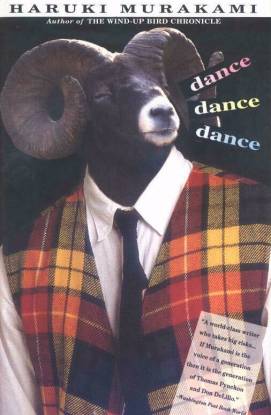
DANCE DANCE DANCE
Acclaim
for H A R U К I MURAKAMI'S
DANCE
DANCE DANCE
'An
entertaining mix of modern sci-fi, nail-biting suspense, and ancient myth ... a
sometimes funny, sometimes sinister mystery spoof . . . [that] also aims at
contemporary human concerns.' - Chicago Tribune
'The
plot is addictive.' - Detroit Free Press
'There
are novelists who dare to imagine the future, but none is as scrupulously,
amusingly up-to-the-minute as ... Murakami.' - Newsday
'[Dance
Dance Dance] has the fascination of a well-written detective story
combined with a surreal dream narrative . . . full of appealing, well-developed
characters.'
- Philadelphia
Inquirer
'A
world-class writer who . . . takes big risks. ... If Murakami is the voice of a
generation, then it is the genera-tion of Thomas Pynchon and Don DeLillo.'
-
Washington Post Book World
'All
the hallmarks of Murakami's greatness are here: restless and sensitive
characters, disturbing shifts into altered reality, silky smooth turns of
phrase and a narrative with all the momentum of a roller-coaster. . . . This is
the sort of page-turner [Mishima] might have written.'
- Publishers
Weekly
'[Murakami's]
writing injects the rock 'n' roll of everyday language into the exquisite
silences of Japanese literary prose.' - Harper's Bazaar
'One of
the most exciting new writers to appear on the inter-national scene.' - USA Today
HARUKI MURAKAMI
DANCE DANCE DANCE
Haruki
Murakami was born in Kyoto in 1949 and grew up in Kobe. He is the author of A Wild
Sheep Chase; Hard-Boiled Wonderland and the End of the World; and The
Elephant Vanishes. He
lives with his wife in Cambridge, Massachusetts.
books by HARUKI MURAKAMI
South
of the Border, West of the Sun
The
Wind-Up Bird Chronicle
Dance
Dance Dance
The
Elephant Vanishes
Hard-Boiled
Wonderland and the End of the World
A Wild
Sheep Chase
a novel
by
HARUKI MURAKAMI
translated
by Alfred Birnbaum
Vintage International
3-4
Vintage
Books
A
Division of Random House, Inc.
New
York
FIRST
VINTAGE INTERNATIONAL EDITION, FEBRUARY
1995
Copyright
© 1994 by Kodansha International Ltd.
All
rights reserved under International and Pan-American
Copyright
Conventions. Published in the United States by Vintage Books, a division of
Random House, Inc., New York, and simultaneously in Canada by Random House of
Canada Limited, Toronto.
Originally
published in Japanese under the title Dansu Dansu Dansu
by
Kodansha Ltd., Tokyo, in 1988. This translation first published in the United
States in hardcover by Kodansha America, Inc., New York, in 1994.
Library
of Congress Cataloging-in-Publication Data Murakami, Haruki, 1949- [ Dansu dansu dansu. English ]
Dance
dance dance : a novel / by Haruki Murakami: translated by Alfred Birnbaum.
p. cm
ISBN
0-679-75379-6
I.
Birnbaum, Alfred. II. Title
PL856.
U673D3613 1995
895.6'35-dc20
94-34713
CIP
Author
photograph © Jerry Bauer
Manufactured
in the United States of America 13579886420
I often
dream about the Dolphin Hotel.
In
these dreams, I'm there, implicated in some kind of ongoing circumstance. All
indications are that I belong to this dream
continuity.
The
Dolphin Hotel is distorted, much too narrow. It seems more like a long, covered
bridge. A bridge stretching endlessly through time. And there I am, in the
middle of it. Someone else is there too, crying.
The
hotel envelops me. I can feel its pulse, its heat. In dreams, I am part of the
hotel.
I wake
up, but where? I don't just think this, I actually voice the question to
myself: 'Where am I?' As if I didn't know: I'm here. In my life. A feature of
the world that is my existence. Not that I particularly recall ever having
approved these matters, this condition, this state of affairs in which I
feature. There might be a woman sleeping next to me. More often, I'm alone.
Just me and the expressway that runs right next to my apartment and, bedside, a
glass (five millimeters of whiskey still in it) and the malicious - no, make
that indifferent-dusty morning light. Sometimes it's raining. If it is, I'll
just stay in bed. And if there's
2
whiskey
still left in the glass, I'll drink it. And I'll look at the raindrops dripping
from the eaves, and I'll think about the Dolphin Hotel. Maybe I'll stretch,
nice and slow. Enough for me to be sure I'm myself and not part of something
else. Yet I'll remember the feel of the dream. So much that I swear I can reach
out and touch it, and the whole of that something that
includes me will move. If I strain my ears, I can hear the slow, cautious
sequence of play take place, like droplets in an intricate water puzzle
falling, step upon step, one after the other. I listen carefully. That's when I
hear someone softly, almost imperceptibly, weeping. A sobbing from somewhere in
the darkness. Someone is crying for me.
The
Dolphin Hotel is a real hotel. It actually exists in a so-so section of
Sapporo. Once, a few years back, I spent a week there. No, let me get that
straight. How many years ago was it? Four. Or more precisely, four and a half.
I was still in my twenties. I checked into the Dolphin Hotel with a woman I was
living with. She'd chosen the place. This is where
we're staying, was what she said. If it hadn't been for her, I doubt
I'd ever have set foot in the place.
It was a tiny dump of a hotel. In the whole
time we were there, I don't know if we saw another paying customer. There were
a couple of characters milling around the lobby, but who knows if they were
staying there? A few keys were always missing from the board behind the front
desk, so I guess there were other hotel guests. Though not too many. I mean,
really, you hang out a hotel sign somewhere in a major city, put a phone number
in the business listings, it stands to reason you're not going to go entirely
without cus-tomers. But granting there were other customers besides our-selves,
they were awfully quiet. We never heard a sound from them, hardly saw a sign of
their presence-with the exception of the arrangement of the keys on the board
that changed slightly each day. Were they like shadows creeping along the walls
of the corridors, holding their breath? Occa-
3
sionally
we'd hear the dull rattling of the elevator, but when it stopped the oppressive
silence bore down once more.
A
mysterious hotel.
What it
reminded me of was a biological dead end. A ge-netic retrogression. A freak
accident of nature that stranded some organism up the wrong path without a way
back. Evo-lutionary vector eliminated, orphaned life-form left cowering behind
the curtain of history, in The Land That Time Forgot. And through no fault of
anyone. No one to blame, no one to save it.
The
hotel should never have been built where it was. That was the first mistake,
and everything got worse from there. Like a button on a shirt buttoned wrong,
every attempt to correct things led to yet another fine-not to say elegant-
mess. No detail seemed right. Look at anything in the place and you'd find
yourself tilting your head a few degrees. Not enough to cause you any real
harm, nor enough to seem par-ticularly odd. Who knows? You might get used to
this slant on things (but if you did, you'd never be able to view the world
again without holding your head out of true).
That
was the Dolphin Hotel. Normalness, it lacked. Con-fusion
piled on confusion until the saturation point was reached, destined in the
not-too-distant future to be swal-lowed in the vortex of time. Anyone could
recognize that at a glance. A pathetic place, woebegone as a three-legged black
dog drenched in December rain. Sad hotels existed every-where, to be sure, but
the Dolphin was in a class of its own. The Dolphin Hotel was conceptually
sorry. The Dolphin Hotel was tragic.
It goes
without saying, then, that aside from those poor, unsuspecting souls who
happened upon it, no one would willingly choose to stay there.
A far
cry from its name (to me, the 'Dolphin' sobriquet suggested a pristine
white-sugar candy of a resort hotel on the Aegean Sea), if not for the sign
hung out front, you'd never have known the building was a hotel. Even with the
sign and the brass plaque at the entrance, it scarcely looked
4
the
part. What it really resembled was a museum. A peculiar kind of museum where
persons with peculiar curiosities might steal away to see peculiar items on
display.
Which
actually was not far from the truth. The hotel was indeed part museum. But I
ask, would anyone want to stay in such a hotel? In a lodge-cum-reliquary, its dark
corridors blocked with stuffed sheep and musty fleeces and mold-covered
documents and discolored photographs? Its corners caked with unfulfilled
dreams?
The
furniture was faded, the tables wobbled, the locks were useless. The
floorboards were scuffed, the light bulbs dim; the washstand, with ill-fitting
plug, couldn't hold water. A fat maid walked the halls with elephant strides,
ponder-ously, ominously coughing. And the sad-eyed, middle-aged owner,
stationed permanently behind the front desk, had two fingers missing. The kind
of a guy, by the looks of him, for whom nothing goes right. A veritable
specimen of the type-dredged up from an overnight soak in thin blue ink, soul
stained by misfortune, failure, defeat. You'd want to put him in a glass case and
cart him to your science class: Homo nihilsuccessus. Almost anyone who
saw the guy would, to a greater or lesser degree, feel their spirits dampen.
Not a few would be angered (some folks get upset seeing miserable examples of
humanity). So who would stay in that hotel?
Well, we stayed
there. This is where we're staying, she'd
said. And then later she disappeared. She upped and van-ished. It was the Sheep
Man who told me so. Thewomanleftalonethisafternoon, the
Sheep Man said. Somehow, the Sheep Man knew. He'd known that she had to get
out. Just as I know now. Her purpose had been to lead me there. As if it were
her fate. Like the Moldau flowing to the sea. Like rain.
When I
started having these dreams about the Dolphin Hotel, she was the first thing
that came to mind. She was seeking me out. Why else would I keep having the
same dream, over and over again?
5
She. What was her name?
The months we'd spent togeth-er, and yet I never knew. What did I
actually know about her? She'd been in the employ of an exclusive call girl
club. A club for members only; persons of less-than-impeccable standing not
welcome. So she was a high-class hooker. She'd had a couple other jobs on the
side. During regular business hours she was a part-time proofreader at a small
publishing house; she was also an ear model. In other words, she kept busy.
Naturally, she wasn't nameless. In fact I'm sure she went by a number of names.
At the same time, practically speaking, she didn't have a name. Whatever she
carried- which was next to nothing-bore no name. She had no train pass, no
driver's license, no credit cards. She did carry a little notebook, but that
was scrawled in an indecipherable code. Apparently she wanted no handle on her
identity. Hookers may have names, but they inhabit a world that doesn't need
to
know.
I
hardly knew a thing about her. Her birthplace, her real age, her birthday, her
schooling and family background- zip. Precipitate as weather, she appeared from
somewhere, then evaporated, leaving only memory.
But
now, the memory of her is taking on renewed reality. A palpable reality. She
has been calling me via that circum-stance known as the Dolphin Hotel. Yes, she
is seeking me once more. And only by becoming part of the Dolphin Hotel will I
ever see her again. Yes, there is no doubt: it is she who is crying for me.
Gazing
at the rain, I consider what it means to belong, to become part of something.
To have someone cry for me. From someplace distant, so very distant. From,
ultimately, a dream. No matter how far I reach out, no matter how fast I run,
I'll never make it.
Why
would anyone want to cry for me?
She is
definitely calling me. From somewhere in the Dol-phin Hotel. And apparently,
somewhere in my own mind,
6
the
Dolphin Hotel is what I seek as well. To be taken into that scene, to become
part of that weirdly fateful venue.
It is
no easy matter to return to the Dolphin Hotel, not a simple question of ringing
up for a reservation, hopping on a plane, flying to Sapporo, and mission
accomplished. For the hotel is, as I've suggested, as much circumstance as
place, a state of being in the guise of a hotel. To return to the Dol-phin
Hotel means facing up to a shadow of the past. The prospect alone depresses. It
has been all I could do these four years to rid myself of that chill, dim
shadow. To return to the Dolphin Hotel is to give up all I'd quietly set aside
dur-ing this time. Not that what I'd achieved is anything great, mind you.
However you look at it, it's pretty much the stuff of tentative convenience.
Okay, I'd done my best. Through some clever juggling I'd managed to forge a
connection to reality, to build a new life based on token values. Was I now
supposed to give it up?
But the
whole thing started there. That much was undeni-able. So the story had to
start back there.
I
rolled over in bed, stared at the ceiling, and let out a deep sigh. Oh
give in, I thought. But the idea of giving in didn't take hold.
It's out of your hands, kid.
Whatever you may be thinking, you can't resist. The story's already decided.
2
I got
sent to Hokkaido on assignment. As work goes, it wasn't terribly exciting, but
I wasn't in a position to choose. And anyway, with the jobs that come my way,
there's generally very little difference. For better or worse, the further from
the midrange of things you go, the less rela-tive qualities matter. The same
holds for wavelengths: Pass a certain point and you can hardly tell which of
two adjacent notes is higher in pitch, until finally you not only can't dis-tinguish
them, you can't hear them at all.
The assignment
was a piece called 'Good Eating in Hakodate' for a women's magazine. A
photographer and I were to visit a few restaurants. I'd write the story up,
he'd supply the photos, for a total of five pages. Well, somebody's got to
write these things. And the same can be said for col-lecting garbage and
shoveling snow. It doesn't matter wheth-er you like it or not-a job's a job.
For
three and a half years, I'd been making this kind of contribution to society.
Shoveling snow. You know, cultural snow.
Due to
some unavoidable circumstances, I had quit an office that a friend and I were
running, and for half a year I did almost nothing. I didn't feel like doing
anything. The previous autumn all sorts of things had happened in my life. I
got divorced. A friend died, very mysteriously. A woman
8
ran out
on me, without a word. I met a strange man, found myself caught up in some
extraordinary developments. And by the time everything was over, I was
overwhelmed by a stillness deeper than anything I'd known. A devastating
absence hovered about my apartment. I stayed shut-in for six months. I never
went out during the day, except to make the absolute minimum purchases
necessary to survive. I'd venture into the city with the first gray of dawn and
walk the deserted streets, and when the streets started to fill with people, I
holed up back indoors to sleep.
Toward
evening, I'd rise, fix something to eat, feed the cat. Then I'd sit on the
floor and methodically go over the things that had happened to me, trying to
make sense of them. Rearrange the order of events, list up all possible alter-natives,
consider the right or wrong of what I'd done. This went on until the dawn, when
I'd go out and wander the streets again.
For
half a year that was my daily routine. From January through June 1979. I didn't
read one book. I didn't open one newspaper. I didn't watch TV, didn't listen to
the radio. Never saw anyone, never talked to anyone. I hardly even drank; I
wasn't in a drinking frame of mind. I had no idea what was going on in the world,
who'd become famous, who'd died, nothing. It wasn't that I stubbornly resisted
information, I simply had no desire to know anything. Even so, I knew things
were happening. The world didn't stop. I could feel it in my skin, even sitting
alone in my apartment. Though little did it compel me to show interest. It was
like a silent breath of air, breezing past me.
Sitting
on the floor, I'd replay the past in my head. Funny, that's all I did, day
after day after day for half a year, and I never tired of it. What I'd been
through seemed so vast, with so many facets. Vast but real, very real, which
was why the experience persisted in towering before me, like a monument lit up
at night. And the thing was, it was a monument to me. I inspected the events
from every possible angle. I'd been damaged, badly, I suppose. The damage was
not petty. Blood
9
had
flowed, quietly. After a while some of the anguish went away, some surfaced
only later. And yet my half year indoors was not spent in convalescence. Nor in
autistic denial of the external world. I simply needed time to get back on my
feet. Once on my feet, I tried not to think about where I was heading. That was
another question entirely, to be thought out at a later date. The main thing
was to recover my equi-librium.
I
scarcely talked to the cat. The telephone rang. I let it ring. If someone
knocked on the door, I wasn't there. There were a few letters. A couple from my
former part-ner, who didn't know where I was or what I was up to and was
concerned. Was there anything he could do to help? His new business was going
smoothly, old acquaintances had asked about me.
My
ex-wife wrote, needing some practical affairs taken care of, very
matter-of-fact. Then she mentioned she was get-ting married-to someone I didn't
know, and probably never would. Which meant she'd split up with that friend of
mine she'd gone off with when we divorced. Not surprising, them splitting up.
The guy wasn't so great a jazz guitarist and he wasn't so great a person
either. Never could understand what she saw in him-but none of my business, eh?
About me, she said she wasn't worried. She was sure I'd be fine whatever it was
I chose to do. She reserved her worries for the people I'd get involved with.
I read
these letters over a few times, then filed them away. And so the months passed.
Money
wasn't a problem. I had saved plenty enough to live on, and I wasn't thinking
about what came later. Winter was past.
And
spring took hold. The scent of the wind changed. Even the darkness of night was
different.
At the
end of May, Kipper, my cat, died. Suddenly, with-out warning. I woke up one day
and found him curled up on the kitchen floor, dead. He himself probably hadn't
known it
10
was
happening. His body was cold and hard, like yesterday's roast chicken, sheen
gone from the fur. He could hardly have claimed he had the best life. Never
really loved by anyone, never seeming really to love anyone either. His eyes
always had this uneasy look, like, what now? You don't see that
look in a cat too often. But anyway, he was dead. Nothing more. Maybe that's
the best thing about death.
I put
his body in a Seiyu supermarket bag, placed him on the backseat of the car, and
drove to the hardware store for a shovel. I turned off the highway a good ways
up in the hills and found an appropriate grove of trees. A fair distance back
from the road I dug a hole one meter deep and laid Kipper in his shopping bag
to rest. Then I shoveled dirt on top of him. Sorry, I told the little guy,
that's just how it goes. Birds were singing the whole time I was burying him.
The upper registers of a flute recital.
Once
the hole was filled in, I tossed the shovel into the trunk of the car, and got
back on the highway. I turned the radio on as I drove home to Tokyo.
Which
is when the DJ had to put on Ray Charles moan-ing about being born
to lose . . . and now I'm losing you.
I felt
like crying. Sometimes one little thing will do the trick. I turned the radio
off and pulled into a service area. First, I washed the dirt from my hands,
then went into the restaurant. I could only manage a third of a sandwich, but I
put down two cups of coffee.
What
was Kipper doing now? I wondered. Down there in the dark. The sound of the dirt
hitting the Seiyu bag echoed in my brain. That's just how it goes, pal, for me
the same as you.
I sat
staring at my unfinished sandwich for an hour. Until a violet-uniformed
waitress came by and nervously asked if she could clear the plate away.
That's
that, I thought. So now, back to society.
3
It
takes no great effort to find work in the giant anthill of an advanced
capitalist society. That is, of course, so long as you're not asking the
impossible. When I still had my office, I did my share of editing and writing,
and I'd gotten to know a few professionals in the field. So as I embarked on a
free-lance career, there was no major retooling required. I didn't need much to
live on any-way.
I
pulled out my address book and made some calls. I asked if there was work
available. I said I'd been laying back but was ready to take stuff on. Almost
immediately jobs came my way. Though not particularly interesting jobs, mostly
filler for PR newsletters and company brochures. Speaking conservatively, I'd
say half the material I wrote was meaningless, of no conceivable use to anyone.
A waste of pulp and ink. But I did the work, mechanically, without thinking. At
first, the load wasn't much, maybe a couple hours a day. The rest of the time
I'd be out walking or seeing a movie. I saw a lot of movies. For three months,
I had an easy time of it. I was slowly getting back in touch.
Then,
in early autumn, things began to change. Work orders increased dramatically.
The phone rang nonstop, my mailbox was overflowing. I met people in the
business and had lunch with them. They promised me more work.
12
The
reason was simple. I was never choosy about the jobs I did. I was willing to do
anything, I met my deadlines, I never complained, I wrote legibly. And I was
thorough. Where others slacked off, I did an honest write. I was never snide,
even when the pay was low. If I got a call at two-thirty in the morning asking
for twenty pages of text (about, say, the advantages of non-digital clocks or
the appeal of women in their forties or the most beautiful spots in Helsinki,
where, needless to say, I'd never been) by six A.M., I'd have it done by
five-thirty. And if they called back for a rewrite, I had it to them by six.
You bet I had a good reputa-tion.
The
same as for shoveling snow.
Let it
snow and I'd show you a thing or two about effi-cient roadwork.
And
with not one speck of ambition, not one iota of expectation. My only concern
was to do things systemati-cally, from one end to the other. I sometimes wonder
if this might not prove to be the bane of my life. After wasting so much pulp
and ink myself, who was I to complain about waste? We live in an advanced
capitalist society, after all. Waste is the name of the game, its greatest
virtue. Politicians call it 'refinements in domestic consumption.' I call it
meaningless waste. A difference of opinion. Which doesn't change the way we
live. If I don't like it, I can move to Bangladesh or Sudan.
I for
one am not eager to live in Bangladesh or Sudan.
So I
kept working.
And
soon enough, it wasn't just PR work. I got called to do bits and pieces for
regular magazines. For some reason, mostly women's magazines. I started doing
interviews, minor legwork reportage. But really, the work wasn't much of an
improvement over PR newsletters. Due to the nature of these magazines, most of
the people I had to interview were in show business. No matter what you asked
them, they had only stock replies. You could predict what they'd answer before
you asked the question. In the worst cases, the man-
13
ager
would insist on seeing the questions in advance. So I always came with
everything written out. Once I asked a seventeen-year-old singer something that
wasn't on the list, which caused her manager to pipe up: 'That wasn't what we
agreed on-she doesn't have to answer that.' That was a kick. I wondered if the
girl couldn't answer what month fol-lowed October without this manager by her
side. Still, I did my best. Before each interview I did my homework, surveyed
available sources, tried to come up with questions others wouldn't think to
ask. I took pains structuring the article. Not that these efforts received any
special recognition. They never got me an appreciative word. I went the extra
step because, for me, it was the simplest way. Self-discipline. Giv-ing my
disused fingers and head a practical-and if at all possible, harmless-dose of overwork.
Social
rehabilitation.
After
that, my days were busier than ever. Not only with double or triple my regular
load, but with a lot of rush jobs too. Without fail, jobs that had no takers
found their way to me. My role in those circles was the junkyard at the edge of
town. Anything, particularly if complicated or a pain, would get hauled to me
for disposal.
By way
of thanks, my savings account swelled to figures I'd never seen the likes of,
though I was too busy to spend much of it. So when a guy I knew offered me a
good deal, I got rid of my nothing-but-headaches car and bought his year-old
Subaru Leone. Hardly any miles on it, stereo and air-conditioning. A real first
for me. And I moved to an apartment in Shibuya, closer to the center of town.
It was a bit noisy-the expressway passing right outside my win-dow-but you got
used to it.
I slept
with a few women I met through work.
Social
rehabilitation.
I had a
sense about which women I ought to sleep with. And which women I'd be able to
sleep with, which not. Maybe even which I shouldn't sleep with. It's an
intelligence that comes with age. I also knew when to call it quits, all
14
very
nice and easy so no one got hurt. The only thing miss-ing was those tugs on the
heartstrings.
The
deepest I got involved was with a woman who worked at the phone company. I met
her at a New Year's party. Both of us were tipsy, we joked with each other,
liked each other, and ended up back at my place. She had a good head on her
shoulders and terrific legs. We went for rides in my new-used Subaru. She'd
call, whenever the mood struck, and come over and spend the night. She was the
only rela-tionship with one foot in the door like that. Though both of us knew
there was no place this thing could go. Still, we qui-etly shared something
approaching a pardon from life. I knew days of peace for the first time in
ages. We exchanged tenderness, talked in whispers. I cooked for her, gave her
birthday presents. We'd go to jazz clubs and have cocktails. We never argued,
not once. We knew exactly what we wanted in each other. And even so, it ended.
One day it stopped, as if the film simply slipped off the reel.
Her
departure left me emptier than I would have sus-pected. For a while, I stayed
in again.
The
problem was that I hadn't wanted her, really wanted her. I'd liked her, liked
being with her. She brought me back to gentle feelings. But what it came down
to was, I never felt a need
for her. Not
three days after she got out of my life, the realization hit home. That
ultimately, all the time I'd been next to her, I might as well have been on the
moon. The whole while I'd felt her breasts against me, I'd really wanted
something else.
It took
four years to get my life back on steady ground. I carefully dispatched each
piece of work that came my way, and people came to feel they could depend on
me. Not many, but a few, even became friendly. Though, it goes with-out saying,
that wasn't enough. Not enough at all. Here I'd spent all this time trying to
get up to speed, and I was back to where I started.
Okay, I
thought, age thirty-four, square one. What do you do now?
15
I
didn't have to think much about that one. I knew already. The answer had been
floating over my head like a dark, dense cloud. All I had to do was take
action, instead of putting it off and putting it off. / had to
go to the Dolphin Hotel. That's
where it all started.
I also
had to find her. The
woman who'd first guided me to the Dolphin Hotel, she who'd
been a high-class call girl in her own covert world of night. (Under astonishing
circum-stances, I was to learn this nameless woman's name some-time later, but,
for reasons of convenience, unorthodox as it will seem, I'll tell it to you
now. Pardon me, please. It was Kiki.) Yes, Kiki held the key. I had to call her
back to me. To a life with me she'd left never to return. Was it possible? Who
knew, but I had to try. From then would begin a new cycle.
I
packed my bags, did double time to finish up outstand-ing work, then canceled
all the jobs I'd penciled in for the next month. I said I was leaving Tokyo on
family business. A couple of editors made noises, but what could they do? I'd
never let them down before, and besides I was giving them plenty of advance
notice to find other ways and means. In the end, it was fine. I'd be back in a
month, I told them.
Then I
took a flight to Hokkaido. This was the beginning of March 1983.
Of
course, the family business wasn't over in anything near a month.
4
I
booked a taxi for two days, and the photographer and I raced around Hakodate in
the snow checking out eateries in the city.
I'm
good at researching, very systematic, very efficient. The most important thing
about this sort of job is to do your homework and set up a schedule. That's the
key. When it comes to gathering materials beforehand, you can't beat
organizations that compile information for people in the field. Become a member
and pay your dues; they'll look up almost anything for you. So if by chance
you're researching eating places in Hakodate, they can dig up quite a bit. They
use mainframe computer retrieval, arrange the facts in file format, print out
hard copy, even deliver to your doorstep. Granted, it's not cheap, but plenty
worth the time it buys.
In
addition to that, I do a little walking for information myself. There are
reading rooms specializing in travel mate-rials, libraries that collect local
newspapers and regional publications. From all of these sources, I pick out the
prom-ising spots, then call them up to check their business hours. This much
done, I've saved a lot of trouble on site. Then I draw lines in a notebook and
plan out each day's itinerary. I look at maps and mark in the routes we'll
travel. Trying to reduce uncertainties to a minimum.
Once we
arrive in Hakodate, the photographer and I go
17
around
to the restaurants in order. There are about thirty. We take a couple of
bites-just enough to get the taste-then casually leave the rest of the meal
uneaten. Refinements in consumption. We're still undercover at this stage, so
no pic-ture taking. Only after leaving the premises do the photogra-pher and I
discuss the food and evaluate it on a scale of one to ten. If it passes, it
stays on the list; if not, it's out. We gen-erally figure on dropping at least
half. Taking a parallel tack, we also check the local papers for listings of
places we've missed, selecting maybe five. We go to these too, and weed out the
not-so-good. Then we've got our finalists. I call them up, give the name of the
magazine, tell them we'd like to do a feature on them-text with photos. All
that in two days. Nights, I stay in my hotel room, laying down the basic copy.
The
next day, while the photographer does quick shots of the food and table
settings, I talk to the restaurant owners. Saves on time. So we can call it a
wrap in three days. True, there are those in our league who take even less
time. But they don't do any research. They do a handful of the more well-known
spots, cruise through without eating a thing, write brief comments. It's their
business, not mine. If I may be perfectly frank, I doubt that many writers take
as many pains as I do at this level of reportage. It's the kind of work that
can break you if you're too serious about it, or you can kick back and do
almost nothing. The worst of it is, whether you're earnest or you loaf, the difference
will hardly show in the finished piece. On the surface. Only in the finer
points can you find any hint of the distinction.
I'm not
explaining this out of pride or anything.
I just
wanted you to have a rough idea of the job, the sort of expendables I deal
with.
On the
third night, I finish writing.
The
fourth day is left free, just in case.
But
since the work has been completed and we don't have anything else in the tube,
we rent a car and head off for a day of cross-country skiing. That evening, the
two of us set-tle down to drinks over a nice, simmering hot pot. One day's
18
relaxation.
I turn over my manuscript to the photographer, and that's it. My job's done,
the work's in someone else's hands.
But
before turning in that evening, I rang up Sapporo directory assistance for the
number of the Dolphin Hotel. I didn't have to wait long. I sat up in bed and
sighed. Well, at least the Dolphin Hotel hadn't gone under. Relief, I guess.
Because I wouldn't have been surprised if it had, a mysteri-ous place like
that. I took a deep breath, dialed the number -and someone answered
immediately. As if they'd been just waiting for it to ring. So immediately, in
fact, I was taken aback.
'Hello,
Dolphin Hotel!' went a cheerful voice.
It was
a young woman. A woman? What's going on? I don't remember a woman being there.
It
didn't figure, so I checked if the address was the same. Yes, it was exactly
where the Dolphin Hotel I knew used to be. Maybe the hotel had hired someone
new, the owner's niece or something. Nothing so odd about that. I told her I
wanted to make a reservation.
'Thank
you very much, sir,' she chirped. 'Please wait a moment while I transfer you to
our reservations desk.'
Our
reservations desk? Now I
was really confused. I couldn't begin to digest that one. What the hell
happened to the old joint?
'Sorry
to keep you waiting. This is the reservations desk. How may I help you?' This
time, a young man's voice. The brisk, friendly pitch of the professional hotel
man. Curiouser and curiouser.
I asked
for a single room for three nights. I gave him my name and my Tokyo phone
number.
'Very
well, sir. That's three nights, starting from tomor-row. Your single room will
be waiting for you.'
I
couldn't think of anything to say to that, so I thanked him and hung up, completely
disoriented. Shouldn't I have
19
asked
for an explanation? Oh well, it'd all become clear once I got there. And
anyway, I couldn't not go. I didn't have
an alternative.
I asked
the concierge to check the schedule for trains to Sapporo. After that, I got
room service to send up a bottle of whiskey and some ice, and I stayed up
watching a late-night movie on TV. A Clint Eastwood western. Clint didn't smile
once, didn't sneer. I tried laughing at him, but he never broke his deadpan.
The movie ended and I'd had my fill of whiskey, so I turned out the light and
slept straight through the night. If I dreamed, I don't remember.
All I
could see outside the window of the early morning express train was snow. It
was a bright, clear day, so the glare soon got to be too much. I didn't see
another passenger look-ing out the windows. They all knew what snow looks like.
I'd
skipped breakfast, so a little before noon I made my way to the dining car.
Beer and an omelet. Across from me sat a fiftyish man in a suit and tie, having
beer with a ham sandwich. He looked like a mechanical engineer, and that's just
what he was. He spoke to me first, telling me he serviced jets for the
Self-Defense Forces. Then he filled me in on how Soviet fighters and bombers
invaded our airspace, though he didn't seem particularly upset about it. He was
more con-cerned about the economics of F4 Phantoms. How much fuel they guzzled
in one scramble, a terrible waste. 'If the Japanese had made them, you can bet
they'd be more effi-cient. And at no loss to performance either! There's no
reason why we couldn't build a low-cost fighter if we wanted to.'
That's
when I proffered my words of wisdom, that waste is the highest virtue one can
achieve in advanced capitalist society. The fact that Japan bought Phantom jets
from Amer-ica and wasted vast quantities of fuel on scrambles put an extra spin
in the global economy, and that extra spin lifted capitalism to yet greater
heights. If you put an end to all the waste, mass panic would ensue and the
global economy
20
would
go haywire. Waste is the fuel of contradiction, and contradiction activates the
economy, and an active economy creates more waste.
Well,
maybe so, the engineer admitted, but having been a wartime child who had to
live under deprived conditions, he couldn't grasp what this new social
structure meant. 'Our generation, we're not like you young folks,' he said,
strain-ing a smile. 'We don't understand these complex workings of yours.'
I
couldn't say I exactly understood things either, but as I wasn't eager for the
conversation to drag on, I kept quiet. No, I'm not used to things; I just
recognize them for what they are. There's a decisive difference between those
two propositions. Which is just as well, I supposed, as I finished my omelet
and excused myself.
I slept
for thirty minutes, and the rest of the trip I read a biography of Jack London
I'd bought near the Hakodate sta-tion. Compared to the grand sweep and romance
of Jack London's life, my existence seemed like a squirrel with its head against
a walnut, dozing until spring. For the time being, that is. But that's how
biographies are. I mean, who's going to read about the peaceful life and times
of a nobody employed at the Kawasaki Municipal Library? In other words, what we
seek is some kind of compensation for what we put up with.
Arriving
at Sapporo, I decided to take a leisurely stroll to the hotel. It was a
pleasant enough afternoon, and I was car-rying only a shoulder bag.
The
streets were covered in a thin layer of slush, and peo-ple trained their eyes
carefully at their feet. The air was exhilarating. High school girls came
bustling along, their rosy red cheeks puffing white breaths you could have
written cartoon captions in. I continued my amble, taking in the sights of the
town. It had been four and a half years since I was in Sapporo. It seemed like
much longer.
21
Along
the way I stopped into a coffee shop. All around me normal, everyday city types
were going about their nor-mal, everyday affairs. Lovers were whispering to
each other, businessmen were poring over spread sheets, college kids were
planning their next ski trip and discussing the new Police album. We could have
been in any city in Japan. Transplant this coffee shop scene to Yokohama or
Fukuoka and nothing would seem out of place. In spite of which-or, rather, all
the more because-here I was, sitting in this coffee shop, drinking my coffee,
feeling a desperate loneliness. I alone was the outsider. I had no place here.
Of
course, by the same token, I couldn't really say I belonged to Tokyo and its
coffee shops. But I had never felt this loneliness there. I could drink my
coffee, read my book, pass the time of day without any special thought, all
because I was part of the regular scenery. Here I had no ties to any-one. Fact
is, I'd come to reclaim myself.
I paid
the check and left. Then, without further thought, I headed for the hotel.
I
didn't know the way exactly and part of me worried that I might miss the place.
I didn't. How could anyone have? It had been transformed into a gleaming
twenty-six-story Bauhaus Modern-Art Deco symphony of glass and steel, with
flags of various nations waving along the drive-way, smartly uniformed doormen
hailing taxis, a glass eleva-tor shooting up to a penthouse restaurant. A
bas-relief of a dolphin was set into one of the marble columns by the entrance,
beneath which the inscription read:
l'Hotel
Dauphin
I stood
there a good twenty seconds, mouth agape, star-ing up at it. Then I let out a
long, deep breath that might as easily have been beamed straight to the moon.
Surprise was not the word.
5
I
couldn't stand around gawking at the facade forever. Whatever this building
was, the address was correct, as was the name-for the most part. And anyway, I
had a reservation, right? There was nothing to do but go in.
I
walked up the gently sloped driveway and pushed my way through the shiny brass
revolving door. The lobby was large enough to be a gymnasium, the ceiling at
least two sto-ries high. A wall of glass rose the full height, and through it
cascaded a brilliant shower of sunlight. The floor space was appointed with a
fleet of luxurious designer sofas, between which were stationed planters of
ornamental trees. Lots of them. The overall decor focused on an oil
painting-three tatami mats large-of some Hokkaido marshland. Nothing
outstanding artistically, but impressive, if only for its size. At the far end
of the lobby a posh coffee bar beckoned. The sort of place where you order a
sandwich and they bring you four deviled ham dainties arrayed like calling
cards on a sil-ver tray with an embellishment of potato crisps and cornichons. Throw in a cup of
coffee and you're spending enough to buy a frugal family of four a midday meal.
The
lobby was crowded. Apparently a function was in progress. A group of well-dressed,
middle-aged men sat on facing sofas, nodding and smiling magnanimously. Jaws
thrust out, legs crossed, identically. A professional organiza-
23
tion?
Doctors or university professors? On their periph-ery-perhaps they were part of
the same gathering-cooed a clutch of young women in formal dress, some of them
in kimono, some in floor-length dresses. There were a few Westerners as well,
not to mention the requisite salarymen in dark suits and harmless ties, attache
cases in hand.
In a
word, business was booming at the new Dolphin Hotel.
What we
had here was a hotel founded on a proper out-lay of capital and now enjoying
proper returns. But how the hell had this come about? Well, I could guess, of
course. Having once put together a PR bulletin for a hotel chain, I knew the
whole process. Before a hotel of this scale is built, someone first costs out
every aspect of the venture in detail, then consultants are called in and every
piece of information is input into their computers for a thorough simulation
study. Everything including the wholesale price and usage volume of toilet
paper is taken into account. Then students are hired to go around the
city-Sapporo in this case-to do a market survey. They stop young men and women
on the street and ask how many weddings they expect to attend each year. You
get the picture. Little is left unchecked. All in an effort to reduce business
risk.
So the
Hotel Dauphin project team had gone to great lengths over many months to draw
up as precise a plan as possible. They bought the property, they assembled the
staff, they pinned down flash advertising space. If money was all it took-and
they were convinced they'd make that money back-there'd be no end of funds
pouring in. It's big busi-ness of a big order.
Now,
the only enterprises that could embark on such a big business venture were the
huge conglomerates. Because even after paring away the risks, there's bound to
be some hidden factor of uncertainty lurking around, which only a major player
can conceivably absorb.
24
To be
honest, this new Dolphin Hotel wasn't my kind of hotel.
Or at
least, under normal circumstances, if I had to choose a place to stay, I
wouldn't go for one that looked like this. The rates are too high; too much
padding, too many frills. But this time the die had been cast.
I went
to the front desk and gave my name, whereupon three light blue blazered young
women with toothpaste-com-mercial smiles greeted me. This smile training surely
figured into the capital outlay. With their virgin-snow white blouses and
immaculate hairstyles, the receptionists were picture-perfect. Of the three,
one wore glasses, which of course suited her nicely. When she stepped over to
me, I actually felt a shot of relief. She was the prettiest and most immedi-ately
likable. There was something about her expression I responded to, some
embodiment of hotel spirit. I half expected her to produce a tiny magic wand,
like in a Disney movie, and tap out swirls of diamond dust.
But
instead of a magic wand, she used a computer, swiftly typing in my name and
credit card number, then verifying the details on the display screen. Then she
handed me my card-key, room number 1523. I smiled as I accepted the hotel
brochure from her. When had the hotel opened? I asked. Last October, she
answered, almost in reflex. It was now in its fifth month of operation.
'You
know,' I began, donning my professional
smile, 'I seem to remember a small hotel with a similar name in this location a
few years ago. Do you have any idea what became of it?'
A
slight disturbance clouded her smile. Quiet ripples spread across her face, as
if a beer bottle had been tossed into a sacred spring. By the time the ripples
subsided, her reassumed smile was a shade less cheerful than before. I observed
the changes with great interest. Would the sprite of the spring now appear to
ask whether the item I disposed of had a gold or silver twist top?
'Well,
now,' she hedged, touching the bridge
of her
25
glasses
with her index finger. 'That was before we opened our doors, so I really couldn't-'
Her
words cut off. I waited for her to continue, but she didn't.
'I'm
terribly sorry,' she said.
'Oh,' I
said. Seconds went by. I found myself liking her. I wanted to touch the bridge
of my glasses as well, except that I wasn't wearing any glasses. 'Well, then,
is there anyone you can ask?'
She
held her breath a second, thinking it over. The smile vanished. It's
exceedingly difficult to hold your breath and keep smiling. Just try it if you
don't believe me.
'I'm
terribly sorry,' she said again, 'but would you mind waiting a bit?' Then she
retreated through a door. Thirty seconds later, she returned with a fortyish
man in a black suit. A real live hotelier by the looks of him. I'd met enough
of them in my line of work. They are a dubious species, with twenty-five
different smiles on call for every variety of cir-cumstance. From the cool and
cordial twinge of disinterest to the measured grin of satisfaction. They wield
the entire arsenal by number, like golf clubs for particular shots.
'May I
help you, please,' he said, sending a midrange smile my way with a polite bow
of the head. When he noted my attire, however, the smile was quickly adjusted
down three notches. I was wearing my fur-lined hunting jacket with a Keith
Haring button pinned to the chest, an Austrian Army-issue Alps Corps fur cap, a
rough-and-ready pair of hiking trousers with lots of pockets, and snow-tire
treaded work boots. All fine and practical items of dress, but just a tad
unsuitable for this hotel lobby. No fault of mine, only a difference in
life-style.
'You
had a question concerning our hotel, I believe?' he voiced most properly.
I put
both hands on the counter and repeated my query.
The man
cast a glance at my Mickey Mouse watch with the same clinical unease a vet
might direct at a cat's sprained paw.
26
'Might
I inquire,' he regained his composure to speak, 'why you wish to know about the
previous hotel? If you don't mind my asking, that is?'
I
explained as simply as I could: A good while back I had stayed at the old
Dolphin Hotel and gotten to know the owner; now, years later, I visit and
everything's completely changed. Which makes me wonder, what happened to the
old guy?
The man
nodded attentively.
'In all
honesty, I'm not entirely clear on the details my-self,' he chose his words
guardedly. 'Nevertheless, my understanding of the history of this hotel is that
our con-cerns purchased the property where the previous Dolphin Hotel stood and
erected on the site what we now have before us. As you can see, the name was
for all intents and purposes retained, but let me assure you that the manage-ment
is altogether separate, with no relation whatsoever to its predecessor.'
'Then
why keep the name?'
'You
must forgive me, I'm afraid I really don't. . .'
'And I
suppose you wouldn't have any idea where I could find the former owner?'
'I am sorry,
but no, I do not,' he answered, moving on to smile number 16.
'Is
there anyone else I could ask? Someone who might know?'
'Since
you insist,' the man began, straining his neck slightly. 'We are merely employees
here, and accordingly we are strictly out of touch with any goings on prior to
when the current premises opened for business. So unfortunately, if someone
such as yourself desires to know anything more specific, there's really very
little ...'
Certainly
what he said made sense, yet something caught in the back of my mind. Something
artificial, manufactured really, about the responses from both the young woman
and the stiff now fielding my questions. I couldn't put my finger on anything
exactly, yet I couldn't swallow the line. Do your
27
share
of interviews and you get this professional sixth sense. That tone of voice
when someone's hiding something, that knowing expression of someone who's
lying. No real evi-dence to go on. Only a hunch, that there was more here than
being said.
Still,
it was clear that nothing more would come from pushing them further. I thanked
the man; he excused himself and withdrew. After his black suit had vanished
from view, I asked the young woman about meals and room service, and she went
on at length. While she spoke, I peered straight into her eyes. Beautiful eyes.
I swear I almost began to see things in them. But when she met my gaze, she
blushed. Which made me like her even more. Why was that? Was it that hotel
spirit in her? Whatever, I thanked her, turned away, and took the elevator up
to my floor.
Room
1523 proved to be quite a room. Both the bed and the bath were far too big for
a single. A full complement of shampoo, conditioner, and after-shave was
provided, as was a bathrobe. The refrigerator was chock-full of snacks. There
was an ample writing desk, with plenty of stationery and envelopes. The closet
was large, the carpet deep-piled. I took off my coat and boots and picked up
the hotel brochure. Quite a production. They hadn't spared any expense on this
job.
L'Hotel
Dauphin represents a wholly new development in quality city center lodgings, the
brochure stated. Complete with the latest conveniences and full
twenty-four-hour ser-vices. Our
guest rooms are spacious and sumptuously styled. Featuring the finest selection of products, a restful
atmo-sphere, and a warm at-home feeling. 'Professional
space with a human face.'
In
other words, they'd spent a lot of money, so the rates were high.
Indeed,
this was a very well turned out hotel. A big shop-ping arcade in the basement,
an indoor pool, sauna, and tan-ning salon. Tennis courts, a health club with
training coaches and exercise equipment, conference rooms outfitted
28
for
simultaneous translation, five restaurants, three lounges, even a late-night
cafe. Not to mention a limousine service, free work space, unlimited business
supplies available to all guests. Anything you could want, they'd thought
of-and then some. A rooftop heliport?
Intelligent
facilities in an impeccable decor.
But
what of the commercial group that owned and oper-ated this hotel? I reread the
brochure from cover to cover. Not one mention of the management. Odd, to say
the least. It was unthinkable that any but the most experienced hotel chain
could run a topflight operation like this, and any enterprise of such scale
would be certain to stamp its name everywhere and take every opportunity to
promote its full line of hotels. You stay at one Prince Hotel and the brochure
lists every Prince Hotel in the whole of Japan. That's how it is.
And
then there was still the question, why would a hotel of this class take on the
name of a dump like the old Dol-phin?
I
couldn't come up with even a flake of an answer to that one.
I threw
the brochure onto the table, fell back into the sofa with my feet kicked up,
and looked out my fifteenth-story window. All I could see was blue sky. I felt
like I was flying.
All
this was fine, but I missed the old dive. There'd been a lot to see from those
windows.
6
I
puttered around in the hotel, seeing what there was to see. I checked out the
restaurants and lounges, took a peek at the pool and sauna and health club and
tennis courts, bought a couple of books in the shopping arcade. I criss-crossed
the lobby, then gravitated to the game center and played a few rounds of
backgammon. That alone took up the afternoon. The hotel was practically an
amusement park. The world is full of ways and means to waste time.
After
that, I left the hotel to have a look around the area. As I strolled through
the early evening streets, the lay of the town gradually came back to me. Back
when I'd stayed at the old Dolphin Hotel, I'd covered this area with depressing
regularity, day after day. Turn here, and there was this or that. The old
Dolphin hadn't had a dining room-if it had, I doubt I would have been inclined
to eat there-so we, Kiki and I, would always go someplace nearby for meals. Now
I felt like I was visiting an old neighborhood and was content just to wander
about, taking in familiar sights.
When
the sun went down, the air grew cold. The streets echoed with the wet sounds of
slush underfoot. There was no wind, so walking was not at all unpleasant. It
was still crisp and clear. Even the piles of exhaust-gray snow plowed up on
every corner looked positively enchanting beneath the streetlights.
30
The
area had changed markedly from the old days. Of course, those 'old days' were
only four years back, as I've said, so most of the places I'd frequented were
more or less the same. The local atmosphere was basically the same as well, but
signs of change were everywhere. Stores were boarded up, announcements of
development to come tacked over. A large building was under construction. A
drive-through burger stand and designer boutiques and a Euro-pean auto showroom
and a trendy cafe with an inner courtyard of sara trees-all
kinds of new establishments had popped up one after the next, pushing aside the
dingy old three-story blockhouses and cheap eateries festooned with traditional
noren entrance curtains and the sweetshop where a cat lay
napping by the stove. The odd mix of styles presented an all-too-temporary show
of coexistence, like the mouth of a child with new teeth coming in. A bank had
even opened a new branch, maybe a spillover of the new Dolphin Hotel
capitalization. Build a hotel of that scale in a perfectly ordinary-if a bit
neglected-neighborhood, and the balance is upset. The flow of people changes,
the place starts to jump. Land prices go up.
Or
perhaps the changes were more cumulative. That is, the upheaval hadn't been
wrought by the new Dolphin Hotel alone, but was a stage in the greater
infrastructural changes of the area. Some long-term urban redevelopment
program, for example.
I went
into a small bar I remembered, and had a few drinks and a bite to eat. The
place was dirty, noisy, cheap, and good. The kind of hole-in-the-wall I always
look for when I have to eat out alone. Places like this put me at ease, never
make me lonely. I can talk to myself and nobody listens or cares.
After
eating, I still wanted something else, so I asked for some sake. As the warm
brew seeped into my system, the question came to me: What on earth am I doing
up here? The Dolphin Hotel, such that I was seeking, no longer existed. It
didn't matter what it was I was looking for, the place was no more. And not
merely gone, it'd been replaced by this idiotic
31
Star
Wars high-tech hotel-a-thon. I was too late. My dreams of the once-Dolphin
Hotel had been nothing more than dreams of Kiki, long vanished out the door.
Perhaps there was someone crying for me. But that too was
gone. Nothing was left. What could you possibly hope to find here, kid?
You
said it, I thought. Or maybe I had my mouth open and actually
said it to myself. There's nothing left here. Not one thing left for you.
I
clamped my lips tight and stared at the bottle of soy sauce on the counter.
You
live by yourself for a stretch of time and you get to staring at different
objects. Sometimes you talk to yourself. You take meals in crowded joints. You
develop an intimate relationship with your used Subaru. You slowly but surely
become a has-been.
I left
the bar and headed back to the hotel. I'd walked a fair bit, but it wasn't hard
finding my way back. I had only to look up to see the new Dolphin Hotel
towering above everything else. Like the three wise men guided by a star to
Jerusalem or Bethlehem or wherever it was, I steered straight for the main
attraction.
After a
bath, toweling my hair dry, I gazed out over the Sapporo cityscape. When I
stayed at the old Dolphin, hadn't there been a small office building outside my
window? What kind of office, I never did figure out, but it was a company and
people were busy. That had been my view day after day. What ever became of that
company? There'd been a nice-looking woman working there. Where was she now?
I had
nothing to do, so I shuffled around the room before flicking on the TV. It was
the same old nausea-inducing fare. Not even original nausea-inducing fare. It
was phony, syn-thetic, but being synthetic, it wasn't entirely repugnant. If I
didn't turn the thing off, though, I felt sure I'd be seeing the results of
some real nausea.
I
pulled on some clothes and went up to the lounge on the twenty-sixth floor. I
sat at the bar and ordered a vodka-and-soda with lemon. One whole wall of the
lounge was win-
32
dow,
providing a sweeping panorama of Sapporo at night. A Star Wars alien city set.
Otherwise, it was a comfortable, quiet place, with real crystal glasses that
had a nice ring.
Besides
myself, there were only three other customers. Two middle-aged men talking in a
hush at a back table. Some very important matter by the look of things. A plot
to assassinate Darth Vader? And sitting at a table directly to their right, a
girl of twelve or thirteen, plugged in to a Walk-man, sipping a drink through a
straw. She was a pretty girl. Her long hair, unnaturally straight, draped
silkily against the edge of the table. She tapped her fingers on the tabletop,
keeping time to the rhythm she was hearing. Her long fin-gers made a more childlike
impression than the rest of her. Not that she was trying to act like an adult.
No, not dis-agreeable or arrogant, but aloof.
Yet, in
fact, the girl wasn't looking at anything. She was completely oblivious to her
surroundings. She was wearing jeans and white Converse All Stars and a
sweatshirt embla-zoned with genesis, sleeves
rolled up to her elbows, and she seemed to be concentrating entirely on the
music. Sometimes she'd move her lips to form fragments of lyrics.
'Lemonade,'
the bartender volunteered, as if to excuse the presence of a minor. 'The girl's
waiting for her mother.'
'Hmm,'
I answered, noncommital. Certainly, you don't go into a hotel bar after ten at
night and expect to find a young girl sitting by herself with a drink and a
Walkman. But if the bartender hadn't broached the subject, I probably wouldn't
have thought anything was out of the ordinary. The girl just seemed a part of
the place.
I
ordered another drink and made small talk with the bar-tender. The weather, the
view, assorted topics. Then noncha-lantly I dropped the line that, hey, this
place sure has changed, hasn't it? To which the bartender strained a smile and
admitted that, until recently, he'd been working at a hotel in Tokyo, so he
scarcely knew anything about Sap-poro. And at that point, a new customer walked
in, termi-nating our fruitless conversation.
33
I drank
a total of four vodka-and-sodas. I could have drunk any number more but decided
to call it quits. The girl was still in her seat, grafted to the Walkman. Her mother
hadn't shown, and the ice in her glass had melted, which she didn't seem to
notice. Yet when I got up from the counter, she looked up at me for two or
three seconds, and smiled. Or perhaps it was the slightest trembling of her
lips. But to me, it looked like she smiled. Which-I know it sounds
strange-really shook me up. I felt as if I'd been chosen. A charge shot through
me; my body seemed to lift up a few centimeters.
A bit
disarmed, I boarded the elevator and returned to my room. A smile from a twelve-year-old
girl? How could any-thing so innocent have set me off so much? She could have
been my daughter.
And
Genesis-what a stupid name for a band.
But
because the girl had that sweatshirt on, the name seemed somehow symbolic. Genesis.
Why do
rock groups have overblown names like that?
I fell
back onto the bed with my shoes still on. Closed my eyes and the young girl's
image came to me. Walkman. White fingers tapping tabletop. Genesis. Melted ice.
Genesis.
With my
eyes shut, I could feel the alcohol swimming around inside me. I pulled off my
work boots, got out of my clothes, and crawled under the covers. I was too
tired, too drunk, to feel much of anything. I waited for the woman next to me
to say, 'Had a bit too much, have we?' But there was no such conversation.
Genesis.
I
reached out to turn out the light. Will my dreams take me to the Dolphin Hotel?
I wondered in the dark.
When I
awoke the next morning, I felt a hopeless empti-ness. No dream, no hotel.
Zilch.
My work
boots lay at the foot of the bed where they'd fallen. Two tired puppies.
Outside
my window the sky hung low and gray. It looked
34
like
snow, which added to my malaise. The clock read five after seven. I punched the
remote control and watched the morning news as I lay in bed. Something about an
upcoming election. Fifteen minutes later I got up and went to the bath-room to
wash and shave, humming the overture to The Marriage of
Figaro as a wake-me-up. Or was it the overture to The
Magic Flute? I
racked my brain, but couldn't get it straight. I cut my chin shaving, then
popped a button from my cuff getting into my shirt. The signs for the day were
not good.
At
breakfast, I saw the young girl I'd seen in the bar, sit-ting with a woman I
took to be her mother. Wearing the same genesis
sweatshirt but at least without the Walkman. She'd hardly touched her
bread or scrambled eggs, seemed absolutely bored drinking her tea. Her mother
was a small-ish woman in her early forties. Hair pulled into a tight bun,
eyebrows exactly like her daughter's, slender, refined nose, camel-colored
sweater that looked like it was cashmere over a white blouse. She wore her
clothes well, clothes that suit a woman accustomed to the attentions of others.
There was a touching world-weariness in the way she buttered her toast.
As I
passed by their table, the girl glanced up at me. Then smiled. A more
definitive smile than last night's. Unmistak-ably, a smile.
I ate
my breakfast alone and tried to think, but after that smile I couldn't focus.
No matter what came to mind, the thoughts spun around uselessly. In the end, I
stared at the pepper shaker and didn't think at all.
7
There
was nothing for me to do. Nothing I should do, and nothing I wanted to do. I'd
come all this way to the Dolphin
Hotel, but the Dolphin
Hotel that I wanted had vanished
from the face of the earth. What to do? I went down to the lobby, planted
myself in one of the magnificent sofas, and tried to come up with a plan for
the day. Should I go sightseeing? Where to? How about a movie? Nah, nothing I
wanted to see. And why come all the way to Sapporo to see a movie? So, what to
do? Nothing to do.
Okay,
it's the barbershop, I said to myself. I hadn't been to a barber in a month,
and I was in need of a cut. Now that's making good use of free time. If you
don't have any-thing better to do, go to the barber.
So I
made tracks for the hotel barbershop, hoping that it'd be crowded and I'd have
to wait my turn. But of course the place was empty, and I was in the chair
immediately. An abstract painting hung on the blue-gray walls, and Jacques
Rouchet's Play Bach lilted soft and
mellow from hidden speakers. This was not like any barbershop I'd been to-you
could hardly call it a barbershop. The next thing you know, they'll be playing
Gregorian chants in bathhouses, Ryuichi Sakamoto in tax office waiting rooms.
The guy who cut my hair was young, barely twenty. When I mentioned that there
36
used to
be a tiny hotel here that went by the same name, his
response
was, 'That so?' He didn't know much about Sap-poro either. He was cool. He was
wearing a Men's Bigi designer shirt. Even so, he knew how to cut hair, so I
left there pretty much satisfied.
What
next?
Short
of other options, I returned to my sofa in the lobby and watched the scenery.
The receptionist with glasses from yesterday was behind the front desk. She
seemed tense. Was my presence setting off signals in her? Unlikely. Soon the
clock pushed eleven. Lunchtime. I headed out and walked around, trying to think
what I was in the mood for. But I wasn't hungry, and no place caught my fancy.
Lacking will, I wandered into a place for some spaghetti and salad. Then a
beer. Outside, snow was still threatening, but not a flake in sight. The sky
was solid, immobile. Like Gulliver's flying island of Laputa, hanging heavily
over the city. Everything seemed cast in gray. Even, in retrospect, my
meal-gray. Not a day for good ideas.
In the
end, I caught a cab and went to a department store downtown. I bought shoes and
underwear, spare batteries, a travel toothbrush, nail clippers. I bought a
sandwich for a late-night snack and a small flask of brandy. I didn't need any
of this stuff, I was just shopping, just killing time. I killed two hours.
Then I
walked along the major avenues, looking into win-dows, no destination in mind,
and when I tired of that, I stepped into a cafe and read some Jack London over
coffee. And before long it was getting on to dusk. Talk about bor-ing. Killing
time is not an easy job.
Back at
the hotel, I was passing by the front desk when I heard my name called. It was
the receptionist with glasses. She motioned for me to go to one end of the
counter, the car-rental section actually, where there was a display of pam-phlets.
No one was on duty here.
She
twirled a pen in her fingers a second, giving me a I've-got-something-to-tell-you-but-I-don't-know-how-to-say-it
37
look.
Clearly, she wasn't used to doing this sort of thing.
'Please
forgive me,' she began, 'but we have to pretend we're discussing a car rental.'
Then she shot a quick glance out of the corner of her eye toward the front
desk. 'Man-agement is very strict. We're not supposed to speak privately to
customers.'
'All
right, then,' I said. 'I'll ask you about car rates, and you answer with
whatever you want to say. Nothing personal.'
She
blushed slightly. 'Forgive me,' she said again. 'They're real sticklers for
rules here.'
I
smiled. 'Still, your glasses are very becoming.'
'Excuse
me?'
'You
look very cute in those glasses. Very cute,' I said.
She
touched the frame of these glasses, then cleared her throat. The nervous type.
'There's something I've been wanting to ask you,' she regained her composure.
'It's a private matter.'
If I
could have, I would have patted her on the head to comfort her, but instead I
kept quiet and looked into her eyes.
'It's
what we talked about last night, you know, about there having been a hotel
here,' she said softly, 'with the same name as this one. What was that other
hotel like? I mean, was it a regular hotel?'
I
picked up a car-rental pamphlet and acted like I was studying it. 'That depends
on what you mean by 'regular.''
She
pinched the points of her collar and cleared her throat again. 'It's . . . hard
to say exactly, but was there anything strange about that hotel? I can't get it
out of my mind.'
Her
eyes were earnest and lovely. Just as I'd remembered. She blushed again.
'I
guess I don't know what you mean, but I'm sure it will take a little time to
talk about and we can't very well do it here. You seem like you're pretty
busy.'
She
looked over at the other receptionists at the front desk, then bit her lower
lip slightly. After a moment's hesita-
38
tion,
she spoke up. 'Okay, could you meet me after I get off work?'
'What
time is that?'
'I
finish at eight. But we can't meet near here. Hotel rules. It's got to be
somewhere far away from here.'
'You
name the place. I don't care how far, I'll be there.'
She
thought a bit more, then scribbled the name of a place and drew me a map. 'I'll
be there at eight-thirty.'
I
pocketed the sheet of paper.
Now it
was her turn to look at me. 'I hope you don't think I'm strange. This is the
first time I've done something like this. I've never broken the rules before.
But this time I don't know what else to do. I'll explain everything to you
later.'
'No, I
don't think you're strange. Don't worry,' I said. 'I'm not so bad a guy. I may
not be the most likable person in the world, but I try not to upset people.'
She
twirled her pen again, not quite sure how to take that. Then she smiled vaguely
and pushed up the bridge of her glasses. 'Well, then, later,' she said, and
gave me a busi-nesslike bow before returning to her station at the front desk.
Charming, if a little insecure.
I went
up to my room and pulled a beer from the refriger-ator to wash down my
department-store roast beef sand-wich. Okay, at least we have a plan of action.
We may be in low gear, but we're rolling. But where to?
I
washed and shaved, brushed my teeth. Calmly, quietly, no humming. Then I gave
myself a good, hard look in the mirror, the first time in ages. No major
discoveries. I felt no surge of valor. It was the same old face, as always.
I left
my room at half past seven and grabbed a taxi. The driver studied the map I
showed him, then nodded without a word, and we were off. It was
a-thousand-something-yen distance, a tiny bar in the basement of a five-story
building. I was met at the door with the warm sound of an old Gerry Mulligan
record.
39
I took
a seat at the counter and listened to the solo over a nice, easy
J&B-and-water. At eight-forty-five she still hadn't shown. I didn't
particularly mind. The bar was plenty com-fortable, and by now I was getting to
be a pro at killing time. I sipped my drink, and when that was gone, I ordered
another. I contemplated the ashtray.
At five
past nine she made her entrance.
'I'm
sorry,' she said in a flurry. 'Things started to get busy at the last minute,
and then my replacement was late.'
'Don't
worry. I was fine here,' I said. 'I had to pass the time anyway.'
At her
suggestion we moved to a table toward the back. We settled down, as she removed
her gloves, scarf, and coat. Underneath, she had on a dark green wool skirt and
a lightweight yellow sweater-which revealed generous vol-umes I'm surprised I
hadn't noticed before. Her earrings were demure gold pinpoints.
She
ordered a Bloody Mary. And when it came, she sipped it tentatively. I took
another drink of my whiskey and then she took another sip of her Bloody Mary. I
nibbled on nuts.
At
length, she let out a big sigh. It might have been bigger than she had
intended, as she looked up at me nervously.
'Work
tough? 'I asked.
'Yeah,'
she said. 'Pretty tough. I'm still not used to it. The hotel just opened so the
management's always on edge about something.'
She
folded her hands and placed them on the table. She wore one ring, on her
pinkie. An unostentatious, rather ordi-nary silver ring.
'About
the old Dolphin Hotel . . . ,' she began. 'But wait, didn't I hear you were a
magazine writer or some-thing?'
'Magazine?'
I said, startled. 'What's this about?'
'That's
just what I heard,' she said.
I shut up.
She bit her lip and stared at a point on the wall. 'There was some trouble
once,' she began again, 'so the
40
management's
very nervous about media. You know, with property being bought up and all. If
too much talk about this gets in the media, the hotel could suffer. A bad image
can ruin business.'
'Has
something been written up?'
'Once,
in a weekly magazine a while ago. There were these suggestions about dirty
dealings, something about call-ing in the yakuza or some
right-wing thugs to put pressure on the folks who were holding out. Things like
that.'
'And I
take it the old Dolphin Hotel was mixed up in this trouble?'
She
shrugged and took another sip. 'I wouldn't be sur-prised. Otherwise, I don't
think the manager would have acted so nervous talking to you about the old
hotel. I mean, it was almost like you sounded an alarm. I don't know any of the
details, but I did hear once about the Dolphin name in connection with an older
hotel. From someone.'
'Someone?'
'One of
the blackies.'
'Blackies?'
'You
know, the black-suit crowd.'
'Check,'
I said. 'Other than that, you haven't heard any-thing about the old Dolphin
Hotel?'
She
shook her head and fiddled with her ring. 'I'm scared,' she whispered. 'I'm so
scared I ... I don't know what to do.'
'Scared?
Because of me and magazines?'
She
shook her head, then pressed her lip against the rim of her glass. 'No, it's
not that. Magazines don't have any-thing to do with it. If something gets
printed, what do I care? The management might get all bent out of shape, but that's
not what I'm talking about. It's the whole place. The whole hotel, well, I
mean, there's always something a little weird about it. Something funny . . .
something . . . warped.'
She
stopped and was silent. I'd finished my whiskey, so I ordered another round for
the both of us.
41
'What
do you mean by 'warped'?' I tried prompting her. 'Do you mean anything
specific?'
'Of
course I do,' she said sharply. 'Things have hap-pened, but it's hard to find
the words to describe it. So I never told anyone. I mean, it was really real,
what I felt, but if I try to explain it in words, then it sort of starts to
slip away.'
'So
it's like a dream that's very real?'
'But
this wasn't a dream. You know dreams sort of
fade after a while? Not this thing. No way. It's always stayed the same. It's
always real, right there, before my eyes.'
I
didn't know what to say.
'Okay,
this is what happened,' she said, taking a drink of her Bloody Mary and dabbing
her lips with the napkin. 'It was in January. The beginning of January, right
after New Year's. I was working the late shift, which I don't gen-erally like,
but on that day it was my turn. Anyway, I didn't get through until around
midnight. When it's late like that, they send you home in a taxi because the
trains aren't run-ning. So after I changed clothes, I realized that I'd left my
book in the staff lounge. I guess I could have waited until the next day, but
the girl I was going to share the taxi with was still finishing up, so I
decided to go get it. I got in the employee elevator and punched the button for
the sixteenth floor, which is where the staff lounge and other staff facilities
are-we take our coffee break there and go up there a lot.
'Anyway
I was in the elevator and the door opened and I stepped out like always. I didn't
think anything of it, I mean, who would? It's something that you do all the
time, right? I stepped out like it was the most natural thing in the world. I
guess I was thinking about something, I don't remember what. I think I had both
hands in my pockets and I was standing there in the hallway, when I noticed
that everything around me was dark. I mean, like absolutely pitch black. I
turned around and the elevator door had just shut. The first thing I thought
was, uh-oh, the power's gone out. But that's impossible. The hotel has this
in-house emergency generator,
42
so if
there's a power failure, the generator kicks on automat-ically. We had these
practice sessions during training, so I know. So, in principle, there's not
supposed to be anything like a blackout. And if on the million-to-one chance
some-thing goes wrong with the generator, then emergency lights in the hallway
are supposed to come on. So what I'm saying is, it wasn't supposed to be pitch
black. I should have been seeing green lamps along the hall.
'But
the whole place was completely dark. All I could see were the elevator call
buttons and the red digital display that says what floor it's on. So the first
thing I did was press the call buttons, but the elevator kept going down. I
didn't know what to do. Then, for some reason, I decided to take a look around.
I was really scared, but I was also feeling really put out.
'What I
was thinking was that something was wrong with the basic functions of the
hotel. Mechanically or structurally or something. And that meant more hassle
from the management and no holidays and all sorts of annoying stuff. So, the
more I thought about these things, the more annoyed I got. My annoyance got
bigger than my fear. And that's how I decided to, you know, just have a look
around. I walked two or three steps and-well, something was really strange. I
mean, I couldn't hear the sound of my feet. There was no sound at all. And the
floor felt funny, not like the regular car-pet. It was hard. Honest. And then
the air, it felt different, too. It was ... it was moldy. Not like the hotel
air at all. Our hotel is supposed to be fully air-conditioned and management is
very fussy about it because it's not like ordinary air-condi-tioning, it's
supposed to be quality air, not the dehumidified stuff in
other hotels that dries out your nose. Our air is like natural air. So the
stale, moldy air was really a shock. And it smelled like it was . . . old-you
know, like when you go to visit your grandparents in the country and you open
up the old family storehouse-like that. Stagnant and musty.
'I
turned around and now even the elevator call buttons had gone out. I couldn't
see a thing. Everything was out, com-
43
pletely,
which was really frightening. I mean, I was entirely alone in total darkness,
and it was utterly quiet. Utterly. There wasn't a single sound. Strange.
You'd think that in a power failure, at least one person would be calling out.
And this was when the hotel was almost full. You'd've thought a lot of peo-ple
would be making noise. Not this time.'
Our
drinks arrived, and we each took sips. Then she set hers down and adjusted her
glasses.
'Did
you follow me so far?'
'Pretty
much,' I said. 'You got off the elevator on the sixteenth floor. It's pitch
black. It smells strange. It's too quiet. Something funny is going on.'
She let
out a sigh. 'I don't know if it's good or bad, but I'm not especially a timid
person. At least I think I'm pretty brave. I'm not the type who screams her
head off when the lights go out. I get scared but I don't freak out. I figure
that you ought to go check things out. So I started feeling my way blind up the
hallway.'
'In
which direction?'
'To the
right,' she said, raising her right hand. 'I felt my way along the wall, very
slowly, and after a bit the hallway turned to the right again. And then, up
ahead, I could see a faint glow. Really faint, like candlelight leaking in from
far away. My first thought was that someone had found some emergency candles
and lit them. I kept going, but when I got closer, I saw that the light was
coming from a room with the door slightly ajar. The door was pretty strange
too. I'd never seen an old door like that in the hotel before. I just stood
there in front of it, not knowing what to do next. What if somebody was inside?
What if somebody weird came out? What was this door doing here in the first
place?
'So I
knocked on the door softly, very softly. It was hardly a knock at all, but it
came out sounding really loud -maybe because the hallway was dead quiet.
Anyway, no response. I waited ten seconds, and during those ten seconds, I was
just frozen. I hadn't the slightest idea what I was going to do. Then I heard
this muffled noise. I don't know, it was
44
like a
person in heavy clothing standing up, and then there were these footsteps.
Really slow, shuffle ...
shuffle .. . shuf-fle ..., like he was wearing slippers or something.
The foot-steps came closer and closer to the door.'
She
stared off into space and was shaking her head.
'That was when I started
to freak out. Like maybe these footsteps weren't human. I don't know how I came
to that conclusion. It was just this creepy feeling I got, because human feet
don't walk like that. Chills ran up my spine, I mean seriously. I ran. I didn't
even look where I was going. I must have fallen once or twice, I think, because
my stockings were torn. This part I don't remember very well. All I can
remember is that I ran. I panicked. Like what if the eleva-tor's dead? Thank
god, when I finally got back there, the red floor-number light and call buttons
were lit up and every-thing. The elevator was on the ground floor. I started
pound-ing the call buttons and then the elevator started coming back up. But
much slower than usual. Really, it was like this incredible slug. Like, second
. . . third
. . .
fourth ... I was praying, c'mon, hurry up,
oh come on, but it didn't do any good. The thing took forever. It
was like somebody was jam-ming the controls.'
She let
out a deep breath and sipped her drink again. Then she played with her ring a
second longer.
I
waited for her to continue. The music had stopped, someone was laughing.
'I
could still hear those footsteps, shuffle . . .
shuffle . . . shuffle . . . , getting closer. They just didn't stop, shuffle
. . .
shuffle . . . shuffle . . . , moving down the hall,
coming toward me. I was terrified! I was more terrified than I'd ever been in
my whole life. My stomach was practically squeezed up into my throat. I was
sweating all over, but I was cold. I had the chills. The elevator wasn't
anywhere near. Seventh ...
eighth . . . ninth ... The
footsteps kept coming.'
She
paused for twenty or thirty seconds. And once again, she gave her ring a few
more turns, almost as if she were tuning a radio. A woman at the counter said
something,
45
which
drew another laugh from her companion. If only they'd hurry up and put on a
record.
'I
can't really describe how I felt. You just have to experi-ence it,' she spoke
dryly.
'Then
what happened?'
'The
next thing I knew, the elevator was there,' she said, shrugging her shoulders.
'The door opened and I could see that nice, familiar light. I fell in,
literally. I was shaking all over, but I managed to push the button for the
lobby. When it got there, I must've scared everyone silly. I was all pale and
speechless and trembling. The manager came over and shook me, and said, 'Hey,
what's wrong?' So I tried to tell him about the strange things on the sixteenth
floor, but I kept running out of breath. The manager stopped me in the middle
of my story and called over one of the staff boys, and all three of us went
back up to the sixteenth floor. Just to check things out. But everything was
perfectly normal up there. All the lights were shining away, there was no old
smell, everything was the same as always, as it was supposed to be. We went to
the staff lounge and asked the guy who was there if he knew anything about it,
but he swore up and down he'd been awake the whole time and the power hadn't
gone out. Then, just to be sure, we walked the entire six-teenth floor from one
end to the other. Nothing was out of the ordinary. It was like I'd been
bewitched or something.
'We
went back down and the manager took me into his office. I was sure he was going
to scream at me, but he didn't even get mad. He asked me to tell him what
happened again in more detail. So I explained everything as clearly as I could,
from the beginning, right down to those footsteps coming after me. I felt like
a complete idiot. I was sure he was going to laugh at me and say I'd dreamed
the whole thing up.
'But he
didn't laugh or anything. Instead, he looked dead serious. Then he said:
'You're not to tell anyone about this.' He spoke very gently. 'Something must
have gone wrong, but we shouldn't upset the other employees, so let's keep this
completely quiet.' And let me tell you, this manager is not
46
the
type to speak gently. He's ready to fly off the handle at any second. That's
when it occurred to me-that maybe I wasn't the first person this happened to.'
She now
sat silent.
'And
you haven't heard anybody talk about something like this? Weird experiences, or
strange happenings, or any-thing mysterious? What about rumors?'
She
thought it over and shook her head. 'No, not that I'm aware of. But there
really is something funny about the place. The way the manager reacted when I
told him what happened and all those hush-hush conversations going on all the
time. I really can't explain any better, but something isn't right. It's not at
all like the hotel I worked at before. Of course, that wasn't such a big hotel,
so things were a little different, but this is real different.
That hotel had its own ghost story-every hotel's probably got one-but we all
could laugh at it. Here, it's not like that at all. Nobody laughs. So it's even
more scary. The manager, for example, if he made a joke of it, or even if he
yelled at me, it wouldn't have seemed so strange. That way, I would've thought
there was just a malfunction or something.'
She
squinted at the glass in her hand.
'Did
you go back to the sixteenth floor after that?' I asked.
'Lots of
times,' she said matter-of-factly. 'It's still part of my workplace, so I go
there when I have to, whether I like it or not. But I only go during the day. I
never go there at night, I don't care what. I don't ever want to go through that again.
That's why I won't work the night shift. I even told my boss that.'
'And
you've never mentioned this to anyone else?'
She
shook her head quickly. 'Like I already said, this is the first time. No one
would've believed me anyway. I told you about it because I thought maybe you'd
have a clue about this sixteenth-floor business.'
'Me?'
She
gazed at me abstractedly. 'Well, for one thing, you
47
knew
about the old Dolphin Hotel and you wanted to hear what happened to it. I
couldn't help hoping you might know something about what I'd gone through.'
'Nope,
afraid not,' I said, after a bit. 'I'm not a special-ist on the hotel. The old
Dolphin was a small place, and it wasn't very popular. It was just an ordinary
hotel.'
Of
course I didn't for a moment think the old Dolphin was just an ordinary hotel,
but I didn't want to open up that can of worms.
'But
this afternoon, when I asked you about the Dolphin Hotel, you said it was a
long story. What did you mean by that?'
'That
part of it's kind of personal,' I said. 'If I start in on that, it gets pretty
involved. Anyway, I don't think it has anything to do with what you just told
me.'
She
seemed disappointed. Pouting slightly, she stared down at her hands.
'Sorry
I can't be of more help,' I said, 'especially after all the trouble you took to
tell me this.'
'Well,
don't worry, it's not your fault. I'm still glad I could tell you about it.
These sort of things, you keep them all to yourself and they really start to
get to you.'
'Yup,
you gotta let the pressure out. If you don't, it builds up inside your head.' I
made an over-inflated balloon with my arms.
She
nodded silently as she fiddled with her ring again, removing it from her
finger, then putting it back.
'Tell
me, do you even believe my story? About the six-teenth floor and all?' she
whispered, not raising her eyes from her fingers.
'Of
course I believe you,' I said.
'Really?
But it's kind of peculiar, don't you think?'
'That
may be, but peculiar things do happen. I know that much. That's why I believe
you. It all links up somewhere, I think.'
She
puzzled over that a minute. 'Then you've had a simi-lar experience?'
48
'Yeah,
at least I think I have.'
'Was it
scary?' she asked.
'No, it
wasn't like your experience,' I answered. 'No, what I mean is, things connect
in all kinds of ways. With me ...' But for no reason I could understand, the
words died in my throat. As if someone had yanked out the telephone line. I
took a sip of whiskey and tried again. 'I'm sorry. I don't know how to put it.
But I definitely have seen my share of unbelievable things. So I'm quite
prepared to believe what you've told me. I don't think you made up the story.'
She
looked up and smiled. An individual smile, I thought, not the professional
variety. And she relaxed. 'I don't know why,' she said, 'but I feel better
talking to you. I'm usually pretty shy. It's really hard for me to talk to
people I don't know, but with you it's different.'
'Maybe
we have something in common,' I laughed.
She
didn't know what to make of that remark, and in the end didn't say anything.
Instead, she sighed. Then she asked, 'Feel like eating? All of a sudden, I'm
starving.'
I
offered to take her somewhere for a real meal, but she said a snack where we
were would do.
We
ordered a pizza. And continued talking as we ate. About work at the hotel,
about life in Sapporo. About herself. After high school, she'd gone to hotelier
school for two years, then she worked at a hotel in Tokyo for two years, when
she answered an ad for the new Dolphin Hotel. She was twenty-three. The move to
Sapporo was good for her; her parents ran an inn near Asahikawa, about 120
kilometers away.
'It's a
fairly well-known inn. They've been at it a long time,' she said.
'So
after doing your job here, you'll take over the family business?' I asked.
'Not
necessarily,' she said, pushing up the bridge of her glasses. 'I haven't
thought that far ahead. I just like hotel work. People coming, staying,
leaving, all that. I feel com-fortable there in the middle of it. It puts me at
ease. After all, it's the environment I was raised in.'
49
'So
that's why,' I said.
'Why
what?'
'Why
standing there at the front desk, you looked like you could be the spirit of
the hotel.'
'Spirit
of the hotel?' she laughed. 'What a nice thing to say! If only I really could
become like that.'
'I'm sure
you can, if that's what you want,' I smiled back.
She
thought that over a while, then asked to hear my story.
'Not
very interesting,' I begged off, but still she wanted to hear. So I gave her a
short rundown: thirty-four, divorced, writer of odd jobs, driver of used
Subaru. Nothing novel.
But
still she was curious about my work. So I told her about my interviews with
would-be starlets, about my piece on restaurants in Hakodate.
'Sounds
like fun,' she said, brightening up.
''Fun'
is not the word. The writing itself is no big thing. I mean I like writing.
It's even relaxing for me. But the content is a real zero. Pointless in fact.'
'What
do you mean?'
'I
mean, for instance, you do the rounds of fifteen restau-rants in one day, you
eat one bite of each dish and leave the rest untouched. You think that makes
sense?'
'But
you couldn't very well eat everything, could you?'
'Of
course not. I'd drop dead in three days if I did. And everyone would think I
was an idiot. I'd get no sympathy whatsoever.'
'So
what choice have you got?' she said.
'I
don't know. The way I see it, it's like shoveling snow. You do it because
somebody's got to, not because it's fun.'
'Shoveling
snow, huh?' she mused.
'Well,
you know, cultural snow,' I said.
We
drank a lot. I lost track of how much, but it was past eleven when she eyed her
watch and said she had an early
50
morning.
I paid the bill and we stepped outside into flurries of snow. I offered to have
my taxi drop her at her place, about ten minutes away. The snow wasn't heavy,
but the road was frozen slick. She held on tight to my arm as we walked to the
taxi stand. I think she was more than a little inebriated.
'You
know that expose about how the hotel got built,' I asked as we made our way
carefully, 'do you still remember the name of the magazine? Do you remember
around when the article came out?'
She
knew right off. 'And I'm sure it was last autumn. I didn't see the article
myself, so I can't really say what it said.'
We
stood for five minutes in the swirling snow, waiting for a cab. She clung to my
arm.
'It's
been ages since I felt this relaxed,' she said. The same thought occurred to me
too. Maybe we really did have something in common, the two of us.
In the
taxi we talked about nothing in particular. The snow and chill, her work hours,
things in Tokyo. Which left me wondering what was going to happen next. One
little push and I could probably sleep with her. I could feel it. Nat-urally I
didn't know whether she wanted to sleep with me. But I understood that she
wouldn't mind sleeping with me. I could tell from her eyes, how she breathed,
the way she talked, even her hand movements. And of course, I knew I wouldn't
mind sleeping with her. There probably wouldn't be any complications either.
I'd have simply happened through and gone off. Just as she herself had said.
Yet, some-how, the resolve failed me. The notion of fairness lingered somewhere
in the back of my mind. She was ten years younger than me, more than a little
insecure, and she'd had so much to drink she couldn't walk straight. It'd be
like call-ing the bets with marked cards. Not fair.
Still,
how much jurisdiction does fairness hold over sex? If fairness was what you
wanted, your sex life would be as
51
exciting
as the algae growing in an aquarium.
The
voice of reason.
The
debate was still raging when the cab pulled up to her plain,
reinforced-concrete apartment building and she briskly swept aside my entire
dilemma. 'I live with my younger sister,' she said.
No
further thought on the matter needed or wanted. I actually felt a bit relieved.
But as
she got out, she asked if I would see her to her door. Probably no reason for
concern, she apologized, but every once in a while, late at night, there'd be a
strange man in the hall. I asked the driver to wait for a few minutes, then
accompanied her, arm in arm, up the frozen walk. We climbed the two flights of
stairs and came to her door marked 306. She opened her purse to fish around for
the key. Then she smiled awkwardly and said thanks, she'd had a nice time.
As had
I, I assured her.
She
unlocked the door and slipped the key back into her purse. The dry snap of her
purse shutting resounded down the hall. Then she looked at me directly. In her
eyes it was the old geometry problem. She hesitated, couldn't decide how she
wanted to say good-bye. I could see it.
Hand on
the wall, I waited for her to come to some kind of decision, which didn't seem
forthcoming.
'Good
night,' I said. 'Regards to your sister.'
For
four or five seconds she clamped her lips tight. 'The part about living with my
sister,' she half whispered. 'It's not true. Really, I live alone.'
'I
know,' I said.
A slow
blush came over her. 'How could you know?'
'Can't
say why, I just did,' I said.
'You're
impossible, you know that?'
The
driver was reading a sports newspaper when I got back to the cab. He seemed
surprised when I climbed back
52
into
the taxi and asked him to take me to the Dolphin.
'You
really going back?' he said with a smirk. 'From the look of things, I was sure
you'd be paying me and sending me on. That's the way it usually happens.'
'I
bet.'
'When
you do this job as long as I have, your intuition almost never misses.'
'When
you do the job that long, you're bound to miss sometime. Law of averages.'
'Guess
so,' the cabbie answered, a bit nonplussed. 'But still, kinda odd, aren'tcha
pal?'
'Maybe
so,' I said, 'maybe so.'
Back in
my room, I washed up before getting into bed. That was when I started to regret
what I'd done-or didn't do-but soon fell fast asleep. My bouts of regret don't
usu-ally last very long.
First
thing in the morning, I called down to the front desk and extended my stay for
another three days. It was the off-season, so they were happy to accommodate
me.
Next I
bought a newspaper, headed out to a nearby Dunkin' Donuts and had two plain
muffins with two large cups of coffee. You get tired of hotel breakfasts in a
day. Dunkin' Donuts is just the ticket. It's cheap and you get refills on the
coffee.
Then I
got in a taxi and told the driver to take me to the biggest library in Sapporo.
I looked up back numbers of the magazine the Dolphin Hotel article was supposed
to be in and found it in the October 20th issue. I xeroxed it and took it to a
nearby coffee shop to read.
The
article was confusing to say the least. I had to read it several times before I
understood what was going on. The reporter had tried his best to write a
straightforward story, but his efforts had been no match for the complexity of
the
53
details.
Talk about convolution. You had to sit down with it before the general outline
emerged. The title, 'Sapporo Land Dealings: Dark Hands behind Urban
Redevelopment.' And printed alongside, an aerial photograph of the nearly com-pleted
new Dolphin Hotel.
The
long and the short of the story was this: Certain par-ties had bought up a
large tract of land in one section of the city of Sapporo. For two years, the
names of the new prop-erty holders were moved around, under the surface, in sur-reptitious
ways. Land values grew hot for no apparent reason. With very little else to go
on, the reporter started his investigation. What he turned up was this: The
properties were purchased by various companies, most of which existed only on
paper. The companies were fully registered, they paid taxes, but they had no
offices and no employees. These paper companies were tied into still other
paper companies. Whoever they were, their juggling of property ownership was
truly masterful. One property bought at twenty million yen was resold at sixty
million, and the next thing you knew it was sold again for two hundred million
yen. If you per-sisted in tracing each paper company's holdings back through
this maze of interconnecting fortunes, you'd find that they all ended at the
same place: B industries, a
player of some renown in real estate. Now B industries
was a real company, with big, fashionable headquarters in the Akasaka
section of Tokyo. And B industries happened
to be, at a less-than-public level, connected to A enterprises, a massive conglomerate that encompassed railway
lines, a hotel chain, a film company, food services, department stores,
magazines, . . . , everything from credit agencies to damage insurance. A enterprises had a direct pipeline to
certain political circles, which prompted the reporter to pursue this line of
investiga-tion further. Which is how he found out something even more
interesting. The area of Sapporo that B industries
was so busily buying up was slated for major redevelopment. Already,
plans had been set in motion to build subways and to move governmental offices
to the area. The greater part of
54
the
moneys for the infrastructural projects was to come from the national level. It
seems that the national, prefectural, and municipal governments had worked
together on the plan-ning and agreed on a comprehensive program for the zoning
and scale and budget. But when you lifted up this 'cover,' it was obvious that
every square meter of the sites for redevel-opment had been systematically
bought up over the last few years. Someone was leaking information to A enterprises, and, moreover, the leak
existed well before the redevelop-ment plans were finalized. Which also
suggested that, politi-cally speaking, the final plans had been a fait accompli
probably from the very beginning.
And
this is where the Dolphin Hotel entered the picture. It was the spearhead of
this collusive cornering of real estate. First of all, the Dolphin Hotel
secured prime real estate. Hence, A enterprises
could set up offices in this new chrome-and-marble wonder as its local
base of operations. The place was both a beacon and a watchtower, a visible
symbol of change as well as a nerve center which could redi-rect the flow of
people in the district. Everything was pro-ceeding according to the most
intricate plans.
That's
advanced capitalism for you: The player making the maximum capital investment
gets the maximum critical information in order to reap the maximum desired
profit with maximum capital efficiency-and nobody bats an eye. It's just part
of putting down capital these days. You demand the most return for your capital
outlay. The person buying a used car will kick the tires and check under the
hood, and the conglomerate putting down one hundred billion yen will check over
the finer points of where that capital's going, and occasionally do a little
fiddling. Fairness has got nothing to do with it. With that kind of money on
the line, who's going to sit around considering abstract things like that?
Sometimes
they even force hands.
For
instance, suppose there's someone who doesn't want to sell. Say, a
long-established shoe store. That's when the tough guys come out of the
woodwork. Huge companies
55
have
their connections, and you can bet they count everyone from politicians and
novelists and rock stars to out-and-out yakuza in
their fold. So they just call on the boys with their samurai swords. The police
are never too eager to deal with matters like this, especially since
arrangements have already been made up at the top. It's not even corruption.
That's how the system works. That's capital investment. Granted, this sort of
thing isn't new to the modern age. But everything before is nothing compared to
the exacting detail and sheer power and invulnerability of today's web of
capitalism. And it's megacomputers that have made it all possible, with their
inhuman capacity to pull every last factor and condition on the face of the
earth into their net calculations. Advanced capitalism has transcended itself.
Not to overstate things, financial dealings have practically become a religious
activ-ity. The new mysticism. People worship capital, adore its aura, genuflect
before Porsches and Tokyo land values. Wor-shiping everything their shiny
Porsches symbolize. It's the only stuff of myth that's left in the world.
Latter-day
capitalism. Like it or not, it's the society we live in. Even the standard of
right and wrong has been subdi-vided, made sophisticated. Within good, there's
fashionable good and unfashionable good, and ditto for bad. Within fashionable
good, there's formal and then there's casual; there's hip, there's cool,
there's trendy, there's snobbish. Mix 'n' match. Like pulling on a Missoni
sweater over Trussardi slacks and Pollini shoes, you can now enjoy hybrid
styles of morality. It's the way of the world-philosophy starting to look more
and more like business administration.
Although
I didn't think so at the time, things were a lot simpler in 1969. All you had
to do to express yourself was throw rocks at riot police. But with today's
sophistication, who's in a position to throw rocks? Who's going to brave what
tear gas? C'mon, that's the way it is. Everything is rigged, tied into that
massive capital web, and beyond this web there's another web. Nobody's going
anywhere. You throw a rock and it'll come right back at you.
56
The
reporter had devoted a lot of energy to following the paper trail. Still,
despite his outcry-or rather, all the more because of his outcry-the article
curiously lacked punch. A rallying cry it wasn't. The guy just didn't seem to
realize: Nothing about this was suspect. It was a natural state
of affairs. Ordinary, the order of the day, common knowledge. Which is why
nobody cared. If huge capital interests obtained information illegally and
bought up property, forced a few political decisions, then clinched the deal by
having yakuza extort a little shoe store here,
maybe beat up the owner of some small-time, end-of-the-line hotel there, so
what? That's life, man. The sand of the times keeps running out from under our
feet. We're no longer standing where we once stood.
The
reporter had done everything he could. The article was well researched, full of
righteous indignation, and hope-lessly untrendy.
I
folded it, slipped it into my pocket, and drank another cup of coffee.
I
thought about the owner of the old Dolphin. Mister Unlucky, shadowed by defeat
since birth. No way he could have made the cut for this day and age.
'Untrendy!'
I said out loud.
A
waitress gave me a disturbed look.
I took
a taxi back to the hotel.
8
From my
room I rang up my ex-partner in Tokyo. Some-body I didn't know answered the
phone and asked my name, then somebody else came on the line and asked my name,
then finally my ex-partner came to the phone. He seemed busy. It had been close
to a year since we'd spoken. Not that I'd been consciously avoiding him; I
simply didn't have anything to talk to him about. I'd always liked him, and
still did. But the fact was, my ex-partner was for me (and I for him) 'foregone
territory.' Again, not that we'd pushed each other into that position. We'd
just gone our own separate ways, and those two paths didn't seem to cross. No
more, no less.
So
how's it going? I asked him.
Well
enough, he said.
I told
him I was in Sapporo. He asked me if it was cold.
Yeah,
it's cold, I answered.
How's
work? was my next question.
Busy,
his one-word response.
Not
hitting the bottle too much, I hoped.
Not
lately, he wasn't drinking much these days.
And was
it snowing up here? His turn to ask.
Not at
the moment, I kept the ball in the air.
We were
almost through with our polite toss-and-catch.
'Listen,'
I broke in, 'I've got a favor to ask.' I'd done
58
him one
a long while back. Both he and I remembered it. Otherwise, I'm not the type to
go asking favors of people.
'Sure,'
he said with no formalities.
'You
remember when we worked on that in-house news-letter for that hotel group?' I
asked. 'Maybe five years ago?'
'Yeah,
I remember.'
'Tell
me, is that connection still alive?'
He gave
it a moment's thought. 'Can't say it's kicking, but it's alive as far as alive
goes. Not impossible to warm it up if necessary.'
'There
was one guy who knew a lot about what was going on in the industry. I forget
his name. Skinny guy, always wore this funny hat. You think you can get in
contact with him?'
'I
think so. What do you want to know?'
I gave
him a brief rundown on the Dolphin scandal arti-cle. He took down the date the
piece appeared. Then I told him about the old, tiny Dolphin that was here
before the present monster Dolphin and said I'd like to know more about the
following things: First, why had the new hotel kept the old Dolphin name? Second,
what was the fate of the old owner? And last, were there any recent
developments on the scandal front?
He
jotted it all down and read it back to me over the phone.
'That's
it?'
'That'll
do,' I said.
'Probably
in a hurry, too, huh?' he asked.
'Sorry,
but-'
'I'll
see what I can do today. What's your number up there?'
I gave
it to him.
'Talk
to you later,' he said and hung up.
I had a
simple lunch in a cafe in the hotel. Then I went down to the lobby and saw that
the young woman with
59
glasses
was behind the counter. I took a seat in a corner of the lobby and watched her.
She was busy at work and didn't seem to notice me. Or maybe she did, but was
playing cool. It didn't really matter, I guess. I liked seeing her there. As I
thought to myself, I could have slept with her if I wanted to.
There
are times when I need to chat myself up like that.
After
I'd watched her enough, I took the elevator back to my room and read a book.
The sky outside was heavy with clouds, making me feel like I was living in a
poorly lit stage set. I didn't know when my ex-partner would call back, so I
didn't want to go out, which left me little else to do but read. I soon
finished the Jack London and started in on the Spanish Civil War.
It was
a day like a slow-motion video of twilight. Uneventful, to put it mildly. The
lead gray of the sky mixed ever so slowly with black, finally blending into
night. Just another quality of melancholy. As if there were only two col-ors in
the world, gray and black, shifting back and forth at regular intervals.
I
dialed room service and had them send up a sandwich, which I ate a bite at a
time between sips of a beer. When there's nothing to do, you do nothing slowly
and intently. At seven-thirty, my ex-partner rang.
'I got
ahold of the guy,' he said.
'A lot
of trouble?'
'Mmm,
some,' he said after a slight pause, making it obvious that it had been
extremely difficult. 'Let me run through everything with you. I suppose you
could say the lid was shut pretty tight on this one. And not just shut, it was
bolted down and locked away in a vault. No one had access to it. Case closed.
No dirt to be dug up anymore. Seems there might have been some small
irregularities in govern-ment or city hall. Nothing important, just fine
tuning, as they say. Nobody knows any more than that. The Attorney's Office
snooped around, but couldn't come up with anything incriminating. Lots of lines
running through this one. Hot stuff. It was hard to get anything out of
anyone.'
60
'This
concern of mine is personal. It won't make trouble for anyone.'
'That's
exactly what I told the guy.'
Still
holding the receiver, I reached over to the refrigerator to get another beer,
and poured it into a glass.
'At the
risk of sounding like your mother, a word to the wise: If you're going to pry,
you're going to get hurt,' my ex-partner said. 'This one, it seems, is big,
real big. I don't know what you've got going there, but I wouldn't get in too
deep if I were you. Think of your age and standing, you ought to live out your
life more peaceably. Not that I'm the best example, mind you.'
'Gotcha,'
I said.
He
coughed. I took another sip of beer.
'About
the old Dolphin owner, seems the guy didn't give in until the very last, which
brought him a lot of grief. Should've walked right out of there, but he just
wouldn't leave. Couldn't read the big picture.'
'He was
that type,' I said. 'Very untrendy.'
'He got
the bad end of the business. A bunch of yakuza moved
into the hotel and had a field day. Nothing so bad as to bother the law. They
set up court in the lobby, and stared down anyone who walked into the place.
You get the idea, no? Still, the guy held out for the count.'
'I can
see it,' I said. The owner of the Dolphin Hotel was well acquainted with misery
in its various forms. No small measure of misfortune was going to faze him.
'In the
end, the Dolphin came out with the strangest counteroffer. Your guy told them
he'd pack up shop on one condition. And you know what that was?'
'Haven't
a clue,' I said.
'Take a
guess. Think, man, just a bit. It's the answer to one of your other questions.'
'On the
condition that they kept the Dolphin Hotel name. Is that it?'
'Bingo,'
he said. 'Those were the terms, and that's what the buyers agreed to.'
61
'But
c'mon, why?'
'It's
not such a bad name. 'Dolphin Hotel' sounds fair enough, as names go.'
'Well,
I guess,' I said.
'What's
more, this hotel was supposed to be the flagship for a whole new chain of
hotels that A enterprises was
planning. Luxury hotels, not their usual top-of-the-middle class. And they
didn't have a name for it yet.'
'Voila!
The Dolphin Hotel Chain.'
'Right.
A chain to rival the Hiltons and Hyatts of the world.'
'The
Dolphin Hotel Chain,' I tried it out one more time. A heritage passed on, a
dream unfurled. 'So then what hap-pened to the old Dolphin owner?'
'Who
knows?'
I took
another sip of my beer and scratched my ear with the tip of my pen.
'When
he left they gave him a good chunk of money, so he could be doing almost
anything. But there's no way to trace him. He was a bit player, just passing
through.'
'I
suppose.'
'And
that's about it,' said my ex-partner. 'That's all I could find out. Nothing
more. Will that do you?'
'Thanks.
You've been loads of help,' I said.
He
cleared his throat.
'You
out some dough?' I asked.
'Nah,'
he said. 'I'll buy the guy dinner, then take him to a club in Ginza, pay his
carfare home. That's not a lot, so forget about it. I can write it off as
expenses anyway. Every-thing's deductible. Hell, my accountant tells me all the
time to spend more. So don't worry about it. If you ever feel like going to a
Ginza club, let me know. It'll be on me. Seeing as you've never been to any of
those places.'
'And
what's the attraction of a Ginza club?'
'Booze,
girls,' he said. 'Kind words from my tax accountant.'
'Why
don't you go with him?'
62
'I did,
not so long ago,' he said, sounding absolutely bored.
We said
our good-byes and hung up.
I
started to think about my ex-partner. He was the same age as me, and already he
was getting a paunch. All kinds of prescription drugs in his desk. Actually concerned
about who won elections. Worried about his kids' education. He was always
fighting with his wife, but basically he was a real family man. He had his
weaknesses to be sure, he was known to drink too much, but he was a
hardworking, straightforward kind of guy. In every sense of the word.
We'd
teamed up right after college and gotten on pretty well. It was a small
translation business, and it gradually expanded in scale. We weren't exactly
the closest of friends, but we made a fine enough partnership. We saw each
other every day like that, but we never fought once. He was quiet and
well-mannered, and I myself wasn't the arguing type. We had our differences,
but managed to keep working together out of mutual respect. But when something
unfore-seen came up, we split up, perhaps at the best time too. He got started
again, kept up both ends of the business, maybe better than when we were
together, honestly. That is, if his client list is anything to go on. The
company got bigger, he got a whole new crew. Even psychologically, he seemed a
lot more secure.
More
likely I was the one with problems. And I probably exerted a not-so-healthy
influence over him. Which helps to explain why he was able to find his way
after I left. Fawning and flattering to get the best out of his people,
cracking stupid jokes with the woman who keeps the books, dutifully taking
clients out to Ginza clubs no matter how dull he found it. He might have been
too nervous to do that if I were still around. He was always aware of how I saw
him, worried about what I would think. That was the kind of guy he was. Though,
to tell the truth, I didn't pay a lot of atten-
63
tion to
what he was doing next to me.
Good
he's his own man now. In every way.
That
is, by my leaving, he wasn't afraid to act his age, and he came into his own.
So
where did that leave me?
At nine
o'clock the phone rang. I wasn't expecting a call -nobody besides my ex-partner
knew I was here-so at first the sound of the phone ringing didn't register.
After four rings I picked up the receiver.
'You
were watching me in the lobby today, weren't you?' It was my receptionist
friend. She didn't seem angry, but then she wasn't exactly happy either. Her
voice was without equivocation.
'Yes, I
was,' I admitted.
Silence.
'I
don't like it when people watch me while I'm working. It makes me nervous and I
start making mistakes. I could feel your eyes on me the whole time.'
'Sorry,
I won't stare at you again,' I said. 'I was only watching you to give myself
confidence. I didn't think you'd get so nervous. From now on I'll be more
careful. Where are you calling from?'
'Home,'
she answered. 'I'm just about to take a bath and go to bed. You extended your
stay, didn't you?'
'Uh-huh.
Business got postponed a bit.'
Another
short silence.
'Do you
think I'm too nervous?' she asked.
'I
don't know. It's a different thing for everybody. But in any case, I promise
not to stare again. I don't want to ruin your work.'
She
thought it over a second, then we said good night.
I hung
up the phone, took a bath, and stretched out on the sofa reading until
eleven-thirty. Then I dressed and stepped out into the hall. I walked it from
one end to the other. It was like a maze. At the farthest recess was the staff
64
elevator,
a little hidden from view, next to the emergency staircase. If you followed the
signs pointing past the guest rooms, you came to an elevator marked freight only. I stood before it, noting
that the elevator was stopped on the ground floor. No one seemed to be using
it. From speakers in the ceiling came the strains of 'Love Is Blue.' Paul
Mauriat.
I
pressed the button. The elevator roused itself and started to ascend. The
digital display registered the floors-1, 2, 3, 4, 5, 6-slowly but surely
advancing, to the rhythm of the music. If someone was in the elevator, I could
always plead ignorance. It was a mistake guests were probably making all the
time. 11, 12, 13, 14-and rising steadily. I took one step back, dug my hands in
my pockets, and waited for the doors to open.
15-the
count stopped. There was a moment's pause, and not a sound, then the door slid
open. The elevator was empty.
Awfully
quiet, I thought to myself. A far cry from that wheezing contraption in the old
hotel. I got in and pressed 16. The door shut, soundlessly, again, I felt a
slight move-ment, and the door opened. The sixteenth floor. Bright, fully lit,
with 'Love Is Blue' flowing out of the ceiling. No dark-ness, no musty odor.
For good measure, I walked the entire floor from end to end. It proved to have
the exact same lay-out as the fifteenth. Same winding hallways, same inter-minable
array of guest rooms, same vending machine alcove midway along, same bank of
guest elevators.
The
carpet was deep red, rich with soft pile. You couldn't hear your own footsteps.
In fact, everything was resound-ingly hushed. There was only 'A Summer Place,'
probably by Percy Faith. After getting to the end, I turned around and walked
back halfway to where the guest elevators were and took one down to the
fifteenth floor. Then I went through the whole routine all over again. Staff
elevator to the six-teenth floor, where there was the same, perfectly ordinary,
well-lit floor as before. And it was still 'A Summer Place.'
65
I gave
up and went down to the fifteenth floor again, had two sips of brandy and hit
the sack.
At
dawn, the black changed back to gray. It was snowing. Well now, I thought, what
do I do today?
As
usual, there wasn't anything to do.
I
walked in the snow to Dunkin' Donuts, chewed on a couple doughnuts, and read
the morning paper as I sipped my coffee. I skimmed through an article about
local elec-tions. I looked through the movie listings. Nothing I particu-larly
wanted to see, but there was this one film featuring a former junior high
school classmate of mine. A teen angst movie by the title of Unrequited
Love, with an up-and-com-ing teenage actress and an
up-and-coming teenage singer. I could guess the sort of role my classmate would
play: hand-some, young teacher with his wits about him, tall, slim, all-around
athlete, girls swooning all over him. Naturally the lead girl has a crush on
him. So she spends Sunday baking cookies and takes them to his apartment. But
there's a boy who's got his eyes on her. Average boy, kind of shy, . . . Typi-cal.
I could see the movie without seeing it.
When
this classmate of mine became an actor, I went to see his first few films,
partly out of curiosity. But before long I didn't bother. Every movie was
straight out of the same mold, and every role he had was basically the same:
tall, handsome, athletic, clean-cut, often a student at first, then later
teacher or doctor or young elite salaryman, adored by the girls around him. He
had perfect teeth, a charming smile. Very suave. Though still not anything
you'd want to pay money to see. Now I'm not a snob who only goes to see Fellini
or Tarkovsky. No, not by any means. But this guy's films were the pits.
Low-budget productions with cliche plots and mediocre dialogue, movies you
could tell even the directors didn't care about.
Although,
come to think of it, in real life the guy had been pretty much like the parts
he played. He was nice
66
enough,
but who actually knew anything about him? We were in the same class during
junior high school, and once we shared the same lab table on a science
experiment. We were friendly. But even back then he was too nice to be
real-just like in his movies. Girls were already falling all over him. If he
talked to them, their eyes would go moist. If he lit a Bunsen burner with those
graceful hands of his, it was like the opening ceremony of the Olympics. None
of the girls ever noticed I was alive.
His
grades were good too, always first or second in the class. Kind, sincere,
friendly. It didn't matter what kind of clothes he wore, he always looked neat
and clean. Even when he took a leak, there was something elegant about him. And
there's hardly a male around who looks elegant when pissing. Of course, he was
good at sports, active in school government. There was talk that he had a thing
going with the most popular girl in the class, but no one knew for sure. All
the teachers thought he was great, and on Parents' Day all the mothers would be
enchanted with him too. He was just that type. Though, like I said, it was hard
to know what the guy was thinking.
His
life was practically right out of the movies.
Why the
hell would I pay money to go see a movie like that?
I
tossed the newspaper into the trash and walked back to the hotel in the snow.
In the lobby, I glanced at the front desk, but my friend was nowhere to be
seen. I went over to the video game corner and played a couple rounds of Pacman
and Galaxy. Nerve-racking. Games like those bring out the aggression in people.
But they do kill time.
After
that I went back to my room and read.
The day
was impossible to get a handle on. When I got tired of reading, I looked out
the window at the snow. It snowed the entire day. I found it inspiring that a
sky could actually snow this much. At twelve o'clock I went down to the cafe
for lunch. Then I returned to my room and read and watched the snow.
67
But the
day wasn't a complete loss. Around four o'clock, while I lay in bed reading,
there was a knock on the door. It was my receptionist friend, standing there in
glasses and light blue blazer. Without waiting for me to open the door any
wider, she slipped into the room like a shadow and shut the door.
'Hotel
policy. If they catch me here, I'm fired,' she said quickly.
She
looked around the room and sat down on the sofa, straightening the hem of her
skirt at her knees. Then she breathed a sigh. 'I'm on my break now,' she said.
'I'm
going to have a beer. Want something to drink?' I asked.
'No
thanks. I don't have too much time. You've been holed up inside here all day,
haven't you?'
'I
didn't have anything special to do. I'm just whiling away the hours, reading
and watching the snow,' I said.
'What's
the book?'
'It's
about the Spanish Civil War. The whole history, from beginning to end. Full of
innuendo.' To be sure, the Spanish Civil War was rich in historical suggestion.
It was a real old-fashioned war.
'Listen,
don't take this wrong,' she interrupted me.
'Don't
take what wrong?' I asked.
Pause.
'You
mean, your coming to my room?' I asked.
'Uh-huh.'
I sat
down on the edge of the bed, beer in hand. 'Don't worry. I was surprised to see
you standing at my door, but pleasantly surprised. I'm happy for some company.
It's been pretty boring.'
She
stood up and in the middle of the room removed her blazer. She draped it over
the back of a chair, carefully so it wouldn't wrinkle. Then she walked over to
me at the edge of the bed and sat down, her legs neatly aligned. Without the
blazer, she seemed vulnerable, defenseless. I put my arm around her and she
rested her head on my shoulder. Her
68
white
blouse was pressed crisply, and she smelled nice. We stayed in this position
for five minutes. Me just holding her, her just sitting there, head on my
shoulder, eyes closed, breathing softly, almost as if she were asleep. Out in
the street, the snow kept falling, without end, swallowing all sound.
She was
tired. She needed somewhere to roost. I was the nearest tree branch. I
understood. It seemed unreasonable, unfair, that a woman so young and beautiful
should be so exhausted. Of course, it was neither unreasonable nor unfair.
Exhaustion pays no mind to age or beauty. Like rain and earthquakes and hail
and floods.
Then
she raised her head, stood up, and slipped her blazer back on. She walked over
to the sofa, sat down, and fiddled with the ring on her pinkie. In her uniform,
she seemed stiff and distant.
I kept
sitting on the edge of the bed.
'You
know that weird experience you had on the six-teenth floor?' I began, 'did you
do anything special or was there something out of the ordinary? Like before you
got into the elevator, or while you were going up?'
She
cocked her head quizzically. 'Hmm ... let me think. No, I don't think so. But I
can't really remember.'
'There
wasn't a hint of anything odd?'
'Everything
was like always,' she shrugged. 'There was nothing unusual at all. And, really,
it was a completely nor-mal elevator ride, but when the door opened everything
was pitch black. That's all.'
'I
see,' I said. 'How about dinner somewhere tonight?'
She
shook her head. 'I'm sorry. I've made other plans for tonight.'
'How
about tomorrow?'
'I have
swim club tomorrow.'
'Swim
club?' I said, smiling. 'Did you know they had swim clubs in ancient Egypt?'
'No,'
she said, 'but I find it awfully hard to believe, don't you?'
69
'No,
it's the truth. I learned that from some research I had to do once,' I
explained. A token from the department of useless facts.
She
looked at her watch and got up. 'Well, thanks,' she said. And slid out the
door, as noiselessly as when she en-tered. So much for my only handle on the
day. It left me wondering how the ancient Egyptians filled their days, what
little pleasures they enjoyed as they whiled their weary way to death. Learning
to swim, wrapping mummies. And the sum accomplishment of that you call a
civilization.
9
By
eleven o'clock that night I was out of things to do. I'd pretty well done
everything. I'd trimmed my nails, taken a bath, cleaned my ears, even watched
the news on TV. Did push-ups, sit-ups, stretched, ate dinner, finished my book.
But I wasn't sleepy. I thought about checking out the staff elevator one more
time, but it was too early for that. I had to wait until after midnight for the
comings and goings of the employees to fall off.
In the
end I decided to go up to the lounge on the twenty-sixth floor. I nursed a
martini while gazing out blankly at the flecks of white swirling down through
the void. I thought about the ancient Egyptians, tried to imagine what kind of
lives they led. Who were the ones that joined the swim club? No doubt, it was
the Pharaoh's clan, aristocrats, the upper classes. Trendy, jet-set ancient
Egyptians. They probably had their own private section of the Nile or built
special pools to teach their chic strokes in. Complete with handsome, likable
swim instructor, like my friend the movie star, who'd say things like,
'Excellent, Your Highness, only perhaps Thou might extend Thy right arm a
little further for the crawl.'
The
sky-blue waters of the Nile, the scintillating sun (thatched cabanas and palm
fronds a must), spear-bearing soldiers to beat back the crocodiles and
commoners, swaying reeds, the Pharaoh's crowd. Princes, sure, but what about
71
princesses?
Did women learn to swim? Cleopatra, for instance. In her younger days looking
like Jodie Foster, would she have swooned over my classmate, the swim
instructor? Most likely. That's what he was there for.
Somebody
ought to make a film like that. I, for one, would pay to see it.
No, the
swim instructor couldn't be of poor birth. He'd be the son of the King of
Israel or Assyria or somewhere like that, captured in battle and dragged back
to Egypt, a slave. But he doesn't lose an iota of his good-naturedness, even if
he is a slave. That's where he differs from Charlton Heston or Kirk Douglas. He
flashes his brilliant white teeth in a smile and takes a leak,
aristocratically. Then, standing on the banks of the Nile, he takes out a
ukulele and bursts into a chorus of 'Rock-a-Hula Baby.' Obviously he's the only
man for the part.
Then,
one day, the Pharaoh and entourage happen by. The swim instructor's out
scything reeds when he sees a barge capsize. Without the least hesitation, he
dives into the river, swims a magnificent crawl out and rescues a little girl
and races the crocodiles back to shore. All with powerful grace. As gracefully
as he'd lit the Bunsen burner in science class. The Pharaoh is most impressed
and thinks, that's it, I'll get this youth to teach my princes how to swim. The
previ-ous swim instructor had proven insubordinate and was thrown into the
bottomless pit just the week before. Thus my classmate becomes the Royal Swim
Instructor. And he's so likable everyone adores him. At night, the
ladies-in-wait-ing anoint their bodies with oils and perfumes and hasten to his
bed. The princes and princesses are all devoted to him.
Cut to
a spectacle scene on the order of The Bathing Beauty or The
King and I. My
classmate and the princes and princesses in a grand synchronized swim routine
in celebra-tion of the Pharaoh's birthday. The Pharaoh is overjoyed, which
further boosts the youth's stock. Still, he doesn't let it go to his head. He's
a paragon of humility. He smiles the same as ever, and pisses elegantly. When a
lady-in-waiting
72
slips
under the covers with him, he spends a full one hour on foreplay, brings her
all the way to climax, then afterward strokes her hair and says, 'You're the
best.' He's a good
guy.
For a
moment, I tried to picture sleeping with an Egyptian court lady, but the image
wouldn't gel. The more I forced it, the more everything turned into 20th
Century Fox's Cleo-patra. Very epic. Elizabeth Taylor, Richard
Burton, Rex Har-rison. The 'Hollywood Exotic' mode-olive-skinned, long-legged
slave girls waving long-handled fans over Liz, who strikes various glamorous
poses to seduce my class-mate. A specialty of the Egyptian femme fatale.
But the
Jodie Foster Cleopatra has fallen head-over-heels for him.
Mediocre
fare, admittedly, but that's the movies.
He's
pretty much gone on Jodie Cleopatra, too.
But
he's not the only one who's crazy about Jodie Cleopa-tra. There's a dark, dark
Arabian prince who's burning with passion for her. He's so in love with her
that just thinking about her is enough to make him dance. The role is
tailor-made for Michael Jackson. He's crossed the Arabian sands all the way to
Egypt for her love. We see him dancing around the caravan camp fire, shaking a
tambourine, singing 'Billie Jean.' His eyes gleam in the starlight. So of
course there ensues a major face-off between Michael and my class-mate, our
swim instructor. A rivalry between lovers. . . .
I'd
gotten this far when the bartender came over and said sorry, closing time. It
was a quarter past twelve; I was the last customer in the lounge, glasses were
already drying on towels, the bartender almost through cleaning up. Had I been
tweaking this nonsense all this time? What an idiot! I signed the bill, downed
the last of my martini, and walked out, shuffling my way to the elevators,
hands useless in my pockets.
Still,
wasn't Jodie Cleopatra obliged to marry her younger brother? My dream scenario
had a life of its own. I couldn't get it out of my head. The scenes kept on
coming. Her shift-
73
less and
crooked younger brother. Now who'd be good for the part? Woody Alien? Gimme a
break. This isn't a com-edy! We don't need a court jester cracking stupid jokes
and hitting himself over the head with a plastic mallet.
We'll
work on the brother later. The Pharaoh's got to go to Laurence Olivier. Always
got a migraine, always pressing fingers to his temples. Throws anyone who gets
on his nerves into the bottomless pit or makes them swim the Nile with the
crocs. Intelligent, cruel, and high-strung. Digs out people's eyes and throws
the poor souls into the desert.
Oh, the
casting, the casting, and then the elevator arrived. The door opened, ever so
silently. I got in and pressed 15. And went back to my Egyptian movie. Not that
I really wanted to, but there was no way to stop it.
The
scene changes to the desert wastelands. Unbeknownst to all, in a cave in the
wilderness lives a solitary prophet-recluse, cast out of society by the
Pharaoh. With his eyes gouged out, he has miraculously survived his long trek
across the desert. A sheepskin shields him from the merciless sun. He dwells in
total darkness, eating locusts and wild grasses. He gains inner vision and sees
the future. He sees the fall of the Pharaoh, Egypt's twilight, a world shifting
on its foundations.
It's
the Sheep Man, I think. The Sheep Man?
The
elevator door opened silently, and I exited without thought. The Sheep Man? In
ancient Egypt? Isn't this all meaningless pastiche anyway? I reasoned these
things out, standing, hands in my pockets, in total darkness.
Total
darkness?
Only
then did I notice the complete absence of light. Not one speck of light. As the
elevator door shut behind me, I was enveloped in lacquer black darkness. I
couldn't see my own hands. The Muzak was gone too. No 'Love Is Blue,' no 'A
Summer Place.' And the air was chill and moldy.
I stood
there alone, abandoned in utter nothingness.
10
The
darkness was deathly absolute. I could not distinguish one shape or object. I
could not see my own body. I could not get any sense of any-thing out
there. I was
in a great black vacuum.
I was
reduced to pure concept. My flesh had dissolved; my form had dissipated. I
floated in space. Liberated of my corporeal being, but without dispensation to
go anywhere else. I was adrift in the void. Somewhere across the fine line
separating nightmare from reality.
I
stood. But I could not move. My arms and legs felt para-lyzed. I was at the
bottom of the sea, the pressure dense, crushing, inexorable. Dead silence
strained against my eardrums. The darkness was without reprieve. No mental
adjustment could make it less absolute. It was impenetra-ble-black painted over
black painted over black.
Unconsciously
I groped around in my pockets. On the right was my wallet and key holder, on
the left my room card-key and handkerchief and small change. All useless now.
Now if I hadn't quit smoking, I'd at least be carrying a lighter or some
matches. As if that would make a difference. I pulled my hands out of my
pockets and reached out to touch a wall. I found one all right, alarmingly
slick and chill, not exactly a wall you'd expect to find in the climate-con-trolled
Dolphin Hotel.
75
Easy
now. Think it through.
Okay,
this is exactly what happened to my receptionist friend. I am merely retracing
her steps. There is no need for alarm. She survived; I will too. Calm down; do
what she did. Now, something funny is definitely going on here. Maybe it has
something to do with me? With the old Dolphin Hotel? That's why I came here,
isn't it? Yes. So go through the motions and finish the job.
Scared?
Damned
straight.
I was
scared, scared witless. I felt naked. Cast into the midst of violent particle
drifts of intense black, thrashing about me like blind eels. I was overcome
with my helpless-ness. My shirt was drenched in cold sweat, my throat felt
raspy, dry.
Where
the hell was I? I wasn't here, at 1'Hotel
Dauphin, that's for sure. I had crossed a line and I had entered this world in
limbo. I shut my eyes and breathed deeply.
I know
it sounds ridiculous, but I found myself longing for 'Love Is Blue.' The sound
of Muzak-any Muzak- would give me strength. I'd have settled for Richard
Clayderman. Or Los Indios Tabajaras, Jose Feliciano, Julio Iglesias, Sergio
Mendes, The Partridge Family, 1910 Fruitgum Company, Mitch Miller and chorus,
Andy Williams in duet with Al Martino . . . , anything.
But
enough. My mind went blank. From fear? Could fear lurk in empty space?
Michael
Jackson dancing around the camp fire with his tambourine singing 'Billie Jean.'
The camels entranced by the song.
I must
be getting a little confused.
I must
be getting a little confused.
Seems
like an echo inside my head. An echo inside my head.
I took
another deep breath, and tried to drive meaningless images from my mind.
I
braced myself and turned right, arms extended. But my
76
legs
would not move, as if they were not mine. The muscles and nerves would not
respond. I was sending the signals, but nothing was happening. I was immersed
in fluid darkness. I was trapped, I was immobilized.
The
darkness was without end. I was being propelled toward the center of the earth.
I would never resurface. Think of something else, kid. Think, or fear will take
over your whole being. How about that Egyptian film scenario? Where were we?
The Sheep Man enters. Move on from desert wilderness back to palace of the
Pharaoh. Tinsel tow-ers aglitter with the treasures of Africa. Nubian slaves
every-where. Dead center, the Pharaoh. Music, by Miklos Rozsa. The Pharaoh is
pissed off. Something is rotten in the state of Egypt, he
thinks. I smell a plot in
the palace. I can
feel it in my bones. I
must set it right.
One
foot at a time, I stepped forward, carefully. That was when it occurred to me.
What my receptionist friend had been able to do. Amazing! Thrown into some
crazy black hole and she's able to go check out everything for herself.
And now
she's wearing her black racing swimsuit, doing her laps at the swim club. And
who's there but my movie star classmate. Sure enough, she goes gaga at the
sight of him. He gives her pointers on the right arm extension for the crawl.
She gazes at him, her eyes aglow. And that very night, she slips into his bed.
I'm crushed. I can't let this happen. She doesn't know a thing. Oh, he's nice
and kind all right. He says sweet things and he gets her juices going. But that's
as far as the kindness goes. That's just foreplay.
The
hallway bent to the right.
Just
like she said.
But
she's in bed with my classmate. Gently he takes off her clothes, lavishing
compliments on her about each part of her body. And he's being sincere. Great,
just great. Got to hand it to the guy. But little by little the anger mounts
inside me. This was wrong!
The
hallway bends to the right.
I
turned right, feeling my way along the wall. Far off up
77
ahead
there was a faint light. As if filtered through layers and layers of veils.
Just
like she said.
My
classmate is kissing her all over. Slowly, with such finesse, from the nape of
her neck to her shoulders to her breasts. Camera angle shows his face and her
back. Then the camera dollies around to reveal her face. But it isn't my
receptionist friend, no. It's Kiki! My high-class call-girl friend with the
world's most beautiful ears, who was with me at the old Dolphin. Kiki, who
disappeared without a word, without a trace. And here she is, sleeping with my
classmate.
It's a
real scene from a real movie. Every shot and cut according to plan. Maybe a
little too planned-it looks so commonplace. They are making love in an
apartment, the light shining in through the blinds. Kiki. What's she doing
here? Time and space must be getting out of whack.
Time
and space must be getting out of whack.
I kept
walking toward the light. As my feet took the lead, the image in my head
evaporated.
FADE
OUT.
I
proceeded along the wall. No more thinking. Concen-trate on moving feet
forward. Carefully, surely. The dim light ahead begins to leak and spread, from
a door. But I still don't know where I am. And I can barely tell that it's a
door. It isn't like anything I saw when I made the rounds earlier. On the door,
a metal plate, a number engraved on it. I can't read the number. It's dark, the
plate's tarnished. But, at the very least, I know this
isn't the Dolphin Hotel. The doors are different. The air is wrong too. That
smell, what is it? Like old papers. The light sways from time to time.
Candlelight.
I
thought about my receptionist friend again. I should have slept with her when I
could have. Who knew if I'd ever return to the real world? Would I ever get
another chance to see her? I was jealous of the real world and her swim club.
Or maybe I wasn't jealous. Maybe it was a matter of regret, an overblown,
distorted sense of regret, although maybe
78
what it
came down to, plunged in this darkness, was I was jealous. It'd been years. I'd
forgotten what it felt like to be jealous. It's such a personal emotion. Maybe
I was feeling jealous now. Maybe, but toward a swim club?
This is
stupid.
I
swallowed. It sounded like a metal baseball bat striking a barrel drum. That
was saliva?
Then a
strange vibration, a half sound. I had to knock. That's right, like she said. I
summoned up my courage and let go with a tiny rap. Something that didn't
necessarily demand to be heard. But it was a huge, booming noise. Cold and
heavy as death.
I held
my breath.
Silence.
Just like with her. How long it lasted, I couldn't tell. It might have been
five seconds, it might have been a minute. Time wasn't fixed. It wavered,
stretched, shrank. Or was it me that wavered, stretched, and shrank in the
silence? I was warped in the folds of time, like a reflection in a fun house
mirror.
Then
that sound. A rustling, amplified, like fabric. Some-thing getting up from the
floor. Then footsteps. Coming toward me. The scuffling of slippers. Something,
but not human. Like she said. Something from another reality-a reality that existed
here.
There
was no escape. I did not move. Sweat streamed down my back. Yet, as the
footsteps grew closer and closer, unaccountably my fears began to subside. It's
all right, I said to myself. Whatever it is, it is not evil. I knew. I knew
there was nothing to fear. I could let it happen.
I felt
aswirl with warm secretions. I gripped the door-knob, I shut my eyes, I held my
breath. You're all right, you're fine. I heard a tremendous heartbeat through
the darkness. It was my own. I was enveloped in it, I was a part of it. There
was nothing to fear. It was all connected.
The
footsteps halted. They were beside me. It was
beside me. My eyes were shut. It is beginning to come together. I knew. I knew I
was connected to this place. The banks of the
79
Nile
and the perfumed Nubian court ladies and Kiki and the Dolphin Hotel and rock
'n' roll, everything, everything, everything! An implosion of time and physical
form. Old light, old sound, old voices.
'Beenwaitingforyou.
Beenwaitingforages. Comeonin.' I knew who it was without opening my eyes.
11
We
faced each other across a small table, talking. The table was very old, round,
set with one candle in the middle. The candle had been stuck directly onto a
saucer. And that was the entire inventory of furnish-ings in the room. There
weren't any chairs. We sat on piles of books.
It was
the Sheep Man's room.
Narrow
and cramped. The walls and ceiling had the feel-ing of the old Dolphin Hotel,
but it wasn't the old hotel either. At the far end of the room was a window, boarded
up from inside. Boarded up a long time ago, if the rusty nails and gray dust in
the cracks of the boards were any indica-tion. The room was a rectangular box.
No lights. No closet. No bath. No bed. He must've slept on the floor, wrapped
in his sheep costume.
There
was barely enough room to walk. The floor was lit-tered with yellowing old
books and newspapers and scrap-books filled with clippings. Some were
worm-eaten, falling apart at their bindings. All, from what I could tell,
having to do with the history of sheep in Hokkaido. All, probably, from the
archive at the old Dolphin Hotel. The sheep refer-ence room, which the owner's
father, the Sheep Professor, pretty much lived in. What ever became of him?
The
Sheep Man looked at me across the flickering candle
81
flame.
Behind him, his disproportionately enormous shadow played over a grimy wall.
'Beenalongtime,'
he spoke from behind his mask. 'Let's-ussee, youthinnerorwhat?'
'Yeah,
I might have lost some weight.'
'Sotellus,
what'stheworldoutside? Wedon'tgetmuchnews, notinhere.'
I
crossed my legs and shook my head. 'Same as ever. Nothing worth mentioning.
Everything's getting more com-plicated. Everything's speeding up. No, nothing's
really new.'
The
Sheep Man nodded. 'Nextwarhasn'tbegunyet, we-takeit?'
Which
was the Sheep Man's last war? I wasn't sure. 'Not yet,' I said.
'Butsoonerorlateritwill,'
he voiced, uninflected, folding his mitted hands. 'Youbetterwatchout.
War'sgonnacome, nothreewaysaboutit. Markourwords. Can'ttrustpeople.
Won'tdoanygood. They'llkillyoueverytime. They'llkilleach-other.
They'llkilleveryone.'
The
Sheep Man's fleece was dingy, the wool stiff and greasy. His mask looked bad
too, like something patched together at the last minute. The poor light in the
damp room didn't help and maybe my memory was wrong, but it wasn't just the
costume. The Sheep Man was worn-out. Since the last time I'd seen him four
years ago, he'd shrunk. His breathing came harder, more disturbing to the ears,
like a stopped-up pipe.
'Thoughtyou'dgetheresooner,'
said the Sheep Man. 'We-beenwaiting, allthistime. Meanwhile,
somebodyelsecame-'round. Wethought, maybe, butwasn'tyou. Howdoyoulike-that?
Justanybody, comewanderinginhere. But anyway, was-expectingyousooner.'
I
shrugged my shoulders. 'I always thought I would come back, I guess. I knew I
had to, but I didn't have it together. I dreamed about it. About the Dolphin
Hotel, I mean. Dreamed about it all the time. But it took a while to make up my
mind to come back.'
82
'Triedtoputitoutofmind?'
'I
guess so, yes,' I said. Then I looked at my hands in the flickering
candlelight. A draft was coming in from somewhere. 'In the beginning I thought
I should try to forget what I could forget. I wanted a life completely
dissociated from this place.'
'Becauseyourfrienddied?'
'Yes.
Because my friend died.'
'Butyoucameback,'
said the Sheep Man.
'Yes, I
came back,' I said. 'I couldn't get this place out of my mind. I tried to
forget things, but then something else would pop up. So it didn't matter
whether I liked it or not, I sort of knew I belonged here. I didn't really know
what that meant either, but I knew it anyway. In my dreams about this place, I
was . . . part of everything. Someone was crying for me here. Someone wanted
me. That's why I came back. What is this place anyway?'
The
Sheep Man looked me hard in the face and shook his head.
''Fraidwedon'tknowmuch. It'srealbig, it'srealdark. All-weknow'sthisroom.
Beyondhere, wedon'tknow. Butanyway, you'rehere, somust'vebeentime.
Timeyoufoundyourwayhere. Wayweseeit, atleast. ...' The Sheep Man paused to rumi-nate.
'Maybesomebody'scryingforyou, throughthisplace. Somebodywhoknewyou,
knewyou'dbeheadinghereanyway. Likeabird, comingbacktothenest. . . .
Butlet'sussayitdifferent. Ifyouweren'tcomingbackhere, thisplacewouldn'texist.'
The Sheep Man wrung his mitts. The shadow on the wall exag-gerated every
gesture on a grand scale, a dark spirit poised to seize me from above.
Like a
bird returning to the nest? Well, it did have that feel about it. Maybe my life
had been following this unspo-ken course all this time.
'Sonow,
yourturn,' said the Sheep Man. 'Tellus'boutyourself. Thishere'syourworld.
Noneedstandingonceremony. Takeyourtime. Talkallyouwant.'
There
in the dim light, staring at the shadow on the wall, I poured out the story of
my life. It had been so long, but slowly, like melting ice, I released each
circumstance. How I
83
managed
to support myself. Yet never managed to go any-where. Never went anywhere, but
aged all the same. How nothing touched me. And I touched nothing. How I'd lost track
of what mattered. How I worked like a fool for things that didn't. How it
didn't make a difference either way. How I was losing form. The tissues
hardening, stiffening from within. Terrifying me. How I barely made the
connection to this place. This place I didn't know but had this feeling that I
was part of. ... This place that maybe I knew instinctively I belonged to....
The
Sheep Man listened to everything without saying a word. He might even have been
asleep. But when I was through talking, he opened his eyes and spoke softly.
'Don'tworry. Youreallyarepartofhere, really. Alwayshavebeen, alwayswillbe.
Itallstartshere, itallendshere. Thisisyour-place. It'stheknot.
It'stiedtoeverything.'
'Everything?'
'Everything.
Thingsyoulost. Thingsyou'regonnalose. Everything.
Here'swhereitalltiestogether.'
I
thought about this. I couldn't make any sense of it. His words were too vague,
fuzzy. I had to get him to explain. But he was through talking. Did that mean
explanation was impossible? He shook his woolly head silently. His sewed-on
ears flapped up and down. The shadow on the wall quaked. So massively I thought
the wall would collapse.
'It'llmakesense.
Soonenough, it'llallmakesense. Whenthe-timecomes, you'llunderstand,' he assured
me.
'But
tell me one thing then,' I said. 'Why did the owner of the Dolphin Hotel insist
on the name for the new hotel?'
'Hediditforyou,'
said the Sheep Man. 'Theyhadtokeep-thename, soyou'dcomeback. Otherwise,
youwouldn'tbehere. Thebuildingchanges, theDolphinHotelstays. Likewesaid, it'sallhere.
Webeenwaitingforyou.'
I had
to laugh. 'For me? They called this place the Dol-phin Hotel just for me?'
'Darntootin'.
Thatsostrange?'
I shook
my head. 'No, not strange, just amazing. It's so
84
out-of-the-blue,
it's like it's not real.'
'Oh,
it'sreal,' said the Sheep Man softly.
'RealastheDolphinHotelsigndownstairs'sreal. Howrealdoyouwant?' He tapped the
tabletop with his fingers, and the flame of the candle shuddered.
'Andwe'rereallyhere. Webeenwaiting. Foryou. Wemadearrangements.
Wethoughtofeverything. Everything, soyoucouldreconnect, witheveryone.'
I gazed
into the dancing candle flame. This was too much to believe. 'I don't get it.
Why would you go to all the trou-ble? For me?'
'Thisisyourworld,'
said the Sheep Man matter-of-factly. 'Don'tthinktoohardaboutit.
Ifyou'reseekingit, it'shere. The-placewasputhereforyou. Special.
Andweworkedspeciallhard-togeyoubackhere. Tokeepthingsfromfallingapart.
Tokeep-youfromforgetting.'
'So I
really am part of something here?'
''Courseyoubelonghere.
Everybody'sallinhere, together. Thisisyourworld,' repeated the Sheep Man.
'So who
are you? And what are you doing here?'
'WearetheSheepMan,'
he chortled. 'Can'tyoutell? Wewearthesheepskin,
andweliveinaworldhumanscan'tsee. Wewerechasedintothewoods. Longtimeago. Long,
long-timeago. Canhardlyrememberwhatwewerebefore.
Butsince-thenwebeenkeepingoutofsight. Easytodo, ifthat'swhatyou-want.
Thenwecamehere, tolookaftertheplace. It'ssomewhere, outoftheelements.
Thewoodsgotwildanimals. Knowwhatwemean?'
'Sure,'
I said.
'Weconnectthings.
That'swhatwedo. Likeaswitchboard, weconnectthings. Here'stheknot. Andwetieit.
We'rethelink. Don'twantthingstogetlost, sowetietheknot. That'sourduty.
Switchboardduty. Youseekforit, weconnect, yougotit. Getit?'
'Sort
of,' I said.
'So,'
resumed the Sheep Man, 'sonowyouneedus. Else, youwouldn'tbehere. Youlostthings,
soyou'relost. Youlostyour-way. Yourconnectionscomeundone. Yougotconfused,
think-yougotnoties. Buthere'swhereitalltiestogether.'
85
I
thought about what he said. 'You're probably right. As you say, I've lost and
I'm lost and I'm confused. I'm not anchored to anything. Here's the only place
I feel like I belong to.' I broke off and stared at my hands in the candle-light.
'But the other thing, the person I hear crying in my dreams, is there a connection
here? I think I can feel it. You know, if I could, I think I want to pick up
where I left off, years ago. That must be what I need you here for.'
The
Sheep Man was silent. He didn't seem to have more to say. The silence weighed
heavily, as if we'd been plunged to the bottom of a very deep pit. It bore down
on me, pin-ning my thoughts under its gravity. From time to time, the candle
sputtered. The Sheep Man turned his gaze toward the flame. Still the silence
continued, interminably. Then slowly, the Sheep Man raised his eyes toward me.
'We'lldowhatwecan,'
said the Sheep Man. 'Though-we'regettingoninyears. Hopewestillgotthestuffinus,
hehheh. We'lltry, butnoguarantees, nopromisesyou'regonnabe-happy.' He picked at
a snag in his fleece and searched for words. 'Wejustcan'tsay. Inthatotherworld,
mightnotbeany-placeanymore, notanywhereforyou.
You'restartingtolook-prettyfixed, maybetoofixedtopryloose.
You'renotsoyoung-anymore, either, yourself.'
'So
where does that leave me?'
'Youlostlotsofthings.
Lostlotsofpreciousthings. Notany-body'sfault. Buteachtimeyoulostsomething,
youdroppeda-wholestringofthingswithit. Nowwhy? Why'dyouhavetogo-anddothat?'
'I
don't know.'
'Hardtododifferent.
Yourfate, orsomethinglikefate. Ten-dencies.'
'Tendencies?'
'Tendencies.
Yougottendencies. Soevenifyoudidevery-thingoveragain, yourwholelife,
yougottendenciestodojust-whatyoudid, alloveragain.'
'Yes,
but where does that leave me?'
'Likewesaid, we'lldowhatwecan. Trytoreconnectyou,
86
towhatyouwant,'
said the Sheep Man. 'Butwecan'tdoitalone. Yougottaworktoo.
Sitting'snotgonnadoit, thinking's-notgonnadoit.'
'So
what do I have to do?'
'Dance,'
said the Sheep Man. 'Yougottadance. Aslong-asthemusicplays. Yougotta dance.
Don'teventhinkwhy. Start-tothink, yourfeetstop. Yourfeetstop, wegetstuck. Wegetstuck,
you'restuck. Sodon'tpayanymind, nomatterhowdumb. You-gottakeepthestep.
Yougottalimberup. Yougottaloosenwhat-youbolteddown. Yougottauseallyougot.
Weknowyou're tired, tiredandscared. Happenstoeveryone, okay?
Justdon't-letyourfeetstop.'
I
looked up and gazed again at the shadow on the wall.
'Dancingiseverything,'
continued the Sheep Man. 'Danceintip-topform. Dancesoitallkeepsspinning.
Ifyoudo-that, wemightbeabletodosomethingforyou. Yougottadance.
Aslongasthemusicplays.'
Dance. As long as the music plays, echoed
my mind.
'Hey,
what is this world you keep talking
about? You say that if I stay fixed in place, I'm going to be dragged from that
world to this world, or something like
that. But isn't this world meant for me? Doesn't it exist for me? So what's the
problem? Didn't you say this place really exists?'
The
Sheep Man shook his head. His shadow shook a hur-ricane. 'Here'sdifferent.
You'renotready, notforhere. Here's-toodark, toobig. Hardtoexplain. Likewesaid,
wedon't-knowmuch. Butit'sreal, allright. Youandustalkinghere'sreal-ity.
Butit'snottheonlyonereality. Lotsofrealitiesoutthere. Wejustchosethisone,
because, well, wedon'tlikewar. Andwe-hadnothingtolose. Butyou,
youstillgotwarmth. Sohere'stoo-cold. Nothingtoeat. Nottheplaceforyou.'
No
sooner had the Sheep Man mentioned the cold than I noticed the temperature in
the room. I burrowed my hands in my pockets, shivering.
'Youfeelit,
don'tyou?' asked the Sheep Man.
Yes, I
nodded.
'Time'srunningout,'
warned the Sheep Man. 'Themore-
87
timepasses,
thecolderitgets. Youbetterbegoing.'
'Wait,
one last thing. I guess you've been around all this time, except I haven't seen
you. Just your shadow every-where. You're just sort of always there.'
The
Sheep Man traced an indefinite shape with his finger. 'That'sright. We'rehalfshadow,
we'reinbetween.'
'But I
still don't understand,' I said. 'Here I can see your face and body clearly. I
couldn't before, but now I can. Why?'
'Youlostsomuch,'
he bleated softly, 'thatnowyoucan-seeus.'
'Do you
mean . . . ?' And bracing myself, I asked the big question: 'Is this the world
of the dead?'
'No,'
replied the Sheep Man. His shoulders swayed as he took a breath. 'Youandus,
we'reliving. Breathing. Talking.'
'I
don't get it.'
'Dance,'
he said. 'It'stheonlyway. Wishwecouldex-plainthingsbetter.
Butwetoldyouallwecould. Dance. Don't-think. Dance. Danceyourbest,
likeyourlifedependedonit. Yougottadance.'
The
temperature was falling. I suddenly seemed to remem-ber this chill. A
bone-piercing, damp chill. Long ago and far away. But where? My mind was
paralyzed. Fixed and rigid.
Fixed
and rigid.
'Youbettergo,'
urged the Sheep Man. 'Stayhere, you'll-freeze. Butifyouneedus, we'rehere.
Youknowwheretofind us.'
The
Sheep Man escorted me out to the bend in the hall-way, dragging his feet along,
shuffle . . . shuffle . . . shuffle. We said
good-bye. No handshake, no special salutations. Just good-bye, and then we
parted into the darkness. He returned to his tiny room and I continued to the
elevator. I pressed the call button. When the elevator arrived, the door opened
without a sound. Bright light spilled out over me into the hallway. I got in
and collapsed against the wall. The door closed. I did not move.
Well .
. . , I thought to myself. Well what? Nothing came after. My mind was a huge
vacuum. A vacuum that went on
88
and on
endlessly nowhere. Like the Sheep Man said, I was tired and scared. And alone.
And lost.
'Yougottadance,'
the Sheep Man said.
You
gotta dance, echoed my mind.
'Gotta
dance,' I repeated out loud.
I
pressed the button for the fifteenth floor.
When
the elevator got there, 'Moon River' greeted me from the ceiling speakers. The
real world-where I probably could never be happy, and never get anywhere.
I
glanced at my watch. Return time, three-twenty A.M.
Well
now, I thought. Well now well now well now well now well now well now . . ., echoed
my mind.
12
Back in
my room, I ran a bath. I undressed, then slowly sank in. But strangely, I
couldn't get warm. My body was so chilled, sitting in the hot water only made
me shiver. I considered staying in the tub until I stopped shiver-ing, but
before that happened, the steam made me woozy, so I climbed out. I pressed my
forehead against the window to clear my head, then poured myself a brandy which
I downed in one gulp before dropping into bed. I wanted to sleep with-out the
taint of a thought in my head, but no such luck. I lay in bed, conscious beyond
control. Eventually morning came, heavy, overcast. It wasn't snowing, but
clouds filled the sky, thick and seamless, turning the whole town gray. All I
saw was gray. A sump of a city slushed with sunken souls.
Thinking
wasn't what kept me awake. I hadn't been thinking at all. I was too tired to
think. Except that one hardened corner of my head insisted on pushing my psyche
into high gear. I was on edge, irritable, as if trying to read station signs
from a speeding train. A station approaches. The letters blur past. You can
almost read something, but you're traveling too fast. You try again, when the
next sta-tion careens into view, but you fly by before you can make anything
out. And then the next station . . . Backwater flags in the middle of nowhere.
The train sounds its whistle. High, shrill, piercing.
90
This
routine went on until nine, when I got out of bed. I shaved, but had to keep
telling myself I'm shaving now to get me through.
I dressed and brushed my hair and went down to the hotel restaurant. I sat at a
table by the window and ordered coffee and toast. It took me an eternity to get
through the toast, which tasted like lint and was gray from the sky. The sky
foretold the end of the world. I drank my coffee and read and reread and reread
the menu. My head was too hard. Nothing would register. The train raced on. The
whistle screamed. I felt like a dried lump of toothpaste. All around me, people
were devouring their breakfasts, stir-ring their coffee, buttering their toast,
forking up their ham and eggs. Plates and cutlery clink-clink-clinking. A regular train
yard.
I
thought about the Sheep Man. He existed at this very moment. Somewhere, in a
small time-space warp of this hotel. Yes, he was here. And he was trying to
tell me some-thing. But it was no good. I couldn't read it. I was speeding by
too fast for the message to register. My head was too thick to make out the
words. I could only read what wasn't moving: (A) Continental
Breakfast-Juice (choice of orange, grapefruit, or tomato), Toast or ...
Someone
was talking to me. Seeking my response. But who? I looked up. It was the
waiter. Immaculate in his white uniform, coffee pot in both hands, like a
trophy. 'Care for more coffee, sir?' he asked politely. I shook my head. He
moved on and I got up to go. Leaving the train yard behind.
Back in
my room, I took another bath. No shivers this time. I took a long stretch in
the tub, softening my stiff joints. I got my fingers moving freely again. Yes,
this was my body all right. Here I am now. Back in a real room, in a real tub.
Not aboard some superexpress train. No whistle in my ears. No need to read
station signs. No need to think at all.
Out of
the bath, I crawled into bed. Ten-thirty. Great, just great. I half considered
canning the sleep and going out for a walk, but before I could focus, sleep
overtook me. The house-lights went down and suddenly everything went dark. It
hap-
91
pened
quickly. I can remember the instant I fell asleep. As if a giant, gray gorilla
had sneaked into the room and whacked me over the head with a sledgehammer. I
was out cold.
My
sleep was hard, tight. Too dark to see anything. No background Muzak. No 'Moon
River' or 'Love Is Blue.' A simple no-frills sleep. Someone asks me, 'What
comes after 16?' I answer, '41.' The gray gorilla steps in and says, 'He's
out.' That's right, I was asleep. All rolled up in a tight little squirrel ball
inside a steel sphere. A solid steel wrecking ball, fast asleep.
Something
is calling me.
A steam
whistle?
No,
something else, the gulls inform me.
Somebody's
trying to cut open the steel ball with a blow-torch. That's the sound.
No, not
that, chant the gulls. Like a Greek chorus.
It's
the phone, I think.
The
gulls vanish.
I reach
out and grope for the bedside telephone. 'Yes?' I hear myself saying. But all I
hear is a dial tone. Beeeeeeee eeeeeeee, comes a
noise from somewhere else. The doorbell! Somebody's ringing the doorbell! Beeeeeeeeeeeeeeee.
'The
doorbell,' I mumbled.
Gone
are the gulls. No one applauds. No 'bingo,' no nothing.
Beeeeeeeeeeeeeeee.
I threw
on a bathrobe and went to the door. Without ask-ing who it is, I opened up.
My
receptionist friend. She slipped inside and shut the door.
The back
of my head was numb. Did that ape have to whack me so hard? It feels like
there's a dent in my skull.
She
noted my bathrobe, and her brows knitted. 'Sleeping at three in the afternoon?'
she said in disbelief.
'Three
in the afternoon?' I repeated. It didn't make much sense even to me. 'Why?' I
asked myself.
'What
time did you get to bed? Really!'
I tried
to think. It took real effort. Nothing came.
92
'It's
okay, don't bother,' she said, shaking her head. Then she plopped down on the
sofa, adjusted the frame of her glasses, and looked at me straight in the face.
'You look ter-rible.'
'Yeah,
I bet I do,' I said.
'You're
pale and puffed up. Are you okay? Do you have a fever?'
'I'm
okay. I just need some sleep. Don't worry. I'm gener-ally pretty healthy. Are you
on break?'
'Yes,'
she said. 'I wanted to see you. I hope I'm not intruding.'
'Not at
all,' I said, sitting down on the bed. 'I'm zonked, but no, you're not
intruding.'
'You
won't try anything funny?'
'I
won't try anything funny.'
'Everyone
says they won't, but they all do.'
'Maybe
everyone does, but I don't,' I said.
She
thought it over and tapped her finger on her temple as if to verify the mental
results. 'Well, I guess probably not. You're kind of different from other
people.'
'Anyway,
I'm too sleepy right now,' I added.
She
stood up and peeled off her light blue blazer, draping it over the back of the
chair like the day before. This time, though, she didn't sit next to me. She
walked over to the window and stood, gazing out at the sky. Maybe she was surprised
to find me in such a haggard state, in only a bath-robe-but you can't have
everything. I don't make my living looking great all the time.
'Listen,'
I spoke up. 'I didn't tell you, but I think we have a few things in common.'
'Oh?'
she said without emotion. 'For instance?'
'For
instance-,' I began, but right then my mental transmission stalled. I couldn't
think of a thing. I couldn't get words to come. Maybe it was only a feeling.
But if it was a feeling between the two of us, however slight, that at least
meant something. No for instance or even
so. Knowing it was
enough.
93
'I
don't know,' I picked up again. 'I need to put my thoughts in order. A method
to the madness. First organize, then ascertain.'
'Wow,
that's really something,' she addressed the windowpane. While her voice didn't
she entirely cynical, it didn't quite have the ring of enthusiasm either.
I got
into bed, leaned back against the headboard, and observed her. That
wrinkle-free white blouse. Navy blue tight skirt. Stockinged legs. Yet, even
she was tinged gray, like an old photograph. Actually quite wonderful. I felt
like I'd connected to something. Next thing I knew I had an erec-tion. Not bad.
Gray sky, exhaustion, hard-on at three in the afternoon.
I
continued to watch her. Even when she turned around and saw me looking, I kept
looking.
'Why
are you staring at me like that?' she demanded. 'I'm jealous of your swim
club,' I said. She shook her head, then broke into a smile. 'You're a strange
guy, you know?'
'Not
strange,' I said. 'Confused. I need to put my thoughts in order.'
She
drew close and felt my forehead. 'Well, no fever,' she said. 'You should get
some sleep. Pleasant dreams.'
I
wanted her to stay here with me. By my bedside, while I slept. But I knew that
was impossible, so I didn't say any-thing. I watched her put on her light blue
blazer and leave. And then the gray gorilla entered the room with his sledge-hammer
again. 'That's okay, I was falling asleep anyway,' I started to tell him. But
the words weren't out of my mouth before another blow fell.
'What
comes after 25?' somebody asks. '71,' I answer. 'He's out,' says the gray
gorilla, Surprise, surprise, I thought. Hit me that hard and I'm not going to
be in a coma? Darkness overcame me once again.
13
Knots.
It was nine P.M. I was eating dinner alone, having awakened from a deep sleep
at eight. I got up and was awake, about as abruptly as I'd fallen asleep. There
was no middle ground between sleeping and waking. And my head seemed to be back
in working order. All postcranial gray gorilla lesions had vanished. I wasn't
drowsy or sluggish and I had no shivers. I remembered everything with great
clarity. I had an appetite-I was ravenous. So I headed out to the local
watering hole I'd gone to the first night and had a few nibbles with drinks.
Drinks and grilled fish and simmered vegetables and crab and potatoes. The
place was packed, thick with smoke and smells and noise, everybody and his
neighbor screaming at each other.
Need to
organize, I thought.
Knots?
I queried myself in the midst of the chaos. I brought the words softly to my
lips: You have but to seek and the Sheep Man shall connect.
Not
that I completely understood what that meant. It was a bit too figurative,
metaphoric. But maybe it was the sort of thing you had to
express metaphorically. For one thing, I could hardly believe the Sheep Man had
chosen to speak that way for his amusement. Maybe it was the only way.
Through
that world of the Sheep Man-via his switch-
95
board-all
sorts of things were connected. Some connections led to confusion, he'd said.
Because I lost track of what I wanted. So were all my ties meaningless?
I drank
and stared at the ashtray in front of me.
What
had become of Kiki? I'd felt her presence very strongly in dreams. It was she
who'd called me here. It was she who needed me. She was the reason I'd come to
the Dol-phin Hotel. But I had yet to hear her voice. Her message was cut off.
As if someone had pulled the plug.
Why was
everything so vague?
Perhaps
the lines were crossed. I had to get clear what it was she wanted from me.
Enlist the help of the Sheep Man and link things up one by one. No matter how
out of focus the picture, I had to unravel each strand patiently. Unravel, then
bind all together. I had to recover my world.
But
where to begin? Not a clue. I was flat against a high wall. Everything was
mirror-slick. No place for the hand, no place to reach out and grab. I was at
wit's end.
I paid
my bill and left. Big flakes of snow tumbled down from the sky. It wasn't
really coming down yet, but the sound of the town was different because of the
snow. I walked briskly around the block to sober up. Where to begin? Where to
go? I didn't know. I was rusting, badly. Alone like this, I would gradually
render myself useless. Great, just great. Where to begin? My receptionist
friend? She seemed nice. I did like her. I did feel a bond between us. I could
sleep with her if I tried. But then what? Where would I go from there? Nowhere,
probably. Just another thing to lose. I don't
know what I want. And, if
that's the case, as my ex-wife said, I'd only hurt people.
Once
more around the block. Snow quietly coming down. Sticking to my coat, lingering
a brief instant, then disappear-ing. I tried to put my thoughts in order.
People walked past, puffing white breaths into the air. It was so cold the skin
of my face hurt. Still, I kept going around the block, kept trying to think. My
ex-wife's words stuck in my head like a curse. Worse, because it was true. I
hurt everybody. If I kept going
96
like
this, I'd go on losing them too.
'Go
home to the moon!' were my last girlfriend's parting words. No, not departing-returning. She was braving it
back to the big, bad, real world.
Then
along comes Kiki. Yes! Kiki's got to be the touch-stone. But her message had
vaporized midway.
So
where to begin?
I
closed my eyes and struggled for an answer. But in my head no one was at home.
No Sheep Man, no gulls, no gray gorilla. I was abandoned, sitting in a vast
empty chamber, alone. No one could give me the answer. I'd sit, grow old, and
shrivel in that room. No dancing here. Very sad.
Why
couldn't I read the station signs?
The
answer was to come the following afternoon. As usual, with no prior warning,
out of nowhere. Like a gorilla whack out of the gray.
14
Strangely
enough-but not that strangely, I suppose- when I hit the sack at midnight, I
fell asleep immedi-ately. And I didn't wake until eight in the morning.
Precisely at eight, as if I'd come full cycle. I felt rested- and hungry. So I
went back to Dunkin' Donuts, and then went for a walk around town. The streets
were frozen solid, feather-soft snow drifting quietly down. As ever, the sky
was heavy with clouds. Not exactly weather for a care-free stroll, but getting
out was good for my spirits. The cold was bracing and cleared my head. I hadn't
resolved a thing, so why a simple stretch should make a difference was curious.
After
an hour, I made my way back to the hotel. My receptionist friend was on duty at
the front desk, together with a colleague busy with a guest. My friend was on the
phone, smiling her professional smile, unconsciously twirling a pen between her
fingers. I walked up and waited until she finished her call.
She
shot me a look of reproach, but she didn't let it interfere with her
manual-perfect professional smile. 'How may I help you?' she asked politely.
I
cleared my throat. 'Excuse me,' I began, 'but I heard that two girls were
tragically attacked by an alligator at the
98
swim
club last night. Do you know if there's any truth to that story?'
'Well,
one never knows about these things, does one?' she replied, the fastidious
artificial flower of her smile pinned in place. Her cheeks blushed slightly,
her nostrils taut. 'I can't say I know anything about it, sir. Excuse me, but
are you certain that was the story you heard?'
'It was
a huge alligator, by all accounts, the size of a Volvo station wagon. It came
flying through the skylight, shattering glass everywhere, and it swallowed the
two girls in one bite. Then it had half a potted palm for dessert. I was
wondering if the creature was still at large. Do you think it's safe to go
out?'
'Forgive
me,' she broke in, without a flicker of change in her expression, 'but have you
considered contacting the police yourself, sir? I'm sure they could provide you
with the most recent developments on the case. There's a police sta-tion not
far from here. You might try asking there.'
'Thank
you. I'll do that,' I said. 'May the Force be with you.'
'Not at
all, sir,' she said coolly, adjusting her glasses.
Not
long after I returned to my room, she called.
'Would
you care to tell me what that was all about?' Her calm monotone scarcely
disguised her anger. 'You weren't going to do anything funny during business
hours. Didn't I ask you that? I hate pranks like that when I'm working.'
'I just
had to talk to you,' I said apologetically. 'I wanted to hear your voice. It
was a dumb joke. I'm sorry. I only wanted to say hello. I really didn't mean to
bother you.'
'It's
very upsetting. I told you that. When I'm on duty, I get tense. So please,
don't do anything like that again. You promised not to stare too.'
'I
wasn't staring. I was just trying to talk to you.'
'Well,
then, from now on, no more talking like that. Please.'
'I
promise, I promise. No talking. No staring and no
99
talking.
I'll be as quiet as granite. But you know, while I've got you on the line, are
you free this evening? Or do you have mountain-climbing lessons tonight?'
There
was the sound of a dry laugh, half of it silence, and then she hung up.
I
waited for thirty minutes, but she didn't call back. I'd pissed her off.
Sometimes people don't know when I'm kid-ding, any more than when I'm being
serious. At a loss for something better to do, I went out walking again. With
luck, I might run into something new. Anyway, the idea of exer-cise seemed more
appealing than sitting and doing nothing. May the Force be with me.
I
walked for an hour and succeeded only in getting cold. The snow kept coming
down. At twelve-thirty I popped into a McDonald's for a cheeseburger and coke
and fries. I didn't even know why. For reasons that escape me, I sometimes just
find myself eating the stuff. Maybe my physical make-up's been programmed for
periodic ingestion of junk food. Maybe I did 'need a break today.'
After
McDonald's, I walked for another thirty minutes. Still no major revelations.
The snow picked up. The storm was getting fierce. I zipped my coat all the way
to the collar and wrapped my scarf around over my nose. Even then I was cold.
And I had to take a leak. Why'd I have to go and drink a coke on a day like
this? I scanned the area for a place where I could use the toilet, but the only
possibility was a movie theater. A real deadbeat establishment, but they had to
have a toilet. And it was probably warm in there. Why not? I had time to kill
anyway. So what was playing? A domestic double bill, one of which was Unrequited
Love, that movie starring my former classmate. Well, fancy
that.
After
relieving myself at length, I bought a hot coffee and took it into the theater.
The place was empty, as expected, and warm. It was thirty minutes into the
film, but it was hardly like walking into a complicated plot. My classmate
played a tall, handsome biology teacher, the object of a young girl's
adoration. Predictably, she was gaga over him,
100
practically
fainting at the sight of him. And of course, there was this other guy-who did
kendo in his spare time- earnestly in love with her. Talk about an original
concept. Hell, / could've written this movie.
Even
so, I had to admit, my classmate-whose real name was Ryoichi Gotanda, not
exactly the stuff for making girls swoon, so he'd been given some dashing
screen pseudo-nym-played his role with a little bit of complexity. Not only was
he handsome and nice, etc., but he also exuded traces of a troubled past.
Common garden-variety wounds, to be sure-maybe he'd been a student radical or
maybe he'd gotten a girl pregnant and abandoned her-but better than nothing.
From time to time, the film would have these flash-backs-CUT TO ACTUAL FOOTAGE
OF STUDENT TAKEOVER OF TOKYO university-inserted
with all the subtlety of a mon-key lobbing clay against a wall.
Anyway,
Gotanda played his part to the hilt. But the film was ludicrous and the
director such an obvious zero talent and the script so embarrassingly
infantile, with an endless succession of breathtakingly meaningless scenes and
close-ups of the girl, that Gotanda was doomed from the start. No matter how
much real acting he did, you couldn't bear to watch.
Then,
at one point in the film, Gotanda's in bed in his apartment on a Sunday morning
with some woman when the girl who's in love with him shows up with homemade
cookies or something. Good grief, I did write
this movie. Gotanda's oh-so sweet and slow and sincere in bed, close to what
I'd imagined. It's very nice sex. And he probably has very nice-smelling
armpits too. His hair has been mussed sensuously. He's caressing the woman's
back. She's naked. The camera dollies around to zoom in on her. And suddenly I
see her face-
It's
Kiki!
I froze
in my seat. I could hear the sound of an empty bottle rolling down the aisle.
Unbelievable! This was the exact same image I'd seen in that dark corridor of
the
101
Dolphin.
Gotanda sleeping with her!
That's
when I knew: We were all connected.
That's
the only scene Kiki appears in. Sunday morning, in bed with Gotanda. That's it.
Gotanda had gone to a bar on Saturday night, picked her up, and brought her
home. Then they fuck one more time in the morning. That's when his love-smitten
pupil, the girl lead, enters. He's forgotten to lock the door. That's the whole
scene. Kiki has only one line. And it's a pretty awful line at that. This is
how it goes:
KIKI
What
was that all about?
After
the girl lead runs out in shock and Gotanda's all in a daze, that's the line
Kiki says.
I
wasn't even sure if it was her own voice. My memories of her weren't very
clear, nor were the movie theater speak-ers too sharp on audio fidelity. I
could remember her body, though. The shape of her back, the feel of her neck,
her silky breasts-yes, it was she all right. I sat
there riveted to my seat, staring at the screen. The scene couldn't have lasted
more than a couple of minutes. Kiki's in Gotanda's embrace, she flows to his
caresses, she closes her eyes in a state of bliss, her lips tremble slightly.
She lets out a little sigh. I can't tell whether she's acting or not-but let's
suppose it's acting. This is a movie, after all. Not that I believe for a
moment that Kiki could act. Which poses definite phenomenological problems.
Suppose
Kiki wasn't acting, then that meant she really was coming on to Gotanda's
lovemaking. But if she was act-ing, then that meant she wasn't the woman I
knew. She didn't believe in acting. She wasn't meant to act. Either way,
though, I was burning with jealousy.
First a
swim club, now a stupid movie. Was I capable of getting jealous of anything?
Was this a good sign?
102
Now the
girl lead opens the door. She catches sight of the two naked bodies embracing.
She swallows her breath. She shuts her eyes. She turns and runs.
Gotanda
is stunned. Kiki says: 'What was that all about?' Close-up of Gotanda's dazed
face. fade out.
Aside
from that cameo, Kiki appeared in no other scene. Forget the dumb plot, I was
all eyes at the screen, and I know she wasn't anywhere. She was destined to be
a one-night stand, witness to one fleeting scene in Gotanda's life, before
vanishing forever. That was her role. The same as with me. Suddenly she's
there, she sees what there is to see, then she's gone.
The
movie ended. The lights came up. Music played. I remained in my seat,
transfixed by the blank white screen. Was this reality? The film was over, but
I didn't get it. What was Kiki doing in a movie? And together with Gotanda, no
less. Absurd. I must have been mistaken. Got the wrong cir-cuit. Got my wires
crossed somewhere. How else could I explain it?
I
walked around again for a while after leaving the the-ater. Thinking about Kiki
the whole time. 'What was that all about?' she whispered into my ears.
What was that
all about?
It had to have
been her. It couldn't be a mistake. She'd made the same
face when I made love to her, her lips trem-bled like that, she'd sighed like
that. That wasn't acting. No way. But this was a movie.
It
didn't make sense.
The
more I walked, the less I trusted my memory. Maybe the movie was a hallucination.
An hour
and a half later, I went back to the same movie theater. And I watched Unrequited
Love again from the beginning. Sunday morning, Gotanda is
making love to a
103
woman.
The woman's back is to the camera. The camera dollies around. The woman's face
comes into view. It's Kiki! Plain as day. Enter the girl lead. Who swallows her
breath. Shuts her eyes. Runs. Gotanda, dazed and confused. kiki: 'What was that all about?' fade out.
Exactly
the same, down to the last detail.
I'd
seen it a second time and I still didn't believe it. Not at all. There had to
be something wrong here. Why would Kiki be sleeping with Gotanda?
The
following day, I went to the movies again. I sat stiffly through Unrequited
Love another time, waiting for that one scene. Antsy and
impatient. At last the scene came up. Sun-day morning, Gotanda is making love
to a woman. The woman's back is to the camera. The camera dollies around. The
woman's face comes into view. It's Kiki! Plain as day. Enter the girl lead. Who
swallows her breath. Shuts her eyes. Runs. Gotanda, dazed and confused. KIKI:
'What was that all about?' FADE OUT.
There
in the dark, I let out a deep sigh.
Okay,
okay. You win. This is real. There's no mistake. We are connected.
15
I sank
back into my seat, folded my hands in front of my nose, and asked the old
familiar: What to do? The same question. But now I knew I really needed to
think things over calm and collected. Needed to put things in order. Needed to
sort through the confused connections.
Something
was confused here, that was for sure. Some-thing was amiss. Kiki and Gotanda
and I were all connected, in a tangle, but why? I had to untangle us. I had to
recover my own sense of reality. But maybe the connections weren't confused,
maybe this was a totally unrelated, new connec-tion. Still, I had to untangle
the entangled threads. In order not to break any.
Here
was a clue. I had to get moving. I couldn't stand still. I had to dance. So
light on my feet that it all keeps spin-ning.
You
gotta dance, the Sheep Man said.
Gotta
dance, echoed my mind.
Time to
return to Tokyo. Nothing more for me here. The Dolphin Hotel had fulfilled its
purpose. Once I got back to Tokyo, I'd have a lot of knots to untie.
I
bundled myself up and left the theater. Snow was falling thicker than ever,
nearly obscuring my way. The entire city was as icy as a corpse, and every bit
as depressing.
Back at
the hotel, I rang up All Nippon Airways and
105
booked
a flight to Tokyo that evening.
'Because
of the snow, there's a good chance of delay or even cancellation,' the
reservation lady informed me. I didn't care. I'd made up my mind and the sooner
I got back to Tokyo the better. Then I packed and went down to settle my bill.
My friend with the glasses was on duty at the front desk. I asked to speak to
her at the car-rental desk.
'Urgent
business came up and I have to go back to Tokyo,' I explained.
'Thank
you very much. Please come again,' she said with a professional smile. Could
she have been hurt that I was giving her so little notice?
'I plan
to be back soon,' I said. 'When I do get back, we'll go to dinner and talk
things over. There's a lot I want to tell you. First I have things to
straighten out in Tokyo. But when I'm done, I'm coming back. I don't know how
many months it'll take, but I'm coming back. There's something-I don't know how
to put it-special about this place. So sooner or later I know I'll be here
again.' 'Hmm,' she said, rather dubiously. 'Hmm,' I countered, rather
positively. 'I'm sure what I'm saying sounds phony.'
'Not at
all,' she said, expressionless. 'One can't be sure about things so many months
down the road.'
'It
won't be so many months. We'll meet again. I really feel that we share
something special too,' I said, as sincerely as I meant it. 'Don't you have
that feeling?'
She
tapped her pen on the countertop in lieu of a response. 'And I suppose you're
going to tell me you're tak-ing the next flight out?'
'Well,
uh, yes, I planned to. If they're flying, that is. But with this weather, we
may not get off the ground.'
'Well,
if you do leave by the next plane, I have a request.'
'Of
course.'
'There's
a thirteen-year-old girl who has to get back to Tokyo. Her mother had to leave
suddenly on business, and
106
the
girl's been left here in the hotel. I realize it's a terrible imposition, but
could the girl possibly accompany you down to Tokyo? She's got a lot of
luggage, and I'm afraid to send her off on a plane by herself.'
'I
don't really understand,' I said. 'Isn't it kind of off-the-wall for a mother
to run off somewhere and leave her child behind?'
My
friend shrugged. 'I suppose, but she is off-the-wall.
She's an artist, a famous photographer, and she can be quite eccentric. An idea
popped into her head, and she was off and running. She completely forgot about
the child. Later on, we got this call from her, about her daughter being
somewhere around the hotel, and could we please put her on a flight back to
Tokyo. That was it.'
'Shouldn't
she come and get the girl herself?'
'That's
not for me to say. Besides, she's in Kathmandu on this job, and she said she'd
be busy for another week. She's very famous and she's a regular guest at the
hotel, so who am I to contradict her? She said that if I got her daughter to
the airport, she'd be fine by herself the rest of the way. Maybe so, but
really, the girl's a child, and if anything were to happen to her, it'd be our
responsibility.'
'Great,'
I said. Then the thought occurred to me. 'It wouldn't happen to be a kid with
long hair and rock 'n' roll sweatshirts and a Walkman, would it?'
'The very
same. How did you know?'
'Fun
for the whole family.'
My
friend snapped into action immediately. She phoned ANA and reserved a seat for
the girl on my flight. She buzzed the girl and told her that someone-someone
she knew-was going to take her back to Tokyo and that she should gather her
things together right away. She called the bellboy and sent him up to the
girl's room for the bags. She summoned the hotel limousine service. I couldn't
help expressing my admiration.
107
'I told
you I liked my job. I'm cut out for it.' 'But if someone gives you a hard time,
you'd rather cut out.'
She
tapped her pen. 'That's different. I don't like being
the
butt of jokes.'
'I
didn't mean it that way. Please believe me,' I said. 'I was only trying to be
funny. No offense intended, honest. I only joke around because I need to
relax.'
She
pursed her lips slightly and looked me in the face. With the look of someone
surveying the lowlands from a hill after the floodwaters have subsided. Then
she spoke in a voice that was almost a sigh, almost a snort. 'By the way, could
I ask you for your business card, please? As a professional measure, of course,
seeing as how I'm entrusting a young girl to your care.'
'As a
professional measure,' I muttered and pulled out a card for her. For what it's
worth, I do carry business cards. For what it's worth, at least a dozen people
have told me how necessary for business they are. She eyed my card as if it
were a dust rag.
'And
could I ask what your name is?' I had to try.
'Next
time, maybe,' she said, pushing up her glasses with her middle finger. 'If we meet
again.'
'Of
course we will,' I said.
Soft
and silent as a new moon, a smile drifted across her face.
Ten
minutes later the bellboy and the girl appeared in the lobby. The bellboy was
lugging two huge Samsonite suit-cases. Each could have held a full-grown German
shepherd, standing. A bit much for a thirteen-year-old girl to haul to the
airport all by herself, to be sure. She was wearing tight jeans and boots, and
her sweatshirt of the day read talking
heads. Over which she wore an expensive-looking fur stole. There was the
same transparent sense about her as before. A beauty that was so vulnerable, so
high-strung. A balance too delicate to last.
108
Talking
Heads. Not bad, for a band name. Like some-thing out of Kerouac.
The
girl looked me over, blase. She didn't smile. But she did raise an eyebrow,
then turned to my receptionist friend with glasses.
'Don't
worry, he's all right,' my friend said.
'I'm
not as bad as I look,' I declared.
The girl
looked at me again. Then she made an oh-well-I-suppose
sort of nod.
'Really,
you'll be fine,' my friend went on. 'The old man tells funny jokes-'
'Old man!' I
gasped.
'He
throws in a nice word from time to time,' she con-tinued, paying me no
attention, 'he's a real gentleman to us ladies. Besides, he's a friend of mine.
So you'll be just fine.'
The two
of them proceeded to the limousine at the entrance of the hotel. I followed,
dignity deflated, quietly behind.
The
weather was terrible. The road to the airport all ice and snow. Antarctica.
'What's
your name?' I asked the girl.
The
girl stared at me, then shook her head briefly. Gimme a break. Then she slowly
looked around as if searching for something, but all there was to see was the
blizzard outside. 'Yuki,' she
said. Snow.
'You
can say that again.'
'It's
my name!' she hissed.
Then
she pulled her Walkman out of her pocket and plugged in to her own private pop
music microcosm. The rest of the way to the airport she never gave me so much
as a glance.
Snow, eh?
Such a charming character, so full of social grace. You'd think she'd at least
offer me a stick of gum every time she helped herself to some. Not that I
wanted any, but hadn't she heard of polite? It would have made me feel like I
was riding in the same car with her. I sank into my
109
seat,
aging by the minute, and shut my eyes.
Only
later did I learn that 'Yuki' actually was her name.
I
thought about when I was her age. I used to collect pop records myself.
Singles. Ray Charles' 'Hit the Road, Jack,' Ricky Nelson's 'Travelin' Man,'
Brenda Lee's 'All Alone Am I.' I owned maybe a hundred 45s. I used to listen to
them day in and day out. I knew all the lyrics by heart. The things kids can
memorize. Always the most meaningless, idi-otic lines. Stuff about a China
doll down in old Hong Kong, waiting for my return. . . .
Not
quite Talking Heads. But okay, the times they are a-changin'.
I
stationed Yuki in the waiting room and went to pur-chase our tickets. The
flight was running an hour late, but the ticket agent warned that the chances
were it'd be delayed even longer. 'Please listen for the announcement,' she
said. 'At the moment, visibility is extremely bad.'
'Do you
think the weather will improve?' I asked.
'That's
what the forecast says, but it may take some time,' she said grimly. She
probably had to say the same thing two hundred times. Enough to depress anyone.
I
returned to Yuki with the news. She glanced up at me with a hmmph sort of
look, but didn't say a word.
'Who
knows when we'll get on, so let's not check in yet. It might be a disaster
trying to get our luggage back,' I said.
A whatever-you-say
look. Again, not a word.
'I
guess there's nothing we can do but wait. No fun get-ting stuck at an airport
for hours, though.' No one could accuse me of not keeping up my end of the
non-conversa-tion. 'Have you eaten?'
She
nodded.
'What
do you say we go to the coffee shop anyway? We could get something to drink.
Whatever you want.'
An I-don't-know-about-this
look. She had a whole reper-toire of expressions.
110
'Okay,
let's go,' I said, rising to my feet. And off we went, rolling her Samsonites
along.
The
coffee shop was crowded. All flights out of Sapporo were delayed, and everyone
looked uniformly on edge. We waded through waves of irritability. I ordered a
sandwich and coffee. Yuki asked for hot chocolate.
'How
long were you staying at the hotel?' Well, some-body had to try to be civil.
After a
moment's thought, a real live answer: 'Ten days.'
'And
when did your mother leave?'
She
looked out the window at the snow a bit, then: 'Three days ago.'
I felt
like we were practicing a Beginning English language drill.
'So
your school's been on vacation all this time?'
That
did the trick. 'No, my school hasn't been on vaca-tion all this time. Don't bug
me,' she snapped. She retrieved her Walkman from her pocket and plugged her
ears in.
I
finished my coffee and read the paper. Was every female in the world out to
give me a hard time? Was it just my luck or a fundamental flaw in me?
If I
had a choice, I'd rather it be just my luck, I decided, folding up my newspaper
and pulling out a paperback of The Sound and the Fury. Faulkner, and
Philip K. Dick too. When besieged by groundless fatigue, there's something
about them you can always relate to. That's why I always pack a novel-for times
like these.
Yuki
went to the restroom, came back, changed the bat-teries in her Walkman. Thirty
minutes later the announce-ment came: The flight to Tokyo, Haneda Airport, was
delayed four hours due to continued poor visibility. Great, just great. More
agony sitting here.
Look on
the bright side, I tried cheering myself up. Use the power of positive
thinking. Give yourself five minutes to consider how you can turn a miserable
situation to your benefit and that little light bulb is going to click on.
Maybe it will, and then again maybe it won't. But something had to
111
beat
sitting and killing time in this noisy, smoke-filled hole.
I told
Yuki to stay put while I went back into the lobby. I walked over to a car
rental and the woman behind the counter quickly did the paperwork for a Toyota
Corolla Sprinter, complete with stereo. A microbus gave me a lift to the lot,
where I was handed the keys to a white car with brand-new snow tires. I drove
ten minutes back to the air-port and went to fetch Yuki in the coffee shop.
'Let's go for a three-hour ride.'
'In the
middle of a blizzard? What are we going to see? And where are we going anyway?'
'Nowhere.
Just around,' I said. 'But the car's got a stereo and you can play your music
as loud as you want. Better for your ears than listening to that Walkman.'
A you-gotta-be-kidding
shake of the head this time. All the same, as I got up to go, she stood
up too.
I got
her suitcases into the trunk, then pointed the car out into the snow-swept
no-man's-land. Yuki fished a cassette tape out of her bag, popped it into the
stereo, and David Bowie was singing. Followed by Phil Collins, Jefferson
Star-ship, Thomas Dolby, Tom Petty & the Heartbreakers, Hall & Oates,
Thompson Twins, Iggy Pop, Bananarama. Typical teenage girl's stuff.
Then
the Stones came on with 'Goin' to a Go-Go.' 'I know this one,' I boasted. 'The
Miracles did it ages ago. Smokey Robinson and the Miracles. Years ago when I
was fifteen or sixteen.'
'Oh,'
said Yuki with not a flicker of interest.
Next it
was Paul McCartney and Michael Jackson singing 'Say Say Say.'
The
wipers were going full force, batting away at the flakes. Few cars on the road.
Almost none in fact. We were warm, riding around in the car, and the rock music
pleasant. I even didn't mind Duran Duran. Singing along, I kept our wheels on
the straight roads. We did this for ninety minutes, when she noticed the
cassette I'd borrowed from the car rental.
112
'What's
that?' she asked.
'Oldies,'
I said.
'Put it
on.'
'Can't
guarantee you'll like it.'
'That's
okay. I can handle it. I've been listening to the same tapes for the last ten
days.'
No
sooner had I punched the PLAY button than Sam Cooke's 'Wonderful World' came
on. Don't know much about history . . . Sam the Man,
killed when I was in ninth grade. Then it was 'Oh Boy,' by Buddy Holly, another
dead man. Airplane crash. Bobby Darin, 'Beyond the Sea.' He was gone, too.
Elvis 'Hound Dog' Presley. A drugged stiff. Everyone dead and gone. Everyone
except maybe Chuck Berry with his 'Sweet Little Sixteen.' And me, singing
along.
'You
really remember the words, don't you!' Yuki said, genuinely impressed.
'Who
wouldn't? I was just as crazy about rock as you are,' I said. 'I used to be
glued to the radio every day. I spent all my allowance on records. I thought
rock 'n' roll was the best thing ever created.'
'And
now?'
'I
still listen sometimes. I like some songs. But I don't lis-ten so carefully,
and I don't memorize all the lyrics anymore. They don't move me like they used
to.'
'How
come?'
'How come?'
'Yeah, how
come? Tell me.'
'Maybe
it's because after all this time I think that really good songs-or really good
anything-they're hard to find,' I said. 'Like if you listen to the radio for a
whole hour, there's maybe one decent song. The rest is mass-produced garbage.
But back then I never thought about it, and it was great just listening. Didn't
matter what it was. I was a kid. I was in love. And when you're a kid you can
relate to any-thing, even if it's silly. Am I making sense to you?'
'Kind
of.'
113
The Del
Vikings' 'Come Go with Me' came on, and I sang along on the chorus. 'Are you
bored?' I asked Yuki.
'Uh-uh,
not so much,' she answered.
'Not so
much at all,' I threw in.
'Now
that you're not young anymore, do you still fall in love? 'asked Yuki.
I had to
think about that one. 'Difficult question,' I said finally. 'You got any boy
you like?'
'No,'
she said flatly. 'But there sure are a lot of creeps out there.'
'I know
what you mean,' I said.
'I'd
rather just listen to music.'
'I know
what you mean.'
'You
do?' she said, surprised.
'Yeah,
I really do,' I said. 'Some people say that's escapism. But that's fine by me.
I live my life, you live yours. If you're clear about what you want, then you
can live any way you please. I don't give a damn what people say. They can be
reptile food for all I care. That's how I looked at things when I was your age
and I guess that's how I look at things now. Does that mean I have arrested
development? Or have I been right all these years? I'm still waiting on the
answer to that one.'
Jimmy
Gilmer's 'Sugar Shack.' I whistled the riff during the refrain. A huge expanse
of pure white snow spread out to the left of the road. Just a
little shack made out of wood.
Espresso coffee tastes mighty good .... 1964.
'You
know,' remarked Yuki, 'anyone ever tell you you're . . . different?'
'Hmmph.'
My response.
'Are
you married?'
'I was
once.'
'So
you're not married now?'
'That's
right.'
'Why?'
'Wife
walked out on me.'
'Are
you telling the truth?'
114
'Yeah,
I'm telling the truth. She went to live with some-one else.'
'Oh.'
'You
can say that again,' I said.
'But I
think I can see how your wife must've felt.'
'What
do you mean?'
She
shrugged her shoulders but didn't say anything. I made no effort to probe
further.
'Want
some gum?' she asked after a bit.
'No
thanks.'
By now,
the two of us were chiming in on the back chorus of the Beach Boys' 'Surfin'
U.S.A.' All the dumb parts. Inside-outside-U.S.A. Maybe I
wasn't entirely relegated to the dustheap of 'old men' after all.
The
snow was starting to lighten. We headed back to the airport, turned in the keys
at the car rental, checked in, and thirty minutes later were at the gate.
In the
end, the plane took off five hours late. Yuki fell asleep as soon as we left
the ground. She was beautiful, sleeping next to me. Finely made, exquisite, and
fragile. The stewardess brought around drinks, looked over at Yuki, and smiled
broadly at me. I had to smile too. I ordered a gin and tonic. And as I drank, I
thought about Kiki. The scene played over and over again in my head. Kiki and
Gotanda are in bed, making love. The camera pans around. And there she is.
'What was that all about?' she says.
Yes, what
was that all about?
16
After
collecting our bags at Haneda, Yuki told me where she lived. Hakone.
'That's
a pretty long haul,' I said. It was already past eight in the evening, and even
if I got a taxi to take her, she'd be wiped out by the time she reached there.
'Do you know anybody in Tokyo? A relative or a friend?'
'No one
like that, but we have a place in Akasaka. It's small, but Mama uses it when
she comes to town. I can stay there. Nobody's there now.'
'You
don't have any family? Besides your mother?'
'No,'
answered Yuki. 'Just Mama and me.'
'Hmm,'
I said. Unusual family situation, but what busi-ness was it of mine? 'Why don't
we go to my place first? Then we can eat dinner somewhere. Then afterward, I'll
drive you to your Akasaka apartment. That okay with you?'
'Anything
you say.'
We
caught a cab to my apartment in Shibuya, where I got out of my Hokkaido clothes.
Leather jacket, sweater, and sneakers. Then we got in my Subaru and drove
fifteen min-utes to an Italian restaurant I sometimes go to. Call it an
occupational skill; I do know how to locate good eating establishments.
116
'It's
like those pigs in France,' I told her, 'trained to grunt when they find a
truffle.'
'Don't
you like your work?'
'Nah.
What's to enjoy? It's all pretty meaningless. I find a good restaurant. I write
it up for a magazine. Go here, try this. Why bother? Why shouldn't people just
go where they feel like and order what they want? Why do they need some-one to
tell them? What's a menu for? And then, after I write the place up, the place
gets famous and the cooking and ser-vice go to hell. It always happens. Supply
and demand gets all screwed up. And it was me who screwed it up. I do it one by
one, nice and neat. I find what's pure and clean and see that it gets all
mucked up. But that's what people call infor-mation. And when you dredge up
every bit of dirt from every corner of the living environment, that's what you
call enhanced information. It kind of gets to you, but that's what I do.'
She
eyed me from across the table, as if she were looking at some rare species in
the zoo.
'But
still you do it,' she said.
'It's
my job,' I replied, then suddenly I remembered that I was with a
thirteen-year-old. Great. What did I think I was doing, shooting my mouth off
like that to a girl not half my age? 'Let's go,' I said. 'It's getting late.
I'll take you to your apartment.'
We got
in the Subaru. Yuki picked up one of my cassettes and put it on to play.
Driving music. The streets were empty, so we made it to Akasaka in no time.
'Okay,
point the way,' I said.
'I'm
not telling,' Yuki answered.
'What?
'I said.
'I said
I'm not telling you. I don't want to go home yet.'
'Hey,
it's past ten,' I tried reasoning with her. 'It's been a long, hard day. And
I'm dog-tired.'
This
made little impression on her. She was unbudgeable. She just sat there and
stared at me, while I tried to keep my eyes on the road. There was no emotion
whatsoever in her
117
stare,
but it still made me jumpy. After a while, she turned to look out the window.
'I'm
not sleepy,' she began. 'Anyway, once you drop me off, I'll be all alone, so I
want to keep driving and listening to music.'
I
thought it over. 'All right. We drive for one hour. Then you're going home to
bed. Fair?'
'Fair,'
said Yuki.
So we
drove around Tokyo, music playing on the stereo. It's because we let ourselves
do these things that the air gets polluted, the ozone layer breaks up, the
noise level increases, people become irritable, and our natural resources are
steadily depleted. Yuki lay her head back in her seat and gazed silently at the
city night.
'Your
mother's in Kathmandu now?' I asked.
'Yeah,'
she answered listlessly.
'So
you'll be on your own until she returns?'
'We
have a maid in Hakone.'
'Hmm,
this sort of scene happens all the time?'
'You
mean Mama up and leaving me?'
'Yeah.'
'All
the time. Work is the only thing Mama thinks of. She doesn't mean to be mean or
anything, that's just how she is. She only thinks about herself. Sometimes she
forgets I'm around. Like an umbrella, you know, I just slip her mind. And then
she's outa there. If she gets it into her head to go to Kathmandu, that's it,
she's off. She apologizes later. But then the same thing happens the next time.
She dragged me up to Hokkaido on a whim-and that was kind of fun-but she left
me alone in the room all the time. She hardly ever came back to the hotel and I
usually ate by myself. . . . But I'm used to it now, and I guess I don't expect
anything more. She says she'll be back in a week, but maybe from Kathmandu
she'll fly off to somewhere else.'
'What's
your mother's name?' I asked.
I'd
never heard of her.
'Her
professional name,' she tried again, 'is Ame. Rain.
118
That's
why I'm Yuki. Snow. Dumb,
huh? But that's her idea of a sense of humor.'
Of
course I'd heard of Ame. Who hadn't? Probably the most famous woman
photographer in the country. She was famous, but she herself never appeared in
media. She kept a low profile. She only accepted work that she liked.
Well-known for her eccentricity. Her photos were known for the way they
startled you and stuck in your mind.
'So
that means your father's the novelist, Hiraku Makimura?' I said.
Yuki
shrugged. 'He's not such a bad person. No talent though.'
Years
back I'd read a couple of his early novels and a col-lection of short stories.
Pretty good stuff. Fresh prose, fresh viewpoint. Which is what made them
best-sellers. He was the darling of the literary community. He appeared on TV,
was in all the magazines, expressed an opinion on the full spectrum of social
phenomena. And he married an up-and-coming photographer who went by the name of
Ame. That was his peak. After that, it was downhill all the way. He never wrote
anything decent. His next two or three books were a joke. The critics panned
them, they didn't sell.
So
Makimura underwent a transformation. From naif novelist he was suddenly
avant-garde. Not that there was any change in the lack of substance. Makimura
modeled his style on the French nouvelle vague, rhetoric
for rhetoric's sake. A real horror. He managed to win over a few brain-dead
critics with a weakness for such pretensions. But after two years of the same
old stuff, even they got tired of him. His talent was gone, but he persisted,
like a once-virile hound sniffing the tail of every bitch in the neighborhood.
By that time, he and Ame had divorced. Or more to the point, Ame had written
him off. At least that was how it played in the media.
Yet
that wasn't the end of Hiraku Makimura. Early in the seventies, he broke into
the new field of travel writing as a self-styled adventurer. Good-bye
avant-garde, time for action
119
and
adventure. He visited exotic and forbidden destinations in far corners of the
globe. He ate raw seal meat with the Eskimos, lived with the pygmies,
infiltrated guerrilla camps high in the Andes. He cast aspersions on armchair
literarians and library shut-ins. Which wasn't so bad at first, but after ten
years, the pose wore thin. After all, we're no longer liv-ing in the age of
Livingstone and Amundsen. The adventures didn't have the stuff they used to,
but Makimura's prose was pompous as ever.
And the
thing of it was, they'd ceased to be real adven-tures. By now he was dragging
around whole entourages, coordinators and editors and cameramen. Sometimes TV
would get into the act and there'd be a dozen crew members and sponsors tagging
along. Things got to be staged, more and more. Before long, everyone had his
number.
Not
such a bad person perhaps. But like his daughter said, no talent.
Nothing
more was said about Yuki's father. She obviously didn't want to talk about the
guy. I was sorry I brought him up.
We kept
quiet and listened to the music. Me at the wheel, eyes on the lights of the
blue BMW in front of us. Yuki tapped her boot along with Solomon Burke and
watched the passing scenery.
'I like
this car,' Yuki spoke up after a while. 'What is it?'
'A
Subaru,' I said. 'I got it used from a friend. Not many people look twice at
it.'
'I
don't know much about cars, but I like the way it feels.'
'It's
probably because I shower it with warmth and affec-tion.'
'So
that makes it nice and friendly?'
'Harmonics,'
I explained.
'What?'
'The
car and I are pals. We help each other out. I enter its space, and I give off
good vibes. Which creates a nice atmo-
120
sphere.
The car picks up on that. Which makes me feel good, and it makes the car feel
good too.'
'A
machine can feel good?'
'You
didn't know that? Don't ask me how, though. Machines can get happy, but they
can get angry too. I have no logical explanation for it. I just know from
experience.'
'You
mean, machines are like humans?'
I shook
my head. 'No, not like humans. With machines, the feeling is, well, more
finite. It doesn't go any further. With humans, it's different. The feeling is
always changing. Like if you love somebody, the love is always shifting or
wavering. It's always questioning or inflating or disappear-ing or denying or
hurting. And the thing is, you can't do anything about it, you can't control
it. With my Subaru, it's not so complicated.'
Yuki
gave that some thought. 'But that didn't get through to your wife? Didn't she
know how you felt?' she asked.
'I
guess not,' I said. 'Or maybe she had a different per-spective on the matter.
So in the end, she split. Probably going to live with another man was easier
than adjusting her perspective.'
'So you
didn't get along like with your Subaru?'
'You
said it.' Of all the things to be talking about to a thirteen-year-old.
'And
what about me?' Yuki suddenly asked.
'What
about you? I hardly know you.'
I could
feel her staring at me again. Much more of this and pretty soon she'd bore a
hole in my left cheek. I gave in. 'Okay, of all the women I've gone out with,
you're probably the cutest,' I said, eyes glued on the road. 'No, not proba-bly.
Without question, absolutely, the cutest. If I were fifteen, I'd fall in love
with you just like that. But I'm thirty-four, and I don't fall in love so
easily. I don't want to get hurt any-more. So it's safer with the Subaru. All
right?'
Yuki
gave me a blank look. 'Pretty weird,' was all she could say.
121
Which
made me feel like the dregs of humanity. The girl probably didn't mean anything
by it, but she packed a punch.
At
eleven-fifteen we were back in Akasaka.
Yuki
kept her part of the bargain and told me how to get to the apartment. It was a
smallish redbrick condo on a quiet back street near Nogi Shrine. I pulled up to
the build-ing and killed the engine.
'About
the money and all,' she said before opening the door, 'the plane and the dinner
and everything-'
'The
plane fare can wait until your mother gets back. The rest is on me. Don't worry
about it. I don't go dutch on dates.'
Yuki
shrugged and said nothing, then got out and dropped her wad of gum into a
convenient potted plant.
Thank
you very much.
You're quite welcome. I
bandied with myself. Then I took a business card out of my wallet. 'Give this
to your mother when she returns. And in the meanwhile, if you need anything,
you can call me at this number. Let me know if I can help out.'
She
snapped up the card, glared at it a second, then buried it in her coat pocket.
I
pulled her overweight suitcases out of the car, and we took the elevator to the
fourth floor. Yuki unlocked the door, |nd I brought the suitcases in. It was a
dinette-kitchen-bed-room-bath studio. Practically brand-new, spick-and-span as
a showroom, complete with neatly arrayed furniture and appliances, all tasteful
and expensive and without sign of use. The apartment had the unlived-in charm
of a glossy magazine spread. Very chic, very unreal.
'Mama
hardly ever uses this place,' Yuki declared, as she watched me scan the place.
'She has a studio nearby, and she usually stays there when she's in Tokyo. She
sleeps there, and she eats there. She only comes here between jobs.'
'I
see,' I said. Busy woman.
122
Yuki
hung up her fur coat and turned on the heater. Then she brought out a pack of
Virginia Slims and lit up with a cool flick of the wrist. I couldn't say I
thought much of a thirteen-year-old smoking. Yet there was something posi-tively
attractive about that pencil-thin filter poised on her sharp knife-cut lips,
her long lashes luxuriating on the updraft. Picture perfect. I held my peace.
If I were fifteen years old, I really would have fallen for her. As fatefully
as the snow on the roof comes tumbling down in spring. I would have lost my
head and been terribly unhappy. It took me back years. Made me feel helpless, a
teenage boy pining away again for a girl who could almost have been Yuki.
'Want
some coffee?'
I shook
my head. 'Thanks, but it's late. I'm heading home.'
Yuki
deposited her cigarette in an ashtray and showed me to the door.
'Mind
the cigarette and heater before you turn in.'
'Yes,
Dad,' she replied.
Back in
my own apartment at last, I collapsed on the sofa with a beer. I glanced
through my mail. Nothing but busi-ness and bills. File under: later. I was
dead, didn't want to do anything. Still, I was on edge, too pumped up with
adren-aline to sleep. What a day!
How
long had I stayed in Sapporo? The images jumbled together in my head, crowding
into my sleep time. The sky had been a seamless gray. Implicating events and
dates. Date with receptionist with glasses. Call to ex-partner for back-ground
on Dolphin Hotel. Talk with Sheep Man. Movie showing Gotanda and Kiki. Beach
Boys, thirteen-year-old girl, and me. Tokyo. So how many days altogether?
You
tell me.
Tomorrow,
I told myself. It can wait.
I went
into the kitchen and poured myself a whiskey. Straight, neat, and otherwise unadulterated.
Plus some
123
crackers.
A bit damp, like my head, but they'd have to do. I put on an old favorite of
the Modernaires singing Tommy Dorsey numbers. Nice and low. A bit out-of-date,
like my head. A bit scratchy, but not enough to bother anyone. A perfection of
sorts. That didn't go anywhere. Like my head.
What
was that all about? Kiki
repeated in my brain.
The
camera pans around. Gotanda's able fingers sail gen-tly down her back. Seeking
for that long-lost sea passage.
What
was going on here? I was thoroughly confused. Gone was my self-confidence. Love
and used Subarus were two different things. Weren't they? I was jealous of
Gotan-da's fingers. Had Yuki put out her cigarette? Had she turned off the
heater? Yes, Dad. You
said it. No confidence at all. Was I doomed to rot, muttering away to myself
like this in this elephants' graveyard of advanced capitalist society?
Leave
it to tomorrow. Everything.
I
brushed my teeth, changed into my pajamas, then pol-ished off the last of the
whiskey in my glass. The moment I got into bed, the phone rang. At first I just
stared at the thing ringing there in the middle of the room, and finally I
picked it up.
'I
turned off the heater,' Yuki began. 'Put out my cigarette. Everything's okay.
Sleep easier now?'
'Yes,
thank you,' I replied.
'Nighty-night
then,' she said.
'Good
night,' I said.
'Hey,'
Yuki started, then paused, 'you saw that guy in the sheepskin up at the Sapporo
hotel, didn't you?'
I sat
down on the bed, holding the telephone to my chest as if keeping a cracked
ostrich egg warm.
'You
can't fool me. I know you saw him. I knew that right away.'
'You
saw the Sheep Man?' I blurted out.
'Mmm,'
Yuki skirted the question, then clicked her tongue. 'But we can talk about that
later. Next time, huh? We'll have a long talk. I'm beat right now.'
And she
hung up, just like that. Click.
124
I had a
pain in my temples. I went to the kitchen and poured myself another whiskey. I
was trembling all over. A roller coaster was rumbling under me. It's
all connected, the Sheep Man had said.
Connected.
All
sorts of strange connections were starting to come together.
17
I
leaned up against the sink in the kitchen and downed the whiskey. What should I
do? How could Yuki have known about the Sheep Man? Should I ring her back? But
I really was exhausted. It'd been one long day. Maybe I should wait for her to
call. Did I know her phone number?
I
climbed into bed and stared at the phone. I had a feeling that Yuki might call.
If not Yuki, somebody else. At times like this, the telephone becomes a time
bomb. Nobody knows when it's going to go off. But it's ticking away with
possibility. And if you consider the telephone as an object, it has this truly
weird form. Ordinarily, you never notice it, but if you stare at it long
enough, the sheer oddity of its form hits home. The phone either looks like
it's dying to say something, or else it's resenting that it's trapped inside
its form. Pure idea vested within a clunky body. That's the tele-phone.
Now the
phone company. All those lines coming together. Lines stretching all the way
from this very room. Connecting me, in principle, to anyone and everyone. I
could even call Anchorage if I wanted. Or the Dolphin Hotel, for that mat-ter,
or my ex-wife. Countless possibilities. And all tied together through the phone
company switchboard. Com-puter-processed these days of course. Converted into
strings of digits, then transmitted via telephone wires to under-
126
ground
cable or undersea tunnel or communications satel-lite, ultimately finding its
way to us. A gigantic computer-controlled network.
But no
matter how advanced the system, no matter how precise, unless we have the will
to communicate, there's no connection. And even supposing the will is there,
there are times like now when we don't know the other party's num-ber. Or even
if we know the number, we misdial. We are an imperfect and unrepentant species.
But suppose we clear those hurdles, suppose I manage to get through to Yuki,
she could always say, 'I don't want to talk now. Bye.' Click!
End of conversation, before it ever began. Talk about one-way
communication.
Actually,
the telephone looked rather irritated.
It-or
let's call it a 'she'-seemed pissed off at being less than pure idea. Angered
at the uncertain and imperfect grounds upon which volitional communication must
neces-sarily base itself. So very imperfect, so utterly arbitrary, so wholly
passive.
I
propped myself up on my pillow and watched the tele-phone fume. A perfectly
pointless exercise. It's not my fault, the
phone seemed to be telling me. Well, that's communica-tion. Imperfect,
arbitrary, passive. The lament of the not-quite-pure idea. But I'm not to blame
either. The phone probably tells this to all the boys. It's just that being
part of these quarters of mine makes her-it-all the more irritable. Which makes
me feel responsible. As if I'm aiding and abet-ting all the imperfection.
Take my
ex-wife, for example. She'd just sit there and, without a word, put me in my
place. I'd loved her. We'd had some really good times. Traveled together. Made
love hun-dreds of times. Laughed a lot. But sometimes, she'd give me the silent
treatment. Usually at night, subtle, but unrelenting. As punishment for my
imperfection, my arbitrariness and passiveness.
I knew
what was eating her. We got along well, but what she was after, the image in
her mind, was somewhere else,
127
not
where I was. She wanted a kind of autonomy of commu-nication. A scene where the
hero-whose name was 'Com-munication'-led the masses to a bright, bloodless revo-lution,
spotless white flags waving. So that perfection could swallow imperfection and
make it whole. To me, love is a pure idea forged in flesh, awkwardly maybe, but
it had to connect to somewhere, despite twists and turns of under-ground cable.
An all-too-imperfect thing. Sometimes the lines get crossed. Or you get a wrong
number. But that's nobody's fault. It'll always be like that, so long as we
exist in this physical form. As a matter of principle.
I
explained it to her. Over and over again.
Then
one day she left.
Or else
I'd magnified that imperfection, and helped her out the door.
I
looked at the telephone and replayed scenes of me get-ting it on with my wife.
For the three months before she left, she hadn't wanted to sleep with me once.
Because she was sleeping with the other guy. At the time, I didn't have the
least idea.
'Sorry
dear, but why don't you go sleep with someone else? I won't be mad,' she'd
said. And I thought she was joking. But she was serious. I told her I didn't
want to sleep with another woman, which was true. But she wanted me to, she
said. Then we could think things over from there.
In the
end, I didn't sleep with anyone. I'm not a prude, but I don't go sleeping with
women just to think things over. I sleep with someone because I want to.
Not
long after that, she walked out on me. But say I had gone and slept with
someone like she wanted me to, would that have kept her from leaving? Did she
really believe that that would've put our communication on even slightly more
autonomous grounds? Ridiculous.
Already
past midnight, but the drone of the expressway showed no sign of letting up.
Every now and then a motor-cycle would blast by. The soundproof glass dampened
the noise, but not much. It was right out there, up against my
128
life,
oppressing me. Circumscribing me to this one patch of ground.
I grew
tired of looking at the phone and closed my eyes.
And as
soon as I did, the surrender I must have been wait-ing for silently filled the
void. Very deftly and ever so quick. Sleep came over me.
After
breakfast, I thumbed through my address book for the number of a guy in talent
management I'd met when I needed to interview young stars. It was ten in the
morning when I rang him up, so naturally he was still asleep. That's showbiz. I
apologized, then told him I had to find Gotanda. He moaned and groaned, but
eventually came across with the goods. The number for Gotanda's agency, a
midsize entertainment production firm.
I
called up and got his manager on the line. I said I was a magazine writer and
wanted to talk with Gotanda. Was I doing a piece on him? Not exactly, this was
personal. How personal? Well, I happened to be a junior high school class-mate
of his, and this was urgent. Fine, he'd pass the message on. No, I had to talk
to Gotanda directly. Me and how many others?
'But
this is very important,' I insisted. 'So if you'd be so kind as to put us in
touch, I'm sure I can return the favor on a professional level.'
The
manager considered my proposition. Of course it was a lie. I didn't have any
strings to pull. My whole claim to editorial sway consisted of going out and
doing the interview I was assigned to do. A glorified gofer. But the manager
didn't know that.
'And
you're sure this isn't coverage?' he said. 'Because all media have to go
through me. Out front and official.'
No,
this was one-hundred-percent personal.
The guy
asked for my number. 'Junior high school class-mate, eh?' he said with a sigh.
'He'll call tonight or tomor-row. If he feels
like it.'
129
'Of
course,' I said.
The guy
yawned and hung up. Couldn't blame him. It was only ten-thirty.
Before
noon I drove to Aoyama to do my shopping at the fancy-schmancy Kinokuniya
supermarket. Parking my Suba-ru among the Saabs and Mercedes in the lot, I
almost felt as if I were exposing myself, the twin of this narrow-shouldered
old chassis of mine. Still, I admit it: I enjoy shopping at Kinokuniya. You may
not believe this, but the lettuce you buy there lasts longer than lettuce
anywhere else. Don't ask me why. Maybe they round up the lettuce after they
close for the day and give them special training. It wouldn't surprise me. This
is advanced capitalism, after all.
At
home, there were no messages on my answering machine. No one had called. I put
away the vegetables to the 'Theme from Shaft' on the
radio. Who's that man? Shaft! Right on!
Then I
went to see Unrequited Love yet again. That
made four times. I couldn't not see it. I
concentrated on the critical scene, trying to catch every detail.
Nothing
had changed. It was Sunday morning. Every-thing bathed in peaceful Sunday
light. Window blinds drawn. A woman's bare back. A man's caressing fingers. Le
Corbusier print on wall. Bottle of Cutty Sark on table at side of bed. Two
glasses, ashtray, pack of Seven Stars. Stereo equipment. Flower vase. Daisies.
Peeled-off clothes on floor. Bookshelf. The camera pans. It's Kiki. I shut my
eyes invol-untarily. Then I open them. Gotanda is embracing her. Gen-tly,
softly. 'No way,' I say. Out loud. A young kid four seats away shoots me a
look. The girl lead comes into frame. Hair in a ponytail. Yachting windbreaker
and jeans. Red Adidases. She's holding a container of cookies. She walks right
in, then dashes out. Gotanda is dumbfounded. He sits up in bed, squinting into
the light, following the girl with his eyes. Kiki rests a hand on his shoulder,
her words drenched with
130
world-weariness.
'What was that all about?'
After I
left the theater, I walked around the streets of Shibuya.
I
walked, through the swarming crowds of school kids, as Gotanda's slender,
well-mannered fingers played over her back in my mind. I walked to Harajuku.
Then to Sendagaya past the stadium, across Aoyama Boulevard toward the cemetery
and over to the Nezu Museum. I passed Cafe Figaro and then Kinokuniya and then
the Jintan Building back toward Shibuya Station. A bit of a hike. It was
getting late. From the top of the hill, I could see the neon signs com-ing on
as the dark-suited masses of salarymen crossed the intersection like
instinct-blinded salmon. When I got back to my apartment, the red message lamp
on my answering machine was blinking. I switched on the room lights, took off
my coat, and pulled a beer out of the fridge. I sat down on my bed, took a sip,
and pushed PLAY.
'Well,
been a long time.' It was Gotanda.
18
Well,
been a long time.' Gotanda's voice came through bright and clear. Not too fast,
not too slow. Not too loud, not too soft. Not tense, not inordinately relaxed.
A perfect voice. I knew it was Gotanda in a second. It's not the sort of voice
you forget once you've heard it. Any more than his smiling face, his sparkling
white teeth, his finely sculpted nose. Actually, I'd never paid any attention
to Gotanda's voice before, couldn't really recall it either, but obviously it'd
stuck subconsciously to the inside of my skull, and it came back to me
immediately, as vivid as the tolling of a bell on a still night. Amazing.
'I'm
going to be at home tonight, so call. I don't go to bed until morning anyway,'
he said, then enunciated his telephone number, twice. 'Be talking to you.'
From
the exchange, his place couldn't have been so far from here. I wrote the number
down, then carefully dialed. At the sixth ring, an answering machine kicked on.
A woman's voice saying, 'I'm out right now, but if you'd care to leave a
message.' I left my name and the time and said that I'd be in all evening.
Complicated world we live in. I hung up and was in the kitchen when the phone
rang.
It was
Yuki. What was I up to? My response: Chewing
132
on a
stalk of celery and having a beer. Hers: Yuck. Mine: It's not so bad. She
wasn't old enough to know things could be a lot worse.
'So
where are you calling from?' I asked.
'Akasaka,'
she said. 'How about going for a drive?'
'Sorry,
I can't today,' I said. 'I'm waiting for an impor-tant business call. How about
another time? But first I got a question. When we talked yesterday, you said
you'd seen a man in a sheep suit? Can you tell me more about that? I need to
know.'
'How
about another time?' she said, then slammed the phone down.
I
munched on the celery and thought about what to have for dinner. Spaghetti.
First
slice two cloves of garlic and brown in olive oil. Tilt the frying pan on its side just so, to pool the
oil, and cook over a low flame. Toss
in dried red peppers, fry together but remove before oil gets too spicy. Touch-and-go. Then cut thin slices of ham into strips and saute
until crisp. Last,
add to al dente spaghetti, toss, sprinkle with chopped parsley. Serve with salad of fresh mozzarella and
tomatoes.
Okay,
let's do it.
The
water for the spaghetti was just about to boil when the telephone rang. I
turned off the gas and went to pick up the phone.
It was
Gotanda. 'He-ey, long time. Takes me back. How're you doing?'
'All
right, I guess.'
'So
what's up? My manager said you had something urgent. Hope we don't have to dissect
a frog again,' he laughed.
'No,
nothing like that. I know this call is out of the blue, but I just needed to
ask you something. Sorry, I know you're busy. Anyway, this may sound kind of
strange, but-'
'Listen,
are you busy right now?' Gotanda interrupted.
133
'No,
not at all. I had some time on my hands, so I was about to fix dinner.'
'Perfect.
How about a meal? I was just thinking about looking for a dinner partner. You
know how it is. Nothing tastes good when you eat alone.'
'Sure,
but I didn't mean to ... I mean, I called so sud-denly and-'
'No
problem. We all get hungry whether we like it or not, and a man's got to eat.
I'm not forcing myself to eat on your account. So let's go have a good meal
somewhere and talk about old times. Haven't seen you in ages. I really want to
see you. I hope I'm not imposing. Or am I?'
'C'mon,
I'm the one who wanted to talk to you.'
'Well,
then, I'll swing by and pick you up. Where are
you?'
I told
him where my apartment building was.
'Not so
far from here. Maybe twenty minutes. So get yourself ready to go. I don't know
about you, but I'm starving.'
I'd hop
to it, I said, and hung up. Old times?
What
old times could Gotanda possibly have to talk about? We weren't especially
close back then. He was the bright boy of the class, I was a nobody. It was
some kind of miracle that he even remembered who I was.
I
shaved and put on the classiest items in my wardrobe: an orange striped shirt
and Calvin Klein tweed jacket, an Armani knit tie (a birthday present from a
former girlfriend), just-washed jeans, and brand-new Yamaha tennis shoes. Not
that he'd ever think this was classy. I'd never eaten with a movie star before.
What was one supposed to wear anyway?
Twenty
minutes later on the dot, my doorbell rang. It was Gotanda's chauffeur, who
politely informed me that Gotanda was downstairs. In a metallic silver Mercedes
the size and shape of a motorboat. The glass was also silvered so you couldn't
see in. The chauffeur opened the door with a smart, professional snap of the
wrist and I got in. And there was Gotanda.
134
'Who-oa,
been a while, eh?' he flashed me his smile. He didn't shake my hand, and I
guess I was glad.
'Yeah,
it has, hasn't it?' I said.
He wore
a dark blue windbreaker over a V-neck sweater and faded cream corduroy slacks.
Old Asics jogging shoes. Impeccable. Perfectly ordinary clothes, but the way he
wore them was perfect. He gave my outfit a once-over and offered, 'Tres chic.'
'Thanks,'
I said.
'Just
like a movie star.' No irony, just kidding. We both laughed. Which let us
relax.
I sized
up the interior of the car.
'Not
bad, eh?' he said. 'The agency lets me use it when-ever I want. Complete with
driver. This way there're no acci-dents, no drunken driving. Safety first.
They're happy, I'm happy.'
'Makes
sense,' I said.
'But if
it were up to me, I would never drive this baby. I don't like cars this big.'
'Porsche?'
'Maserati.'
'I like
cars even smaller,' I said.
'Civic?'
'Subaru.'
'Subaru,'
he repeated, nodding. 'You know, the first car I ever bought was a Subaru. With
the money I made on my first picture, I bought a used Subaru. Boy, I loved that
car. I used to drive it to the studio when I had my second support-ing role.
And someone got on my case right away. Kid, if you want
to be a star, you can't drive a Subaru. What a busi-ness. So I traded it in. But
it was a great car. Dependable. Cheap. Really terrific.'
'Yeah,
I like mine too.'
'So why
do you think I drive a Maserati?'
'I
haven't the foggiest.'
'I have
this expense account I got to use up,' he said with a tilt of his eyebrow. 'My
manager keeps telling me,
135
spend
more, more. I'm never using it up fast enough. So I went and bought an
expensive car. One high-priced auto-mobile can write off a big chunk of
earnings. It makes every-body happy.'
Good
grief. Didn't anyone have anything else on their mind but expense account
deductions?
'I'm
really hungry,' he said, running his hand through his hair. 'I feel like a
nice, thick steak. Are you up for some-thing like that?'
'Whatever
you say.'
He gave
directions to the driver, and we were off. Go-tanda looked at me and smiled.
'Don't mean to get too per-sonal,' he said, 'but since you were fixing a meal
for yourself, I take it you're single.'
'Correct,'
I said. 'Married and divorced.' 'Just like me,' he said. 'Married and divorced.
Paying alimony?' 'Nope.' 'Nothing?'
'Nothing.
She didn't want a thing.' 'You lucky bastard,'
he said, grinning. 'I don't pay
alimony either, but the marriage broke me. I suppose you heard about my
divorce?' 'Vaguely.'
It'd
been in all the magazines. His marriage four or five years ago to a well-known
actress, then the divorce a couple years later. But as usual, who knew the real
story? The rumor was that her family didn't like him-not so unusual a thing-and
that she had this cordon of relatives who mus-cled in on every move she made,
public and private. Gotan-da himself was more the spoiled, rich-kid type, used
to the luxury of living life at his own pace. So there was bound to be trouble.
'Funny,
isn't it? One minute we're doing a science experi-ment together, the next thing
you know we're both divorced. Funny,', he forced a smile, then lightly rubbed
his eyes. 'Tell me, how come you split up?'
136
'Simple.
One day the wife up and walked out on me.'
'Just
like that?'
'Yup.
No warning, not a word. I didn't have a clue. I thought she'd gone out to do
the shopping or something, but she never came back. I made dinner and I waited.
Morning came and still no sign of her. A week passed, a month passed. Then the
divorce papers came.'
He took
it all in, then he sighed. 'I hope you don't mind my saying this, but I think
you got a better deal than I did.'
'How's
that?'
'With
me, the wife didn't leave. I got thrown out. Liter-ally. One day, I was thrown
out on my ear.' He gazed out through the silvered glass. 'And the worst part
about it was, she planned the whole thing. Every last detail. When I wasn't
around, she changed the registration on everything we owned. I never noticed a
thing. I trusted her. I handed everything over to her accountant-my official seal,
my IDs, stock certificates, bankbooks, everything. They said they needed it for
taxes. Great, I'm terrible at that stuff, so I was happy for them to do it. But
the guy was working for her relatives. And before I knew it, there wasn't a
thing to my name left. They stripped me to the bone. And then they kicked me
out. A real education, let me tell you,' he forced another smile. 'Made me grow
up real fast.'
'Everybody
has to grow up.'
'You're
right there. I used to think the years would go by in order, that you get older
one year at a time,' said Gotanda, peering into my face. 'But it's not like
that. It hap-pens overnight.'
The
place we went to was a steak house in a remote cor-ner of Roppongi. Expensive,
by the looks of it. When the Mercedes pulled up to the door, the doorman and
maitre d' and staff came out to greet us. We were conducted to a secluded booth
in the back. Everyone in the place was very fashionable, but Gotanda in his
corduroys and jogging shoes
137
was the
sharpest dresser in the place. His nonchalance oozed style. As soon as we
entered, everyone's eyes were on him. They stared for two seconds, no longer,
as if it were some unwritten law of etiquette.
We sat
down and ordered two scotch-and-waters. Gotanda proposed the toast: 'To our
ex-wives.'
'I know
it sounds stupid,' he said, 'but I still love her. She treated me like dirt and
I still love her. I can't get her out of my mind, I can't get interested in
other women.'
I
stared at the extremely elegant ice cubes in the crystal
tumblers.
'What
about you?' he asked.
'You
mean how do I feel about my ex-wife? I don't know. I didn't want her to go. But
she left all right. Who was in the wrong? I don't know. It sure doesn't matter
now. I'm used to it, though I suppose 'used to it' is about the best I
can
do.'
'I hope
I'm not touching a sore spot?'
'No,
not really,' I said. 'Fact is fact, you can't run away from it. You can't
really call it painful, you don't really know what to call it.'
He
snapped his fingers. 'That's true. You really can't pin it down. It's like the
gravity's changed on you. You can't even call what you're feeling pain.'
The
waiter came and took our orders. Steak, both medium rare, and salad and another
round of scotch.
'Oh
yeah, wasn't there something you wanted to talk to me about? Let's get that out
of the way first. Before we get too plastered.'
'It's
kind of a strange story,' I began.
He
floated me one of his pleasant smiles. Well-practiced, but still, without
malice.
'I like
strange stories,' he said.
'Well,
here goes. The other day I went to see the movie you have out.'
'Unrequited?' he said
with a grimace, his voice dropping to a whisper. 'Terrible picture. Terrible
director, terrible
138
script,
it's always like that. Everybody involved with the thing wishes they could
forget it.'
'I saw
it four times,' I said.
His
eyes widened, as if he were peering into the cosmic void. 'I'd be willing to
bet there's not a human alive in this galaxy who's sat through that movie four
times.'
'Someone
I knew was in the film,' I said. 'Besides you, I mean.'
Gotanda
pressed an index finger into his temple and squinted. 'Who?'
'The
girl you were sleeping with on the Sunday morning.'
He took
a sip of whiskey. 'Oh yeah,' he said, nodding. 'Kiki.'
'Kiki,'
I repeated.
Kiki. Kiki. Kiki.
'That
was the name I know her by anyway. In the film world, she went by Kiki. No last
name, that was it.'
Which
is how, finally, I learned her name.
'And
can you get in touch with her?' I asked.
'Afraid
not.'
'Why
not?'
'Let's
take it from the top. First of all, Kiki wasn't a pro-fessional actress.
Actors, famous or not, all belong to some production company. So you get in
contact with them through their agents. Most of them live next to their phones,
waiting for the call, you know. But not Kiki. She didn't belong to any production
group I knew of. She just hap-pened through that one time.'
'Then
how did she land that part?'
'I
recommended her,' he said dryly. 'I asked her if she wanted to be in a picture,
and I introduced her to the direc-tor.'
'What
for?'
He took
a sip of whiskey. 'The girl had-maybe not tal-ent exactly-she had the makings
of ... presence. She had something. She wasn't really beautiful. She wasn't a
born actress. But you got the feeling that if she ever got on film,
139
she
could pull the whole frame into focus. And that's talent, you know. So I asked
the director to put her in the picture. And she made that
scene. Everyone thought she was great. I don't mean to brag, but that scene was
the best thing in the movie. It was real. Didn't you think so?'
'Yeah,
I did,' I had to agree. 'Very real.'
'So I
thought the girl would go into movies. She could've cut the ice. But then she
disappeared. Vanished. Like smoke, like morning dew.'
'Vanished?'
'Like
literally. Maybe a month ago. I'd been telling every-one she was exactly what
we needed for this new part, and she was set. All the girl had to do was to
show up, and it was hers. I even called her up the day before to remind her.
But she never showed. That was the last time we ever
talked.'
He
raised a finger to call over the waiter and ordered two
more
scotches.
'One
question, though it's none of my business,' Gotanda said. 'Did you ever sleep
with her?'
'Uh-huh.'
'So
then, well, if I were to say, supposing I slept with her too, would that bother
you?'
'Not
especially,' I said.
'Good,'
said Gotanda, relieved. 'I'm a terrible liar. So I'll come right out with it.
We slept together a few times. She was a good kid. A little mixed-up maybe, but
really a good person. She should've become an actress. Could've done some good
things. Too bad.'
'And
you really don't know where to contact her? Or what her real name is?'
'Afraid
not. I don't know of any way to find her. Nobody knows. 'Kiki' is all there is
to go on.'
'Weren't
there any pay slips in the film company account-ing department?' I asked.
'They've got to put your real name and address on those things. For the tax
office and all.'
'Don't
you think I checked? Not a clue. She didn't bother
140
to pick
up her pay. No money accepted, so no record, nothing.'
'She
didn't pick up her pay?'
'Don't
ask me why,' said Gotanda, well into his third drink. 'The girl's a mystery.
Maybe she wanted to keep her name and address a secret. Who knows? But
whatever, now we have three things in common. Science lab in junior high.
Divorce. And Kiki.'
Presently
our steaks and salads arrived. Beautiful steaks. Magazine-perfect medium rare.
Gotanda dug in with gusto. His table manners were less than finishing-school
polished, but he did have a casual ease that made him an ideal dining
companion. Everything he ate looked appetizing. He was charming. He had a grace
you don't encounter every day. A woman would be snowed.
'So
tell me, where did you meet Kiki?' I asked, cutting into my steak.
'Let's
see, where was it?' he thought out loud. 'Oh yeah, I called for a girl and she
showed up. You know what I mean, there are these numbers you call. Right?'
'Uh-huh.'
'After
my divorce, for a while there I would call up and these girls would come and
spend the night. No fuss, no muss. I wasn't up for an amateur and if I was
sleeping with someone in the industry it'd be splashed all over the maga-zines.
So that's the companionship I had. They weren't cheap, but they kept quiet
about it. Absolutely confidential. A guy at the agency gave me an introduction
to this club, and all the girls were nice and easy. Professional, but with-out
the attitude. They enjoy themselves too.'
He
brought a forkful of steak to his mouth and slowly savored the juiciness.
'Mmm,
not bad,' he said.
'Not
bad at all,' I seconded. 'This is a great place.'
'Great,
but you get tired of it six times a month.'
'You
come here six times a month?'
'Well,
I'm used to the place. I can walk right in and no
141
one
bats an eye. The employees don't whisper. They're used to famous people, so
they don't stare. No one coming to ask for your autograph when you've got your
mouth full. It's hard to relax and eat in other places. Really.'
'Rough
life,' I kidded. 'Plus you can't slack off on that expense account.'
'You
said it! So where were we?'
'Up to
the part about call girls.'
'Oh
right,' said Gotanda, wiping his mouth with his napkin. 'So, one time I call
for the usual girl. But she's not available. Instead, they send these two other
girls. I get to choose, because I'm such a special customer. Well, one of the
girls was Kiki. It was tough to decide, so I slept with both of them.'
'Hmm,'
I said.
'That
bother you?'
'If I
were still in high school, maybe. But not now, no.'
'I
never did anything like that in high school, that's for sure,' chuckled
Gotanda. 'But anyway, I slept with both of them. It was a funny combination. I
mean, one girl was absolutely gorgeous. I'm talking stunning. Some expensive
work on that body, let me tell you. Every square millimeter of her dripping
with money. In my business you run into plenty of beautiful women, and this
girl was no slouch. She had a nice personality, intelligent too. And then there
was Kiki. Not a real beauty. Pretty enough, but no pizzazz, not like the
typical club girl. She was more, well,...'
'Ordinary?'
I offered.
'Yeah,
ordinary. Regular clothes, hardly any makeup, not a super conversationalist
either. She didn't seem to care a lot about what people thought of her. No one
you'd give a sec-ond look. And the strange thing about her was, somehow she was
more attractive, she interested me more. After the three of us got it on, we
were sitting on the floor, drinking and listening to music and talking. I
hadn't enjoyed myself like that in ages. Not since college. I felt so relaxed
with them that the three of us got together a few more times after that.'
142
'When
was this?'
'This
was about six months after I got divorced, so that makes maybe a year and a
half ago,' he said. 'We had this threesome five or six times. I never slept
with Kiki alone. I wonder why. I really should have.'
'Yeah,
why not?'
He set
his knife and fork down on his plate, then pressed at his temple again. Seemed
to be a mannerism of his. And a charming one too.
'Maybe
I was scared,' Gotanda said.
'What
do you mean?'
'Scared
to be alone with her,' he said, picking up his cut-lery. 'There was something
challenging about her, almost threatening. At least that was the feeling I got.
No, not exactly threatening.'
'Sort
of suggestive? Or leading?'
'Yeah,
maybe. I can't really say. But whatever it was, I got only a hint of it. I
never got the full frontal effect. So anyway, I never felt like sleeping with
just her. Despite the fact that she attracted me more. Does this make any sense
to you?'
'I
guess.'
'Somehow,
if I'd slept with Kiki, just the two of us, I wouldn't have been able to relax.
I'd have wanted to go a lot deeper with her. Don't ask me why. But that wasn't
what I was after. I only wanted to sleep with girls as a kind of release. Even
though I really did like Kiki.'
We ate
in silence for a moment or two.
'When
Kiki didn't show for the audition, I rang up her club,' Gotanda went on, as if
he'd just remembered. 'I specifically asked for her, but she wasn't there. They
told me they didn't know where she was. True, she could've told them to say
that if I called. Who knows? But in any case, she evaporated, just like that.'
The
waiter cleared the table and asked if we wanted coffee.
143
'No,
but I'd like another drink,' said Gotanda. 'How about you?'
'I'm in
your hands.'
And so
we were brought our fourth round.
'What
do you think I did today?' Gotanda asked out of nowhere.
I told
him I had no idea.
'I
assisted a dentist, all afternoon. Background study for a role. Right now I'm
doing this series where I play a dentist. Ryoko Nakano's an optometrist, and we
have clinics in the same neighborhood. We've known each other since child-hood,
but something's always conspiring to keep us apart. Pretty harmless stuff. But,
well, TV dramas are all the same. You ever seen it?'
'No,
can't say I have,' I said. 'I don't watch TV. Except the news. And I only watch
it twice a week.'
'Smart,'
said Gotanda. 'It's a stupid program anyway. If I wasn't in it, I wouldn't
watch it myself. But it's a popular show. The ratings are pretty high. You know
how the public loves this kind of stuff. And you wouldn't believe the mail I
get every week. Dentists writing in, complaining about how such-and-such a
procedure wasn't rendered right or the treatment for such-and-such a toothache
should have been something else. And then there are these jokers who say they
never saw such a poor excuse for a show. Well, if you don't like it, don't
watch.'
'Nobody's
forcing them to.'
'The
funny thing is, I always get stuck playing a doctor or a teacher or somebody
wholesome and respectable like that. I've played more doctor roles than I can
count. The only thing I haven't been is a proctologist! Imagine how much fun
that would be! But I've been a vet and a gynecolo-gist and of course I've been
a teacher of every curriculum in the book. I've even taught home economics.
What do you make of all this?'
'Well,
obviously, you radiate trust,' I laughed.
'Yes, a
fatal flaw,' Gotanda laughed back. 'Once, I played
144
this
crooked used-car salesman. A bullshit artist with one glass eye. Boy, I had fun
with that. The role had some bite to it, and I wasn't bad either. But no way.
The letters came pour-ing in. It was too mean a role for the noble likes of me.
Some-body even threatened to boycott the sponsor! Toothpaste, if I remember
correctly. So my character got scratched in the mid-dle of the season. Written
right out. A pretty important part, killed by natural selection. And ever since
then, it's been doc-tors and teachers, doctors and teachers.'
'Complicated
life.'
'Or a
truly simple one,' he laughed again. 'Anyway, today I was doing time as a
dental assistant, studying tech-nique. I've been doing this for a while now,
and I swear, I can probably do a simple procedure myself. The dentist-the real
live dentist-even praised the way I handle the tools. I have this gauze mask
on, and none of the patients knows it's me. But still, they all relax when I
talk to them.'
'Can't
stop radiating that trust, can you?'
'Yup,
that's what I'm beginning to think. Matter of fact, I get to
feeling so relaxed I wonder if I wasn't cut out to be a real dentist
or a doctor or a teacher or something. I could've done that, you know. Maybe
I'd be happier doing something like that.'
'You're
not happy now?'
'Don't
know,' said Gotanda, finger in the middle of his forehead this time. 'It's this
trust business I'm such a pro at. I don't know whether I trust
myself. Everybody else trusts me, sure, but, really, I'm nothing but this
image. A push of the button and-brrp!-I'm gone. Right?'
'Hmm.'
'If I
really was a doctor or a teacher, no one could switch me off. I'm always
there.'
'True,
but even with acting, you always have to be there.'
'Sometimes
I just get tired,' said Gotanda. 'I get headaches, and I just lose track. I
mean, it's like which is me and which the role? Where's the line between me and
my shadow?'
145
'Everybody
feels that way, not just you.'
'I know
that. Everybody loses track of themselves. Only in me, the slant is too strong.
It's, well, fatal. I've always been this way, since I don't know when. To be
honest, I was always envious of you.'
'Of
me?' I was incredulous. 'Why the hell would you be
envious of me?'
'I
don't know, you always seemed to get along just fine doing your own thing.
Didn't matter what others thought, you didn't really care. You did what you
wanted, how you wanted. You were solid.' He raised his glass and looked through
it. 'I, on the other hand, was the eternal golden boy. I never did anything
wrong, I got the best grades, I won elections, I was a star athlete. Girls
liked me. And teachers and parents believed in me.
How do things like this happen? I never really understood what was going on,
but you sort of get into a groove, you know. You probably can't even imag-ine
what I'm talking about.'
No, not
really, I told him.
'After
junior high, I went to this school that was big in soccer. We almost made it to
the nationals. So it was like an extension of junior high. I kept on being good. I had a girl-friend.
She was gorgeous. Used to come cheer for me at the soccer matches. That's how
we met. But we didn't go all the way, as we used to say. We only fooled around.
We'd go to her place when her folks weren't home and we'd fool around. We'd
have dates at the library. High school days right out of NHK Teen Playhouse.'
Gotanda
took a sip of whiskey.
'Things
changed a bit in college. There was all this cam-pus unrest, the United Student
Front. I got put in a leading role again. And I played the role all right. I
did everything. Put up barricades, slept around, smoked dope, listened to Deep
Purple. The riot squad broke in and we got dragged off to jail. After that,
there wasn't much for us to do.
'That
was when the girl I was living with talked me into doing underground theater.
So I tried out, partly as a joke,
146
but
gradually it got interesting. I was this beginner, and I lucked into a couple
decent roles. Pretty soon I realized I had a talent for that kind of thing. I'd
have this role and I could actually make it work. After a couple years, people
started to know who I was. Even if I was a real mess in those days. I drank a
lot, slept around all the time. But that's how every-one was.
'One
day a guy from the movies came around and asked if I'd ever considered acting
on-screen. Of course I was inter-ested, so I tried out and I landed a bit part.
It wasn't a bad part-I was this sensitive young man-and that led to some-thing
else. There was even talk of TV. Things got busy, and I had to quit the theater
group. I was sorry to leave but, you know how it is, you think, there's a big,
wide world out there, gotta move on. And, well, you know the rest. I'm a doctor
and a teacher and I hustle antacid lozenges and instant coffee in between. Real
big, wide world, eh?'
Gotanda
sighed. A charming sigh, but a sigh no less.
'Life
straight out of a painting, don't you think?'
'Not
such a bad painting, though,' I said.
'You
got a point. I haven't had it bad. But when I think back on my life, it's like
I didn't make one choice. Sometimes I wake up in the middle of the night and it
scares me. Where's the first-person 'I'? Where's the beef? My whole life is
playing one role after another. Who's been playing the lead in my life?'
I
didn't say anything.
'I
guess I'm running off at the mouth.'
'Doesn't
bother me,' I told him. 'If you want to talk, you ought to talk. I won't spread
it around.'
'I'm
not worried about that,' said Gotanda, looking me in the eye. 'Not worried in
the least. There's something about you-I don't know what it is-somehow I know I
can trust you. I trust you from the word go. But it's hard to be open with
people. I could talk-well, maybe I could-to my ex-wife. For a while there,
until everyone around us screwed up the works, we really understood and loved
each other. If
147
it was
just the two of us, things might have worked out. But she was too insecure. She
needed her family too much, couldn't get out from under them. So that's when I
... No, I'm getting ahead of myself. That's a whole other story. What I want to
know is, is all this talk a drag?'
Nope, I
said, not a drag at all.
After
that he talked about our science lab unit. How he was always uptight, having to
see to it that the experiment came out right, having to explain things to the
slow girl. How, again, he envied my puttering along at my own pace. I, however,
could scarcely recall what we'd done in science class. So I was at a total loss
what there'd been to envy. All I remember was that Gotanda was good with his
hands. Set-ting up the microscope, things like that. Meanwhile, I could relax
precisely because he tended to all the hard tasks.
I
didn't say that to him. I just listened.
At some
point, a well-appointed man in his forties came up to our table and tapped
Gotanda on the shoulder. They exchanged greetings and talked show business. The
fellow glanced at me, pegged me immediately as a nobody, and continued his
conversation. I was invisible.
When
the fellow left, after a promise of lunch and golf, Gotanda fretted one eyebrow
a few millimeters, raised two fingers to gesture for a waiter, and asked for
the check. Which he signed, with no ceremony whatsoever.
'It's
all expenses,' he said. 'It's not money, it's expenses.'
19
Then we
rode in the Mercedes to a bar down a back street in Azabu. We took seats at one
end of the coun-ter and had a few more drinks. Gotanda could hold his liquor;
he didn't show the least sign of inebriation, not in his color or his speech.
He went on talking. About the inanity of the TV stations. About the lamebrained
directors. About the no-talents who made you want to throw up. About the
so-called critics on news shows. He was a good storyteller. He was funny, and
he was incisive.
He
wanted to hear about me. What sorts of turns my life had taken. So I proceeded
to relate snippets of the saga. The office I set up with a friend and then
quit, the personal life, the free-lance life, the money, the time, . . . Taken
in gloss, an altogether sedate, almost still life. It hardly seemed to be my
own story.
The bar
began to fill up, making conversation difficult. People were ogling Gotanda's
famous face. 'Let's get out of here. Come over to my place,' he said, rising to
his feet. 'It's close by. And empty. And there's drink.'
His
condo proved to be a mere two or three turns of the Mercedes away. He gave the
driver the rest of the night off, and we went in. Impressive, with two
elevators, one requir-ing a special key.
'The
agency bought me this place when I got thrown out
149
of my
house,' he said. 'They couldn't have their star actor broke and living in a
dump. Bad for the image. Of course, I pay rent. On a formal level, I lease the
place from the office. And the rent gets deducted from expenses. Perfect
symmetry.'
It was
a penthouse condo, with a spacious living room and two bedrooms and a veranda
with a view of Tokyo Tower. Several Persian rugs on the hardwood floor. Ample
sofa, not too hard, not too soft. Large potted plants, post-modern Italian
lighting. Very little in the way of decorator frills. Only a few Ming dynasty
plates on the sideboard, GQ and architectural
journals on the coffee table. And not a speck of dust. Obviously he had a maid
too.
'Nice
place,' I said with understatement.
'You
leave things to an interior designer and it ends up looking like this.
Something you want to photograph, not live in. I have to knock on the walls to
make sure they're not props. Antiseptic, no scent of life.'
'Well,
you've got to spread your scent around.'
'The
problem is, I haven't got one,' he voiced expressionlessly.
He put
a record on a Bang & Olufsen turntable
and low-ered the cartridge. The speakers were old-favorite JBL P88s, the music
an old Bob Cooper LP. 'What'll you have?' he asked.
'Whatever
you're drinking,' I said.
He
disappeared into the kitchen and returned with vodka and soda and ice and
sliced lemons. As the cool, clean West Coast jazz filtered through this
glorified bachelor pad, I couldn't help thinking, antiseptic or not, the place
was com-fortable. I sprawled on the sofa, drink in hand, and felt utterly
relaxed.
'So out
of all the possibilities, here I am,' Gotanda addressed the ceiling light,
drink in hand also. 'I could have been a doctor. In college I got my teaching
credentials. But this is how I end up, with this lifestyle. Funny. The cards
were laid out in front of me, I could have picked any one. I could've done all
right whatever I chose. Not a doubt in my
150
mind.
All the more reason not to make a choice.'
'I never
even got to see the cards,' I said in all honesty. Which elicited a laugh from
Gotanda. He probably thought I was joking.
He
refilled our glasses, squeezed a lemon, and tossed the rind into the trash.
'Even my marriage was by default, almost. We were in the same film and went on
location together. We got friendly and went on drives. Then after the filming
was over, we dated a couple of times. Everyone thought what a nice couple we
made, so we thought, yeah, what a nice couple we make, let's get married. Now I
don't know if you realize it, but the film industry's a small world. It's like
living in a tenement at one end of a back alley. Not only do you see
everybody's dirty laundry, but once rumors start, you can't stop 'em. All the
same, I did like her, truly. She was the best thing I ever laid hands on. That
really came home to me after we got married. I tried to make it last, but it
was no go. The second I make a conscious choice, I chase the thing away. But if
I'm on the receiving end, if it's not me that's making the decision, it seems
like I can't lose.'
I
didn't say anything.
'I'm
not looking on the dark side,' he said. 'I still love her. Maybe that's the
problem. I still think of her. How it might have been if we both had given up
acting and settled down to a quiet life. Wouldn't need a condo that looked like
this. Wouldn't need a Maserati. None of that. Only a decent job and our own
little place. Kids. After work I'd stop some-where for a beer and let off
steam. Then home to the wife. A Civic or Subaru on installment. That's the
life. That would be everything I needed-if she was there. But it's not going to
happen. She wanted something different. And her family -don't get me started on
them. Anyway, I guess some things just don't work out. But you know what? I
slept with her last month.'
'With
your former wife?'
'Yup.
Do you think that's normal?'
'I
don't think it's abnormal,' I said.
151
'She
came here, I couldn't figure out what for. She rings up, wants to drop by. Of
course, I say. So we're drinking, the two of us, just like old times, and we
end up in bed together. It was great. She told me she still liked me and I told
her how I wished we could start all over again. But she didn't say anything to
that. She just listened and smiled. I started going on about having a normal
life, a regular home, like I was telling you now. And she listened and smiled,
but she wasn't really listening. She didn't hear a word of it. It was like
talking to a wall. Futile. She was feeling lonely and wanted to be with someone.
I happened to be available. Not a nice thing to say about yourself, but it's
true. She's a world apart from somebody like you or me. For her, loneliness is
something you have others remove for you. And once it's gone, everything's
okay. Doesn't go any further. I can't live that way.'
The
record finished. He raised the cartridge and stood thinking in silence for a
moment.
'What
do you think about calling in some girls?' he asked.
'Fine
by me. Whatever you want,' I said.
'You
never bought a woman?' he asked.
Never,
I told him.
'How
come?'
'Never
occurred to me,' I said, honestly.
Gotanda
shrugged his shoulders. 'Well tonight, I think you should. Play along with me,
okay?' he said. 'I'll ask for the girl who came with Kiki. She might know
something about her.'
'I
leave it up to you,' I said. 'But don't tell me you can write it off as
expenses.'
He
laughed as he refilled his glass. 'You won't believe it, but I can. There's a
whole system. This place has this front as a party service, so they can make
out these very legitimate receipts. Sex as 'business gifts and entertainment.'
Amazing, huh?'
'Advanced
capitalism,' I said.
152
While
waiting for the girls to arrive, Kiki and her fabu-lous ears came to mind. I
asked Gotanda if he'd ever seen them.
'Her
ears?' he said, puzzled. 'No, I don't think so. Or if I did, I don't remember.
What about her ears?'
Oh,
nothing, I told him.
It was
past twelve when the girls arrived. One was Gotanda's stunningly beautiful
companion to Kiki. And really, she was stunning. The sort of woman who'd linger
in your memory even if she never spoke a word to you. Not glitter and glamour,
but refinement. Under her coat she wore a green cashmere sweater and an
ordinary wool skirt. Simple earrings, no other adornment. Very well-bred
university girl.
The
other woman wore glasses and a soft-colored dress. She wasn't beautiful like
her companion. She was more what you would call appealing and fresh. With long
legs and slen-der arms, and tan as if she'd spent the last week on the beach in
Guam. Her hair was short and neatly pinned up. She wore silver bangles that
played on her wrists with her brisk movements, her flesh trim and taut, like a
sleek carni-vore.
Memories
of high school came to mind. These two dis-tinct types were to be found in any
class. The elegant beauty and the quick-witted mink. It was like being at a
reunion. Especially with Gotanda there, so relaxed and effervescent. He seemed
to have slept with both of them before, so it was all, 'Hey there, how's it
going?' Gotanda introduced me as a former schoolmate, now a writer. Both smiled
warmly, fine-we're-all-friends-here smiles.
We sat
on the floor with brandy-and-sodas, Joe Jackson and the Alan Parsons Project
playing in the background. Gotanda put on his dentist act for the girl with the
glasses. Then he whispered something to her and she giggled. Then
153
the
Beauty was leaning on my shoulder and holding my hand. Her scent was lovely.
She was every man's, every boy's dream. The high school girl you'd always
wanted, now come back years later. / always liked you
though I didn't know how to tell you at the time. Why didn't you try to reach me? I put my arm
around her, and she gently closed her eyes, seeking out my ear with the tip of
her nose. She kissed me lightly on the neck, breathing softly. Then I noticed
that Gotanda and his girl weren't around. Why didn't I turn the lights down a
bit? my coed cooed. I got up and switched off the overhead lights, leaving only
a low table lamp on. Bob Dylan was droning it's all over
now, baby blue.
'Undress
me nice and slow,' she whispered into my ear. So I took off first her sweater,
then her skirt, then her blouse and stockings. Out of reflex I almost started
to fold her things, but then realized that in this scene there was no need to
do that. She in turn undressed me. Armani tie, Levi's, T--shirt.
She
stood before me in scanty bra and panties. 'Well, what do you think?' she asked
with a smile.
'Super,'
I said. She had a beautiful body. Full, brimming with life, clean and sexy.
'How super?'
she wanted to know. 'If you tell me better, I'll do you the best ever.'
'It's
like old times. Takes me back to high school.' I was being honest.
She
squinted curiously, then smiled. 'Unique, I'll say that.'
'Did I
say something wrong?'
'Not at
all,' she said. Then she came over next to me and did things nobody in my
thirty-four years had ever done for me. Delicate, yet daring, things you
wouldn't think of so readily. But somebody obviously had. The tension slipped
out of my body as I closed my eyes, giving myself over to the flow of
sensations. This was utterly different from any sex I'd known before.
'Not
bad, huh?' she said, whispering again.
154
'Not
bad,' I agreed.
It put
my mind at ease, like the best music, released the pockets of tension from my
being, sent my temporal senses into limbo. Instead, there was a quiet intimacy,
a blending of time and space, a perfect self-contained form of communica-tion.
And to think it was tax deductible! 'Not bad,' I said again. What was Dylan
going on about now? 'A Hard Rain's A-Gonna Fall.' She snuggled into the crook
of my arm. What a world, where you can sleep with gorgeous women while
listening to Bob Dylan and then write off the whole works! Unthinkable in the
sixties.
It's
all just images, I found myself thinking. Pull out the plug and it'll all go
away. A 3-D sex scene. Complete with eau de cologne, soft touchie-feelies, hot
breath.
I
followed the expected course, I came, then we took a shower. We returned to the
living room, wrapped in over-sized towels, to listen to Dire Straits and sip
some brandy.
She
asked me about my work, what kind of things I wrote. I explained briefly and
she said, how uninteresting. Well, it depends, I told her. What I did was
shovel cultural snow. To which she responded that her work was to shovel sensual
snow. I had to laugh. But wouldn't I like to shovel some more snow, right about
now? And so we rolled over on the carpet and made love again, this time very
simply, very slowly. And she knew just how to please me. Uncanny.
Later,
both lying full-length in Gotanda's luxurious tub, I asked her about Kiki.
'Kiki?'
she said. 'Now there's a name I haven't heard in a while. You know Kiki?'
She
pursed her lips like a child and tried to think. 'She's not anywhere now. She
just disappeared, all of a sudden. We were pretty close too. Sometimes we'd go
out shopping or drinking together. Then, without warning, she was gone. A
month, maybe two months ago. But that's not so unusual. You don't need to hand
in a formal resignation in this line of
155
work.
If you want to quit, you quit. You don't have to tell anyone. I'm sorry she
left. We were friends, but that's how it goes. We're not girl scouts, after
all,' she said, stroking my thighs and cock with her long graceful fingers.
'Have you slept with Kiki?'
'There
was a time we lived together. Four years ago.' 'Four years ago?' she said with
a smile. 'That's ancient history. Four years ago, I was still in high school.'
'Hmm.'
I let it pass. 'You know of any way I could get
to see
Kiki?'
'Pretty
difficult, I'd say. I honestly don't have any idea where she went. It's like I
told you, she just up and left. Prac-tically vanished into a blank wall.
Haven't a clue how you'd go about looking for her. So, you still got a thing
for her?'
I
stretched out in the tub and looked up at the ceiling. Was I still in love with
Kiki?
'I
don't know. But that's almost beside the point now. I just have to see her.
Something's been telling me Kiki wants to see me. I keep dreaming about her.'
'Strange,'
she said, looking me in the eye. 'I sometimes dream about Kiki, too.'
'What
sort of dreams?'
She
didn't reply. She only smiled and said she'd like another drink. She rested
against my chest and I threw my arm around her naked shoulder. Gotanda and his
girl showed no sign of emerging from the bedroom. Asleep, I
supposed.
'I know
you won't believe me,' she then said, 'but I like being with you like this. I
enjoy it, no business, no acting.
It's
the truth.'
'I
believe you,' I said. 'I'm enjoying myself, too. I feel really relaxed. It's
like a class reunion.'
'Unique,
again,' she giggled.
'About
Kiki,' I pressed on, 'isn't there anyone who'd know? Her real name, her
address, that sort of thing?'
She
shook her head slowly. 'We almost never talk about those things. Why else would
we bother with these names?
156
She was
Kiki. I'm Mei, the other girl's Mami. Everyone's four letters or less. It's our
cover. Private life is out-of-bounds. We don't know and we don't ask. Manners,
you know. We're all real friendly and we go out together some-times. But it's
not really us. We don't actually know each other. Mei, Kiki. These names don't
have real lives. We're all image. Signs tacked up in empty air. That's why we
respect each other's illusions. Does that make sense?'
'Perfect
sense,' I said.
'Some
of our customers take pity on us. But we don't do this just for the money. Me,
for example, I do it 'cause it's fun. And because the club is strictly for
members only, we don't have to worry about crazies, and everyone wants to have
fun with us. After all, we're all in this made-up world together.'
'Shoveling
snow for the fun of it,' I threw in.
'Right,
shoveling snow for fun,' she laughed. Then putting her lips to my chest,
'Sometimes even snowball fights.'
'Mei.'
I said her name over again. 'I once knew a girl whose name really was Mei. She
worked as a receptionist at the dentist's next to my office. From a farming
family up in Hokkaido. Skinny, dark. Everyone called her Mei the Goat Girl.'
'Mei
the Goat Girl,' she repeated. 'And your name?'
'Winnie
the Pooh,' I said.
'Our
own little fairy tale.'
I drew
her to me and kissed her. It was a heady kiss, a nostalgic kiss. Then we drank
our umpteenth brandy-and-soda, and snuggled together while listening to the
Police. Soon Mei had drifted off to sleep, no longer the beautiful dream woman,
but only an ordinary, brittle young girl. A class reunion. The clock read four
o'clock and everything was still. Mei the Goat Girl and Winnie the Pooh.
Images. Deductible fairy tales. What a day! Connections that almost connected
but didn't. Follow the string until it snaps. I'd met Gotanda after all these
years, even come to like him, really.
157
Through
him I'd met Mei the Goat Girl. We made love. Which was wonderful. Shoveled
sensual snow. But none of it led anywhere.
I made
some coffee, and at half past six the others woke up. Mei had on a bathrobe.
Mami came in wearing a paisley pajama top and Gotanda the bottom. I was in my
jeans and T-shirt. We all took seats at the dining table and passed around the
toast and marmalade. The fm station
was play-ing 'Baroque for You.' A Henry Purcell pastoral.
'Morning
at camp,' I said.
Cuck-koo,
sang Mei.
At
seven-thirty Gotanda called a taxi for the girls. Mei kissed me good-bye. 'If
you find Kiki, give her my best,' I said. I handed her my card and asked her to
call if she learned anything.
'Hope
we can meet again and shovel some more snow,' she winked.
'Shovel
snow?' Gotanda asked.
Gotanda
and I sat down to another cup of coffee. It was like a commercial. A quiet
morning, sun rising, Tokyo Tower gleaming in the distance. Tokyo
begins its mornings with Nescafe.
Time
for normal people to be starting their day. Not for us though. Like it or not,
we two were excluded.
'Find
out anything about Kiki?' asked Gotanda.
I shook
my head. 'Only that she'd disappeared. Just like you said. No leads, not a
clue. Mei didn't even know her real name.'
'I'll
ask around the film company,' he said. 'Maybe somebody knows something.'
He
pouted slightly and pressed at his temple with the han-dle of his coffee spoon.
He sure was good at it.
'But
tell me, what do you plan to do if you find her?' he
158
asked.
'Try to win her back? Or is it just for old times?'
I told
him I didn't know. I hadn't thought that far.
Gotanda
saw me home in his spotless brown Maserati.
'Mind
if I call you again soon?' he said. 'It really was terrific seeing you. Don't
know anyone else I can talk to like we did. That is, if it's okay by you.'
'Of
course,' I said. And I thanked him again for the steak and drinks and girls and
. . .
He gave
a quiet shake of his head. Without a word, I understood everything he meant to
say.
20
The
next few days passed uneventfully. The phone rang, but the whole time I kept
the answering machine on and didn't bother picking up. Nice to know that my
services were still in demand, though. I cooked meals, went into Shibuya, and
saw Unrequited Love every day. It was spring break, so the
theater was always packed with high school students. It was like an animal
house. I wanted to burn the place down.
Now
that I knew what to look for, I was able to find Kiki's name, in fine type, in
the opening credits.
Then
after her scene, I'd leave the theater and walk my usual course. From Harajuku
to the Jingu Stadium, Aoyama Cemetery, Omotesando, past the Jintan Building,
back to Shibuya. Sometimes I'd stop for a coffee along the way. Spring had
surely come, bringing its familiar smells. The earth persisted in its measured
orbit of the sun. I always find it a cosmic mystery that spring knows when to
follow win-ter. And how is it that spring always brings out the same smells?
Year after year, however subtle, exactly identical.
The
town was plastered with election posters. Ugly and repugnant. Trucks were
making the rounds, blaring out speeches by politicians. So loud you couldn't
tell what they were saying. Noise.
I
walked and I thought about Kiki. And before long I
160
noticed
I'd regained my stride, a lift had come back to my step. My awareness of things
around me had sharpened. I was moving forward intently, one step at a time. I
had focus, a goal. Which somehow, quite naturally, lightened my step, almost
gave me soft-shoe footwork. This was a good sign. Dance. Keep in step,
light but steady. Freshen up, maintain the rhythm, keep things going. I had to
pay careful attention where this was leading me to next. Had to make sure I
stayed in this world.
The
last four or five days of March passed in this way. On the surface, there was
no progression at all. I'd do the shopping, make meals in the kitchen, see Unrequited, go for
long walks. I'd play back the answering machine when I got home-inevitably
calls about work. At night, I'd read and drink alone. Every day was a repeat of
the day before.
Drinking
alone at night, I fixated on sex with Mei the Goat Girl. Shoveling snow. An
oddly isolated memory, unconnected to anything. Not to Gotanda, not to Kiki.
But ever so real. Down to the smallest details, in some sense even more vivid
than waking reality, though ultimately uncon-nected. I liked it that way. A
self-bound meeting of souls. Two persons joined together respecting their
illusions and images. That fine-we're-all-friends-here smile. Morning at camp. Cuck-koo.
I tried
to picture Kiki and Gotanda sleeping together. Did she give him the same
ultra-sexy service as Mei gave me? Were all the girls at the club drilled in
such professional know-how? Or was Mei strictly her own technician? I had no
idea, and I couldn't very well ask Gotanda. All the time Kiki was living with
me, she was, if anything, rather passive about sex. Sure, she warmed up and
responded, but she never made the first move, never had demands of her own. Not
that I ever had any complaints. She was wonderful when she relaxed. Her soft
inviting body, quiet easy breath, hot vagina. No, I had no complaints. I just
couldn't picture her delivering professional favors to anyone-to Gotanda, for
instance. Maybe I lacked the imagination.
161
How do
prostitutes keep their private sex separate from their professional sex? Before
Mei, I'd never slept with a call girl. I'd slept with Kiki. And Kiki was a call
girl. But I didn't sleep with Kiki the call girl, I slept with Kiki. And
conversely I'd slept with Mei the call girl, but not Mei. There probably was
nothing to gain from correlating these two circum-stances. That would only make
matters more complicated. And anyway, where does sex stop being a thing of the
mind? Where does technique begin? How far does the real thing go, how much is
acting? Was sufficient foreplay a spiritual con-cern? Did Kiki actually enjoy
sex with me? Was she really acting in the movie? Were Gotanda's graceful
fingers sliding down her back turning her on?
Caught
in the cross hair of the real and the imaginary.
Take
Gotanda. His doctor persona was all image. Yet he looked more like a real
doctor than any doctor I knew. All the dependability and trust he projected.
What
was my image? Did I even have one?
Dance,
the Sheep Man said. Dance in tip-top form. Dance so it all keeps spinning.
Did
that mean I would then have an image? And if I did, would people be impressed?
Well, more than they'd be impressed by my real self, I bet.
When I
awoke the following morning, it was April. As delicately rendered as a passage
from Truman Capote, fleet-ing, fragile, beautiful. April, made famous by T.S.
Eliot and Count Basie.
I went
to Kinokuniya for some overpriced groceries and well-trained vegetables. Then I
picked up two 6-packs of beer and three bottles of bargain wine.
When I
got back home, there was a message from Yuki, her voice totally disinterested.
She said she'd call again around twelve. Then she slammed down the receiver. A
com-mon phrasing in her body language.
I
dripped some coffee, then sat down with a mug and the
162
latest
87th Precinct adventure, something I've failed to quit for ten years now. Then
a little past noon, the phone rang.
'How's it
going?' It was Yuki.
'Okay.'
'What
are you doing?' she asked.
'Thinking
about lunch. Smoked salmon with pedigreed lettuce and razor-sharp slices of
onion that have been soaked in ice water, brushed with horseradish and mustard,
served on French butter rolls baked in the hot ovens of Kinokuniya. A sandwich
made in heaven!'
'It
sounds okay.'
'It's
not okay. It's nothing less than uplifting. And if you don't believe me, you
can ask your local bee. You could also ask your friendly clover. They'll tell
you-it really is great.'
'What's
this bee and clover stuff? What're you talking about?'
'Figure
of speech.'
'You
know,' said Yuki, 'you ought to try growing up. I'm only thirteen, but even so
I sometimes think you're kind of dumb.'
'You
mean I should become more conventional? Is that what you're telling me? Is that
what growing up means?'
'I want
to go for a drive,' she ignored my question. 'How about tonight?'
'I
think I'm free,' I said.
'Well,
then, be here at five in Akasaka. You remember how to get here, don't you?'
'Yeah,
but don't tell me you've been alone all this time?'
'Uh-huh.
Nothing's happening in Hakone. I mean, the place is on top of a mountain. Who
wants to go there to be alone? More fun in town.'
'What
about your mother? She hasn't returned?'
'Not that
I know of. I can't keep track of her. I'm not her mother,
you know. She hasn't called or anything, so maybe she's still in Kathmandu.'
'What
about money?'
'I'm
okay for money. I've got a cash card that I pinched
163
from
her purse. One less card, she'll never notice. I mean, if I
don't
look out for myself, I'll die. Mama's such a space
cadet,
as you know.'
My turn
to ignore her. 'You been eating healthy?' 'I'm eating. What did you think? I'd
die if I didn't.' 'That's not what I asked. I said, are you eating healthy?' Yuki
coughed. 'Let's see. First there was Kentucky Fried
Chicken,
then McDonald's, then Dairy Queen, . . . And what
else?'
'I'll
be there at five,' I said. 'We'll go somewhere decent to eat. You can't survive
on the garbage you've been putting down. An adolescent girl needs nourishment.
You're at a very delicate time of life, you know. Bad diet, bad periods.'
'You're an idiot,' she muttered.
'Now,
if it's not too much to ask, would you give me your phone number?' 'Why?'
'Because
one-way communication isn't fair. You know my number, I don't know yours. You
call me when you feel like it, I can't call you. It's one-sided. Besides,
suppose some-thing came up suddenly, I wouldn't be able to reach you.'
She
paused, muttered some more, then gave me her num-ber.
'But
don't think you can change plans anytime you feel like it,' said Yuki. 'Mama's
so good at it already, you wouldn't stand a chance.'
'I
promise. I won't change plans. Cross my heart and hope to die. You can ask the
cabbage moth, you can ask the alfalfa. There's not a human alive who keeps
promises better than me. But sometimes the unexpected happens. It's a big,
complicated world, you know. And if it happens, don't you think it'd be nice if
I could get through to you? Got it?' 'Unforeseeable circumstances,' she said.
'Out of the clear blue sky.' 'Nice if they didn't happen,' said Yuki. 'Nice if
they didn't,' I echoed. But of course they did.
21
They
showed up a little past three in the afternoon. I was in the shower when the
doorbell started ring-ing. By the time I got there, it was on ring number
eight. I opened up, and there stood two men.
One in
his forties, one in his thirties. The older guy was tall, with a scar on his
nose. A little too well-tanned for this time of the year, a deep, tried-and-true
bronze of a fisher-man, not the precious color you get from the beach or ski
slope. He had stiff hair, obscenely large hands, and a gray overcoat. The
younger guy was short with longish hair and narrow, intense eyes. A generation
ago he might have been called bookish. The fellow at the literary journal
meeting who ran his hands through his hair as he declared, 'Mishima's our man.'
He had on a dark blue trench coat. Both guys in regulation black shoes, cheap
and worn-out. The sort you wouldn't glance at twice if you saw them lying by
the side of the road. Nor were the fellas the type you'd go out of your way to
make friends with.
Without
a word of introduction, Bookish flashed his police ID. Just like in the movies.
I'd never actually seen a police ID before, but one look convinced me it was
the real thing. It fit with the worn-out shoes. Something in the way he pulled
it out of his pocket, he could have been selling his literary journal
door-to-door.
165
'Akasaka
precinct,' Bookish announced, and asked if I was who I was.
Uh-huh.
Fisherman
stood by silently, both hands in the pockets of his overcoat, nonchalantly
propping the door open with his foot. Just like in the movies. Great!
Bookish
filed away his ID, then gave me the once-over. Me in bathrobe and wet hair.
'We
need you to come down to headquarters for ques-tioning,' said Bookish.
'Questioning?
About what?'
'Everything
in due time,' he said. 'We have formal pro-cedures to follow for this sort of
thing, so why don't we get going right away.'
'Huh?
Okay, but mind if I get into some clothes?'
'Certainly,'
said Bookish flatly, without the slightest change of expression. If Gotanda
played a cop, he'd do a better job. That's reality for you.
The
fellas waited in the doorway while I got some clothes on and turned off
switches. Then I stepped into my blue top-siders, which the two cops stared at
as if they were the trendiest thing on the market.
A
patrol car was parked near the entrance to my building, a uniformed cop behind
the wheel. Fisherman got into the backseat, then me, then Bookish. Again, like
in the movies. Bookish pulled the door shut and the car took off.
The
streets were congested, but did they turn on the siren? No, they made like we
were going for a ride in a taxi. Sans meter. We spent more time stopped in
traffic than mov-ing, which gave everybody in all the cars and on the street
plenty of opportunity to stare at me. No one uttered a word. Fisherman looked
straight ahead, arms folded. Bookish looked out the window, grimacing like he
was laboring over a literary exercise. The school of dark-and-stormy meta-phors.
Spring as concept raged in upon us, a somber tide of longing. Its advent roused the passions of those
nameless multitudes fallen between the cracks of the city, sweeping
166
them noiselessly
toward the quicksands of futility.
I
wanted to erase the whole passage from my head. What the hell was 'spring as
concept'? Just where were these 'quicksands of futility'? I was sorry I started
the whole dumb train of thought.
Shibuya
was full of mindless junior high students dressed like clowns, same as ever. No
passions, no quicksand.
At
police headquarters, I was taken to an interrogation room upstairs. Barely
three meters square with one tiny win-dow. Table, two steel office chairs, two
vinyl-covered stools, clock on the wall. That was it. On the table, a
telephone, a pen, ashtray, stack of folders. No vase with flowers. The gumshoes
entered the room and offered me one of the steel office chairs. Fisherman sat
down opposite me, Bookish stood off to the side, notepad open. Lots of silent
communi-cation.
'So
what'd you do last night?' Fisherman finally got going after a lengthy wait.
Those were the first words I'd heard out of his mouth.
Last
night? What was I doing? I could hardly think last night was any different from
any other night. Sad but true. I told them I'd have to think about it.
'Listen,'
Fisherman said, coughing, 'legal rigmarole takes a long time to spit out. We're
asking you a simple question: From last evening until this morning what did you
do? Not so hard, is it? No harm in answering, is there?'
'I told
you, I have to think about it,' I said.
'You
can't remember without thinking? This was yester-day. We're not asking about
last August, which maybe you don't remember either,' Fisherman sneered.
Like I
told you before, I was about to say, then I reconsid-ered. I doubted they would
understand a temporary memory loss. They'd probably think I had some screws
loose.
'We'll
wait,' said Fisherman. 'Take all the time you need.' He pulled a pack of
cigarettes from his jacket pocket and lit up with a Bic. 'Smoke?'
'No
thanks,' I said. According to Brutus magazine,
167
today's
new urbanite doesn't smoke. Apparently these two guys didn't know about this,
Fisherman with his Seven Stars, Bookish with his plain Hopes, chain-smoking.
'We'll
give you five minutes,' said Bookish, very dead-pan. 'After that you will tell
us something simple, such as, where you were last night and what you were doing
there.'
'Don't
rush the guy. He's an intellectual,' Fisherman said to Bookish. 'According to
his file here, this isn't his first time talking to the law. University
activist, obstruction of public offices. We have his prints. Files sent to the
prosecu-tor's office. He's used to our gentle questioning. Steel-rein-forced
will, it says here. He doesn't seem to like the police very well. You know, I
bet he knows all about his rights, as provided for in the constitution. You
think he'll be calling for his lawyer next?'
'But he
came downtown with us of his own volition and we merely asked him a simple
question,' Bookish said to Fisherman. 'I haven't heard any talk of arrest, have
you? I don't think there's any reason for him to call his lawyer, do you?
Wouldn't make sense.'
'Well,
if you ask me, I think it's more than an open-and-shut case of hating cops. The
gentleman has a negative psy-chological reaction to anything that resembles
authority. He'd rather suffer than cooperate,' Fisherman went on.
'But if
he doesn't answer our questions, what can we do but wait until he answers? As
soon as he answers, he can go home. No lawyer's going to come running down here
just because we asked him what he was doing last night. Lawyers are busy
people. An intellectual understands that.'
'Well,
I suppose,' said Fisherman. 'If the gentleman can grasp that principle, then we
can save each other a lot of time. We're busy, he's busy. No point in wasting
valuable time when we could be thinking deep thoughts. It gets tire-some. We
don't want to wear ourselves out unnecessarily.'
The duo
kept up their comic routine for the allotted five minutes.
'Well,
it looks like time's up,' Fisherman smiled. 'How
168
about
it? Did you remember anything?'
I
hadn't. True, I hadn't been trying very hard. Current sit-uation aside, the
fact was, I couldn't remember a thing. The block wouldn't budge. 'First of all,
I'd like to know what's going on,' I spoke up. 'Unless you tell me what's going
on, I'm not saying a thing. I don't want to say anything that may prove
inopportune. Besides, it's common courtesy to explain the circumstances before
asking questions. It's a breach of good manners.'
'He
doesn't want to say anything that may prove inop-portune,' Bookish mocked me.
'Where is our common courtesy? We
don't want to have a-what did he call it?- breach of good
manners.'
'I told
you the gentleman was an intellectual,' said Fish-erman. 'He looks at
everything slanted. He hates cops. He subscribes to Asahi Shimbun and
reads Sekai.'
'I do
not subscribe to newspapers and I do not read Sekai,' I broke in. Had to
put my foot down somewhere. 'And as long as you don't tell me why I'm here, I'm
not going to feel a lot like talking. If you want to keep insulting me, go
ahead. I've got as much time to sit around shooting the breeze as you guys do.'
The two
detectives looked at each other.
Fisherman:
'Are you telling us that if we're polite and explain these circumstances to
you, you'll cooperate and give us some answers?'
Me:
'Probably.'
Bookish,
folding his arms and glancing high up the wall: 'The guy's got a sense of humor.'
Fisherman
rubbed the horizontal scar on his nose. Proba-bly a knife gash, and fairly
deep, judging from how it tugged at the surrounding flesh. 'Listen,' he got
serious. 'We're busy, and this isn't a game. We all want to finish up and go
home in time to eat dinner with the family. We don't have anything against you,
and we got no axes to grind. So if you'll just tell us what you did last night,
there'll be no more demands. If you got a clear conscience, what's the grief in
169
telling
us? Or is it you got guilty feelings about something?'
I
stared at the ashtray.
Bookish
snapped his notepad shut and slipped it into his pocket. For thirty seconds, no
one said a word. During which time, Fisherman lit up another Seven Stars.
'Steel-reinforced
will,' said Fisherman.
'Want
to call the Committee on Human Rights?' asked Bookish.
'Please,'
Fisherman and his partner were at it again, 'this is not a human rights issue.
This is the duty of the citi-zen. It's written, right here in your favorite Statutes
of Law, that citizens are obliged to cooperate to the fullest
extent with police investigations. So what do you have against us officers of
the law? We're good enough to ask for directions when you're lost, we're good
enough to call if a robber breaks into your home, but we're not good enough to
coop-erate with just a little bit. So let's try this again. Where were you last
night and what were you doing?'
'I want
to know what's going on,' I repeated.
Bookish
blew his nose with a loud honk. Fisherman took a plastic ruler out of the desk
drawer and whacked it against the palm of his hand.
'Listen,
guy,' pronounced Bookish, tossing a soiled tissue into the trash, 'you do
realize that your position is becom-ing worse and worse?'
'This
is not the sixties, you know. You can't keep carry-ing on with this
antiestablishment bullshit,' said Fisherman, disgruntled. 'Those days are over.
You and me, we're hemmed in up to here in society. There's no such thing as
establishment and antiestablishment anymore. That's passe. It's all the same
big-time. The system's got everything sewed up. If you don't like it, you can
sit tight and wait for an earthquake. You can go dig a hole. But getting sassy
with us won't get you or us anywhere. It's a dead grind. You under-stand?'
'Okay,
we're beat. And maybe we've not shown you proper respect. If that's the case,
I'm sorry. I apologize.'
170
Bookish's
turn again, notepad open again. 'We've been working on another job and hardly
even slept since yester-day. I haven't seen my kids in five days. And although
you have no respect for me, I'm a public servant. I try to keep society safe.
So when you refuse to answer a simple ques-tion, you can bet it rubs us the
wrong way. And when I say things are looking worse for you, it's because the
more tired we get, the worse our temper gets. An easy job ends up being not so
easy after all. Of course you got rights, the law's on your side, but sometimes
the law takes a long time to kick in and so it gets put in the hands of us poor
suckers on duty. You get my drift?'
'Don't
misunderstand, we're not threatening you,' Fish-erman interjected. 'He was just
giving you a friendly warn-ing. He doesn't want anything bad to happen to you.'
I kept
my mouth shut and looked at the ashtray. A plain old dirty glass ashtray without
markings. How many decades had it sat here on this desk?
Fisherman
kept slapping his hands with the ruler. 'Very well,' he gave in. 'I'll explain
the circumstances. It's not the procedure we follow when asking questions, but
since we want your respect, we'll try things your way.'
He
picked up a folder, removed an envelope and pro-duced three large photographs.
Black-and-white site photos, without much in the way of artistry. That much was
clear at a glance. The first photo showed a naked woman lying face-down on a
bed. Long legs, tight ass, hair fanned out from the neck up. Her thighs were
parted just enough to reveal what was between them. Her arms flung out to the
sides. She could have been sleeping.
The
second photo was more graphic. She was turned over, her pubic area, breasts,
face exposed. Her legs and arms arranged stiffly at attention. Her eyes open
wide, glassy, her mouth contorted out of shape. The woman was not sleeping. The
woman was dead.
The
woman was Mei.
The
third photo was a close-up of Mei's face. Mei. No
171
longer
beautiful. Cold, ice cold. Chafe marks around her
neck.
My
mouth went dry, I couldn't swallow. My palms itched.
Mei. So
full of life and sex. Now cold, dead.
I
stopped myself from shaking my head, from showing any reaction. I knew the two
guys were watching my every move. I restacked the three photos and casually
handed them back to Fisherman. I tried to look unaffected. 'Do you know this
woman?' asked Fisherman. 'No.' I could've said yes, of course, but then I
would've had to tell them about Gotanda, who was my link to Mei, and his life
would be ruined if this got out to the media. True, he might have been the one
who coughed up my name. But I didn't know that. I'd have to risk it. They weren't
about to bring up Gotanda's name.
'Take
another look,' Fisherman said slowly. 'This is extremely important, so do look
again carefully before you answer. Have you ever seen this woman before? Don't
bother lying to us. We're not babes in the woods. We catch you lying, you'll really
be in trouble. Understand?'
I took
a lengthy look at the three photographs. I didn't want to look at all, but that
would have given me away. 'I don't know her,' I said. 'But she's dead, right?'
'Dead,' Bookish repeated
after me. 'Very
dead. Extremely dead. Completely dead. As you can see for your-self.
This fox is naked and dead. Once a very fine specimen, but now that she's dead
it cuts no ice. She's dead, like all dead people. You let her decay, her skin
starts to crack and shrivel, the rot oozes out. And the stink! And the bugs.
Ever see that?' Never, I said.
'Well,
we've seen it plenty. It gets to where you can't even tell that it was a woman.
It's dead meat. Rotten steak. And once the smell gets in your nose, you don't
think of food, let me tell you. It's a smell you never forget. True, if you let
things go for a long, long, long time, then all you got are bones. No smell.
Everything's all dried up. White, beautiful,
172
clean
bones. Needless to say, this lady didn't make it that far. And she wasn't rotting
either. Just dead. Just stiff. You could tell she had to be some piece when she
was warm. But seeing her like this, I didn't even twitch.
'Somebody
killed this woman. She had the right to live. She was barely twenty. Somebody
strangled her with a stock-ing. Not a very quick way to go. It's painful and it
takes time. You know you're going to die. You're thinking why do I have to die
like this? You want to go on living. But you can feel the oxygen drying up.
Your head goes foggy. You piss. You lose the feeling in your legs. You die
slow. Not a nice way to die. We'd like to catch the son of a bitch who killed
this gorgeous young thing. And I think you're going to help us.
'Yesterday
at noon, the lady reserved a double room in a luxury hotel in Akasaka. At five
P.M., she checked in, alone,' Fisherman recounted the facts. 'She told the desk
her hus-band would show up later. Phony name, phony telephone number. At six p.m., she called room service for
dinner for one. She was alone at the time. At seven p.m., the empty tray was put out in the hall. The do not disturb sign was hang-ing on the
door. Checkout time was twelve noon. When the lady didn't check out, the front
desk called her room at twelve-thirty. No answer. The do not disturb sign was still on the door. There was no
response. When hotel security unlocked the door, the lady was naked and dead,
exactly as you see in this first photograph. No one saw the lady's 'hus-band.'
The hotel has a restaurant on the top floor, so there's a lot of people going
in and out. Very popular place to rendezvous.'
'There
was no identification in her handbag,' said Book-ish. 'No driver's license,
address book, credit cards, no bank card. No initials on her clothing. Besides
cosmetics, birth-control pills, and thirty thousand yen, the only item in her
possession, tucked, almost hidden, in her wallet, was a busi-ness card. Your business
card.'
'You're
going to say you really don't know her?' Fisher-man tried again.
173
I shook
my head. I wanted to give these guys all the coop-eration I could. I really
did. I wanted to see her killer caught as much as anyone. But I had the living
to think about.
'Well,
then, now that you know the circumstances, why don't you tell us where you were
last night and what you were doing,' Bookish drummed on.
My
memory came rushing back. 'At six o'clock I ate sup-per at home by myself, then
I read and had a couple of drinks, then before midnight I went to bed.'
'Did
you see anyone?' asked Fisherman.
'I
didn't see anyone. I was alone the entire time.'
'Any
phone calls to anyone? Anyone call you?'
I told
them I didn't take any calls. 'A little before nine, one came in on the
machine. When I played it back, it was Work-related.'
'Why
keep the answering machine on, if you're at home?'
'I'm on
a break. I don't want to have to talk business.'
They
asked for the name of the caller, and I told them.
'So you
ate dinner alone, and you read all evening?'
'After
washing the dishes, yes.'
'What
was the book?'
'You
may not believe it, but it was Kafka. The Trial.'
Kafka. The
Trial. Bookish
made note.
'Then,
you read until twelve,' Fisherman kept going. 'And drank.'
'First
beer was around sundown. Later brandy.'
'How
much did you drink?'
'Two
cans of beer, and then I guess a quarter of a bottle of brandy. Oh, and I also ate
some canned peaches.'
Fisherman
took everything down. Also ate canned peaches. 'Anything else?'
I
tried, but it really had been a night without qualities. I'd quietly read my
book, while somewhere off in the still of the night Mei was strangled with a stocking.
I told them there was nothing else.
'I'd
advise you to try harder,' said Bookish with a cough.
174
'You
realize what a vulnerable position you're in, don't you?'
'Listen,
I didn't do anything, so how can I be in a vulner-able position? I work free-lance,
so I hand my business card out all over the place. I don't know how this girl
got ahold of my card. Just because she had it on her doesn't mean I killed
her.'
'People
don't carry around business cards that don't mean anything to them in the
safest corner of their wallets,' Fisher-man said. 'We have two hypotheses. One,
the lady arranged to meet one of your business associates in the hotel and that
person killed her. Then the guy dumped something into her bag to throw us off
the track. Except the card, that single card, was wedged too deep in her wallet
for that. Hypothesis number two, the lady was a professional lady of the night.
A prostitute. A high-class prostitute. The kind that fulfills her duties at
luxury hotels. The kind that doesn't carry any iden-tification on her person.
But for some reason the john kills her. He doesn't take any money, so it's
possible he's a psycho, a nut case. Those are our angles. What do you think?'
I
cocked my head to the side and kept silent.
'Your
business card is the central piece of evidence in this case,' said Fisherman
leadingly, rapping his pen on the desk.
'A
business card is just a piece of paper with a name printed on it,' I said.
'It's not evidence. It doesn't prove any-thing.'
'Not
yet it doesn't.' He kept rapping on the desk. 'The Criminal ID boys are going
over the room for traces. There's an autopsy going on right now. By tomorrow
we'll know a lot more. So you know what? You're going to wait with us.
Meanwhile, be a good idea if you start remembering more details. It might take
all night. Take your time, you'll be sur-prised at what you can remember. Why
don't we start from the beginning? What did you do when you woke up in the
morning?'
I
looked at the clock on the wall. Ten past five. I suddenly remembered my date
with Yuki.
175
'I need
to call somebody first, okay?' I said to Fisherman. 'I was supposed to meet
someone at five. It was important.'
'A
girl?' questioned Fisherman.
'Right.'
He held
out the phone to me.
'You're
going to tell me that something came up and you can't come,' Yuki said
immediately, beating me to the punch.
'Something
unforeseen. Really,' I explained. 'I'm sorry, it's not my fault. I've been
hauled down to the Akasaka police station for questioning. It'll take too long
to tell you about it now, but it looks like they're going to hold onto me for a
while.'
'Police?
What'd you do?'
'I
didn't do anything. There was a murder, and the cops wanted to talk to me.
That's all.'
'What a
drag,' Yuki remarked, unmoved.
'I'll
say.'
'You
didn't kill anyone, did you?'
'Of
course I didn't kill anyone. I'm a bungler, not a mur-derer. They're just
asking about, you know, circumstances. But I'm sorry I'm going to let you down.
I'll make it up to you.'
'What a
drag,' said Yuki, then slammed down the receiver in her inimitable fashion.
I
passed the phone back to Fisherman. They had been straining to listen in, but
didn't seem to come away with much. If they knew it was a thirteen-year-old
girl, you can be sure their opinion of me wouldn't have shot up.
They
had me go over the fine points of my movements all day yesterday. They wrote
everything I said down. Where I'd gone, what I ate. I gave them the full
rundown on the konnyaku yam stew I'd eaten for dinner. I
explained how I shaved the bonito flakes. They didn't think I was being
176
humorous
at all. They just wrote everything down. The pages were mounting fast.
At half
past six they sent out for food-salty, greasy, tasteless, terrible-which we all
ate with relish. Then we had some lukewarm tea, while they smoked. Then we got
back to questions and answers.
At what
time had I changed into pajamas? From what page to what page of The
Trial had I read? I tried to tell them what the story was
about, but they didn't show much interest.
At
eight o'clock I had to take a leak. Which they let me do alone, happily. I
breathed deeply. Not the ideal place to breathe deeply, but at least I could
breathe. Poor Mei.
When I
got back, Bookish wanted to know about my soli-tary telephone caller that
evening. Who was he? What did he want? What was my relationship with him? Why
didn't I call him back? Why was I taking a break from work? Didn't I need to
work for a living? Did I declare my taxes?
My
question, which I didn't ask, was: Did they actually think all this was
helpful? Maybe they had read Kafka. Were
they trying to wear me down so that I'd let the truth escape? Well, they'd
succeeded. I was so exhausted, so depressed, I was answering everything they
asked with a straight face. I was under the mistaken impression that I'd get
out of here quicker that way.
By
eleven, they hadn't stopped. And they showed no sign of stopping. They'd been
able to take turns, leave the room and take a nap while the other kept at me. I
hadn't had that luxury. Instead, they offered me coffee. Instant coffee, with
sugar and white powder mixed in.
At
eleven-thirty I made my declaration: I was tired and wasn't going to answer any
more questions.
'Aww,
c'mon, pul-eeze,' Bookish
said lamely, drumming his fingers on the table. 'Listen, we're going as fast as
we can, but this investigation is very important. We have a dead lady on our
hands, so I'm afraid you're going to have to stick it out.'
177
'I find
it hard to believe these questions have any impor-tance at all,' I said.
'Petty
details serve their purpose. You'd be surprised how many cases are solved by
petty details. What looks like petty isn't always petty, especially when it
comes to homicide. Murder isn't petty. Sorry, but why don't you just hang
around a while. To be perfectly frank, if we felt like it, we could designate
you a prime witness and you'd be stuck here as long as we liked. But that would
take a lot of paperwork. Bogs everything down. That's why we're being nice,
asking you to go through this with us nice and easy. If you cooper-ate, we won't
have to get rough.'
'If
you're sleepy, there's a bunk downstairs,' Fisherman said. 'Catch a few hours
of shut-eye, you might remember something.'
Okay, a
few hours sleep would be nice. Anywhere was better than this smoke-filled hole.
Fisherman
walked me down a dark corridor, down an even darker stairwell, to another
corridor. This was not bod-ing well. Indeed, the bunk room was a holding tank.
'Nice
place, but can I get something with a better view?'
'All
due apologies. It's our only model,' said Fisherman without expression.
'No
way. I'm going home. I'll be back tomorrow.'
'Don't
worry, we're not locking you in,' said Fisherman. 'A cell is just a room if you
don't lock the door.'
I was
too tired to argue. I gave up. I stumbled in and fell onto the hard cot. Damp
mattress, cheap blanket, smell of piss. Love it.
'It
won't be locked,' Fisherman repeated as he shut the door with a cold, solid thunk.
I
sighed and pulled the blanket over me. Someone some-where was snoring loudly.
It seemed to come from far off, but it could've been in the next cell. Very
disturbing.
But
Mei, Mei! You were on my mind last night. I don't know if you were alive at the
time, but you were on my mind. I was slowly taking off your clothes, and then
we were
178
making
love. It was our little class reunion. I was so relaxed, I thought someone had
loosened the main screw of this world. But now, Mei, there's nothing I can do
for you. Not a damned thing. I'm sorry. We lead such tenuous lives. I don't
want Gotanda to get caught up in a scandal. I don't want to ruin his image. He
wouldn't get work after that. Trashy work in a trashy world of trashy images.
But he trusted me, as a friend. So it's a matter of honor. But Mei, my little
Goat Girl Mei, we did have a good time together. It was so won-derful. Like a
fairy tale. It's no comfort to you, Mei, but I'll never forget you. Shoveling
snow until dawn. Holding you tight in that world of images, making love on
deductible expenses. Winnie the Pooh and Mei the Goat Girl. Stran-gling is a
horrible way to die. And you didn't want to die, I know. But there's nothing I
can do for you now. I don't know what's right or wrong. I'm doing all I can.
This is how I live. It's the system. I bite my lip and do what I got to. Good
night, Mei, my little Goat Girl. At least you'll never have to wake again.
Never have to die again.
Good
night, I voiced the words.
Good
night, echoed my mind.
Cuck-koo,
sang Mei.
22
The
next day wasn't much different than the previous. In the morning the three of
us reassembled in the interrogation room over a silent breakfast of coffee and
bread. Then Bookish loaned me an electric razor, which was not exactly sharp.
Since I hadn't planned ahead and brought my toothbrush, I gargled as best I
could.
Then
the questioning started. Stupid, petty legal torture. This went on at a snail's
pace until noon.
'Well,
I guess that about does it,' said Fisherman, lay-ing his pen down on the desk.
As if
by prior agreement, the two detectives sighed simultaneously. So I sighed too.
They were obviously stall-ing for time, but obviously they couldn't keep me
here for-ever. One business card in a dead woman's wallet does not constitute
sufficient cause for detention. Even if I didn't have an alibi. They'd have to
strap me down-at least until the fingerprinting and autopsy yielded a more
plausible suspect.
'Well,'
said Fisherman, pounding the small of his back as he stretched. 'About time for
lunch.'
'As you
seem to have finished your questions, I'll be going home,' I told them.
180
'I'm
afraid that's not possible,' Fisherman said with fake hesitation.
'And
why not?' I asked.
'We
need to have you sign the statement you've made.'
'I'll
sign, I'll sign.'
'But
first, read over the document to verify that the con-tents are accurate. Word
by word. It's extremely important you know what you're signing your name to.'
So I
read those forty-odd sheets of official police tran-scriptions. Two hundred
years from now, I couldn't help but think, they might be of some value in
reconstructing our era. Pathologically detailed, faultlessly accurate. A real
boon to research. The daily habits of an average, thirty-four-year-old, single
male. A child of his times. The whole exercise of read-ing it through in this
police interrogation room was depress-ing. But read it I did, from beginning to
end. Now I could go home. I straightened the stack of papers and said that
every-thing looked in order.
Playing
with his pen, Fisherman glanced over at Bookish. Bookish pulled a single
cigarette from his box of Hope Reg-ulars on top of the radiator, lit up and
grimaced into the smoke. I had an awful feeling.
'It's
not that simple,' Bookish spoke in that slow profes-sional tone reserved for
elucidating matters to the unordained. 'You see, the statement's got to be in
your own hand.'
'In my
own band?'
'Yes,
you have to copy everything over. In your own handwriting. Otherwise, it's not
legally valid.'
I
looked at the stack of pages. I didn't have the strength to be angry. I wanted
to be angry, I wanted to fly into a rage, I wanted to pound on the desk and
scream, You jerks have no right to do this! I
wanted to stand up and walk out of there. And strictly speaking, I knew they
had no right to stop me. Yes, but I was too tired. Too tired to say a word, too
tired to protest. If I wasn't going to protest, I'd be better off doing what I
was told. Faster and easier. I'm wimping out, I
181
confessed
to myself. I'm worn out and I'm wimping out. Used to be, they'd
have to tie me down. But then again, their junk food and cigarette smoke and
razor that chewed up my face wouldn't have gotten to me either. I was getting
weak in my old age.
'No
way,' I surprised myself by saying. 'I'm going home. I have the right to go
home. You can't stop me.'
Bookish
sputtered something indecipherable. Fisherman stared up at the ceiling and
rapped his pen on the desk. Tap-tap-tap, tap, tap-tap, tap-tap, tap.
'You're
making things difficult,' said Fisherman suc-cinctly. 'But very well. If that's
the way it's going to be, we'll get a summons. And we'll forcibly hold you here
for investi-gation. Next time won't be such a picnic. We don't mind that, you
know. It'll be easier for us to do our job that way too. Isn't that right?' he
tossed the question over to Bookish.
'Yes
sir, that's going to be even easier in the long run. That's what we should've
done earlier. Let's get a sum-mons,' he declared.
'As you
like,' I said. 'But I'm free until the summons is issued. If and when the
summons comes through, you know where to find me. Otherwise, I don't care. I'm
outta here.'
'We can
place a temporary hold on your person until the summons is issued.'
I
almost asked them to show me where it said that in Statutes of Law, but now
I really didn't have the energy. I knew they were bluffing, but
it didn't matter.
'I give
up. I'll write out my statement. But I need to make a phone call first.'
Fisherman
passed me the telephone. I dialed Yuki's number.
'I'm
still at the police station,' I said. 'It looks like this'll take all night. So
I guess I won't make it over today either. Sorry.'
'You're
still in the clink?'
'A real
drag.' This time I beat her to the punch.
'That's
not fair,' she came back. There's a lot of descrip-tive terms out there.
182
'What
have you been doing?'
'Nothing
special,' she said. 'Just lying around, listening to music, reading magazines,
eating cake. You know.'
The two
detectives tried to listen in again.
'I'll
call you as soon as I get out of here.'
'If you get out of there,'
said Yuki flatly.
'Well,
okay then, lunchtime,' announced Fisherman, soon as I hung up.
Lunch
was soba, cold buckwheat noodles. Overcooked and falling apart.
Hospital food, practically a liquid diet. An aura of incurable illness hovered
over it. Still, the two of them wolfed the stuff down, and I followed suit. To
wash down the starch, Bookish brought in more of his famous lukewarm tea.
The
afternoon passed as slowly as a silted-up river. The ticking of the clock was
the only sound in the room. A tele-phone rang in the next room. I did nothing
but write and write and write and write. Meanwhile the two detectives took
turns resting. Sometimes they'd go out into the corridor and whisper.
I kept
the pen moving. At six-fifteen I decided to make dinner, first taking
the yam cake out of the refrigerator . . .
By
evening I'd copied twenty pages. Wielding a pen for hours on end is hard work.
Definitely not recommended. Your wrist starts to go limp, you get scribe's
elbow. The mid-dle finger of your hand begins to throb. Drift off in your
thoughts for a second and you get the word wrong. Then you have to draw a line
through it and thumbprint your mis-take. It could drive a person batty. It was
driving me batty.
For
dinner, we had generic take-out food again. I hardly ate. The tea was still
sloshing around in my gut. I felt woozy, lost the sense of who I was. I went to
the toilet and looked in the mirror. I could barely recognize myself.
'Any
findings yet?' I asked Fisherman. 'Fingerprints or traces or autopsy results?'
183
'Not
yet,' he said. 'These things take time.'
I kept
at it until ten. I had five more pages to go, but I'd reached my limit. I
couldn't write another word and I told them so. Fisherman conducted me to the
tank and I dozed right off.
In the
morning, it was the same electric razor, coffee, and bread. The five pages took
two hours. Then I signed and thumbprinted each sheet. Then Bookish checked the
whole lot.
'Am I
free to go now?' I asked hopefully.
'If you
answer a few more questions, yes, you can go,' said Bookish.
I
heaved a sigh. 'Then you're going to have me do more paperwork, right?'
'Of
course,' answered Bookish. 'This is officialdom. Paperwork is everything.
Without the paper and your prints, it doesn't exist.'
I
pressed my fingers into my temples. It felt as if some loose object were lodged
inside. As if something had found its way into my head and ballooned up to
where it was impossible to remove.
'This
won't take too long. Be over before you know it.'
More
mindless answers to more mindless questions. Then Fisherman called Bookish out
into the corridor. The two stood whispering for I don't know how long. I leaned
back in my chair and studied the patterns of mildew on the ceil-ing. The
blackened patches could have been photographs of pubic hair on dead bodies.
Spreading down along the cracks in the wall like a connect-the-dots picture.
Mildew, cultured in the body odor of the poor fools ground down in this room
the last several decades. From a systematic effort to undermine a person's
beliefs, dignity, and sense of right and wrong. From psychological coercion
that fed on human inse-curity and left no visible scars. Where far removed from
sun-light and stuffed with bad food, you sweat uncontrollably. Mildew.
I
placed both hands on the desk and closed my eyes,
184
thinking
of the snow falling in Sapporo. The Dolphin Hotel and my receptionist friend
with glasses. How was she getting along? Standing behind the counter, flashing
that profes-sional smile of hers? I wanted to call her up this very second.
Tell her some stupid joke. But I didn't even know her name. I didn't
even know her name.
She
sure was cute. Especially when she was working hard. Imbued with that
indefinable hotel spirit. She loved her work. Not me. I never once enjoyed
mine. I do good work, but I have never loved my
work. Away from her work, she was vulnerable, uncertain, fragile. I could have
slept with her if I'd felt like it. But I didn't.
I want
to talk to her again.
Before
someone killed her too.
Before
she disappeared.
23
The two
detectives came back into the room to find me still lost in the mildew. They
both stood. 'You can go home now,' Fisherman told me, expres-sionless. 'Thanks
for your cooperation.'
'No
more questions. You're done,' Bookish added his comments.
'Circumstances
have changed,' Fisherman said. 'We can't keep you here any longer. You're free
to go. Thank you again.'
I got
up from my chair and pulled on my jacket, which reeked of cigarette smoke. I
didn't have a clue what had hap-pened, but I was happy to get the hell out of
there. Bookish accompanied me to the entrance.
'Listen,
we knew you were clean last night,' he said. 'We got the results from the
coroner and the lab. You were clean. Absolutely clean. But you're hiding
something. You're biting your tongue. You're not so hard to read. That's why we
figured we'd hold you, until you spit it out. You know who that woman is. You just
don't want to tell us. For some reason. You know, that's not playing ball.
We're not going to forget that.'
'Forgive
me, but I don't know what you're talking about,' I said.
186
'We
might call you in again,' he said, digging into his cuticle with a matchstick.
'And if we do, you can be sure we'll work you over good. We'll be so on top of
things that lawyer of yours won't be able to do a damn thing.'
'Lawyer?'
I asked, all innocence.
But by
then he'd disappeared into the building. I grabbed a taxi back home.
I ran a
bath and took a nice, long soak. I brushed my teeth, washed my face, shaved. I
couldn't get rid of the smoke on me. What a hole that place was!
Refreshed,
I boiled some cauliflower, which I ate along with a beer. I put on Arthur
Prysock backed by the Count Basie Orchestra. An unabashedly gorgeous record.
Bought sixteen years before. Once upon a time.
After
that I slept. Just enough sleep to say I'd been some-where and back, maybe
thirty minutes. When I woke up, it was one in the afternoon. Still time in the
day. I packed my gear, threw it into the Subaru, and drove to the Sendagaya
Pool. After an hour's swim I was almost feeling human again. And I was hungry.
I
called Yuki. When I reported that I'd been released, she gave me a cool that's
nice. As for food, she'd
eaten only two cream puffs all day, sticking to her junk-ridden regimen. If I
came over now, though, she'd be ready and waiting, and probably pleased.
I
tooled the Subaru through the outer gardens of Meiji Shrine, down the
tree-lined avenue before the art museum, and turned at Aoyama-Itchome for Nogi
Shrine. Every day was getting more and more like spring. During the two days
I'd spent inside the Akasaka police station, the breeze had become more placid,
the leaves greener, the sunlight fuller and softer. Even the noises of the city
sounded as pleasant as Art Farmer's fliigelhorn. All was right with the world
and I was hungry. The pressure lodged behind my temples had magically vanished.
Yuki
was wearing a David Bowie sweatshirt under a brown leather jacket. Her canvas
shoulder bag was a patch-
187
work of
Stray Cats and Steely Dan and Culture Club but-tons. Strange combination, but
who was I to say?
'Have
fun with the cops?' asked Yuki.
'Just
awful,' I said. 'Ranks up there with Boy George's singing.'
'Oh,'
she remarked, unimpressed with my cleverness.
'Remind
me to buy you an Elvis button for your collec-tion,' I said, pointing at her
bag.
'What a
nerd,' she said. Such a rich vocabulary.
We went
to a restaurant where we each had a roast beef sandwich on whole wheat and a
salad. I made her drink a glass of wholesome milk too. I skipped the milk for
myself, got coffee instead. The meat was tender and alive with horseradish.
Very satisfying. This was a meal.
'Well
then, where to from here?' I asked Yuki.
'Tsujido,'
she said without hesitation.
'Okay
by me,' I said. 'To Tsujido we shall go. But what's there to see in Tsujido?'
'Papa
lives there,' said Yuki. 'He says he wants to meet you.'
'Me?'
'Yeah,
you. Don't worry, he's not such a bad guy.'
I
sipped my second cup of coffee. 'You know, I never said he was a bad guy.
Anyway, why would he want to meet me? You told him about me?'
'Sure.
I phoned him and told him how you'd helped me get back from Hokkaido and how
you got picked up by the cops and might never come out. So Papa had one of his
lawyer friends make inquiries about you. He's got all kinds Of connections.
He's real practical that way.'
'I
see,' I said. 'So that's what it was.'
'He can
be handy sometimes.'
'I'll
say.'
'Papa
said that the police had no right to hold you there like that. If you didn't
want to stay there, you were free to go. Legally, that is.'
'I knew
that myself,' I said.
188
'Why
didn't you just go home then? Just up and say, I'm going. Sayonara.'
'That's
a difficult question,' I said after some moments' thought. 'Maybe I was
punishing myself.'
'Not
normal,' she said, propping up her chin.
It was
late in the afternoon and the roads to Tsujido were empty. Yuki had brought a
bagful of tapes with her. A com-plete travel selection, from Bob Marley's
'Exodus' to Styx's 'Mister Roboto.' Some were interesting, some not. Which was
pretty much all you could say about the scenery on the way. It all sped past.
Yuki sank into her seat silently listening to the music. She tried on the pair
of sunglasses I'd left on the dashboard, and at one point she lit up a Virginia
Slim. I concentrated on driving. Methodically shifting gears, eyes fixed on the
road ahead, carefully checking each traffic sign.
I was
jealous of Yuki. Here she was, thirteen years old, and everything, including
misery, looked, if not wonderful, at least new. Music and places and people. So
different from me. True, I'd been in her place before, but the world was a
simpler place then. You got what you worked for, words meant something, things
had beauty. But I wasn't happy. I was an
impossible kid at an impossible age. I wanted to be alone, felt good being
alone, but never had the chance. I was locked in these two frames, home and
school. I had this crush on a girl, which I didn't know what to do about. I
didn't know what love meant. I was awkward and intro-verted. I wanted to rebel
against my teachers and parents, but I didn't know how. Whatever I did, I
bungled. I was the exact opposite of Gotanda.
Even
so, there were times that I saw freshness and beauty. I could smell the air,
and I really loved rock 'n' roll. Tears were warm, and girls were beautiful,
like dreams. I liked movie theaters, the darkness and intimacy, and I liked the
deep, sad summer nights.
'Hey,'
I said to Yuki. 'Could you tell about that man in
189
the
sheepskin? Where did you meet him? And how did you know I'd met him too?'
She
looked at me, placing the sunglasses back on the dashboard, then shrugged.
'Okay, but first, will you answer something for me?'
'I guess
so,' I agreed.
Yuki
hummed along with a hangover-heavy Phil Collins song for a moment, then picked
up the sunglasses again and played with them. 'Do you remember what you said
after we got back from Hokkaido? That I was the prettiest girl you ever dated?'
'Uh-huh.'
'Did
you mean that? Or were you just trying to make me like you? Tell me honestly.'
'Honestly,
it's the truth,' I said.
'How
many girls have you dated, up to now?'
'I
haven't counted.'
'Two
hundred?'
'Oh,
come on,' I laughed. 'I'm not that kind of a guy. I may play the field, but my
field's not that big. I'd say fifteen, max.'
'That
few?'
I
nodded. This gave her something to puzzle over.
'Fifteen,
huh?'
'Around
there,' I said. 'Twenty on the outside.' 'Twenty, huh?' sighed a disappointed
Yuki. 'But out of all of them, I'm the prettiest?'
'Yes,
you are the prettiest,' I said.
'You
never liked the beautiful type?' she asked, lighting up her second Virginia
Slim. I spotted a policeman at the intersection ahead, grabbed the cigarette
out of her hand, and flung it out the window.
'I
dated some pretty girls,' I went on. 'But none of them was as pretty as you. I
mean that. You probably will take this wrong, but you're pretty in a different
way. Nothing like most girls. But please, no smoking in the car, okay? You'll
stink it up. And I don't want cops poking their nose in.
190
Besides,
don't you know that girls who smoke too much when they're young get irregular
periods?'
'Gimme
a break,' she cried.
'Now
tell me about the guy in the sheepskin,' I said.
'The
Sheep Man?'
'How do
you know that was his name?'
'You
said it over the phone. The Sheep Man.'
'Did
I?'
'Uh-huh.'
We were
stopped at an intersection, waiting for the light to change. Traffic, as we
neared Tsujido, had picked up, and the light had to change twice before we
could move on.
'So
about the Sheep Man. Where did you see him?'
Yuki
shrugged. 'I never saw him. He just came into my head, when I saw you,' she
said, winding a strand of her fine straight hair around her finger. 'I just had
this feeling. About a guy dressed in a sheepskin. Like a hunch. Whenever I ran
into you at the hotel, I had this . . . feeling. So I brought it up. That was
it.'
I tried
to make sense of that. I had to think, had to wrack my brains.
'What
do you mean by like a hunch?' I
pressed her. 'You mean you didn't really see him? Or you only caught a glimpse
of him?'
'I
don't know how to put it,' she said. 'It wasn't like I saw him with my own
eyes. It was more this feeling that someone had
seen him, even though he was invisible. I couldn't see anything, but inside,
the feeling I had had a kind of shape. Not a definite shape. Something like a
shape. If I had to show it to someone, they probably wouldn't know what it was.
It could only make sense to me. I'm not explaining this very well. Am I coming
through at all?'
'Vaguely.'
Yuki
raised her eyebrows and nibbled at the frame of my sunglasses.
'Let me
go over this again,' I tried. 'You sensed some-thing in me, some kind of
feeling, or ideation-'
191
'Ideation?'
'A very
strong thought. And it was attached to me and you visualized it, like you do in
a dream. You mean some-thing like that?'
'Yeah,
something kind of like that. A strong thought, but not only that. There was
some thing behind it. Something powerful. Like
energy that was creating the thinking. I could just feel that it was out there.
They were like vibes that I could see. But not like a dream. Like an empty
dream. That's
it, an empty dream. Nobody's there, so you don't see any-body. You know, like
when you turn the contrast on the TV real low and the brightness way up. You
can't see a thing. But there's an image in the picture, and if you squint real
hard, you can feel what the image is. You know what I
mean?'
'Uh-huh.'
'Anyway,
I could sort of see this man in a sheepskin. He didn't seem evil or anything
like that. Maybe he wasn't even a man. But the thing is, he wasn't bad. I don't
know how to put it. You can't see it, but it's like a heat rubbing, you know
it's something, like a form without a shape.' She clicked her tongue. 'Sorry,
awful explanation.'
'You're
explaining just fine.'
'Really?'
'Really,'
I said.
We
continued our drive along the sea. Beside a pine grove, I pulled the car over
and suggested we go for a short walk. The afternoon was pleasant, hardly any
wind, the surf gentle. Just a rippling sheet of tiny waves drawing in toward
shore. Perfect peaceful periodicity. The surfers had all given up and were
sitting around on the beach in their wet suits, smoking. The white smoke trail
from burning trash rose nearly straight up into the blue, and off to the left
drifted the island of Enoshima, faint and miragelike. A large black dog trotted
across the breakers from right to left. In the distance
192
fishing
boats dotted the deeper waters, while noiseless white clouds of sea gulls
swirled above them. Spring had come even to the sea.
Yuki
and I strolled the path along the shore, passing jog-gers and high school girls
on bicycles going the other way. We ambled in the direction of Fujisawa, then
we sat down on the sand and looked out to sea.
'Do you
often have experiences like that?' I asked.
'Sometimes,'
said Yuki. 'Rarely, actually. I get these feel-ings from very few people. And I
try to avoid them if I can. If I get a feeling, I try not to think about it, I
try to close it off. That way I don't have to feel it so deep. It's like if you
close your eyes, you don't have to see what's in front of you. You know
something's there, like with a scary part in the movies, but you don't have to
see it if you shut your eyes and keep them shut until the scary part is over.'
'But
why should you close yourself up?'
'Because
it's horrible to see it,' she said. 'When I was small, I didn't close up. At
school, if I felt something, I just came right out and told everybody about it.
But then, it made everyone sick. If someone was going to get hurt, I'd say,
so-and-so is going to get hurt, and sure enough, she would. That happened over
and over again, until everyone started treating me like a weird spook. That's
what they called me. 'Spook.' That was the kind of reputation I had. It was
terrible. So ever since then, I decided not to say any-thing. And now if I feel
like I'm going to feel anything, I just close myself up.'
'But
with me you didn't close up.'
She
shrugged. 'It was an accident. There wasn't any warning. Really, suddenly, the
image just popped up. The very first time I saw you. I was listening to music .
. . Duran Duran or David Bowie or somebody . . . and I wasn't on guard. I was
relaxed. That's why I like music.'
'Then
you're kind of clairvoyant?' I asked. 'Like when, say, you knew beforehand that
a classmate was going to get hurt.'
193
'Maybe.
But kind of different. When something's going to happen, there's this
atmosphere that gives me the feeling it's going to happen. I know it sounds
funny, for instance, with someone who's going to get injured on the high bar,
there's this carelessness or this overconfidence that's in the air, almost like
waves. People who are sensitive can pick up these waves. They're like pockets
in the air, maybe even solid pockets in the air. You can tell that there's
danger. That's when those empty dreams pop up. And when they do ... Well,
that's what they are. They aren't like premonitions. They're more unfocused.
But they appear and I can see them but I'm not talking about them anymore. I
don't want peo-ple calling me a spook. I just keep my mouth shut. I might see
that that person over there is maybe going to get burned. And maybe he does get
burned. But he can't blame me. Isn't that horrible? I hate myself for it.
That's why I close up. If I close myself, I don't hate myself.'
She
scooped up sand and sifted it through her fingers.
'Is
there really a Sheep Man?' she asked.
'Yes,
there really is,' I said. 'There's a place in that hotel where he lives. A
whole other hotel in that hotel. You can't see it most of the time. But it's
there. That's where the Sheep Man lives, and all sorts of things connect to me
through there. The Sheep Man is kind of like my caretaker, kind of like a
switchboard operator. If he weren't around, I wouldn't be able to connect
anymore.'
'Huh?
Connect?'
'Yeah,
when I'm in search of something, when I want to connect, he's the one who does
it.'
'I
don't get it.'
I
scooped up some sand and let it run through my fingers too.
'I
still don't really understand it myself. But that's how the Sheep Man explained
it to me.'
'You
mean, the Sheep Man's been there from way back?'
'Uh-huh,
for ages. Since I was a kid. But I didn't realize he had the form of the Sheep
Man until not so long ago.
194
Why is he
around? I don't know. Maybe I needed him. Maybe because as you get older,
things fall apart, so some-thing needs to help hold things together. Put the
brakes a lit-tle on entropy, you know. But how do I know? The more I think
about it, the stranger it seems. Stupid even.'
'You
ever tell anybody else about it?'
'No. If
I did, who would believe me? Who would under-stand what the hell I was talking
about? And anyway, I can't explain it very well. You're the first person I've
told.'
'I've
never talked to anybody about this thing I have either. Mama and Papa know
about it a little, but we never discussed it or anything. After what happened
in school, I just clamped up about it.'
'Well,
I guess I'm glad we had this talk,' I said.
'Welcome
to the Spook Club,' said Yuki.
'I
haven't gone to school since last summer vacation,' Yuki told me as we strolled
back to the car. 'It's not because I don't like to study. I just hate the
place. I can't stand it. It makes me sick, physically sick. I was puking every
day and every time I puked, they'd gang up on me some more. Even the teachers
were picking on me.'
'Why
would anyone want to pick on someone as pretty as you?'
'Kids
just like to pick on other kids. And if your parents are famous, it can be even
worse. Sometimes they treat you special, but with me, they treat me like trash.
Anyway, I have trouble getting along with people to begin with. I'm always
tense because I might have to close myself up any moment, you know. So I
developed this nervous twitch, which makes me look like a duck, and they tease
me about that. Kids can be really mean. You wouldn't believe how mean ...'
'It's
all right,' I said, grabbing for Yuki's hand and hold-ing it. 'Forget about
them. If you don't feel like going to school, don't. Don't force yourself.
School can be a real
195
nightmare.
I know. You have these brown-nosing idiots for classmates and these teachers
who act like they own the world. Eighty percent of them are deadbeats or
sadists, or both. Plus all those ridiculous rules. The whole system's designed
to crush you, and so the goodie-goodies with no imagination get good grades. I
bet that hasn't changed a bit.'
'Was it
like that for you too?'
'Of
course. I could talk a blue streak about how idiotic school is.'
'But
junior high school is compulsory.'
'That's
for other people to worry about, not you. It's not compulsory to go someplace
where you're miserable. Not at all. You have rights too, you know.'
'And
then what do I do after that? Is it always going to be like this?'
'Things
sure seemed that way when I was thirteen,' I said. 'But that's not how it
happens. Things can work out. And if they don't, well, you can deal with that
when the time comes. Get a little older, you'll fall in love. You'll buy
brassieres. The whole way you look at the world will change.'
'Boy,
are you a dolt!' she turned to me and shook her head in disbelief. 'For your
information, thirteen-year-old girls already wear bras. You're half a century
behind, I swear!'
'I'm
only thirty-four,' I reminded her.
'Fifty
years,' said Yuki. 'Time flies when you're a dolt.'
And at
that, she walked to the car ahead of me.
24
By the
time we reached Yuki's father's house near the beach, it was dusk. The house
was big and old, the property thick with trees. The area exuded the old charm of
a Shonan resort villa. In the grace of the spring evening all was still. Cherry
trees were beginning to fill out with buds, a prelude to the magnolias. A
masterful orches-tration of colors and scents whose change day to day reflected
the sweep of the seasons. To think there were still places like this.
The
Makimura villa was circumscribed by a high wooden fence, the gate surmounted by
a small, traditional gabled roof. Only the nameplate was new. We rang the
doorbell and soon a tall youth in his mid-twenties came to let us in. With
short-cropped hair and a pleasant smile, he was clean-cut and amiable-not
unlike Gotanda but without the refine-ment. Apparently Yuki had met him several
times before. Leading us around to the back of the house, he introduced himself
as Makimura's assistant.
'I act
as his chauffeur, deliver his manuscripts, research, caddy, accompany him
overseas, whatever,' he explained eagerly. 'I am what in times past was known
as a gentle-man's valet.'
'Ah,' I
said.
I felt
sure Yuki was about to come out with something
197
rude,
but to my surprise she said nothing. Apparently she could be discreet if she
wanted to.
Makimura
was practicing his golf swing in the backyard. A green net had been stretched
between the trunks of two pines. The famous writer was trying to hit the target
in the center with little white balls. When his club sliced through the air,
you'd hear this whoosh. One of
my least favorite sounds. Asthmatic and hollow. Though it was pure prejudice
that I should feel that way. I hated golf.
Makimura
set down his club and wiped his forehead with a towel. 'Good to see you,' he
said to Yuki, who pretended not to have heard. Averting her eyes, she fished a
stick of gum from the pocket of her jacket and began to chew with loud cracks. Then she wadded up
the wrapper and tossed it into a potted plant.
'How
about a hello at least?' Makimura tried again.
'Hello,'
Yuki sneered, plunging her hands into her pock-ets and wandering off.
'Boy,
bring us some beer,' Makimura called out rather
curtly.
'Yes
sir,' the manservant answered in a clear voice and hurried into the house.
Makimura coughed and spat, wiped his forehead again. Then ignoring my presence
for the time being, he squinted at the target on the green net and concen-trated.
I concerned myself idly with the moss-covered rocks.
The
whole scene seemed artificial-and more than a little absurd. There wasn't
anything specific that seemed odd. It was more the sense that I had happened
upon the stage of an elaborate parody. The author and his valet-except that
Gotanda could have played either role better and with more sophistication and
appeal.
'Yuki
tells me you've been looking after her,' said the famous man.
'It
wasn't anything special,' I said. 'I merely got her onto a flight coming back
from Hokkaido. More important, though, let me thank you for the help with the
police.'
'Uh, oh
that? No, not at all. Glad to be able to return a
198
favor.
It's so rare that my daughter asks me for anything. I was very happy to help. I
hate the police. I had a run-in with them at the Diet way back in the sixties
when Michiko Kanba was killed. Back in those times-'
At that
he bent over from the waist and gripped his golf club, tapping its head on his
foot. He turned to look me in the face, then glanced down at my feet and up at
my face again.
'-when
a man knew what was right and what wasn't right,' said Hiraku Makimura.
I
nodded without much conviction.
'You
play golf?'
'I'm
afraid not,' I said.
'You
dislike golf?'
'I
don't like it or dislike it. I've never played.'
He
laughed. 'There's no such thing as not liking or dislik-ing golf. People who've
never played golf hate golf. That's the way it is. So be honest with me.'
'Okay,
I don't like golf,' I said.
'Why
not?'
'I
guess it strikes me as silly. The overblown gear, the cute carts, the flags and
the pompous clothes and shoes. The look in the eyes, the way ears prick up when
you crouch down to read the turf. Little things like that bother me.'
'The
way ears prick up?'
'Just
something I've observed. It doesn't mean anything. But there's something about
golf that doesn't sit well with me,' I answered, summing up.
Makimura
stared at me blankly.
'Is
there something wrong with you, son?'
'Not at
all,' I said. 'I'm perfectly normal. I guess my jokes aren't very funny.'
Before
long, the manservant brought out beer on a tray with two glasses. He set the
tray down, poured for us, then quickly disappeared.
'Cheers,'
said Makimura, raising his glass.
'Cheers,'
I said, doing the same.
199
I
couldn't quite place Makimura's age, but he had to be at least in his
mid-forties. He wasn't tall, but his solid frame made him seem like a large
man. Broad-chested, thick arms and neck. His neck was thick. If it were
trimmer, he could have passed for a sportsman, as opposed to someone with years
of dissipated living. I remembered photos of a young, slender Makimura with a
piercing gaze. He hadn't been par-ticularly handsome, but he had presence,
which he still had. How many years ago had it been? Fifteen? Sixteen? Today,
his hair was short, peppered with gray. He was well-tanned and wore a wine-red
Lacoste shirt, which couldn't be but-toned around the neck.
'I hear
you are a writer,' said Makimura.
'Not a
real writer,' I said. 'I produce fill on demand. Negligible stuff, based on how
many words they need. Somebody's got to do it, and I figure it might as well be
me. I'll spare you my spiel about shoveling snow.'
'Shoveling
snow, huh?' repeated Makimura, glancing over at the golf clubs he'd set aside.
'Clever notion.'
'Pleased
you think so,' I said.
'Well,
you like writing?'
'I
can't say I like or dislike it. I'm proficient at it, or should I say
efficient? I've got the knack, the know-how, the stance, the punch, all that. I
don't mind that aspect.'
'Uh-huh.'
'If the
level of the job is low enough, it's very simple any-way.'
'Hmm,'
he mused, pausing several seconds. 'You think up that phrase, 'shoveling
snow'?'
'I
did,' I said.
'Mind
if I use it somewhere? It's an interesting expres-sion.'
'Go
right ahead. I didn't take out a copyright on it.'
'It's
exactly the way I feel sometimes,' said Makimura, fingering his earlobe. 'That
it doesn't amount to a hill of
200
beans.
It didn't used to be that way. The world was smaller, you could get a handle on
things, you knew-or thought you knew-what you were doing. You knew what people
wanted. The media wasn't this huge, vast thing.'
He
drained his glass, then poured us two more glasses. I declined, said I was
driving, but he ignored me.
'But
not now. There's no justice. No one cares. People do whatever they have to do
to survive. Shoveling snow. Just like you say,' he said, eyeing the green net
stretched between the tree trunks. Thirty or forty white golf balls lay on the
grass.
Makimura
seemed to be thinking of what to say next. That took time. Not that it concerned
him, he was used to people waiting on his every word. I decided to do the same.
He kept pulling at his earlobe.
'My
daughter's taken to you,' Makimura began again, finally. 'And she doesn't take
to just anyone. Or rather, she doesn't take to almost everyone. She hardly says
a word to me. She doesn't say much to her mother either, but at least she
respects her. She's got no respect for me. None whatso-ever. She thinks I'm a
fool. She hasn't got any friends. She doesn't go to school, she just stays in
her room alone, listen-ing to that noise she calls music. She's got problems
with people. But for some reason, you, she takes to you. I don't know why.'
'Me
either.'
'Maybe
you're a kindred spirit?'
'Maybe.'
'Tell
me, what do you think of Yuki?'
This
was starting to feel like a job interview. 'Yuki's thir-teen, a terrible age,'
I answered straightforwardly. 'And from what I can see, her home environment's
a disaster. No one looks after her. No one takes responsibility for her. No one
talks to her. She's lonely and she's hurt. She's got two famous parents. She's
too beautiful for her own good. And she's acutely sensitive to everything
around her. That's a pretty heavy burden for a thirteen-year-old girl to bear.'
201
'And no
one's giving her proper attention.'
'That's
what I think.'
He
heaved a long sigh. He let go of his ear and stared at his fingers. 'I think
you're right, absolutely right. But I can't
do a thing about it. When her mother and I divorced, I signed papers that said
I would lay off Yuki. I can't get around that. I wasn't the most faithful
husband at the time, so I wasn't in any position to contest it. In fact, I'm
sup-posed to get Ame's permission even before seeing Yuki like this. And the
other thing is, like I said before, Yuki doesn't have a whole lot of respect
for me. So I'm in a double bind. But I'd do anything for her if I could.'
He
turned his gaze back toward the green net. Evening was gathering, darker and
deeper.
'Still,
things can't continue the way they've been going,' I said. 'You know that her
mother flew off to Kathmandu and it was three days before she remembered that
Yuki was still in that hotel in Hokkaido? Three days! And after I brought Yuki
back to Tokyo, she stayed in that apartment and didn't go anywhere for days. As
far as I know, all she did was listen to rock and eat junk food. I hate to
sound wholesome and middle-class, but this isn't healthy.'
'I'm
not arguing. What you say is one hundred percent correct,' said Makimura. 'No,
make that two hundred per-cent. That's why I wanted to talk to you. Why I had
you come all the way down here.'
I had
an ominous feeling. The horses were dead. The Indi-ans had stopped beating
their drums. It was too quiet. I scratched my temple.
'I was
wondering,' he began cautiously, 'if you wouldn't like to look after Yuki.
Nothing formal or anything like that. Just two or three hours a day. Spend time
with her, make sure she's all right and eating reasonable meals. That's all.
I'll pay you for your time. You can think of it as tutoring without having to
teach. I don't know how much you make, but I can guarantee you something close
to that. The rest of the time you can do as you like. That's not such a bad
deal,
202
is it?
I've already talked to her mother about it. She's in Hawaii now, and she agreed
that it was a good idea. Even if it doesn't look that way, she has Yuki's best
interests at heart, really. She's just . . . different. She's brilliant, but
sometimes her head's off in the stratosphere. She forgets about people and
things around her. She even has trouble with arithmetic.'
'Right,'
I said, smiling without much conviction, 'but what Yuki needs more than
anything else is a parent's love-you know, completely unconditional love. I'm
not her parent and I can't give her that. She also needs friends her own age.
Which leads me to another thing: I'm a man, and I'm too old. A
thirteen-year-old girl is already a woman in some ways. Yuki's very pretty and
emotionally unstable. Are you going to put a girl like that in the care of some
guy out of nowhere? What do you know about me? I was just hauled in by the cops
in connection with a homicide. What if I was the murderer?'
'Are
you the killer?'
'Of
course not.'
'Well,
then what's the problem? I trust you. If you say you're not the killer, then
you're not the killer.'
'But
why trust me?'
'You
don't seem the killer type. You don't seem the statu-tory rapist type either.
Those things are pretty clear,' said Makimura. 'Plus Yuki's the key here, and I
trust Yuki's instincts. Sometimes, as a matter of fact, her instincts are too
acute for comfort. She's like a medium. There've been times when I could tell
she was seeing something I couldn't. Know what I mean?'
'Kind
of,' I said.
'She
gets it from her mother. It's her eccentric side. Her mother focused all of it
on her art. That way, people call it talent. But Yuki hasn't got any place to
direct that side of her, not yet anyway. It's just overflowing, with no place
to go. Like water spilling out of a bucket. I'm not like either of them. I'm
not eccentric. Which is why neither of them gives
203
me the
time of day. When we were living together, it got so I didn't want to see
another woman's face. I don't know if you can imagine what it was like, living
with Ame and Yuki. Rain and snow. Ame's private joke! Frigging weather report.
They wore me out completely. Of course I love them both. I still talk to Ame
now and then. But I don't ever want to live with her again. That was hell. I
may have had talent once, but living like that sapped me dry. That's the truth.
But even so, I haven't done badly, I must say. Shoveling snow, huh? I like
that. But we're getting off track-what were we talking about?'
'About
whether you should trust me.' 'That's right. I trust Yuki's intuition. Yuki
trusts you. Therefore I trust you. And you can trust me. I'm not such a bad
person. I may write crap, but I can be trusted,' he said, spitting again.
'Well, how about it? Will you look after Yuki? What you've said about the role
of the parent isn't lost on me. I agree entirely. But the kid is, well, exceptional.
And as you can see, she'll barely talk to me. You're the only one I can depend
on.'
I
peered down into the foam of the beer in my glass. What was I supposed to do?
Strange family. Three misfits and Boy Friday. Space Family Robinson.
'I
don't mind seeing Yuki that often,' I said, 'but I can't, I won't, do it every
day. I have my own life to look after, and I don't like seeing people out of
obligation. I'll see her when I feel like it. I don't need your money, I don't
want your money. I'm not hard up and the money I spend with Yuki won't be any
different than the money I spend with friends. I like Yuki a lot and I enjoy
seeing her, but I don't want the responsibility. Do you read me? Because
whatever happens with Yuki, the responsibility ultimately comes back to you.'
Makimura nodded several times. The rolls of flesh beneath his ears quivered.
Golf wasn't going to trim away that fat. That called for a whole change of
life. But that was beyond him. If he'd been capable, he'd have changed long
ago.
204
'I
understand what you're saying, son, and it makes a lot of sense,' he said. 'I'm
not trying to push any responsibility onto you. No need to assume
responsibility at all. I just don't have any other options, so I bow to your
judgment. This isn't about responsibility. And the money we can think about
when the time comes. I'm a man who always pays his debts. Just remember that. I
leave it to you. You do as you like. If you need money, you get in touch with
me or Ame. Neither of us is short in that department. So don't be a stranger.'
I
didn't say a word.
'I'd
say you're one stubborn young man,' Makimura added.
'I'm
not stubborn. I just work according to my system.'
'Your
system,' he said. Then he fingered his earlobe again. 'Your system may be
beside the point these days. It went out with handmade vacuum tube amplifiers.
Instead of wasting all your time trying to build your own, you ought to buy a
brand-new transistor job. It's cheaper and it sounds better. And if it breaks
down they come fix it in no time. When it gets old, you can trade it in. Your
system may not be so watertight anymore, son. It might've been worth some-thing
once upon a time. But not now. Nowadays money talks. It's whatever money will
buy. You can buy off the rack and piece it all together. It's simple. It's not
so bad. Get stuck on your system and you'll be left behind. You can't cut tight
turns and you get in everybody's way.'
'Advanced
capitalist society.'
'You
got it,' said Makimura. Then he fell silent.
Nearby
a dog was baying neurotically. Someone was fum-bling through a Mozart piano
sonata. Makimura sat down on the back porch with his beer, thinking.
Darkness
was swallowing the whole scene. Things were losing their shapes and melting
together. Suddenly there was Gotanda, his graceful fingers stroking Kiki's bare
back; there were the snow-swept streets of Sapporo, Cuck-koo from
Mei the Goat Girl, the flatfoot rapping the plastic ruler in
205
the
palm of his hand, the Sheep Man at the end of a dark corridor, ... all fusing
and blending. I must be tired, I thought. But I wasn't. It was only the essence
of things leaching away, then swirling into chaos. And I was looking down on it
as if it were some cosmic sphere. A piano played, a dog barked, someone was
saying something. Someone was speaking to me.
'Say,
son-.' It was Makimura. I glanced up at him.
'You
know something about that murdered woman, don't you?' he was saying. 'The
newspapers say they still don't know who she is, and the only lead is a
business card in her wallet. They were supposed to be questioning that party,
but your name didn't come out. According to my lawyer, you pulled one over on
them. You said you didn't know anything, but that's not to say you don't, am I
right?' 'What makes you think that?'
'I just
do,' he said, picking up a golf club and holding it straight out like a sword.
'The more I listened to you talk, the more it kind of grew on me. You fuss over
tiny details, but you're awful generous with big things. There's a pattern that
builds up. I figure you know more than you say, maybe you're covering for
somebody. You're an interesting charac-ter. Almost like Yuki that way. You have
a hard time just surviving. This time you came through okay, but the next time
you may not be so lucky. Remember, the police aren't so nice. I've got no beef
with your system-I actually have respect for it-but you could get hurt,
sticking to your guns like that. Times have changed. You got to adapt.'
'I'm
not sticking to my guns,' I said. 'It's more like just a dance. Something the
body remembers. It's a habit. The music plays, the body moves. It almost
doesn't matter what else is happening. If too many things get in my head, I
might end up blowing my steps. I'm clumsy, not trendy.' Hiraku Makimura glared
at his golf club in silence. 'You're odd, you know?' he said. 'You remind me of
something.'
206
'Same
here.' Picasso's Dutch Vase and Three Bearded Knights?
'I like
you, son. I trust you as a person. I'm sorry that I have to ask you to look out
for Yuki. But I'll make it up to you someday. I always repay favors. Like I
said before.'
'I
heard.'
25
At
seven o'clock, Yuki came sauntering back. She'd been walking on the beach.
Would she like dinner, then? Not hungry, she said. She wanted to go home.
'Well,
drop by whenever you feel in the mood,' said her father. 'This month I'll be in
Japan straight through.' Then he turned to me and thanked me for making the
long trip, apologizing for not being able to be more hospitable.
Boy
Friday saw us out. As we turned the corner from the backyard, I spied a four-wheel-drive
Jeep Cherokee, a Honda 750cc, and an off-road mountain bike parked in a corner
of the grounds.
'Heavy-duty
living, eh?' I commented to Friday.
'Well,
it's not namby-pamby,' Friday responded after a moment. 'Mr. Makimura doesn't
live in an ivory tower. He's into action, he lives for adventure.'
'A
bozo,' Yuki mumbled.
Both
Friday and I pretended not to have heard her.
No
sooner had we gotten into the Subaru than Yuki said she was famished. I pulled
into a Hungry Tiger along the coast road and we ordered steaks.
'What
did you talk about?' she asked me over dessert.
There
was no reason to hide anything, so I gave her a general recap.
208
'Figures,'
she sneered. 'Just the sort of thing he'd dream up. What'd you tell him?'
'I said
I wasn't cut out for an arrangement like that. It wouldn't be bad, us getting
together and hanging out, when-ever we wanted to. That could be fun, but no
formal arrangement. You know, I may be an old man next to you, but we still
have plenty to talk about, don't you think?'
She
shrugged.
'If you
didn't feel like seeing me, you could just say so. People shouldn't feel
obligated to see each other. See me when you feel like it. We could tell each
other things we can't say to anyone else, share secrets. Or no?'
She
seemed to hesitate, then nodded, 'Umm.'
'You
shouldn't let the stuff build up inside. It gets to a point where you can't
keep it under control. You got to let off the pressure or it'll explode. Bang! Know
what I mean? Life is hard enough. Holding down the fort all by your lone-some
is tough. And it's tough for me too. But the two of us', I think maybe we can
understand each other. We can talk pretty honestly.'
She
nodded.
'I
can't force you. But if you want to talk, just call up. This has nothing to do
with what your father and I dis-cussed. And try not to think of me as a big
brother or some-thing. We're friends. I think we can be good for each other.'
Yuki
didn't respond. She finished off her dessert and gulped down a glass of water.
Then she peered over at the heavyset family stuffing their jowls at the next
table. Mother and father and daughter and baby brother. All wonderfully rotund.
I
planted my elbows on the table and drank my coffee, watching Yuki watch them.
She was truly a beautiful girl. I could feel a small polished stone sinking
through the darkest waters of my heart. All those deep convoluted channels and
passageways, and yet she managed to toss her pebble right down to the bottom of
it all. If I were fifteen, I'd have been a
209
goner
for sure, I thought for the twentieth time.
How
could her classmates be so rotten? Was her beauty too much to be around
everyday? Too pointed? Too intense? Too aloof? Did she make them afraid of her?
Well,
she certainly wasn't cool like Gotanda. Gotanda had this remarkable awareness
of the effect he had on oth-ers, and he held it in reserve. He controlled it.
He never lorded it over people, never scared them off. And even when his
presence had inflated to star proportions, he could smile and joke about it. It
was his nature. That way everyone around him could smile along and think, Now
there's one nice guy. And
Gotanda really was a nice guy. But Yuki was different. Yuki was not nice.
She
didn't have it in her to keep tabs on everyone else's emotions and then to fit
her own emotions in without stomping on people. It was all she could do to keep
on top of herself. As a result, she hurt others, which only hurt her-self. A
hard life. A little too hard for a thirteen-year-old. Hard even for an adult.
I
couldn't begin to predict what the girl would do from here on. Maybe she'd find
a way to express herself, like her mother did, and make her way in art. Maybe
she'd channel her powers into something positive. I couldn't swear to it, but
like her father, I could sense an aura, a talent, in her. She was
extraordinary.
Then
again, she might become a perfectly normal eigh-teen-year-old. It wouldn't be
the first time.
Humans
achieve their peak in different ways. But who-ever you are, once you're over
the summit, it's downhill all the way. Nothing anyone can do about it. And the
worst of it is, you never know where that peak is. You think you're still going
strong, when suddenly you've crossed the great divide. No one can tell. Some
people peak at twelve, then lead rather uneventful lives from then on. Some
carry on until they die; some die at their peak. Poets and composers have lived
like furies, pushing themselves to such a pitch
210
they're
gone by thirty. Then there are those like Picasso, who kept breaking ground
until well past eighty.
And
what about me?
My
peak? Would I even have one? I hardly had had any-thing you could call a life.
A few ripples. Some rises and falls. But that's it. Almost nothing. Nothing
born of nothing. I'd loved and been loved, but I had nothing to show. It was a
singularly plain, featureless landscape. I felt like I was in a video game. A
surrogate Pacman, crunching blindly through a labyrinth of dotted lines. The
only certainty was my death.
No promises
you're gonna be happy, the Sheep Man had said. So you
gotta dance. Dance
so it all keeps spinning.
I gave
up and closed my eyes.
When I
opened them again, Yuki was sitting across the table from me.
'You
okay?' she said, concerned. 'You looked like you blew a fuse. Did I say
something wrong?'
I
smiled. 'No, it wasn't anything you said.'
'You
just thought of something unpleasant?'
'No, I
just thought that you're too beautiful.'
Yuki
looked at me with her father's blank stare. Then silently she shook her head.
Yuki
paid for dinner. Her father had given her lots of money, she informed me. She
took the check over to the reg-ister, peeled a ten-thousand-yen note from a wad
of five or six, handed it over to the cashier, then scooped up the change
without even looking at it.
'Papa
thinks that all he has to do is fork over money and everything's cool,' she
said, piqued. 'He's real dim. But that's why I can treat you today. Makes us
even, kind of, right? You're always treating me, so fair's fair.'
'Thank
you,' I said. 'But you know, all this goes against classic date etiquette.'
'Huh?'
211
'On a
dinner date, even if the girl is paying for it, she doesn't run up to the
register with the bill. She lets the guy do it, then pays him back, or she
gives him the money ahead of time. That's the way to do it. Males are very
sensitive creatures. Of course, I'm not such a macho guy, so I don't care. But
you ought to know that there are lots of sensitive fellows out there who really
do care.'
'Gross!'
she said. 'I'll never go out with guys like that.'
'It's,
well, just an angle on things,' I said, easing the Su-baru out of the parking
space. 'People fall in love without reason, without even wanting to. You can't
predict it. That's love. When you get to the age that you wear a brassiere,
you'll understand.'
'I told
you, dummy. I already have one!' she screamed and pounded me on the shoulder.
I
almost plowed the car into a dumpster, and had to stop. 'I was only kidding,' I
said. 'It was a stupid joke, but you ought to give your laugh muscles some
practice anyway.'
'Hmmph,'
she pouted.
'Hmmph,'
I echoed.
'It was
stupid, that's for sure,' she said.
'It was
stupid, that's for sure,' I said.
'Stop
it!' she cried.
I was
tempted not to, but didn't, and pulled the car out of the lot.
'One
thing, Yuki, and this is not a joke. Don't hit people while they're driving,' I
said. 'You could get us killed. So date etiquette lesson number two: Don't
die. Go on living.'
On the
way back, Yuki hardly said a word to me. She melted into her seat, and appeared
to be thinking. Though it was hard to tell if she was asleep or awake. She
wasn't lis-tening to her tapes. So I put on Coltrane's Ballads
that I'd brought along. She didn't utter a word, barely noticed any-thing
was on. I hummed along with the solos.
212
The
road was a bore. I concentrated on the taillights of the cars ahead. When we
got onto the expressway, Yuki sat up and started chewing gum. Then she lit a
cigarette. Three, four puffs and out the window it went. I was going to say
something if she lit up a second, but she didn't. She could tell what was on my
mind.
As I
pulled up in front of the Akasaka condo, I announced, 'Here we are, Princess.'
Whereupon
she balled up her wad of gum in its wrapper and placed it on the dashboard.
Then she sluggishly opened the car door, got out, and started walking. Didn't
say good-bye, didn't shut the door, didn't look back. Okay, a difficult age, I
thought. She seemed like a character out of Gotanda's movies. The sensitive,
complex girl. No doubt, Gotanda could have played my part loads better than I
did. And prob-ably Yuki would be head over heels in love with him. It wouldn't
make a movie otherwise. Good grief, I can't stop thinking about Gotanda! I
reached across her seat and pulled the door shut. Slam! Then I
listened to Freddie Hub-bard's 'Red Clay' on the way home.
After
waking the next morning, I went to the train sta-tion. Before nine and Shibuya
was swarming with com-muters. Yet despite the spring air, you could count the
number of smiles on one hand. I bought two papers at the kiosk, went to Dunkin'
Donuts, and read the news over coffee. Opening ceremonies for Tokyo Disneyland,
fighting between Vietnam and Cambodia, Tokyo mayoral election, violence in the
schools. Not one line about a beautiful young woman strangled in an Akasaka
hotel. What's one homicide compared to the opening of a Disney theme park
anyway? It's just one more thing to forget.
I
checked the movie listings and saw that Unrequited Love had
finished its run. Which brought Gotanda to mind again. I had to let him know
about Mei.
213
I tried
calling him from the pink phone in Dunkin' Donuts. Naturally he was out, so I
left a message on his machine: urgent. Then I tossed the newspapers in the
trash and headed home. Walking back, I tried to imagine why on earth Vietnam
and Cambodia, two communist countries, should be fighting. Complicated world.
It was
my day for catching up on things.
There
were tons of things I had to do. Very practical mat-ters. I put on my
practical-minded best and attacked things head-on.
I took
shirts to the cleaners and picked some up. I stopped by the bank, got some cash
from the atm, paid my phone and
gas bills, paid my rent. I had new heels put on my shoes. I bought batteries
for the alarm clock. I returned home and straightened up the place while
listening to fen. I scrubbed the
bathtub. I cleaned the refrigerator, the stove, the fan, the floors, the
windows. I bagged the garbage. I changed the sheets. I ran the vacuum cleaner.
I was wiping the blinds, singing along to Styx's 'Mister Roboto,' when the
phone rang at two.
It was
Gotanda.
'Can
you meet me? I can't talk over the phone,' I said.
'Sure.
But how urgent is it? I'm right in the middle of a shoot right now. Can it wait
two or three days?'
'I
don't think it can. Someone's been killed,' I said. 'Someone we both know and
the cops are on the move.'
Silence
came over the line. An eloquent silence as only Gotanda could deliver. Smart,
cool, and intelligent. I could almost hear his mental gears whirring at high
speed. 'Okay, how about tonight? It'll have to be pretty late. That okay?'
'Fine.'
'I'll
call you around one or two. Sorry, but I won't have one free minute before
that.'
'No
problem. I'll be up.'
We hung
up and I replayed the entire conversation in my mind.
214
Someone's
been killed.
Someone we both know and the cops are on the move.
A
regular mob flick. Involve Gotanda and everything becomes a scene from the
movies. Little by little reality retreated from view. Made me feel like I was
playing a scripted role. Gotanda in dark glasses, trench coat collar turned up,
leaning against his Maserati. Charming. A radial tire commercial. I shook the
image off and returned to my blinds.
At
five, I walked to Harajuku and wandered through the teenybopper stalls along
Takeshita Street. There was plenty of stuff inscribed with Kiss and Iron Maiden
and AC/DC and Motorhead and Michael Jackson and Prince, but Elvis? No. Finally,
after visiting several stores, I found what I was looking for: a badge that
read elvis the king.
Then to
Tsuruoka's for tempura and beer. The sun went down, the hours passed. My Pacman
kept crunching away at the dotted lines. I was making no progress. Getting
closer to nothing. Even as the lines seemed to be multiplying. But lines to
Kiki were nowhere to be seen. I'd been sent off on detours. Energies expended
on sideshows, never on the main event. Where the hell was the main event? Was there a
main event?
Free
until after midnight, I went to see Paul Newman in The Verdict. Not a bad movie,
but I kept losing myself in thought and losing track of the story. I was
expecting Kiki's naked back to appear on screen at any moment. Kiki, Kiki, what
did you want from me?
The end
credits came on and I left the theater, hardly hav-ing any grasp of the plot. I
walked, stepped into a bar, and had a couple vodka gimlets. I got back home at
ten and read, waiting for Gotanda to call.
I
eventually tossed my book aside and lay back in bed. I thought about Kipper.
Dead and buried, quiet in the quiet ground.
The
next thing I knew the room was flooded with silence.
215
Waves
of helplessness washed over me. I needed to rouse myself. I closed my eyes and
counted from one to ten in Spanish, ending in a loud finito
and a clap of the hands. My own spell to conquer helplessness. One of
the many skills I'd acquired living alone. Without these tricks I may not have
survived.
26
It was
twelve-thirty when Gotanda called.
'Things
have been crazy. Sorry about the late hour, but could I ask you to drive to my
place this time?' No problem, I told him, and I was on my way.
**
He came
down immediately after I rang the doorbell. To my surprise, he really
had a trench coat on. Which did suit him. No dark glasses though, just a
pair of normal glasses, which gave him the look of an intellectual.
'Again,
sorry this had to be so late,' Gotanda said as we greeted each other. 'What a
day it's been. Incredibly busy. And I have to go to Yokohama after this. A
shoot first thing in the morning, so they booked me a room.'
'Why
don't I drive you there?' I offered. 'We'd have more time to talk, and it'd
save you some time too.'
'Great,
if you're sure you don't mind.'
Not at
all, I assured him, and he quickly got his things together.
'Nice
car,' he said as we settled into the Subaru. 'Hon-est, it's got a nice feel to
it.'
'We
have an understanding.'
'Uh-huh,'
he said, nodding as if he understood.
217
I slid
a Beach Boys tape into the stereo and we were on our way. As soon as we got on
the expressway to Yokohama, it began to drizzle. I turned on the wipers, then
stopped them, then turned them on again. It was a very fine spring rain.
'What do
you remember about junior high?' Gotanda asked out of nowhere.
'That I
was a hopeless nobody,' I answered.
'Anything
else?'
I
thought a second. 'You're going to think I'm nuts, but I remember you lighting
Bunsen burners in science class.'
'What?'
'It was
just, I don't know, so perfect. You made lighting the flame seem like a great
moment in the history of mankind.'
'Well
of course it was,' he laughed. 'But, okay, I get what you mean. Believe me, it
was never my intention to show anybody up. Even though I guess I did look like
a prima donna. Ever since I was a kid, people were always watching me. Why? I
don't know. Naturally I knew it was happening, and it made me into a little
performer. It just stuck with me. I was always acting. So when I actually became
an actor, it was a relief. I didn't have to be embarrassed about it,' he said,
placing one palm atop the other on his lap and gazing down at them. 'I hope I
wasn't a total shit, or was I?'
'Nah,'
I said. 'But that's not what I meant at all. I only wanted to say you lighted
that burner with style. I'd almost like to see you do it again sometime.'
He
laughed and wiped his glasses. With style, of course. 'Anytime,' he said. 'I'll
be waiting with the burner and matches.'
'I'll
bring a pillow in case I swoon,' I added. We laughed some more. Then Gotanda
put his glasses back on and turned the stereo down slightly. 'Shall we get on
with our talk, about that dead person?'
'It was
Mei,' I said flat out, peering out beyond the wipers. 'She's been murdered. Her
body was found in a hotel
218
in
Akasaka, strangled with a stocking. Killer unknown.'
Gotanda
faced me abruptly. It took him three or four sec-onds to grasp what I had said,
then his face wrenched in realization. Like a window frame twisting in a big
quake. I glanced over at him out of the corner of my eye. He seemed to be in
shock.
'When
was she killed?' he asked finally.
I gave
him the details, and he was quiet again, as if to set his feelings in order.
'That's
horrible,' he finally said, shaking his head. 'Hor-rible. Why? Why would anyone
kill Mei? She was such a good kid. It's just-' He shook his head again.
'A good
kid, yes,' I said. 'Right out of a fairy tale.'
He
sighed deeply, his face suddenly aged with fatigue. Until this moment he had
managed to contain an unbearable strain within himself. Yet, even fatigue was
becoming to him, serving as a rather distinguished accent on his life. Unfair
to say, I suppose, hurt and tired as he was. Whatever he touched, even pain,
seemed to turn to refinement.
'The
three of us used to talk until dawn,' Gotanda spoke, his voice barely a
whisper. 'Me and Mei and Kiki. Maybe it was right out of a fairy tale, but
where do you even find a fairy tale these days? Man, those times were
wonderful.'
I
stared at the road ahead, Gotanda stared at the dash-board. I turned the wipers
on and off. The stereo played on, low, the Beach Boys and sun and surf and dune
buggies.
'How
did you know she'd been killed?' Gotanda asked.
'The
police hauled me in,' I explained. 'I'd given Mei my business card, and she had
it deep in her wallet. Matter of fact, it was the only thing on her with any
kind of name. So they picked me up for questioning. Wanted to know how I knew
her. A couple of tough, dumb flatfoots. But I lied. I told them I'd never seen her
before.'
'Why'd
you lie?'
'Why?
You were the one introduced us, buying those two girls that night, right? What
do you think would've hap-pened if I'd blabbed? Have you lost your thinking
gear?'
219
'Forgive
me,' he said. 'I'm a little confused. Stupid.' 'The cops didn't believe me at
all. They could smell the lies. They put me through the wringer for three days.
A thor-ough job, careful not to infringe on the law. They never touched me,
bodily, that is. But it was hard. I'm getting old, I'm not what I used to be.
They pretended they didn't have a place for me to sleep and threw me in the
tank. Technically, I wasn't in the tank because they didn't lock the door. It
was no picnic, let me tell you. You think you're losing your mind.'
'Know
what you mean. I was held for two weeks once. Not pleasant. I didn't get to see
the sun the whole time. I thought I'd never get out. It gets to you, how they
ride you. They know how to break you,' he said, staring at his finger-nails.
'But three days and you didn't talk?'
'What
do you think? Of course not. If I started in mid-way with 'Well, actually-,'
it'd be all over. Once you take a line, you've got to stick by it to the end.'
Gotanda's
face twisted again. 'Forgive me. Introducing you to Mei and getting you caught
up in this mess.'
'No
reason for you to apologize,' I said. 'I thoroughly enjoyed myself with her.
That was then. This is something else. It's not your fault she's dead.'
'No,
it's not, but still you had to lie to the cops for me. You got dragged into the
middle of it. That was my fault. Because I was
involved.'
I
turned to give him a good hard look and then went straight to the heart of the
matter. 'That isn't a
problem. Don't worry about it. No need to apologize. You got your stake and I
respect it, fully. The bigger problem is, they weren't able to identify her.
She's got relatives, hasn't she? We want to catch the psycho who killed her,
don't we? I would have told them everything if I could. That's what's eating
me. Mei didn't deserve to die that way. At the least, she should have a name.'
Gotanda
closed his eyes for so long I almost thought he'd gone to sleep. The Beach Boys
had finished their serenade. I pushed the eject
button. Everything went dead silent. There
220
was
only the drone of the tires on the wet asphalt.
'I'll
call the police,' Gotanda intoned as he opened his eyes. 'An anonymous phone
call. And I'll name the club she was working for. That way they can get on with
their inves-tigation.'
'Genius,'
I said. 'You've got a good head on your shoul-ders. Why didn't I think of it?
But suppose the police put the screws to the club. They'll find out that a few
days before she was killed, you had Mei sent to your place. Bingo, they've got
you downtown. What's the point of me keeping my mouth shut for three days?'
'You're
right. You got me. I am confused.'
'When
you're confused,' I said, 'the best thing to do is sit tight and wait for the
coast to clear. It's only a matter of time. A woman got strangled to death in a
hotel. It happens. People forget about it. No reason to feel guilty. Just lie
low and keep quiet. You start acting smart now, you'll only make things worse.'
Maybe I
was being hard on him. My tone a little too cold, my words too harsh, but hell,
I was in this pretty deep too. I apologized. 'Sorry,' I said. 'I didn't mean to
light into you like that. I couldn't lift a finger to help the girl. That's
all, it's not your fault.'
'But it
is my fault,' he insisted.
Silence
was growing oppressive, so I put on another tape. Ben E. King's 'Spanish
Harlem.' We said nothing more until we reached Yokohama, an unspoken bond
between us. I wanted to pat him on the back and say it's okay, it's all over
and done with. But a person had died. She was cold, alone, and nameless. That
fact weighed more heavily than I could bear.
'Who do
you think killed her?' asked Gotanda much later.
'Who
knows?' I said. 'In that line of work, you get all types. Anything can happen.'
221
'But
the club is real careful about screening the clients. It's so organized, they
should be able to find the guy easily.'
'You'd
think so, but it could be anybody else too. What-ever, she made a mistake, and
it turned out to be fatal. It happens, I guess,' I said. 'She lived in this
world of images that was safe and pure. But there are rules even in that world.
Somebody breaks the rules and the fantasy's kaput.'
'It
doesn't make sense,' said Gotanda. 'Why would such a beautiful, intelligent
girl want to become a hooker? Why? She could've had a good life, a decent job.
She could've mod-eled, she could've married a rich guy. How come a hooker?
Okay, the money's good, but she didn't seem all that inter-ested in money. You
think she really wanted this fairy tale?'
'Maybe,'
I answered. 'Like me, like you. Like every-body. Only everybody goes about it
different. That's why you never know what's going to happen.'
When we
pulled up to the New Grand Hotel in Yoko-hama, Gotanda suggested I stay over
too. 'I'm sure we can get you a room. We'll call up room service and knock back
some drinks. I don't think I can sleep right away.'
I shook
my head, no. 'I'll take a rain check on those drinks. I'm pretty worn out. I'll
just go home and collapse.'
'You
sure?' he said. 'Well, thanks for driving me down here. I feel like I haven't
said a responsible thing all day.'
'You're
tired too,' I said. 'But listen, with someone who's dead, there's no rush to
make amends. She'll be dead for a long time. Let's think things over when we're
in better spirits. You hear what I'm saying? She's dead. Extremely, irrevocably
dead. Feel guilt, feel whatever you like, she's not coming back.'
Gotanda
nodded. 'I hear you.'
'Good
night,' I said.
'Thanks
again,' he said.
'Light
a Bunsen burner for me next time, and we'll call it even.'
222
He
smiled as he got out of the car. 'Strange to say, but you're the only friend I
have who'd say that. Not another soul. We meet after twenty years, and the
thing you chose to remember!'
At that
he was off. He turned up the collar of his trench coat and headed through the
spring drizzle into the New Grand. Almost like Casablanca. The beginning of a
beautiful friendship . . .
The
rain kept coming down, steadily, evenly. Soft and gentle, drawing new green
shoots up into the spring night. Extremely, irrevocably dead, I said
aloud.
I
should have stayed overnight and drunk with Gotanda, it occurred to me. Gotanda
and I had four things in com-mon. One, we'd been in the same science lab unit.
Two, we were both divorced. Three, we'd both slept with Kiki. And four, we'd
both slept with Mei. Now Mei was dead. Extremely,
irrevocably. Worth a
drink together. Why didn't I stay and keep him company? I had time on my hands,
I had nothing planned for tomorrow. What prevented me? Maybe, somehow, I didn't
want it to seem like a scene from a movie. Poor guy. He was just so unbearably
charming. And it wasn't his fault. Probably.
When I
got back to my Shibuya apartment, I poured myself a whiskey and watched the
cars on the expressway through the blinds.
27
A week
passed. Spring made solid advances, never once retreated. A world away from
March. The cherries bloomed and the blossoms scattered in the evening showers.
Elections came and went, a new school year started. Bjorn Borg retired. Michael
Jackson was number one in the charts the whole time. The dead stayed dead.
It was
a succession of aimless days. I went swimming twice. I went to the barber. I
bought newspapers, never saw an article about Mei. Maybe they couldn't identify
her.
On
Tuesday and Thursday Yuki and I went out to eat. On Monday we went for a drive
with the music playing. I enjoyed these times. We shared one thing. We had time
to waste.
When I
didn't see her, Yuki stayed indoors during the day, afraid that truant officers
might nab her. Her mother had yet to return.
'Why
don't we go to Disneyland then?' I asked.
'I
don't want to go,' she sneered. 'I hate those places.'
'You
hate all that gooey Mickey Mouse kid stuff, I take it?'
'Of
course I hate it,' she said.
'But
it's not good for you to stay indoors all the time,' I said.
'So why
don't we go to Hawaii?' she said.
'What?
Hawaii?'
224
'Mama
phoned up and asked if I wanted to come to Hawaii. That's where she is right
now, taking pictures. She leaves me alone all this time and then suddenly she
gets wor-ried about me. She can't come home yet, and since I'm not going to
school anyway, she said to get on a plane and come see her. Hawaii's not such a
bad idea, yeah? Mama said she'd pay your way. I mean, I can't go alone, right?
Let's go, please. Just for one week. It'll be fun.'
I
laughed. 'What exactly is the difference between Disneyland and Hawaii?'
'No
truant officers in Hawaii.'
'Well,
you got a point there.'
'Then
you'll go?'
I
thought it over, and the more I thought about it the more I liked it. Getting
out of Tokyo had to be a good idea. I'd reached a dead end
here. My head was stuck. I was in a funk. And Mei was extremely, irrevocably
dead.
I'd
been to Hawaii once. For one day only. I was going to Los Angeles on business
and the plane had engine trouble, so we set down in Hawaii overnight. I bought
a pair of sun-glasses and swim trunks in the hotel and spent the day on the
beach. A great day. No, Hawaii was not such a bad idea.
Swim,
drink fruit drinks, get a tan, and relax. I might even have a good time. Then I
could reset my sights and get on with whatever I had to do.
'Okay,
let's go,' I said.
'Goody!'
Yuki squealed. 'Let's go buy the tickets.'
But
before doing that, I made a call to Hiraku Makimura and explained the offer
that was on the table.
He was
immediately positive. 'Might do you some good too, son. You need to stretch your
legs,' he said, 'take a break from all that shoveling you do. It'd also put you
out of harm's way with the police. That mess isn't cleared up yet, is it?
They're bound to knock on your door again.'
'Maybe
so,' I said.
225
'Go.
And don't worry about money,' he said. Any dis-cussions you had with this guy
always turned to money. 'Go for as long as you like.'
'I
figure on a week at the most. I still have a pile of things to get back to.'
'As you
like,' Makimura said. 'When are you going? Probably the sooner the better.
That's how it is with vaca-tions. Go when the mood strikes. That's the trick.
You hardly need to take anything with you anyway. I tell you what-we'll get you
tickets for the day after tomorrow. How's that?'
'Fine,
but I can buy my own ticket.' 'Details, details, always fussing. This is in my
line of work. I know how to get the best seats for the cheapest price. Let me
do this. Each to his own abilities. Don't say anything. I don't want to hear
your-system-this your-system-that. I'll take care of the hotel too. Two rooms.
What do you think-you want something with a kitchenette?'
'Well,
I like to be able to cook my own sometimes, but it's-'
'I know
just the place. I stayed there once myself. Near the beach, quiet, clean.' 'But
I-'
'Just
leave it all to me, okay? I'll get the word to Ame. You just go to Honolulu
with Yuki, lie on the beach and have a good time. Her mother's going to be busy
anyway. When she's working, daughter or whoever doesn't exist. So don't worry.
Just make sure Yuki eats well. And, oh yes, you got a visa?' 'Yes, but-'
'Good.
Day after tomorrow, son. Don't forget your pass-port. Whatever you need, get it
there. You're not going to Siberia. Siberia was rough, let me tell you.
Horrible place. Afghanistan wasn't much better either. Compared to them,
Hawaii's like Disneyland. And you're there in no time. Fall asleep with your
mouth open and you're there. By the way, son, you speak English?'
226
'In
normal conversation I-'
'Good,'
he said. 'Perfect in fact. There's nothing more to say. Nakamura will meet you
with the tickets tomorrow. He'll also bring the money I owe you for Yuki's
flight down from Hokkaido.'
'Who's
Nakamura?'
'My
assistant. The young man who lives with me.'
Boy
Friday.
'Any
other questions?' asked Makimura. 'You know, I like you, son. Hawaii. Wonderful
place. Wonderful smells. A playground. Relax. No snow to shovel over there.
I'll see you whenever you get back.'
Then he
hung up.
The
famous writer.
When I
reported to Yuki that all systems were go, she squealed again.
'Can
you get ready by yourself? Pack your swimsuit and whatever you need?'
'It's
only Hawaii,' she said patronizingly. 'It's like going to the beach at Oiso.
We're not going to Kathmandu, you know.'
The
next day I ran errands: to the bank for cash, to the bookstore for a few
paperbacks, to the cleaners for my shirts. At three o'clock, I met Boy Friday
at a coffee shop in Shibuya, where he handed me a thick envelope of cash, two
first-class open tickets to Hawaii, two packets of American Express travelers
cheques, and a map to the hotel in Hono-lulu.
'It's
all been arranged. Just give them your name when you get there,' Nakamura said.
'The reservation's for two weeks, but it can be changed for shorter or longer.
Don't for-get to sign the travelers cheques when you get home. Use them as you
please. It's all on expense account. That's the word from Mr. Makimura.'
'Everything's
on expense account?' I couldn't believe it.
227
'Maybe
not everything, but as long as you get receipts, it should be fine. That's my
job. Please get receipts for what-ever you spend,' he laughed good-naturedly.
I
promised I would.
'Take
care of yourselves and have a good trip,' he said.
'Thanks,'
I said.
At
nightfall I rummaged through the refrigerator and made dinner.
Then I
quickly threw together some things for the trip. Was I forgetting anything?
Nothing
I could think of.
Going
to Hawaii's no big deal. You need to take a lot more stuff going to Hokkaido.
I
parked my travel bag on the floor and laid out what I'd wear the next day.
Nothing more to do, I took a bath, then drank a beer while watching the news.
No news to speak of, except for a not-too-promising weather forecast. Great,
we'll be in Hawaii. I lay in bed and had another beer. And I thought of Mei.
Extremely, irrevocably dead Mei. She was in a very cold place now.
Unidentified. Without customers. Without Dire Straits or Bob Dylan. Tomorrow
Yuki and I were going to Hawaii, on someone else's expense account. Was this
any way to run a world?
I tried
to shake Mei's image from my head.
I tried
to think about my receptionist friend at the Dol-phin Hotel. The one with the
glasses, the one whose name I didn't know. For some reason the last couple of
days I'd been wishing I could talk to her. I'd even dreamed about her. But how
could I even ring her up? What was I supposed to say-'Hello, I'd like to talk
to the receptionist with glasses at the front desk'? They'd probably think I
was some joker. A hotel is serious business.
There
had to be a way. Where there's a will, et cetera.
I rang
up Yuki and set a time to meet the next day. Then asked if by chance she knew
the name of the receptionist in
228
Sapporo,
the one who'd entrusted her to me, the very one with the glasses.
'I
think so,' she said, 'because it was an odd name. I'm sure I wrote it in my
diary. I don't remember it, but I could check.'
'Would
you, right now?' I asked.
'I'm
watching TV.'
'Forgive
me, but it's urgent. Very urgent.'
She
grumbled, but fetched her diary. 'It's Miss Yumiyoshi,' she said.
'Yumiyoshi?'
I repeated.
'I told
you it was an odd name. Sounds Okinawan, doesn't it?'
'No,
they don't have names like that in Okinawa.'
'Well,
anyway, that's her name. Yu-mi-yo-shi,' Yuki pro-nounced. 'Okay? Can I watch TV
now?'
'What
are you watching?'
She
hung up without responding.
Next I rang
up the Dolphin Hotel and asked to speak to my receptionist friend by name. I
didn't know how far this would go, but the operator connected us and Miss
Yumiyoshi even remembered me. I hadn't been written off entirely.
'I'm
working,' she spoke in a low voice, cool and clean. 'I'll call you later.'
'Fine
then, later,' I said.
While
waiting for her call back, I rang up Gotanda and was just leaving a message
that I was going to Hawaii when he came on the line.
'Sounds
great. I'm envious,' he said. 'Wish I could go too.'
'Why
not? What's stopping you?' I asked.
'Not as
easy as you think. It looks like I'm loaded, but I'm so deep in debt you
wouldn't believe.'
'Oh?'
229
'The
divorce, the loans. You think I do all these ridicu-lous commercials for fun? I
can write off expenses, but I can't pay off my debts. Tell me you don't think
that's odd.' 'You owe that much?'
'I owe
a lot,' he said. 'I'm not even sure how much. Not as smart as I look, am I?
Money gives me the creeps. The way I was brought up. Vulgar to think about it,
you know. Didn't your mother ever tell you that? All I had to do was work hard,
live modestly, look at the big picture. Good advice-for then maybe. Whoever
heard of living modestly these days? Whoever heard of the big picture? What my
mother never told me was where the tax accountant fit in. Maybe my mother never
heard about debts and deductions. Well, I got plenty of both. Which means I
gotta work and I can't go to Hawaii with you. Sorry, once you get me going I
can't stop.' 'That's okay, I don't mind,' I said.
'Anyway,
it's my problem, not yours. We'll go together the next time, okay? I'm going to
miss you. Take care of
yourself.'
'It's
just Hawaii,' I laughed. 'I'll be back in a week.'
'Still.
Give me a call when you get back, will you?'
'Sure
thing,' I said.
'And
while you're lying on the beach at Waikiki, think of me. Playing dentist to pay
my debts.'
Miss
Yumiyoshi called a little before ten. She was back at her apartment. Ah
yes-simple building, simple stairs, sim-ple door. Her nervous smile. It all
came back so poignantly. I closed my eyes, and the snowflakes danced silently
in the depths of the night. I almost felt like I was in love.
'How
did you know my name?' was the first thing she
asked.
'Don't
worry. I didn't do anything I shouldn't have. Didn't pay anyone off. Didn't tap
your phone. Didn't work anybody over until they talked.' I explained that Yuki
had told me.
230
'I
see,' she said. 'How did it go with her, by the way? Did you get her to Tokyo
safe and sound?'
'Safe
and sound,' I said. 'I got her to her front door. In fact I still see her now
and then. She's fine. Odd, but fine.'
'Kind
of like you,' said Yumiyoshi matter-of-factly. She spoke as if she were
relating the most commonly known fact in the world. Monkeys like bananas, it doesn't
rain much in the Sahara. 'Tell me, why did you want to keep me in the dark
about your name?' I asked.
'I
didn't mean to, honest. I meant to tell you the next time we met,' she said.
'If you have an unusual name, you tend to be careful about it.'
'I checked
the telephone directory. Did you know that there are only two Yumiyoshis in all
of Tokyo?'
'I
know,' she said. 'I used to live in Tokyo, remember? I used to check the
telephone book all the time. Wherever I went, I checked the phone book. There's
one Yumiyoshi in Kyoto. Anyway, what did you want?'
'Nothing
special,' I said. 'I'm going on a trip from tomorrow. And I wanted to hear your
voice before I left. That's all. Sometimes I miss your voice.'
She
didn't respond, and in her silence I could hear the slight cross talk of a
woman speaking, as if at the end of a long corridor. Quiet yet crisp, strangely
charged electricity, with what I took to be a tone of bitterness. There were
pained breaks and jags in her voice.
'You
know how I told you about the sixteenth floor in total darkness?' Yumiyoshi
spoke up.
'Uh-huh,'
I said.
'Actually,
it happened again,' she said.
It was
my turn not to respond.
'Are
you still there?' she asked.
'I'm
here,' I said. 'Go on.'
'First,
you have to tell me the truth. Did you honestly believe
what I told you that time? Or were you just humor-ing me?'
'I honestly
believed you,' I said. 'I didn't
have the
231
chance
to tell you, but the very same thing happened to me. I took the elevator,
stepped out into total darkness. I experi-enced the very same thing. So I
believe you, I believe you.' 'You went there?'
'I'll
give you the whole story next time. I still don't know how to put it into
words. Lots of things I don't understand. So you see, I really do need to talk
to you again. But never mind that, tell me what happened to you. That's much
more important.'
Silence.
The cross talk had died.
'Well,
about ten days ago,' Yumiyoshi began, 'I was rid-ing in the elevator down to
the parking garage. It was around eight at night. The elevator went down, the
door opened, and suddenly I was in that place again. Exactly like before. It
wasn't in the middle of the night, and it wasn't on the sixteenth floor. But it
was the same thing. Totally dark, moldy, kind of dank. The smell and the air
were exactly the same. This time, I didn't go looking around. I stood still and
waited for the elevator to come back. I ended up waiting a long time, I don't
know how long. When the elevator finally got there, I got in and left. That was
it.' 'Did you tell anyone about it?' I asked. 'You think I'm crazy?' she said.
'After the way they reacted the last time? Not on your life.' 'Yeah, better not
tell a soul.'
'But
what am I supposed to do? Whenever I get into an elevator now, I'm scared that
I'm going to end up in dark-ness. And in a hotel like this, you have to ride
the elevators a lot. What am I going to do? I can't talk to anybody but you
about this.'
'So why
didn't you call sooner?' I asked. 'I did, several times,' her voice hushed to a
whisper. 'But you were never in.'
'But my
machine was on, wasn't it?' 'I hate those things. They make me nervous.' 'Fair
enough. Well, let me tell you what I know about what's going on. There's
nothing evil about that darkness. It
232
doesn't
harbor any ill will, so there's no need to feel threat-ened. But there is someone
who lives there. This guy heard your footsteps, but he's someone who'd never do
you any harm. He'd never hurt a fly. So I think that if you find your-self in
that darkness again, you should just shut your eyes, get back in the elevator,
and leave. Okay?'
Yumiyoshi
chewed silently on my words. 'May I say what I honestly think?'
'Of
course.'
'I
don't understand you,' she said. 'I don't understand you at all. When I think
about you, I realize I don't know a thing about you, really.'
'Hmm.
I've told you already how old I am. But I guess for someone my age, I've got a
lot of undefined territory. I've left too many loose ends hanging. So now, I'm
trying to tie up as many of those loose ends as I can. If I manage to do that,
maybe then I can explain things a little more clearly. Maybe then we can
understand each other better.'
'We can
only hope,' she said with third-person detach-ment. She sounded like a TV
anchorwoman. We can only hope. Next on the news . . .
I told
her I was going to Hawaii.
'Oh,'
she remarked, unmoved. End of conversation. We said good-bye and hung up. I
drank a shot of whiskey, turned out the light, and went to sleep.
28
Next
on the news. I lay
on the beach at Fort DeRussy looking up at the high blue sky and palm fronds
and sea gulls and did my newscaster spiel. Yuki was next to me. I lay face up
on my beach mat, she lay on her belly with her eyes shut. Next to her a huge
Sanyo radio-cassette deck was playing Eric Clapton's latest. Yuki wore an
olive-green bikini and was covered head-to-toe with coconut oil. She looked
sleek and shiny as a slim, young dol-phin. A burly Samoan trudged by carrying a
surfboard, while a deep-brown lifeguard surveyed the goings-on from his
watchtower, his gold chain flashing. The whole town smelled of flowers and
fruit and suntan oil.
Next
on the news.
Stuff
happened, people appeared, scenes changed. Not very long ago I was wandering
around, nearly blind, in a Sapporo blizzard. Now I was lolling on the beach at
Waikiki, gazing up at the blue. One thing led to another. Connect the dots.
Dance to the music and here's where it gets you. Was I dancing my
best? I checked back
over my steps in order. Not so bad. Not sublime, but not so bad. Put me back in
the same position and I'd make the same moves. That's what you call a system.
Or tendencies. Anyway my feet were in motion. I was keeping in step.
And now
I was in Honolulu. Break time.
234
Break
time. I hadn't meant to
say it aloud, but apparently I did. Yuki rolled over and squinted at me
suspiciously.
'What've
you been thinking about?' she said hoarsely.
'Nothing
much,' I said.
'Not
that I care, but would you mind not talking to your-self so loud that I can
hear? Couldn't you do it when you're alone?'
'Sorry,
I'll keep quiet.'
Yuki
gave me a restive look.
'You
act like an old geezer who's not used to being around people,' said Yuki, then
rolled over away from me.
We'd
taken a taxi from the airport to the hotel, changed into T-shirts and shorts,
and the first thing we did was to go buy that big portable radio-cassette deck.
It was what Yuki wanted.
'A real
blaster,' as she said to the clerk.
Other
than a few tapes, she needed nothing else. Just the blaster, which she took
with her whenever we went to the beach. Or rather, that was my role. Native
porter. B'wana memsahib with blaster in tow.
The
hotel, courtesy of Makimura, was just fine. A certain unstylishness of
furniture and decor notwithstanding (though who went to Hawaii in search of
chic?), the accom-modations were exceedingly comfortable. Convenient to the
beach. Tenth-floor tranquillity, with view of the horizon. Sea-view terrace for
sunbathing. Kitchenette spacious, clean, outfitted with every appliance from
microwave to dish-washer. Yuki had the room next door, a little smaller than
mine.
We
stocked up on beer and California wine and fruit and juice, plus sandwich
fixings. Things we could take to the beach.
And
then we spent whole days on the beach, hardly talk-.
235
ing.
Turning our bodies over, now front, now back, soaking up the rays. Sea breezes
rustled the palms. I'd doze off, only to be roused by the voices of passersby,
which made me wonder where I was. Hawaii, it'd take me a few moments to
realize. Hawaii. Sweat and suntan oil ran down my cheek. A range of sounds
ebbed and flowed with the waves, mingling with my heartbeat. My heart had taken
its place in the grand workings of the world.
My
springs loosened. I relaxed. Break time.
Yuki's
features underwent a remarkable change from the moment we touched down and that
sweet, warm Hawaiian air hit her. She closed her eyes, took a deep breath, then
looked at me. Tension seemed to fall off her. No more defensiveness, no
irritation. Her gestures, the way she ran her hands through her hair, the way
she wadded up her chewing gum, the way she shrugged, . . . She eased up, she
slowed down.
With
her tiny bikini, dark sunglasses, and hair tied tight atop her head, it was
hard to tell Yuki's age. Her body was still a child's body, but she had a kind
of poise far more grown-up than her years. Her slender limbs showed strength.
She seemed to have entered her most dynamic phase of growth. She was becoming
an adult.
We
rubbed oil on each other. It was the first time anyone ever told me I had a
'big back.' Yuki, though, was so ticklish she couldn't stay still. It made me
smile. Her small white ears and the nape of her neck, how like a girl's
neck it was. How different from a mature woman's neck. Though don't ask
me what I mean by that.
'It's
better to tan slow at first,' Yuki told me with authority. 'First you tan in
the shade, then out in direct sun, then back in the shade. That way you don't
get burned. If you blister, it leaves ugly scars.'
'Shade,
sun, shade,' I intoned dutifully as I oiled her back.
And so
I spent our first afternoon in Hawaii lying in the shade of a palm tree
listening to an FM station. From time
236
to time
I'd go in the water or go to a bar at the beach for an ice-cold pina colada.
Yuki didn't swim a single stroke. She aimed to relax, she said. She had a hot
dog and pineapple juice.
The
sun, which seemed huge, sank into the ocean, and the sky turned brilliant
shades of red and yellow and orange. We lay and watched the sky tint the sails
of the sunset-cruise catamarans. Yuki could hardly be budged.
'Let's
go,' I urged. 'The sun's gone down and I'm hun-gry. Let's go get a fat, juicy,
charcoal-broiled hamburger.'
Yuki
nodded, sort of, but didn't get up. As if she were loath to forfeit what little
time that remained. I rolled up the beach mats and picked up the blaster.
'Don't worry.
There's still tomorrow. And after tomor-row, there's the day after tomorrow,' I
said.
She
looked up at me with a hint of a smile. And when I held out my hand, she
grabbed it and pulled herself up.
29
The
following morning, Yuki said she wanted to go see her mother. She didn't know
where she was, but she had her phone number. So I rang up, exchanged greet-ings,
and got directions. Ame had rented a small cottage near Makaha, about
forty-five minutes out of Honolulu.
We
rented a Mitsubishi Lancer, turned the radio up loud, rolled down the windows,
and were on our way. Everywhere we passed was filled with light and surf and
the scent of flowers.
'Does
your mother live alone?' I asked Yuki.
'Are
you kidding?' Yuki curled her lip. 'No way the old lady could get by in a
foreign country on her own. She's the most impractical person you ever met. If
she didn't have someone looking after her, she'd get lost. How much you want to
bet she's got a boyfriend out there? Probably young and handsome. Just like
Papa's.'
'Huh?'
'Remember,
at Papa's place, that pretty gay boy who lives with him? He's so-o
clean.'
'Gay?'
'Didn't
you think so?'
'No, I
didn't think anything.'
'You're
dense, you know that! You could tell just by looking at him,' said Yuki. 'I
don't know if Papa's gay too,
238
but
that boy sure is. Absolutely, two hundred percent gay.'
Roxy
Music came on the radio and Yuki turned the vol-ume up full blast.
'Anyway,
Mama's weakness is for poets. Young poets, failed poets, any kind of poets. She
makes them recite to her while she's developing film. That's her idea of a good
time. Kind of nerdy if you ask me. Papa should've been a poet, but he couldn't
write a poem if he got showered with flowers out of the clear blue sky.'
What a
family! Rough-and-tumble writer father with gay Boy Friday, genius photographer
mother with poet boyfriends, and spiritual medium daughter with . . . Wait a
minute. Was I supposed to be fitting into this psychedelic extended family? I
remembered Boy Friday's friendly, attrac-tive smile. Maybe, just maybe, he was
saying, Welcome to the dub. Hold it right there. This gig with the
family is strictly temporary. Understand? A short R&R before I go back to
shoveling. At which point I won't have time for the likes of this craziness. At
which point I go my own way. I like things less involved.
Following
Ame's instructions, I turned right off the high-way before Makaha and headed
toward the hills. Houses with roofs half-ready to blow off in the next
hurricane lined either side of the road, growing fewer and fewer until we
reached the gate of a private resort community. The gate-keeper let us in at
the mention of Ame's name.
Inside
the grounds spread a vast, well-kept lawn. Garden-ers transported themselves in
golf carts, as they diligently attended to turf and trees. Yellow-billed birds
fluttered about. Yuki's mother's place was beyond a swimming pool, trees, a
further expanse of hill and lawn.
The
cottage was tropical modern, surrounded by a mix of trees in fruit. We rang the
doorbell. The drowsy, dry ring of the wind chime mingled pleasantly with
strains of Vivaldi coming from the wide-open windows. After a few seconds
239
the
door opened, and we were met by a tall, well-tanned white man. He was solidly
built, mustachioed, and wore a faded aloha shirt, jogging pants, and rubber
thongs. He seemed to be about my age, decent-looking, if not exactly handsome,
and a bit too tough to be a poet, though surely the world's got to have tough
poets too. His most distin-guished feature was the entire lack of a left arm
from the shoulder down.
He
looked at me, he looked at Yuki, he looked back at me, he cocked his jaw ever
so slightly and smiled. 'Hello,' he greeted us quietly, then switched to
Japanese, 'Konnichiwa.' He shook our
hands, and said come on in. His Japanese was flawless.
'Ame's
developing pictures right now. She'll be another ten minutes,' he said. 'Sorry
for the wait. Let me introduce myself. I'm Dick. Dick North. I live here with
Ame.'
Dick
showed us into the spacious living room. The room had large windows and a
ceiling fan, like something out of a Somerset Maugham novel. Polynesian
folkcrafts decorated the walls. He sat us on the sizable sofa, then he brought
out two Primos and a coke. Dick and I drank our beers, but Yuki didn't touch
her drink.
She stared
out the window and said nothing. Between the fruit trees you could see the
shimmering sea. Out on the horizon floated one lone cloud, the shape of a
pithecanthro-pus skull. Stubbornly unmoving, a permanent fixture of the
seascape. Bleached perfectly white, outlined sharp against the sky. Birds
warbled as they darted past. Vivaldi crescendoed to a finish, whereupon Dick
got up to slip the record back in its jacket and onto a rack. He was amazingly
dexter-ous with his one arm.
'Where
did you pick up such excellent Japanese?' I asked him for lack of anything else
to say.
Dick
raised an eyebrow and smiled. 'I lived in Japan for ten years,' he said, very
slowly. 'I first went there during the War-the Vietnam War. I liked it, and
when I got out, I went to Sophia University. I studied Japanese poetry, haiku
and
240
tanka,
which I translate now. It's not easy, but since I'm a poet myself, it's all for
a good cause.'
'I
would imagine so,' I said politely. Not young, not especially handsome, but a
poet. One out of three.
'Strange,
you know,' he spoke as if resuming his train of thought, 'you never hear of any
one-armed poets. You hear of one-armed painters, one-armed pianists. Even
one-armed pitchers. Why no one-armed poets?'
True
enough.
'Let me
know if you think of one,' said Dick.
I shook
my head. I wasn't versed in poets in general, even the two-armed variety.
'There
are a number of one-armed surfers,' he contin-ued. 'They paddle with their
feet. And they do all right too. I surf a little.'
Yuki
stood up and knocked about the room. She pulled down records from the rack, but
apparently finding nothing to her liking, she frowned. With no music, the
surroundings were so quiet they could lull you into drowsiness. In the dis-tance
there was the occasional rumble of a lawn mower, someone's voice, the ring of a
wind chime, birds singing.
'Quiet
here,' I remarked.
Dick
North peered down thoughtfully into the palm of his one hand.
'Yes.
Silence. That's the most important thing. Especially for people in Ame's line
of work. In my work too, silence is essential. I can't handle hustle and
bustle. Noise, didn't you find Honolulu noisy?'
I
didn't especially, but I agreed so as to move the conver-sation along. Yuki was
again looking out the window with her what-a-drag sneer
in place.
'I'd
rather live on Kauai. Really, a wonderful place. Qui-eter, fewer people. Oahu's
not the kind of place I like to live in. Too touristy, too many cars, too much
crime. But Ame has to stay here for her work. She goes into Honolulu two or
three times a week for equipment and supplies. Also, of course, it's easier to
do business and to meet people here.
241
She's
been taking photos of fishermen and gardeners and farmers and cooks and road
workers, you name it. She's a fantastic photographer.'
I'd
never looked that carefully at Ame's photographic works, but again, for
convenience sake, I agreed. Yuki made an indistinct toot through her nose.
He
asked me what sort of work I did.
A
free-lance writer, I told him. He seemed to show inter-est, thinking probably I
was a kindred spirit. He asked me what sort of things I wrote.
Whatever,
I write to order. Like shoveling snow, I said, trying the line now on him.
Shoveling
snow, he repeated gravely. He didn't seem to understand. I
was about to explain when Ame came into the room.
Ame was
dressed in a denim shirt and white shorts. She wore no makeup and her hair was
unkempt, as if she'd just woken up. Even so, she was exceedingly attractive,
exuding the dignity and presence that impressed me about her at the Dolphin Hotel.
The moment she walked into the room, she drew everyone's attention to her.
Instantaneously, without explanation, without show.
And
without a word of greeting, she walked over to Yuki, mussed her hair lovingly,
then pressed the tip of her nose to the girl's temple. Yuki clearly didn't
enjoy this, but she put up with it. She shook her head briskly, which got her
hair more or less back into place, then cast a cool eye at a vase on a shelf.
This was not the utter contempt she showed her father, however. Here, she was
displaying her awkwardness, composing herself.
There
was some unspoken communication going on between mother and daughter. There was
no 'How are you?' or 'You doing okay?' Just the mussing of hair and the touch
of the nose. Then Ame came over and sat down next to me, pulled out a pack of
Salems and lit up. The poet
242
ferreted
out an ashtray and placed it ceremoniously on the table. Ame deposited the
matchstick in it, exhaled a puff of smoke, wrinkled up her nose, then put her
cigarette to rest.
'Sorry.
I couldn't get away from my work,' she began. 'You know how it is with
pictures. Impossible to stop mid-way.'
The
poet brought Ame a beer and a glass, and poured for her.
'How
long are you going to be in Hawaii?' Ame turned to me and asked.
'About
a week,' I said. 'We don't have a fixed schedule. I'm on a break right now, but
I'm going to have to get back to work one of these days.'
'You
should stay as long as you can. It's nice here.'
'Yes,
I'm sure it's nice here,' I responded, but her mind was already somewhere else.
'Have
you eaten?' she then asked.
'I had
a sandwich along the way,' I answered, 'but not Yuki.'
'What
are we doing for lunch?' she directed her question toward the poet.
'I seem
to remember us fixing spaghetti an hour ago,' he spoke slowly and deliberately.
'An hour ago would have been twelve-fifteen, so that probably would qualify as
what we did for lunch.'
'Is
that right?' she commented vaguely.
'Yes,
indeed,' said the poet, smiling in my direction. 'When Ame gets wrapped up in her
work, she loses all track of everything. She forgets whether she's eaten or
not, what she'd been doing where. Her mind goes blank from concen-trating so
intensely.'
I
smiled politely. But intense concentration? This seemed more in the realm of
psychopathology.
Ame
eyed her beer glass absently for a while before pick-ing it up. 'That may be
so, but I'm still hungry. After all, we didn't eat any breakfast,' she said.
'Or did we?'
'Let me
relate the facts as I remember them. At seven-thirty this morning you had a
fairly large breakfast of grape-
243
fruit
and toast and yogurt,' Dick recounted. 'In fact, you were rather enthusiastic
about it, saying how a good break-fast is one of the pleasures in life.'
'Did
I?' said Ame, scratching the side of her nose. She stared off into space
thinking it over, like a scene out of Hitchcock. Reality recedes until you
can't tell who's sane and who's not.
'Well,
it doesn't matter. I'm incredibly hungry,' she said. 'You don't mind if I've
already eaten, do you?'
'No, I
don't mind,' laughed her poet lover. 'It's your stomach, not mine. And if you
want to eat, I say you should eat as much as you want. Appetite's a good thing.
It's always that way with you. When your work's going well, you get an
appetite. Shall I fix you a sandwich?'
'Thanks.
And could you get me another beer?'
'Certainly,'
he said, disappearing into the kitchen.
'And
you, have you had lunch?' Ame asked me.
'I had
a sandwich en route,' I repeated.
'Yuki?'
No, was
Yuki's terse reply.
'Dick
and I met in Tokyo,' Ame spoke to me as she crossed her legs. But she could
have as well been explaining things to Yuki. 'He's the one who suggested I go
to Kath-mandu. He said it would inspire me. Kathmandu was won-derful, really.
Dick lost his arm in Vietnam. It was a land mine. A 'Bouncing Betty,' the ones
that fly up into the air and explode. Boom! The guy
next to him stepped on it and Dick lost his arm. Dick's a poet. He speaks good
Japanese too, don't you think? We stayed in Kathmandu a while, then we came
here to Hawaii. After Kathmandu, we wanted somewhere warm. That's when Dick
found this place. The cottage belongs to a friend of his. I use the guest
bathroom as a darkroom. Nice place, don't you think?'
Then
she exhaled deeply, as if she'd said all there was to say. She stretched and
was quiet. The afternoon silence deep-ened, particles of light flickered like
dust, drifting freely in all directions. The white pithecanthropus skull cloud
still
244
floated
above the horizon. Obstinate as ever. Ame's Salem lay burning in the ashtray,
hardly touched.
How did
Dick manage to make sandwiches with just one arm? I found myself wondering. How
did he slice the bread? How did he keep the bread in place? Was it a matter of
meter and rhyme?
When
the poet emerged bearing a tray of beautiful ham sandwiches, well-made,
well-cut, there was no end to my admiration. Then he opened a beer and poured
it for Ame.
'Thanks,
Dick,' she said, then turned to me. 'Dick's a great cook.'
'If
there were a cooking competition for one-armed poets, I'd win hands down,' he
said with a wink. And then he was back in the kitchen, making coffee. Despite
his lack of an arm, Dick was far from helpless.
Ame
offered me a sandwich. It was delicious, and some-how lyrical in composition.
Dick's coffee was good too.
'It's no
problem, you with Yuki, just the two of you?' Ame picked up the conversation
again.
'Excuse
me?'
'I'm
talking about the music, of course. That rock stuff. It doesn't give you a
headache?'
'No,
not especially,' I said.
'I
can't listen to that stuff for more than thirty seconds before I get a
splitting headache. Being with Yuki is fine, but the music is intolerable,' she
said, screwing her index finger into her temple. 'The kinds of music I can put
up with are very limited. Some baroque, certain kinds of jazz. Ethnic music.
Sounds that put you at ease. That's what I like. I also like poetry. Harmony
and peace.'
She lit
up another cigarette, took one puff, then set it down in the ashtray. I was
sure she would forget about it too, and she did. Amazing that she hadn't set
the house on fire. I was beginning to understand what Hiraku Makimura meant
about Ame's wearing him down. Ame didn't give any-
245
thing. She only took. She consumed
those around her to sus-tain herself. And those around her always gave. Her talent
was manifested in a powerful gravitational pull. She believed it was her
privilege, her right. Harmony and peace. In order for her to have that, she had everyone waiting on her hand and
foot.
Not
that it made any difference to me, I wanted to shout. I was here on vacation. I
had my own life, even if it was doing you-know-what. Let all this weirdness
reach its natu-ral level. But maybe it didn't matter what I thought? I was a
member of the supporting cast.
Ame
finished her sandwich and walked over to Yuki, slowly running her fingers
through the girl's hair again. Yuki stared at the coffee cups on the table,
expressionless. 'Beau-tiful hair,' said Ame. 'The hair I always wanted. So
shiny and silky straight. My hair's so unmanageable. Isn't that right, Princess?'
Again she touched the tip of her nose to Yuki's temple.
Dick
cleared away the dishes. Then he put on some Mozart chamber music. He asked me
if I wanted another beer, but I told him I'd already had enough.
'Dick,
I'd like to discuss some family matters with Yuki,' Ame spoke with a snap in
her voice. 'Mother and daughter talk. Why don't you show this gentleman the
beach? We should be about an hour.'
'Sure,'
the poet answered, rising to his feet. He gave Ame a loving peck on the
forehead, donned a white canvas hat and green Ray-Bans. 'See you in an hour.
Have a nice chat.' Then he took me by the arm and led me out. 'We've got a
great beach here,' he said.
Yuki
shrugged and gave me a blank look. Ame was about to light up another Salem.
Leaving the women on their own, we stepped out into the afternoon sun.
As I
drove the Lancer down to the beach, Dick mentioned that with a prosthetic arm,
driving would be no problem.
246
Still,
he preferred not to wear one. 'It's unnatural,' he explained. 'I wouldn't feel
at ease. It might be more conve-nient having one, but I'd be so self-conscious
with it. It wouldn't be me. I'm trying to train myself to live one-armed. I'm
limited in what I can do, but I do okay.'
'How do
you slice bread?'
'Bread?'
He thought it over a second, as if he didn't know what I was talking about.
Then it dawned on him. 'Oh, slicing bread? Why sure, that's a reasonable
question. It's not so hard. I use one hand, of course, but I don't hold the
knife the usual way. I'd be useless if I did that. The trick is to keep the
bread in place with your fingers while you move the blade. Like this.'
Dick
demonstrated with his hand, but for the life of me I couldn't imagine how it
would actually work. Yet I'd seen his handiwork. His slices were cleaner than most
people with two hands could cut.
'Works
perfectly well,' he declared with a smile. 'Most things I can manage with one
hand. I can't clap, but I can do push-ups. Chin-ups too. It takes practice, but
it's not impos-sible. How did you think I sliced bread?'
'I
don't know, maybe with your feet?'
That
drew a laugh from him. 'Clever,' he said. 'I'll have to write a poem about
that. The one-armed poet making sandwiches with his feet. Very clever.'
I
didn't know whether to agree or not.
A
little ways down the coast highway, we pulled over and bought a six-pack, then
walked to a deserted area of the beach. We lay down and drank beer after beer,
but it was so hot the beer didn't seem to go to my head.
The
beach was very un-Hawaiian. Unsightly scrub bushes, uneven sands, somehow
rocky, but at least it was off the tourist track. A few pickup trucks were
parked nearby, local families hanging out, veteran surfers doing their stuff.
The pithecanthropus cloud was still pinned in place, sea
247
gulls
going around like washing-machine suds.
We
talked in spurts. Dick had nothing but awe and respect for Ame. She was a true
artist, he repeated several times. When he spoke about her, his Japanese
trailed off into English. He said he couldn't express his feelings in Japanese.
'Since
meeting her, my own thinking about poetry has changed. Her photographs-how can
I put it?-strip poetry bare. I mean, here we are, choosing our words, braiding
strands to cut a figure. But with her photos it's immediate, the embodiment.
Out of thin air, out of light, in the gap between moments, she grabs things
just like that. She gives physical presence to the depths of the human psyche.
Do you know what I mean?'
Kind
of, I allowed.
'Sometimes
it frightens me, looking at her photos. My whole being is thrown into question.
It's that overwhelming. She's a genius. Not like me and not like you . . .
Forgive me, that's awfully presumptuous of me. I don't even know a thing about
you.'
I shook
my head. 'That's okay, I understand what you're saying.'
'Genius
is rare. I'm not talking about talent, or even first-rate talent. With genius,
you're lucky just to encounter it, to see it right there before your eyes. And
yet-,' he paused, opening his hand up in a gesture of helplessness. 'And yet,
in some sense, the experience can be pretty upsetting. Some-times it's like a
needle piercing straight through my ego.'
I gazed
out at the ocean as I listened. The surf was rough, the waves breaking hard. I
buried my fingers in the hot sand, scooped some up and let it drizzle down.
Over and over again. Meanwhile, the surfers caught the waves they'd been
waiting for and paddled back out.
'But
you know,' Dick went on, 'even with my ego sacri-ficed, her talent attracts me.
It makes me love her even more. Sometimes I think I've been drawn into a
whirlpool. I already have a wife-she's Japanese too-and we have a child. I love
them, I love them very much. Even now I love
248
them.
But from the first time I met Ame, I was drawn right in to her. I couldn't
resist her. And I knew it was happening. I knew it wasn't going to come my way
again, not in this life. That's when I decided-if I go with her, there'll come
a time that I'll regret it. But if I don't go with her, I'll be losing the key
to my existence. Have you ever felt that way about something?'
Never,
I told him.
'Odd,'
Dick continued. 'I'd struggled so hard to have a quiet, stable life. A wife and
kid, a small house, my own work. I didn't make a lot of money, but the work was
worth doing. I was writing and translating, and it was a good life, I thought.
I'd lost my arm in the war, and that was pretty traumatic, but I worked hard at
getting my head together and I found some peace and I was doing all right. Life
was all right. And then-' He lifted his palm in a broad flat sweep. 'In an instant
it was lost. Just like that. I have no place to go. I have no home in Japan
anymore, I have no home in America. I've been away too long.'
I
wanted to offer him some words of comfort, but didn't know what to say. I
continued scooping up sand and letting it fall. Dick stood up, walked over to a
bush and took a leak, then walked slowly back.
'Confession
time,' he said, then smiled. 'I wanted to tell someone. What do you think?'
What
was I supposed to think? We weren't kids. You choose who you sleep with, and
whirlpool or tornado or sandstorm, you make a go of what you choose. This Dick
made a good impression on me. I respected him for all the difficulties he
overcame with only one arm. But this diffi-culty probably cut deeper.
'I'm
afraid I'm not an artist,' I said. 'So I can't really understand what it means
to have an artistically inspiring relationship. It's beyond me. I'm sorry.'
Dick
seemed saddened by my response and looked out to sea. I shut my eyes. And the
next thing I knew, I was waking up. I'd dozed off. Maybe the beer after all.
The heat made
249
my head
feel light. My watch read half past two. I shook my head from side to side and
sat up. Dick was playing with a dog at the edge of the surf. I felt bad. I
hoped I hadn't offended him.
But
what was I supposed to have said?
Was I
cold? Of course I could appreciate his feelings. One arm or two, poet or not,
it's a tough world. We all have to live with our problems. But weren't we
adults? Hadn't we come this far already? At the very least, you don't go asking
impossible questions of someone you've just met. That wasn't courteous.
Cold.
Dick
rang the doorbell when we got back, and Yuki opened the door with a totally
unamused look on her face. Ame was seated on the sofa, cigarette at her lips,
eyes peer-ing off into space as if she were in Zen meditation. Dick walked over
and planted a kiss on her forehead.
'Finished
talking?' he asked.
'Mmm,'
she said, cigarette still in her mouth. Affirma-tive, I assumed.
'We had
a nice relaxing time on the beach, looked off the edge of the earth, and caught
some rays,' Dick reported.
'We
have to be going,' said Yuki flatly.
My
thoughts exactly. Time we were getting back to the real world of tourist-town
Honolulu.
Ame
stood up. 'Well, come visit again. I'd like to see you,' she said, giving her
daughter a tweak on the cheek.
I
thanked Dick for his hospitality and had just helped Yuki into the car when Ame
hooked me by the elbow. 'I have something to tell you,' she said. She led me to
a small playground a bit up the road. Leaning against the jungle gym, she put a
cigarette to her mouth and seemed almost bothered that she'd have to strike a
match to light it.
'You're
a decent fellow, I can tell,' she began earnestly. 'So I know I can ask a favor
of you. I want you to bring the
250
child
here as often as you can. I don't have to tell you that ] love her. She's my
child. I want to see more of her. Under-stand? I want to talk with her. I want
to become friends with her. I think we can become friends, good friends, even
before being parent and child. So while she's here, I want to talk with her a
lot.'
Ame
gave me a meaningful look.
I
couldn't think of an appropriate reply. But I had to say something. 'That's
between you and her.'
'Of
course,' she said.
'So if
she wants to see you, certainly, I'll be happy to bring her around,' I said.
'Or if you, as her parent, tell me to bring her here, I'll do that. One way or
the other. But other than that, I have no say in this. Friends don't need the
intervention of a third party. Friendship's a voluntary thing. At least that's
the way I know it.'
Ame
pondered over what I'd said.
I got
started again: 'You say you want to be her friend. That's very good. But before
being Yuki's friend, you're her mother, whether you like it or not. Yuki's thirteen.
She needs a mother. She needs someone who will love her and hold
her and be with her. I know I'm way out of line shooting my mouth off like
this. But Yuki doesn't need a part-time friend; she needs a situation that
accepts her one hundred percent. That's what
she needs first.'
'You
don't understand,' said Ame.
'Exactly.
I don't understand,' I said. 'But let's get this straight. Yuki's still a child
and she's been hurt. Someone needs to protect her. It's a lot of trouble, but
somebody's got to do it. That's responsibility. Can't you understand that?'
'I'm
not asking you to bring her here every day,' she said. 'Just when she wants to
come. I'll be calling regularly too. Because I don't want to lose that child.
The way things are going, she's going to move away from me as she grows up. I
understand that, so what I want are psychological ties. I want a bond. I know I
probably haven't been a great mother. But I have so much to do before being a
mother.
251
There's
nothing I can do about it. The child knows that. That's why what I want is a
relationship beyond mother and daughter. Maybe you could call it blood
friends.'
On the
drive back, we listened to the radio. We didn't talk. Occasionally I'd whistle,
but otherwise silence pre-vailed. Yuki gazed out the window, face turned away
from me. For fifteen minutes. But I knew something was coming. I told myself,
very plainly: You'd better stop the car some-where.
So
that's what I did. I pulled over into a beach parking lot. I asked Yuki how she
was feeling. I asked her if she wanted something to drink. Yuki said nothing.
Two
girls wearing identical swimsuits walked slowly under the palms, across my
field of vision, stepping like cats balancing on a fence. Their swimsuits were
a skimpy patch-work of tiny handkerchiefs that any gust of wind might eas-ily
blow away. The whole scene had this wild, too-real unreality of a suppressed
dream.
I
looked up at the sky. A mother wants to make friends with her daughter. The
daughter wants a mother more than a friend. Ships passing in broad daylight.
Mother has a boyfriend. A homeless, one-armed poet. Father also has a
boyfriend. A gay Boy Friday. What does the daughter have?
Ten
minutes later it began. Soft sobs at first, but then the dam burst. Her hands
neatly folded in her lap, her nose buried in my shoulder, her slim body
trembling. Cry, go ahead and cry. If I were in your position I'd cry too. You better believe I'd cry.
I put
my arm around her. And she cried. She cried until my shirt sleeve was sopping.
She cried and cried and cried.
Two
policemen in sunglasses crossed the parking lot flashing revolvers. A German
shepherd wandered by, pant-ing in the heat. Palm trees swayed. A huge Samoan
climbed out of a pickup truck and walked his girlfriend to the beach. The radio
was playing.
252
'Don't
ever call me Princess again,' she said, head still resting in my shoulder.
'Did I
do that?' I asked.
'Yes,
you did.'
'I
don't remember.'
'Driving
back from Tsujido, that night. Don't say it again.'
'I
won't. I promise I won't. I swear on Boy George and Duran Duran. Never, never,
never again.'
'That's
what Mama always calls me. Princess.'
'I
won't call you that again.'
'Mama,
she's always hurting me. She's just got no idea. And yet she loves me. I know
she does.'
'Yes,
she does.'
'So
what am I supposed to do?'
'The
only thing you can. Grow up.'
'I
don't want to.'
'No
other way,' I said. 'Everyone does, like it or not. People get older. That's
how they deal with it. They deal with it till the day they die. It's always
been this way. Always will be. It's not just you.'
She
looked up at me, her face streaked with tears. 'Don't you believe in comforting
people?'
'I was comforting
you.'
She
brushed my arm from her shoulder and took a tissue from her bag. 'There's
something really abnormal about you, you know,' she said.
We went
back to the hotel. We swam. We showered. We went to the supermarket and bought
fixings for dinner. We grilled the steak with onions and soy sauce, we tossed a
salad, we had miso soup with tofu and scallions. A pleasant supper. Yuki even
had half a glass of California wine.
'You're
not such a bad cook,' Yuki said.
'No,
not true. I just put my heart into it. That's the dif-ference. It's a question
of attitude. If you really work at
253
something,
you can do it, up to a point. If you really work at being happy, you can do it,
up to a point.'
'But
anything more than that, you can't.'
'Anything
more than that is luck,' I said.
'You
really know how to depress people, don't you? Is that what you call being
adult?'
We
washed the dishes, then went out walking on Kalakaua Avenue as the lights were
blinking on. We cri-tiqued the merchandise of different offbeat shops, eyed the
outfits of the passersby, took a rest stop at the crowded Royal Hawaiian Hotel
garden bar. I got my requisite pina colada; Yuki asked for fruit punch. I
thought of Dick North and how he would hate the noisy city night. I didn't mind
it so much myself.
'What
do you think of my mother?' Yuki asked when
our
drinks arrived.
'Honestly,
I don't know what to think,' I said after a moment. 'It takes me a while to
consider everything and pass judgment. Afraid I'm not very bright.'
'But
she did get you a little mad, right?'
'Oh
yeah?'
'It was
all over your face,' said Yuki.
'Maybe
so,' I said, taking a sip and looking out on the night sea. 'I guess I did get
a little annoyed.'
'At
what?'
'At the
total lack of responsibility of the people who should be looking after you. But
what's the use? Who am I to get mad? As if it does any good.'
Yuki
nibbled at a pretzel from a dish on the table. 'I guess nobody knows what to
do. They want to do some-thing, but they don't know how.'
'Nobody
seems to know how.'
'And
you do?'
'I'm
waiting for hints to take shape, then I'll know what
action
to take.'
254
Yuki
fingered the neck of her T-shirt. 'I don't get it,' she said.
'All
you have to do is wait,' I explained. 'Sit tight and wait for the right moment.
Not try to change anything by force, just watch the drift of things. Make an
effort to cast a fair eye on everything. If you do that, you just naturally
know what to do. But everyone's always too busy. They're too tal-ented, their
schedules are too full. They're too interested in themselves to think about
what's fair.'
Yuki
planted an elbow on the table, then swept the pret-zel crumbs from the tablecloth.
A retired couple in matching aloha shirt and muumuu at the next table sipped
out of a big, brash tropical drink. They looked so happy. In the torch-lit
courtyard, a woman was playing the electric piano. Her singing was less than
wonderful, but two or three pairs of hands clapped when her vocal stylings were
over. And then Yuki grabbed my pina colada and took a quick sip.
'Yum,'
she exclaimed.
'Two
votes yum,' I said. 'Motion passed.'
Yuki
stared at me. 'What is with you? I can't
figure you out. One minute you're Mister Cool, the next you're bonkers from the
toes up.'
'If
you're sane, that means you're off your rocker. So don't worry about it,' I
replied, then ordered another pina colada from a frighteningly cheerful
waitress. She wiggled off, trotted back with the drink, then vanished leaving
behind a mile-wide Cheshire grin.
'Okay,
so what am I supposed to do?' said Yuki.
'Your
mother wants to see more of you,' I said. 'I don't know any more than that.
She's not my family, and she's as unusual as they come. As I understand her,
she wants to get out of the rut of a mother-daughter relationship and become
friends with you.'
'Making
friends isn't so easy.'
'Agreed,'
I said. 'Two votes not so easy.'
With
both elbows now on the table, Yuki gave me a dubi-ous look.
255
'And
what do you think? About Mama's way of thinking.'
'What I
think doesn't matter. The question is, what do you think? You could think it's
wishful thinking on her part. Or you could think it's a constructive stance
worth consider-ing. It all depends on you. But don't make any rush deci-sions.
You should take your time thinking it over.'
Yuki
propped her chin up on her hands. There was a loud guffaw from the counter. The
pianist launched into 'Blue Hawaii.' Heavy breathing to a tinkling of high
notes. The night is young and so are we. . .
'We're
not doing so well right now,' said Yuki. 'Before going to Sapporo was the
worst. She was on my case about not going to school. It was real messy. We
hardly spoke to each other. I never wanted to see her. That dragged on and on.
But then Mama doesn't think like normal people do. She says whatever comes into
her head and then she forgets it right after she's said it. She's serious when
she says it, but after that she might as well have never said a thing. And then
out of nowhere, she wants to play mother again. That's what really pisses me
off.'
'But-,'
I tried to interrupt.
'But
she is interesting. She isn't like anybody else in the world.
She may be the pits as a mother and she's really screwed me up, but she is interesting.
Not like Papa. I don't really know what to think, though. Now she says she
wants to be friends. She's so ... overwhelming, so powerful, and I'm just a
kid. Anyone can see that, right? But no-o, not
her. Mama says she wants to be friends, but the harder she tries, the more it
hurts me. That's how it was in Sapporo. She tried to get close to me, she
actually tried. So I started to get closer to her. I tried, honest. But her
head's always so full of stuff, she just spaces out. And the next thing I know,
she's gone.' Yuki sent her half-nibbled pretzel out over the sand. 'Now if
that's not loopy, what is? I like Mama. I guess I like her. And I guess I
wouldn't mind if we were friends. I just don't want to have everything dumped
back on me again like that. I hate that.'
256
'Everything
you say is right,' I said. 'Completely under-standable.'
'Not
for Mama. She wouldn't understand if you spelled it all out for her.'
'No, I
don't think so either.'
The
next day dawned with another glorious Hawaiian sunrise. We ate breakfast, then
went to the beach in front of the Sheraton. We rented boards and tried to surf.
Yuki enjoyed herself so much that afterward we went to a surf shop near the Ala
Moana Shopping Center and bought two used boards. The salesclerk asked if we
were brother and sis-ter. I said yes. I was glad we didn't look like father and
daughter.
At two
o'clock we were back on the beach, lazing. Sun-bathing, swimming, napping,
listening to the radio and tun-ing out, thumbing through paperbacks,
people-watching, listening to the wind in the palms. The sun slowly traveled
its prescribed path. When it went down, we returned to our rooms, showered, ate
some spaghetti and salad, then we went to see a Spielberg movie. After the
movie we took a walk and ended up at the Halekulani poolside bar, where I had a
pina colada again and Yuki her usual fruit punch.
A dance
band was playing 'Frenesi.' An elderly clarinet-ist took a long solo,
reminiscent of Artie Shaw, while a dozen retired couples in silks and satins
danced around the pool, faces illuminated by the rippling blue light from
below. A hallucinatory vision. After how many years, these people had finally
made it to Hawaii. They glided gracefully, their steps learned and true. The
men moved with their backs straight, chins tucked in, the women with their
evening dresses swirling, drawing cheek-to-cheek as the band played 'Moon
Glow.'
'I'm
getting sleepy again,' said Yuki. But this time, she walked back alone.
Progress.
257
Returning
to my room, I opened a bottle of wine and watched Clint Eastwood's Hang
'Em High on the tube. By the time I was on my third glass, I
was so sleepy I gave up on the whole thing and got ready to knock off. It'd
been another perfect Hawaiian day. And it wasn't over yet.
Five
minutes after I'd crawled into bed, the doorbell rang. A little before
midnight. Terrific. What did Yuki want now? I got myself decent and got to the
door as the bell sounded another time. I flung the door open-only to find that
it wasn't Yuki at all. It was an attractive young woman. 'Hi,' said the
attractive young woman. 'Hi,' I said back.
'My
name is June,' she said with a slight accent. She seemed to be Southeast Asian,
maybe Thai or Filipino or Vietnamese. Petite and dark, big eyes. Wearing a
sleek dress of some lustrous pink material. Her purse and shoes were pink too.
Tied on her left wrist was a large pink ribbon. Gift-wrapped. She placed a hand
on the door and smiled. 'Hi, June,' I said.
'I come
in?' she asked, pointing behind me. 'Just a minute. You must have the wrong
party. Which
room do
you want?'
'Umm,
wait second,' she said and pulled a piece of paper from her purse. 'Mmm, Mistah
. .' She showed me the note.
'That's
me.'
'No
mistake?'
'No
mistake. But not so fast,' I said. 'I'm the fellow you want, but I don't know
who you are. What's going on?'
'I come
in first? Here people listen. People think strange things. Everything relax, no
problem. No gun, no holdup.
Okay?'
True,
we'd wake Yuki up if we continued talking in the
corridor.
I let June in.
258
I asked
her if she wanted something to drink. She'd have what I'd have. I mixed two
gin-and-tonics, which I placed on the low table between us. She boldly crossed
her legs as she brought the drink to her lips. Beautiful legs.
'Okay,
June, why are you here and what do you want?'
'I come
make you happy,' she said naturally.
'Who
told you to come?'
She
shrugged. 'Gentleman friend who not want say. He already pay. He pay from
Japan. He pay for you. Under-stand?'
Makimura.
It had to be Makimura. The way that man's mind worked! What a world! Everyone
wanting to buy me women.
'He pay
for all night. So we can enjoy. I very good,' June said, lifting her legs to
remove her pink high heels. She then lay down on the floor, very provocatively.
'I'm
sorry, but I can't go through with this,' I interrupted her.
'Why?
You gay?'
'No,
I'm not gay. It's a difference of opinion between me and the gentleman who paid
for you. I'm afraid I can't accept, June.'
'But I
get money. I cannot pay back. He care whether we fuck or not fuck? I don't call
overseas and say, 'Yessir, we fuck three times.''
I
sighed.
'Let's
do it,' she said simply. 'It feel good.'
I
didn't know what to think. One foot in dreamland after a long day, then someone
you don't know shows up and says 'Let's fuck.' Good grief.
'We
drink one more gin tonic, okay?'
I
agreed somehow. June fixed our drinks, then switched the radio on. 'Saiko!' June said,
throwing in some Japanese for effect, relaxing as if she were at home. 'Great.'
Then sipping her drink, she leaned against me. 'Don't think too much,' she
said, reading my mind. 'I very good. I know very much. Don't try do nothing, I
do everything. Gentle-
259
man in
Japan out of picture. Now just you and me.'
June
ran her fingers across my chest. My resolve was weakening steadily. This was
beginning to seem quite easy. If I could just live with the fact that Makimura
had bought me a prostitute. But it was only sex. Erection, insertion, ejacula-tion,
that's all folks.
'Okay,'
I said, 'Let's do it.'
'Thatta
boy!' exclaimed June, downing her
gin-and-
tonic.
'But
tonight I'm very tired. So no special stunts.' 'I do everything. But you do two
things.' 'Which are?'
'Turn
off light, untie ribbon.'
Done.
We headed into the bedroom. June had her dress off in a flash, then set about
undressing me. She may not have been Mei, but she was skilled at her job and
she took pride in her skills. She was fingers and tongue all over me. She got
me hard and then she made me come to the beat of Foreigner on the radio. The
night had just begun. 'Was that good?' 'V-very,' I panted.
We
treated ourselves to another round of drinks. Suddenly I
had a thought. 'June, last
month you wouldn't have had a
'Mei' here, would you?'
'Funny
man!' June burst out laughing. 'I like jokes. And next month she is July,
right?'
I tried
to tell her that it wasn't a joke, but it didn't do any good. So I shut up. And
when I did, June did another profes-sional job on me. I didn't have to do a
thing, exactly like she said. I just lay there.
She was
as fast and efficient as a service station attendant. You pull up and hand over
the keys. She takes care of every-thing else: fill up the tank, wash and wax,
check the oil, empty the ashes. Could you call it sex? Well, whatever it was,
we kept at it until past two when we finally ran out of gas and conked out. It
was already light out when we awoke. We'd left the radio on. June was curled up
naked
260
next to
me, her pink dress and pink shoes and pink ribbon lying on the floor.
'Hey,
get up,' I said, trying to rouse her. 'You've got to get out of here. There's a
little girl coming over for break-fast.'
'Okay,
okay,' she muttered, grabbing up her bag and walking naked into the bathroom to
brush her teeth and comb her hair.
When
she was ready to leave, she tossed her lipstick into her bag and closed it with
a snap. 'So when I come next?'
'Next?'
'I get
money for three nights. We fuck last night, we fuck two more nights. Maybe you
want different girl? I no mind. Men like sleep with lots girls.'
'No,
you're who I want, of course,' I said, at a loss for what else to say. Three
nights? Did Makimura want me milked dry?
'You
very nice. You no regret. I do wild next time. Okay? You count on me. Night
after tomorrow, okay? I have free night. I do whole works.'
'Okay,'
I told her, handing her ten dollars for carfare.
'Thank
you, you very nice. Bye-bye.'
I
cleaned the place up before Yuki arrived, got rid of all the telltale signs,
including the pink ribbon. But the moment Yuki stepped into the room a stern
expression came over her face. She knew right away. I pretended not to notice
her demeanor, whistling as I prepared the coffee and toast and brought them to
the table.
She
didn't say a word through breakfast, refused to respond to my attempts at
conversation.
Finally
she placed both hands on the table and glared at me. 'You had a woman here last
night, didn't you?' she said.
'You
really pick up on things, don't you?' I tried to make light of the situation.
261
'Who
was she? Some girl you picked up somewhere?' 'Oh c'mon. I'm not that good. She
came here of her own
doing.'
'Don't
lie to me! Nothing happens like that.' 'I'm not lying, I promise. The woman
really did come here on her own,' I said. I tried to explain: The woman sud-denly
showed up and turned out to be a gift from her father. Maybe it was his idea of
giving me a good time, or maybe he was worried and figured if I was sexually
sated, I'd stay out of his daughter's bed.
'That's
exactly the kind of garbage he'd pull,' said Yuki, resigned but angry. 'Why
does he always operate on the lowest level? He never understands anything,
anything important. Mama's screwy, but Papa's head is on ass back-wards.'
'Yeah,
he's totally off the mark.'
'So
then why'd you let her in? That woman.'
'I
didn't know what was coming off. I had to talk with
her.'
'But
don't tell me you ...'
'It
wasn't so simple, I-'
'You
didn't!' Yuki flew into a huff. Then, at a loss for what to say, she blushed.
'Well,
yes. It's a long story. But the truth of the matter is,
I
couldn't say no.'
She
closed her eyes and pressed her hands to her cheeks. 'I don't believe this!'
Yuki screamed, her voice breaking. 'I can't believe you'd do such a thing!'
'Of
course, I refused at first,' I tried to defend myself. 'But in the end-what can
I say?-I gave in. It wasn't just the woman, though of course it was the woman.
It was your father and your mother and the way they have this influence on
everybody they meet. So I figured what the hell. Also, the woman didn't seem
like such a bad deal.'
'I
can't believe you're saying this!' Yuki cried. 'You let Papa buy a woman for
you? And you think nothing of it? That's so shameless, that's wrong. How could
you?'
262
She had
a point.
'You
have a point,' I said.
'That's
really, really shameless.'
'I
admit it. It's really, really shameless.'
We
repaired to the beach and surfed until noon. During which time Yuki didn't
speak a single word to me. When I asked if she wanted to have lunch, she
nodded. Did she want to eat back at the hotel? She shook her head. Did she want
to eat out? She nodded. After a bit more nonverbal conver-sation, we settled
for hot dogs, sitting out on the grass by Fort DeRussy. Three hours and still
not a peep out of her.
So I
said, 'Next time I'll just say no.'
She
removed her sunglasses and stared at me as if I were a rip in the sky. For a
full thirty seconds. Then she brushed back her bangs. 'Next time?!' she
enunciated, incredulous. 'What do you mean, next time!'
So I
did my best to explain how her father had prepaid for two more nights. Yuki
pounded the ground with her fist. 'I don't believe this.
This is really barfbag.'
'I
don't mean to upset you, Yuki, but think of it this way. Your father is at
least showing concern. I mean, I am a male of the species and you are a young,
very pretty female.'
'Really
and truly barfbag,' Yuki screamed, holding back tears. She stormed off back to
the hotel and I didn't see her until evening.
30
Hawaii.
The next few days were bliss. A respite of peace. When June showed up for my
next installment, I begged a fever and turned her down politely. She was very
gracious. She got a mechanical pencil from her bag and jot-ted down her number
on a notepad. I could call when I felt up to it. Then she said good-bye and
left, swinging her hips off into the sunset.
I took
Yuki to her mother's a few more times. I took walks with Dick North on the
beach, I swam in their pool. Dick could swim amazingly well. Having just one
arm hardly seemed to make a difference. Yuki and her mother talked by
themselves, about what I had no idea. Yuki never told me and I never asked.
On one
occasion Dick recited some Robert Frost to me. My understanding of English
wasn't good enough, but Dick's delivery alone conveyed the poetry, which flowed
with rhythm and feeling. I also got to see some of Ame's photos, still wet from
the developing. Pictures of Hawaiian faces. Ordinary portraits, but in her
hands the subjects came alive with honest island vitality and grace. There was
an earthiness, a chilling brutality, a sexiness. Powerful, yet
264
unassuming.
Yes, Ame had talent. Not like me and not like you, as Dick
had said.
Dick
looked after Ame in much the same way I looked after Yuki. Though he, of
course, was far more thorough. He cleaned house, washed clothes, cooked meals,
did the shopping. He recited poetry, told jokes, put out her ciga-rettes, kept
her supplied with Tampax (I once accompanied him shopping), made sure she
brushed her teeth, filed her photos, prepared a typewritten catalogue of all
her works. All single-handedly. I didn't know where the poor guy found the time
to do his own creative work. Though who was I to talk? I was having my trip
paid by Yuki's father, with a call girl thrown in on top.
On days
when we didn't visit Yuki's mother, we surfed, swam, lolled about on the beach,
went shopping, drove around the island. Evenings, we went for strolls, saw
movies, had pina coladas and fruit drinks. I had plenty of time to cook meals
if I felt like it. We relaxed and got beautifully tanned, down to our
fingertips. Yuki bought a new Hawaiian-print bikini at a boutique in the
Hilton, and in it she looked like a real local girl. She got quite good at
surfing and could catch waves that were beyond me. She listened to the Rolling
Stones. Whenever I left her side on the beach, guys moved in, trying to strike
up a conversation with her. But Yuki didn't speak a word of English, so she had
no trouble ignoring them. They'd be shuffling off, disgruntled, when I got
back.
'Do
guys really desire girls so much?' Yuki asked.
'Yeah.
Depends on the individual of course, but generally I guess you could say that
men desire women. You know about sex, don't you?'
'I know
enough,' said Yuki dryly.
'Well,
men have this physical desire to sleep with women,' I explained. 'It's a
natural thing. The preservation of the species-'
'I
don't care about the preservation of the species. I don't
265
want to
know about science and hygiene. I want to know about sex
drive. How
does that work?'
'Okay,
suppose you were a bird,' I said, 'and flying was something you really enjoyed
and made you feel good. But there were certain circumstances that, except on
rare occa-sions, kept you from flying. I don't know, let's say, lousy weather
conditions, the direction of the wind, the season, things like that. But the
more you couldn't fly, the more you wanted to fly and your energy built up
inside you and made you irritable. You felt bottled up or something like that.
You got annoyed, maybe even angry. You get me?' 'I get you,' she said. 'I
always feel that way.' 'Well, that's your sex drive.'
'So
when was the last time you flew? That is, before Papa bought that prostitute
for you?' 'The end of last month.' 'Was it good?' I nodded.
'Is it
always good?'
'No,
not always,' I said. 'Bring two imperfect beings together and things don't
always go right. You're flying along nice and easy, and suddenly there's this
enormous tree in front of you that you didn't see before, and cr-rash.'
Yuki
mulled this over. Imagining, perhaps, a bird flying high, its peripheral vision
completely missing the danger straight ahead. Was this a bad explanation or what?
Was she going to take things the wrong way? Aww, what the hell, she'd find out
for herself soon enough.
'The
chance of things going right gradually improves with age,' I continued my
explanation. 'You get the knack of things, and you learn to read the weather
and wind. On the other side of the coin, sex drive decreases with age. That's
just how it goes.' 'Pathetic,' said Yuki. 'Yes, pathetic.'
266
Hawaii.
Just
how many days had I been in the Islands? The con-cept of time had vanished from
my head. Today comes after yesterday, tomorrow comes after today. The sun comes
up, the sun goes down; the moon rises, the moon sets; tide comes in, tide goes
out.
I
pulled out my appointment book and checked the calen-dar. We'd been in Hawaii
for ten days! It was approaching the end of April. Wasn't I going to stay for
one week? Or was it one month? Days of surfing and pina coladas. Not bad as far
as that went.
But how
did I get to this spot? It started with me looking for Kiki, except that I
didn't know that was her name at the time. I'd retraced my steps to Sapporo,
and ever since, there'd been one weird character after another. And now, look
at me, lying in the shade of a coconut palm, tropical drink in hand, listening
to Kalapana.
What
happened along the way? Mei was murdered. The police hauled me in. Whatever
happened with Mei's case? Did the cops find out who she was? What about
Gotanda? How was he doing? The last time I saw him he looked awful, tired and
run-down. And then we left everything half-assed up in the air.
Pretty
soon I had to be getting back to Japan. But it was so hard to take the first
step in that direction. Hawaii had been the first real release from tension in
ages-for both Yuki and me-and boy, had we needed it. Day after day I was
thinking about almost nothing. Just swimming and lying in the sun getting tan,
driving around the island listening to the Stones and Bruce Springsteen,
walking moonlit beaches, drinking in hotel bars.
I knew
this couldn't go on forever. But I couldn't get myself moving. And I couldn't
bear to see Yuki get all uptight again. It was a perfect excuse.
Two
weeks passed.
267
One day
toward dusk, Yuki and I motored our way through downtown Honolulu. Traffic was
bad, but we were in no hurry, content to drive around and take in all the road-side
attractions. Porno theaters, thrift shops, Chinese gro-cers, Vietnamese
clothing stores, used book and record shops, old men playing go, guys with
blurry eyes standing on street corners. Funny town, Honolulu. Full of cheap,
good, interesting places to eat. But not a place for a girl to walk
alone.
Right
outside the downtown area, toward the harbor, the city blocks became sparser,
less inviting. There were office buildings and warehouses and coffee shops
missing letters from their signs, and the buses were full of people going home
from work.
That's
when Yuki said she wanted to see E.T. again.
Okay,
after dinner, I said.
Then
she said what a great movie it was and how she wished I was more like E.T. and
then she touched my fore-head with her index finger.
'Don't
do that,' I said. 'It'll never heal.'
That
drew a chuckle from her.
And
that's when it happened.
When
something connected up inside my head with a loud clink. Something
happened, though I didn't know then
what it
was.
It was
enough to make me slam on the brakes, though. The Camaro behind us honked
bitterly and showered me with abuses as it pulled around us. I had seen
something, and something connected. Just there now, something very
important.
'What's
the matter?' Yuki said, or so I thought she said.
I may
not have heard a thing. Because I was deep in thought at that moment. I was
deep in thought thinking that I'd just seen her. Kiki. I'd just seen Kiki-in downtown Hono-lulu!
She was here! Why? It was definitely her. I'd driven past, close enough to have
reached out and touched her. She was walking in the opposite direction, right
beside the car.
268
'Listen,
close all the windows and lock all the doors. Don't set a foot outside. And
don't open up for anyone. I'll be right back,' I said, leaping out of the car.
'Hey, wait! Don't leave me here!'
But I
was already running down the sidewalk, bumping into people, pushing them out of
my way. I didn't have time to be polite. I had to catch up with her. I had to
stop her, I had to talk to her, I had found her! I ran for two blocks, I ran
for three blocks. And then, way up ahead, I spotted her, in a blue dress with a
white bag swinging at her side in the early evening light. She was heading back
toward the hustle and bustle of town. I followed, reaching the main drag, where
the sidewalk traffic got thicker. A woman three times the size of Yuki couldn't
seem to get out of my way. But I kept going, trying to catch up. As Kiki kept
walking. Not fast, not slow, at normal speed. But not turning around to look
behind her, not glancing to the side, not stopping to board a bus, just walking
straight ahead. You'd think I'd be right up with her any second now, but the
distance between us never seemed to close.
The
next thing I knew she turned a corner to the left. Naturally I followed suit.
It was a narrow street, lined on both sides with nondescript, old office
buildings. There was no sign of her anywhere. Out of breath, I came to a stand-still.
What is this? How could she disappear on me again? But Kiki hadn't disappeared.
She'd just been hidden from view by a large delivery truck, because there she
was again, walking at the same clip on the far sidewalk.
'Kiki!
'I yelled.
She
heard me, apparently. She shot a glance back in my direction. There was still
some distance between us, it was dusk, and the streetlights weren't on yet, but
it was Kiki all right. I was sure of it. I knew it was
her. And she knew who was calling her. She even smiled.
But she
didn't stop. She'd simply glanced over her shoul-der at me. She didn't slacken
her pace. She kept on walking and then entered a building. By the time I got
there, it was
269
too
late. No one was in the foyer, and the elevator door was just shutting. It was
an old elevator, the kind with a clock-like dial that told you what floor it
was on. I took the time to breathe, eyes glued to the dial. Eight. She'd gotten
off on eight. I pressed the button, then impulsively decided to take the stairs
instead.
The
whole building seemed to be empty, dead quiet. The gummy slap of my rubber
soles on the linoleum steps resounded hollow through the dusty stairwell.
The
eighth floor wasn't any different. Not a soul in sight. I looked left and right
and saw nothing to suggest life. I walked down the hall and read the signs on
each of the seven or eight doors. A trading company, a law office, a den-tist,
. . . None in business, the signs old and smudged. Non-descript offices on a
nondescript floor of a nondescript building on a nondescript street. I went
back and reexamined the signs on the doors. Nothing seemed to connect to Kiki;
nothing made sense. I strained my ears, but the build-ing was as quiet as a
ruins.
Then
came the sound. A clicking of heels, high heels. Echoing eerily off the
ceilings, bearing a weight . . . the dry weight of old memories. All of a
sudden, I was wandering through the labyrinthine viscera of a large organism.
Long-dead, cracked, eroded. By something beyond reality, beyond human
rationality, I had slipped through a fault in time and entered this . . .
thing.
The
clicking heels continued to echo, so loudly, so deeply, that it was difficult
to determine which direction they were coming from. But listening carefully, I
traced the steps to the distant end of a corridor that turned to the right. I
moved quickly, quietly, to the door farthest. Those steps, the click-ing of the
heels, grew murky, remote, but they were there, beyond the door. An unmarked
door. Which was unnerving. When I'd checked a minute before, each door had a
sign.
Was
this a dream? No, not with such continuity. All the details followed in perfect
order. I'm in downtown Honolulu, I chased Kiki here. Something's gone whacky,
but it's real.
270
I
knocked.
The
footsteps stopped, the last echo sucked up midair. Silence filled the vacuum.
For
thirty seconds I waited. Nothing. I tried the door-knob. And with a low,
grating grumble, the door opened inward. Into a room that was dark, tinged with
the somber blue of the waning of the day. There was a faint smell of floor wax.
The room was empty, with the exception of old newspapers scattered on the
floor.
Footsteps
again. Exactly four footsteps, then silence.
The
sound seemed to emerge from somewhere even far-ther. I walked toward the window
and discovered another door set off to the side. It opened onto a stairwell that
went up. I gripped the cold metal handrail, tested my footing, then slowly
climbed into what became total black darkness. The stairs rose at a steep
pitch. I imagined I could hear sounds above. The stairs ended. I groped for a
light switch; there wasn't any. Instead, my hand found another door.
It
opened into what I sensed to be a sizable space, perhaps an attic. There was
not the total darkness of the stairwell, but it was still not light enough to
see. Faint refractions from the glow of the streetlights below stole in through
a skylight. I held on to the doorknob.
'Kiki!
'I shouted.
There
was no response.
I stood
still, waiting, not knowing what to do. Time evap-orated. I peered into the
darkness, ears alert. Slowly, uncer-tainly, the light filtering into the room
seemed to increase. The moon? The lights of the city? I proceeded cautiously
into the center of the space.
'Kiki!'
I called out again.
No
response.
I
turned slowly around, straining to see what I could. Odd pieces of furniture
were arranged in the corners of the room. Gray silhouettes that might be a
sofa, chairs, a table, a chest. Peculiar, very peculiar. The stage had been set
as if by centrifuge, surreal, but real. I mean, the furniture looked real.
271
On the
sofa was a white object. A sheet? Or the white bag Kiki'd been carrying? I
walked closer and discovered that it was something quite different. The
something was bones.
Two
human skeletons were seated side by side on the sofa. Two complete skeletons,
one larger, one smaller, sitting exactly as they might have when they were
alive. The larger skeleton rested one arm on the back of the sofa. The smaller
one had both hands placed neatly on its lap. It was as if they'd died
instantly, before they knew what hit them, their flesh having fallen away,
their position intact. They almost seemed to be smiling. Smiling, and
incredibly white.
I felt
no fear. Why, I don't have the slightest idea, but I was quite calm. Everything
in this room was so still, the bones clean and quiet. These two skeletons were
extremely, irrevocably dead. There was nothing to fear.
I
walked slowly around the room. There were six skele-tons in all. Except for
one, all were whole. All sat in natural positions. One man (at least from the
size, I imagined it was a man) had his line of vision fixed on a television.
Another was bent over a table still set with dishes, the food now dust. Yet
another, the only skeleton in an imperfect state, lay in bed. Its left arm was
missing from the shoulder. I squeezed my eyes shut. What on earth was this?
Kiki, what are you trying to
show
me?
Again,
I heard footsteps. Coming from another room, but in which direction? It seemed
to have no location at all. As far as I could see, this room was a dead end.
There was no other way out. The footsteps persisted, then vanished. The silence
that lingered then was so dense it was suffocating. I wiped the sweat from my
face with the palm of my hand. Kiki had disappeared again.
I
exited through the door I'd entered from. One last glance: the six skeletons
glowing faintly in the deep blue gloom. They almost seemed ready to get up and
move about once I was gone. They'd switch on the TV, help themselves
272
to hot
food. I closed the door quietly, so as not to disturb them, then went back
downstairs to the empty office. It was as before, not a soul around, old
newspapers scattered on the floor.
I went
over to the window and looked down. The street-lights glowed brightly; the same
trucks and vans were parked in the narrow thoroughfare. The sun had completely
set. Nobody in sight.
But
lying on the dust-covered windowsill, I noticed a scrap of paper, the size of a
business card. I picked it up and studied it carefully. There was a phone
number on it. The paper was fresh, the ink unfaded. Curious. I slipped it in my
pocket and went out into the corridor.
I was
trying to find the building superintendent to ask about the office, when I
remembered Yuki, stranded in the car, in a seedy section of town. How long had
I left her there? Twenty minutes? An hour? The sky was sliding info night.
Yuki
was dazed, her face buried into the seat, the radio on, when I got back to the
car. I tapped on the window, and she unlocked the door.
'Sorry,'
I said solemnly.
'All
kinds of weird people came. They yelled and they banged on the windshield and
rocked the car,' she said, almost numb. 'I was scared out of my mind.'
'I'm
very sorry.'
She
looked me in the face. Then her eyes turned to ice. The pupils lost their
color, the slightest tremor raced over her features like the surface of a lake
rippled by a fallen leaf. Her lips formed unspoken words. Where
on earth did you go?
'I
don't know,' my voice issued from somewhere and blurred out into the distance
like those echoing footsteps. I pulled a handkerchief from my pocket and slowly
wiped the sweat from my brow. 'I don't know.'
Yuki
squinted and reached out to touch my cheek. Her
273
fingertips
were soft and smooth. She sniffed the air around me, her tiny nostrils swelling
slightly. She gave me another long look. 'You saw something,
didn't you?'
I nodded.
'But
you can't say what. You can't put it into words. Can't explain, not to anyone.
But I can see it.' She leaned over and grazed her cheek against mine. 'Poor
thing,' she said.
'How
come?' I asked, laughing. There was no reason to laugh, but I couldn't not
laugh. 'All things considered, I'm the most ordinary guy you could hope to
find. So why do these weird things keep happening to me?'
'Yeah,
why?' said Yuki. 'Don't look at me. I'm just a kid. You're the adult here.'
'True
enough.'
'But I
understand how you feel.'
'I
don't.'
'At
times like this, adults need a drink.'
We went
to the Halekulani bar. The one indoors, not the one by the pool. I ordered a
martini this time, and Yuki got a lemon soda. We were the only customers in the
place. The balding pianist, with a Rachmaninoff scowl, was at the con-cert
grand running through old standards-'Stardust,' 'But Not for Me,' 'Moonlight in
Vermont.' Flawlessly, with lackluster. Then he finished off with a very serious
Chopin prelude. Yuki clapped for this, and the pianist forced a smile.
On my
third martini, I shut my eyes and that room came to mind again. The sort of
scene where you wake up drenched in sweat, relieved that it was just a dream.
But it hadn't been a dream. I knew it and so did Yuki. She knew I'd seen something.
Those six skeletons. What did they mean? Who were they? Was that one-armed
skeleton sup-posed to be Dick North?
What
was Kiki trying to tell me?
I
remembered the scrap of paper in my pocket, the scrap
274
of
paper I'd found on the windowsill. I went to the phone and dialed the number.
No answer. Only endless ringing, like plumb bobs hanging in bottomless
oblivion. I returned to my bar stool and sighed. 'I'm thinking about going back
to Japan tomorrow. If I can get a seat, that is,' I said. 'I've been here a
little too long. It's been great, but time to go back. I've got things I got to
clear up back home.'
Yuki
nodded, as if she'd known this all along. 'It's okay, don't worry about me. Go
back if you think you should.'
'What
are you going to do? Stay here? Or do you want to go back with me?'
Yuki
shrugged her shoulders. 'I think I'll go stay with Mama for a while. I don't
think she'd mind. I'm not in the mood to go back yet.'
I
finished up the last of my martini.
'We'll
do this then: I'll drive you out to Makaha tomor-row. That way I get to see
your mother one more time. And then I'll head off to the airport.'
That
night we had our last dinner together at a seafood restaurant near Aloha Tower.
Yuki didn't talk much, and nei-ther did I. I was sure I would drift off at any
moment, mouth full of fried oysters, to join those skeletons in the attic.
Yuki
gave me meaningful glances throughout the meal. After we were done, she said,
'You better go home to bed. You look terrible.'
Back in
my room I poured myself some wine and turned on the television. The Yankees vs.
the Orioles. I had no desire to watch baseball, but I left the game on anyway.
It was a link to reality.
The
wine had its effect. I got sleepy. And then I remem-bered the slip of paper in
my pocket and tried the number again. No answer again. I let the telephone ring
fifteen times. I glared at the tube to see Winfield step into the batter's box,
when something occurred to me.
What
was it? My eyes were fixed on the screen.
275
Something
resembled something. Something was con-nected to something.
Nah,
unlikely. But what the hell, check it out. I took the slip of paper and went to
get the notepad where June had written her phone number. I compared the two
numbers.
Good
grief. They were the same.
Everything,
everything, was linking up. Except I didn't have a clue what it meant.
The
next morning I rang up JAL and booked a flight for the afternoon. I paid our
bills, and Yuki and I were on our way to Makaha. For once, the sky was
overcast. A squall was brewing on the horizon.
'Sounds
like there's a Pacman crunching away at your heart,' said Yuki. 'Bip-bip-bip-bip-bip-bip-bip-bip.' 'I don't
understand.' 'Something's eating you.'
I
thought about that as I drove on. 'Every so often I glimpse this shadow of
death,' I began. 'It's a very dense shadow. As if death was very close,
enveloping me, holding me down by the ankles. Any minute now it could happen.
But it doesn't scare me. Because it's never my death. It's always someone
else's. Still, each time someone dies it wears me down.
How come?' Yuki shrugged.
'Death
is always beside me, I don't know why. And given the slightest opening, it
shows itself.'
'Maybe
that's your key. Maybe death's your connection to the world,' Yuki said.
'What a
depressing thought,' I said.
Dick
North seemed sincerely sad to see me leave. Not that we had a great deal in
common, but we did enjoy a certain ease with each other. And I respected him
for the poetry he brought to practical concerns. We shook hands. As we did,
276
the one-armed
skeleton came to mind. Could that really be this man?
'Dick,
do you ever think about death? How you might die?' I asked him, as we sat
around one last time.
He
smiled. 'I thought about death a lot during the War. There was death all
around, so many ways you could get killed. But lately, no, I don't have time to
worry about what I don't have control over. I'm busier in peace than in war,'
he laughed. 'What makes you ask?'
No
reason, I told him.
'I'll
think about it. We'll talk about it next time we meet,' he said.
Then
Ame asked me to take a walk with her, and we strolled along a jogging path.
'Thanks
for everything,' said Ame. 'Really, I mean it. I'm not very good at saying
these things. But-umm-well, I mean it. You've really helped smooth things out.
Yuki and I have been able to talk. We've gotten closer. And now she's come to
stay with me.'
'Isn't
that nice,' I said. I couldn't think of anything less banal to say. Of course
Ame barely heard me.
'The
child seems to have calmed down considerably since she met you. She's not so
irritable and nervous. I don't know what it is, but you certainly have a way
with her. What do you have in common with her?'
I
assured her I didn't know.
What
did I think ought to be done about Yuki's schooling?
'If she
doesn't want to go to school, then maybe you should think of an alternative,' I
said. 'Sometimes it's bad to force school on a kid, especially a kid like Yuki
who's extra sensitive and attracts more attention than she likes. A tutor might
be a good idea. I think it's pretty clear Yuki isn't cut out for all this
cramming for entrance exams and all the silly competition and peer pressure and
rules and extracur-ricular activities. Some people can do pretty well without
it. I'm being idealistic, I know, but the important thing is that Yuki finds
her talent and has a chance to cultivate it. Maybe
277
she'll
decide to go back to school. That would be okay too, if that's her decision.'
'You're
right, I suppose,' Ame said after a moment's thought. 'I'm not much of a group
person, never kept up with school either, so I guess I understand what you're
saying.'
'If you
understand, then there shouldn't be anything to
think
about. Where's the problem?'
She
swiveled her head, going from side to side, popping
her
neck bones.
'There is
no problem. I mean, the only problem is, I don't have unshakable confidence in
myself as a mother. So I don't have it in me to stand up for her like that. If
you lack confi-dence, you give in. Deep down, you worry that the idea of not
going to school is socially wrong.'
Socially
wrong? 'I
can't make any reassurances, but who knows what's going to be right or what's
going to be wrong? No one can read the future. The results could be
devastating. But that could happen either way. I think if you showed the girl
that you're really trying-as a mother or as a friend-to make things work with
her, and if you showed her some respect, then she'd be sharp enough to pick up
on it and do the rest for herself.'
Ame
stood there, hands in the pockets of her shorts, and was quiet. Then she said,
'You really understand how the child feels, don't you? How come?'
Because
I wasn't always on another planet, I felt like telling her. But I didn't.
Ame
then said she wanted to give me something as an expression of her appreciation.
I told her I'd already received more than enough from her former husband.
'But I want
to. He's him and I'm me. And I want to thank you. And if I don't now, I'll
forget to.' 'I'd be quite happy if you forgot,' I joked. We sat down on a
bench, and Ame pulled out a pack of Salems from her shirt pocket. She lit up,
inhaled, exhaled. Then she let the thing turn to ash between her fingers.
278
Meanwhile,
I listened to the birds singing and watched the gardeners whirring about in
their carts. The sky was begin-ning to clear, though I did hear the faint
report of thunder in the distance. Strong sunlight was breaking through thick
gray cloud cover. In her sunglasses and short sleeves, Ame seemed oblivious to
the glare and heat, although several trails of sweat had stained the neck of
her shirt. Maybe it wasn't the sun. Maybe it was concentration, or mental diffu-sion.
Ten minutes went by, apparently not registering with her. The passage of time
was not a practical component in her life. Or if it was, it wasn't high on her
list of priorities. It was different for me. I had a plane to catch.
'I have
to be going,' I said, glancing at my watch. 'I've got to return the car before
I check in.'
She
made a vague effort to refocus her eyes on me. A look I occasionally noted in
Yuki. Like mother, like daughter, after all. 'Ah, yes, the time. I hadn't
noticed,' said Ame. 'Sorry.'
We got
up from the bench and walked back to the cot-tage.
They
all came outside to see me off. I told Yuki to cut out the junk food, but
figured Dick North would see to that. Lined up in the rearview mirror as I
pulled away, the three of them made a curious sight. Dick waving his one arm on
high; Ame staring ahead blankly, arms folded across her chest; Yuki looking off
to the side and kicking a pebble. The remnant of a family in a makeshift corner
of an imperfect universe. How had I ever gotten involved with them? A left-hand
turn of the wheel and they were gone from sight. For the first time in ages I
was alone.
31
Back at
the Shibuya apartment, I went through my mail and messages. Nothing, of course,
but petty work-related matters. How's that piece for the next issue coming
along? Where the hell did you disappear to? Can you take on this new project? I
returned nobody's call. Faster, simpler to get on with the work at hand.
But
first, a phone call to Makimura. Friday picked up and promptly turned me over
to the big man. I gave him a brief rundown of the trip, saying that Hawaii
seemed to be a good breather for Yuki.
'Good,'
he said. 'Many thanks for everything. I'll give Ame a call tomorrow. Did the
money hold out, by the way?'
'With
lots to spare.'
'Well,
go ahead and use it up. It's yours.'
'I
can't do that,' I said. 'Oh yes, I've been meaning to ask you about your little
present.'
'Oh,
that,' he said, making light of it.
'How
did you arrange that?'
'Through
channels. I trust you didn't stay up all night playing cards, eh?'
'No, I
don't mean that. I want to know how you could buy me a woman in Honolulu all
the way from Tokyo. I'm just curious how something like that is done.'
Makimura
was quiet, sizing up the extent of my curiosity.
280
'Well,'
he began, 'it's like international flower delivery. I call the organization in
Tokyo and tell them I want a girl sent to you, at such-and-such a place, at
such-and-such a time. Then Tokyo contacts its affiliated Honolulu organiza-tion
and they send the girl. I pay Tokyo. Tokyo takes a com-mission and wires the
rest to Honolulu. Honolulu takes its commission and what's left goes to the
girl. Convenient, eh? All kinds of systems in the modern world.'
'Sure
seems that way,' I said. International flower deliv-ery.
'Very
convenient. It costs you, but you save on time and energy. I think they call it
worldwide sex-o-grams. They're safe, too. No run-ins with violent pimps. Plus
you can write it off as expenses.'
'That
so?' I said, nodding to myself. 'I guess you couldn't give me the number to
this organization?'
'Sorry,
no go. It's absolutely confidential. Members only, very exclusive. You need
glamour and money and social standing. You'd never pass. I mean, forget it.
Listen, I'm already talking too much. I told you this much out of the kindness
of my heart.'
I
thanked him for it.
'Well,
was she good?' he asked.
'Yes,
quite good,' I admitted.
'Glad
to hear it. I asked them to send you the best. What was her name?'
'June.'
'June,
eh? Was she white?'
'No,
Southeast Asian.'
'I'll
have to check her out next time,' he said.
There
wasn't much more to say, so I thanked him again and hung up.
Next, I
rang Gotanda and got his answering machine. I left a message saying I was back
and would appreciate a call. By then it was already getting late in the day, so
I hopped in the Subaru and drove to Aoyama to do some shopping before the
stores closed. More pedigreed vegetables, the lat-
281
est
shipment fresh from Kinokuniya's own pedigreed veg-etable farms. Somewhere in
the remote mountains of Nagano, pristine acres surrounded by barbed wire.
Watch-tower, guards with machine guns. A prison camp like in The
Great Escape. Rows of
lettuce and celery whipped into shape through unimaginably grueling
supravegetable train-ing. What a way to get your fiber.
No
message from Gotanda when I got back.
The
following morning, after a quick breakfast at Dunkin' Donuts, I headed to the
library and combed through the last month's newspapers. Checking if there'd
been a breakthrough in the investigation of Mei's death. I read the Asahi and Mainichi
and Yomiuri with extreme care, but found only
election results and a statement by Revchenko and a big piece on delinquency in
the schools and how for reasons of 'musical impropriety' the White House had
canceled a command performance by the Beach Boys. Anyway, not one line about
the case.
I then
read through back issues of various weekly maga-zines. And there it was: 'Naked
Beauty Found Strangled in Akasaka Hotel.' A sensationalized, one-page article
on Mei. Instead of a photograph, there was a sketch of the corpse by a
specialist in criminal art. Next best thing if you didn't have the bloody photo
itself. True, the sketch did look like Mei, but then I knew who it was supposed
to be. Could anyone else have recognized her? No, Mei had been warm and ani-mated.
Full of hopes, full of illusions. She'd been gentle and smooth, fantastic,
shoveling her sensual snow. It was the rea-son we could connect so well, could
share those illusions. Cuck-koo. She was all innocence.
This
lousy sketch made it cheap and dirty. I shook my head. I shut my eyes and
sighed slowly. Yet that line draw-ing, better than any morgue photograph,
hammered home the fact that Mei was dead. Extremely, irrevocably dead. She was
gone. Her life had been sucked away into black nothing-ness.
The
article fit the drawing. A young woman believed to
282
be in
her early twenties was discovered strangled to death with a stocking in a
luxury Akasaka hotel. Completely naked, without identification, an assumed
name, et cetera, et cetera. Nothing new to me, except for a one detail: Police
were running down probable links to a prostitution ring, an organization that
dispatched call girls to first-class hotels.
I
returned the magazines to the racks and sat thinking. How had the police been
able to narrow their leads to the prostitution ring? Had some hard evidence
turned up? Not that I was about to call those two cops to find out.
I left
the library and ate a quick lunch nearby, then went for a walk, waiting for a
brilliant notion to pop into my head. No such luck. I walked to Meiji Shrine,
stretched out on the grass and looked up at the sky.
I
thought about the call girl organization. Worldwide sex-o-grams. Place your
order in Tokyo and your girl is waiting in Honolulu. Systematic, efficient,
sophisticated. No muss, no fuss. Very businesslike. Just went to prove, once
you've got an illusion going, it can function on the market like any other
product. Advanced capitalism churning out goods for every conceivable niche.
Illusion, that was the key word here. Whether prostitution or discrimination or
personal attacks or displaced sex drive, give it a pretty name, a pretty
package, and you could sell it. Before too long they'll have a call girl
catalog order service at the Seibu department store. You
can rely on us.
I
looked up at the sky and thought about sex.
I
wanted to sleep with Yumiyoshi. It wasn't out of the question. Just get one foot
in her door, so to speak, and tell her, 'You have to sleep with me. You should
sleep with me.' Then I undress her, gently, like untying the ribbon on a
pre-sent. First her coat, then her glasses, then her sweater. Her clothes off,
she'd turn into Mei. Cuck-koo, she says. 'Like my
body?'
But
before I can answer, the night is gone. Kiki is beside me, Gotanda's graceful
fingers playing over her back. The door opens. Enter Yuki. She sees me making
love with Kiki.
283
It's me
this time, not Gotanda. Only the fingers are his.
'I
can't believe this,' says Yuki. 'I really can't believe
this.'
'It's
not like that,' I say.
'What
was that all about?' says Kiki for the umpteenth time.
It's
not like that, I insist. The one I want to sleep with is
Yumiyoshi. I just
got my signals crossed.
First
thing, I have to untangle the connections. Otherwise, I come away empty-handed.
Or with someone else's hands. Or even a missing hand.
Leaving
the grounds of Meiji Shrine, I went into a back-street cafe in Harajuku and had
a good strong cup of coffee. Then I walked leisurely home.
In the
evening Gotanda rang.
'Sorry,
I don't have much time now,' he spoke on the fly. 'Can I see you tonight around
eight or nine?'
'Don't
see why not.'
'Good,
let's have dinner. I'll come pick you up.'
While I
waited, I put away my suitcase, then went over the receipts from the trip,
methodically separating Maki-mura's charges from my own. Half the meals and the
car rental go to him, along with Yuki's personal purchases- surfboard, blaster,
swimsuit, ... I itemized our expenses and slipped the calculations into an
envelope together with the leftover travelers cheques, ready to be cashed at
the bank and returned to Makimura. I always keep on top of these business
details. But not because I like them. I just hate sloppiness in money matters.
After
finishing with the accounting, I mixed up some baby whitefish with boiled
spinach to go with a bottle of Kirin black label. Then I reread a Haruo Sato
short story from years ago. It was a lovely uneventful spring evening. The sky
grew darker, painted blue on blue, one stroke at a time, into deeper and deeper
shades of night.
284
When I
tired of reading, I put on the Stern-Rose-Istomin Trio playing Schubert's Opus
100, a piece I always reserve for spring. It breathed with the lush sadness of
the night. Where off in the depths of gloom drifted six white skeletons. Life
was sinking into an abyss, bones hard as memories posi-tioned before me.
32
Gotanda
swung by at eight-forty. He was wearing a perfectly ordinary gray V-neck
sweater over a per-fectly ordinary blue button-down shirt with-you got
it-perfectly ordinary cotton slacks. And still he looked striking.
Extraordinarily so.
He was
curious about my digs, so I invited him in.
'Nice,'
he said with a shy smile. Such a sweet smile, it made you feel like offering to
let him stay for a week.
'Takes
me back,' he said, as if to himself. 'Reminds me of the place I used to
have-before I hit it big.' From any-one else, the comment would have been an
unbearable snub, but from him it was a compliment, straightforward and pure.
I
offered Gotanda a big cushion and got out my fold-away low table from the
closet. Then I brought us black beer with my spinach-and-whitefish concoction
and put on the Schubert again.
'Fantastic!'
'Really?
How about something else?'
'I'd
love it, but I don't want you to have to go to the trouble.'
'No
trouble at all. I can whip something up quick and easy. Nothing too fancy,
though.'
'Can I
watch?'
286
'Sure,'
I said.
Scallions
tossed with salt-plum. Wakame seaweed and shrimp
vinaigrette. Wasabi preserves and grated daikon with
sliced fish mousse. Slivered potatoes in olive oil and garlic with minced
salami. Homemade cucumber pickles. Yester-day's hijiki seaweed
plus tofu garnished with heaps of ginger.
'Amazing,'
sighed Gotanda. 'You're a genius.'
'Very
kind of you to say so, but I assure you, it's real sim-ple. Just throwing
together stuff I have around.'
'Sheer
genius. I could never do it.'
'Well,
thank you, but I could never imitate a dentist.'
'Aaa-,'
he said, dismissing my return of compliment. 'You know, would you mind if we
didn't go out tonight? This stuff is great.'
'Fine
by me.'
So we
drank and ate. When the beer ran out, we switched to Cutty Sark. We listened to
Sly and the Family Stone, the Doors and Stones, Pink Floyd. We listened to the
Beach Boys' Surf's Up. It was
a sixties kind of night. The Loving Spoonful, Three Dog Night. Any
self-respecting alien transponding in from Sirius would have thought himself
caught in a time warp.
No
alien showed, but from ten o'clock it did start to rain. Softly, quietly,
barely audible on the eaves. Almost silent as the dead.
As the
night wore on, we stopped putting on music. My apartment didn't have the thick
walls of Gotanda's condo-minium, and loud noise after eleven asked for
complaints. With the music off, the whisper of the rain underscored the tone of
our conversation. The police hadn't made much headway on Mei's case, I
lamented. No, they haven't, Gotanda sighed. He'd been checking the newspapers
and magazines too.
I
opened a second bottle of Cutty Sark, and for the first round we toasted Mei.
'The
cops have narrowed their investigations down to prostitution rings,' I went on,
'so they must have gotten a
287
hold
somewhere. I'm worried that'll lead them to you.'
'There's
a chance,' said Gotanda, knitting his eyebrows slightly. 'But it's probably
okay. I was a little nervous, so I asked the folks at my agency about it.
Whether that club's as tight-lipped as they claim. And you know what? Seems the
club has a lot of political connections, some pretty big names apparently. So
even if the club did spill to the police, they wouldn't be able to go sniffing
too far. They couldn't lay a hand on anybody. And for that matter, my agency
has a bit of clout too. Some of the bigger stars have very close friends in
high places. Sometimes in not-so-nice places. So either way, the cops don't
have a lot of room to maneuver. And because I'm a money tree for the agency,
they don't want anything to happen to me. I'm a major investment. They don't
want to see my value plummet. True, if you'd men-tioned my name to the cops, my
ass would've been hauled in for sure. All the political connections in Ginza
couldn't have kept that from happening. But no fear of that now. The rest is a
power play, one system against another.'
'It's a
dirty world,' I said.
'Isn't
it, though,' said Gotanda. 'Dirty to the core.'
'Two
votes, dirty.'
'Say
what?'
'Two
votes for dirty, motion adopted.'
He
nodded, then smiled sadly. 'Two votes for dirty. No one can be bothered to
think about a murder victim. Every-one's busy looking out for Number One,' he
said. 'Myself
included.'
I went
into the kitchen to replenish the ice, bringing out
crackers
and cheese.
'I want
to ask you a favor,' I said, sitting down. 'Could you call up the organization
and ask them something for
me?'
He
pinched his earlobe. 'What do you want to know? Anything to do with this case
is out of the question. They'd never crack.'
'Completely
unrelated. I want to know about a call girl I
288
met in
Honolulu. I've heard a girl overseas could be arranged through the club.'
'Who
told you that?'
'Someone
with no name. I'm willing to bet that the orga-nization this guy was talking
about is the same club we're talking about. Because you got to be rich and
famous to join. Neither of which I begin to approach, or so I was told.'
Gotanda
smiled. 'Yeah, I think I may have heard about a service like that. One phone
call does the trick. I haven't had the pleasure, but it's probably the same
setup. So, what about that hooker in Honolulu?'
'I just
want to know if the club has a Southeast Asian woman named June working for
them.'
Gotanda
thought about this, but didn't ask anything more. He jotted down the name in
his datebook.
'June
what?'
'Gimme
a break. She's a call girl,' I said. 'It's just June.'
'Got
it. I'll ring the place up tomorrow.'
'Thanks.
I owe you,' I said.
'Forget
it. After what you've done for me, this is a pit-tance.' He winked and gave me
a thumbs-up. 'You go to Hawaii alone, by the way?'
'Who
goes to Hawaii alone? I went with a girl. She's only thirteen, though.'
'You
slept with a thirteen-year-old girl?'
'What
do you think I am? The kid doesn't even wear a bra yet.'
'Then
why'd you go with her?'
'To
teach her table manners, interpret the mysteries of the sex drive, bad-mouth
Boy George, go see E.T. You
know, the usual.'
Gotanda
gave me a long look. Then he skewed his lips into a smile. 'You really are a
little odd, you know?'
Now
everyone seemed to think so. Motion passed by unanimous vote.
Gotanda
drank some whiskey and nibbled on a cracker.
289
'I saw
my ex-wife a couple of times while you were away,' he said. 'We're getting
along pretty well. Strange to say, but sleeping with your ex-wife can be fun.'
'I guess.'
'Why
don't you try seeing your ex-wife?' 'No way. She's about to get married. Didn't
I tell you?' He shook his head. 'Didn't know. Well, too bad.' 'No, it's better
this way,' I said and I meant it. 'But what about your ex?'
He
shook his head again. 'It's hopeless. No other way to put it. Hopeless. A dead
end. You know, we make better love than we ever have. We don't have to say a
word. We understand each other. It's better than when we were mar-ried. We
love each other, if you want to know. But it can't go on
forever like this, meeting in love hotels. I wish we didn't have to hide, but
if her family finds out, they'll make my life miserable. As if they haven't
already. If it's between me or them, she'll pick them every time. I lose
whichever way I turn. . . . God, the things I would give for a normal life with
her.' Gotanda swirled the ice in his glass, around and around. 'Funny isn't it?
I can get almost anything I want. Except the one thing I want the most.'
'That's
how it is,' I said. 'But I never could get every-thing I wanted, so I can't really
talk.'
'No,
you've got it wrong,' said Gotanda. 'You never wanted things to begin with. For
instance, would you ever want a Maserati or a condo in Azabu?'
'Well,
if somebody forced them on me, . . . But I guess I can live
without them. My little apartment and my trusty Subaru satisfy me all right.
Well, maybe satisfy is an over-statement. But they suit me all right, they're
easy to manage, they're not dissatisfying anyway.
But who knows? Maybe there'll come a time when I need those things.'
'No,
you're wrong again. That's not what need is. This stuff isn't natural. It's
manufactured. Take that place where I live. A roof over your head is the point,
not what fancy part of town it's in. But the idiots at the agency say-Itabashi
or
290
Kameido
or Nakano Toritsukasei? No status. You big star, you live Azabu. The next thing
I know, they've stuck me in that ridiculous condo. What bullshit! What the hell
is so great about Azabu? A bunch of rip-off restaurants run by fashion
designers and that eyesore called Tokyo Tower and all those crazed women
wandering around all night. The same thing with the goddamn Maserati. Who the
hell drives a Maserati in Tokyo? It's such bullshit! Subaru or Bluebird or
Corona? Nope. Big star no get caught dead in anything but Maserati. The only
saving grace of that car is that it's not new; they got it off some enka singer.'
He
poured some whiskey over melted ice, took a sip, frowned.
'That's
my world. Azabu, European sports car, first-class. Stupid, meaningless, idiotic
bullshit. How did all this . . . this . . . this total nonsense get started?
Well, it's very, very sim-ple. You just repeat the message and repeat the
message and repeat the message. You pound that baby in. Until every-body
believes it. Like a mantra. Azabu, BMW, Rolex, Azabu, BMW, Rolex, Azabu, BMW,
Rolex, Azabu, . . .
'That's
how you get those poor suckers who actually believe the bullshit. But if they
believe that, they're exactly like everybody else. They're blind; they got zero
imagination. I'm fed up with it. I'm fed up with this life they have me liv-ing.
I'm their life-size dress-up doll. Sewed together with loans and mortgages. But
who wants to hear this grief? After all, I live in a jet-stream condo in Azabu,
I drive a Maserati, I have this Patek Philippe watch-a step up from Rolex,
don't you know? And I can sleep with a high-class call girl anytime I feel like
it. I'm the envy of the whole goddamn town. I want you to know I didn't ask for
any of it. But the worst thing is-boy, this must be getting boring-as long as I
keep living like this, I can't get what I really want.'
'Like,
for instance, love?' I said.
'Yeah,
like, for instance, love. And tranquillity. And a healthy family. And a simple
life,' he ran down the list. Then he placed both hands together before his
face. 'Look
291
at me,
I had a world of possibilities, I had opportunities. But now I'm a puppet. I
can get almost any woman I want. Yet the one woman I really want...'
Gotanda
was getting good and drunk. It didn't show on him, but he sure was letting it
all hang out. Which I could appreciate, absolutely, this urge to drink himself
silly. We'd been going for almost four hours like this. Gotanda asked if he
should get out of here, but I told him I wasn't doing any-thing special, same
as always.
'Sorry
to force myself on you,' he said. 'I don't have anyone else to talk to, to tell
you the truth. If I told someone that deep down I'm a Subaru man, they'd think
I was stark raving mad, they'd cart me off to a shrink. Of course, it's in
fashion, you know, going to a shrink. Amazing bullshit. A show-business shrink
is like a vomit clean-up specialist.' He closed his eyes. 'Seems like I came
here just to bitch.' 'You've said 'bullshit' at least twenty times.' 'Have I?'
'Go
ahead, blow it off, if that's what you want.' 'No, enough of this. I'm sorry to
make you listen to this garbage. It's just that I'm surrounded by all this
steaming shit. Makes me want to puke.' 'Then go ahead and puke.'
'Idiots
all around me,' Gotanda practically spat out the words. 'Bloodsuckers, fat,
ugly bloodsuckers, slopping their fat asses around, feeding off the hopes and
dreams of decent people. I tell myself it'd be a waste of good energy
strangling them.'
'Yeah,
using a baseball bat would be better. Strangling
takes
too long.'
'You're
right,' said Gotanda. 'But strangling makes the point clearer. Instant death is
too good. Why waste kindness on them?'
'Ah,
the voice of reason.'
'Honestly-,'
he went on, ignoring my irony, then broke off with a sigh and brought his hands
together in front of his face again. 'I feel so much better.'
292
'Well,
now that we've settled that, how about some o-chazuke?'
'O-chazuke? You're kidding. I'd love some o-chazuke.'
I
boiled water for tea, tossed together some crumbled nori and
salt-plum and wasabi horseradish, topped two bowls of
rice with the mixture, and poured tea over each. O-chazuke. Yum.
'From
where I sit, seems to me you don't have a bad life,' Gotanda said.
I lay
back against the wall and listened to the rain. 'Some parts, sure. I'm not unhappy.
But I'm like you. I feel like something's missing. I'm living a normal life, I
suppose. I'm dancing. I know the steps, and I'm dancing. It's all right. But
socially speaking, I've got nothing. I'm thirty-four, I'm not married, I don't
have a regular job, I live from day to day. I can't get a public housing loan.
I'm not sleeping with any-body. What am I going to be like in thirty years?'
'You'll
get by.'
'Or
else I won't,' I said. 'Who knows? Same as every-one.'
'But
with my life, I don't even have parts I enjoy.'
'Maybe
not, but you look like you're doing pretty well for yourself.'
Gotanda
shook his head. 'Do people who're doing pretty well for themselves pour out
such endless streams of grief? Do they come bother you and slosh all over you?'
'Sometimes
they do,' I said. 'We're talking about peo-ple, not common denominators.'
At
one-thirty, Gotanda announced he was leaving.
'You
can stay if you like. I've got an extra futon. I'll even make you
breakfast,' I said.
'No,
really, but thanks for the offer. I'm sober now, so I might as well go home,'
he said. 'But I've got a favor to ask first. I'm afraid you're going to think
it's a little strange.'
'Fire
away.'
293
'Would
you be willing to let me borrow the Subaru for a bit? I'll trade you the
Maserati for it. The Maserati is so flashy, I can't go anywhere in peace,
especially when I'm try-ing to see my ex-wife.'
'Borrow
the Subaru for as long as you like,' I said. 'But to be honest, I don't know
about taking on the Maserati. I keep my heap in a parking lot, so it could
easily get banged up at night. And if I dent it or something, I'll never be
able
to pay
for it.'
'Don't
worry about it. I don't. If anything happens, the agency will take care of it.
That baby's insured up the tail pipe. Drive the thing into the sea if you feel
like. Honest. They'll only buy me a Ferrari next. There's a porno writer who's
got one he wants to sell.' 'A Ferrari?' I said limply.
'I know
what you're thinking,' he laughed. 'But you can just shelve it. It's hard for
you to understand, but in this debauched world of mine, you can't survive with
good taste. Because a person with good taste is a twisted, poor person, a sap
without money. You get sympathy, but no one thinks
better
of you.'
So
Gotanda drove off in my Subaru, and I pulled his Maserati into the lot. A
superaggressive machine. All response and power. The slightest pressure on the
accelerator and it practically left the ground.
'Easy
baby, you don't have to try so hard,' I said with an affectionate pat on the
dashboard. But the Maserati wasn't listening to the likes of me. Cars know
their class too.
33
The
following morning, I went to check on the Maserati. It was still there,
untouched. A curious picture, seeing it parked where the Subaru usually was. I climbed inside and sank into the seat, but
just couldn't get comfortable. Like waking up and finding a beautiful woman you
don't know sleeping next to you. She might be great to look at, but having her
there doesn't feel right. Makes you a little tense. You need time to get used
to things.
In the
end, I left the car alone that day. Instead, I walked, saw a movie, bought some
books.
Toward
evening Gotanda rang. Thanks for yesterday. Don't mention it.
'About
the Honolulu connection,' he said. 'I made a call to the club. And, well, yes,
it is possible to reserve a woman in Hawaii from here. Modern conveniences, you
know.'
'Uh-huh.'
'I also
asked about this June of yours. I mentioned some-one recommending this
Southeast Asian girl to me. They went and checked their files. They made a big
deal about their information being confidential, but seeing as how I was such a
favored customer, blah blah blah. Not something to be so proud of, let me tell
you. Anyway, they did have a list-
295
ing for
a June in Honolulu. A Filipino girl. But she quit three months ago.'
'Three
months ago?'
'That's
what they said.'
I
thanked him and hung up. This was going to take some hard figuring.
I went
out walking again.
June
quit three months ago, but I slept with her not two weeks before. She gave me
her telephone number, but when I called it, nobody answered. This made my third
call girl- first Kiki, then Mei, now June-who'd disappeared. All of them
somehow connected to Gotanda and Makimura and me.
I
stepped into a coffee shop and drew a diagram in my notebook of these personal
relations of mine. It looked like a chart of the European powers before the
start of World War I.
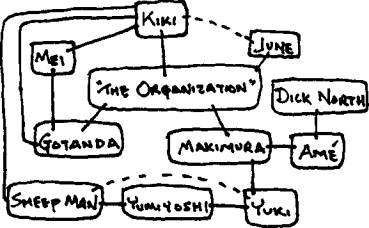
I pored
over the diagram, half in admiration, half in despair. Three call girls, one
too-charming-for-his-own-good actor, three artists, one budding teenage girl,
and a very uptight hotel receptionist. If this was anything more than a network
of casual relationships, I sure didn't see it. But it
296
might
make a good Agatha Christie novel. By George, that's it! The
Secretary did it! Only who was laughing?
And who
was I kidding? I didn't have a clue. The ball of yarn tangled wherever you
tried to unravel it. First there were the Kiki and Mei and Gotanda threads. Add
Makimura and June. Then Kiki and June were somehow connected by the same phone
number. And around and around you go.
'Hard
nut to crack, eh, Watson?' I addressed the ashtray before me. The ashtray, of
course, did not respond. Smart ashtray. Same went for the coffee cup and sugar
bowl and the bill. They all pretended not to hear. Stupid me. I was the one
running amok in these weird goings-on. I was the worn-out one. Such a wonderful
spring night, and no prospect for a date.
I went
home and tried calling Yumiyoshi. No luck. The early shift? Or her swim club
night? I wanted to see her badly. I missed her nervous patter, her brisk
movements. The way she pushed her glasses up on her nose, her serious
expression when she stole into the room. I liked how she took off her blazer
before sitting down beside me. I felt warm just thinking about her. I felt
drawn to her. But would we ever get things straight between us?
Working
behind the front desk of a hotel, going to her swim club-that gave her
satisfaction. While I found plea-sure in my Subaru and my old records and
eating well as I went on shoveling. That's the two of us. It might work and
then again it might not. insufficient
data, prognosis impos-sible. Or would I wind up hurting her too, as I
did every woman I ever got involved with? Like my ex-wife said.
The
more I thought about Yumiyoshi, the more I felt like flying up to Sapporo to
fill in the missing data. At least I could tell her how I felt. But, no, first
I had to untie some critical knots. Things were half-done. I didn't want to
keep dragging them around with me. A half-gray shadow would cloud my path for
the rest of my days. Not entirely ideal.
The
problem was Kiki. I couldn't get over the feeling that she was at the heart of
it. She was trying to reach me. In my
297
dreams,
in a movie in Sapporo, in downtown Honolulu. She kept crossing my path, trying
to lead me somewhere, leave me a message. That much was clear. But nothing
else. Kiki, what did you want from me?
What
was I supposed to do?
I could
only wait, until something showed. Same as ever. There was no point in rushing.
Something was bound to happen. Something was bound to show. You had merely to
wait for it to stir, up from the haze. Call it a lesson from experience.
Very
well, then, I would wait.
I got
together with Gotanda every few days after that. After a while, it became a
habit. And each time we met, he'd apologize for keeping the Subaru so long.
'Haven't
plowed the Maserati into the sea yet, have
you?'
he joked.
'Sorry
to say, but I haven't had time to go to the sea,' I
parried.
Gotanda
and I sat at a bar drinking vodka tonics. His
pace a
little faster than mine.
'I bet
it would feel great, though. Plowing it into the sea,' he said, raising his
glass to his lips.
'Like a
cool breeze,' I said. 'But then you'd only get yourself a Ferrari.'
'I'd
ditch that too.'
'And
after the Ferrari?'
'Hmm,
who knows? But sooner or later, the insurance company's going to want a word
with me.'
'Insurance
company? Who gives a damn about your insurance company? You got to think big.
Go for the grand sweep. This is fantasy, not one of your low-budget movies.
Fantasies don't have budgets, so why be middle class about it? Go wild!
Lamborghini, Porsche, Jaguar! The sky's the limit! And the ocean's big enough
to swallow cars by the thousands. Let your imagination do its stuff, man.'
298
He
laughed. 'Well, it certainly lightens me up.'
'Me
too, especially since it's not my car and not my imagination,' I said, then
asked how things were going with his ex-wife.
He took
a sip of his drink and looked out at the rain. The bar had emptied out except
for us. The bartender had noth-ing to do but dust the bottles.
'Things're
going okay,' he said meekly, under a whisper of a smile. 'We're in love. A love
affirmed and consum-mated by divorce. Romantic, isn't it?'
'Isn't
it, though. I might faint.'
He
chuckled.
'But
it's true,' he said.
'I
know,' I said.
That
was the general drift of conversation each time I saw Gotanda. What we talked
about was too serious to treat anything but lightly. Most of the jokes weren't
terribly good, but it didn't matter. It was enough that we could joke,
that there were jokes between us. We ourselves didn't know how serious we were.
Thirty-four
is a difficult age. A different kind of difficult than age thirteen, but plenty
difficult. Gotanda and I were both thirty-four, both beginning to acknowledge
middle age. It was time we did. Readying things to keep us warm during the
colder days ahead.
Gotanda
put it succinctly. 'Love. That's what I need.'
'I'm so
touched,' I said. But the fact was, that's what I needed too.
Gotanda
paused to consider what he'd said. I thought about it as well. I also thought
about Yumiyoshi. How she drank all those Bloody Marys that snowy night.
'I've
slept with so many women, I can't count them. You sleep with one, you've slept
with them all. Hell, you go through the same motions,' said Gotanda after a
while. 'Love's what I want. Here I am, baring my sentimental soul
299
to you
again. But I swear, the only woman I want to sleep with is my ex-wife.'
I
snapped my fingers. 'Incredible. The Word from Above. O Light Resplendent. You've
got to hold a press conference. Make your I-only-want-to-sleep-with-my-wife
proclamation. Everyone will be moved beyond tears. You might even receive a
citation from the Prime Minister.'
'No,
this is Nobel Prize material. Not something the common man can do.'
'You'll
need a frock coat for the ceremony.'
'I'll
buy it. Put it on my expense account.'
'Sanctus tax deductum.'
'I'll
be on stage with the King of Sweden,' Gotanda went on. 'I'll declare it for all
the world to hear. Ladies and gen-tlemen, the only woman I want to sleep with
is my wife! Waves of emotion. Storm clouds part; sun breaks through.'
'The
ice cap melts, the Vikings are vanquished, the mer-maids sing.'
Ah,
love. We both lapsed silent, meditating on its grandeur. I had a lot to think
about. I had to make sure I picked up some vodka and tomato juice and Lea &
Perrins and lemons.
'Or
then again, maybe you won't receive an award,' I piped up. 'Maybe they'll just
take you for a pervert.'
Gotanda
considered that. 'Maybe. We're talking neo-sexual revolution here. The masses
might rise up and tram-ple me to death,' he said. 'I'd be a sexual martyr.'
'The
first actor martyred to the neo-sexual revolution.'
'Martyred
and never to sleep with his ex-wife again.'
Time
for another drink.
If he
had a spare moment, Gotanda would call and we'd go out or he'd come over to my
place or I'd go over to his. The days passed. I'd resolved not to work at all.
I couldn't be bothered. The world was doing very well without me. Meanwhile I
was waiting.
300
I
mailed Hiraku Makimura the balance of his money and receipts from the trip.
The
next day I got a call from Boy Friday, begging me to take it all.
It was
too much trouble to go through the whole back-and-forth bow-and-scrape routine,
so I gave in. If it made the Master happy, who was I to argue? And before you
could say 'money in the bank,' Makimura had sent me a check for three hundred
thousand yen. Also in the envelope was a receipt marked for services rendered-field
research. I signed it, stamped it with my seal, and posted it. Back to
the wonderful world of expense accounts.
I
placed the check for three hundred thousand yen on my desk to appreciate 83/4%
dust.
The
Golden Week holidays came and went.
I
called Yumiyoshi a number of times. She was always the one who determined the
length of the conversation. Some-times we talked for a long time, other times
she'd simply say, 'Busy, got to go now,' and hang up. Or if a silence hung on
the line too long, she'd cut me off without warning. But at least we talked.
Exchanged data, a little at a time. And one day, she gave me her home phone
number. Progress.
She
went to her swim club twice a week. Which I found, to my dismay, still brought
on moments of jealousy. Hand-some instructors and all. I was as bad as a high
school boy and I knew it. And what was worse, I was afraid she knew it. Jealous
of a swim club?
That's ridiculous.
You're so immature. I was
afraid she'd never want to see me again.
So
whenever the subject came up, I held my tongue. Though not talking about it only
inflated my paranoia. Visions of the instructor-Gotanda, of course-keeping
Yumiyoshi after class for intensive one-on-one sessions. His hands supporting
her chest and abdomen as she practiced the crawl. His hands caressing her
breasts, easing between her thighs. But it's all right, he says.
301
It's
all right. Don't
you know? The
only woman I want to sleep with is my wife.
Then he
takes Yumiyoshi's hand and puts it on his crotch. She begins to massage it. An
underwater erection, like coral. Yumiyoshi is in rapture.
It's
all right. Don't
you know? The
only woman I want to sleep with is my wife.
Idiotic,
yet that's what came to mind whenever I called Yumiyoshi. As time went on, the
vision got more and more complex, with a whole cast of characters. Kiki and Mei
and Yuki put in guest appearances. As Gotanda's fingers stroked her body,
Yumiyoshi became Kiki.
'Listen,
I'm just a plain, run-of-the-mill person,' Yumi-yoshi said one night. She
seemed particularly drained after a long day's drudgery. 'The only difference
between me and anyone else is my name. Otherwise I'm the same. I'm just working
behind the counter of a hotel day after day, pointlessly wearing down my life.
Don't call me any more. I'm not worth the phone charges.'
'But I
thought you liked hotel work.' 'I do.' 'But?'
'The
work is fine. But sometimes, I think the hotel's going to eat me up. Just
sometimes. I ask myself, if I'm here or not, what's the difference? The hotel
would still be there. But not me. I'm out of the picture. That's the
difference.'
'Aren't
you taking this hotel business a little too seri-ously?' I asked. 'The hotel's
the hotel, you're you. I think about you a lot, and sometimes I think about the
hotel. But never together. You're you, the hotel's the hotel.'
'You
think I don't know that? I know that, but people get confused. My private life
and my identity get dragged into this hotel world, and then they get swallowed
up.'
'It
happens to everyone. You get dragged into something and you lose track of where
one thing ends and the other
302
begins.
You're not the only one. It happens to me too,' said.
'It's
not the same thing, not at all,' she declared.
'No,
maybe not. But I can still sympathize, can't I? Because, I mean, there's
something about you that's very attractive.'
Yumiyoshi
went silent, out there in the telephone void.
'I ...
I'm frightened,' said Yumiyoshi, verging into sobs. 'I'm frightened of that
darkness. I'm frightened that it's going to come again, soon.'
'Hey,
what's going on with you? Are you all right?'
'Of
course I'm all right. What did you think?' She was clearly sobbing now. 'So I'm
crying. Anything wrong with that?'
'No,
nothing at all. I was merely concerned.'
'Can't
you just be quiet?'
I did
as told and Yumiyoshi cried until she couldn't cry anymore, then she hung up on
me.
On May
seventh, Yuki called.
'I'm
back,' she announced. 'Why don't we go out for a ride?'
I
tooled the Maserati to the Akasaka condo. But when Yuki saw the car, she
wrinkled up her face unpleasantly.
'What's
with this?'
'I
didn't steal it, don't worry. My car fell into an enchanted spring and what do
you know? The fairy of the spring appeared looking like Isabelle Adjani and
asked, 'Was that a gold Maserati or a silver BMW just now?' And I said,
'Neither, that was a copper Subaru,' and-'
'C'mon,
bag the stupid jokes,' said Yuki. 'I'm asking a serious question. Where the
heck did you get this thing?'
'I
traded temporarily with a friend. He needed to borrow the Subaru, for personal
reasons.'
'A
friend?'
'You
may not believe it, but yes, I do have at least one friend.'
303
She
climbed into the passenger seat, took a look around inside, then made a funny
face. 'Weird car,' she said.
Dopey.'
'Now
that you mention it, the owner said the same thing. Although his words were
slightly different.'
That
shut her up.
I
pointed the Maserati south, toward Shonan. Yuki wouldn't speak. I played a
Steely Dan tape on low and drove with care. The weather was clear and warm, so
I was wear-ing an aloha shirt and sunglasses, and Yuki had on a pink Polo
shirt. It was like being in Hawaii again. In front was a livestock truck full
of pigs, their red eyes peering through the slats at us. Could pigs distinguish
between a Maserati and a
Subaru?
'How
was it in Hawaii after I left?' I finally asked.
Yuki
shrugged.
'Things
go all right with your mother?'
Another
shrug.
'Get
your surfing down?'
Still
another shrug.
'You
look real healthy. Perfectly tanned. Like cafe au lait, all smooth and
delicious.'
Shrug.
You
couldn't say I wasn't trying. I was trying everything.
'Is it
your period or something?'
The
same.
So I
shrugged back.
'I want
to go home,' Yuki said. 'Hang a U.'
'This
is an expressway. Even Niki Lauda couldn't man-age a U-turn here.'
'Then
exit someplace.'
I
turned to her. She looked exhausted suddenly, her eyes lifeless and unfocused.
Perhaps a bit pale too; it was hard to tell through the tan.
'Want
to stop and take a rest?'
'I
don't want a rest stop. I want to go back to Tokyo.
Now!'
304
We got
off at the expressway at Yokohama, then headed back on going in the opposite direction.
When we reached Akasaka, Yuki asked if we could go sit somewhere. So I parked
the Maserati in the lot, and we walked to the grounds of Nogi Shrine and found
a bench.
'I'm
sorry,' said Yuki, trying to be reasonable. 'I felt sick. I didn't want to say
anything, so I held it in.'
'You
don't have to hold it in. I know how girls get. I'm used to it.'
'It's
not like that!' she shouted. 'That has nothing to do with it! What got to me
was riding in that car. That stupid car!'
'What's
wrong with the Maserati? It's not such a bad car. It handles real well, rides
pretty nice too. True, a bit too flashy for my simple tastes. Even if I could
afford it, I guess I'd never buy a car like that.'
'I
don't care what brand that car is. The problem's that car. Couldn't you feel
it? It was icky. I was
suffocating. I could feel a pressure in my chest, and in my stomach too. You
didn't feel it?'
'No,' I
said. 'Although I got to admit, I don't feel one hundred percent comfortable in
it. I thought it was because I was used to the Subaru. You know, you like what
you're used to, but that's not this pressure you're talking about.'
She
shook her head. 'No, it's not that at all. This is some-thing real peculiar.'
'Is
this more of your . . . ?' I cut myself short. I didn't want to say anything
that sounded condescending.
'Yeah,
it's more of that. I felt something.'
'Well,
what was it? What did you sense in that car?'
Yuki
shrugged yet again, but this time she was talking. 'It'd be easy if I could
explain, but I can't. I can't picture it. There's just this feeling-a heavy,
dark, awful lump of pres-sure in me. And it's totally ...' Yuki searched for
the word, hands on her lap. 'It's wrong! I don't
know what's wrong.
305
But something's
wrong. I couldn't breathe in there. I tried to ignore it, I thought maybe it
was jet lag or something, but then it got worse and worse. I don't want to ride
in that car ever again, you hear me? Get your Subaru back.'
'The
Curse of the Maserati,' I intoned.
'This
is no joke. You shouldn't be driving that car,' she said, very seriously.
'Okay,
okay,' I gave in with a smile. 'I know you're not kidding. I'll try not to
drive the Maserati too much. Or maybe I should go sink the thing in the sea?'
'If
possible,' said a grave Yuki.
It took
Yuki about an hour to recover from this shock to her system. We sat on the
bench, and she rested her chin on her hands and kept her eyes shut. People
passed through the grounds. Old folks, mothers with children, foreign tourists
with cameras strung around their necks. Occasionally, a salesman-type or
salaryman would stop and take a breather on a bench near us. Dark suit, plastic
briefcase, glassy stare. Ten minutes later, he'd be off beating the pavement
again. By most standards, a normal adult should be working at this hour, and a
normal kid should be in school.
'What
about your mother?' I asked. 'Did she come back with you?'
'Mmm.'
That was Yuki saying yes. 'She's up in Hakone with that one-armed guy. Sorting
out her photos of Kath-mandu and Hawaii.'
'And
you didn't want to stay in Hakone?'
'I
didn't feel like it. There's nothing for me to do there.'
'Just
thought I'd ask,' I said. 'Tell me, what exactly is there for you to do on your
own in Tokyo?'
One of
her patented shrugs. Then, 'I can hang out with you.'
'Well,
I couldn't ask for more myself. However, trying to be realistic, pretty soon I
ought to be getting back to work. I can't afford to keep running around with
you forever. And I
306
don't
want handouts from your father either.'
Yuki
sneered. 'I can understand your not wanting to take handouts from my parents,
but why do you have to make such a big deal about it? How do you think it makes
me feel, dragging you all around the place like this?'
'So you
want me to take the money?'
'If you
did, I wouldn't feel so guilty.'
'You don't
get it, Yuki,' I said. 'I don't want money for being your friend. I don't want
to be introduced at your wedding reception as 'the professional male companion
of the bride since she was thirteen.' Everyone would be titter-ing,
'professional male companion, professional male com-panion.' I want to be
introduced as 'the boyfriend of the bride when she was thirteen.''
Yuki
blushed. 'You turkey. I'm not going to have a wed-ding reception.'
'Great.
I don't like weddings. All those absurd speeches and the bricks of wedding cake
you're supposed to take home. Strains the boundaries of propriety. But all I
want to say is, you don't buy friends. Especially not with expense account
money.'
'That
makes a good moral for a fairy tale.'
'Wow!
You're finally getting the proper gift of gab. With practice we could be a
couple of stand-up comics.'
Shrug.
'But
seriously, folks, ...' I cleared my throat. 'If you want to hang out with me
every day, Yuki, I'm all for it. Who needs to work? It's just pointless
shoveling anyway. But we have to have one thing clear: I'm not going to accept
money for doing things with you. Hawaii was different. I took money for that. I
even took the woman thrown in. Of course, I thought you weren't ever going to
talk to me again. I hated myself for allowing the whole business about pay-ment
for services to happen at all. From now on, I'm doing things my way. I don't
want to answer to anybody, and I don't want to be on somebody's dole. I'm not
Dick North and I'm not your father's manservant, whatever his name is.
307
You
don't need to feel guilty.'
'You
mean you'll really go out with me?' Yuki chirped, then looked down at her
polished toenails.
'You
bet. You and me, we could be this pair of outcasts. We could be quite an item.
So, let's just relax and have a good time.'
'Why
are you being so kind?'
'I'm
not.'
Yuki
traced a design in the dirt with the tip of her sandal. A squared spiral.
'And
I'm not a burden on you?'
'Maybe
you are and maybe you aren't. Don't worry your pretty little head about it. I want
to be with you because I like you. Sometimes when I'm with you, I remember
things I lost when I was your age. Like I remember the sound of the rain and
the smell of the wind. And it's really a gift, getting these things back. Even
if you think I'm weird. Maybe you'll understand what I mean some day.'
'I
already know what you mean.'
'You
do?'
'I
mean, I've lost plenty of things this far in my life too,' said Yuki.
'Well,
then, there you are,' I said.
She
said nothing. I returned to looking at the visitors to the shrine grounds.
'I
don't have anybody I can really talk to but you,' Yuki spoke up. 'Honest.'
'What
about Dick North?'
Yuki
stuck out her tongue. 'He's a goon.'
'Maybe
he is and maybe he isn't. But I think you should know, he does good, and he's not
pushy about it. That's pretty rare. He may not be up to your mother's level,
and he may not be a brilliant poet. But he genuinely cares for your mother. He
probably loves her. He's a good cook, he's dependable, he's considerate.'
'He's
still a goon.'
Okay,
okay. Yuki obviously had her feelings on the mat-
308
ter. So
I changed the subject. We talked about the good times we had in Hawaii. Sun and
surf and tropical breezes and pina coladas. Yuki said this made her hungry, so
we went to eat pancakes and fruit parfaits. Then we took in a movie.
The
following week, Dick North died.
34
Dick
North had been doing the shopping on a Mon-day evening in Hakone and had just
stepped out from the supermarket with a bag of groceries under his arm when a
truck came barreling down the road and slammed into him. The truck driver
confessed that he didn't know what possessed him to gun full-speed ahead in
such poor road visibility. And Dick himself had made a telling slip. He'd
looked to his left, but was one or two breaths behind in checking his right. A
common mistake among people who have lived overseas for any length of time and
have just returned to Japan. You haven't gotten used to cars driving on the
left-hand side yet. In most cases, you come away with chills, but sometimes
it's worse. The truck sent Dick sailing into the opposite lane, where he was
battered again by an oncoming van. He died instantly.
When I
heard the news, the first thing that came to mind was going shopping with Dick
at a probably similar supermarket in Makaha. How knowledgeably he selected his
purchases, how he examined the fruit and vegetables and unembarrassedly tossed
a box of Tampax into the
310
shopping
cart. Poor bastard. Unlucky to the last. Arm blown off in Vietnam when the guy
next to him stepped on a mine. Running around morning to night putting out
Ame's smol-dering cigarettes. Now dead on the asphalt holding onto a load of
groceries.
His
funeral saw him returned to his rightful family, his wife and child. Neither
Ame nor Yuki nor I attended.
I
borrowed the Subaru back from Gotanda and drove Yuki to Hakone that Tuesday
afternoon. It was at Yuki's urging. 'Mama can't get by on her own. Sure,
there's the maid, but she's too old to do anything and she goes home at night.
We can't leave Mama alone up there.'
'Yeah,
it's probably good for you to spend some time with your mother,' I said.
Yuki
was flipping through the road atlas. 'Hey, you remember I said bad things about
him?'
'Who?
Dick North?'
'Yeah.'
'You
called him a goon,' I said.
Yuki
stowed the book in the door pocket, rested her elbow on the window, and turned
her gaze to the scenery ahead. 'But you know,' she said, 'he wasn't so bad. He
was nice to me. He spent time telling me how to surf and all. Even without that
arm, he was a lot more alive than most people with two arms. Plus, he took good
care of Mama.'
'I
know.'
'But I
said nasty things about him.'
'You
couldn't help yourself,' I said. 'It's not your fault.'
She
looked straight ahead the whole way. She didn't turn to look at me. The breeze
blowing in through the window ruffled her bangs.
'It's
sad, but I think he was that sort of person,' I said. 'A nice guy, maybe even
worthy of respect. But he got treated like some kind of fancy trash basket.
People were always dumping on him. Maybe he was born with that tendency.
Mediocrity's like a spot on a shirt-it never comes off.'
'It's
unfair.'
311
'As a
rule, life is unfair,' I said.
'Yeah,
but I think I did say some awful things.'
'To
Dick?'
'Yeah.'
I
pulled the car over to the shoulder of the road and
turned
off the ignition.
'That's
just stupid, that kind of thinking,' I said, nailing her with my eyes. 'Instead
of regretting what you did, you could have treated him decently from the
beginning. You could've tried to be fair. But you didn't. You don't even have
the right to be sorry.'
Yuki
looked at me, shocked and hurt. 'Maybe I'm being too hard on you. But listen, I
don't care what other people do. I don't want to hear that sort of talk from
you. You shouldn't say things like that lightly, as if saying them is going to
solve anything. They don't stick. You think you feel sorry about Dick, but I
don't believe you really do. If I were Dick, I wouldn't want your easy regret.
I wouldn't want people saying, 'Oh, I acted horribly.' It's not a question of
manners; it's a question of fairness. That's something you have to learn.'
Yuki
couldn't respond. She pressed her fingers to her tem-ples and quietly closed
her eyes. She almost seemed to have dozed off, but for the slight flutter of
her eyelashes, the trem-bling of her lips. Crying inside, without sobs or
tears. Was I expecting too much of a thirteen-year-old girl? Who was I to be so
self-righteous? Still, whether or not she was thirteen, whether or not I was an
exemplary human being, you can't let everything slide. Stupidity is stupidity.
I won't put up with it.
Yuki
didn't move. I reached out and touched her arm.
'It's
okay,' I said. 'I'm very narrow-minded. No, to be fair, you've done the best
that can be expected.'
A
single tear trailed down her cheek and fell on her lap. That was all. Beautiful
and noble.
'So
what can I do now?' she spoke up a minute later.
'Nothing,'
I said. 'Just think about what comes before
312
words.
You owe that to the dead. As time goes on, you'll understand. What lasts, lasts;
what doesn't, doesn't. Time solves most things. And what time can't solve, you
have to solve yourself. Is that too much to ask?'
'A
little,' she said, trying to smile.
'Well,
of course it is,' I said, trying to smile too. 'I doubt that this makes sense
to most people. But I think I'm right. People die all the time. Life is a lot
more fragile than we think. So you should treat others in a way that leaves no
regrets. Fairly, and if possible, sincerely. It's too easy not to make the
effort, then weep and wring your hands after the person dies. Personally, I
don't buy it.'
Yuki
leaned against the car door.
'But
that's real hard, isn't it?' she said.
'Real
hard,' I said. 'But it's worth trying for. Look at Boy George: Even a fat gay
kid who can't sing can become a star.'
'Okay,'
she smiled, 'but why are you always getting on Boy George's case? I bet you
must really like him, deep down.'
'Let me
think about that one,' I said.
Yuki's
mother's house was in a large resort-housing tract. There was a big gate, with a
pool and a coffee house adja-cent. There was even a stop-and-shop minimart
filled with junk food. No place someone like Dick North would have bought
groceries at. Me either. As the road twisted and turned up the grade, my
friendly Subaru began to gasp.
Halfway
up the hill was Ame's house, too big for just a mother and daughter. I stopped
the car and carried Yuki's bags up the steps to the side of the stone
embankment. Down the slope, between the ranks of cedars, you could make out the
ocean by Odawara. The air was hazy, the sea dull under the leaden glaze of
spring.
Ame
paced the large, sunny living room, lit cigarette in hand. A big crystal
ashtray was overflowing with bent and
313
crushed
Salem butts, the entire tabletop dusted with ashes. She tossed her latest butt
into the ashtray and came over to greet Yuki, mussing her hair. She wore a
chemical-spotted oversized sweatshirt and faded jeans. Her hair was uncombed,
eyes bleary.
'It's
been terrible,' said Ame. 'Why do these horrible things always happen?'
I
expressed my condolences and inquired about the details of yesterday's
accident. It was all so sudden, she told me, she felt out of control, confused,
uncertain. 'And of course the maid came down with a fever today and won't be
in. Now of all times, a fever! I'm going crazy. The police come, Dick's wife
calls, I don't know what they expect of me.' 'What did Dick's wife have to
say?' 'I couldn't make it out,' she said. 'She just cried. And when she wasn't
crying, she mumbled so I could barely under-stand what she was saying. And me,
in this position, what was I supposed to say?. . . What was I
supposed to say?' I shook my head.
'I told
her I'd send along Dick's things as soon as I could, but then the woman was
crying even more. It was hopeless.' She let out a big sigh and collapsed into
the sofa. I asked her if she wanted anything to drink, and she asked for
coffee. For good measure, I also cleared away the ashtray and cocoa-caked mugs,
and wiped off the table. While I waited for the water to boil, I tidied up the
kitchen. Dick North had kept a neat pantry, but already it was a mess. Dirty
dishes were piled in the sink, cocoa had been dribbled across the stainless
steel cooktop, knives lay here and there smeared with cheese and
who-knows-what, the lid of the sugar container was nowhere in sight.
Poor
bastard, I thought as I made a strong pot of coffee. He tried so hard to bring
order to this place. Now in the space of one day, it was gone. Just like that.
People leave traces of themselves where they feel most comfortable, most
worthwhile. With Dick, that place was the kitchen. But even that tenuous
presence was on its way out.
314
Poor
bastard.
I
carried in the coffee and found Ame and Yuki sitting on the sofa. Ame's head
rested on her daughter's shoulder. She looked drugged and drained. Yuki seemed
ill at ease. How odd they appeared together-so different from when they were
apart-how doubly unapproachable.
Ame
accepted the coffee with both hands and drank it slowly, preciously. The
slightest glow came to her eyes.
'You
want anything to drink?' I asked Yuki.
She
shook her head with no expression whatsoever.
'Has
everything been taken care of?' I asked Ame. 'The business about the accident,
legal matters, and all that?'
'Done.
The actual procedure wasn't so difficult. It was a perfectly common accident. A
policeman came to the house to tell me the news, and that was it. I told them
to contact Dick's wife, and she handled everything. I mean, I had no legal or
even professional relationship with Dick. Then the wife called here. She hardly
said a word, she just cried. She didn't even scream, nothing.'
A
perfectly common accident.
Another
three weeks and Ame wouldn't remember there ever was someone in her life named
Dick North. Ame was the forgetful type, and, unfortunately, Dick was
forgettable.
'Is
there anything I can do to help?' I asked.
'Well,
yes. Dick's belongings,' she muttered. 'I told you I was going to return them
to her, didn't I?'
'Yes.'
'Well,
last night I put his things in order. His manuscripts and typewriter and books
and clothes-they all fit in one suitcase. There wasn't that much stuff. Just
one suitcase full. I hate to ask, but could you deliver it to his wife?'
'Sure.
Where does the family live?'
'I
don't know exactly. Somewhere in Gotokuji, I know. Could you find out for me?'
Yuki
showed me the study where Dick's things were. Upstairs, a long, narrow garret
at the end of the hall, what had originally been the maid's room. It was
pleasant enough,
315
and
naturally Dick had kept everything in immaculate order. On the desk were
arranged five precision-sharpened pencils and an eraser, an unqualified still
life. A calendar on the wall had been annotated with meticulous handwriting.
Yuki
leaned in the doorway and scanned the interior in silence. All you could hear
were the birds outside. I recalled the cottage in Makaha. It had been just as
quiet, and there had been birds too.
The tag
on the suitcase, also in Dick's hand, had his name and address. I lugged it
downstairs. With his books and papers, it was much heavier than it looked. The
weight yet another reminder of the fate of Dick North.
'There's
not much here to eat,' said Ame. 'Dick went out to do the shopping and then all
this happened.'
'Don't
worry. I'll go to the store,' I said.
I
checked the contents of the refrigerator to see what she did have. Then I drove
down to town, to the supermarket where Dick had spent the last moments of his
life, and pur-chased four or five days' worth of provisions.
I put
away the groceries, and Ame thanked me. I felt like I was merely finishing up
the task that Dick had left undone.
The two
women saw me off from atop the stone embank-ment. The same as in Makaha, only
this time nobody was waving. That had been Dick's role. The two stood there,
not moving, gazing down on me. An almost mythological scene, like an icon. I
heaved the gray suitcase into the backseat and slid behind the wheel. Mother
and daughter were still stand-ing there when I turned the curve and headed out
of their sight. The sun was starting to sink into an orange sea. How would they
spend the night? I wondered.
That
one-armed skeleton in the eerie gloom of the room in Honolulu, it was now
clear, was Dick North. So, who could the other five
be?
316
Let's
say my old friend, the Rat, for one. Dead several years now, in Hokkaido.
Then
Mei, for another.
That
left three. Three more.
What
was Kiki doing there? Why did she want to show me these six deaths?
I made
it down to Odawara and got on the Tokyo-Nagoya Expressway. Exiting at
Sangenjaya, I navigated my way into the suburbs of Setagaya by map and found
Dick North's house. An ordinary two-story suburban home, very small. The door
and windows and mailbox and entry light- everything seemed to be in miniature.
A mongrel on a chain patrolled the front door. There were lights on inside the
house, the sound of voices. Dick's wake was in progress. At least he had
somewhere to come home to.
I took
the suitcase out of the car and hauled it to the front door. I rang the
doorbell and a middle-aged man appeared. I explained that I'd brought Dick's
things; my expression said I didn't know any more than that. The man looked at
the name tag and grasped the situation immediately.
'Very
much obliged,' said the man, stiff but cordial.
And so,
with no more resolve than before, I returned to my Shibuya apartment.
Three
more, I thought.
In the
scheme of things, what possible meaning was there to Dick North's death?
Alone
in my room, I mulled it over a whiskey. It hap-pened so suddenly, how could
there have been meaning? All these blank spots in the puzzle and this piece
didn't fit any-where. Flip it over, turn it sideways, still no good. Did the
piece belong somewhere else entirely?
Even if
Dick's death had no meaning in itself, a major change of circumstances seemed
inevitable. And not for the better either, my intuition told me. Dick North was
a man of good intentions. In his own way, he had held things together.
317
But now
that he was gone, things were going to change, things were going to get harder.
For
instance?
For
instance, I didn't care for Yuki's blank expression whenever she was with Ame.
Nor did I like Ame's dull, spaced-out stare when she was with Yuki. There was
some-thing bad there. I liked Yuki. She was a good kid. Smart, maybe a little
stubborn at times, but sensitive underneath it all. And I had nothing against
Ame, really. She was attrac-tive, full of vision, defenseless. But put the two
of them together and the combination was devastating.
There
was an energy that mounted with the two females together.
Dick
North had been the buffer after Makimura. But now that he was gone, I was the
only one left to deal with them.
For
instance-
I rang
up Yumiyoshi a few times. She was as cool as ever, although I may have detected
a hint of pleasure in her voice. Apparently I wasn't too much of a nuisance.
She was work-ing every day, going to her swim club twice a week, dating
occasionally. The previous Sunday, she told me, a guy had taken her for a drive
to a lake.
'He's
just a friend. An old classmate, now working in Sapporo. That's all.'
I
didn't mind, I said. Drive or hike or like, I didn't need to know. What really
got to me was her swim club.
'But
anyway, I just wanted to tell you,' said Yumiyoshi. 'I hate to hide things.'
'I
don't mind,' I repeated. 'All I care about is that I get up to Sapporo to see
you again. You can go out with any-body you like. That's got nothing to do with
us. You've been in my thoughts. Like I said before, I feel a bond between us.'
Once
again, she asked me what I meant. And again, my heart was in my words, but the
explanation made no sense. Typical me.
318
A
moderate silence ensued. A neutral-to-slightly-positive silence. True, silence
is still silence, except when you think about it too much.
Gotanda
looked tired whenever I saw him. He'd been squeezing trysts with his ex-wife
into an already tight work schedule.
'All I
know is, I can't keep this up forever,' he said, sigh-ing deeply. 'I'm not cut
out for this living on the fringes. I'm a homebody. That's why I'm so run-down.
I'm over-extended, burned out.'
'You
ought to go to Hawaii for a break,' I said. 'Just the two of you.'
'Wouldn't
I love to,' he said, smiling weakly. 'Maybe for five days, lying on the beach,
doing nothing. Even three days would be terrific.'
That
evening I'd gone to his condo in Azabu, sat on his chic sofa with a drink in my
hand, and watched a compila-tion tape of the antacid commercials he'd appeared
in. The first time I'd ever seen them.
Four
office building elevators without walls or doors are rising and falling at high
speeds like pistons. Gotanda is in a dark suit, briefcase in hand, every inch
the elite businessman. He's hopping back and forth from elevator to elevator,
con-ferring with his boss in one, making a date with a pretty young secretary
in another, picking up papers here, rushing to dispatch them there. Two
elevators away a telephone is ringing. All this jumping back and forth between
speeding elevators is no easy trick, but Gotanda isn't losing his cool mask. He
looks more and more serious.
VOICE
OVER
Everyday
stress builds up in your stomach. Give
the busi-ness to your busy-ness with a gentle remedy....
I
laughed. 'That was fun.'
319
'I
think so too,' he said. 'Idiotic but fun. All commer-cials are nonsense, but
this one is well shot. It's a damn sight better than most of my feature films,
I'm sorry to say. Ad people have no qualms about spending on details, and the
sets and those special effects cost a lot. It's not a bad concept either.'
'And
it's practically autobiographical.' 'You said it,' he laughed. 'Boy, does my stomach
get stressed out. But let me tell you, that stuff doesn't do a damn thing. They
gave me a dozen packs to try, and it's a wonder how little it works.'
'You
really do move, though,' I said, rewinding the tape by remote control to watch
the commercial again. 'You're a regular Buster Keaton. You might have found
your calling.'
A smile
floated across Gotanda's lips. 'I'd be interested. I like comedy. There's
something to be said when a straight man like me can bring out the humor of a
routine like that. You try to live straight in this crazy, crooked, mixed-up
world-that's what's funny. You know what I
mean?' 'I do, I do,' I said.
'You
don't even have to do anything especially funny. You just act normal. That
alone looks strange and funny. Acting like that interests me. That type of
actor simply doesn't exist in Japan today. People always overact when it comes
to comedy. What I want to do is the reverse. Not act.' He took a sip of his
drink and looked up at the ceiling. 'But no one brings me roles like that. The
only roles they ever, ever bring into my agency are doctors or teachers or
lawyers. You've heard me go on about this before, and let me tell you, I'm
bored, bored, bored, bored. I'd like to turn them down, but I'm in no
position to reject anything, and my stomach takes a beating.'
Gotanda's
first antacid commercial had been so well received, he'd made a number of
sequels. The pattern was always the same. If he wasn't jumping back and forth
between trains and buses and planes with split-second tim-ing, he was scaling a
skyscraper with papers under his arms
320
or
tightrope-walking between offices. Through it all, Gotan-da kept a perfect
deadpan.
'At
first the director told me to look tired. Like I was about to keel over from
exhaustion. But I told him, no, that it'd come off better if I just played it
straight. Of course, they're all idiots, they didn't go for it at all. But I
didn't give in. I don't do these commercials for fun, but I was sure about the
right way to do it. I insisted. So they shot it two ways and everyone liked
mine much more. And then, of course, the commercial was a success, so the
director took all the credit. He even won some kind of prize for it. Not that I
care. What eats me is how they all act so big, as if they thought the whole thing
up. The ones with no imagination are always the quickest to justify
themselves.'
Gotanda
switched off the video and put on a Bill Evans record.
'All
these idiots think they're so sharp, they got me danc-ing on their pinheads. Go
here, go there. Do this, do that. Drive this car, go out with that woman. It's
a bad movie of a bad life. How long can it last?'
'Maybe
you ought to just toss it and start again from scratch. If anyone could do it,
you could. Leave your agency, and take your time paying back what you owe.'
'Don't
think I haven't thought about it. If I was on my own, that's what I'd do. Go
back to square one, and join some theater group. I wouldn't mind, believe me.
But if I did, my ex-wife would drop me, just like that. She grew up under
pressure-star-system pressure-and she needs people around her who feel that
pressure too. If the atmosphere drops, she can't breathe. So if I want to be
with her, I haven't got a choice,' said Gotanda, with a smile of resignation.
'Let's talk about something else. I could go on until morning and still not get
anywhere.'
And so
he brought up Kiki.
It was
because of Kiki that Gotanda and I had become friends, yet he'd hardly heard a
word out of my mouth
321
about
her. Did I find it hard to talk about her? If so, he wouldn't insist.
No, I
told him, not at all.
I told
him that Kiki and I got together entirely by chance and that we were living
together soon after that. She bur-rowed into my life so unobtrusively, I could
hardly believe she hadn't always been there. 'I didn't notice how extraordi-nary
it was at the time. But when I thought it over later, the whole scenario seemed
completely unreal. And when I put it into words, it sounds silly. Which is why
I haven't told any-one about it.'
I took
a drink, swirling the ice in my glass.
'In
those days, Kiki was working as an ear model, and I'd seen these photos of her
ears and, well, I got obsessed, to put it mildly. Her ear was going to appear
in this ad-I for-get what for-and my job was to write the copy. I was given these
three photos, these three enormous close-ups of her ears, close enough to see
the baby fuzz, and I tacked them up on my wall. I started gazing at these ears,
day in and day out. At first I was fishing for some kind of inspiration, some
kind of catchphrase, but then the ears became a part of my life. Even after I
finished the job, I kept the photos up. They were incredible-they were
perfectly formed, bewitching. The dream image of an ear. You'd have to see the
real thing, though. They were ...'
'Yeah,
you did mention something about her ears.'
'I had
this total fixation. So I made these calls and found out who she was and I
finally got ahold of her and she agreed to see me. The first day we met, we
were at a restau-rant and she personally showed me her
ears. Personally, I mean, not professionally, and they were even more amazing
than in the photograph. They were exquisite! Fantastic! When she exposed her
ears professionally-that is, when she modeled them-she blocked
them, she said. So they were gorgeous but they were different from her
ears when she showed them. And when she did, it was like
the entire world
322
underwent
a transformation. I know that sounds ludicrous, but I don't know how else to
put it.'
Gotanda
considered seriously what I'd said. 'What do you mean by her 'blocking' her
ears?'
'Severing
her ears from her consciousness.'
'Oh.'
'She
pulled the plug on her ears.'
'Uh-huh.'
'Sounds
crazy, but it's true.'
'Oh, I
believe you. I'm honestly trying to understand. Really, no kidding.'
I eased
back into the sofa and looked at a painting on the wall.
'Her
ears had special power. They were like some great whirlpool of fate sucking me
in. And they could lead people to the right place.'
Gotanda
pondered my words again. 'And,' he said, 'did Kiki lead you anywhere? To some
'right place'?'
I
nodded, but didn't say more about it. Too long and involved to explain.
'Now,'
I said, 'she's trying to lead me somewhere again. I can sense it, very
strongly. For the last few months, I've had this nagging feeling. And little by
little I've been reeling in the line. It's a very fine line. It got snagged a
couple of times, but it's gotten me this far. It's brought me in contact with a
lot of different people. You, for instance. You're one of the central figures
in this drama. Still, I can't get a grip on what's going on. Two people I knew
have died recently. One was Mei. The other was a one-armed poet. I don't know
what's going on, but I know something is.'
The ice
in the bucket had all but melted, so Gotanda fetched a new batch from the
kitchen to freshen both our drinks.
'So you
see, I'm stuck too,' I picked up again. 'Just like you.'
'No,
there you're wrong. You and I are not alike,'
323
Gotanda
said. 'I'm in love with one woman. And it's a dead-end kind of love. But not you.
Maybe you're confused and wandering in a maze, but compared with this emotional
morass I've gotten myself dragged into, you're much, much better off. You're
being guided somewhere. You've got hope. There's possibility of a way out. But
not for me, not at all. That's the big difference between us.'
Well,
maybe, maybe so. 'Whatever. I've been clinging to this line from Kiki. That's
all I can do for now. She's been sending these signals, these messages. So I
spend my time trying to stay tuned in.'
'Do you
think,' Gotanda started cautiously, 'that there's a possibility Kiki's been
killed?' 'Like Mei?'
'Uh-huh.
I mean, she disappeared so suddenly. When I heard Mei was murdered, right away
I thought about Kiki. Like maybe the same thing happened to her. I didn't want
to say it before.'
And yet
I'd seen her, in downtown Honolulu, in the dim dusk light. I'd actually seen
her. And Yuki knew it.
'Just
something that crossed my mind. I didn't mean any-thing by it,' Gotanda said.
'Sure,
the possibility exists. But she's still sending me messages. Loud and clear.'
Gotanda
crossed his arms for a few minutes, pensive. He looked so exhausted, I thought
he might nod off. Night was stealing into the room, enveloping his trim
physique in fluid shadow.
I
swirled the ice around in my glass again and took a sip. That was when I
noticed a third presence in the room. Someone else was here besides Gotanda and
myself. I sensed body heat, breathing, odor. Yet it wasn't human. I froze. I
glanced quickly around the room, but I saw nothing. There was only the feeling
of something. Something
solid, but invisible. I breathed deeply. I strained to hear.
It
waited, crouching, holding its breath. Then it was gone.
324
I eased
up and took another sip.
A
minute or two later Gotanda opened his eyes and smiled at me. 'Sorry. Seems
we're making a depressing eve-ning of it,' he said.
'That's
because, basically speaking, we're both depressing people,' I said.
Gotanda
laughed, but offered no further comment.
35
Toward
the end of May, by chance-as far as I know-I ran into one of the cops who'd
grilled me about Mei's murder. Bookish. I was coming out of Tokyu Hands, the
department store with everything for the home you ever wanted, and found myself
squeezed up against him at the exit. The day seemed like midsummer, yet here he
was in a heavy tweed jacket, entirely unaffected by the heat. Maybe police
stiffs are trained to be insensitive. He was holding a Tokyu Hands bag like me.
I pretended not to see him and was moving past when the undaunted detective spoke
directly to me.
'You
don't have to be so standoffish, you know,' he quipped. 'As if we didn't know
each other.'
'I'm in
a hurry,' was all I said.
'Oh?'
said he, not swallowing the line for a second.
'I have
to be getting back to work,' I stammered.
'I can
imagine,' said he. 'But surely even a busy man like yourself can spare ten
minutes. Let me buy you a cup of coffee. I've been wanting to talk to you,
business aside. Honest, just ten minutes of your time.'
I
followed him into a crowded coffee shop. Don't ask me why. I could've politely
said sorry and gone home. But I didn't. We went in and sat down alongside young
couples and clusters of students. The coffee tasted horrible, the air
326
was
bad. Bookish pulled out a cigarette and lit up.
'Been
trying to quit,' he said. 'But there's something about the job. When I'm
working, I gotta smoke.'
I
wasn't going to say anything.
'The
job's rough on the nerves. Everybody hates you. The longer you're in homicide,
the more they hate you. Your eyes go, your complexion starts to look like shit.
You wouldn't know your own age. Even the way you talk changes. Not a healthy
way to live.'
He
added three spoonfuls of sugar and creamer to his cof-fee, stirred well, and
drank it like a connoisseur.
I
looked at my watch.
'Ah,
yes, the time,' said Bookish. 'We still have five min-utes, right? Fine. I'll
keep this short. So about that murdered girl. Mei.'
'Mei?'
I asked. I'm not snared that easily.
He
twisted his lips, insinuating. 'Oh, right, sure. The deceased young woman's name
was Mei. Not her real name, of course. Her nom d'amour. She turned out to
be a hooker, just like I thought. She may not have looked professional, but I
could tell. Used to be you could spot the hookers in a second. The clothes, the
makeup, the look on their faces. But nowadays you get girls you'd never believe
in the trade. It's the money, or they're curious. I don't like it. And it's
danger-ous. Or don't you think so? Meeting unknown men behind closed doors.
There's all types out there. Perverts and nut cases.'
I
forced a nod.
'But
young girls, they don't know that. They think every-thing's cool. Can't be
helped. When you're young, you think you can handle anything. By the time you
find out other-wise, it's already too late. You got a stocking wrapped around
your neck. Poor thing.'
'So did
you find the killer?'
Bookish
shook his head and frowned. 'Not yet, unfortu-nately. We did discover some
interesting facts. Only we didn't publish them in the newspaper. Seeing as how
the
327
investigation
is still going on. For example, we found out her professional name was Mei, but
her real name was . . . Aww, what difference does it make what her real name
was. The girl was born in Kumamoto. Father a public servant. Kumamoto's not
such a big city, but he was next-to-top there. Family very well-off. Mother
came to Tokyo once or twice a month to shop. No financial problems. The girl
got a good allowance from them. She told them she was in the fashion business.
She had one older sister, married to a doc-tor; one younger brother, studying
law at Kyushu University. So what's a nice girl from a good home like that
doing sell-ing her tail? The family had a big shock coming. We spared them the
call girl part, but their darling daughter strangled to death in a hotel room
was pretty unsettling.' I said nothing and let him continue.
'We
looked into the prostitute ring she was involved in. It wasn't easy, but we
managed to track it down. How do you think we did it? We staked out the lobbies
of some luxury hotels around town and hauled in a few women on suspicion of
illegal commerce. We showed them the same photos we showed you and asked a few
questions. One of them cracked. Not everyone's got a tough hide like you, heh
heh. Anyway, turns out the deceased worked for this exclusive operation.
Superexpensive membership. Nothing the likes of you or me can swing. I mean,
can you pay seventy thousand yen a pop? I know I can't.
At that price, I'd just as soon screw the wife and buy the kid a new bike,' he
laughed ner-vously. 'But suppose I could swing the seventy
grand, I still wouldn't be good enough. They run a background check, you see.
Safety first. They can't afford weird shit from cus-tomers. But also they
prefer a certain class of customer. No way a detective can
get membership. Not that law enforce-ment is necessarily a strike against you.
If you're top brass, real top brass, that's another story. You might come in
handy someday. But a cop like me, no way.'
He
finished his coffee and lit up another cigarette.
'So we
went to the captain for a search warrant. It took
328
three
days to come through. By the time we set foot in the place, the whole operation
had been cleaned out. Spotless. Not a speck of dust. There'd been a leak. And
where do you think that leak came from?' I didn't
know.
'C'mon,
man, you're not dumb. The leak came from inside. I'm talking inside
the police. Somebody
on top. No proof, of course. But we grunts on the street know an inside job
when we see one. The word goes out to get scarce. Sorry state of affairs. But
predictable. And an operation like that one is used to this sort of thing. They
can move in the time it takes us to use the toilet. They are gone. They find another
place to rent, buy new phone lines, and just like that they're back in
business. No sweat off their back. They still got their subscriber list, they
still got their girls lined up, they barely been inconvenienced. And there's no
way to trace them. The thread's cut. With this dead girl, if we had some idea
what type of customer was her specialty, we could do something. But as it is,
we gotta throw up our hands.' 'Don't look at me,' I said. 'You sure you don't
know anything?' 'Hey, if she was part of this exclusive call girl setup like
you say, they'd know in an instant who killed her, right?'
'Exactly,'
said Bookish. 'So chances are the killer was probably someone not on the list.
The girl's own private lover, or else she was turning tricks on the side. We
searched her apartment. Not a clue.' 'Listen, I didn't kill her.'
'I know
that,' said
Bookish. 'I already told you that. You're not the killer type. I can tell by
looking at you. Your type never kills anybody. But you do know something, I
know that. You know more than you're letting on. So why don't you come out with
it? That's all I want. No hard-lin-ing. I give you my word of honor.' 'I don't
know a thing,' I said.
'Figures,'
Bookish mumbled, puffing his smoke. 'This is going nowhere. Fact is, the boys
upstairs aren't crazy about
329
this
investigation. After all, it's only a hooker killed in a hotel, no big deal. To
them, that is. They probably think a hooker's better off dead anyway. The guys
on top, they hardly ever set eyes on a stiff. They haven't got the vaguest idea
what it's like to see a beautiful girl naked and strangled like that. They can't
imagine how pitiful it is. And you can bet that it's
not just police brass in on this prostitution racket. There's always a few
upstanding public servants got their fingers in the pie too. You can see the
gold lapel pins flashing in the dark. Cops develop an eye for this sort of
business. We see the least little glint, and we pull in our necks, like
turtles. Something you learn from your superiors. So that's how it goes.
Somehow, the drift is, our Miss Mei's murder is just going to get buried. Poor
thing.'
The
waitress cleared away Bookish's cup. I still had half of my coffee left.
'It's
weird, but I feel close to this Mei girl,' said Bookish. 'Now why should that
be? It doesn't figure, does it? But when I saw her strangled naked on that
hotel bed, she did a number on me. And I decided, I made this pledge to her, I
was going to get the fucker who did it. Now, I've seen more stiffs than I care
to. So what's one more corpse, you say? This one was special. Strange and
beautiful. The sunlight was pouring in through the window, the girl lying
there, frozen. Eyes wide open, tongue hanging out of her mouth, stocking around
her throat. Just like a necktie. Her legs were spread, and she'd pissed. When I
saw that, I knew. The girl was asking me for help. Must seem remarkable to you,
this soft touch I have. No?'
I
couldn't say.
'You,
you've been away a while. Got a tan I see,' said the detective.
I
mumbled something about Hawaii on business.
'Nice
business. Wish I could switch saddles to your line of work, instead of looking
at stiffs morning to night. Makes a fellow real fun company. You ever see a
corpse?'
No, I
hadn't.
330
He
shook his head and looked at the clock. 'Very well, then, hope you excuse me
for wasting your time. But like they say, small world running into you at a
place like this. What do you got in your bag?'
A
soldering iron.
'Oh
yeah? I got some drainpipe cleaner. Sink in the house backed up.'
He paid
the bill. I offered to pay my portion, but he insisted.
As we
were walking out, I asked casually if prostitute murders happened a lot.
'Well,
I guess you could say so,' he said, eyes sharpening slightly. 'Not every day,
but not only on holidays either. Any reason you're so interested in prostitute
murders?'
Just
curious is all.
We went
our separate ways, but the queasy feeling in the pit of my stomach still hadn't
gone away the following morning.
36
May
drifted past, slow as clouds. It had been two and a half months since I'd
worked. Fewer and fewer work calls came in. The trade was gradually forgetting
about me. To be sure, no work, no money coming in, but I still had plenty in my
account. I didn't lead an expensive life. I did my own cook-ing and washing,
didn't spend a lot. No loans, no fancy tastes in clothes or cars. So for the
time being, money was no problem. I calculated my monthly expenses, divided it
into my bank balance, and figured I had another five months or so. Something
would come of this wait-and-see. And if it didn't, well, I could think it over
then. Besides, Makimura's check for three hundred thousand yen still graced my
desk-top. No, I wasn't going to starve.
All I
had to do was keep things at a steady pace and be patient. I went to the pool
several times a week, did the shopping, fixed meals. Evenings, I listened to
records or
read.
I began
going to the library, leafing through the bound editions of newspapers, reading
every murder case of the last few months. Female victims only. Shocking, the
number of women murdered in the world. Stabbings, beatings, stranglings. No
mention of anyone resembling Kiki. No body resembling Kiki, in any case. Sure,
there were ways to
332
dispose
of a body. Weight it down and throw it in the sea. Haul it up into the hills
and bury it. Just like I'd buried Kip-per. Nobody would ever find him.
Maybe
it was an accident? Maybe she'd gotten run over, like Dick North. I checked the
obituaries for accident vic-tims. Women victims. Again, a lot of
accidents that killed a lot of women.
Automobiles, fires, gas. Still no Kiki.
Suicides?
Heart attacks? The papers didn't seem inter-ested. The world was full of ways
to die, too many to cover. Newsworthy deaths had to be exceptional. Most people
go unobserved.
So
anything was possible. I had no evidence that Kiki was dead, no evidence that
she was alive.
I
called Yuki now and then. But always, when I asked how she was, the answer was
noncommital.
'Not
good, not bad. Nothing much.'
'And
your mother?'
'She's
taking it easy, not working a lot. She sits around all day, kind of out of it.'
'Anything
I can do? The shopping or something?'
'The
maid does the shopping, so we're okay. The store delivers. Mama and I are just
spacing out. It's like ... up here, time's standing still. Is time really
passing?'
'Unfortunately,
the clock is ticking, the hours are going by. The past increases, the future
recedes. Possibilities decreasing, regrets mounting.'
Yuki
let that pass.
'You
don't sound like you have much vim and vigor,' I said.
'Oh
really?'
'Oh
really?'
'What's
with you?'
'What's
with you?'
'Stop
mimicking me.'
'Who's
mimicking you? I'm just a mental echo, a figment
333
of your
imagination. A rebound to demonstrate the fullness of our conversation.'
'Dumb
as usual,' said Yuki. 'You're acting like a child.'
'Not
so. I'm solid with deep inner reflection and prag-matic spirit. I'm echo as
metaphor. The game is the message. This is of a different order than child's
play.'
'Hmph,
nonsense.'
'Hmph,
nonsense.'
'Quit
it. I mean it!' yelled Yuki.
'Okay,
quits,' I said. 'Let's take it again from the top. You don't sound like you
have much vim and vigor, Yuki.'
She let
out a sigh. 'Okay, maybe not. When I'm with Mama ... I end up with one of her
moods. It's like she has this power over how I feel. All she ever thinks about
is her-self. She never thinks about anyone else. That's what makes her so
strong. You know what I mean. You've seen it. You just get all wrapped up in
it. So when she's feeling down, I feel down. When she's up, I'm up.'
I heard
the flicking of a lighter.
'Maybe
I could come up and visit you,' I said.
'Could
you?'
'Tomorrow
all right?'
'Great,'
said Yuki. 'I feel better already.'
'I'm
glad.'
'I'm
glad.'
'Stop
it.'
'Stop
it.'
'Tomorrow
then,' I said and hung up before she could say it.
Ame was
indeed 'kind of out of it.' She sat on the sofa, legs neatly crossed, gazing
blankly at a photography maga-zine on her lap. She was a scene out of an
impressionist painting. The window was open, but not a breeze stirred the
curtains or pages. She looked up ever so slightly and smiled when I entered the
room. The very air seemed to vibrate
334
around
her smile. Then she raised a slender finger a scan five centimeters and
motioned for me to sit down on the chair opposite. The maid brought us tea.
'I
delivered the suitcase to Dick's house,' I said. 'Did you meet his wife?' Ame
asked. 'No, I just handed it over to the man who came to the door.'
'Thank
you.' 'Not at all.'
She
closed her eyes and put her hands together in front of her face. Then she
opened her eyes again and looked around the room. There was only the two of us.
I lifted my cup and sipped my tea.
Ame
wasn't wearing her usual denim shirt. She had on a white lace blouse and a pale
green skirt. Her hair was neatly brushed, her mouth freshened with lipstick.
Her usual vital-ity had been replaced by a fragility that enveloped her like
mist. A perfumed atmosphere that wavered on evaporation. Ame's beauty was
wholly unlike Yuki's. It was the chromatic opposite, a beauty of experience.
She had a firm grasp on it, knew how to use it, whereas Yuki's beauty was
without pur-pose, undirected, unsure. Appreciating an attractive middle-aged
woman is one of the great luxuries in life.
'Why is
it . . . ?' Ame wondered aloud, her words trail-ing off. I waited for her to
continue.
'. . .
why is it,' she picked up again, 'I'm so depressed?'
'Someone
close to you has died. It's only natural that you feel this way,' I said.
'I
suppose,' she said weakly.
'Still-'
Ame
looked me in the face, then shook her head. 'You're not stupid. You know what I
want to say.'
'That
it shouldn't be such a shock to you? Is that it?'
'Yes, well,
something like that.'
That
even if he wasn't such a great man. Even
if he wasn't so talented. Still
he was true. He
fulfilled his duties nobly, excellently. He forfeited what he treasured and
335
worked
hard to attain, then he died. It
was only after his death that his worth became apparent. I wanted to say
that-but didn't. Some things I can't bring myself to utter.
'Why is
it?' she addressed a point in space. 'Why is it all my men end up like this?
Why do they all go in strange ways? Why do they always leave me? Why can't I
get things right?'
I
stared at the lace collar of her blouse. It looked like pristinely scrubbed
folds of tissue, the bleached entrails of a rare organism. A subtle shaft of
smoke rose from her Salem in the ashtray, merging into a dust of silence.
Yuki
reappeared, her clothes changed, and indicated that she wanted to leave. I got
up and told Ame we were going out for a bit.
Ame
wasn't listening. Yuki shouted, 'Mother, we're going out now,' but Ame scarcely
nodded as she lit another cigarette.
We left
Ame sitting on the sofa motionless. The house was still haunted by Dick North's
presence. Dick North was still inside me as well. I remembered his smile, his
surprised look when I asked if he used his feet to slice bread.
Interesting
man. He'd come more alive since his death.
37
I went
up to see Yuki a few more times. Three times, to be exact. Staying in the
mountains of Hakone with her mother didn't seem to hold any particular
attraction for her. She wasn't happy there, but she didn't hate it either. Nor
did she feel compelled to look after her mother. Yuki let herself be blown
along by the prevailing winds. She simply existed, without enthusiasm for all
aspects of living.
Taking
her out seemed to bring back her spirits. My bad jokes slowly began to elicit
responses, her voice regained its cool edge. Yet, no sooner would she return to
the house than she became a wooden figure again. Her voice went slack, the
light left her eyes. To conserve energy, her little planet stopped spinning.
'Wouldn't
it be better for you to be back on your own in Tokyo for a while?' I asked her
as we sat on the beach. 'Just for a change of pace. Three or four days. A
different environment can do wonders. Staying here in Hakone's only going to
bring you down. You're not the same person you were in Hawaii.'
'No way
around it,' said Yuki. 'But it's like a phase I have to go through. Wouldn't
matter where I was, I'd still be like this.'
'Because
Dick North died and your mother's like that?'
337
'Maybe.
But it's not the whole thing. Just getting away from Mama isn't going to solve
everything. I can't do any-thing on my own. I don't know, it's just the way I
feel. Like my head and body aren't really together. My signs aren't so good
right now.'
I
turned and looked out to sea. The sky was overcast. A warm breeze rustled
through the clumps of grasses on the
sand.
'Your
signs?' I asked.
'My
star signs,' Yuki smiled. 'It's true, you know. The signs are getting worse.
Both for Mama and me. We're on the same wavelength. We're connected that way,
even if I'm away from her.'
'Connected?'
'Yeah,
mentally connected,' Yuki said. 'Sometimes I can't stand it and I try to fight
it. Sometimes I'm just too tired and I give in, and I don't care. It's like I'm
not really in control of myself. Like I'm being moved around by some force. I
can't stand it. I want to throw everything out the window. I want to scream
'I'm only a kid!' and go hide in a corner.'
Before
it got too late I drove Yuki home and headed back to Tokyo. Ame asked me to
stay for dinner, as she invariably did, but I always declined. A very
unappetizing prospect, the idea of sitting down to a meal with mother dreary
and her disinterested daughter, both on the same wavelength, there in the
lingering presence of the deceased. The dead-weighted air. The silence. The
night so quiet you could hear any sound. The thought of it sank a stone in my
stomach. The Mad Hatter's tea party might have been just as absurd, but at
least it was more animated.
I
played loud rock 'n' roll on the car stereo all the way home, had a beer while
cooking supper, and ate alone in peace.
338
Yuki
and I never did much. We listened to music as we drove, lolled around gazing at
clouds, ate ice cream at the Fujiya Hotel, rented a boat on Lake Ashinoko.
Mostly we just talked and spent the whole afternoon watching the day pass. The
pensioners' life.
Once,
upon Yuki's suggestion that we see a movie, we drove all the way down to
Odawara. We checked the listings and found nothing of interest. Gotanda's Unrequited
Love was playing at a second-run theater, and when I
mentioned that Gotanda was a classmate from junior high school, whom I got
together with occasionally, Yuki got curious.
'Did
you see it?'
'Yeah,'
I admitted, 'I saw it.' I didn't say how many times.
'Was it
good?' asked Yuki.
'No, it
was dumb. A waste of film, to put it mildly.'
'What
does your friend say about the movie?'
'He
said it was a dumb movie and a waste of film,' I laughed. 'And if the performer
himself says so, you can be sure it's bad.'
'But I
want to see it anyway.'
'As you
wish.'
'You
don't mind?'
'It's
okay. One more time's not going to hurt me,' I said.
On a
weekday afternoon, the theater was practically empty. The seats were hard and
the place smelled like a closet. I bought Yuki a chocolate bar from the snack
bar as we waited for the movie to start. She broke off a piece for me. When I
told her it'd been a year since I'd last eaten chocolate, she couldn't believe
it.
'Don't
you like chocolate?'
'It's
not a matter of like or dislike,' I said. 'I guess I'm just not interested in
it.'
'Interested?
You are weird. Whoever heard of not liking chocolate?
That's abnormal.'
'No,
it's not. Some things are like that. Do you like the Dalai Lama?'
339
'What's
that?'
'It's
not a 'what,' it's a 'who.' He's the top priest of Tibet.'
'How
would I know?'
'Well,
then, do you like the Panama Canal?'
'Yes,
no, I don't care.'
'Okay,
how about the International Date Line? Or pi? Or the
Anti-Trust Act? Or the Jurassic Period? Or the Sene-galese national anthem? Do
you like or dislike November 8, 1987?'
'Shut
up, will you? How can you churn out so much garbage so fast?' she struck back.
'So you don't like or dis-like chocolate, you're just not interested in it.
Happy?'
Presently
the movie began. I knew the whole story back-wards, so I didn't bother paying a
lot of attention. Yuki didn't think much of the picture either, if the way she
mut-tered to herself was any indication.
On
screen, the handsome teacher Gotanda was explaining to his class how mollusks
breathe. Simply, patiently, with just the right touch of humor. The girl lead
gazed at him.
'Is
that guy your friend?' Yuki asked.
'Yeah.'
'Seems
like a real airhead,' said Yuki.
'You
said it,' I said. 'But only in the film. In real life, he's a good guy.'
'Then
maybe he should get into some good movies.'
'That's
what he wants to do. Not so easy, though. It's a long story.'
The
movie creaked along, obvious and mediocre plot. Mediocre script, mediocre
music. They ought to have sealed the thing in a time capsule marked 'Late 20th
Century Mediocrity' and buried it somewhere.
Finally
Kiki's scene came up. The most intense point in the movie. Gotanda and Kiki
sleeping together. The Sunday morning scene.
I took
a deep breath and concentrated on the screen. Sun-day morning sunlight slanting
through the blinds, the same
340
light,
same exposure, same colors as always. I'd engraved every detail of that room in
my brain. I could almost breathe the atmosphere of that room. Zoom in on
Gotanda. His hand moves down Kiki's spine. Sensuously, effortlessly, caressing.
The slightest tremor of response runs through her body. Like a candle flame
just flickering in a microcurrent of air that the skin doesn't feel. I hold my
breath. Close-up of Gotanda's fingers. The camera starts to pan. Kiki's face
comes into view. Enter lead girl. She climbs the apartment stairs, knocks on
the door, opens it. Once again, I ask myself, why isn't it locked? Makes no
sense. But it doesn't have to. It's just a film and a mediocre one at that. The
girl walks in, sees Gotanda and Kiki getting it on. Her eyes regis-ter shock.
She drops her cookies and runs. Gotanda sits up in bed, numbly observing what
has transpired. Kiki has her line, 'What was that all
about?'
The
very same as always. Exactly the same.
I shut
my eyes. The Sunday morning light, Gotanda's hand, Kiki's back, everything
floats up with singular clarity. A discrete little world existing in a
dimension all its own.
The
next thing I know, Yuki was bent forward, head on the backrest of the seat in
front, with both arms wrapped around herself as if to ward off the cold. Dead
silent, not moving a hair. Hardly a sign of breathing.
'Hey,
are you all right?' I asked.
'No, I
don't feel very well,' Yuki barely squeezed out the words.
'Let's
get out of here. Do you think you can manage?'
Yuki
half-nodded. I held her stiffened arms and helped her out of the theater. As we
walked up the aisle, Gotanda was up on the screen behind us, lecturing the
class in biol-ogy. Outside, the streets were hushed under a curtain of fine rain.
The scent of surf blew in from the sea. Supporting her by the elbow, I walked
her slowly to the car. Yuki was biting her lip, not saying anything. I didn't
say anything either. The parking lot was scarcely two hundred meters from the
the-ater, but it took forever.
38
I sat
Yuki in the front seat and wound her window open. Soft rain fell, undetectable
to the eye, though the asphalt was slowly staining black. There was the smell
of rain. Some people had their umbrellas up, others walked along as if nothing
was coming down. An outstretched hand would be retracted with only a hint of
dampness. It was that fine a rain.
Yuki
rested an arm on the door and her chin upon that, the tilt of her neck turning
her face half out of the car. She held that pose for a good while, not moving
except to breathe. Each tiny rise followed by a tiny fall, the slightest crest
and trough of breath. How could anyone look so fragile, so defenseless? From
where I sat, it seemed that the least impact would be enough to snap off her head
and elbow. Was it merely that she was a child, not hardened to the ways of the
world, while I was an adult, who, however inexpertly, had endured?
'Is
there anything I can I do?' I asked. 'Not really,' said Yuki, swallowing as she
spoke face-down. The saliva clearing her throat sounded unnaturally loud. 'Take
me somewhere quiet where there's no people, but not too far.' 'The beach?'
342
'Wherever.
But don't drive fast. I might throw up if we bump too much.'
I
lifted her head inside onto the headrest, careful as if cradling an egg, and
rolled up her window halfway. Then as slowly as the traffic would allow, we
headed to the Kunifuzu seaside. We parked the car and walked to the beach,
where Yuki vomited onto the sand. There'd been hardly anything in her stomach,
only the chocolate and gastric juices. The most excruciating way to get sick.
The body is in spasms, but nothing comes. You're wringing out your entire
system, until your stomach is a knot the size of a fist. I massaged her back.
The misting rain continued, but Yuki didn't notice.
Glyauughhh
. . . Yuki's
eyes welled up with tears as she retched.
I tried
lamely to comfort her.
After
ten minutes of this, I wiped her mouth with a hand-kerchief and kicked sand
over the mess. Then holding her by the elbow, I walked her over to a nearby
jetty. We sat down, leaning back against the seawall as the rain began to fall.
We stared off into the waves, at the cars droning in the back-ground on the
West Shonan Causeway. The only people around were standing in the water before
us, fishing. They wore slickers and rain hats, their eyes trained somewhere
below the horizon, their rods unbending. They didn't turn around to see us.
Yuki lay her head on my shoulder, but didn't say a word. We must have seemed
like lovers.
Yuki closed
her eyes. Breathing so lightly, she seemed to be asleep. Her wet bangs were
plastered in a clump across her forehead, her skin still tan from last month.
But beneath the overcast sky, Yuki looked sickly. I wiped the rain and tears
from her face. Rain kept falling silently over the boundless sea. Self-Defense
Force submarine-spotting planes groaned past overhead like dragonflies in heat.
Finally,
her head still resting on my shoulder, she opened her eyes and looked at me in
soft focus. She pulled a Virginia Slim from her hip pocket and lit up. Or tried
to repeat-edly-she barely had the strength to light a match. No lec-
343
tures
from me about smoking, not this time. Eventually she got it lit and flicked the
match away. Then after two drags on the cigarette, she tossed it away too. It
continued burning until the rain put it out.
'Your
stomach still hurt?' I asked.
'A
little.'
'Let's
just stay put a while though. You're not cold?'
'I'm
fine. The rain feels good.'
The
fishermen were still transfixed on the Pacific. What was the attraction of
fishing? It couldn't be merely catching fish. Was it just one of those acquired
tastes? Like sitting out on a rainy beach with a high-strung thirteen-year-old?
'Your
friend,' Yuki ventured cautiously, her voice cracking.
'My
friend?'
'Yeah,
the one in the film.'
'His
real name's Gotanda,' I said. 'Like the station on the Yamanote Line. The one
after Meguro and before Osaki.'
'He
killed that woman.'
I
squinted at Yuki, hard. She looked wan. Her breathing came irregularly, like a
nearly drowned soul trawled up from the drink. What was the girl saying? It
didn't register. 'Killed what woman?' I asked.
'That
woman. The one he was sleeping with on Sunday morning.'
I
didn't get it. I couldn't get it. What was she talking about? Half-consciously,
I smiled and said, 'But nobody dies in the movie. You must be mistaken.'
'Not in
the movie. In real life. He actually killed her. I saw it,' said Yuki,
clutching my arm. 'It scared me so much I could hardly breathe. That whatever-it-is
came over me again. I could see the whole murder, sharp and clear. Your
friend killed that woman. I'm not making this up. Honest.'
My
spine turned to ice, I couldn't utter a word. Every-thing was falling out of
place, tumbling down, out of my hands. I couldn't hold on to anything.
'I'm
sorry. Maybe I shouldn't have said anything,' said
344
Yuki.
She sighed and let go of my arm. 'The honest truth is, I don't know. I can feel that
it's real, but I can't really be sure if it's
real or not. And I know you'll probably hate me like everyone else for saying
so. But I couldn't not tell you. Whether
it's real or not, I saw it. I couldn't keep quiet about it. I'm really scared.
Please don't get angry at me. I can't handle it. I feel like I'm falling
apart.'
'I'm
not mad, so calm down and tell me what you saw,' I said, holding her hand.
'It's
the first time I've ever seen anything clearly like this. He strangled her, the
woman in the movie. And he put the body in the car and drove a long, long way.
It was that Ital-ian car you were driving once. That car, it's his, isn't it?'
'Yes,
it's his car,' I said. 'Is there anything else? Slow down and think it over.
Whatever comes to mind, no matter how small, tell me. I want to know.'
She
shook her head tentatively, twice, three times. Then she breathed deeply.
'There's really not much more. The smell of soil. A shovel. Night. Birds
chirping. That's about it. He strangled that girl to death, loaded her off
somewhere in that car, and buried her. That's all. But-and this is the truly
strange part-the whole thing didn't seem vicious or horrible or anything. It
didn't even seem like a crime. It was more like a ceremony. It was a quiet
thing, between the killer and the victim. But a very strange quiet. Like it was
out on the edge of the earth or something.'
I
closed my eyes. My thoughts wouldn't go anywhere. Objects and events in my head
were disintegrating, flying like shrapnel through the dark. I didn't believe
what Yuki was saying; I didn't disbelieve what Yuki was saying. I let her words
sink in. They weren't fact. They were possibility. Nothing more, nothing less,
but the force of the possibility was shattering.
Any
semblance of order I had come to know over the last few months was shot.
Diffuse, uncertain, but it was order, and it had taken hold. No more.
The
possibility exists. And in
the moment that I admitted
345
that,
something came to an end. Ever subtly, yet decisively, it was over. But what? I
couldn't think further. No, not now. Meanwhile, I found myself alone again.
With a thirteen-year-old girl, on a rainy beach, desperately alone.
Yuki
squeezed my hand.
How
long she held it, I don't know. A hand so small and warm it almost didn't seem
real. Her touch was more like a tiny replay from memory. Warm as a memory, but
it doesn't lead you anywhere.
'Let's
go,' I said. 'I'll take you home.'
I drove
her back up to Hakone. Neither of us spoke. When the silence became too
oppressive, I put on the stereo. There was music, but I didn't hear it. I
concentrated on driv-ing. Hands and feet, shifting gears, steering. The wipers
going back and forth, monotonously.
I
didn't want to have to see Ame, so I let Yuki out at the bottom of the steps.
'Hey,'
said Yuki, looking in through the passenger seat window, arms crossed tight and
shivering, 'you don't have to swallow everything I told you. I just saw it,
that's all. Like I said, I don't know if it really happened.
Please don't hate
me. I'd
die.'
'I
don't hate you,' I said, coming up with a smile. 'And I won't swallow anything,
unless it's the truth. It's got to come out some time. The fog's got to pull
away. I know that much. If what you say turns out to be true, okay, it just
means that I got a glimpse of the truth through you. Don't worry. It's
something I have to find out for myself.'
'Are
you going to see him?'
'Of
course. I'll ask him if it's true. There's no other way.'
Yuki
shrugged. 'You're not mad at me?'
'No,
I'm not mad at you, of course not,' I said. 'Why would I be mad at you? You
haven't done anything wrong.'
'You
were such a good guy,' she said. 'I never met any-one like you.'
Why
the past tense? I
wondered. 'And I've never met a
girl
like you.'
346
'Good-bye,'
said Yuki. Then she took a good, long look at me. She seemed fidgety. As if she
wanted to add some-thing more or hold my hand or kiss me on the cheek.
Nervous
images of possibility kept floating into my head all the way home. I made
myself focus on the mindless music and tacked my attention to the road ahead.
The rain let up just as I exited the Tokyo-Nagoya Expressway, but I didn't have
the energy to turn off the wipers until I pulled into my parking space in
Shibuya. My head was in a shambles. I had to do something. So I sat there in my
parked Subaru, my hands glued to the wheel.
39
I tried
to put my thoughts in order. First question: Should I believe Yuki? I analyzed
matters on the level of pure possibility, wiping the field clear of emotional
elements as far as I could see. This required no great effort. My feelings had
been numbed, as if I'd been stung, from the very beginning. The
possibility exists. The
longer I considered the possibility, the more the possibility moved toward
probability. I stood in the kitchen making coffee. Then pouring myself a cup, I
retreated with it to my bed. By the time I'd finished it, the probability had
become a fair certainty. Yes, it was exactly as Yuki had seen it: Gotanda had
murdered Kiki, hauled her body away, and
buried
it.
How
absurd. There was no proof whatsoever. Only the dream of an oversensitive
thirteen-year-old girl watching a movie. And yet, somehow, what she said could
not be doubted. This was shocking. Still my instincts accepted it fully. Why?
How could I be so sure?
I
didn't know.
Next
question: Why would Gotanda kill Kiki?
I
didn't know.
Next
question: Did Gotanda also kill Mei? Why? What would make Gotanda want to kill
her?
Again I
didn't know. I wracked my brains, but couldn't
348
come up
with a single reason why Gotanda would kill either Kiki or Mei.
There
were too many unknowns.
I had
to see Gotanda. I had to ask him directly. I reached for the phone but couldn't
bring myself to dial his number. I set down the receiver, rolled over on the
bed, and gazed up at the ceiling. Gotanda had become a friend. I would never
have guessed how much of a friend. Suppose he did kill Kiki, he was still my
friend. I didn't want to lose him. Not like I'd already lost so many things in
this life. No, I couldn't call him.
I
didn't want to talk to anybody.
I sat,
and when the phone rang, I let it ring. If it was Gotanda, what was I going to
say? If it was Yuki, or even Yumiyoshi, I didn't care. I didn't want to talk to
anybody.
Four
days, five days, I stayed put and thought. Why? I hardly ate,
hardly slept. I didn't drink a drop. I stayed indoors. I lost touch with my
body. With all that had hap-pened to me already, I was still losing. And now
here I was, alone. It was always like this. In some ways, Gotanda and I were of
the same species. Different circumstances, different thinking, different
sensibilities, the same species. We both kept losing. And now we were losing
each other.
I could
see Kiki. What was that all about? But was Kiki dead, covered with dirt, in
the ground? Like my Kipper? Ultimately, Kiki had to die. Strange how I couldn't
see things any other way. The skin of my soul was no longer tender. I tried not
to feel anything at all. My resignation was a silent rain falling over a vast
sea. Even loneliness was beyond me. Everything was taking leave of me, like
ciphers in the sand, blown away on the wind.
So
another person had joined the group in that most bizarre chamber of my world.
Four down, two to go. Sooner or later, bleached white bones ferried to that
room via some impossible architecture. Death's waiting room in downtown
Honolulu, connected to the dark chill lair of the Sheep Man in a Sapporo hotel,
connected to the Sunday morning bed-
349
room
where Gotanda lay with Kiki. Was I losing my mind? Real events, under imaginary
circumstances, filtering back, wild, distorted, bizarre. Was there nothing
absolute? Was there no ... reality? Sapporo in the March snow could as easily not have
been real. Sitting on the beach in Makaha with Dick North had seemed real
enough-but a one-armed man cutting bread in perfect slices? And a Honolulu call
girl giving me a phone number that I later find in the anteroom to the death
chamber Kiki leads me to? Why isn't that real? What could I reasonably admit
into evidence without caus-ing my whole world to shake at its foundations?
Was the
sickness in here or out there? Did it matter?
What was the line now? Get in step and dance, so that everyone's impressed.
Keeping in step-was that the only reality? Well, dance yourself to the
telephone, give your pal Gotanda a ring, and ask him casually: 'Did you kill
Kiki?'
No way.
My hand experienced sudden paralysis. I sat by the phone, numb, shaking, as if
I was in a crosswind. Breath-ing grew difficult. I liked Gotanda, I liked him a
lot. He was my only friend, he was part of my life. I understood him.
I tried
dialing. I got the wrong number, every time. On the sixth try, I hurled the
receiver to the floor.
I never
did manage to call. In the end it was Gotanda who showed up at my place.
It was
a rainy night. He was wearing a rain hat and the same white trench coat as the
night I drove him to Yoko-hama. The rain was coming down hard, and his hat was
dripping. He didn't have an umbrella.
He
smiled when he saw me. I smiled back, almost by
reflex.
'You
look awful,' he said. 'I called and called but never got an answer. So I
decided just to come over. You been under the weather?'
'Under
is not the word,' I said.
He
sized me up. 'Well, maybe it's a bad time. I'll come
350
back
when you're feeling better. Sorry to come by unan-nounced like this.'
I shook
my head and exhaled. No words came. Gotanda waited patiently. 'I'm not sick or anything,'
I assured him. 'I just haven't been sleeping or eating. I think I'm okay now.
Anyway I've been wanting to talk to you. Let's go some-where. I haven't eaten a
full meal in ages.'
We took
the Maserati out into the rainy neon streets. Gotanda's driving was precise and
smooth as ever, but the car now made me nervous. The deep soundproofed ride cut
a channel through the clamor that rose all around us.
'Where
to?' Gotanda asked. 'All I care is that it's some-where quiet where we can talk
and get decent food without running into the Rolex crowd.' he said. He looked
my way, but I said nothing. For thirty minutes we drove around, my eyes focused
on the buildings we were passing.
'I
can't think of any place,' Gotanda tried again. 'How about you? Any ideas?'
'No, me
neither.' I really couldn't. I was still only half present.
'Okay,
then, why don't we take the opposite approach?' he said brightly.
'The
opposite approach?'
'Someplace
noisy and crowded. That way we can relax.'
'Okay.
Where?'
'Feel
like pizza? Let's go to Shakey's.'
'I
don't mind. I'm not against pizza. But wouldn't they spot you, going to a place
like that?'
Gotanda
smiled weakly, like the last glow of a summer sun between the leaves. 'When was
the last time you saw anyone famous in Shakey's, my friend?'
Shakey's
was packed with weekend shoppers. Crowded and noisy. A Dixieland quartet in
suspenders and red-and-white striped shirts were pumping out The
Tiger Rag to a raucous college group loud on beer. The smell of
pizza was everywhere. No one paid attention to anyone else.
We
placed our order, got a couple drafts, then found a
351
table
under a gaudy imitation Tiffany lamp in the back of
the
restaurant.
'What
did I tell you? Isn't this more like it?' said Gotanda.
I'd
never craved pizza before, but the first bite had me thinking it was the best
thing I'd ever tasted. I must have been starving. The both of us. We drank and
ate and ate and drank. And when the pizza ran out, we each bought another
round
of beer.
'Great,
eh?' belched Gotanda. 'I've been wanting a pizza for the last three days. I
even dreamed about it, sizzling hot, sliding right out of the oven. In the
dream I never get to eat it, though. I just stare at it and drool. That's the
whole dream. Nothing else happens. What would Jung say about pizza archetypes?'
Gotanda chuckled, then paused. 'So what was this that you wanted to talk to me
about?'
Now or
never, I thought. But come right out with it? Gotanda was thoroughly relaxed,
enjoying the evening. I looked at his innocent smile and couldn't bring myself
to do it. Not now, at least.
'What's
new with you?' I asked. 'Work? Your ex-wife?' 'Work's the same,' Gotanda said.
'Nothing new, nothing good, nothing I want to do. I can yell until my throat
gives out, but nobody wants to hear what I have to say. My wife -did you hear
that? I still call her my wife after all this time-I've only seen her once
since I last saw you. Hey, you ever do the love hotel thing?' 'Almost never.'
'I told
you she and I have been meeting at love hotels. You know, the more you use
those places, it gets to you. They're dark, windows all covered up. The place
is only for fucking, so who needs windows, right? All you got is a bath-room
and a bed-plus music and TV and a refrigerator-but it's all pretty blank and
anonymous and artificial. Actually, very conducive to getting down and doing
it. Makes you feel like you're really doing it. After a while,
though, you feel the claustrophobia, and you begin to sort of hate the place.
Still, they're the only refuge we got.'
352
Gotanda
took a sip of beer and wiped his mouth with the napkin.
'I
can't bring her to my condo. The scandal rags would have a field day if they
ever found out. I got no time to go off somewhere. They'd sniff it out too
anyway. We've practi-cally sold our privacy by the gram. So we go to these
cheesy fuck hotels and ...' Gotanda looked over at me, then smiled. 'Here I go,
griping again.'
'That's
okay. I don't mind listening.'
The
Dixieland band struck up 'Hello Dolly.'
'Hey,
how about another pizza?' Gotanda asked. 'Halve it with you. I don't know what
it is with me, but am I starv-ing!'
Soon we
were stuffing our faces with one medium anchovy. The college kids kept up their
shouting match, but the band had finished their final set. Banjo and trumpet
and trombone were packed in their cases, and the musicians left the stage,
leaving only the upright piano.
We'd
finished the extra pizza, but somehow couldn't take our eyes off the empty
stage. Without the music, the voices in the crowd became plastic, almost
palpable. Waves of sound solidifying as they pressed toward us, yet broke
softly on contact. Rolling up slowly over and over again, striking my
consciousness, then retreating. Farther and farther away. Distant waves,
crashing against my mind in the distance.
'Why
did you kill Kiki?' I asked Gotanda. I didn't mean to ask it. It just slipped
out.
He
stared at me as if he were looking at something far off. His lips parted
slightly. His teeth were white and beauti-ful. For the longest time, he stared
right through me. The surf in my head went on and on, now louder, now fainter.
As if all contact with reality was approaching and receding. I remember his
graceful fingers neatly folded on the table. When my reality strayed out of
contact, they looked like fine craftwork.
Then he
smiled, ever so peaceably. 'Did I kill Kiki?' he enunciated slowly.
353
'Only
joking,' I hedged.
Gotanda's
eyes fell to the table, to his fingers. 'No, this isn't a joke. This is very
important. I really have to think about it. Did I kill
Kiki? I have to give this very serious thought.'
I
stared at him. His mouth was smiling, but his eyes weren't.
'Could
there be a reason for you to kill Kiki?' I asked.
'Could
there be a reason for me to kill Kiki? I don't even know myself. Did I kill
Kiki? Why?'
'Hey, how
would I know?' I tried to laugh. 'Did you kill Kiki, or didn't you kill Kiki?'
'I
said, I'm thinking about it. Did I kill Kiki, or didn't I?'
Gotanda
took another sip of beer, set down his glass, and propped his head up on his
hand. 'I can't be sure. Sounds stupid, doesn't it? But I mean it. I'm not sure.
I think, maybe, I tried to strangle Kiki. At my place, I think. 'Why would I
have killed Kiki there? I didn't even want to be alone with her. No good, I
can't remember. But anyway, Kiki and I were at my place-I put her body in the
car and took her someplace and I buried her. Somewhere in the moun-tains. I
can't be sure if I really did it. I can't believe I'd do a thing like that. I
just feel as if I might have done it. I can't
prove it. I give up. The most critical part's a blank. I'm. try-ing to think if
there's any physical evidence. Like a shovel. I'd have to have used a shovel.
If I found a shovel, I'd know I did it. Let me try again. I buy a shovel at a
garden supply. I use the shovel to dig a hole and bury Kiki. Then I toss the
shovel. Okay, where?
'The
whole thing's in pieces, like a dream. The story goes this way and that way.
It's going nowhere. I have memories of something. But are the
memories for real? Or are they something I made up later to fit? Something's
wrong with me. It's gotten worse since my wife and I split up. I'm tired. I'm
really . . . lost.'
I said
nothing.
After a
pause, Gotanda went on. 'Well, what's real any-
354
way?
From what point is it all phobia? Or acting? I thought if I hung around you,
I'd get a better grip on things. I thought so from the first time you asked me
about Kiki. Like maybe you'd clear away this muddle. Open a window and let some
fresh air in.' He folded his hands again and peered down at them. 'Let's say I did
kill Kiki-what would be the reason? I liked her. I liked sleeping with her.
When I was down, she and Mei were my only release. So why kill her?'
'Did
you kill Mei?'
Gotanda
stared at his hands for an aeon, then shook his head. 'No, I don't believe I
killed Mei. Thank god, I have an alibi for that night. The day she was killed,
I was at the stu-dio until midnight, then I drove with my manager to Mito. What
a relief. If no one could swear I was at the studio that night, I'd worry that
I killed Mei too. But I still feel responsi-ble for Mei's death. I don't know
why. I wasn't there, but it's like I killed her with my own hands. I have this feeling
that she died on account of me.'
Another
aeon passed while he stared at his fingers.
'Gotanda,
you're beat,' I said. 'That's all. You probably didn't kill anyone. Kiki just
vanished somewhere. When we were together, she used to disappear like that. It
wouldn't be the first time. You're riding yourself too hard. Don't do it.'
'No,
it's not like that. Not that simple. I probably did kill Kiki. I don't think I
killed Mei, but, yes, I think I killed Kiki. The sensation of the air going out
of her throat is still in my fingers. I can still feel the weight of the dirt
in the shovel. In effect, I killed her.'
'But
why would you kill Kiki? It doesn't make sense.'
'No
idea,' he said. 'Maybe an urge to self-destruct. It's happened before. I get
this gap between me Gotanda and me the actor, and I stand back and actually
observe myself doing shit. I'm on one side of this very deep, dark fault, and
then unconsciously, on the other side, I have this urge to destroy something.
Smash it to bits. A glass. A pencil. A plastic model. Never happens when other
people are around, though. Only when I'm alone.
355
'But
once, when I was in elementary school, I knocked into this friend of mine, and
he fell off a small bluff. I don't know why I did it. But the next thing I
knew, he was down there. It wasn't a big fall, so he wasn't hurt too bad. It
was supposed to be an accident. I mean, why would I push this friend of mine
over the edge on purpose? That's what every-one thought. I wasn't so sure. Then
high school, I set fire to these mailboxes. I'd put a burning rag down the
slot. Not just once, not even as a prank. It was like I was compelled to do it.
Like it was the only thing that'd bring me to my senses. Unconsciously, that
was what I thought. But after-wards I would remember the feel of things. I
could still feel it in my hands. And I wouldn't be able to wash it off. God,
what a horrible life. I don't know how I can stand it.' Gotanda shook his head.
'How do
I check if I killed Kiki?' Gotanda went on. 'There's no evidence. No corpse. No
shovel. No dirt on my trousers. No blisters on my hands. Not that digging a
hole is going to give you blisters. I don't even remember where I buried her.
Say I went to the police and confessed, who'd believe me? If there's no body,
it's not a homicide. She disap-peared. That's all I know for sure. There've
been times I wanted to tell you, but I just couldn't. I thought it'd wipe out
whatever closeness we had. Whenever I'm with you, I feel so relaxed. I never
feel the gap. You don't know how precious that is. I don't want to lose a
friendship like ours. So I kept putting off telling you, until you asked, like
this. I really ought to have come clean.'
'Come
clean? When there's no evidence you did any-thing?'
'Evidence
isn't the issue. I ought to have told you first. But I concealed
it. That's the problem.'
'C'mon,
even if it were true, even if you did kill Kiki, you didn't mean to kill
her.'
He held
out his palms, as if he were going to read them. 'No. I didn't mean to. I
didn't have a reason. I liked her, and in a small way we were friends. We could
talk. I could tell
356
her
about my wife, and she'd listen, honestly. Why would I want to kill her? But I
did, I think, with these hands. Maybe I didn't do it willfully. But I did. I
strangled her. But I wasn't strangling her, I was
strangling my shadow. I
remember thinking, if only I could choke my shadow off, I'd get some health.
Except it wasn't my shadow. It was Kiki.
'It all took place in that dark world. You know what I'm
talking about? Not here in this one. And it was Kiki who led me there. Choke
me, Kiki told me. Go ahead and kill me, it's okay. She invited me to,
allowed me to. I swear, honestly, it happened like that. Without me knowing.
Can that happen? It was like a dream. The more I think about it, the more it
doesn't feel real. Why would Kiki ask me to kill her?'
I
downed the last of my lukewarm beer. A dense layer of cigarette smoke hovered
like an ectoplasmic phenomenon.
'Feel
like another beer?' I asked him.
'Yeah,
I could use one.'
I went
to the bar and came back with two mugs, which we drank in silence. The turnover
at the place was as busy as Akihabara Station at rush hour, customers coming
and going constantly. Nobody bothered listening in to our conversa-tion. Nobody
even looked at Gotanda.
'What'd
I tell you?' Gotanda summoned up a smile as he spoke. 'Not a star in sight.'
Gotanda swished his two-thirds empty glass around like a test tube.
'Let's
forget it,' I said quietly. 'I can forget it. You forget it too.'
'You
think I can forget it? Easy to say, but you didn't kill her with your own
hands.'
'Hey,
you hear me? There's no evidence you killed Kiki. Stop blaming yourself for
something that might not have even happened. Your unconscious is using Kiki's
vanishing act as a convenient way to lay a guilt trip on you. Isn't that a
possibility?'
'Okay,
let's talk possibilities,' said Gotanda, laying his palms flat on the table.
'I've been doing nothing but consid-ering possibilities lately. All sorts of
possibilities. Like the
357
possibility
that I'll kill my wife. Am I right? Maybe I'd stran-gle her if she allowed me
to, like Kiki did. Possibilities are like cancer. The more I think about them,
the more they multiply, and there's no way to stop them. I'm out of con-trol. I
didn't just burn mailboxes. I killed four cats. I used a slingshot and busted
the neighbors' window. I couldn't stop doing shit like this. And I never told
anyone about it, until this minute. God,' he sighed deeply, 'it's almost a
relief,
telling
you.
'What
goddamn thing am I going to do next? That gap- it's too big, too deep.
Professional hazard, huh? The bigger the gap, the more weird the shit I find
myself doing. Is it in my genes? God, I'm afraid that I will just kill my wife.
I haven't got any control over it. Because it won't take place
in
this world.'
'You
worry too much,' I said, forcing a smile. 'Forget this nonsense about genes.
What you need is a break from work. Stop seeing your wife for a while. It's the
only way. Throw everything to the wind. Come with me to Hawaii. Lie on the
beach, drink pina coladas, swim, get laid. Rent a con-vertible and cruise
around listening to music. And if you still want to worry, you can do that
later.'
'Not a
bad idea,' he said, the folds of his eyes crinkling as he smiled. 'We'll get us
two girls and the four of us can fool around till morning again. That was fun.'
Shoveling that good snow.
Cuck-koo. 'I can
take off any time,' I said. 'How about you? How long will it take you to finish
up what you're doing?'
Gotanda
gave me the oddest smile. 'You don't under-stand a thing, do you? There's no
such thing as finishing up in my line of work. All you can do is toss the whole
thing. And if I do that, you can be sure I'll never work again. I'd be drummed
out of the industry, permanently. And, I'd lose my wife, permanently.'
He
drained the last of his beer.
'But
that's fine. Back-to-nothing is fine. At this point, I'm ready to call it
quits. I'm tired. Time I went to Hawaii and
358
blanked
out. Okay, let's scrap it all. Let's go to Hawaii. I can think things over
later. I'll . . . become a regular human being. Maybe too late, but worth a
try. I'll leave everything up to you. I trust you. Always did, from the time
you first called me up. You seemed like such a decent guy. Like what I'd always
wanted to be.'
'No
such decent guy here,' I protested. 'I'm just . . . keeping in step, dancing
along. No meaning to it at all.'
Gotanda
spread his hands a body-width apart on the table. 'And just where, pray tell, is there
meaning? Where in this life of ours?' Then he laughed. 'But that's okay.
Doesn't matter anymore. I'm resigned to it. I'll follow your example. I'll hop
around from elevator to elevator. It's not impossible. I can do anything if I
put my mind to it. I'm sharp, hand-some, good-natured Gotanda after all. So,
okay, Hawaii. We'll get the tickets tomorrow. First class. It's gotta be first
class. It's in the cards, you know. BMW, Rolex, Azabu, and first class. We'll
leave the day after tomorrow and land on the same day. Hawaii! I look good in
an aloha shirt.'
'You'd
look good in anything.'
'Thanks
for tickling what remains of my ego.'
Gotanda
gave me a good, long look. 'You really think you can forget I killed Kiki?'
'Uh-huh.'
'Well,
one other thing you don't know about me. Remember I told you I got thrown in
confinement for two weeks?'
'Yeah.'
'That
was a lie. I blabbed everything and they let me out right away. I wasn't
scared. I wanted, in some sick way, to do something gutless. I wanted to hate
myself. I'm such a louse. You didn't know that when you clammed up to save my
face, you also saved my rotten hide. You did something for me that I wouldn't
do for myself-wash away my dirt. And I was glad, you know. It gave me the
chance to finally be honest with myself. I feel like I've come clean at last.
Man, I bet it wasn't too pleasant to watch.'
359
'Don't
worry about it,' I said. It's brought us closer together, I wanted
to say. But I didn't. I decided to wait for a time when the words would mean
more. So I just repeated myself, 'Don't worry about it.'
Gotanda
took his rain hat from the back of his chair, checked to see how damp it was,
then put it back. 'I got a favor to ask you,' he said, 'as a friend. I'd like
another beer, but I don't have it in me to get up and go get one.'
'No
problem,' I said.
I stood
up and went up to the bar. There was a line, so it took me a while. By the time
I waded back to the table, mugs in hand, Gotanda was gone. Ditto his rain hat.
And no Maserati in the parking lot either. Great, I shook my head,
just
great.
There
was nothing I could do. He had disappeared.
40
The
following afternoon they dredged the Maserati out of Tokyo Bay. As I expected.
No surprises. As soon as he disappeared, I saw it coming.
Another
corpse. The Rat, Kiki, Mei, Dick North, and now Gotanda. Five. One more to go.
What now? Who was the next in line to die? Not Yumiyoshi, I wouldn't be able to
bear that. Yumiyoshi was not meant to die. Okay, then Yuki? The kid was
thirteen. I couldn't let that happen to her. I was going down the list, as if I
were the god of doom, deal-ing out orders for mortality.
I went
down to the Akasaka police station to tell Bookish that I'd been with Gotanda
the previous night until right before his death. Somehow I thought it was the
right thing to do, though naturally I didn't mention Kiki. That was a closed
book. Instead, I talked about how exhausted Gotanda had been, how his loans
were piling up, the problems with work, the stresses in his personal life.
Bookish
took down what I said. Unlike before, he made simple notes. Which I signed. It
didn't take an hour. 'People dying left and right around you, eh?' he said. 'At
this rate, you'll never make friends and influence people. They start hating
you, and before you know it, your eyes go and your skin sags. Not a pretty
prospect.'
Then he
heaved a deep sigh.
361
'Well,
anyway, this was a suicide. Open and shut case. Even got witnesses. Still, what
a waste. I don't care if he was a movie star, he didn't have to go blitzing a Maserati
into the Bay, did he? Ordinary Honda Civic or Toyota Corolla would've
done the job.'
'It was
insured.'
'No
sir, insurance never covers suicides,' Bookish reminded me. 'Anyway, you can go
now. Sorry about your friend. And thanks for taking the trouble to come in,' he
said as he saw me to the door. 'Mei's case isn't settled yet. But the
investigation's still going on.'
For a
long time after, I walked around feeling as if I'd killed Gotanda. I couldn't
rid myself of the weight. I went back over all the things we'd talked about
that night. If only I'd given him the responses he'd needed to save himself,
the two of us might be relaxing on the beach in Maui right now. No way. Gotanda
had made up his mind from the begin-ning. He'd been thinking about plowing that
Maserati into the sea all along. He'd been waiting for an excuse. It was his
only exit. He'd already had his hand on the doorknob, the Maserati in his head
sinking, the water pouring in, choking him, over and over again.
Mei's
death had left me shaken, Dick North's death sad and resigned. But Gotanda's
death lay me down in a lead-lined box of despair. Gotanda's death was
unsalvageable. Gotanda never really got himself in tune with his inner
impulses. He pushed himself as far as he could, to the furthest edge of his
awareness-and then right across the line into that dark otherworld.
For a
while, the weeklies and TV and sports tabloids feasted on his death. Like
beetles on carrion. The headlines alone were enough to make me vomit. I felt
like throttling every scandalmonger in town.
I
climbed into bed and shut my eyes. Cuck-koo, I heard
Mei far off in the darkness.
362
I lay
there, hating everything. The deaths were beyond comprehension, the aftertaste
sickening. The world of the living was obscene. I was powerless to do anything.
People came and went, but once gone, they never came back. My hands smelled of
death. I wouldn't be able
to wash it off, like Gotanda said.
Hey,
Sheep Man, is this the way you connect your world? Threading one death to
another? You said it might already be too late for me to be happy. I wouldn't
have minded that, but why this?
When I
was little, I had this science book. There was a section on 'What would happen
to the world if there was no friction?' Answer: 'Everything on earth would fly
into space from the centrifugal force of revolution.' That was my mood.
41
Three
days after Gotanda plowed the Maserati into the sea I called Yuki. To be
honest, I didn't want to speak to anyone, but her of all people I had to talk
to. She was vulnerable and lonely. A child. And I may have been the only person
in the world who would hear her out. Then again, more importantly, Yuki
was alive. And I
had a duty to keep her that way. At least, that's what I felt.
Yuki
wasn't in Hakone. A groggy Ame answered the phone and said that Yuki had left
two days earlier to return to the Akasaka condo.
I
called Akasaka. Yuki snatched up the receiver immedi-ately. She must have been
right beside the phone.
'It's
okay for you to be away from Hakone?' I asked.
'I
don't know. But I needed to be alone. Mama's an adult, right? She ought to be
all right on her own. I wanted to think about myself. Things like what to do
from here on. I think it's time I start to get serious about my life.'
'Well,
maybe so.'
'I saw
the papers. That friend of yours, he died, huh?'
'Yes,
the Curse of the Maserati. As you warned me.'
Yuki
did not answer. The silence seeped through the wires. I switched the receiver
from the right ear to the left.
364
'How
about a meal?' I asked. 'I know you've only been eating junk, right? I haven't
been eating too well myself. Let's get ourselves a better class of grub.'
'I've
got to meet somebody at two, but before that I'm okay.'
I looked
at the clock. A little past eleven.
'Fine.
I'll get ready now. See you in about thirty min-utes,' I said.
I
changed clothes, took a swig of orange juice, pocketed my wallet and keys. I'm
off, I thought. Or no? Had I forgot-ten something? Right, I'm always off. I'd
forgotten to shave. I ran over my beard with a razor, then sized myself up in
the mirror. Could I still pass for a guy in his twenties? Maybe. Maybe not. But
did anybody care? I brushed my teeth again.
Outside
it was sunny. Summer coming on. If only the rainy season could be put on hold.
Sunglasses on, I drove to Yuki's condo. I rang the bell at the entrance to her
building and Yuki came right down. She was wearing a short-sleeve dress and
sandals, and carried a shoulder bag.
'You're
looking very chic today,' I said.
'I told
you I had to see someone at two, didn't I?' she replied.
'It
suits you, your dress. Very becoming, very adult.'
She
smiled but said nothing.
It was
a bit before twelve, so we had the restaurant to ourselves. We filled up on
soup and pasta and sea bass and salad. By the time the tide of salarymen washed
in, we were out of there.
'Where
to?' I asked.
'Nowhere.
Just drive around,' she said.
'Antisocial.
Waste of gasoline,' I said, but Yuki let it drop, pretending not to hear.
Instead
she turned on the stereo. Talking Heads, Fear of Music. When did I ever
put that tape in the deck?
'I
decided to get a tutor,' she said. 'That's who I'm meet-
365
ing
today. I told Papa I wanted to study, and he found her for me. She seems like a
real good person. Strange, but see-ing that movie made me want to learn.' 'What
movie? Unrequited Love?'
'That's
right. Sounds crazy, I know. Even sounds crazy to me. Maybe your friend playing
the teacher made me feel like studying. At first, I thought, gimme a break, but
I must have gotten hooked. Maybe he did have talent.'
'Yeah,
he had talent. He could act. If it was fiction. Not reality, if you get what I
mean.' 'I think so.'
'You
should have seen him as a dentist. He told me that was
acting. . . . Anyway, wanting to do something is a good sign. You can't really go on
living without it. I think Gotanda
would be pleased to hear it.' 'Did you see him?'
'I
did,' I said. 'I saw him and we talked. We talked a long time. A very honest
talk. And then he died, just like that. He was talking with me, then he gunned
the Maserati into the Bay.'
'Because
of me?'
'No,
not because of you.' I shook my head slowly. 'It's not your fault. It's
nobody's fault. People have their own rea-sons for dying. It might look simple,
but it never is. It's just like a root. What's above ground is only a small
part of it. But if you start pulling, it keeps coming and coming. The human
mind dwells deep in darkness. Only the person him-self knows the real reason,
and maybe not even then.'
He'd
been waiting for an excuse. He'd
already had his hand on the doorknob.
No, it
was nobody's fault after all. 'Still, I know you hate me for it,' said Yuki. 'I
don't hate you.'
'You
may not hate me now, but you will later.' 'Not now, not later. I don't hate
like that.' 'Well, maybe not hate, but
something's going to go away,' she
murmured, half to herself. 'I just know it.'
366
I
glanced over at her. 'Strange. Gotanda said the same thing.'
'Really?'
'Yeah.
He said he had the feeling things were disappear-ing on him. I don't know what
kind of things he meant. But whatever they are, sometime they're going to go.
We shift around, so things can't help but go when that happens. They disappear
when it's time for them to disappear. And they don't disappear until it's time
for them to disappear. Like that dress you got on. In a couple of years, it
won't fit you, and you might even think the Talking Heads are moldy oldies. You
might not even want to go on drives with me anymore. Can't be helped. As they
say, just go with the flow. Don't fight it.'
'I'll
always like you. That has nothing to do with time.'
'Makes
me happy to hear that, because I want to think so too,' I said. 'But to be
fair, Yuki, you still don't know much about time. It's better not to go deciding
too many things now. People go through changes like you'd never believe.'
She was
silent. The tape auto-reversed to side B.
Summer.
Wherever you looked, the town looked like sum-mer. Cops and high school kids
and bus drivers were all in short sleeves. There were even women in no sleeves.
And to think not so long ago it had been snowing.
'And
you really don't hate me?'
'Of
course not,' I said. 'In this uncertain world, that's about the only thing I'm
sure of.'
'Absolutely?'
'Absolutely
2,500 percent.'
She
smiled. 'That's what I wanted to hear.' Then she asked, 'You liked Gotanda,
didn't you?'
'I
liked him, sure,' I said. Suddenly my voice caught. Tears welled up. I barely
managed to fight them back and took a deep breath. 'Each time we met I liked
him more. That doesn't happen very much, especially not at my age.'
367
'Did he
kill the woman?'
I
scanned the early summer cityscape for a moment. 'Who knows? Maybe he did and
maybe he didn't.'
He'd
been waiting for an excuse.
Yuki
leaned on her window and looked out, listening to her Talking Heads. She seemed
a little more grown-up than when we first met, only two and a half months
before.
'What
are you going to do now?' asked Yuki.
'Yes,
what am I going to do,' I said. 'I haven't decided. I think I've got to go back
to Sapporo. Tomorrow or the day after tomorrow. Lots of loose ends up there.'
Yumiyoshi.
The Sheep Man. The Dolphin Hotel. A place that I was a part of. Where someone
was crying for me. I had to go back to close the circle.
I
offered to drive Yuki wherever she had to go. 'Heaven knows, I'm free today.'
She
smiled. 'Thanks, but it's okay. It's pretty far; the train'll be faster.'
'Did I
hear you say thanks?' I said, removing my sun-glasses.
'Got
any problems with that?'
'Nope.'
We were
at Yoyogi-Hachiman Station, where she was going to catch the Odakyu Line. Yuki
looked at me for ten or fifteen seconds. No identifiable expression on her
face, only a gradual change in the gleam of her eyes, the shape of her mouth.
Ever so slightly, her lips grew taut, her stare sharp and sassy. Like a slice
of summer sunlight refracting in water.
She
slammed the door shut and trotted off, not looking back. I watched her receding
figure disappear into the crowd. And when she was out of sight, I felt lonely,
as if a love affair had just broken up.
I drove
back up Omotesando to Aoyama to go shopping at Kinokuniya, but the parking lot
was full. Hey, come to think of it, wasn't I going to Sapporo tomorrow or the
day
368
after?
So I cruised around a bit more, then went home. To my empty apartment. Where I
plopped down on the bed and stared up at the ceiling.
They've
got a name for this, I thought. Loss. Bereave-ment. Not nice words.
Cuck-koo.
It
echoed through the empty space of my home.
42
I had a
dream about Kiki. I guess it was a dream. Either that or some act akin to
dreaming. What, you may ask, is an 'act akin to dreaming'? I don't know either.
But it seems it does exist. Like so many other things we have no name for,
existing in that limbo beyond the fringes of con-sciousness.
But
let's just call it a dream, plain and simple. The expression is closest to
something real for us.
It was
near dawn when I had this dream about Kiki.
In the
dream as well, it was near dawn.
I'm on
the phone. An international call. I've dialed the number that Kiki apparently
left me on the windowsill of that room in downtown Honolulu. Beepbeepbeep
beep beepbeep beepbeep ... I can hear the phone lines connect-ing.
I'm getting through. Or so I think. The numbers are linking up in order. A
brief interval, a short dial tone. I press the receiver to my ear and count the
muffled reports. Five, six, seven, eight rings. At the twelfth ring, someone
answers. And in that instant, I'm in that room. That big, empty death chamber
in downtown Honolulu. It seems to be daytime. Noon, judging from the light
pouring straight
370
down
through the skylight. Flecks of dust dance in these upright shafts of light,
bright as a southern sun and sharp as gashes from a knife. Yet the parts of the
room without light are murky and cold. The contrast is remarkable. Like the
ocean floor, I'm thinking.
I'm
sitting on a sofa there in the room, receiver at my ear. The telephone cord
trails away over the floor, across a dark area, through the light, to disappear
again into the gloom. A long, long cord. Longer than any I've seen. I've got
the phone on my lap and I'm looking around the room.
The
furniture in the room is the same as it was. The same pieces in the same
places. Bed, table, sofa, chairs, TV, floor lamp. Spaced unnaturally apart. And
the room has the same smell as before. Stale and moldy, a shut-in air of
disuse. But the six skeletons are gone. Not on the bed, not on the sofa, not in
the chair in front of the TV, not at the dining table. They've all disappeared.
As have the scraps of food and plates from the table. I set the telephone down
on the sofa and stand up. I have a slight headache. The kind you get when
there's a high-pitched hum in your ears. I sit back down.
I
detect a movement from the farthest chair off in the gloom. I strain my eyes.
Someone or something has gotten up and I hear footsteps coming my way. It's
Kiki. She appears from out of the darkness, cuts across the light, takes a
chair at the dining table. She's wearing the same outfit as before. Blue dress
and white shoulder bag.
She
sits there, sizing me up. She is quiet, her expression tranquil. She is
positioned neither in light nor in darkness, but exactly in between. I'm about
to get up and go over to her, but have second thoughts. There's still that
slight pain in my temples.
'The
skeletons go somewhere?' I ask.
'I
suppose,' says Kiki with a smile.
'Did
you dispose of them?'
'No,
they just vanished. Maybe you disposed of them?'
Eyeing
the telephone beside me, I press my fingers to my temples.
371
'What's
it mean? Those six skeletons?'
'They're
you,' says Kiki. 'This is your room. Everything here is you. Yourself.
Everything.'
'My
room,' I repeat after her. 'Well, then, what about the Dolphin Hotel? What's
there?'
'That's
your place too. Of course. The Sheep Man's there. And I'm here.'
The
shafts of light do not waver. They are hard, uniform. Only the air vibrates
minutely in them. I notice it without really looking.
'I seem
to have rooms in a lot of places,' I say. 'You know, I kept having these
dreams. About the Dolphin Hotel. And somebody there, who's crying for me. I had
that same dream almost every night. The Dolphin Hotel stretches out long and
narrow, and there's someone there, crying for me. I thought it was you. So I
knew I had to see you.'
'Everyone's
crying for you,' says Kiki, ever so softly, in a voice to soothe worn nerves.
'After all, that whole place is for you. Everyone there cries for you.'
'But
you were calling me. That's why I went back, to see you. And then from there
... a lot of things started. Just like before. I met all sorts of folks. People
died. But, you did call me, didn't you? It was you who guided me along, wasn't
it?'
'It
wasn't me. It was you who called yourself. I'm merely a projection. You guided
yourself, through me. I'm your phan-tom dance partner. I'm your shadow. I'm not
anything more.'
But I
wasn't strangling her, I was strangling my shadow. If only I could choke off my shadow, I'd get some
health.
'But
why would everyone cry for me?'
She
doesn't answer. She rises, and with a tapping of foot-steps, walks over to
stand before me. Then she kneels and reaches out to touch my lips with her
fingertips. Her fingers are sleek and smooth. Then she touches my temples.
'We're
crying for all the things you can't cry for,' whis-pers Kiki. Slowly, as if to
spell it out. 'We shed tears for all the things you never let yourself shed
tears, we weep for all the things you did not weep.'
372
'Are
your ears still. . . like they were?' I'm curious.
'My
ears-,' she breaks off into a smile. 'They're in per-fect shape. The same as
they were.'
'Would
you show me your ears again, just one more time?' I ask. 'It was an experience
like I've never known, as if the whole world was reborn. In that restaurant
that time, you knocked me out. I've never forgotten it.'
She
shakes her head. 'Maybe sometime,' she says. 'But not today. They're not
something you can see at any moment. It's something to see only at the right
time. That was a right time. Today is not. I'll show you again sometime, when
you really need it.'
She
stands back up and into a vertical shaft of illumina-tion from above. She stays
there, her body almost decompos-ing amid the specks of strong light.
'Tell
me, Kiki, are you dead?' I ask.
She
spins around in the light to face me.
'Gotanda
thinks he killed me,' says Kiki.
'Yes,
he does. Or he did.'
'Maybe
he did kill me. For him it's like that. In his mind, he killed me. That's what
he needed. If he didn't kill me, he'd still be stuck. Poor man,' says Kiki.
'But I'm not dead. I just disappeared. I do that. I move into another world, a
differ-ent world. Like boarding a train running parallel. That's what
disappearing is. Don't you see?'
No, I
don't, I say.
'It's
simple. Watch.'
With
those words, Kiki walks across the floor, headlong toward the wall. Her pace
does not slacken, even on reach-ing the wall. She is swallowed up into the
wall. Her foot-steps likewise vanish.
I keep
watching the wall where she was swallowed up. It's just a wall. The room is
silent. There's only the specks of light sifting through the air. My head
throbs. I press my fin-gers to my temples and keep my eyes on the wall. When I
think of it, of that time in Honolulu, she'd vanished into a wall too.
373
'Well?
Simple enough?' I hear Kiki's voice. 'Now you
try.'
'You
think I can?'
'I said
it's simple, didn't I? Go ahead, give it a try. Walk straight on as you are.
Don't stop. Then you'll get to this side. Don't be afraid. There's nothing to
be afraid about.'
I grab
the telephone and stand up, then walk, dragging the cord, straight toward the
wall where she disappeared. I get wary as the wall looms up, but I do not
slacken my pace. Even as I touch the wall, there is no impact. My body just
passes through, as it might a transparent air pocket. Only the air seems to
change a bit. I'm still carrying the telephone as I pass through and I'm back
in my bedroom, in my own apartment. I sit down on the bed, with the phone on my
lap. 'Simple,' I say. 'Very, very simple.'
I put
the receiver to my ear, but the line is dead.
So went
the dream. Or whatever it was.
43
When I
got back to the Dolphin Hotel, three female receptionists stood behind the
front desk. As ever, they were uniformed in neatly pressed blazers and spotless
white blouses. They greeted me with smiles. Yumiyoshi was not among them. Which
upset me. Or rather, it tipped over all my hopes. I'd been counting so much on
being able to see Yumiyoshi right away that I could hardly pronounce my own
name when asked. As a result, the recep-tionist wavered slightly behind her
smile and eyed my credit card suspiciously as she ran a computer check.
I was
given a room on the seventeenth floor. I dropped my bag, washed up, and went
back down to the lobby. Then I sat on the sofa and pretended to read a
magazine, while casting occasional glances at the front desk. Maybe Yumiyoshi
was on a break. After forty minutes she still had not shown. Still the same
three indistinguishable women with identical hairstyles on duty. After one
hour, I gave up.
I went
out into town and bought the evening paper. Then I went into a cafe and read
the thing from front to back over a cup of coffee, hoping for some article of
interest.
There
wasn't. Not a thing about either Gotanda or Mei. Notices of other murders,
though, other suicides. As I read, I was hoping Yumiyoshi would be standing
behind the counter when I got back to the hotel.
375
No such
luck.
Had she
for some unknown reason suddenly vanished? Walked into a wall? I felt a
terrible uneasiness. I tried calling her at home; no answer. Finally I
telephoned the front desk. Yumiyoshi had taken 'a leave of absence.' She'd be
back on duty the day after next. Brilliant, I thought, why hadn't I called her
before I showed up?
I'd
worked myself up into such a state that it hadn't entered my mind to do
something as obvious as that. What a dummy! And when was the last time I'd
called her anyway? Not once since Gotanda died. And who knows when before that.
Maybe not since Yuki threw up on the beach. How long ago was that? I'd
forgotten about Yumiyoshi. I had no idea what might have happened with her. And
things do happen.
I was
suddenly shaken. What if Yumiyoshi had disap-peared into a wall, and I'd never
see her again? Yes, one more corpse to go. I didn't want to think about it. I
started hyperventilating. I had trouble breathing. My heart swelled big enough
to burst through my chest. Did this mean I was in love with Yumiyoshi? I had to
see her face-to-face to know for sure. I called her apartment, over and over,
so many times my fingers hurt. No answer.
I
couldn't sleep. I lay in my hotel bed, sweating. I switched on the light and
looked at the clock. Two o'clock. Three-fifteen. Four-twenty. After that, I
gave up. I sat by the window and watched the city grow light to the beating of
my heart.
Yumiyoshi,
don't leave me alone. I need you. I don't want to be alone anymore. Without you
I'll be flung out to the far corners of the universe. Show your face, please,
tie me down somewhere. Tie me to this world. I don't want to join the ghosts.
I'm just an ordinary guy. I need you.
From
six-thirty in the morning I dialed her apartment at half-hour intervals. To no
avail.
376
June in
Sapporo is a wonderful time of year. The snow has long since melted, the plains
that were frozen tundra a few months earlier are dark and fertile. Life
breathes every-where. The trees are thick with foliage, the leaves sway in the
breeze. The sky is high and clear, crisply outlining the clouds. An
inspirational season. Yet here I was in my hotel room dialing Yumiyoshi's
number like a maniac. She'll be back tomorrow-what was my rush? I must have
told myself this every ten minutes. I couldn't wait. Who could guarantee she'd
come back tomorrow? I sat by the phone and kept dialing. And then I sprawled
out on the bed and stared up at the ceiling.
Here is
where the old Dolphin Hotel used to stand. It was the pits of a hotel. Untold
others stayed there, stepped in the grooves in the floor, saw the spots on the
wall. I sat deep in my chair, feet on the table, eyes closed, picturing the old
place. The shape of the front door, the worn-out carpeting, the tarnished brass
keys, the corners of window frames thick with dust. I'd walked those halls,
opened those doors, entered those rooms.
The old
Dolphin Hotel had disappeared. Yet its presence lingered on. Beneath this new
intercontinental Dolphin, behind it, within it. I could close my eyes and go
in. The cr-cr-crr-creaking of the elevator,
like an old dog wheezing. It was still here. No one knew, but it was here. This
place was my nexus, where everything tied together. This place is here for me,
I told myself. Yumiyoshi had to come back. All
I had to do was sit tight and wait.
I had
room service bring up dinner, which I accompanied with a beer from the
mini-bar. And at eight o'clock I tried Yumiyoshi's number again. No answer
again.
I
turned on the TV and watched baseball, with the sound off. It was a lousy game.
I didn't want to watch baseball anyway. I wanted to see live human bodies in
action. Bad-minton, water polo, anything would have done as well.
377
At nine
o'clock I tried calling again. This time, she picked up after one ring. At
first I couldn't believe she was actually there. I was cut to the quick, a lump
of air stuck in my throat. Yumiyoshi was actually there.
'I just
got back this minute,' said Yumiyoshi, utterly cool. 'I went to Tokyo to see
relatives. I called your place twice, but nobody answered.'
'I'm up
here in Sapporo and I've been calling you like
crazy.'
'So we
nearly missed each other.'
'Nearly
missed,' was all I could bring myself to say, tightly gripping the receiver and
peering at the muted TV screen. Words would not come. I was caught off-guard,
impossibly confused.
'Hey,
are you there? Hello? Hello?'
'I'm
here all right.'
'Your
voice sounds strange.'
'I ...
I'm nervous,' I explained. 'I've got to see you or I can't talk. I've been on
edge all day. I've got to see you.'
'I
think I can see you tomorrow night,' she said after a moment's thought. I could
just picture her pushing her glasses up on the bridge of her nose.
Receiver
fast to my ear, I lowered myself onto the floor and leaned back against the
wall. 'Tomorrow's a long way off. I kind of think it'd be better to meet
tonight. Right
away,
in fact.'
A
negative air came to her voice. Even if that voice hadn't said anything yet,
the negative came across. 'I'm too tired now. I'm exhausted. I just got back.
And since I'm on duty tomorrow morning, tonight I just want to sleep. Tomorrow,
after I get off, let's get together. How about that? Or won't you be around
tomorrow?'
'No,
I'll be here for a while. And I do sympathize with your being tired. Only,
honestly, I'm worried. Like maybe by tomorrow you'll have disappeared.'
'Disappeared?'
'Disappeared.
Vanished.'
378
Yumiyoshi
laughed. 'I don't disappear so easily. I'm not going anywhere.'
'No,
it's not like that. You don't understand. We keep moving. And as we do, things
around us, well, they disap-pear. I know I'm not entirely coherent, but that's
what wor-ries me. Yumiyoshi, I need you. I mean, I really need you. Like I've
never needed anything before. Please don't disap-pear on me.'
Yumiyoshi
paused for a moment. 'Golly,' she said. 'I promise. I won't disappear. I'll see
you tomorrow. So please just wait until then.'
'Okay,'
I said. I had no choice but to be satisfied-though I wasn't-with her
assurances.
'Good
night then,' she said, and hung up.
I paced
around the room, then went up to the lounge on the twenty-sixth floor, the
lounge where I'd first seen Yuki. The place was crowded. Two young women were
drinking at the bar, both very fashionably dressed, one with beautiful legs. I
sat, nursing my vodka tonic, and eyed them with no special intentions. Then I
turned my gaze to the night sky-line. I pressed my fingers to my temples,
though I did not have a headache. Then I felt the shape of my skull, slowly
tracing the shape of bone matter beneath the skin, imagining the skeletons of
the women at the bar. Skull, vertebrae, ster-num, pelvis, arms, legs, joints.
Beautiful white bones inside those beautiful legs. Pristine, white as clouds,
expressionless. Miss Legs looked my way, undoubtedly aware of my stare. I would
have liked to explain. That I wasn't looking at her body. That I was only
thinking about her bones!
I had
three drinks, then returned to my room. Having reached Yumiyoshi at last, I
slept like a dream.
Yumiyoshi
showed up at three in the morning. The door-bell rang, I turned on the bedside
lamp, and looked at the clock. Then throwing on a bathrobe, I went to the door,
innocently, three-quarters asleep. I cracked it open. And
379
there
she was, in her light blue uniform blazer. She stepped into the room through
the narrow opening, like she always
did.
She
stood in the middle of the room and breathed deeply. Without a sound she
removed her blazer and folded it care-fully over the back of the chair. The
same as ever.
'Well,
I haven't disappeared, have I?' was the first thing
she
said.
'No, it
doesn't look like you've disappeared,' came my voice from somewhere. I couldn't
quite grasp whether this was actually happening or not.
'People
don't disappear so easily,' she spoke deliberately.
'You
just don't know. Lots of things can happen in this world. You name it.'
'Perhaps,
but I'm here. I haven't disappeared. You do
admit
that, don't you?'
I
glanced around the room and looked Yumiyoshi in the eye. This was real waking
reality. 'Yes, I admit it. You don't seem to have disappeared. But what brings
you to my room at three in the morning?'
'I
couldn't sleep,' she said. 'I went to bed right after you called, but my eyes
popped wide open at a little past one and I didn't sleep a wink after that.
What you said kind of got to me. So I called a taxi and came here.'
'Didn't
anyone think it was strange, you showing up at three in the morning?'
'Nobody
noticed. Everyone's asleep. The hotel keeps going twenty-four hours, but the
only people awake at three a.m. are
the front desk and room service. Nobody's hanging around the employees'
entrance. And nobody keeps track anyway. You can always say you came to sleep
in the sleep room. I've done it plenty of times before.'
'You've
done this before?'
'Yes,
when I couldn't sleep. I come and wander around. I know this sounds strange,
but it's very restful. And, well, I like it. No one ever notices. It's not a
problem. Of course, if they found me in this room, that's another story. But
don't
380
worry,
I'll stay until morning and slip out to work. Okay?'
'Of
course it's okay by me. What time do you have to be on duty?'
'Eight,'
she said. 'Another five hours.'
Yumiyoshi
nervously removed her watch and laid it down on the table. Then she
straightened her skirt. I sat down on the corner of the bed, having slowly
awakened to the cir-cumstances. 'So now,' said she, 'did I hear you say you
need me?'
'Like
crazy,' I said. 'I've been all around. I've made a complete revolution. And
I've come back to the fact that I need you.'
'Like
crazy,' she reminded me, tugging at the hem of her skirt.
'That's
right, like crazy.'
'Just
where all around have you been?'
'You
wouldn't believe it if I told you. I've made it back to reality-that's the
important thing. I've come full circle. And I'm still on my feet, dancing.'
She
looked at me quizzically.
'I
can't go into details. Just believe me. I need you. That's very important, to
me anyway. Maybe it could be important to you too.'
'So
what do you want me to do?' said Yumiyoshi, with no change of expression. 'Fall
into your arms? Be moved to tears? Tell you how wonderful it is to be wanted?'
'No,
no, nothing like that,' I said quickly, but then couldn't find the right words
to go on. As if there were right words. 'What can I tell you? I've known it all
along and never doubted it. I knew that we would sleep together. Only at first
we couldn't. The timing wasn't right. It had to wait until it was right.'
'So now
I'm supposed to sleep with you? Just like that?'
'I know
the argument's short-circuited. And I know it's the worst possible way to
convince you. But to be honest, that's what it comes down to. I can't help how
the words come out. I mean, with me too, if these were normal circum-
381
stances,
I'd try to do things in the proper order. I'm not that much of a dud. But this
is a very simple thing, and this approach is truer. I know it. Which is why I
can't express it any other way. I've always known that we would sleep together.
It's decided, it's fact. And we shouldn't go fiddling around with that. That
might ruin everything. Honest!'
Yumiyoshi
eyed her watch. 'You do realize you're not making much sense, don't you?' she
said. Then she sighed and began to unbutton her blouse. 'Don't look.'
I lay
back on the bed and gazed up at a corner of the ceil-ing. There's another world
somewhere, but now I'm here, in this one. Yumiyoshi undressed slowly. I could
hear soft sounds of fabric against skin, then the sound of folding. Then the
sound of her glasses being set down. A very sexy sound. And then she was
turning out the bedside lamp and sliding under the covers next to me. As
quietly as she'd stolen into my room.
We
touched. Her body and mine. Smooth, but with a cer-tain gravity. Yes, this was
real. Unlike with Mei. Mei had been a dream, fantasy, illusion. Cuck-koo. But Yumiyoshi
existed in the real world. Her warmth and weight and vital-ity were real. I
caressed her and held her.
Gotanda's
fingers trailing down Kiki's back was also illu-sion. It was acting, light
flickering on a screen, a shadow slipping between one world and another. It was
not reality. Cuck-koo.
My real
fingers were stroking Yumiyoshi's real skin. Yumiyoshi buried her face in my
neck. I felt the touch of her nose. I searched out every part of her body.
Shoulder, elbow, wrist, palm, the tips of ten fingers. My fingers explored and
my lips kissed. Her breasts, her stomach, her sides and back and legs, each
form registered and sealed. I needed to be sure. I ran my fingers over her
pubis. I moved down and kissed it. Cuck-koo.
We did
not speak. We held each other. Her breath was warm and wet. Words that were not
words hung in the air. I entered her. I was hard, very hard, and full of
desire.
382
Toward
climax, Yumiyoshi bit my arm, enough to draw blood. The pain was real. I held
her hips and slowly eased into ejaculation. Ever so slowly, sure not to miss a
step.
At
seven I woke her. 'Yumiyoshi, time to get up,' I said.
She
opened her eyes and looked at me. Then slid out of bed like a fish and stood
naked in the morning light. She seemed full of new life, alive. I propped
myself on my pillow and admired her. The body I'd registered and sealed a few
hours before.
Yumiyoshi
showered and brushed her hair with my brush and got dressed. I watched her put
on each article of cloth-ing, the care she took doing up each button. Her
blazer was next, then she checked in the mirror for wrinkles. She was very
serious about these things. Her attitude said 'morn-ing.' 'My makeup is down in
my locker,' she announced.
'You're
beautiful as you are,' I said.
'Thanks.
But makeup is a part of the job. I don't have a choice.'
I gave
Yumiyoshi a hug. It was so good to hold her with her glasses and blazer on.
'You
still want me, now that it's morning?' she asked.
'I
still want you,' I said. 'I want you more than I wanted you yesterday.'
'I've
never had anyone want me so much before.'
'No
one's ever wanted you?'
'Not
the way you do,' she said. 'It's like being in a nice, warm room. Nice and
cozy.'
'Well,
stay put. There's no reason ever to leave.'
'Are you going
to stay put?'
'Yes,
I'm going to stay put.'
Yumiyoshi
pulled back a bit. 'Can I come stay with you again tonight?'
'Absolutely.
But aren't the risks too high? Wouldn't it be better if I went to your place or
stayed in another hotel?'
'No,'
she said, 'I like it here. This is your place, and it's
383
also my
place. I want to make love with you here. That is, if
it's
all right with you.'
'I want
to make love with you wherever you like.' 'Okay, I'll see you this evening.
Here.' Then she cracked
the
door open and slipped away.
I felt
happy. Yes, I felt happy. And then I wondered if, maybe, it was time to give up
the shoveling habit. Do some writing for myself for a change. Without the
deadlines. Something for myself. Not a novel or anything. But some-thing for
myself.
44
Yumiyoshi
came back at six-thirty. Still in uniform, al-though her blouse was different.
She'd brought a bag with a change of clothes and toiletries and cosmetics.
'I
don't know,' I said. 'They're going to find out some time.'
'Don't
worry, I'm not careless,' she said, then smiled and draped her blazer over the
back of a chair.
Then we
sat on the sofa and held each other tight.
'I've
thought about you all day long,' she said. 'You know, wouldn't it be wonderful
if I could work during the daytime, then sneak into your room at night? We'd
spend the night together, then in the morning I'd go straight to work?'
'A home
convenient to your workplace,' I joked. 'Unfortunately I couldn't keep footing
the tab to this room. And sooner or later, they'll find out about us.'
'Nothing
goes smoothly in this world.'
'You
can say that again.'
'But
it'd be okay for a few more nights, wouldn't it?'
'I
imagine that's what's going to happen.'
'Good.
I'll be happy with those few days. Let's both stay in this hotel.'
Then
she undressed, neatly folding each article of cloth-ing. She removed her watch
and her glasses, and placed them
385
on the
table. Then we enjoyed an hour of lovemaking, until we were both exhausted. No
better kind of exhaustion.
'Mmm,'
was Yumiyoshi's appraisal. Then she snuggled up in my arms for a nap. After a
while, I got up, showered, then drank a beer. I sat, admiring Yumiyoshi's
sleeping face. She slept so nice.
A
little before eight, she awoke, hungry. We ordered a sandwich and pasta au
gratin from room service. Mean-while, she stored her things in the closet, and
when the bell-hop knocked, she hid in the bathroom. We ate happily.
'I've
been thinking about it all afternoon,' I began, pick-ing up from our earlier
conversation. 'There's nothing for me in Tokyo anymore. I could move up here
and look for work.'
'You'd
live here?' 'That's right, I'd live here,' I said.
'I'll
rent an apartment and start a new life here. You can come over whenever you
want to. You can spend the night if you feel like it. We can try it out like
that for a while. But I've got the feeling it's going to work out. It'll bring
me back to reality. It'll give you space to relax. And it'll keep us together.'
Yumiyoshi
smiled and gave me a big kiss. 'Fantastic!' 'What comes later, I don't know.
But I've got a good feel-ing about it. Like I said.'
'Nobody
knows what's going to happen in the future. I'm not worried about that. Right
now, it's just fantastic! Oooh, the best kind of fantastic!'
I
called room service for a bucket of ice, making Yumiyoshi hide in the bathroom
again. And while she was in there, I took out the bottle of vodka and tomato
juice I'd bought in town that afternoon and made us two Bloody Marys. No lemon
slices or Lea & Perrins, but bloody good enough. We toasted. To us. I switched
on the bedside Muzak and punched the Pops channel. Soon we were treated to the
lush strains of Mantovani playing 'Strangers in the Night.'
386
You
didn't hear me making snide comments.
'You
think of everything,' said Yumiyoshi. 'I was just dreaming of a Bloody Mary
right about now. How did you know?'
'If you
listen carefully, you can hear these things. If you look carefully, you'll see
what you're after.'
'Words
of wisdom?'
'No,
just words. A way of life in words.'
'You
ought to specialize in inspirational writing.'
We had
three Bloody Marys each. Then we took our clothes off and gently made love
again.
At one
point, in the middle of our lovemaking, I thought I could hear that old Dolphin
Hotel elevator cr-cr-crr-creaking up the shaft. Yes,
this place was the knot, the node. Here's where it all tied together and I was
a part of it all. Here was reality, I didn't have to go further. I was already
there. All I had to do was to recover the knot to be connected. It's what I'd
been seeking for years. What the Sheep Man held together.
At
midnight, we fell asleep.
Yumiyoshi
was shaking me. 'Wake up,' she said urgently. Outside it was dark. My head was
half full with the warm sludge of unconsciousness. The bedside light was on.
The clock read a little after three.
She was
dressed in her hotel uniform, clutching my shoul-der, shaking me, looking very
serious. My first thought was that her boss had found out about us.
'Wake
up. Please, wake up,' she said.
'I'm
awake,' I said. 'What is it?'
'Hurry
up and get dressed.'
I
quickly slipped on a T-shirt and jeans and windbreaker, then stepped into my
sneakers. It didn't take a minute. Then Yumiyoshi led me by hand to the door,
and parted it open a scant two or three centimeters.
'Look,'
she said. I peeked through the opening. The hall-
387
way was
pitch black. I couldn't see a thing. The darkness was thick, gelatinous, chill.
It seemed so deep that if you stuck out a hand, you'd get sucked in. And then
there was that familiar smell of mold, like old paper. A smell that had been
brewed in the pit of time.
'It's
that darkness again,' she said.
I put
my arm around her waist and drew her close. 'It's nothing to be afraid of,' I
said. 'Don't be scared. Nothing bad is going to happen. This is my world. The
first time you ever talked to me was because of this darkness. That's how we
got to know each other. Really, it's all right.'
And yet
I wasn't so sure. In fact, I was terrified out of my skin. Thoroughly unhinged,
despite my own calm talk. The fear was palpable, fundamental; it was universal,
historical, genetic. For darkness terrifies. It swallows you, warps you,
nullifies you. Who alive can possibly profess confidence in darkness? In the
dark, you can't see. Things
can twist, turn, vanish. The essence of darkness-nothingness-covers all.
'It's
okay,' I was now trying to convince myself. 'Noth-ing to be afraid of.'
'So
what do we do?' asked Yumiyoshi.
I went
and quickly got the penlight and Bic lighter I'd brought just in case this very
thing happened.
'We
have to go through it together,' I said. 'I returned to this hotel to see two
people. You were one. The other is a guy standing somewhere out there in the
dark. He's waiting for me.'
'The
person who was in that room?'
'Yes.'
'I'm
scared. I'm really scared,' said Yumiyoshi, trem-bling.
Who could blame her?
I
kissed her on her brow. 'Don't be afraid. I'm with you. Give me your hand. If
we don't let go, we'll be safe. No mat-ter what happens, we mustn't let go. You
understand? We have to stay together.' Then we stepped into the corridor.
'Which
way do we go?' she asked nervously.
'To the
right,' I said. 'Always to the right.'
388
We
shined the light at our feet and walked, slowly, delib-erately. As before, the
corridor was no longer in the new Dolphin Hotel. The red carpet was worn, the
floor sagging, the plaster walls stained with liver spots. It was like the old
Dolphin Hotel, though it was not the old Dolphin
Hotel. A little ways on, as before, the corridor turned right. We turned, but
now something was different. There was no light ahead, no door leaking
candlelight. I switched off my pen-light to be certain. No light at all, none.
Yumiyoshi
held my hand tightly.
'Where's
that door?' I said, my voice sounding dry and dead, hardly my voice at all.
'Before when I-'
'Me
too. I saw a door somewhere.'
We
stood there at the turn in the corridor. What hap-pened to the Sheep Man? Was
he asleep? Wouldn't he have left the light on? As a beacon? Wasn't that the
whole reason he was here? What the hell's going on?
'Let's
go back,' Yumiyoshi said. 'I don't like the dark-ness. We can try again another
time. I don't want to press our luck.'
She had
a point. I didn't like the darkness either, and I had the foreboding feeling
that something had gone awry. Yet I refused to give up.
'Let's
keep going,' I said. 'The guy might need us. That's why we're still tied to
this world.' I switched the penlight back on. A narrow beam of yellow light
pierced the dark-ness. 'Hold on to my hand now. I need to know we're together.
But there's nothing to be afraid of. We're staying, we're not going away. We'll
get back safe and sound.'
Step by
step, even more slowly and deliberately, we went forward. The faint scent of
Yumiyoshi's hair drifted through the darkness, sweetly pricking my senses. Her
hand was small and warm and solid.
And
then we saw it. The door to the Sheep Man's room had been left slightly ajar,
and through the opening we could feel the old chill, smell the dank odor. I
knocked. As before, the knock sounded unnaturally loud. Three times I knocked.
389
Then we
waited. Twenty seconds, thirty seconds. No response. Where is he? What's going
on? Don't tell me he died! True, the guy was not looking well the last time we
met. He couldn't live forever. He too had to grow old and die. But if he died,
who would keep me connected to this
world?
I
pushed the door open and pulled Yumiyoshi with me into the room. I shined my
penlight around. The room had not changed. Old books and papers piled
everywhere, a tiny table, and on it the plate used as a candle stand, with a five-centimeter
stub of wax on it. I used my Bic to light it. The Sheep Man was not here.
Had he
stepped out for a second?
'Who
was this guy?' asked Yumiyoshi.
'The
Sheep Man,' I said. 'He takes care of this world here. He sees that things are
tied together, makes sure con-nections are made. He said he was kind of like a
switch-board. He's ages old, and he wears a sheepskin. This is where he's been
living. In hiding.'
'In
hiding from what?'
'From
war, civilization, the law, the system, . . . things that aren't Sheep
Man-like.'
'But
he's not here. He's gone.'
I
nodded. And as I did a huge shadow bowed across the wall. 'Yes, he's gone. Even
though he's supposed to be
here.'
We were
at the edge of the world. That is, what the ancients considered the edge of the
world, where everything spilled over into nothingness. We were there, the two
of us, alone. And all around us, a cold, vast void. We held each other's hand
more tightly.
'Maybe
he's dead,' I said.
'How
can you say a thing like that in the dark? Think more positively,' said
Yumiyoshi. 'He could be off shop-ping, right? He probably ran out of candles.'
'Or
else he's gone to collect his tax refund.' Even in the candlelit gloom I could
see Yumiyoshi smile. We hugged
390
each
other. 'You know,' I said, 'on our days off, let's drive to lots of places.'
'Sure,' she said.
'I'll
ship my Subaru up. It's an old car, but it's a good car. It runs just fine. I
like it better than a Maserati. I really do.'
'Of
course,' she said. 'Let's go everywhere and see lots of things together.'
We
embraced a little longer. Then Yumiyoshi stooped to pick up a pamphlet from the
pile of papers that was lying at her feet. Studies in the
Varietal Breeding of Yorkshire Sheep. It was browned with age, covered with
dust.
'Everything
in this room has to do with sheep,' I explained. 'In the old Dolphin Hotel, a
whole floor was devoted to sheep research. There was this Sheep Professor, who
was the father of the hotel manager. And I guess the Sheep Man inherited all
this stuff. It's not good for anything anymore. Nobody's ever going to read
this stuff. Still, the Sheep Man looks after it.'
Yumiyoshi
took the penlight from me and leafed through the pamphlet. I was casually
observing my own shadow, wondering where the Sheep Man was, when I was suddenly
struck by a horrifying realization: I'd let go of Yumiyoshi's hand!
My
heart leapt into my throat. I was not ever to let go of her hand. I was fevered
and swimming in sweat. I rushed to grab Yumiyoshi by the wrist. If we
don't let go, we'll be safe. But it
was already too late. At the very moment I extended my hand, her body was
absorbed into the wall. Just like Kiki had passed through the wall of the death
chamber. Just like quicksand. She was gone, she had disappeared, together with
the glow of the penlight.
'Yumiyoshi!
'I yelled.
No one
answered. Silence and cold reigned, the darkness deepened.
'Yumiyoshi!'
I yelled again.
'Hey,
it's simple,' came Yumiyoshi's voice from beyond the wall. 'Really simple. You
can pass right through the wall.'
391
'No!' I
screamed. 'Don't be tricked. You think it's sim-ple, but you'll never get back.
It's different over there. That's the otherworld. It's not like here.'
No
answer came from her. Silence filled the room, press-ing down as if I were on
the ocean floor.
I was
overwhelmed by my helplessness, despairing. Yumiyoshi was gone. After all this,
I would never be able to reach her again. She was gone.
There
was no time to think. What was there to do? I loved her, I couldn't lose her. I
followed her into the wall. I found myself passing through a transparent pocket
of air.
It was
cool as water. Time wavered, sequentiality twisted, gravity lost its force.
Memories, old memories, like vapor, wafted up. The degeneration of my flesh
accelerated. I passed through the huge, complex knot of my own DNA. The earth
expanded, then chilled and contracted. Sheep were submerged in the cave. The
sea was one enormous idea, rain falling silently over its vastness. Faceless
people stood on the beachhead gazing out to the deep. An endless spool of time
unraveled across the sky. A void enveloped the phantom fig-ures and was
encompassed by a yet greater void. Flesh melted to the bone and blew away like
dust. Extremely, irre-vocably dead, said
someone. Cuck-koo. My body
decom-posed, blew apart-and was whole again.
I
emerged through this layer of chaos, naked, in bed. It was dark, but not the
lacquer-black darkness I feared. Still, I could not see. I reached out my hand.
No one was beside me. I was alone, abandoned, at the edge of the world.
'Yumiyoshi!'
I screamed at the top of my lungs. But no sound emerged, except for a dry
rasping in my throat. I screamed again. And then I heard a tiny click.
The
light had been switched on. Yumiyoshi smiled as she sat on the sofa in her
blouse and skirt and shoes. Her light blue blazer was draped over the back of
the chair. My hands were clutching the sheets. I slowly relaxed my fingers,
feeling
392
the
tension drain from my body. I wiped the sweat from my face. I was back on this
side. The light filling the room was real light.
'Yumiyoshi,'
I said hoarsely.
'Yes?'
'Are
you really there?'
'Of
course, I'm here.'
'You
didn't disappear?'
'No.
People don't disappear so easily.'
'It was
a dream then.'
'I
know. I was here all the time, watching you. You were sleeping and dreaming and
calling my name. I watched you in the dark. I could see you, you know.'
I
looked at the clock. A little before four, a little before dawn. The hour when
thoughts are deepest. I was cold, my body was stiff. Then it was a dream? The
Sheep Man gone, Yumiyoshi disappearing, the pain and despair. But I could
remember the touch of Yumiyoshi's hand. The touch was still there within me.
More real than this reality.
'Yumiyoshi?'
'Yes?'
'Why
are you dressed?'
'I
wanted to watch you with my clothes on,' she said.
'Mind
getting undressed again?' I asked. It was one way to be sure.
'Not at
all,' she said, removing her clothes and easing under the covers. She was warm
and smooth, with the weight of someone real.
'I told
you people don't just disappear,' she said.
Oh
really? I
thought as I embraced her. No, anything can happen. This world is more fragile,
more tenuous than we could ever know.
Who was
skeleton number six then? The Sheep Man? Someone else? Myself? Waiting in that
room so dim and dis-tant. Far off, I heard the sound of the old Dolphin Hotel,
393
like a
train in the night. The cr-cr-crr-creaking of the
eleva-tor, going up, up, stopping. Someone walking the halls, someone opening a
door, someone closing a door. It was the old Dolphin. I could tell. Because I
was part of it. And some-one was crying for me. Crying for me because I
couldn't cry.
I
kissed Yumiyoshi on her eyelids.
She
snuggled into the crook of my arm and fell asleep. But I couldn't sleep. It was
impossible for my body to sleep. I was as wide awake as a dry well. I held
Yumiyoshi tightly, and I cried. I cried inside. I cried for all that I'd lost
and all that I'd lose. Yumiyoshi was soft as the ticking of time, her breath
leaving a warm, damp spot on my arm. Reality.
Eventually
dawn crept up on us. I watched the second hand on the alarm clock going around
in real time. Little by little by little, onward.
I knew
I would stay.
Seven
o'clock came, and summer morning light eased through the window, casting a
skewed rectangle on the floor.
'Yumiyoshi,'
I whispered. 'It's morning.'
Сканирование: Янко Слава (библиотека Fort / Da) yanko_slava@yahoo.com | | http://yanko.lib.ru ||
зеркало: http://members.fortunecity.com/slavaaa/ya.html
|| http://yankos.chat.ru/ya.html
| Icq# 75088656
update 17.10.01
HARUKI MURAKAMI
THE ELEPHANT VANISHES
'A world-class writer
who takes big risks. ... If Murakami is the voice of a generation . . . then it
is the generation of Thomas Pynchon and Don DeLillo.'
-Washington Post Book
World
Haruki Murakami makes
this collection of stories a deter-mined assault on the normal. A man sees his
favorite ele-phant vanish into thin air; a newlywed couple suffers attacks of
hunger that drive them to hold up a McDonald's in the middle of the night; and
a young woman discovers that she has become irresistible to a little green monster
who burrows up through her backyard. The Elephant Vanishes crosses the border
between separate realities-and returns bearing trea-sure.
Fiction/Literature/
0-679-75053-3
HARD-BOILED WONDERLAND AND THE
END OF THE WORLD
'[Murakami] has become the
foremost representative of a new style of Japanese writing: hip, cynical,
highly stylized. . . . [He is] adept at deadpan wit, outrageous style.'
-Los Angeles Times Magazine
In this hyperkinetic and
relentlessly inventive novel, Japan's most popular fiction writer hurtles into
the consciousness of the West, drawing readers into a narrative particle
accelera-tor in which a split-brained data processor, a deranged scien-tist,
his shockingly undemure granddaughter, Lauren Bacall, Bob Dylan, and various
thugs, librarians, and subterranean monsters collide to dazzling effect.
Fiction/Literature/o-679-74346-4
Available at your local
bookstore, or call toll-free to order: 1-800-793-2665 (credit cards only).
vintage
international
TIME'S
ARROW
by
Martin Amis
Dr. Tod
T. Friendly dies and then feels markedly better, breaks up with his lovers as a
prelude to seducing them, and mangles his patients before he sends them home,
in this ingenious novel that not only rethinks history but drastically revises
our notion of time itself.
'Splendid...bold...Time's Arrow is
Martin Amis's most thrilling book...gripping from start to finish.' -Los
Angeles Times Book Review
Fiction/Literature/0-679-73572-0
FLAUBERT'S
PARROT
by
Julian Barnes
An
elegant work of literary imagination involving a cranky amateur scholar's
obsessive search for the truth about Gustave Flaubert, Flaubert's
Parrot also investigates the obsession of the detective,
whose passion for the page is fed by personal bitterness-and whose life seems
oddly to mirror those of Flaubert's characters.
'A high
literary entertainment carried off with great brio...rich in parody and
parrotry, full of insight and wit...a great success.'
-The New
York Times Book Review
Fiction/Literature/0-679-73136-9
POSSESSION
by A. S.Byatt
An intellectual
mystery and a triumphant love story of a pair of young scholars researching the
lives of two Victorian poets.
'Gorgeously
written...dazzling...a tour de force.'
-The New
York Times Book Review
Fiction/Literature/0-679-73590-9
THE
STRANGER
by Albert
Camus
Through
the story of an ordinary man who unwittingly gets drawn into a senseless
murder, Camus explores what he termed 'the nakedness of man faced with the
absurd.'
Fiction/Literature/0-679-72020-0
IN COLD
BLOOD
by
Truman Capote
As
Capote reconstructs the 1959 murder of a Kansas farm family and the
investigation that led to the capture, trial, and execution of the killers, he
generates both mesmerizing suspense and astonishing empathy. The resulting work
transcends its moment, yielding poignant insights into the nature of American
violence.
'A
masterpiece...a spellbinding work.' -Life
Nonfiction/Literature/0-679-74558-0
INVISIBLE
MAN by Ralph Ellison
This
searing record of a black man's journey through contemporary America reveals,
in Ralph Ellison's words, 'the sheer rhetorical challenge involved in
communicating across our barriers of race and religion, class, color and
region.'
'The
greatest American novel in the second half of the twentieth century...the
classic representation of American black experience.' -R.W. B. Lewis
Fiction/Literature/0-679-72313-7
THE
SOUND AND THE FURY
by
William Faulkner
The
tragedy of the Compson family, featuring some of the most memorable characters
in American literature: beautiful, rebellious Caddy; the manchild Benjy;
haunted, neurotic Quentin; Jason, the brutal cynic; and Dilsey, their black
servant.
'For
range of effect, philosophical weight, originality of style, variety of
characterization, humor, and tragic intensity, [Faulkner's works] are without
equal in our time and country.' -Robert Penn Warren
Fiction/Literature/0-679-73224-1
THE
REMAINS OF THE DAY
by
Kazuo Ishiguro
A
profoundly compelling portrait of the perfect English butler and of his fading,
insular world in postwar England.
'One of
the best books of the year.' -The New York Times Book Review
Fiction/Literature/0-679-73172-5
THE
WOMAN WARRIOR
by
Maxine Hong Kingston
'A
remarkable book...As an account of growing up female and Chinese-American in
California, in a laundry of course, it is anti-nostalgic; it burns the fat
right out of the mind. As a dream-of the 'female avenger'-it is dizzying,
elemental, a poem turned into a sword.' -The New York Times
Nonfiction/Literature/0-679-72188-6
BUDDENBROOKS
THE
DECLINE OF A FAMILY
by
Thomas Mann
Thomas
Mann's first novel, published when he was only twenty-five, is an utterly
absorbing chronicle of four generations of a German mercantile family. This
acclaimed new English version by the award-winning translator John E. Woods
deftly conveys the tonal variety, vigorous wordplay, and unfettered humor that
previous translations missed.
'Wonderfully
fresh and elegant...bound to become the definitive English version....
Essential reading for anybody who wishes to enter Mann's fictional universe.' -Los
Angeles Times
Fiction/Literature/0-679-75260-9
ALL THE
PRETTY HORSES
by
Cormac McCarthy
At
sixteen, John Grady Cole finds himself at the end of a long line of Texas
ranchers, cut off from the only life he has ever imagined for himself. With two
companions, he sets off for Mexico on a sometimes idyllic, sometimes comic
journey, to a place where dreams are paid for in blood.
'A book
of remarkable beauty and strength, the work of a master in perfect command of
his medium.' -Washington Post Book World
Winner
of the National Book Award for Fiction Fiction/Literature/0-679-74439-8
THE
CEMENT GARDEN
by Ian
McEwan
Out of
the blasphemous wishes and hair-raising games of four children alone in a world
without parents or teachers, Ian McEwan constructs a novel that is all the more
chilling for its offhand approach to the unspeakable.
'A
writer of uncanny power.' -Time
Fiction/Literature/0-679-75018-5
A RIVER
SUTRA
by Gita
Mehta
Set by
India's Narmada River, whose banks are said to contain four hundred billion
sacred places, and inhabited by characters including naked ascetics and
ecstatic singers, a millionaire monk and an erotically possessed businessman, A River
Sutra combines Indian storytelling traditions with
thoroughly modern perceptions into the nature of love-love both carnal and sublime,
treacherous and redeeming.
'Enchanting...sometimes
comic, sometimes tragic and always filled with insights.... A delight, bringing
to Western readers the mystery and drama of a rich cultural heritage.' -The New
York Times Book Review
Fiction/Literature/0-679-75247-1
THE
ENGLISH PATIENT
by
Michael Ondaatje
During
the final moments of World War II, four damaged people come together in a
deserted Italian villa. As their stories unfold, a complex tapestry of image
and emotion, recollection and observation is woven, leaving them inextricably
connected by the brutal, improbable circumstances of war. 'It seduces and
beguiles us with its many-layered mysteries, its brilliantly taut and lyrical
prose, its tender regard for its characters.' -Newsday
Winner
of the Booker Prize Fiction/Literature/0-679-74520-3
LOLITA
by
Vladimir Nabokov
The
famous and controversial novel that tells the story of the aging Humbert
Humbert's obsessive, devouring, and doomed passion for the nymphet Dolores
Haze.
'The
only convincing love story of our century.' -Vanity Fair
Fiction/Literature/0-679-72316-1
OPERATION
SHYLOCK
by
Philip Roth
In this
tour de force of fact and fiction, Philip Roth meets a man who may or may not
be Philip Roth. Because someone with that name has
been touring the State of Israel, promoting a bizarre exodus in reverse, and it
is up to Roth to stop him-even if that means impersonating his impersonator. 'A
diabolically clever, engaging work...Roth is so splendidly convincing...that
the result is a kind of dizzying exhilaration.' -Boston Globe
Fiction/Literature/0-679-75029-0
THE
PASSION
by
Jeanette Winterson
Intertwining
the destinies of two remarkable people-the soldier Henri, for eight years
Napoleon's faithful cook, and Villanelle, the red-haired daughter of a Venetian
boatman-The Passion is 'a deeply
imagined and beautiful book, often arrestingly so' (The New York
Times Book Review).
Fiction/Literature/0-679-72437-0
VINTAGE
INTERNATIONAL
AVAILABLE AT
YOUR LOCAL BOOKSTORE, OR CALL TOLL-FREE TO ORDER: 1-800-733-3000 (CREDIT CARDS ONLY).
DANCE DANCE
DANCE:
FICTION
A
Japanese
Philip K. Dick with a sense of humor.... [Murakami belongs] in the topmost rank
of writers of international stature.'-Newsday
In this propulsive novel
by the author of Hard-Boiled Wonderland and the End of the World and The Elephant Vanishes, one of the most
idiosyncratically brilliant writers at work in any language fuses science
fiction, the hard-boiled thriller, and white-hot satire into a new element of
the literary periodic table.
As he searches for a
mysteriously vanished girlfriend, Haruki Murakami's protagonist plunges into a
wind tun-nel of sexual violence and metaphysical dread in which he collides
with call girls; plays chaperone to a lovely teenaged psychic; and receives
cryptic instructions from a shabby but oracular Sheep Man. Dance Dance Dance is a tense, poignant,
and often hilarious ride through the cultural Cuisinart that is contemporary
Japan, a place where everything that is not up for sale is up for grabs.
'Loaded
with... mystery, mysticism, sex and rock 'n' roll.... Fast-moving and funny....
The narrative voice... pulls like a diesel.'-Los Angeles Times
Book Review
U.S.
$14.OO
Can.
$19.5O
Art
direction: Susan Mitchell
Design:
Marc J. Cohen
Cover
photography (sheep): Courtesy
of The
Wildlife Collection,
(man):
Barnaby Hall
ISBN 0-679-75379-6
VINTAGE
INTERNATIONAL
Сканирование: Янко
Слава (библиотека Fort / Da) yanko_slava@yahoo.com
| | http://yanko.lib.ru
|| зеркало: http://members.fortunecity.com/slavaaa/ya.html
|| http://yankos.chat.ru/ya.html | Icq# 75088656
update 17.10.01